Quotulatiousness

December 6, 2010

A qualified list of terror targets in Canada

Filed under: Cancon, Economics, Military, USA — Tags: , , , — Nicholas @ 12:25

Norman Spector goes where US federal government employees are forbidden to go:

In February of last year, U.S. diplomatic posts were given one month by Washington to compile and forward an inventory of critical infrastructure and key resources in their respective reporting areas “whose loss could critically impact the public health, economic security, and/or national and homeland security of the United States.” The U.S. embassy in Ottawa — and the string of American consulates across Canada — were included in this “action request.”

[. . .]

Not surprisingly given that we share a continent, the U.S. compilation of critical infrastructure and key resources in foreign countries includes many sites and undertakings in Canada, from Nova Scotia to British Columbia. Dams; undersea cables; oil and gas pipelines; border crossings, including bridges; nuclear power plants; defence production factories; mines; and, last but not least, pharmaceutical and vaccine production plants.

While, there has been considerable sympathy to date for WikiLeaks and for Mr. Assange, I suspect that some of this might erode once Canadians get a look at this latest cable, which is now widely available, and which sets out the juiciest targets in Canada for those looking to do harm to the United States. Moreover, once Canadians have had a chance to examine the list of sites it includes, I doubt that many of our compatriots will conclude that its compilation by U.S. diplomats serving in this country amounts to anything remotely connected to what we understand to constitute espionage:

Canada: Hibernia Atlantic undersea cable landing Halifax, Nova Scotia, Canada
James Bay Power Project, Quebec: monumental hydroelectric power development
Mica Dam, British Columbia: Failure would impact the Columbia River Basin.
Hydro Quebec, Quebec: Critical irreplaceable source of power to portions of Northeast
U. S. Robert Moses/Robert H. Saunders Power, Ontario: Part of the St. Lawrence Power Project, between Barnhart Island, New York, and Cornwall, Ontario
Seven Mile Dam, British Columbia: Concrete gravity dam between two other hydropower dams along the Pend d’Oreille River
Pickering Nuclear Power Plant, Ontario, Canada
Chalk River Nuclear Facility, Ontario: Largest supplier of medical radioisotopes in the world
Hydrofluoric Acid Production Facility, Allied Signal, Amherstburg, Ontario
Enbridge Pipeline Alliance Pipeline: Natural gas transmission from Canada
Maritime and Northeast Pipeline: Natural gas transmission from Canada
Transcanada Gas: Natural gas transmission from Canada
Alexandria Bay POE, Ontario: Northern border crossing
Ambassador Bridge POE, Ontario: Northern border crossing
Blaine POE, British Columbia: Northern border crossing
Blaine Washington Rail Crossing, British Columbia
Blue Water Bridge POE, Ontario: Northern border crossing
Champlain POE, Quebec: Northern border crossing
CPR Tunnel Rail Crossing, Ontario (Michigan Central Rail Crossing)
International Bridge Rail Crossing, Ontario International Railway Bridge Rail Crossing
Lewiston-Queenstown POE, Ontario: Northern border crossing
Peace Bridge POE, Ontario: Northern border crossing
Pembina POE, Manitoba: Northern border crossing
North Portal Rail Crossing, Saskatchewan
St. Claire Tunnel Rail Crossing, Ontario
Waneta Dam, British Columbia: Earthfill/concrete hydropower dam
Darlington Nuclear Power Plant, Ontario, Canada.
E-ONE Moli Energy, Maple Ridge, Canada: Critical to production of various military application electronics
General Dynamics Land Systems – Canada, London Ontario, Canada: Critical to the production of the Stryker/USMC LAV Vehicle Integration
Raytheon Systems Canada Ltd. ELCAN Optical Technologies Division, Midland, Ontario, Canada: Critical to the production of the AGM-130 Missile
Thales Optronique Canada, Inc., Montreal, Quebec: Critical optical systems for ground combat vehicles
Germanium Mine Graphite Mine Iron Ore Mine Nickel Mine Niobec Mine, Quebec, Canada
Niobium Cangene, Winnipeg, Manitoba: Plasma
Sanofi Pasteur Ltd., Toronto, Canada: Polio virus vaccine
GlaxoSmithKile Biologicals, North America, Quebec, Canada: Pre-pandemic influenza vaccines.

As Colby Cosh notes on Twitter, “That scary list of Cdn targets in the Wikileaks cable on security installations? You could have written it after a morning in the library.”

November 19, 2010

Shut up and get in the scanner, redux

Filed under: Bureaucracy, Liberty — Tags: , , , — Nicholas @ 11:27

Some whackjob so-called “libertarian” thinks that the TSA is out of control. No, really, he actually thinks that the TSA is out of control:

Americans can be murdered by terrorists, but shared values cannot be destroyed by guns and bombs and planes. Yet our adversaries in the “War on Terror” can most certainly win. They can win by frightening us into infidelity to our values, into betraying our best selves. Some would argue that they are already winning by that measure.

I thought that the “if x, then the terrorists have won” meme was dead before the end of the Bush administration.

Of course, if you recruit on pizza boxes, you’re not going to wind up with Elliot Ness. You’re going to get people who use the body scanners to make fun of people’s genitals, pretend to find cocaine in passengers’ luggage as a prank, steal from carry-ons, and generally act like badged choads. Oh, and sex offenders. Don’t forget the sex offenders. A security checkpoint is Walt Disney World for them.

See what I mean? This “libertarian” is objecting to the peaceful re-integration of former sex offenders into steady well-paying government jobs. One of the best success stories of the criminal justice system, and he’s criticizing it just because a few whiners don’t want to be molested as part of their travel routine?

Now, however, the TSA might possibly have found a way to startle the herd into genuine anger and defiance. The TSA has rolled out its program requiring you to submit to either a body-revealing scan or a gropefest patdown. Between revealing full-body scanners and the alternative “enhanced pat-downs,” Americans are as close as they have been since 9/11 to calling bullshit on the ever-increasing Security Theater. Is the TSA managing that anger well? Of course not. Some of them smirk that we like it. Still others are clearly furious that the cows are no longer, well, cowed. There are increasing reports that the enhanced pat downs are being threatened, and used, in an angry and retaliatory fashion by government employees who are upset that we don’t want our practically naked bodies displayed on scanners.

Look, the scanners are a labour-saving device. That’s all. Forcing them to caress your buttocks, squeeze your breasts, and manipulate your genitals is extra work for them. You should be grateful for the extra individual attention they’re providing to you!

Well, okay, the scanners are also a really handy source of humour, but that’s just a fringe benefit. How can you complainers be so unsympathetic to the working TSA folks who just want an occasional laugh while they check out your physical assets (or, more often, lack of).

Of course TSA agents are angry when you don’t herd obligingly through the scanner. They feel entitled to it, as a matter of right, based on what the modern Security State envisions that Americans should be. When the TSA expressed angst that “unquestioning compliance has diminished”, it was tipping its hand.

Yes, but you have no right to complain. When you buy an airline ticket, you implicitly give up all of your rights. Flying is a privilege, and you’d better show how grateful you are to be given that privilege or it will be taken away from you. Don’t be disrespectful: avert your eyes and don’t challenge the screeners. Obey orders at all times, and report those who grumble to the proper authorities. Don’t step out of line, or you will face the consequences.

The purpose of Security Theater is to convince us that the government can do something and is doing something, and most importantly to make us accept “unquestioning compliance” with government as an American value. The purpose of Security Theater is to normalize submission.

And you have to admit that it’s done a pretty good job. And, even better, it has had bipartisan support in congress.

In a nation in which we owe fidelity to shared values, accepting unquestioning compliance with government is like sneaking out on the wife and kids and nailing the smeared-lipstick cosmo-addled skank at the sleazy bar in the next town. And don’t come crying back to your wife Liberty and your kids Personal Responsibility and dear little Individuality when you pick up a nasty case of authoritarianism oozing from your — ok, I’m going to have to pull this literary device over and walk.

He references a blog post by “Mom” which I linked to from this post last week.

Now, I’m not saying that Mom is herself a perverted thug, like the people she’s saying we should just obey. I’m saying that she’s a sneering, entitled apologist for perverted thugs — and for the canine, un-American value of slobbery submission to the state. Even though she concedes that the groping is retaliatory bullshit, and even though she has no basis to assert that Security Theater actually increases real security, she’s deeply resentful that people are not putting up with it. Her righteous anger — like the anger of of the TSA thugs groping just a little bit harder to punish you for saying no to the body scanner — is the result we should expect from the small-time thugs whose identity is tied up in their petty authority.

Throughout my career — both as a prosecutor and as a defense attorney — I’ve observed a consistent inverse relationship: the more petty a government officer’s authority, the more that officer will feel a need to swagger and demand that you RESPECT HIS AUTHORITAH. Your average FBI agent might search your house based on a crappy perjured warrant, invade your attorney-client emails, and flush your life down the toilet by lying on the stand at your mail fraud trial. But he doesn’t feel a need to vogue and posture to prove anything in the process. He’s the FBI. But God above help you when you run into the guy with a badge from some obscure and puny government agency with a narrow fiefdom. He and his Napoleon syndrome have got something to prove. And he’s terrified that you’ll not take him very, very seriously. When I call FBI agents on behalf of my clients, they’re cool but professional and nonchalant. When I call a small agency — say, state Fish & Game, or one of the minor agency Inspector Generals — they’re hostile, belligerent, and so comically suspicious that you’d think I was asking for their permission to let my client smuggle heroin into the country in the anuses of handicapped Christian missionary orphans. They are infuriated, OUTRAGED, when a client asserts rights, when a client fails to genuflect and display unquestioning obedience. They are, in short, the TSA.

See? See? Just wait until this guy tries to fly somewhere . . . they’ll subject him to the most degrading procedures they can imagine. No, not to get back at him for all this disrespect . . . they’ll just treat him like the rest of the cattle. Mooo.

November 16, 2010

It was such an urgent threat that only a week later, the authorities reacted

Filed under: Britain, Bureaucracy, Law, Liberty — Tags: , , , , , , — Nicholas @ 08:29

A good round-up of the “Twitter bomber” case:

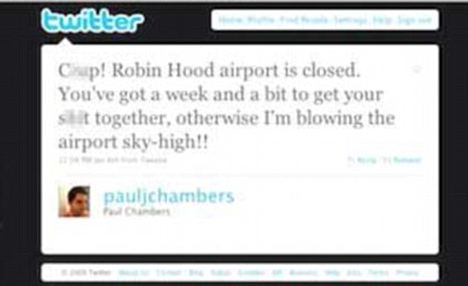
It all started with a moment of grumpy sarcasm on Twitter. Frustrated that his planned trip to Northern Ireland was put in jeopardy by heavy snow at Robin Hood Airport in Doncaster, Mr Chambers whipped out his iPhone and posted the following message on the social networking site: ‘C***! Robin Hood Airport closed. You have got a week to get your s*** together, otherwise I’m blowing the airport sky high!’

A week later, he was in a police ­station being quizzed as a potential terrorist. He was eventually prosecuted under a law aimed at nuisance calls rather than under legislation for bomb hoaxes, which requires stronger evidence of intent.

After all, it was plain as a pikestaff that Mr Chambers didn’t have any intent to bomb anything at all. Even so, he was hauled before magistrates, found guilty of sending a menacing electronic communication and fined £385. A few days ago, Mr Chambers lost his appeal against his conviction and sentence.

He will now have to pay £2,600 legal costs as well. Judge Jacqueline ­Davies, who was sitting with two magistrates, ruled the tweet was ‘menacing in its content and obviously so’, claiming ‘any ordinary person’ would ‘be alarmed’ by it.

September 11, 2010

Nine years on

Filed under: History, USA — Tags: , , — Nicholas @ 00:04

Video by James Lileks.

But every so often — every week, really — I remember the event in some odd echo of the emotions I felt on September 11. It might be the closing credit music of a BBC comedy, or an old movie about New York, or driving past a building designed by the architect of the WTC, or just standing in the spot where I stood when I saw the towers fall. Or more: for God’s sake, the Gallery of Regrettable Food’s publication date was 9/11; half the time I look at the book on the shelf I recall being in the shower, thinking of the interviews I had lined up, turning off the water and hearing Peter Jennings on the radio, wondering why they were replaying tape of the 91 attack on the towers. I remember what Natalie was doing — a happy toddler, she was digging through her box of toys and handing me a phone with a smile as bright as the best tomorrow you could imagine. I remember Jasper on his back, whining, unsure. I remember these things because I picked up my camera and filmed them, because this was a day unlike any other. Today I answered the phone in the same spot where I stood when I called my Washington bureau, told them I’d be rewriting the column — obviously — and wished them well. They were four blocks from the White House. Impossible not to imagine the Fail-Safe squeal on the other end of the line.

On the Hewitt show tonight I started talking about 9/11, and my mouth overran my head, because somewhere down there is a core of anger that hasn’t diminished a joule. This doesn’t mean anything, by itself — anger is an emotion that believes its justification is self-evident by its very existence. Passion is not an argument; rage is not a plan. But as the years go by I find myself as furious now as I was furious then — and no less unmanned by the sight of the planes and the plumes. Once a year I watch the thing I cobbled together from the footage I Tivo’d, and the day is bright and real and true again.

Update: How Twitter can be almost poetry. Disturbing, yet moving.

September 6, 2010

When “informers” become “enablers”

Filed under: Law, Liberty, Media, USA — Tags: , , , , , — Nicholas @ 10:12

Stephan Salisbury writes that many “foiled” terror plots could never have become actual threats . . . without government assistance:

Informers have by now become our first line of defense in our battles with the evildoers, the go-to guys in the never-ending domestic war on terror. They regularly do the dirty work — suggesting and encouraging the plots, laboring as bag men to move the money, fashioning the bombs, and eliciting the flamboyant dialogue, even while following the scripts of their handlers to the letter. They have attended to all the little details that make for the successful and now familiar arrests, criminal complaints, trials, and (for the most part) convictions in the ever-distracting war against . . . what? Al-Qaeda? Terror? Muslims? The inept? The poor?

The Liberty City Seven, the Fort Dix Six, the Detroit Ummah Conspiracy, the Newburgh Four — each has had their fear-filled day in the sun. None of these plots ever came close to happening. How could they? All were bogus from the get-go: money to buy missiles or cell phones or shoes and fancy duds — provided by the authorities; plans for how to use the missiles and bombs and cell phones — provided by authorities; cars for transport and demolition — issued by the authorities; facilities for carrying out the transactions — leased by those same authorities. Played out on landscapes manufactured by federal imagineers, the climax of each drama was foreordained. The failure of the plots would then be touted as the success of the investigations and prosecutions.

It’s often been observed that war is the health of the state. Can we now also say that the war on terror is the health of the intelligence agency?

H/T to Bruce Schneier for the link.

August 10, 2010

Travel advice for unsettled times

Filed under: Media, Middle East — Tags: , , , , — Nicholas @ 12:54

“Gulliver” offers some useful travel tips for people going to dangerous cities:

The first concerns how not be blown up when in Kabul, and comes courtesy of an American TV journalist who was on the course with us. You do not need Kevlar, or night-vision goggles, or an armoured car to evade the Taliban, he said: your secret weapon is to have a jolly good long lie-in every morning. In Kabul, at least, suicide bombs apparently almost always go off early in the morning. Have a leisurely breakfast and, once you venture out after 11am or so, your chances of being killed are drastically reduced. The explanation given was that the bombers spend all night psyching themselves up, then say their prayers at dawn, and go off to murder. A second helping of Corn Flakes could save your life.

The second tip is useful even for those of us who don’t travel to warzones. When booking a hotel, we were told, try to get a room between the second and sixth floors. Being on at least the second floor means you’re a little further away from whatever dangers may lurk near reception: opportunist robbers won’t venture deep into the hotel, and if things get nastier — car-bombs, shootouts and so on — you’re a little further away from the action. So far, pretty obvious.

But why not go above the sixth floor — wouldn’t that be even safer? Apparently not. More likely than a bomb or a shootout is a plain old fire, in which case you will want to make a hasty exit. More storeys mean more stairs and more delay, of course. But the killer, literally, is this: if the stairs are blocked, you will need rescuing from your window by a ladder. And in many parts of the world, the sixth floor is as high as the local fire-engines can reach.

August 9, 2010

Lovely little bit of legal legerdemain

Filed under: Cancon, Law — Tags: , , , , — Nicholas @ 09:44

Colby Cosh points out that Catch-22 was really a highly accurate predictor of Canadian law:

To put it another way, you can conceivably be tried for “participating in or contributing to” a criminal organization even if it didn’t get around to committing any crimes, you didn’t do anything to help it actually commit crimes, you didn’t know what particular crimes it might be thinking of committing, and you couldn’t possibly pick anybody else in the group out of a lineup.

This might seem to make things pretty easy for the police and the prosecutors. Nonsense! According to them, their job can never be easy enough. Like farmers and civil servants, they cease complaining only intermittently to inhale oxygen, and there is no shortage of Joint Multi-Level Integrated Discussion Committees before which they can retail their grievances.

[. . .]

Justice Minister Nicholson, in introducing the new schedule of patently less serious and mostly victimless “serious offences” on Wednesday, offered a dazzlingly simple heuristic: “The fact that an offence is committed by a criminal organization makes it a serious crime.” You will note that this introduces a curious logical circularity into our manner of upholding justice. How does the law define a “criminal organization”? See above: a criminal organization is a group of people that bands together to commit serious crimes. How do we know what a serious crime is? It’s any activity that is characteristic of criminal organizations. What, you thought Catch-22 was fiction?

August 7, 2010

Mr. Harper: Tell the Americans to bugger off!

If you’ve been reading Quotulatiousness for a while, you’ll rarely detect serious amounts of anti-Americanism. I’m not reflexively anti-American, and have little time for those folks who think that being Canadian requires an anti-American attitude. That being said, it’s time for the Canadian government to tell the American government (and Canadian “tough on crime” types) to go to hell:

The Canadian government’s effort to give the United States the authority to veto any Canadian-origin airplane passenger who is unwelcome in the United States — even on flights merely overflying the United States, without a scheduled stop in that country — is unacceptable. It is another worrisome indication that the Conservatives are posturing over-manfully over the tired hagus of law and order, at the expense of the sovereignty of Canada and the rights of its citizens and welcome visitors.

Certainly, the requirements of continental security must be emphasized to give the United States an adequate comfort level that Canada is not a conduit of terrorists. But plausibly suspected terrorists already are subject to detention in, and extradition from Canada. So the main effect of the proposed legal changes would be to extend the rules governing terrorism and other extreme criminal activity to people who are alleged wrongdoers or undesirables on much less grave and certain grounds.

It should be perfectly adequate to advise the United States of the identity of overflying passengers; and to warn all passengers that if they are sought in the United States, or persona non grata in that country for any reason, in the unlikely event of an unscheduled stateside landing, they could be at risk of inconvenience and even detention.

Canada is, despite recent attempts to emulate a doormat, an independent country. We’ve been “offered” chances to join the union and have seen off those offers with fixed bayonets (our own and our British allies). We share with the United States what used to be the world’s longest undefended border, and both countries have benefitted from this arrangement for more than a century. Since 9/11, the “undefended” status has become less and less accurate.

It is in our interests to keep that border as open as possible: most Canadian businesses depend on having access to the 300+ million American market, and our economy would suffer greatly if the border was closed. What would be a minor economic inconvenience to the Americans would be a devastating government-induced depression to Canada. But keeping the border open is not worth allowing Washington to dictate Canada’s foreign and domestic policies.

Though not identical, it smacks of the British practice in the early 18th century of seizing American seamen and forcing them into servitude on British ships. That practice led to the War of 1812, a slightly farcical conflict in which a British-Canadian shore party burned down the White House and the U.S. Capitol, and chased President Madison out of Washington with a painting of the first president under his arm, (one of the less publicized but more picturesque episodes in the eventful history of the U.S. presidency).

It’s unlikely that a war of any kind would break out between Canada and the United States, thank goodness, but Canada should not kowtow to American pressure. Tell Mr. Obama to go to hell, Stephen!

July 28, 2010

What is a “fusion center”?

Filed under: Law, Liberty, USA — Tags: , , , , — Nicholas @ 07:50

Wendy McElroy thinks you should know how much domestic surveillance has increased in recent years:

The Fort Wayne Journal Gazette reported on July 25 that “there are 72 fusion centers around the nation, analyzing and disseminating data and information of all kinds. That is one for every state and others for large urban cities.”

What is a fusion center?

The answer depends on your perspective. If you work for the Department of Homeland Security, it is a federal, state, local, or regional data-coordination units, designed to improve the sharing of anti-terrorism and anti-crime data in order to make America safer. If you are privacy or civil-rights advocate, it is part of a powerful new domestic surveillance infrastructure that combines data from both the public and private sectors to track innocent people and so makes Americans less safe from their own government. In that respect, the fusion center is reminiscent of the East German stasi, which used tens of thousands of state police and hundreds of thousands of informers to monitor an estimated one-third of the population.

The history of fusion centers provides insight into which answer is correct.

July 21, 2010

Return of the autogyro

Filed under: Britain, History, Military, Technology — Tags: , , , — Nicholas @ 12:08

An interesting piece at The Register about that odd flying object, the autogyro:

Former British Army pilots, drawing on military experience carrying out covert surveillance with secret special-forces units, have decided to revive the autogyro — a long-lost aircraft design of the 1930s, probably most famous for its use in the James Bond movies.

British startup firm Gyrojet is exhibiting its planned designs at the Farnborough airshow this week, and the Reg whirlycraft and spook surveillance desk got the chance to chat with company executives.

Gyrojet’s marketing material makes use of several key phrases which ring bells for those familiar with the history of the secret British Army unit formerly known as “14 Intelligence Company”, aka “the Det(s)” during its time carrying out clandestine surveillance in the hard areas of Northern Ireland during the long troubles there.

The operators of 14 Int were selected from across the armed forces in much the same way as the SAS recruits, but far less well known even today. Unlike the SAS and SBS, 14 Int recruited women — for the simple and practical reason that it’s difficult for an all-male covert ops team not to attract notice among a normal local population.

The autogyro has interesting abilities that neither fixed-wing aircraft nor true helicopters can duplicate — abilities of great interest to those needing to conduct surveillance operations.

July 12, 2010

Kill the “Internet Kill Switch” idea

Filed under: Government, Liberty, Politics, Technology, USA — Tags: , , , — Nicholas @ 12:15

I mentioned that the awful notion of handing the President a “kill switch” for the internet has once again been put forward by American legislators. Bruce Schneier explains why this is such a stupid, stupid idea:

Security is always a trade-off: costs versus benefits. So the first question to ask is: What are the benefits? There is only one possible use of this sort of capability, and that is in the face of a warfare-caliber enemy attack. It’s the primary reason lawmakers are considering giving the president a kill switch. They know that shutting off the Internet, or even isolating the U.S. from the rest of the world, would cause damage, but they envision a scenario where not doing so would cause even more.

[. . .]

The Internet is the largest communications system mankind has ever created, and it works because it is distributed. There is no central authority. No nation is in charge. Plugging all the holes isn’t possible.

[. . .]

The second flawed assumption is that we can predict the effects of such a shutdown. The Internet is the most complex machine mankind has ever built, and shutting down portions of it would have all sorts of unforeseen ancillary effects.

Would ATMs work? What about the stock exchanges? Which emergency services would fail? Would trucks and trains be able to route their cargo? Would airlines be able to route their passengers? How much of the military’s logistical system would fail?

That’s to say nothing of the variety of corporations that rely on the Internet to function, let alone the millions of Americans who would need to use it to communicate with their loved ones in a time of crisis.

Even the US Army can’t escape the past

Filed under: Books, History, Military, USA — Tags: , , , , — Nicholas @ 09:28

StrategyPage looks at recent updates to the US Army’s training doctrine, and their need to re-learn from the past:

Over the last few years, the army has been revamping its training and operating manuals to reflect what was learned (or, often, relearned). The army has dozens of manuals, pamphlets and other documents detailing how the troops should be trained, and how they should fight. All these are being brought up to date with what has been learned in Iraq and Afghanistan. Most of what is being lost is speculative stuff added in the 1990s, after the Cold War ended, and the army foresaw a future in which technology would change everything. Tech did bring many changes, but not always as anticipated. Combat and a live (not imaginary) enemy imposes a reality that often cannot be predicted.

For example, five years ago, the army completed a revision of its counterinsurgency (COIN) manual, for the first time in twenty years. The army has a long history of success fighting guerillas. Even Vietnam, which conventional wisdom counts as a defeat, wasn’t. The conventional wisdom, as is often the case, is wrong. By the time the last U.S. combat units pulled out of South Vietnam in 1972, the local guerilla movement, the Viet Cong, was destroyed. North Vietnam came south three years later with a conventional invasion, sending tank and infantry divisions charging across the border and conquering their neighbor the old fashioned way.

[. . .]

The main problem with COIN is that the American armed forces takes it for granted. U.S. troops have been defeating guerilla movements for centuries. Through all that time, COIN has been the most frequent form of warfare American troops have been involved with. But COIN has always been viewed as a minor, secondary, military role. It never got any respect. Even the U.S. Marine Corps, after half a century of COIN operations, were glad to put that behind them in the late 1930s. All that remained of that experience was a classic book, “The Small Wars Manual,” written by some marine officers on the eve of World War II. That book, which is still in print, contained timeless wisdom and techniques on how to deal with COIN operations, and “small wars” in general. Much of the work the army has done in the last five years, to revise their manuals, could have been done just by consulting the Small Wars Manual. In some cases, that’s exactly what was done.

The basic truth is that COIN tactics and techniques have not changed for thousands of years. What has also not changed is the professional soldiers disdain for COIN operations. This sort of thing has never been considered “real soldiering.” But the U.S. Army and Marines have finally come to accept that COIN is a major job, something that U.S. troops have always been good at, and something that you have to pay attention to. So when you see more news stories about the COIN manual, keep in mind the history of that kind of warfare, and how long, and successfully, Americans have been doing it.

June 28, 2010

Running with the nihilists

Filed under: Media, Politics — Tags: , , , , , , , — Nicholas @ 12:13

Tony Keller walked with the main union-led protest marchers on Saturday, pointing out that there was no single, unifying principle — it was a “grievance smorgasbord, an all-you-can-eat buffet of complaints, and apparently anyone protesting anything — anything — was invited”. What interested him the most, however, were the “hobbits”:

Standing in front of Cafe Lettieri, which was still open and doing a booming business even as protesters were packed so tightly outside that they pressed up against its windows, I heard someone to my right say, “Black Bloc, meet up on Queen!”

I turned to see six hobbits in black hoodies shuffling past me. It was on. Whatever “it” was going to be.

[. . .]

And then the non-peaceful part of our program started. The crowd suddenly began to surge away from the police lines at Spadina and Richmond, and back onto Queen Street. We were now heading east, violently following the route the non-violent march had just taken. A mass of maybe 100 people in black hoodies and balaclavas was moving at almost a run, accompanied by several hundred journalists and riot tourists. Occasionally someone would dart out from the group to smash a window or spray paint a slogan: “Against Police Against Prisons,” “F– the Police,” “F- Corporate Rule.”

[. . .]

The hoodie people weren’t just small in number, they were also small in stature. A lot of skinny white boys. And white women. (Some skinny, some really not). They looked like the kind of people who spend a lot of time playing video games in their parents’ basements. Or the graduating class of an art college. They were not marauding toughs. More like marauding geeks. Geeks marauding in a spontaneous yet carefully choreographed manner.

There’s a point in most peoples’ lives when getting out and protesting seems like such a good idea. And then you graduate and get a job . . .

June 24, 2010

The unhinged are now running Spanish “green” tech companies

Filed under: Environment, Europe, Politics, Technology — Tags: , , , — Nicholas @ 18:12

As I read this, I kept hoping that it’d be fake:

Spain’s Dr. Gabriel Calzada — the author of a damning study concluding that Spain’s “green jobs” energy program has been a catastrophic economic failure — was mailed a dismantled bomb on Tuesday by solar energy company Thermotechnic.

Says Calzada:

Before opening it, I called [Thermotechnic] to know what was inside … they answered, it was their answer to my energy pieces.

Dr. Calzada contacted a terrorism expert to handle the package. The expert first performed a scan of the package, then opened it in front of a journalist, Dr. Calzada, and a private security expert.

The terrorism consultant said he had seen this before:

This time you receive unconnected pieces. Next time it can explode in your hands.

Dr. Calzada added:

[The terrorism expert] told me that this was a warning.

I have no idea what Spanish law says about this kind of blatant intimidation, but I hope there are charges laid and convictions resulting from those charges.

Spain, of course, recently announced that they were having to cut back on their plans to become the greenest country in Europe, as they couldn’t afford the additional costs, both up-front and in lost opportunities in other industries.

H/T to Ace for the link.

Update, 25 June: In the comments, Ed Darrell says I’ve been taken in and has a long post up with translations of the original article used by Ace and PajamasMedia: here. If Ed is right and I’ve been taken in, I’ll post a retraction. I’m sure he’ll do the same if it turns out to be true.

Update, 28 June: A clarification posted at Ace of Spades HQ makes it seem a bit less like a mock-bomb threat.

The Green company sending the package apparently had its actual package — a report — swapped with car parts at some point in the mailing. [. . .]

It didn’t look like, or feel like, a letter or report, so at that point Calzada got a security guard to scan it — and what was inside was a cylindrical object with wires attached. At that point, the security guard got an expert to examine it, with others in attendance. The contents were a container for diesel of some sort, and some other parts. The expert saw this as a bomb threat, based on a pattern used by, eg., ETA: “This one is a hoax bomb. The next one might not be.”

June 22, 2010

UK photographers might want to pick up this magazine

Filed under: Britain, Law, Liberty — Tags: , , , , — Nicholas @ 10:02

BoingBoing advises that the July issue of Amateur Photographer is doing something to assist innocent photographers who are still encountering police and rent-a-cop harassment in public spaces:

The UK Amateur Photographer magazine is giving away free lenscloths silk-screened with the Photographers’ Bill of Rights with its July issue. UK anti-terror legislation gave the police sweeping powers to harass photographers for shooting in public places, and to compound matters, tabloid-driven hysteria over paedophilia has seen many photographers accused to paedophilia for taking pictures of (for example) public busses and empty playgrounds.

Between the anti-terror laws, the anti-pedophilia panic in the newspapers, and the general busy-bodiness of security guards, photographers in the UK are being treated like criminals. More on the anti-harassment campaign here.

« Newer PostsOlder Posts »

Powered by WordPress