Quotulatiousness

July 28, 2011

Is Breivik sane enough to prosecute?

Filed under: Europe, Law, Media — Tags: , , , , — Nicholas @ 12:20

Douglas Murray points out that Breivik’s actions even before the attacks would have marked him as insane:

Anders Behring Breivik believed himself a Knight Templar and awarded himself various military ranks accordingly. He also believed that he and other self-described Islamophobic racists had common cause with jihadis and that the USA has a Jewish problem. So even before he planted a car bomb in a civilian area and gunned down scores of young people, it would have been clear to anyone who bothered to question him that Breivik was insane.

Of course, no discussion of the Oslo massacre is complete without considering the media reaction:

But in the coverage since his atrocities first broke on to the world, two troubling tendencies have converged. The first is the search for reason in a mind that was clearly a stranger to it. The second is the tendency — particularly strong on the left — to use any horrific act as a megaphone for existing prejudices. In the aftermath of the shooting of Congresswoman Gabrielle Gifford in January, the left-wing media and politicians hunted for the right-wingers who they claimed had inspired the attack. That the gunman was not only a loner but a psychotic maniac was largely ignored as they rushed off excitedly to attack their ideological enemies. And so it is with Breivik.

For the past decade and more, every time an Islamist has blown something up, a chorus of voices — mainly from the left — has rightly said that ‘we shouldn’t jump to any conclusions’. But this time it was different. The Labour MP Tom Harris observed, with great frankness, that a ‘palpable relief that swept through the left when the identity of the terrorist was made known… Here, thank God, was a terrorist we can all hate without equivocation: white, Christian and far right-wing. Phew.’ So never mind not jumping to conclusions. When it seemed to emerge that, among many other things, the killer also claimed to be opposed to immigration and was fearful of Islam, that jump became a great leap towards group blame.

July 25, 2011

Mark Steyn responds to accusations that he “inspired” the attack in Oslo

Filed under: Europe, Media, Politics — Tags: , , , — Nicholas @ 20:30

Mark Steyn is quoted in Norwegian terrorist Breivik’s “manifesto”, and this is being used to paint him and others as “inspiration” for the attacks. He responds:

I have been away from the Internet for the weekend, and return to find myself being fitted out for a supporting role in Friday’s evil slaughter in Norway. The mass murderer Breivik published a 1,500-page “manifesto.” It quotes me, as well as several friends of NR — Theodore Dalrymple, Daniel Pipes, Roger Scruton, Melanie Phillips, Daniel Hannan (plus various pieces from NR by Rod Dreher and others) — and many other people, including Churchill, Gandhi, Orwell, Jefferson, John Locke, Edmund Burke, Bernard Shaw, Mark Twain, not to mention the U.S. Declaration of Independence.* Those new “hate speech” codes the Left is already clamoring for might find it easier just to list the authors Europeans will still be allowed to read.

It is unclear how seriously this “manifesto” should be taken. Parts of it simply cut and paste chunks of the last big killer “manifesto” by Ted Kaczynski, with the occasional [insert-your-cause-here] word substitute replacing the Unabomber’s obsessions with Breivik’s. This would seem an odd technique to use for a sincerely meant political statement. The entire document is strangely anglocentric — in among the citations of NR and The Washington Times, there’s not a lot about Norway.

[. . .]

Any of us who write are obliged to weigh our words, and accept the consequences of them. But, when a Norwegian man is citing Locke and Burke as a prelude to gunning down dozens of Norwegian teenagers, he is lost in his own psychoses. Free societies can survive the occasional Breivik. If Norway responds to this as the Left appears to wish, by shriveling even further the bounds of public discourse, freedom will have a tougher time.

Electronic weapons to destroy other electronics

Filed under: China, Military, Technology, Weapons — Tags: , — Nicholas @ 12:05

Strategy Page looks at some interesting developments in the electronic weapons area:

A U.S. government report (from the National Ground Intelligence Center) indicates that China has developed useful weapons for disabling the electronics on American aircraft and warships. This is done using high-powered microwave (HPM) devices to create something like the EMP (Electromagnetic Pulse) put out by nuclear weapons, which damaged or destroys microelectronics.

[. . .]

Then there’s the EMP bomb, a legendary weapon that is much talked about, but has never actually been seen. Throughout the 1990s, information came out of Russia that a weapon had been developed that could generate a short range EMP (electromagnetic pulse) similar to that created by nuclear explosions. All computers within the range of the EMP bomb would be ruined. This is a truly devastating capability. Microprocessors are found everywhere these days; in automobiles, appliances, industrial equipment, medical devices and many other devices. Military microprocessors are often shielded to protect them against EMP, but the shielding is not thoroughly tested and even some military equipment will probably be disabled by an EMP attack.

A decade ago, a British military research team announced that they had duplicated the rumored Russian device and produced an EMP bomb that can fit in a 155mm artillery shell, small rockets or bombs. Such a device was supposed to be inexpensive and could be used to destroy civilian electronics that might be useful to nearby enemy troops. What is particularly worrisome about this new development is that, in the hands of terrorists, it could do a new kind of damage. While not killing people directly, the destruction of all electronics within an urban area could cause casualties and much economic loss. But none of these EMP bombs has ever actually reached the stage where they were actually ready to use. There was always some kind of flaw discovered in testing. Naturally, China is thought to have developed an EMP bomb.

Reaction to the attacks in Norway

Filed under: Europe, Media, Politics — Tags: , , — Nicholas @ 10:37

Brendan O’Neill looks at the media reaction to the Oslo and Utoya terror attacks:

When it was reported on Friday that there had been an explosion and an horrific mass shooting in Norway, many observers assumed that al-Qaeda or some other radical Islamist group had struck at the heart of peaceful Scandinavia. ‘Norway’s 9/11’, said the front page of the Sun on Saturday, with the subheading: ‘“Al-Qaeda” massacre.’ Yet when it was revealed that the alleged bomber and shooter is a Norway-born, blonde-haired, farm-owning Aryan, observers quickly bought into the idea that we were faced with something very different from an al-Qaeda attack. This wasn’t ‘Norway’s 9/11’ after all, but something more akin to Columbine-on-steroids, a right-wing madman letting off steam in a most barbaric fashion. As one Norwegian police official put it: this was ‘probably more Norway’s Oklahoma than its World Trade Centre’.

Yet this simplistic categorisation of contemporary terror assaults — where violent outbursts get slotted into files marked ‘Radical Islamist Fury’ or ‘Right-Wing Anger’ — makes too fine a distinction between acts that are actually very similar. Just because something like 7/7 in London was executed by men with dark hair and brown skin who claimed to be fighting on behalf of the Muslim ummah, while the bombing of Oslo and massacre on Utoya were carried out by a white guy who claimed to be protecting European Christian culture, that doesn’t mean these are diametrically different actions. What they have in common is far more important than what separates them. And, stripped of their pseudo-political garb, what unites today’s various terror tantrums, what makes these kind of people possible in the first place, is a very powerful culture of estrangement in modern society.

In much of the media, particularly amongst the respectable broadsheet press, there was a palpable sense of relief when it was revealed that the alleged killer is white with far-right tendencies. This means he is the kind of person we can unambiguously hate. Where Islamist terror attacks, from 9/11 to 7/7, induce in some liberal observers torn and tortured feelings, where they want to condemn the violence but also feel the need to explain it as a natural reaction to evil Western foreign policy, Anders Behring Breivik is someone they can despise in an uncomplicated way. This means that while the attacks may not be ‘Norway’s 9/11’, they could well be the cultural elite’s 9/11 — in the sense that this is an act which the influential liberal classes may seek to politicise in an opportunistic fashion, to make moral mileage out of, in the same way that the right did after 11 September 2001.

July 5, 2011

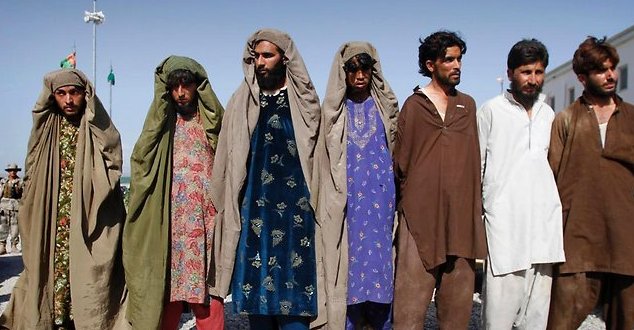
Miss Taliban beauty contest called off after all contestants turn out to be men

Filed under: Military — Tags: , , , — Nicholas @ 16:01

Okay, the real story:

AFGHAN police have arrested seven armed insurgents who disguised themselves as women by wearing burqas, officials said.

Interior ministry spokesman Siddiq Siddiqi said that the men, who carried light weapons with at least one in a suicide vest, were captured in Jalalabad, the capital of the eastern province of Nangarhar.

He said the men wore the all-enveloping veil as part of their disguise and were planning attacks on government targets, but gave no further details.

H/T to Roger Henry, who notes:

Have a look at these delectable Afghan stunners, Afghanistan’s best!
I do so like the look of coy modesty, what possibly could have given them away?
They could do with a little grooming.

Would-be terrorists advised to pretend to be gay

Filed under: Britain, Media — Tags: , , , , — Nicholas @ 09:42

A link from Jon, my former virtual landlord, discussing a document that fell into the hands of the Sunday Mirror:

al-Qaeda fanatics in Britain are being taught to avoid detection — by pretending to be gay.

A new terror training manual tells Islamic extremists to lie about their sexuality if a woman approaches them in case she is a “honeytrap” spy sent by security services.

The handbook, which was uncovered by a Sunday Mirror ­investigation, says: “Many hotels — especially in busy UK cities — have women hanging around the lobby areas in order to attract men.

“A young beautiful woman may come and talk to you. The first thing you do to protect yourself from such a ­situation is to make dua (prayers) to Allah for ­steadfastness.

“The second thing is to find an excuse to get away from her that is realistic and sensible, such as you having a girlfriend for the past few years and you are loyal to her or you are ­homosexual.”

The suggestion is one of many tips in the manual, called Class Notes From The Security and ­Intelligence Course.

Of course, if they were drawing their recruits from Pashtun tribesmen, they might not have to pretend much.

June 11, 2011

QotD: OPEC’s 50-year fishing trip

The petroleum-exporting countries have kept America as a gigantic fish on a steel line for nearly 50 years, reeling it in slowly, and letting it out (relaxing oil prices), when the United States made purposeful noises about raising domestic production, cutting consumption, and going to alternate sources. As soon as OPEC fine-tuned the fishing reel, the great fish went with the docility of the addicted consumer back to its default position mainlining on foreign oil at steadily increasing prices and in ever larger quantities. Every president starting with Richard Nixon warned of the danger in this addiction, but none has done anything useful about it. There must be an emphasis on cheap and plentiful natural gas, more nuclear (with maximum safety standards), more off-shore drilling (with maximum environmental-protection arrangements), and higher gasoline taxes to raise revenues and restrain use. All of this will bring down the international price and reduce the amount of money available for the Iranians, Saudis, Venezuelans, and others to finance terrorism around the world, and will ultimately reduce U.S. defense costs. None of this has been done, though the need for it has been obvious for decades.

Conrad Black, “Why America is suffering”, National Post, 2011-06-11

May 22, 2011

The Tory “omnibus crime legislation” overview

Filed under: Cancon, Law, Liberty — Tags: , , , , — Nicholas @ 12:06

Kathryn Blaze Carlson looks at the likely form of the new federal government’s “tough on crime” omnibus bill:

The Conservative government’s omnibus crime legislation, due ‘‘within 100 days,’’ will mark a watershed moment in Canadian legal history, imposing many controversial changes to how police and the courts operate, experts say.

The bill is sweeping in scale and scope: It is expected to usher new mandatory minimum sentences for drug crimes — growing five marijuana plants to sell the drug would automatically bring six months in jail — and for certain sexual offences against children. It will expand police powers online without court orders, reintroduce controversial aspects of the Anti-Terrorism Act that expired in 2007, end house arrest for serious crimes, and impact young offenders and their privacy.

“This bundle of crime legislation represents the most comprehensive agenda for crime reform since the Criminal Code was introduced,” said Steven Skurka, a Toronto-based criminal defence lawyer.

As always, when the government bundles together a lot of bills, there are some good and some bad ideas all headed down the chute at the same time. An especially bad bit is the preventative arrest provision that expired with the original Anti-Terrorism Act, and another one is the one allowing the police to demand internet records from ISPs without a court order (or, one assumes, notice to the people whose internet records are of interest to the police).

May 15, 2011

US had prepared to fight Pakistan over Bin Laden raid

Filed under: Asia, Military, USA — Tags: , , , , , — Nicholas @ 12:16

Strategy Page reports that the US military had made contingency plans to cover Pakistani military intervention in the raid that killed Osama bin Laden:

On May 2nd, the United States was prepared to go to war with Pakistan. The American raid on that day, which killed Osama bin Laden and seized a huge mass of al Qaeda data from his Pakistani hideout, was carried out without informing Pakistan beforehand. Although Pakistan had years earlier agreed that the U.S. could enter Pakistani territory in hot pursuit of terrorists fleeing Afghanistan, or to grab high ranking al Qaeda leaders, it was always assumed that the U.S. would let the Pakistani military know what was coming. But because the Pakistani government was full of bin Laden fans, the U.S. did not inform Pakistan about the raid until it was underway. Apparently, that message included a reminder that if the U.S. troops in the bin Laden compound were attacked by Pakistani forces, there would be instant, and far-reaching, consequences.

The extent of those consequences have since been pieced together, from unclassified information. By May 2nd, the U.S. had assembled a huge naval and air force in the region, that was pointed at Pakistan. This force would attack any Pakistani troops or warplanes that went after the U.S. forces in the bin Laden compound, or who might be able to do so. The U.S. had assembled three aircraft carriers, hundreds of air force aircraft in Afghanistan and the Persian Gulf, and dozens of helicopters, and thousands of troops, in Afghanistan. Most of these troops didn’t know what they were alerted for. Such alerts happen all the time, often for no reason (as far as the troops are concerned.) But this time, as word of the bin Laden raid got out, it became obvious (at least to those who know how these things work) that the alerts throughout the region were to prepare for the possible need to quickly get the American raiders out, and destroy any Pakistani forces that sought to interfere.

May 2, 2011

Radley Balko: “He won”

Filed under: Government, Liberty, Media, USA — Tags: , , , , , — Nicholas @ 15:58

A distressing round-up of the lifetime achievements of the late Osama Bin Laden:

We have also fundamentally altered who we are. A partial, off-the-top-of-my-head list of how we’ve changed since September 11 . . .

  • We’ve sent terrorist suspects to “black sites” to be detained without trial and tortured.
  • We’ve turned terrorist suspects over to other regimes, knowing that they’d be tortured.
  • In those cases when our government later learned it got the wrong guy, federal officials not only refused to apologize or compensate him, they went to court to argue he should be barred from using our courts to seek justice, and that the details of his abduction, torture, and detainment should be kept secret.
  • We’ve abducted and imprisoned dozens, perhaps hundreds of men in Guantanamo who turned out to have been innocent. Again, the government felt no obligation to do right by them.
  • The government launched a multimillion dollar ad campaign implying that people who smoke marijuana are complicit in the murder of nearly 3,000 of their fellow citizens.
  • The government illegally spied and eavesdropped on thousands of American citizens.
  • Presidents from both of the two major political parties have claimed the power to detain suspected terrorists and hold them indefinitely without trial, based solely on the president’s designation of them as an “enemy combatant,” essentially making the president prosecutor, judge, and jury. (I’d also argue that the treatment of someone like Bradley Manning wouldn’t have been tolerated before September 11.)

The list, unfortunately goes on.

Yes, bin Laden the man is dead. But he achieved all he set out to achieve, and a hell of a lot more. He forever changed who we are as a country, and for the worse. Mostly because we let him. That isn’t something a special ops team can fix.

Location of Bin Laden’s hideaway difficult for Pakistan to explain away

Filed under: Asia, Military — Tags: , , , — Nicholas @ 09:59

From the BBC News website:

More details are emerging of how al-Qaeda leader Osama Bin Laden was found and killed at a fortified compound on the outskirts of Abbottabad in north-west Pakistan.

The compound is a few hundred metres from the the Pakistan Military Academy, an elite military training centre, which is Pakistan’s equivalent to Britain’s Sandhurst, according to the BBC’s M Ilyas Khan who visited the area.

Earlier reports put the distance at about 200 yards (182 metres). Pakistan’s military says the compound is 4km (2.4 miles) away from the academy.

But it lies well within Abbottabad’s military cantonment — it is likely the area would have had a constant and significant military presence and checkpoints.

Pakistan’s army chief is a regular visitor to the academy for graduation parades.

Someone very well placed in Pakistan’s army or intelligence organizations had to have been aware of, and actively protecting Bin Laden’s hideout. There’s no way he could have lived that close to high security military establishments without active collusion with high-ranking officers or intelligence chiefs.

April 20, 2011

Logic, consistency not strong points for this would-be terror gang

Filed under: Britain, Middle East, Religion — Tags: , , , — Nicholas @ 07:30

A group of would-be terrorists were discovered before they could put their plans into action partly because of their disdain for “infidel” technology:

Recently, a British Moslem (Rajib Karim) was sentenced to 30 years for attempting to use his job at British Airways to help plan, coordinate and carry out terrorist attacks. One reason Karim was caught was the refusal of his terrorist cohorts in Yemen and Bangladesh to use modern cryptography for their communications. The reason was that the modern stuff was all invented by infidels (non-Moslems). Instead the group was forced to use ancient (over 2,000 year old) single letter substitution codes. The group’s implementation of this was accomplished using a spreadsheet. Unlike modern ciphers, like PGP and AES, the ancient substitution methods are easy to crack with modern decryption techniques.

A major shortcoming of Islamic radicalism is its disdain for modern, particularly non-Moslem (Western) technology. This often causes problems, like the one Karim (a computer specialist with British Airways) had with his less educated fellow terrorists in Yemen and Bangladesh. But what Karim encountered was another major problem for Islamic radicals, the fact that these groups tend to attract a disproportionate number of poorly educated recruits. The Islamic world, in general, is less educated and literate than the West, thus giving Islamic radical groups a poorly educated pool of potential recruits to begin with.

The disdain is highly selective, unless spreadsheets were also part of the Arabic cultural heritage.

March 8, 2011

Helicopter footage of 9/11 just released

Filed under: History, USA — Tags: , , , , — Nicholas @ 12:21

The Guardian explains:

Previously unseen footage of the 9/11 attacks, filmed from a police helicopter hovering above the burning World Trade Centre, has emerged almost a decade after the terrorist atrocity.

The New York Police Department air and sea rescue helicopter was dispatched to the scene of the attack to see whether any survivors could be rescued from the rooftops.

[. . .]

The video is part of a cache of information about the attack handed over by city agencies to the National Institute of Standards and Technology, the federal agency that investigated the collapse.

It was released by NIST on 3 March under a Freedom of Information Act request, but it remains unclear who published the footage online.

February 7, 2011

Blameshifting, subcontinental style

Filed under: Asia, India, Media, Politics — Tags: , , , , — Nicholas @ 09:37

Strategy Page talks about the common belief in Pakistan that suicide attacks are not really the fault of other Muslims:

While the Islamic terrorist attacks in Pakistan have created a lot of hatred against Islamic militants, many Pakistani government officials, and media executives, blame non-Moslem foreigners for all the Islamic violence. To Westerners, this is bizarre, but to more than half the population of Pakistan, blaming India and Israel (and the West in general), for Islamic suicide bombers killing Pakistanis, has some traction. The basic theme is that India, with the assistance of those clever and diabolical Israelis, are deceiving Moslems to become suicide bombers. In some cases, where there are no bodies left behind, the Indians or Israelis can be blamed for doing the deed themselves. This sort of thing is regularly reported in Pakistan.

Since India and Pakistan (literally, “the land of the pure.”) were created out of British India in 1947, Pakistan has seen India as preparing to invade and conquer them. There followed four wars with India, all of which [were] started by Pakistan. While many Pakistanis have figured out that India has never had any interest in taking over Pakistan, especially as Pakistan slid into a malaise of corruption and economic decline. But those who ran the Pakistani government (a very small group, be they politicians or generals) found it convenient to blame someone else, and India was always a convenient scapegoat. Israel was added when because Israel has long been considered the archenemy of Moslems, and especially since Israel became a close ally of India. The West is blamed because their economic success must have, somehow, come at the expense of the morally superior Islamic world.

On the national level, as at the personal level, having a shadowy “nemesis” to blame for your misfortune allows you to avoid looking for the actual root causes of your situation.

Update: A writer at The Economist reports on revisiting Pakistan after five years away:

Much of the news we read from Pakistan is a grisly catalogue of suicide-bombs, sectarian slaughter, political assassination, grinding insurgency and collateral damage from the war in Afghanistan.

So, on a first visit to Islamabad and Lahore in nearly five years, my initial response was to think how the relentless tide of such reporting obscures another truth about the country: how pleasant it can be; how helpful and hospitable the people; how many well-informed, articulate and enlightened cosmopolitans there are to talk to. In the past I have always argued that Pakistan has a tolerant, flexible core that is far more resilient than it is often given credit for. Surely, that remains true.

A second response, however, was to acknowledge how much worse things had got in those five years. Three sorts of decline stand out—the linked problems of worsening security and the spread of Islamist extremism, and the economy.

[. . .]

One of the commonplaces of analysis in Pakistan is that the roots of extremism lie not just in the war in Afghanistan and the “Islamisation” of public life introduced by General Zia ul-Haq a generation ago, but in economic hardship and lack of opportunity. The economy is lurching along on IMF-provided crutches, just a few months from the next crisis. Most people also agree about some of the basic reforms needed—in particular a broadening of the tax base. But the political parties want to make sure that it is the other parties whose voters’ pockets will suffer from the broadening. So reform is deadlocked.

Pakistan is indeed still not as bad as you might think from the newspaper headlines. And when Mr Hoodbhoy, for example, talks of an impending bloodbath it is still possible to think he exaggerates. But Pakistan is bloody enough already, and it is for now a depressing and frightening place. It is not just that the decline seems unimpeded by the end of Pervez Musharraf’s inept, corrupt military dictatorship and the advent of Asif Ali Zardari’s inept, corrupt and army-reliant civilian administration. It is that the arguments of those who claim the trend is remorseless and heading for disaster seem more persuasive than those I have deployed over the years to refute them.

December 10, 2010

The Economist: “America … should learn from its mistakes in the past decade and stick to its own rules”

Filed under: Bureaucracy, Law, USA — Tags: , , , , , — Nicholas @ 08:23

A very good column in The Economist seems to cover the issues quite well:

BIG crimes deserve tough responses. In any country the theft and publication of 250,000 secret government documents would deserve punishment. If the leak costs lives, let alone the careers and trust that have already perished amid the WikiLeaks disclosures, the case for action is even stronger.

[. . .]

For the American government, prosecution, not persecution, offers the best chance of limiting the damage and deterring future thefts. The blustering calls for the assassination of Julian Assange, the WikiLeaks founder now in custody in London awaiting extradition to Sweden on faintly mysterious charges of sexual assault, look both weak and repellent. If Mr Assange has broken American law, it is there that he should stand trial, just like Bradley Manning, the alleged source of the stolen documents. If not, it may be some consolation that the cables so far reveal a largely flattering picture of America’s diplomats: conscientious, cool-headed, well-informed, perceptive and on occasion eloquent.

[. . .]

If America sticks to those standards now it will display a strength and sanity that contrasts with the shrill absolutism and cyber-vandalism of the WikiLeaks partisans. Calling Mr Assange a terrorist, for example, is deeply counterproductive. His cyber-troops do not fly planes into buildings, throw acid at schoolgirls or murder apostates. Indeed, the few genuine similarities between WikiLeaks and the Taliban — its elusiveness and its wide base of support — argue against ill-judged attacks that merely broaden that support. After a week of clumsy American-inspired attempts to shut WikiLeaks down, it is now hosted on more than 700 servers around the world.

The big danger is that America is provoked into bending or breaking its own rules, straining alliances, eroding credibility and — because it will not be able to muzzle WikiLeaks — ultimately seeming impotent. In recent years America has promoted the internet as a menace to foreign censorship. That sounds tinny now. So did its joy of hosting next year’s World Press Freedom Day this week. Chinese and Russian glee at American discomfort are a sure sign of such missteps.

H/T to John Perry Barlow for the link.

Update: This certainly matches what I expected Julian Assange’s personality to be like:

Defectors include Daniel Domscheit-Berg, otherwise known as Daniel Schmitt, who made a high-profile exit from WikiLeaks in September, and Herbert Snorrason, an Icelandic student. Both resigned in September. Snorrason is quoted as telling Assange, in an online chat log acquired by WiReD:

And you’re not even fulfilling your role as a leader right now. A leader communicates and cultivates trust in himself. You are doing the exact opposite. You behave like some kind of emperor or slave trader.

Snorrason’s departure was fomented by this declaration from Assange:

I am the heart and soul of this organization, its founder, philosopher, spokesperson, original coder, organizer, financier and all the rest. If you have a problem with me, piss off.

And he did.

« Newer PostsOlder Posts »

Powered by WordPress