One of the virtues of You Say You Want a Revolution is that it admits and illuminates, though it does not altogether explain, the failure of post-colonial regimes in Africa — even those that were established without much in the way of violent struggle. The first generation of post-colonial leaders were so taken by the prestige and perhaps by the glamour of revolution that they employed revolutionary rhetoric themselves, and sometimes went in for utopian schemes of their own. Julius Nyerere of Tanzania, for example (he is not mentioned in the book), was bitten by the bug of utopianism, caught in part from socialists at the University of Edinburgh, calling the sole permitted political party in Tanzania the Party of the Revolution. In the name of creating a just and equal society, he forcibly removed at least 70 per cent of the population from where it was living and herded it into collectivised villages. This was, all too predictably, an economic disaster, famine having been prevented only by large infusions of foreign aid, but it served the interests of members of the Party. Tanzania was saved from being much worse than it was by the fact that Nyerere, though perfectly capable of ruthlessness, was not personally a monster, and also by the peaceful nature of the Tanzania people themselves. Another saving grace was that there was no ethnic group that could have become dominant, so ethnic antagonism could not be added to the witches’ brew.
This illustrates a point that Professor Chirot makes clear in his discussion as to why the Vietnamese communist regime, though often brutal, never descended to anything like the level of horror of neighbouring Cambodia. Among the factors must surely have been the character and personality of the leaders as well as of the countries themselves. In other words, the fate of countries cannot be reduced, either in prospect or in retrospect, to an invariable formula. Human affairs will, to an extent, always be incalculable.
Still, some degree of regularity is possible. I was rather surprised that Professor Chirot overlooked one such. He writes the following of the corruption endemic under communist regimes: “a function of a deliberately exploitative, thieving elite that staved the general economy by its dishonesty than it was the essence of the system itself. Avoiding corruption was impossible because without it the society could not function.”
What is surprising here is that he does not mention why it could not function, but the answer seems to me perfectly obvious: it was because the communist system abolished the price system and substituted political decision-making in its place. This explanation is sufficient, for where there are no prices, and the economy is thereby largely demonetarised, goods and services can be distributed only by corruption. This is not to say that where there is a price system there will automatically be no corruption, obviously this is not the case; but such corruption will be limited by the very need for money to retain its value where such a price system exists. To that extent, it imposes at least a degree of honesty. The mystery of the Soviet Union or any other communist country is not why it produced so little, but why it produced anything at all: and here Professor Chirot is quite right. The answer is because of corruption: an “honest” communist state would produce nothing. It could not survive.
Theodore Dalrymple, “Longing for Revolution”, New English Review, 2020-05-13.
September 27, 2025
QotD: Utopian revolution
August 5, 2025
Inside the CIA Coup That Changed Iran Forever! – W2W 38
TimeGhost History
Published 3 Aug 2025In 1953, a battle for Iran’s soul erupts on the streets of Tehran. Prime Minister Mosaddegh defies British oil interests, outwits Soviet intrigue, and faces down the Shah — but a secret Anglo-American plot changes history forever. As coups, street mobs, and betrayal plunge Iran into chaos, the nation’s fragile democracy is crushed and a brutal new order rises. This is the untold story of oil, espionage, and the coup that reshaped the Middle East.
(more…)
July 18, 2025
The Napoleonic-era Royal Navy
David Friedman on some of the aspects of Britain’s Royal Navy in the late eighteenth and early nineteenth century which may be incomprehensible to modern readers who encounter it in works of historical fiction (like the books of C.S. Forester or Patrick O’Brian):

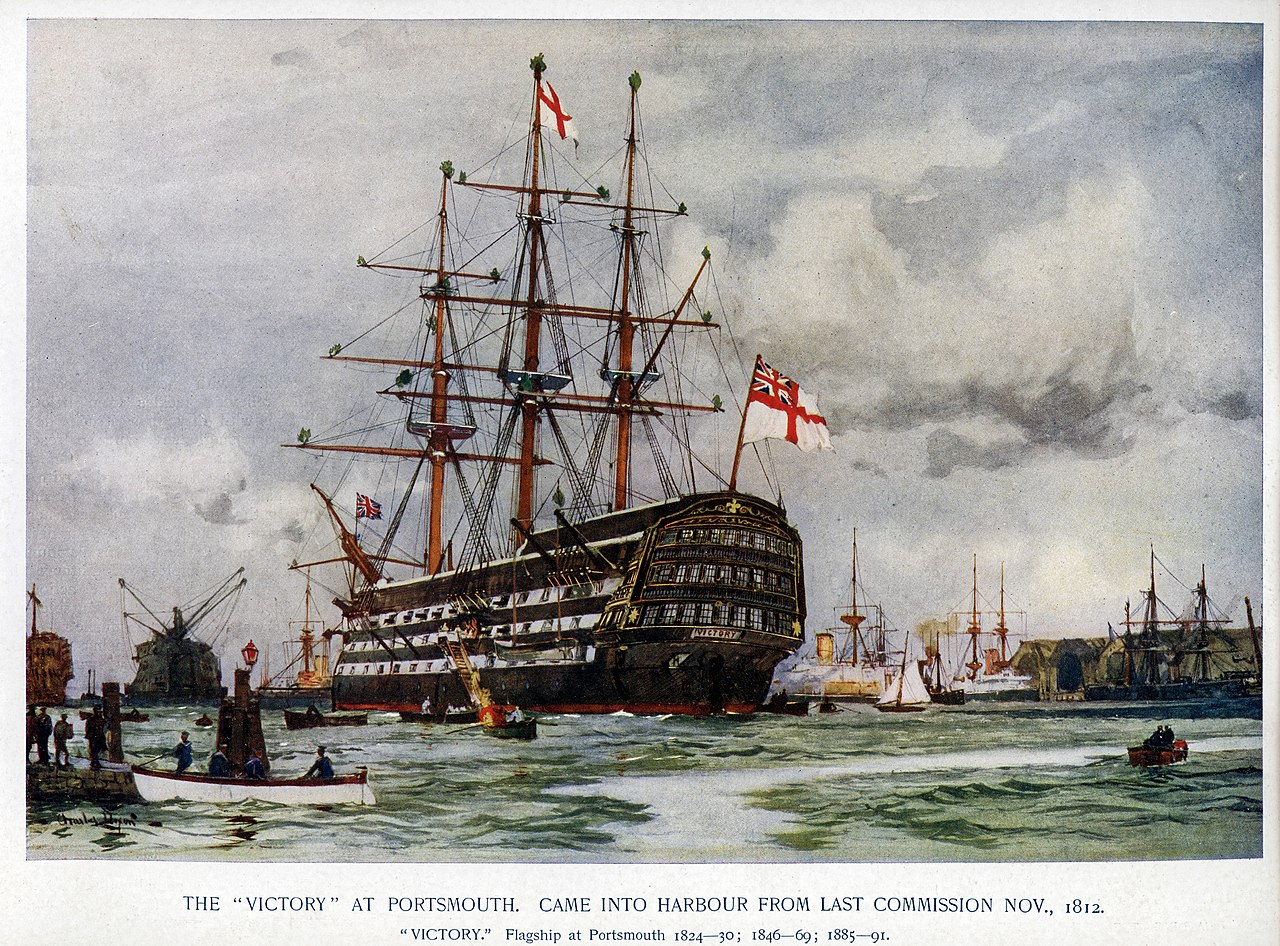
“HMS Victory in Portsmouth Harbour”
Painting by Charles Edward Dixon (1872-1934) via Wikimedia Commons.
I have read and enjoyed several series of novels set in the British navy during the Napoleonic wars, most recently one by Naomi Novik that departs a little further from history than its predecessors by providing the British and their enemies with dragons. The internal structure and the associated rules and customs of the navy seem very strange to a modern eye, yet it was a strikingly successful institution.
One feature likely to catch an economist’s eye was prize money. If a naval vessel captured a legitimate prize, an enemy warship or merchantman, and brought it back to port, the vessel and its contents were sold and the money distributed among those responsible. One large chunk went to the captain, another was distributed among his officers, a third among the crew, a fourth to the admiral under whose orders he was operating.
Another feature of the system was the role of patronage, political influence both within the navy and outside it in the career of an officer, especially a young officer. The critical step of promotion from lieutenant to captain depended in part on performance, in particular on the opinion of the captain under whom a lieutenant was serving. But it depended also on things that seem, to us, irrelevant.
One of Patrick O’Brien’s novels contains a conversation between Maturin, one of his protagonists, and a friend, a young officer of aristocratic birth. The officer has been having an affair with the separated wife of a high naval official and wants to know whether he should live openly with her. Maturin’s response is that, moral issues aside, it might be imprudent for him to offend a powerful official and so risk his future career. His friend replies that he has considered that matter but his family controls a significant number of seats in both houses of parliament and he thinks their influence will be sufficient to balance that of the man he will be offending.
Neither party sees anything strange in either the assumption that giving personal offense to someone within the bureaucracy will make it harder for a competent officer to be promoted or that having a politically influential family will make it easier; that is just part of how the system works. It was a system that produced extraordinarily successful results, a navy that, from the late 18th century to the early 20th won almost every ship to ship or fleet to fleet battle it fought at anything close to even odds.1
A third feature was the seniority system. Once a lieutenant was promoted to captain, his future rank depended only on how long he survived. His name was on the list of captains, the list was ordered by strict seniority, and the next captain to be promoted to admiral would be the one at the top of the list. When two or more captains were working together it was the senior who commanded. That provided an unambiguous rule for allocating command, since every captain knew where he was on the list and knew, or could readily find out, where any other captain was. But it was a rule that had nothing to do with the relative competence of two officers of the same nominal rank.
Promotion beyond captain was entirely determined by seniority; what the officer got to do with his rank was not. An insufficiently competent captain who made it to admiral would end up as an admiral of the yellow, an admiral without a fleet, effectively retired on half pay. A sufficiently competent captain could be assigned particularly important duties, including the command of a group of ships with the temporary position of commodore — provided none of the other captains in the squadron was senior to him. A sufficiently incompetent captain could end up without a ship, on half pay with no chance of prize money. In peacetime, when there was no shortage of competent captains, a minor failing might do it.
[…]
Consider the case of the pre-modern British navy. Prize money was a property solution. The admiralty wanted captains to have an incentive to capture enemy merchant ships, defeat and capture enemy warships, even at risk to their lives. Most of the relevant decisions were made by the captain, so he got the largest part of the reward, but other people, including the admiral whose orders determined what opportunities the captain had to earn prize money, got some of it. A pattern that shows up in the novels, and presumably in the real history, is an admiral who puts an unusually competent and aggressive captain in places where he is likely to encounter enemy warships not because he likes the captain but because he hopes to profit from successful encounters.
Allen argues that prize money was an imperfect property solution because capturing a warship was much riskier, more likely to get the captain killed, than capturing a merchant ship, but prize money was awarded for both. One puzzle he does not consider is why the navy did not solve the problem of misaligned incentives by lowering the prize money awarded for merchant ships or raising it for warships, which should have been easy enough to do.
Allen offers the imperfect alignment of incentives, such as the temptation for a captain in a fleet action to hang back and let other ships and their captains take the risk, as a reason why the property solution had to be supplemented with elements of the other two systems. The admiralty had detailed information on what a captain did through a system of three different logs, one by the captain, one by his first lieutenant, one by the sailing master, the ship’s senior warrant officer. A captain whose career showed him to be incompetent or too inclined to go after merchant ships and avoid warships might end up spending the rest of his career on shore with no ship, hence no opportunity for prize money. A captain who declined a clear opportunity for combat with a ship of the same class was subject to trial by court martial; one admiral ended up convicted and executed for failing to pursue the enemy fleet after an engagement.
1. With the possible exception of the War of 1812.
July 13, 2025
QotD: The ever-elusive perfect future (maybe we can get there with more blood spilled…)
What the modern hard left wants is the same they’ve wanted since the French Revolution: claim the present in the name of the future, repudiate the past, then own the past, redefine it to their terms, then make it off limits for discussion unless you keep within the lines they’ve defined. Discussion of the past outside of the boundaries is counter-revolutionary, and proper consciousness has to be displayed at all times.
James Lileks, The Bleat, 2020-06-15.
July 4, 2025
July 4, 1826
The History Guy: History Deserves to Be Remembered
Published 4 Jul 2022On the fiftieth anniversary of the ratification of the Declaration of Independence, the US lost two of the men most responsible for its creation. Independence Day 1826 might be the most important since July 4, 1776.
(more…)
QotD: US-Canadian conflict before Confederation
Canada has never fought a direct war against the United States. However, before confederation (1867) when Canada became a self-governing dominion, the territories that would later form that dominion, which had been under the control of the British, engaged in a small number of military conflicts with the United States (or as they were known previously, the Thirteen American Colonies). The total is four, if we only count significant engagements which involved organized forces. Economic wars, or trade disputes, are another story. We’ll get there.
The Aroostook War (1838–1839) drew no blood. The conflict concerned the Maine-New Brunswick border and was resolved amicably by the Webster-Ashburton Treaty of 1842. A quarter of a century later the Fenian Raids (1866–1871) saw the Irish-American Fenian Brotherhood make multiple non-state sanctioned attacks in British North America in an effort to sway Britain to withdraw forces from Ireland.
The other far more consequential military struggles between the two North American friends and neighbours occurred first in the late eighteenth century, and second in the early nineteenth century. During the American Revolutionary War (1775-1783), which saw limited involvement of areas north of the 49th parallel, British North America thwarted a particularly serious invasion by the Americans in 1775 known as The Battle of Quebec.
It was fought during a snowstorm on December 31, 1775 (one of few battles fought in such miserable conditions during the revolutionary war). The American intention was to conscript the British colony, which today forms the province of Quebec (and also included parts of Ontario) into their struggle against the British. The Patriots of the Thirteen Colonies had earlier that year begun rebelling against British taxation and governance. They surmised that the French-speaking Quebec settlers, disaffected with the imposition of British rule as it was laid out in the 1763 Treaty of Paris (which ended the Seven Years War), would join the American cause. A significant miscalculation, to say the least.
The battle was fought on two fronts against a British garrison of 1800 soldiers led by British commander, Governor Guy Carleton. The combined total of American troops was only 1200. The first front was commanded by Brigadier General Richard Montgomery, who led his troops in an attack of the Lower Town from the south. The second assault occurred from the north and was led by Colonel Benedict Arnold (who would later become an infamous American traitor).
Montgomery and several officers were killed instantly on their initial advance. This sparked a retreat amongst his remaining soldiers. Arnold had slightly more luck. His army penetrated northern defences but were stymied in the narrow streets of Quebec. During fighting Arnold was wounded, after which he handed the command to Daniel Morgan. After hours of fighting, Morgan and his men were forced to surrender. The Americans lost the battle decisively ensuring Quebec would remain a loyalist stronghold.
The second of the two significant conflicts involving British North America and the Thirteen American Colonies was the infamous War of 1812 – a more well-known period of antagonism between proto-Canada and her American neighbours.
Here is a topline summary with some extra history concerning the U.S.-Canada border (the world’s longest undefended border), from Terry Glavin:
The War of 1812 — which the Americans still pretend they won — was officially concluded with the Treaty of Ghent in 1814. Then came the Rush-Bagot Pact of 1817 and the Convention of 1818, which set the border at the 49th parallel.1
The War of 1812 took place during Britain’s struggle against Napoleonic France. The two most famous Canadian battles from this tragic conflict were the Battle of Queenston Heights and the burning of York (now Toronto) – British troops would even the score of the latter by burning Washington D.C.
The war was unpopular. Like today, there were too many bonds between the Americans and proto-Canadians. But also like today, with Canada and the United States once again bickering over trade and various political interests, the disagreements were accompanied by a reluctance to engage in hostilities.
From Pierre Burton’s War of 1812:
At the outset, it was a gentleman’s war. Officers on opposing sides met for parlays under flags of truce, offered hospitality, exchanged cordialities, murmured the hopes that hostilities would quickly end.2
No matter what time period we are examining, we can never forget that Britons, Canadians and Americans are all first cousins. Yes we disagree from time to time, sometimes we even fight. But always over some unfortunate political dispute, and never for each other’s annihilation.
In 1812, for a variety of reasons, the Americans, especially a minority of hawkish elites in Washington, felt they had no other choice but to invade the north. Some of them felt it would be easy. An aggravating factor concerned Britain’s support of Indian tribes in the north west, at a time when the Americans were aggressively expanding into that region. But also, during their imperial contest with France, the British were impressing sailors in the American navy (forcing them to join British forces), because they considered them traitors of the British crown. Further, they blocked key trade ports under Napoleon’s control, disrupting trade between America and France.
Isn’t it curious how trade so often appears as the rift in Canadian-American relations? Further examples include: the Reciprocity Treaty of 1854 which allowed for free trade of natural resources between the American and British colonies. However, the Americans abrogated that treaty in 1866 partly out of frustration at perceived British support of the confederacy after the Civil War. A post-confederation trade war with the Americans ensued after Canada’s first Prime Minister John A. MacDonald adopted the National Policy in 1879, which imposed high tariffs to protect Canadian industry. Triggering the Americans to respond with tariffs of their own.
James Pew, “Canadians and our ties to Americans”, Woke Watch Canada, 2025-03-30.
1. Because of the day that’s in it – by Terry Glavin
2. Pierre Berton’s War of 1812.
June 25, 2025
H.G. Wells’ Things To Come: Through The Eyes of its Time
Feral Historian
Published 10 Jan 2025H.G. Wells’ Things To Come played much differently in 1936 than it does today. So much so that it offers us an insight into the politics of the period if we can step back from our post-WWII understanding and look at it on its own terms.
Link to the Coupland essay.
http://digamoo.free.fr/coupland2000.pdf00:00 Intro
02:08 Revolution Envy
05:15 The Gulf of Time
06:32 Wells and the BUF
08:02 Empire and Establishment
12:11 The World State
15:18 To Understand the Past …
QotD: Marie Antoinette and the “Diamond Necklace” scandal
Today, the Diamond Necklace affair has been relegated to the status of sensational footnote in history books about the French Revolution. Throughout the 19th century, however, the scandal was widely believed to have been a major factor in the overthrow of the Bourbon monarchy. Decades after the French Revolution, Napoleon observed from the vantage point of his post-Waterloo exile: “The Queen’s death must be dated from the Diamond Necklace trial”. […] And here’s the irony: While the Diamond Necklace affair was the scandal that most tarnished Marie Antoinette’s reputation, it was one in which she was almost certainly guiltless.
The origins of the affair stretched back to Louis XV, who wished to lavish on his mistress, Madame du Barry, a splendid diamond necklace containing 647 stones and weighing 2,800 carats (worth roughly $15 million today). But Louis XV died before the sale of the necklace was concluded. And when young Louis XVI took the throne, the Paris jewelers Boehmer and Bassenge hoped the new king would purchase the same necklace for his own queen, Marie Antoinette. However, she refused to accept a piece of jewelry that had been created for the previous king’s mistress.
Meanwhile, a socially ambitious minor aristocrat named Jeanne de la Motte was plotting to get her hands on the necklace. Married to the Comte de la Motte, she was also the mistress of Cardinal de Rohan, former French ambassador to Marie Antoinette’s native Austria. Madame de la Motte managed to convince Cardinal de Rohan not only that Marie Antoinette wished to possess the necklace, but that she was acting on the Queen’s behalf. He could ingratiate himself at court, she insisted, by obtaining it. Cardinal Rohan foolishly purchased the necklace on credit, under the naive belief that he’d be repaid by Marie Antoinette. The scam concluded with Madame de la Motte stealing the necklace from the cardinal and, using her husband’s louche connections, selling it in pieces through fences in England.
This tawdry business was closer to comic opera than an affair of state. But when the fraud was discovered, the scandal gripped Parisian society. Louis XVI was so infuriated that he had Cardinal de Rohan arrested and imprisoned in the Bastille, which only heightened public interest. Marie Antoinette was already being caricatured in pamphlets as a depraved nymphomaniac. It was now open season.
In some caricatures, she appeared as a wild beast, a tiger feeding on the French nation. In others, she was depicted as an ostrich, a French wordplay with her home country Autriche, for Austria, which reads like autruche for ostrich. Even worse, she was depicted in pornographic postures, legs open and genitals gaping, cuckolding her obese husband with a succession of lovers, including lesbian trysts. Allusions to her sexual appetites suggested a carnal relationship with Satan. Robespierre’s publication Le Journal des hommes libres described her as “more bloodthirsty than Jezebel, more conniving than Agrippina”. The pamphlets blamed Marie Antoinette for all the nation’s misfortunes, including economic recession. She was so hated by the French public that there were serious concerns for her physical safety.
[…]
Cardinal de Rohan, meanwhile, was tried for his role in the Diamond Necklace affair. Astonishingly, he was acquitted. The scheming Madame de la Motte met a different fate. She was found guilty of theft and sentenced to be whipped and branded on the shoulder with the letter V for voleuse (thief). She was also incarcerated in the Salpêtrière prison in Paris, but escaped to London. In 1789, she published a book, Mémoires justificatifs, a scathing tell-all memoir about Marie Antoinette. It was a good year to attack the French monarchy, for the revolution was just getting going. Madame de la Motte was never returned to France to face justice. Exiled in London, she died in 1791 after falling from a window, apparently fleeing debt collectors. She was buried in St. Mary’s Churchyard in south London.
Matthew Fraser, “Marie Antoinette: Figure of Myth, Magnet for Lies”, Quillette, 2020-06-24.
June 15, 2025
QotD: Four stages of revolutions
Considering how often revolutions have produced cataclysms, the word revolutionary has — at least for many people, especially when young — surprisingly positive connotations. The author of this short book [You Say You Want A Revolution by Daniel Chirot], more extended essay than a history of revolutions in the two centuries that followed the French Revolution, sets out to explain why revolutions have so often been followed by slaughter on an unprecedented scale. Pascal said that he who sets out to be an angel ends a beast: to which we might add that he who sets out to create a heaven-on-earth creates a hell.
Professor Chirot writes extremely well and is never less than clear. He uses no jargon and he has a gift for condensing complex historical events into a short compass without resort to procrustean simplification. I would imagine that he is an excellent teacher.
He does not claim to have found a universal law of history that applies at all times and in all places, but he says that large-scale revolutions in the modern world have had a tendency to go through four discernible stages. First, an outmoded governing power refuses to accept that change is necessary and consequently refuses to make the necessary concessions to save itself. This leads to overthrow by relatively moderate leaders who would once have accepted compromise but see that change can only come about by revolution. Second, there is a counter-revolutionary reaction by those who do not accept their loss of power and who provoke a civil war or call for foreign intervention, or both. As a result, much more radical revolutionary leaders come to the fore and defend the revolution by increasing repression of enemies or supposed enemies. Third, the radical leaders, because they hold extreme views and are imbued with unrealistic notions of the complete redemption of mankind from all its earthly ills, impose experimentation on the population which is economically and socially disastrous. Fourth, in the case of its evident failure, the revolutionary regime loses its ideological ardour, and settles down to a kind of routine and less violent authoritarianism accompanied by large-scale corruption and cronyism.
Theodore Dalrymple, “Longing for Revolution”, Law & Liberty, 2020-05-13.
May 20, 2025
The Death of Marat
Daniel Jupp uses the famous Jacques-Louis David painting of the 1793 assassination of French revolutionary leader Jean-Paul Marat by Charlotte Corday to illuminate the twisted dealings of the various radical factions within the larger revolutionary movement:

La Mort de Marat (The Death of Marat) by Jacques-Louis David (1748-1825)
From the Royal Museums of Fine Arts of Belgium via Wikimedia Commons.
One of the most famous and celebrated works of art in European history is a painting about a political assassination. That painting is The Death of Marat (La Mort de Marat in French) by Jacques-Louis David. It was painted in 1793. David was already one of the most respected French artists of the 18th century, a leader of French Neoclassical art. He was also himself a political figure, a prominent member of the Montagnard faction (itself a subset of the Jacobins) and a member of the revolutionary Committee of General Security.
It’s an overtly political painting in every way, created by a man who was as much a French Revolutionary politician as he was an established and esteemed artist. It’s about a shocking political event, and it was crafted as an exercise in propaganda. […] The painting shows us Marat in his bath, immediately after being assassinated by Charlotte Corday on the July 13, 1793. It is a beautifully composed image of political martyrdom. Marat’s posture, for anyone with the slightest awareness of Western art traditions, immediately shows where the sympathies of the artist lie (and also, where the sympathies of the artist lie).
Marat’s pose is, of course, a deliberate mirroring of the pose of Christ in hundreds if not thousands of Western art traditional depictions of the Crucifixion. The pale, slim but muscular figure, marked by the assassin’s blade but in a manner that might be compared to the puncture wound inflicted by the Spear of Longinus or to the stigmata nail wounds of crucifixion on Christ himself, has that peculiar serenity in death that other artists place in depictions of Jesus. The blood is present as proof of supreme sacrifice, but artistically minimised, prevented from distracting from the clean, shining, almost marble-like flesh of the deceased, who is already a kind of heroic statue in repose, fixed for the admiration of the ages. The dead man has a gentle, compassionate smile on his lips, as if interrupted in the process of forgiving his murderer. The angle, the gentleness, the delicacy of it all suggests Christ-like self sacrifice, as if Marat has chosen his death knowingly, given his life willingly.
Here is the martyr of the Revolution. A new Christ, as good as the old one … if not better.
[…]
It’s at this point that we should mention the central dishonesties here. Christian self sacrifice and martyrdom is a very different thing to one politically radical extremist being murdered by another. Marat was, in reality, about as far away from this movingly gentle depiction of him as one could imagine. As one of the most radical and zealous figures of the Revolution, Marat was a lesson for the ages in the exact opposite way to the one that David depicts. He wasn’t a gentle figure of self sacrifice. He wasn’t a Lamb bringing Peace in the manner of Christ. He wasn’t an innocent. He was a brutal, grasping, rapacious sadist. He was one of the leaders of the storming of the Bastille, and that too has symbolic and practical importance – the terrible monarchical regime had hardly anyone in its most hated prison, whereas the Revolutionary “liberators” soon stuffed it full of their political enemies.
Even at a point where many murders were already being committed, Marat was noted as an unusually brutal proponent of Revolutionary excess. His assassin was from a rival, supplanted Jacobin faction, the Girondists. The Girondists too had supported the earliest uses of violence, riot and uprising within France, and were a “war party” who wanted to export the Revolution abroad and topple monarchical dynasties across Europe. These two factions did not really differ on whether you should murder your political enemies or not, but the Girondists were at times embarrassed by Montagnard violence when it was at its most indiscriminate. The Girondists tended to be the most intellectualised of the Revolutionaries. They were the writers of pamphlets and doctrines of great length and increasingly mind-numbing tediousness. Marat, although also a street-level gutter pamphleteer, was much more of a bloody handed man of action, more akin to a modern terrorist. But the two were aligned in the creation of the bloodshed, even if the Girondins wanted it to be more focused and controlled and ultimately directed outside France:
Temperament largely accounts for the dividing line between the parties. The Girondins were doctrinaires and theorists rather than men of action. They initially encouraged armed petitions, but then were dismayed when this led to the émeute (riot) of 20 June 1792. Jean-Marie Roland was typical of their spirit, turning the Ministry of the Exterior into a publishing office for tracts on civic virtues while riotous mobs were burning the châteaux unchecked in the provinces.
The split between the two factions came to a head as a fall out from the September Massacres of 1792. Marat, a leader of the peasant sans-culottes mobs, was personally engaged in the orgy of bloodshed. Girondist leaders were alarmed, already sensing that previously aligned Revolutionaries or widespread mob violence could turn on them. Typically, the Girondists took defensive measures that were mainly concentrated on written statements, declarations or on bureaucratic ministries, whereas the Montagnards gradually took control of revolutionary militias and the people who were prepared to actually decide, at the point of a sword or via the barrel of a musket, who got killed and when. Neither side could be described as moderates, but one side were more ruthlessly pragmatic, which is why it was the Girondists who ended up being put on the execution lists of the Terror.
At the time that Corday assassinated Marat, Girondists had already been ousted from positions of power and arrested. Marat, along with Danton and Robespierre, was one of their three most prominent denouncers and enemies. Corday stated that she had “killed one man so that 100,000 could be saved”. It’s clear that she had hoped her action would save her arrested Girondin allies and personal friends, but it had the opposite effect and sealed their subsequent trial and executions.
May 16, 2025
April 9, 2025
QotD: Legitimacy and revolution
Any revolutionary regime is faced with what you might call a crisis of foundations. Not necessarily a crisis of legitimacy, it’s important to note. “The power of the mighty hath no foundation, but in the opinion and belief of the people,” as Hobbes said, and he put his money where his mouth was — despite writing the firmest possible defense of royal absolutism, he took the Engagement and came home in 1651. Whatever the theoretical rights and wrongs of it, Parliament actually exercised power.
But though the English Civil War produced the first truly revolutionary regime, they were able to effectively co-opt most of the old regime’s symbols …
Let’s back up for a sec: As you recall, a revolution seeks to replace a people’s entire mode of living, whereas rebellions are just attempted changes of government. England had faced many rebellions before 1642, some of them successful, by which I mean they replaced one ruling faction with another. The usurpation of Richard II’s throne by Henry IV was extremely problematic, political theory-wise, but nobody was openly challenging the institution of monarchy as such. So too with the Wars of the Roses, the Peasants’ Revolt, the Pilgrimage of Grace, and so on: Those were all about the person of the king and his methods of rule, not about the legitimacy of his government.
The English Civil War was different. Charles I wasn’t the first English king executed by rebels (the aforementioned Richard II was starved to death; Henry VI died under extremely suspicious circumstances in the Wars of the Roses), but he was the first one found guilty of treason. To the kingdom he was king of. That’s a far different thing than “oopsie, I guess we forgot His Majesty’s lunch for two months running” or “we sent a whole bunch of goons with knives to the Tower, only to find His Majesty dead of melancholy”. A king who is guilty of treason is necessarily somehow inferior to his own kingdom, which forces us to confront the questions of 1) what, exactly, IS the kingdom? and 2) where does its legitimacy come from?
That’s why the rule of first the Council of State, then Lord Protector Cromwell, was a true revolution. In both cases, it was all too obvious where their legitimacy came from: out of the barrel of a gun, as Mao would so pithily put it 300 years later. And thanks to that power, they were free to remake the “lifeways” (as anthropologists say) of the people how they saw fit. Puritan England was as close to a totalitarianism as 17th century technology and information velocity would allow …
… but that wasn’t very close at all, as it turns out, and so most people in most places could get on with their lives pretty much as before. And even for those people directly under the State’s gaze, the Protectorate looked enough like the old monarchy that if you squinted and tilted your head sideways, you couldn’t really see the difference.
Severian, “Repost: National Symbols”, Founding Questions, 2021-10-27.
March 20, 2025
The REAL Cause of the Revolutionary War
Atun-Shei Films
Published 15 Mar 2025What caused the American Revolution? Let’s dive beneath the surface-level understanding of British tyranny and unjust taxation and try to understand the long-term social, political, and economic forces which set the stage for our War of Independence.
00:00 Introduction
03:00 1. The World Turned Upside Down
13:50 2. The Paradox of American Liberalism
28:34 3. The Rage Militaire
38:12 Conclusion / Credits
(more…)
March 2, 2025
The Mexican Revolution – Bandits Turned Heroes
The Great War
Published 11 Oct 2024The Mexican Revolution of 1910-1920 was a conflict of shifting alliances and assassinations, peasant revolutionaries, an attack on US soil, and US intervention in Mexico. The decade of struggle cost hundreds of thousands of lives, resulted in new constitutions and governments, and — for some at least — turned bandits into heroes.
(more…)
January 12, 2025
Quebec within the British Empire after 1760
Fortissax, in response to a question about the historical situation of Quebec within Canada, outlines the history from before the Seven Years’ War (aka the “French and Indian War” to Americans) through the American Revolution, the 1837-38 rebellions, the Durham Report, and Confederation:
First and foremost, Canada itself, as a state — an administrative body, if you will — was originally founded by France. Jacques Cartier named the region in 1535, and Samuel de Champlain established the first permanent French settlement in North America in Quebec City in 1608. This settlement would become the largest and most populous administrative hub for the entire territory. Canada was a colony within the broader territory of New France, which stretched from as far north as Tadoussac all the way down to Louisiana. It included multiple hereditary land-owning noblemen of Norman extraction.
During the Seven Years’ War, on 8 September 1760, General Lévis and Pierre de Vaudreuil surrendered the colony of Canada to the British after the capitulation of Montreal. Though the British had effectively won the war, the Conquest’s details still had to be negotiated between Great Britain and France. In the interim, the region was placed under a military regime. As per the Old World’s “rules of war”, Britain assured the 60,000 to 70,000 French inhabitants freedom from deportation and confiscation of property, freedom of religion, the right to migrate to France, and equal treatment in the fur trade. These assurances were formalized in the 55 Articles of the Capitulation of Montreal, which granted most of the French demands, including the rights to practice Roman Catholicism, protections for Seigneurs and clergymen, and amnesty for soldiers. Indigenous allies of the French were also assured that their rights and privileges would be respected.
The Treaty of Paris in 1763 officially ended the war and renamed the French colony of “Canada” as “the Province of Quebec”. Initially, its borders included parts of present-day Ontario and Michigan. To address growing tensions between Britain and the Thirteen Colonies and to maintain peace in Quebec, the British Parliament passed the Quebec Act in 1774. This act solidified the French-speaking Catholic population’s rights, such as the free practice of Catholicism, restoration of French civil law, and exemption from oaths referencing Protestant Christianity. These provisions satisfied the Québécois Seigneurs (land-owning nobleman), and clergy by preserving their traditional rights and influence. However, some Anglo settlers in America resented the Act, viewing it as favoring the French Catholic majority. Despite this, the Act helped maintain stability in Quebec, ensuring it remained loyal to Britain during the American Revolutionary War and Quebec was fiercely opposed to liberal French revolutionaries.
British concessions, from the terms of the 1763 Treaty of Paris to the Quebec Act of 1774, safeguarded the cultural and religious identity of Quebec’s French-speaking Catholic population, fostering their loyalty during a period of significant upheaval in North America. Following this period, merchant families such as the Molsons began establishing themselves in Montreal, alongside early Loyalist settlers who trickled into areas now known as the Eastern Townships. These merchant families quickly ingratiated themselves with the local Norman lords and seigneurs.
The Lower Canada Rebellion arose in 1837-1838 due to the Château Clique oligarchy (an alliance of Anglo-Scottish industrialists and French noble landowners), in Quebec refusing to grant legislative power to the French Canadian majority. The rebellion was not solely a French Canadian effort; to the chagrin of both chauvinistic Anglo-Canadians and French Canadians, who in recent years believed it was either a brutal crackdown on French degeneracy, or a heroic class struggle of French peasants against an oppressive Anglo elite. It included figures like Wolfred Nelson, an Anglo-Quebecer who personally led troops into battle.
In response to the unrest following the rebellions of 1837-1838, Lord Durham, a British noble, was sent to Canada to investigate and propose solutions. His controversial recommendation, outlined in the Durham Report of 1839, was to abolish the separate legislatures of Upper Canada (Ontario) and Lower Canada (Quebec) and merge them into a single entity: the Province of Canada. This unification aimed to demographically and culturally assimilate the French Canadian population by creating an English-speaking majority.
However, the strategy failed for multiple reasons, and was given up shortly after. Lord Durham, having neither been born nor raised in the New World, underestimated the complexities of Canadian society, which was a unique fusion of Old World ideas in a New World setting. His assumption that French Canadians could be assimilated ignored their strong cultural identity, rooted in large families, which encouraged high birth rates as a means of survival. While Durham hoped unification would erode divisions, the old grievances between the British and French began to dissipate naturally.
Despite Lord Durham’s intentions, French Canadians maintained their dominance in Quebec. Families averaged five children per household for over 230 years, a trend actively encouraged by the Catholic Church’s policy of La Revanche des Berceaux (the Revenge of the Cradles). This strategy aimed to preserve French Canadian culture and identity amidst the British short-lived attempts at assimilation. In Montreal, British industrialists expanded their influence by forging alliances with French landowning nobles through business partnerships and intermarriage. This blending of elites produced a bilingual Anglo-French upper class that became historically influential.
Such alliances drew on long-standing connections established as early as 1763 and later exemplified by the North West Company (NWC). The NWC in particular is interesting as a prominent fur trading enterprise of the late 18th and early 19th centuries, in that it embodied this fusion of cultures. Led primarily by Anglo-Scots, the company’s leaders frequently formed unions or marriages with French Canadian women, fostering vital ties with the French Canadian communities crucial to their trade. Simon McTavish, known as the “father” of the NWC, maintained alliances with French Canadian families, while his nephew, William McGillivray, and other leaders like Duncan McGillivray followed similar paths. Explorers such as Alexander MacKenzie and David Thompson married French women. These unions strengthened familial and cultural bonds, shaping the broader Anglo-French collaboration that defined this period.
This relative harmony between Anglo and French Canadians continued with the formation of the modern Canadian state in 1867 during Confederation. Sir John A. Macdonald deliberately chose George-Étienne Cartier as his second-in-command. This collaboration contributed to the emergence of Canada’s ethnically Anglo-French elite, who have historically been bilingual. This legacy is evident in the backgrounds of many Canadian politicians, such as the Trudeaus, Mulroneys, Martins, Cartiers, and countless others who have both Anglo-Canadian and French-Canadian roots.
In more recent history, this dynamic has been further solidified by the federal government, where higher-paid positions often require bilingual proficiency. Interestingly, about 20% of Canada’s population is bilingual, reflecting the ongoing influence of this historical coexistence.
The last cannon which is shot on this continent in defence of Great Britain will be fired by the hand of a French Canadian.
~ George Etienne Cartier