
As this blog has pointing out for many years now, too many for these tired old eyes, at its core Quebec nationalism is an ethnic nationalism. By their nature ethnic nationalists are bigots. Certainly the sort of bigotry that emanates from the pure laine wing of the PQ is fairly tame. This is Canada and even our fanatics have a dullness about them. Still bigotry is bigotry. Tyranny is tyranny. Telling people what they can wear in the workplace, regardless of any objective public health and safety concerns, is tyranny. A private employer may discriminate at his leisure. The government cannot. It must represent all its people.
Our tax dollars, for Quebec is the great mendicant of modern Canada, are financing a policy of religious bigotry. Some conservatives might welcome this decision as it seems, on the face of it, to be going after the burqa. The ban, however, is on all religious headware. At the moment it applies only to the public sector, which is vast in Quebec, but knowing the statist inclinations of the PQ it will soon apply to the private sector as well.
To borrow from Churchill, this is worse than a crime, it’s a mistake.
Quebec is not an appealing place for ethnic and religious minorities. It’s why so many flee to Ontario when they receive their citizenship papers. Expect a second Exodus from La Belle Province should this Charter of Quebec Values come into force. Just as talented Anglos were driven from Montreal and the Eastern Townships in the 1970s, we’ll soon have waves of Sikhs arriving in Toronto. I will be delighted to greet them. There is a large community here in the Imperial Capital and they are peaceful and productive. If Quebec wants to put their bigotry ahead of economic common sense, let them. Then let us cut the equalization life line that has propped up these statist and bigoted policies for over forty years. First they discriminated against the English. Then the Jews. Now the time comes for all the others who are not of the blood.
Richard Anderson, “Quebec Values”, The Gods of the Copybook Headings, 2013-09-02
September 4, 2013
QotD: Quebec and religious minorities
August 8, 2013
The dismal economics of professional hockey in Arizona
I don’t follow hockey at all, so I had to be reminded that there already was an NHL team in Phoenix. The fact that the team is bleeding money all over is not a surprise — that they’re determined to stay in Arizona and continue losing lots of money? That’s just dumb:
As you probably know by now, the Phoenix Coyotes are staying in Glendale, but they’ll be changing their name to the Arizona Coyotes to reflect the fact they aren’t in Phoenix.
Now anyone with a modicum of common sense knows that this is a venture that is almost certain to fail, given how much money the team has lost over the years, the bankruptcy process, attendance, etc. This is all made worse by the fact there are several viable markets itching to get a team (Quebec City and Southern Ontario spring to mind).
If you’re a Coyotes fan, you might be thinking, “what does this clown know? He’s just some idiot with a blog. Hey, he was probably a diehard Jets supporter and watched, ashen-faced, as his team played its last game on his 15th birthday before leaving for the desert bwahahahahaha.” To which I would respond, “hey, are you a stalker or something?”
Okay, so I’m not a fancy economist or anything and perhaps I’ll never let the departure of the original Jets go.
The guy who wrote the following IS an fancy economist though, and his opinion, which was submitted as part of legal wrangling between the league and former Coyotes owner Jerry Moyes over ex-RIM CEO Jim Balsillie’s brazen attempt to acquire the team without the NHL’s consent, is pretty clear. Leaving the Coyotes to founder Glendale is a terrible move on many levels.
H/T to Colby Cosh for the link.
July 20, 2013
Investigators still don’t know what caused the explosion in Lac-Mégantic derailment
In the Globe and Mail, Jacquie McNish and Grant Robertson report on the ongoing investigations into the causes of the fatal explosion:
Federal officials probing the Lac-Mégantic disaster are testing the chemical composition of crude oil carried by the runaway train as they seek to answer the crucial question of what triggered the unusual and devastating explosion after the derailment.
[…]
Edward Burkhardt, chairman of Montreal, Maine & Atlantic Railway Inc., which operated the derailed train, said Canadian authorities have impounded the rail cars to take “a huge number of samples of oil.” He said the investigators and officials in the rail and oil industries “are asking how come there were explosions here. Crude does not blow up.”
People familiar with the investigation said the TSB is examining the composition of the oil that fuelled the explosion.
Industry sources said there are several possibilities. One is whether the crude, which came from the Bakken oil region of North Dakota, contained volatile chemicals. A possible scenario is that additives were intentionally combined with the crude oil to speed up the transfer of the syrupy oil, common for pipelines but rare in the rail industry. Another possibility is that the tanker cars had chemical contaminants from a previous shipment. Another question is whether the oil contained high levels of flammable hydrogen sulphide gas, which is sometimes present in Bakken oil.
[…]
Regulators in the United States say rail carriers are responsible for knowing what they are carrying, and that the shipper and the railway company are required to work out such details when the train is being loaded.
“The carriers have to know exactly what it is that they’re hauling at all times,” said Warren Flateau, a spokesman for the Federal Railway Association in Washington.
Mr. Burkhardt said MM&A received a detailed bill of lading from the U.S. oil services company, which he declined to identify, and no chemicals were identified as being present in the crude. The intermediary oil services company leased the rail cars, loaded them with oil and then contracted three separate railway companies to transport them.
The first carrier was Canadian Pacific Railway, which handed over the train to MM&A in Montreal. From there, MM&A was to deliver the oil cars to a small rail company in New Brunswick owned by the Irving family.
July 12, 2013
QotD: Canada as mirror-America
Have you heard about this place called Canada? It’s like some weird parallel America where they never had a revolution. There’s some other differences too: It’s colder, for instance, and they call their Seattle “Vancouver.” Also, they keep their Louisiana in the north instead of the south, and every now and then it threatens to leave. Apparently, if you change just a few little variables like that, history comes out differently: You get socialized medicine, and a lot of signs and stuff are in French, and instead of Saturday Night Live there was a show called SCTV which was funnier but didn’t last as long.
Legend has it that if you journey to the far, far north, you can pass through a portal to this alternate America. Unless you live in Alaska, in which case I gather you have to drive west. (*)
(* Or maybe east. The legends are cloudy.)
Jesse Walker, “Canada Repeals Restriction on Online ‘Hate Speech'”, Hit and Run, 2013-07-11
July 9, 2013
Time to let the media in to Lac-Mégantic
In Maclean’s, Paul Wells makes a strong case that it’s high time to let the media in to the disaster area of downtown Lac-Mégantic so they can do their job:
It was when I saw that Justin Trudeau had toured the Lac-Mégantic disaster site that I started to think something is seriously screwy about this whole situation.
I take seriously the sincerity of every politician arriving at Lac-Mégantic to tour the site of Saturday’s early-morning train derailment, and I note that it is starting to be a long list. I stand to be corrected on this chronology, but in very rough order it has included Premier Pauline Marois, NDP leader Thomas Mulcair, Prime Minister Stephen Harper, several members of Marois’s cabinet, two members of Harper’s, and Trudeau. On Tuesday Olivia Chow and another NDP MP will add their names to the list of MPs, MNAs and other dignitaries who have walked through the zone where the devastation occurred and the lives were lost. I assume it has been a harrowing experience for all of them.
But to some extent I can only assume, because no journalist has been allowed to take the same walk the politicians have taken. I did a radio interview today, and the reporter said, “The Prime Minister said it’s like a war zone. What have you seen?” And I said, more or less, I’ve seen some Sûreté du Québec scrums, and the haunted eyes of a few lucky survivors.
Now. There are reasons reporters wouldn’t be allowed to see the accident zone, and reasons why politicians would. But the parade of the latter is starting to make the curtain drawn in front of the former seem faintly ridiculous. The accident zone was hot for days, although apparently not so hot that a succession of politicians couldn’t get close. There are other security concerns, though apparently not insurmountable (see: succession of politicians). And political figures are responsible for authorizing relief efforts. But that’s less true for opposition politicians, and a whole lot less so again when it comes to leaders of third parties.
CNN reports that the CEO of the parent company that owns the MMA claims the Lac-Mégantic train was tampered with before the runaway:
The driverless train that barreled into a small Quebec town and derailed, unleashing a deadly inferno that killed at least 13 people, may have had its brakes inadvertently disabled, the chairman of the company operating the train said Tuesday.
Firefighters in the nearby town of Nantes put out a blaze on the train hours before it rolled into Lac-Megantic. Ed Burkhardt, chief executive officer and president of Rail World, the parent company of the Montreal, Maine & Atlantic Railway, told media outlets there’s evidence the engine powering the brakes was shut down at some point.
The matter needs further investigation, he told the Montreal Gazette. His company has begun an internal inquiry, he said.
“There are a number of missing pieces here,” Burkhardt told the paper, saying he didn’t suspect “the event was malicious or an act of terrorism.”
Pressed to elaborate by CNN affiliate CTV, Burkhardt wrote in an e-mail exchange, “We are now aware the firefighters shut down the locomotive. By the time (Montreal, Maine & Atlantic) people found out, it was too late.”
It’s possible that the firefighters who were called to the scene of the earlier (small) fire may have shut down the diesel engines as a precaution, not realizing that the engines were maintaining the air pressure in the brake system. If the engineer who went off-shift had not locked down enough of the hand brakes to hold the train on that grade, it would account for the train later running downhill towards Lac-Mégantic.
July 7, 2013
Locomotive in Lac-Mégantic derailment had been on fire hours before the crash
In the 680News round-up of details from the Lac-Mégantic explosion and fire, there’s a fascinating bit of news I hadn’t heard before:
Responding to a reporter’s question during Saturday’s news conference, Lauzon confirmed that firefighters in a nearby community were called to a locomotive blaze on the same train a couple of hours before the derailment. Lauzon said he could not provide additional details about that fire since it was in another jurisdiction.
This may or may not have any bearing at all on the subsequent runaway and crash, but it’s of interest. So far, there have been three reported deaths from the explosions and fire, with at least 40 people still unaccounted for. The PM will be visiting the town soon:
Prime Minister Stephen Harper is planning to visit this Quebec community Sunday, one day after powerful explosions caused by a train derailment levelled the town’s downtown core and killed at least one person, with police predicting the death toll would rise.
“We do expect we’ll have other people who will be found deceased unfortunately,” Lt. Guy Lapointe, a spokesman with Quebec provincial police, told a news conference Saturday night.
Authorities in Quebec say two more people are confirmed dead in the train derailment and massive fire in Lac-Mégantic to bring the declared death toll to five.
“We also expect that down the line … there will be more people reported missing than people actually found dead.”
Lapointe refused to give any estimate of people unaccounted for because emergency crews couldn’t reach a two-kilometre-square section of the town out of concern that five of the train’s tanker cars could still explode.
Update on the Lac-Mégantic train derailment
The Guardian provides more recent information about the situation in Lac-Mégantic:
Fires continued burning for more than 24 hours after a runaway train carrying crude oil derailed in eastern Quebec, igniting explosions and fires that destroyed a town’s centre and killed at least one person. Police said they expected the death toll to rise.
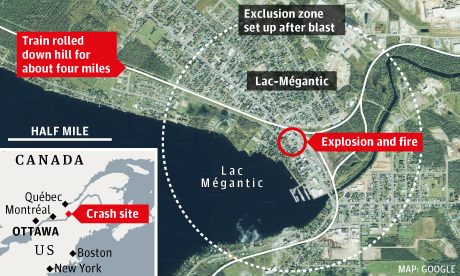
The explosions sent residents of Lac-Mégantic scrambling through the streets under the intense heat of towering fireballs and a red glow that illuminated the night sky, witnesses said. Flames and billowing black smoke could still be seen long after the 73-car train had derailed, and a fire chief likened the charred scene to a war zone.
Up to 2,000 people were forced from their homes in the lakeside town of 6,000 people, which is about 155 miles east of Montreal and about 10 miles west of the Maine border.
Quebec provincial police lieutenant Michel Brunet confirmed that one person had died. He refused to say how many others might be dead, but said authorities had been told “many” people have been reported missing.
Lt Guy Lapointe, a spokesman with Quebec provincial police, said: “I don’t want to get into numbers, what I will say is we do expect we’ll have other people who will be found deceased unfortunately. “People are calling in reported love ones missing, some people are reported two, three times missing by different members of the family,” he said.
[. . .]
The cause of the accident was believed to be a runaway train, the railway’s operator said.
The president and CEO of Rail World Inc, the parent company of Montreal, Maine & Atlantic Railway, said the train had been parked uphill of Lac-Mégantic.
“If brakes aren’t properly applied on a train, it’s going to run away,” said Edward Burkhardt. “But we think the brakes were properly applied on this train.”
Burkhardt, who was mystified by the disaster, said the train was parked because the engineer had finished his run.
“We’ve had a very good safety record for these 10 years,” he said of the decade-old railroad. “Well, I think we’ve blown it here.”
Update: Of course, to a politician, it’s never too soon to turn headlines into props for your favourite causes:
[NDP leader Thomas] Mulcair, speaking in Montreal on Saturday, said the accident was “another case where government is cutting in the wrong area.”
“We are seeing more and more petroleum products being transported by rail, and there are attendant dangers involved in that. And at the same time, the Conservative government is cutting transport safety in Canada, cutting back the budgets in that area,” said Mulcair, who pointed to decreased transportation checks on petroleum at a time when production was increasing.
“When we have a discussion about these things in the coming months or years let’s remember this day. We are watching a magnificent little village being burned to the ground by toxic products that were being transported through it,” Mulcair said.
I really did think better of Mr. Mulcair. This is quite disappointing.
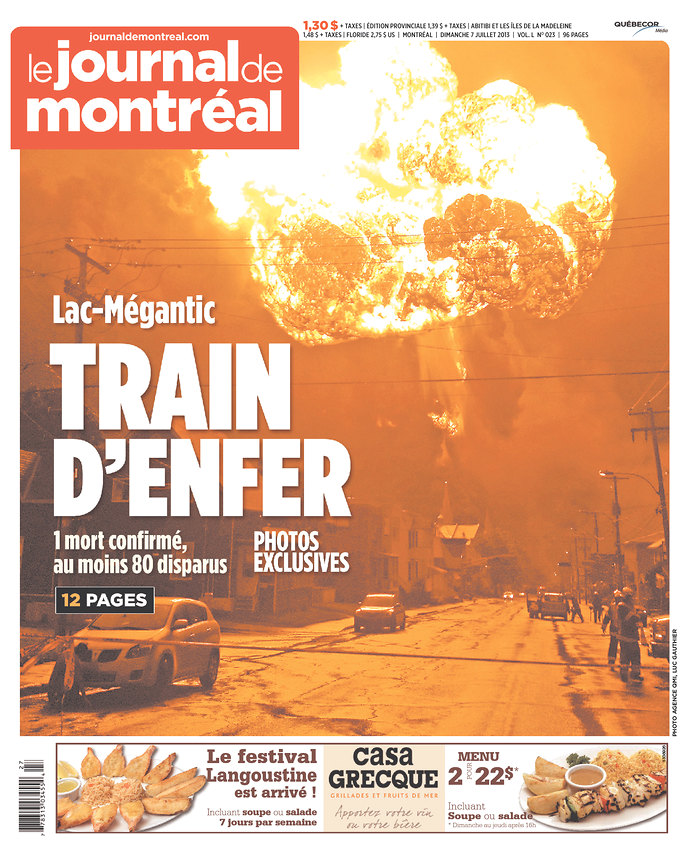
Update, the second: The front page of Le Journal de Montréal, courtesy of Newseum.
July 6, 2013
Explosion and fire in Lac-Mégantic as freight train rolled through the centre of town
The CBC has a report:
A train carrying crude oil derailed overnight in the heart of Lac-Mégantic in Quebec’s Eastern Townships, sparking a major fire that led to the evacuation of 1,000 people from their homes.
Witnesses reported between four and six explosions overnight in the town of about 6,000 people. The derailment happened at about 1 a.m. ET, about 250 kilometres east of Montreal.
It is not yet known if there are any casualties, but several people have been reported missing and are feared dead.
Zeph Kee, who lives about 30 minutes outside of Lac-Mégantic, said he saw a huge fireball coming from the city’s downtown.
Kee said several buildings and homes were completely flattened by the blast.
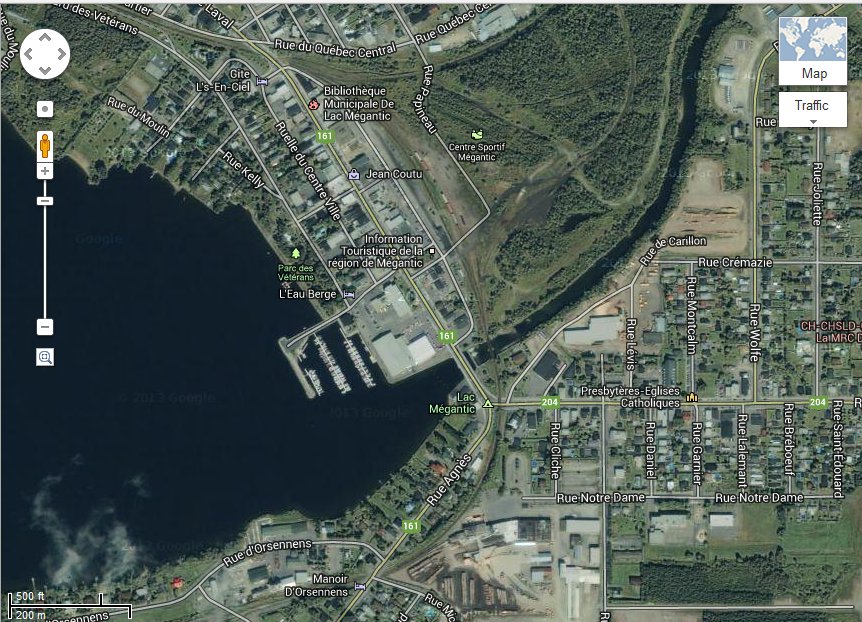
Google Maps shows the railway line entering town from the southwest and curving along the lakeshore, crossing the Chaudière River:
More than 100 firefighters, some as far away as Sherbrooke, Que., and the United States, were on the scene early Saturday morning to bring the flames under control.
A large but as-yet undetermined amount of fuel is also reported to have spilled into the Chaudière River.
The derailed train belongs to Montreal Maine & Atlantic, which owns more than 800 kilometres of track serving Maine, Vermont, Quebec and New Brunswick, according to the company’s website.
The cause of the derailment is under investigation. A spokesperson for Quebec provincial police said it is still early too early to say what caused it.
Update: Twitchy has collected some Tweets and photos from Lac-Mégantic.
Les citoyens de #LacMegantic ont eu une vision d'horreur cette nuit. #Explosion #RCES pic.twitter.com/A4zyOAc7Yn
— Radio-Canada Estrie (@rc_estrie) July 6, 2013
Le Bureau de la Sécurité des Transports fera enquête #LacMegantic #RCES pic.twitter.com/i2HUcr31kG
— Radio-Canada Estrie (@rc_estrie) July 6, 2013
Another unbelievable shot from #LacMegantic: pic.twitter.com/yhu1Z6sUOx
— Michael Forian (@Forian) July 6, 2013
#déflagration à #LacMégantic : photographie prise à partir de l'hélicoptère de la Sûreté du Québec. pic.twitter.com/9l3sZK6wDj
— Sûreté du Québec (@sureteduquebec) July 6, 2013
July 4, 2013
That distinctive society
Richard Anderson on the most recent language flap in Quebec:
One of PET’s few redeeming characteristics was his understanding of Quebec nationalism’s intense parochialism. This was not simply a minority wishing to preserve its culture, the Quebecois of 1960 were among the most successful and secure ethnic minorities in the world. The tribalists who sought the province’s independence were driven by a fear and hatred of the Other. That Other was mostly the English in the 1960s. But Canada, even Quebec, is now a more diverse place. If this was just a matter of holding a grudge against the Anglos it would stop and end with the English. But the die-hards don’t seem be fond of anyone but their own kind.
Ethnic nationalists are like that.
Now let us imagine a scenario. Indeed a great deal of imagination is required to keep the kabuki theatre of Quebec nationalism going. Let us think of a retail manager in Toronto who, for the sake of preventing ghetto formation in the world place, decided to insist on employees speaking only English. How long do you guess before the cops show up? Minutes? The camera crews would probably be there faster. The Toronto Police Service is renowned [both] for their zeal in traffic enforcement and their obsequiousness toward politically correct nostrums. Chief Blair would be hailing the arrest as a victory for diversity by late afternoon.
[. . .]
In the wake of this story the Quebec government was clear that it was not illegal to speak English in Quebec. Not yet anyway. A pure laine nationalist can dream, can’t he? This story has resonance because it captures the status of Anglophones as second class citizens in their own province. It’s linguistic bigotry that would be tolerated nowhere else in Canada. The last acceptable bigotry in modern Canada.
All Canadians are equal. Those who speak French are just more equal than others.
April 23, 2013
What we know (so far) about the would-be Via bombers
Maclean’s has a summary pulling together files from Nicholas Köhler, Charlie Gillis, Michael Friscolanti and Martin Patriquin on what is known about the two men arrested yesterday in a plot to commit an act of terror on a Canadian passenger train:
One of the men, Raed Jaser, is believed to have grown up in a Palestinian family with Jordanian roots. Court records seem to indicate he went on to a troubled history in Toronto, where authorities arrested him after a months’-long investigation they say ultimately leads back to al-Qaeda elements in Iran.
Although he is not a Canadian citizen, Jaser, 35, appears to have been in Ontario for at least two decades.
In October 1995, a man with the same name and year of birth was criminally charged in Newmarket, Ont., with fraud under $5,000 (the charge was withdrawn a year later). In December 2000, a week after his 24th birthday, Jaser was arrested and charged again, this time with uttering threats. Although court records show he was convicted of that charge, it’s not clear what sentence he received.
[. . .]
Details about the other man police say was involved in the plot, [Chiheb] Esseghaier, a resident of Montreal, are also coming into focus. A highly trained engineer, he had the resumé of an academic poised to go places.
As recently as last month he was publishing research papers.
The March 2013 edition of journal Biosensors and Bioelectronics published a paper on advanced HIV detection by Esseghaier, Mohammed Zourob and a fellow PhD student named Andy Ng.
According to his CV, Esseghaier was born in Tunisia. He received an engineering degree from Institut Tunisia’s National des Sciences Appliquées et de Technologie in 2007, with his masters degree following in 2008. He then moved to Université de Sherbrooke to research “SPR biosensor and gallium arsenide semi-conductor biofunctionnalization.” In November 2010, he joined Institut National de la Recherche Scientifique (INRS), a graduate institution associated with the Université du Québec.
April 5, 2013
Northern Quebec is the home of the world’s best gin
Or so Maclean’s says. Thanks to Canada’s odd patchwork of post-Prohibition trade restrictions between provinces, Ungava by Domaine Pinnacle is only available in Alberta, BC, and Quebec itself:
It is a difficult gin to miss. When Ungava won a Best of Show award at the prestigious World Spirits Competition last week, a judge noted its “unusual colour that helps grab your senses.” It’s perhaps the most polite way of drawing attention to Ungava’s yellow tint, about which Pinnacle president Charles Crawford is slightly more blunt. “It’s a bit like morning’s vitamin-enriched urine,” he says. His PR people prefer “sunshine yellow.”
The process by which Ungava gin is made is even more peculiar than its colour. An ice cider producer by trade, Crawford has a history of wonky tinctures — Pinnacle also produces maple-infused whiskey and a cider-brandy concoction. “Ice cider is a good product, but you can only make so much of it,” he says. “We decided to get into spirits, because there aren’t many that are uniquely Canadian.” In fact, Crawford wanted the gin to be truly, pre-colonially Canadian. He whittled down a list of 40 indigenous herbs, berries and flowers (“Nothing planted by Europeans”) to six ingredients, all found on the Ungava Peninsula in Nunavik: cloudberries; crowberries; Labrador tea; a Labrador tea cousin known as Ukiurtatuq, or “Arctic blend”; wild rosehips, which lend the gin its yellow colour; and of course juniper, without which Ungava wouldn’t be proper gin.
Every year, Crawford hires “these two guys from Kuujjuaq” (he’s unsure of their names) to pick the botanicals during Ungava’s four-week harvesting season, which usually begins in late August. The pair pack “a couple hundred kilos” of their pickings into clear, pillowy bags and send them 1,500 km straight south to Ungava’s production facility in Cowansville, about an hour’s drive east of Montreal. A neutral spirit made with locally grown corn is infused with the botanicals.
March 9, 2013
Drones and you (and you, and you, and …)
Mark Steyn on why the deployment of drones within the continental United States was inevitable:
I shall leave it to others to argue the legal and constitutional questions surrounding drones, but they are not without practical application. For the past couple of years, Janet Napolitano, the Secretary of Homeland Security, has had Predator drones patrolling the U.S. border. No, silly, not the southern border. The northern one. You gotta be able to prioritize, right? At Derby Line, Vt., the international frontier runs through the middle of the town library and its second-floor opera house. If memory serves, the stage and the best seats are in Canada, but the concession stand and the cheap seats are in America. Despite the zealots of Homeland Security’s best efforts at afflicting residents of this cross-border community with ever more obstacles to daily life, I don’t recall seeing any Predator drones hovering over Non-Fiction E-L. But, if there are, I’m sure they’re entirely capable of identifying which delinquent borrower is a Quebecer and which a Vermonter before dispatching a Hellfire missile to vaporize him in front of the Large Print Romance shelves.
I’m a long, long way from Rand Paul’s view of the world (I’m basically a 19th century imperialist a hundred years past sell-by date), but I’m far from sanguine about America’s drone fever. For all its advantages to this administration — no awkward prisoners to be housed at Gitmo, no military casualties for the evening news — the unheard, unseen, unmanned drone raining down death from the skies confirms for those on the receiving end al-Qaida’s critique of its enemies: as they see it, we have the best technology and the worst will; we choose aerial assassination and its attendant collateral damage because we are risk-averse, and so remote, antiseptic, long-distance, computer-programmed warfare is all that we can bear. Our technological strength betrays our psychological weakness.
March 8, 2013
Jack Layton biopic provokes outrage … because there isn’t a French version
I’ll let Paul Wells explain this one:
So let me get this straight. The (English-language) CBC makes a film about a Toronto MP with a Toronto wife who wants to be Toronto mayor…
— Paul Wells (@InklessPW) March 8, 2013
….and listens to Parachute Club and hangs out with Steven Page and sat on Toronto Council and spends election night in Toronto…
— Paul Wells (@InklessPW) March 8, 2013
…and it’s a problem that it was in English?
— Paul Wells (@InklessPW) March 8, 2013
Of course, if Rad-Can wants to make a movie about Layton that gives short shrift to the 2/3 of NDP voters outside Quebec, that’s OK too.
— Paul Wells (@InklessPW) March 8, 2013
February 25, 2013
Worst. Student movement. Ever.
The FEUQ speeds into the global lead for worst student movement ever:
I’m trying to imagine a worse excuse for a student movement than the one Quebec has at the moment; and I have to say that I’m not sure I can.
I mean, sure, the Canadian Federation of Students has talked some awful crap about how reducing net tuition for poor students is unacceptable, unless richer kids get a break too — really ludicrous stuff, which objectively favours richer students over poorer ones. But so far as I know, they’ve never actively aided and abetted a government that was intent on making universities poorer.
But that’s what FEUQ, and the rest of the Quebec student movement, seem to be doing right now.
[. . .]
FEUQ’s train of thought seems to run something like this: 1) Universities want more money; 2) the provincial government is broke; 3) therefore, new money can only come out of tuition fees; 4) therefore, we’d better oppose this. The problem is, if you concede point 2 you’re more or less screwed in terms of asking something for yourself, like a more generous student aid system (which Quebec certainly needs, at least for dependent students). And you’ve gone and hacked-off one of your most natural allies as far as higher education is concerned.
H/T to Stephen Gordon for the link.
February 23, 2013
Provincial budgets range from less-than-accurate to verging on financial fraud
Andrew Coyne, after a short diatribe about our first-past-the-post electoral system (he’s agin’ it), gets down to brass tacks about provincial finances:
As bad as the federal government is, the provinces are worse. And as horrendous as the provinces are generally, the record in some provinces borders on the fraudulent. Saskatchewan and Alberta, for instance, have overspent their budgets in the past decade by an average — an average — of nearly 5%. And since each year’s overshoot becomes the baseline for next year’s budget, the cumulative impact is to produce spending, in the fiscal year just ended, vastly larger than was ever specifically authorized in advance: in Saskatchewan’s case, nearly 40% larger.
That’s as best the [C. D. Howe Institute] can make out. Provincial accounting is notoriously haphazard and inconsistent. Not only does each province use its own rules and procedures, making it impossible to compare the public accounts from one province to another with any confidence, but in several provinces — Newfoundland and Quebec are the worst offenders — the public accounts are not even stated on the same basis as the budget.
And while the public accounts must ultimately prevail, efforts to reconcile the two sets of figures, and to explain the discrepancies, remain spotty. In some provinces — Quebec, Saskatchewan, British Columbia — auditors have refused, repeatedly, to sign off on the books without attaching reservations.
So not only can voters have little confidence that governments will spend what they said they would, they can have little ability even to reckon how much they overspent, or to compare their own province’s performance with the others’. All in all, a thoroughly disgraceful performance. (Honourable exceptions: Ontario and Nova Scotia, though voters in both provinces have other reasons to doubt their governments’ fiscal candour.)


