
This demonization of masculinity conflicts with the reality that any boy can see with his own two eyes: The cutest girls in school are attracted to the most masculine boys, and masculine not just in terms of physical traits, but also in terms of personality traits — confidence, assertiveness, “swagger”. Here we see a problem with what Rational Male author Rollo Tomassi calls the feminine-primary social order. Every observant man knows that there is a yawning chasm between (a) what women say they value most in a man and (b) the kind of man women actually go for. Listen to what women say, and you’d think they are magnetically attracted to “sensitive” guys. Watch what women actually do, and you can see that women obviously don’t actually care about “sensitivity”. Women want men who are tall and muscular and, ceteris parabus, rich, although no amount of money is going to make a short chubby guy sexy. As for the claim that women go for “sensitive” guys, anyone with two eyes and a brain knows this is nonsense. You don’t see throngs of lovestruck college girls chasing after guys who major in sociology or English literature (unless, of course, these guys are also tall, muscular and rich). No, it’s the jocks and frat boys who get the best action on campus, and if you pay attention to the choices women make, you’ll begin to suspect that their professed preference for “sensitive” men is the exact opposite of truth. That girl who was lecturing you about your need to be more “sensitive” will, with surprising regularity, end up falling head-over-heels for some selfish creep or dimwit brute who can’t even spell the word “sensitivity”.
Robert Stacy McCain, “Conflicting Signals”, The Other McCain, 2019-05-23.
March 30, 2023
QotD: Revealed preference in the teenage hellscape of high school
March 28, 2023
WEIRD World – basing all our “assumptions about human nature on psych lab experiments starring American undergraduates”
Jane Psmith reviews The WEIRDest People in the World: How the West Became Psychologically Peculiar and Particularly Prosperous by Joseph Henrich:

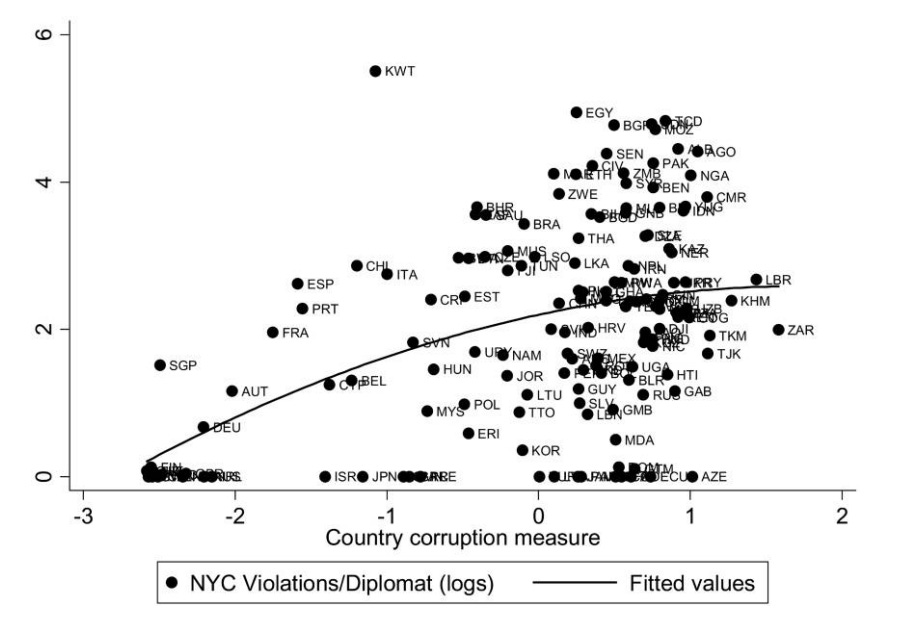
Until 2002, diplomats at the United Nations didn’t have to pay their parking tickets. Double-parking, blocking a fire hydrant, blocking a driveway, blocking an entire midtown Manhattan street — it didn’t matter; when you have diplomatic plates, they let you do it. In the five years before State Department policy changed in November 2002, UN diplomats racked up a whopping 150,000 unpaid parking tickets worth $18 million in fines. (Among other things, the new policy allowed the city to have 110% of the amount due deducted from the US foreign aid budget to the offending diplomats’ country. Can you believe they never actually did it? Lame.) Anyway, I hope you’re not going to be surprised when I say that the tickets weren’t distributed evenly: the nine members of Kuwait’s UN mission averaged almost 250 unpaid tickets apiece per year (followed by Egypt, Chad, Sudan, Bulgaria, and Mozambique, each between 100 and 150; the rest of the top ten were Albania, Angola, Senegal, and Pakistan). The UK, Canada, Australia, Denmark, the Netherlands, Sweden, and Norway had none at all. The rest of the rankings are more or less what you’d expect: for example, Italy averaged three times as many unpaid tickets per diplomat as France and fifteen times as many as Germany.
What did the countries with the fewest unpaid parking tickets have in common? Well, they generally scored low on various country corruption indexes, but that’s just another way of saying something about their culture. And the important thing about their culture is that these countries are WEIRD: western, educated, industrialized, rich, and democratic. But they’re also, in the grand scheme of human history, weird: their inhabitants think differently, behave differently, and value different things than most humans. Among other things, WEIRD people are individualistic, nonconformist, and analytical. They — okay, fine, we — are particularly hard-working, exhibit low time preference, prefer impersonal rules we apply universally, and elevate abstract principles over contextual and relationship-based standards of behavior. In other words, WEIRD people (as Joseph Henrich and his colleagues pointed out in the influential 2010 paper where they coined the phrase) are outliers on almost every measure of human behavior. Wouldn’t it be silly for an entire academic discipline (and therefore an entire society ideologically committed to Trusting The Experts) to base all its assumptions about human nature on psych lab experiments starring American undergraduates? That would give us a wildly distorted picture of what humans are generally like! We might even do something really dumb like assume that the social and political structures that work in WEIRD countries — impersonal markets, constitutional government, democratic politics — can be transplanted wholesale somewhere else to produce the same peace and prosperity we enjoy.
Ever since he pointed out the weirdness of the WEIRD, Henrich has been trying to explain how we got this way. His argument really begins in his 2015 The Secret of Our Success, which I reviewed here and won’t rehash. If you find yourself skeptical that material circumstances can drive the development of culture and psychology (unfortunately the term “cultural Marxism” is already taken), you should start there. Here I’m going to summarize the rest of Henrich’s argument fairly briefly: first, because I don’t find it entirely convincing (more on that below), and second, because I’m less interested in how we got WEIRD than in whether we’re staying WEIRD. The forces that Henrich cites as critical to the forging of WEIRD psychology are no longer present, and many of the core presuppositions of WEIRD culture are no longer taken for granted, which raises some thought-provoking questions. But first, the summary.
Henrich argues that the critical event setting the West on the path to Educated, Industrialized, Rich, and Democratic was the early medieval western Church’s ban on cousin marriage. That might seem a little odd, but bear in mind that most of the humans who’ve ever lived have been enmeshed in incredibly dense kin networks that dictate obligations, responsibilities, and privileges: your identity is given from birth, based simply on your role as a node in an interdependent network. When societies grow beyond the scale of a family, it’s by metaphorically extending and intensifying these kinship bonds (go read our review of The Ancient City for more on this). These kinship networks perpetuate themselves through marriage, and particularly through marriage to relatives, whether blood or in-laws, to strengthen existing connections. Familial or tribal identities come first, before even the claims of universal religions, as when Wali Khan, a Pakistani politician, phrased his personal allegiances as “I have been a Pashtun for six thousand years, a Muslim for thirteen hundred years, and a Pakistani for twenty-five.” You could imagine Edwin of Northumbria or Childeric saying something pretty similar.
Then, beginning in the 4th century, the western Church began to forbid marriages to relatives or in-laws, the kinship networks began to wither away, and alternative social technologies evolved to take their place. In place of the cousin-marriers’ strong tight bonds, conformity, deference to traditional authority, and orientation toward the collective, you get unmoored individuals who have to (or get to, depending on your vantage point) create their own mutually beneficial relationships with strangers. This promotes a psychological emphasis on personal attributes and achievements, greater personal independence, and the development of universalist social norms. Intensive kinship creates a strong in-group/out-group distinction (there’s kin and there’s not-kin): people from societies with strong kinship bonds, for instance, are dramatically more willing to lie for a friend on the witness stand. WEIRD people are almost never willing to do that, and would be horrified to even be asked. Similarly, in societies with intensive kinship norms, you’d be considered immoral and irresponsible if you didn’t use a position of power and influence to benefit your family or tribe; WEIRD people call that nepotism or corruption and think it’s wrong.
March 26, 2023
Plandemic? Manufactured crisis? Mass formation psychosis?
In The Conservative Woman, James Delingpole lets his skeptic flag fly:

“Covid 19 Masks” by baldeaglebluff is licensed under CC BY-SA 2.0


Tell me about your personal experiences of Covid 19. Actually, wait, don’t. I think I may have heard it already, about a million times. You lost all sense of smell or taste – and just how weird was that? It floored you for days. It gave you a funny dry cough, the dryness and ticklishness of which was unprecedented in your entire coughing career. You’ve had flu a couple of times and, boy, when you’ve got real flu do you know it. But this definitely wasn’t flu. It was so completely different from anything you’ve ever known, why you wouldn’t be surprised to learn that it had been bioengineered in a lab with all manner of spike proteins and gain-of-function additives, perhaps even up to and including fragments of the Aids virus …
Yeah, right. Forgive me for treading on the sacred, personal domain of your lived experience. But might I cautiously suggest that none of what you went through necessarily validates lab-leak theory. Rather what it may demonstrate is the power of susceptibility, brainwashing and an overactive imagination. You lived – we all did – through a two-year period in which health-suffering anecdotes became valuable currency. Whereas in the years before the “pandemic”, no one had been much interested in the gory details of your nasty cold, suddenly everyone wanted to compare notes to see whether they’d had it as bad as you – or, preferably, for the sake of oneupmanship, even worse. This in turn created a self-reinforcing mechanism of Covid panic escalation: the more everyone talked about it, the more inconvertible the “pandemic” became.
Meanwhile, in the real world, hard evidence – as opposed to anecdotal evidence – for this “pandemic” remained stubbornly non-existent. The clincher for me was a landmark article published in January 2021 by Simon Elmer at his website Architects For Social Housing. It was titled “Lies, Damned Lies and Statistics: Manufacturing the Crisis”.
In it Elmer asked the question every journalist should have asked but which almost none did: is this “pandemic” really as serious as all the experts, and government ministers and media outlets and medics are telling us it is? The answer was a very obvious No. As the Office for National Statistics data cited by Elmer clearly showed, 2020 – Year Zero for supposedly the biggest public health threat since “Spanish Flu” a century earlier – was one of the milder years for death in the lives of most people.
Let’s be clear about this point, because something you often hear people on the sceptical side of the argument say is, “Of course, no one is suggesting that Covid didn’t cause a horrific number of deaths.” But that’s exactly what they should be suggesting: because it’s true. Elmer was quoting the Age Standardised Mortality statistics for England and Wales dating back to 1941. What these show is that in every year up to and including 2008, more people died per head of population than in the deadly Covid outbreak year of 2020. Of the previous 79 years, 2020 had the 12th lowest mortality rate.
Covid, in other words, was a pandemic of the imagination, of anecdote, of emotion rather than of measured ill-health and death. Yet even now, when I draw someone’s attention to that ONS data, I find that the most common response I get is one of denial. That is, when presented with the clearest, most untainted (this was before ONS got politicised and began cooking the books), impossible-to-refute evidence that there was NO Covid pandemic in 2020, most people, even intelligent ones, still choose to go with their feelings rather with the hard data.
This natural tendency many of us have to choose emotive narratives over cool evidence makes us ripe for exploitation by the cynical and unscrupulous. We saw this during the pandemic when the majority fell for the exciting but mendacious story that they were living through a new Great Plague, and that only by observing bizarre rituals – putting strips of cloth over one’s face, dancing round one another in supermarkets, injecting unknown substances into one’s body – could one hope to save oneself and granny. And we’re seeing it now, in a slightly different variant, in which lots of people – even many who ought to know better – are falling for some similarly thrilling but erroneous nonsense about lab-leaked viruses.
It’s such a sexy story that I fell for it myself. In those early days when all the papers were still dutifully trotting out World Health Organisation-approved propaganda about pangolins and bats and the apparently notorious wet market (whatever the hell that is) in Wuhan, I was already well ahead of the game. I knew, I just knew, as all the edgy, fearless seekers of truth did that it was a lab leak wot done it. If you knew where to dig, there was a clear evidence trail to support it.
We edgy, fearless truth seekers knew all the names and facts. Dodgy Peter Daszak of the EcoHealth Alliance was in it up to the neck; so too, obviously, was the loathsomely chipper and smugly deceitful Anthony Fauci. We knew that all this crazy, Frankenvirus research had initially been conducted in Chapel Hill, North Carolina, but had been outsourced to China after President Obama changed the regulations and it became too much of a hot potato for US-based labs. And let’s not forget Ukraine – all those secret bio-research labs run on behalf of the US Deep State, but then exposed as the Russians unhelpfully overran territory such as Mariupol.
March 24, 2023
From “railway spine” to “shell shock” to PTSD
At Founding Questions, Severian discusses how our understanding of what we now label “Post-Traumatic Stress Disorder” evolved from how doctors visualized bodily ailments over a century ago:
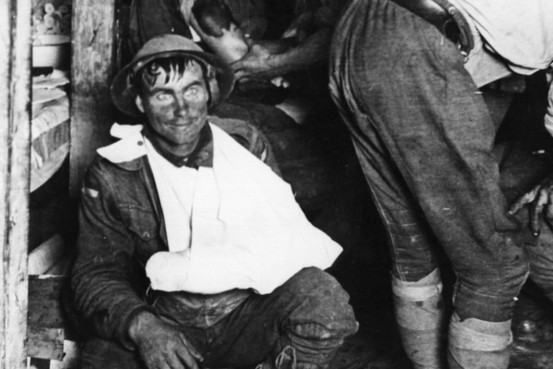
A shell-shocked and physically wounded soldier in the First World War.
I mentioned “shell shock” yesterday, so let’s start there. Medicine in 1914 was still devoted to the “Paris School,” which assumed nothing but organic etiology for all syndromes. Sort of a reverse Descartes — as Descartes (implicitly) “solved” the mind-body problem by disregarding the body, so the “Paris School” of medicine solved it by disregarding the mind. So when soldiers started coming back from the front with these bizarre illnesses, naturally doctors began searching for an organic cause. (That’s hardly unique to the Paris School, of course; I’m giving you the context to be fair to the 1914 medical establishment, whose resistance to psychological explanations otherwise seems so mulish to us).
They’d noticed something similar in the late 19th century, with industrial accidents and especially train crashes. When a train crashed, the people in the first few cars were killed outright, those in the next few wounded, but the ones in the back were often physically fine. But within a few hours to weeks, they started exhibiting all kinds of odd symptoms. Hopefully you’ve never been in a train crash, but if you’ve ever been in a fender-bender you’ve no doubt experienced a minor league version of this.I hit a deer on the highway once. Fortunately I was at highway speed, and hit it more or less dead on (it jumped out as if it were committing suicide), so it got thrown away from the car instead of coming through the windshield. The car’s front end was wrecked, naturally, but I was totally fine. I don’t think the seatbelt lock even engaged, much less the airbag, since I didn’t even have time to hit the brakes.
The next few hours to days were interesting, physiologically. It felt like my body was playing catch up. I had an “oh shit, I’m gonna crash!!!” reaction about 45 minutes after I’d pulled off to the side of the road, duct-taped the bumper back on as best I could, and continued to my destination. All the stuff I would have felt had I seen the deer coming came flooding in. Had I not already been where I was going, I would’ve needed to pull over, because that out of the blue adrenaline hit had my hands shaking, and my vision fuzzed out briefly.
The next morning I was sore. I had all kinds of weird aches, as if I’d just played a game of basketball or something. I assume part of it actually was the impact — it didn’t feel like much in the moment, but if it’s enough to crumple your car’s front end (and it was trashed), it’s enough to give you a pretty good jolt. That would explain soreness in the arms, elbows, and shoulders — a stiff-armed, white-knuckle grip on the steering wheel, followed by a big boom. But I was also just kinda sore all over, plus this generalized malaise. I felt not-quite-right for the next few days. Nothing big, no one symptom I can really put my finger on, but definitely off somehow — a little twitchy, a little jumpy, and really tired.
Having done my WWI reading, I knew what it was, and that’s when I really understood the doctors’ thought processes. I really did take some physical damage, because I really did receive a pretty good full-body whack. It just wasn’t obvious to the naked eye. And since everyone has experienced odd physical symptoms from being rattled around, or even sleeping on a couch or sprung mattress, it makes sense — the impact obviously jiggled my spine, which probably accounts for a great many of the physical symptoms. Hence, “railway spine”. And from there, “shell shock” — nothing rattles your back like standing in a trench or crouching in a dugout as thousands of pounds of high explosive go off around you. It must be like going through my car crash all day, every day.
Skip forward a few decades, and we now have a much better physiological understanding of what we now call (and I will henceforth call) Post-Traumatic Stress Disorder (PTSD). There’s a hypothesis that I personally believe, that “shell shock” is also a whole bunch of micro-concussions as well as “classic” PTSD, but let’s leave that aside for now. The modern understanding of PTSD is largely about chemistry. Cortisol and other stress chemicals really fuck you up. They have systemic physical and mental effects. If those chemicals don’t get a chance to flush out of your system — if you’re in a trench for weeks on end, let’s say — the effects are cumulative, indeed exponential.
Returning to my car crash: I was “off” for a few days because my body got a huge jolt of stress chemicals. That odd not-quite-right thing I felt was those chemicals flushing through. Had I gone to a shrink at that moment, he probably would’ve diagnosed me with PTSD. But I didn’t have PTSD. I had a perfectly normal physiological reaction to a big shot of stress chemicals. If I’d gotten into car crash after car crash, though, day in and day out, that would’ve been PTSD. I’d be having nightmares about that deer every night, instead of just the once. And all that would have cumulative, indeed exponential, effects.
He then goes on to cover similar physical reactions to stimuli in modern life, so I do recommend you RTWT.
March 21, 2023
Few professions are as “optimism biased” as primary school teachers
Freddie deBoer was commissioned to write this for a professional publication for teachers, but it was “too hot” for the editors, so he’s posted it to his Substack instead:

There’s a bias that runs throughout our educational discourse, coming from our media, academia, and the think tanks and foundations that have such sway in education policy. It’s a bias that exists both because of a natural human desire to see every child succeed and because the structural incentives in the field make rejecting that bias professionally risky. The bias I’m talking about is optimism bias, the insistence that all problems in education are solvable and that we can fix them if only we want to badly enough. At least a half-century of research, spending, policy experimentation, and dogged effort has utterly failed to close the gaps that so vex our political class. But still we hear the same old song about how we could close those gaps tomorrow if we really wanted to, an attitude that has distorted education policy and analysis for decades.
My first book, The Cult of Smart, was a commercial failure. It was released during the height of the pandemic and thus my ability to promote it was limited, but by any measure the market rejected it. It’s tough to produce a labor of love like that and find that few people were interested in it.
But there was a silver lining: since publication in 2020 I’ve heard from dozens and dozens of teachers, thanking me for putting their thoughts to print. These educators come from public, private, and charter schools, from schools with affluent study bodies and schools that are mired in poverty, from big city school districts and from low-population regional rural schools. And again and again, these teachers shared the same perspective: they agreed with the book’s overall argument, and often had thought similar things themselves for years, but felt they could not express them publicly for fear of professional consequences.
The essential argument of the book is that overwhelming empirical evidence shows that students sort themselves into academic ability bands in the performance spectrum early in life, with remarkable consistency; that the most natural and simplest explanation for this tendency is that there is such a thing as individual academic potential; and that the most likely source of this individual academic potential is likely influenced by genes. When we look at academic performance, what we see again and again is that students perform at a given level relative to peers early in schooling and maintain that level throughout formal education. (I make that case at considerable length here.) A vast number of interventions thought to influence relative performance have been revealed to make no difference in rigorous research, including truly dramatic changes to schooling and environment. Meta-analyses and literature reviews that assess the strength of many different educational interventions find effect sizes in the range of .01 to .3 standard deviations, small by any standards and subject to all sorts of questions about research quality and randomization. Even the most optimistic reading of the research literature suggests that almost nothing moves the needle in academic outcomes. Almost nothing we try works.
This implies that common sense is correct and that individual students have their own natural or intrinsic level of academic potential, which we have no reason to believe we can dramatically change. I believe that we can change large group disparities in education (such as the racial achievement gap) by addressing major socioeconomic inequalities through government policy. But even after we eliminate racial or gender gaps, there will be wide differences between individual students, regardless of pedagogy or policy. When Black students as a group score at parity with white students, there will still be large gaps within the population of Black students or white or any other group you can name, and we have no reliable interventions to make the weakest perform like the strongest.
My book’s argument is attractive to teachers because they’ve lived under an educational ideology that insists that every student is a budding genius whose potential waits to be unlocked by a dedicated teacher – and which holds teachers to that unachievable standard. From the right, they’re subject to “no excuses” culture, the constant insistence from the education reform movement that student failures are the result of lazy and feckless teachers; from the left, they’re subject to a misguided egalitarianism that mistakes the fact that every child is important and deserves to be nurtured for the idea that every child has perfectly equal potential. The result is a system that presses teachers to deliver learning outcomes in their classrooms that they can’t possibly achieve. But many of them feel that they can’t push back, for fear of professional consequences. If they speak frankly about the fact that different students have different levels of individual potential, they’ll likely be accused of shirking their duty.
February 27, 2023
The instinct to protect
Rob Henderson on the way that women react to men who demonstrate protective instincts toward them:
Human psychology evolved in environments far more violent than even the most dangerous modern U.S. cities. Overall, in the U.S., the average death rates from interpersonal violence are less than 1 in 10,000.
In contrast, in hunter-gatherer societies, 15 percent of deaths were the result of physical violence.
Our violent evolutionary past has shaped our minds. Even peaceable people in developed countries who have never even been in a fight can still readily estimate men’s physical strength from their face, body, and voice. These estimations tightly correlate with men’s actual physical strength.
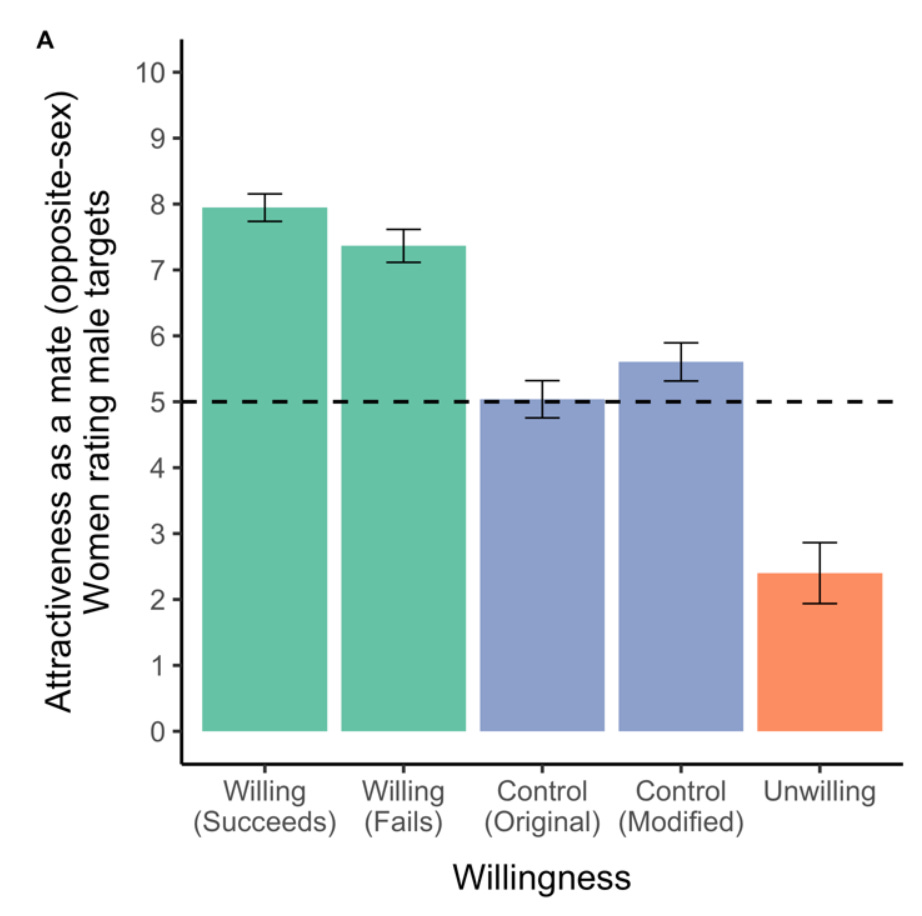
A 2022 paper (preprint link here) investigated whether people prefer romantic partners who are willing and able to protect them from violence.
Considering the frequency and intensity of violence in the human ancestral environment, affiliating with people who were able to protect you would have been advantageous. The authors of the paper suggest such preferences have shaped human mating psychology.
The authors (Barlev, Arai, Tooby, and Cosmides) explore the question of whether a potential partner’s ability to protect you from violence is valued. It seems obvious that the answer (especially for women) is almost certainly yes.
However, they also explore whether a potential partner’s willingness (independent of ability) is also considered attractive.
When a woman judges a man, does learning that he is willing to protect her from violence make him more attractive, even if he isn’t particularly effective at doing so?
What about when a woman learns that a man is able but unwilling to protect her? Imagine a muscular guy who, upon seeing his date get mugged, just stands there and does nothing, or runs away.
Is he still more attractive than a guy who is unable but willing to protect her? Picture a scrawny guy who, upon seeing his date get mugged, physically tries but is unsuccessful in his attempt to stop the mugger.
The paper explores these questions.
[…]
Here you see that women rate male dates (described in this particular version of the study as average in physical strength and average in physical attractiveness) who make no attempt to protect them as a 2 out of 10 in attractiveness. Women rate a man who attempts to protect them but fails as a 7.5 out of 10. And a man who attempts to protect them and succeeds is an 8 out of 10.
So the major bump in attractiveness comes from willingness, rather than ability.
QotD: Sigmund Freud’s insights
That’s what happened with Anna O., history’s most famous psychiatric patient. She had a very turbulent love/hate relationship with her father, as tightly wound girls do. When he became deathly ill on a family vacation, the unresolvable tension caused a whole host of physical symptoms, including hysterical paralysis. Pioneering psychologist Josef Breuer “talked her through” it, finally resolving the emotional conflict and “curing” the patient.
All this would’ve been interesting, but largely irrelevant, were it not for World War I. The world at large didn’t care about the problems of overprivileged Jewish girls, but they did care about their soldiers suddenly going crazy in the trenches. Once military doctors finally ruled out a physical cause, they were left with Freudian explanations: A soldier can’t stop fighting, because he’s an honorable, dutiful soldier. Yet that soldier must stop fighting. The only honorable way out is a wound. If the enemy doesn’t wound him, then, his subconscious will. Hence the bizarre “conversion disorders” — hysterical blindness, paralysis, mutism, etc. — characteristic of “shell shock.”
But a funny thing happened. While everyone now acknowledged the real power of the subconscious mind, we sort of … forgot … about it. Psychology, particularly psychotherapy, went back to being a ghetto Jewish preoccupation. Bored, over-privileged housewives might go to a shrink to talk through their “issues”, but as for the rest of us, well, if we weren’t going into combat anytime soon, why bother? Outside of a few crusty old reactionaries (like yours truly) making fun of SJWs, when was the last time you heard the word “neurotic”?
But that’s the thing: either the subconscious is real, or it isn’t. When we say “neurotic” (the few of us who still do), we usually mean people like Anna O. — rich, cosseted, politically active human toothaches who try to force the entire world into the all-encompassing drama of their Daddy Issues (see also: Virginia Woolf). But that’s not how Freud meant it. According to him, we’re all neurotic to some degree or another, because that’s just how anxiety works.
We all have strong emotional impulses that run counter our self-image. Hence the entire panoply of pop-Freudianism: The preacher who constantly rails against homosexuality from the pulpit is secretly gay (“projection”). The strict, controlling, everything-in-its-place type is a sadist (“anal-retentive”). The player who can’t settle down with any woman is actually trying to find a Mommy figure (“Oedipus complex”). And, of course, the — ahem — daddy of them all, the crippling Daddy Issues that make feminists such fun.
But that’s just the thing: Either anxiety works that way or it doesn’t. Just because we don’t see a specific syndrome in ourselves doesn’t mean we don’t have a whole bunch of anxiety we need to discharge. Just because it’s subclinical, in other words, doesn’t mean it’s not real, or unimportant. See for example the legions of keyboard commandos who show up in the comments of any blog with more than fourteen readers. Yeah, sure, it’s possible that those guys all got kicked out of SEAL Team 6 for being too badass … but it’s probably classic identification. They’re deeply uneasy about the world and their place in it, so they construct themselves an identity as the Rambo of Evergreen Terrace.
Severian, “High Anxiety”, Rotten Chestnuts, 2020-03-16.
February 26, 2023
QotD: Scientology versus psychiatry
Scott Alexander, “The APA Meeting: A Photo-Essay”, Slate Star Codex, 2019-05-22.
February 24, 2023
You may call it “interest cycling”, but I call it “normality”
Tom Knighton on what is apparently called “interest cycling” in hobbies and other leisure-time activities:

An article from a late 1950s issue of Model Railroader magazine showing a very small HO scale layout plan. The author later admitted that it’s really too small to do much with after it’s built — without some expansion — but the building can take more time than you might expect and you’d need to develop some new skills to do it properly.
Something many ADHD people do — and maybe others, I don’t know — is what I call “interest cycling”.
Basically, I get insanely hyperfocused on one thing, devoting almost all of my time to this One Thing for weeks at a time, then suddenly stop for whatever reason and then jump onto something else.
As a result, I never become truly great at anything. What’s more, since many of these areas of hyperfocus — one article called them obsessions, and with plenty of cause — require money, I end up needing to spend large quantities of money that I really can’t afford to spend.
But, it’s a need.
And it’s a problem. For a lot of us.
See, I have obligations that surround some of my interests. I’m a group leader for the local chapter of an organization I’m part of, for example, that requires not just me to teach a class once per week, but also to advance my own knowledge.
I still teach the class because others are counting on me to do so, but I haven’t been devoting much time to the rest of it, and I should since there are some tangential benefits to what I’m trying to accomplish here at The Knighton Experiment. Sure, some of it isn’t, but that’s just part of the game, so to speak.
What’s worse is that, so far as I’ve been able to find, there aren’t a lot of ways to combat this.
Which suggests that I’m kind of doomed to go through this cycle for the rest of my life.
Now, there are upsides. I mean, there aren’t many people who could detail both how to build a chest of drawers and a 14th-century transitional plate harness, for example. While I can’t necessarily build either with a high degree of proficiency, I at least know what’s involved.
In my own case, those sound like perfectly normal interests — I share both of them — although since my income dropped precipitously several years ago, I don’t spend money as Tom still does. What I have done, however, is to accumulate future stocks of books on those topics I typically cycle through over time so that when the urge strikes I can at least ameliorate some of the need by reading about rather than actively engaging in the hobby/interest/activity. That might be the difference between Tom’s concern and my experience … I cycle among a number of interests, but not brand new ones all the time.
February 23, 2023
QotD: Academic types
You do acknowledge, of course, that it’s in the nature of math that 50% of the population are below average?
Our default “solution” for university shooters […] is psychiatry. More access to better “mental health care”, we say, would’ve prevented this. Maybe, maybe not, but at least it’s something. The problem, though, is that the only diagnostic criterion you can realistically use is “So-and-So is a twitchy, weird loner”, which — trust me — exactly describes 99% of grad students and 100% of professors. Do we force feed all of them powerful prescription psychotropics on the off-chance?
Before you jump to agree — and yes, I fully acknowledge how awesome that would be, if you put it on Pay-per-View I’d be the first to sign up […] I’d ask you to consider two things:
First, it’s the government doing this. The same stupid motherfuckers who can’t manage to rig a poll where only a handful of addled old farmers vote. Do you really want to bet America’s future social stability on them loading the right drug into the sprayers? Given the federal bureaucracy’s sterling reputation for basic competence, they’d probably crop-dust the ‘hood with meth.
Severian, “The Scientific Management of Populations”, Rotten Chestnuts, 2020-02-15.
February 22, 2023
Toward a taxonomy of military bullshit
Bruce Gudmundsson linked to this essay from “Shady Maples“, a serving officer in the Canadian Army, on the general topic of bullshit in the military:

Armies, as a rule, are quagmires of bullshit. The Canadian Army is no exception. We accept that bullshit is an occupational hazard in the Army, but it’s a hazard that we struggle to manage and it’s one that threatens our effectiveness as a force.
In order to understand bullshit we need a taxonomy, that is, a map of bullshit and the common varieties found in the wild. Using our taxonomy, we can develop diagnostic tools to detect bullshit and expose its corrosive effects on our integrity and professional culture. I assume that bullshit is also a hazard in other environments and government departments, but since my experience is in the land force I will be focusing my attention on that.
The subject of bullshit entered the mainstream in 2005 when Princeton University Press issued a hardcover edition of Harry G. Frankfurt’s 1988 essay “On Bullshit“. Frankfurt doesn’t mince words: “[one] of the most salient features of our culture is that there is so much bullshit. Everyone knows this. Each of us contributes his share.” He argues that even though we treat bullshit as a lesser moral offence than lying, it’s actually more harmful to a culture of truth. I believe this wholeheartedly, for reasons which will become clear.
In Frankfurt’s view, even though a liar and a bullshitter both aim to deceive their targets, bullshitting and lying require different mental states. In order to lie, someone must believe that they know the truth and intentionally make a false account of it. For example, if you believe that today is Monday but today is in fact Tuesday, and somebody asks you what day it is, you’re not a liar if you say “today is Monday”. You’re not lying because you really do believe that today is Monday, even though this belief is incorrect. In order to lie, you have to intentionally make a statement that is contrary to the truth as you understand it. In this example, you would be lying if you said “today is Tuesday” while believing that today is actually Monday. You would be accidentally correct, but you would still be lying because you are providing a false account of what you believe is true.
This means that lying actually requires a tacit respect for the truth on the part of the liar. The liar has to at least acknowledge the existence of truth in order to avoid it. To provide a false account of the truth, the liar must first believe in the truth.
The bullshitter, by contrast, does not operate under this constraint. Bullshit according to Frankfurt is speech without any regard for the truth whatsoever. To Frankfurt, “[the bullshitter] does not care whether the things he says describe reality correctly. He just picks them out, or makes them up, to suit his purpose.” Bullshit, Frankfurt argues, is speech that is disconnected from a concern for truth. The bullshitter will say anything if it helps them achieve their desired ends.
[…]
Let’s move on to the topic of “bull”, which is discussed at length by British psychologist Norman F. Dixon, author of On the Psychology of Military Incompetence. Dixon beat Frankfurt to the punch by publishing his own theory of bullshit in 1976, twelve years before “On Bullshit”. Dixon is a Freudian psychologist writing in the 1970s, so I am skeptical of the scientific merit of his book. Nonetheless, he provides an interesting outsider’s perspective of British military culture from the Crimean War up to the Second World War and how that culture enabled terrible officers while punishing competent ones (spoiler: aristocrats and nepotism are bad for meritocracy).
There is an entire chapter of the book about bullshit as a contributing factor to military incompetence. Dixon attributes the origin of the word “bullshit” to Australian soldiers, who in 1916 “were evidently so struck by the excessive spit and polish of the British Army that they felt moved to give it a label”. His theory of the Australian origin of bullshit is supported by Australian philosopher David Stove, who believed that it’s a signature national expression.
[…]
Canadian political philosopher G. A. Cohen added some depth to the discourse when he responded to Frankfurt in “Deeper into Bullshit“. Cohen wasn’t satisfied that Frankfurt had explored full range of bullshit as a social phenomenon. Frankfurt anchors his definition of bullshit in the intention or mental state of the speaker (the bullshitter) whose lack of concern for truth is what makes their statements bullshit. Cohen responds to this by pointing out that there are many people who honestly profess their bullshit beliefs. Reading this brought me back to my undergrad days. I had a TA in a 300-level philosophy course who claimed that he doubted his own existence. Personally, I wondered whether he would still doubt his own existence if I punched him in the balls for spewing such performative bullshit in class. So I think that Cohen makes a good point: there are bullshitters who honestly believe their own bullshit.
Cohen’s argument is squarely aimed at a certain style of academic writing, which he calls “unclarifiable unclarity.” These are intentionally vague statements which cannot be clarified without distorting their apparent meaning or dropping the veil of profundity altogether. If you want an example, you can try reading Hegel or a postmodernist philosopher, or just save yourself the effort and click on this postmodern bullshit generator (trust me, it’s indistinguishable from the real thing). Pennycook et al. label statements of this type as “pseudo-profound bullshit“. Hilariously, they ran a series of experiments to see if test subjects would find the appearance of profound truth in both real and algorithmically-generated Deepak Chopra tweets. The result, disappointingly, was yes.
Cohen adds a fourth type of bullshit to our taxonomy: “irretrievably speculative comment”. Basically, when someone is arguing for a proposition which they have no way of knowing is true or false, or they put forward an argument that’s completely unsupported by readily available evidence, then that argument is bullshit.
[…]
Still with me? So far we’ve identified and defined four types of bullshit (BS):
BS1 (Frankfurt): propositions made without concern for truth.
BS2 (Dixon): ritualistic activity which doesn’t serve its stated aim or justification.
BS3 (Cohen/Pennycook): unclarifiable unclarity aka pseudo-profound bullshit.
BS4 (Cohen): speculation beyond what’s reasonably permitted by the evidence.
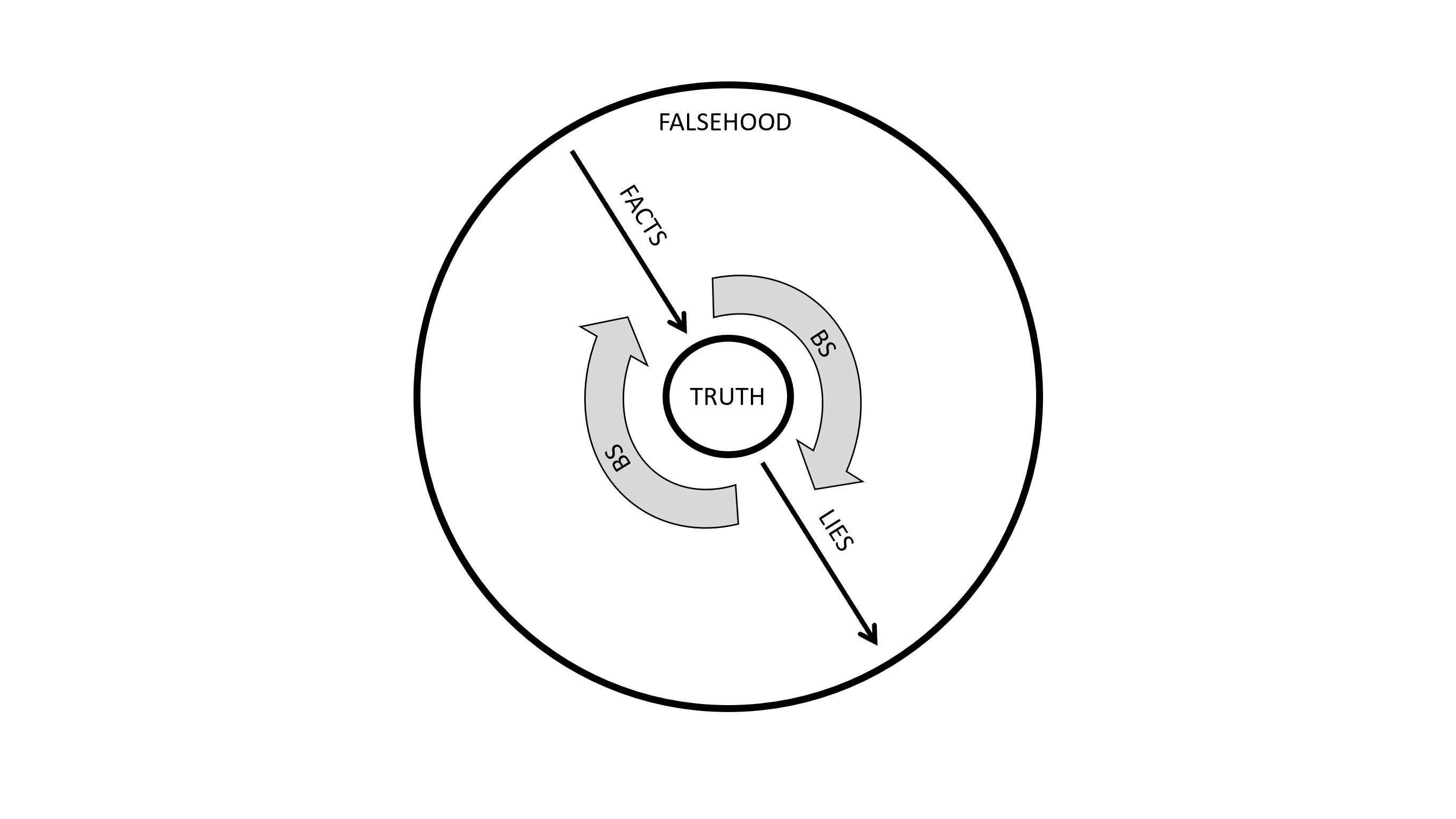
The common denominator of all four types of bullshit is their disconnection from reality. Bullshit statements don’t enhance our understanding and bullshit activity doesn’t get us any closer to achieving our goals in the real world. Bullshit doesn’t necessarily move us further away from truth, like lies do, but it certainly doesn’t get us any closer to it either. Essentially, bullshit lowers the signal-to-noise ratio of discourse.
The endless carousel of bullshit.
QotD: The soul of the bureaucrat
I had all kinds of documents with me to prove that I was the person I said I was, namely me; besides which, it was surely obvious, even to the most casual observer, that I was a respectable citizen not given to obtaining travel or other documents by false pretensions. But these days we live under a regime, if not exactly of laws rather than of men, at least of regulations rather than of men, and an official such as the one with whom I would have to deal would be allowed to exercise no discretion in case he thereby revealed his social prejudices. “Let justice be done though the heavens fall,” said Cicero, which we have changed to “Though the heavens fall, let the forms be filled and the boxes ticked.”
To do my imaginary official justice, I would have behaved just like him if our positions had been reversed. There are many jobs whose sole pleasure or delight must be in disobliging the public. Bureaucrats are themselves so oppressed by bureaucracy that their only way of finding relief is to make others suffer like them. The wonder, then, is not that they are bad, but that they are not worse.
Theodore Dalrymple, “The Bureaucrat’s Point of View”, Taki’s Magazine, 2018-05-12.
February 21, 2023
Smart people are at least as likely to fall for false beliefs as anyone else
Gurwinder explains why people well above average intelligence are actually more likely to adopt irrational ideas:
What causes delusion?
The prevailing view is that people adopt false beliefs because they’re too stupid or ignorant to grasp the truth. This may be true in some cases, but just as often the opposite is true: many delusions prey not on dim minds but on bright ones. And this has serious implications for education, society, and you personally.
In 2013 the Yale law professor Dan Kahan conducted experiments testing the effect of intelligence on ideological bias. In one study he scored people on intelligence using the “cognitive reflection test”, a task to measure a person’s reasoning ability. He found that liberals and conservatives scored roughly equally on average, but the highest scoring individuals in both groups were the most likely to display political bias when assessing the truth of various political statements.
In a further study (replicated here), Kahan and a team of researchers found that test subjects who scored highest in numeracy were better able to objectively evaluate statistical data when told it related to a skin rash treatment, but when the same data was presented as data regarding a polarizing subject — gun control — those who scored highest on numeracy actually exhibited the greatest bias.
[…]
Since we’re a social species, it is intelligent for us to convince ourselves of irrational beliefs if holding those beliefs increases our status and well-being. Dan Kahan calls this behavior “identity-protective cognition” (IPC).
By engaging in IPC, people bind their intelligence to the service of evolutionary impulses, leveraging their logic and learning not to correct delusions but to justify them. Or as the novelist Saul Bellow put it, “a great deal of intelligence can be invested in ignorance when the need for illusion is deep”.
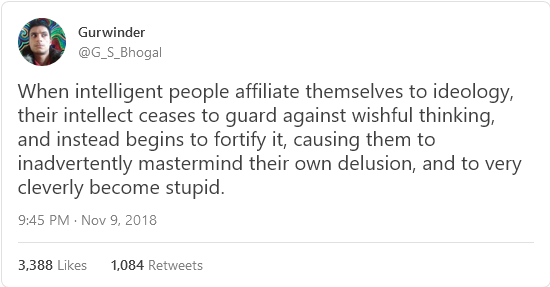
What this means is that, while unintelligent people are more easily misled by other people, intelligent people are more easily misled by themselves. They’re better at convincing themselves of things they want to believe rather than things that are actually true. This is why intelligent people tend to have stronger ideological biases; being better at reasoning makes them better at rationalizing.
This tendency is troublesome in individuals, but in groups it can prove disastrous, affecting the very structure and trajectory of society.
For centuries, elite academic institutions like Oxford and Harvard have been training their students to win arguments but not to discern truth, and in so doing, they’ve created a class of people highly skilled at motivated reasoning. The master-debaters that emerge from these institutions go on to become tomorrow’s elites — politicians, entertainers, and intellectuals.
Master-debaters are naturally drawn to areas where arguing well is more important than being correct — law, politics, media, and academia — and in these industries of pure theory, secluded from the real world, they use their powerful rhetorical skills to convince each other of FIBs. During their master-debatery circlejerks, the most fashionable delusions gradually spread from individuals to departments to institutions to societies.
Some of these FIBs can now be found everywhere. A particularly prominent example is wokeism, a popularized academic worldview that combines elements of conspiracy theory and moral panic. Wokeism seeks to portray racism, sexism, and transphobia as endemic to Western society, and to scapegoat these forms of discrimination on white people generally and straight white men specifically, who are believed to be secretly trying to enforce such bigotries to maintain their place at the top of a social hierarchy.

QotD: The Gods as (literal) machines
But what do we offer? What do we ask for? How do we ask? This isn’t write-your-own-religion, after all: you can’t just offer whatever you feel like (or more correctly, you can, and the god’s silent disapproval will be the response). After all, if your plan is to get me to do something, and you show up at my door with awful, nasty Cherry Pepsi, you are bound to be disappointed; if you show up with some delicious Dr. Pepper, you may have better luck. That’s how people work – why would the gods be any different?
So different gods prefer different things, delivered in different ways, with different words, at different times. There are so many possible details and permutations – but this is important, it matters and you must get it right! So how can you be sure that you are offering the right thing, at the right time, in the right way, to the right god, for the right result?
And that’s where our knowledge from last week comes in. You aren’t left trying to figure this out on your own from scratch, because you can draw on the long history and memory of your community and thus perform a ritual which worked in the past, for the same sort of thing.
The thing to understand about that kind of knowledge is that it’s a form of black box tech; the practitioner doesn’t know why it works, only that it works because – as we discussed – the ritual wasn’t derived from some abstract first-principles understanding of the gods, but by trial and error. Thinking about the ritual as a form of functional, but not understood, technology can help us understand the ancient attitude towards ritual.
Let’s say we discovered a functioning alien spaceship with faster-than-light propulsion, but no aliens and no manual. We don’t understand anything about how it works. What would we do? We might try to copy the ship, but remember: we don’t know what parts are functional and what parts are just cosmetic or what does what. So we’d have to copy the ship exactly, bolt for bolt, to be sure that it would work when we turned it on.
Ritual in ancient polytheistic religions is typically treated the same way: given an unknowable, but functional system, exactitude is prized over understanding. After all, understanding why the ritual works does not help it work any better – only performing it correctly. An error in performance might offend the god, or create confusion about what effect is desired, or for whom. But an error in understanding causes no problems, so long as the ritual was performed exactly anyway. Just as it doesn’t matter what you think is happening when you, say, turn on your TV – it turns on anyway – it doesn’t matter what you think is happening in the ritual. It happens anyway.
Bret Devereaux, “Collections: Practical Polytheism, Part II: Practice”, A Collection of Unmitigated Pedantry, 2019-11-01.
February 19, 2023
Andrew Sullivan on the legacy media’s coverage of transgender issues
In the free portion of his Weekly Dish, Andrew Sullivan looks at how the legacy media chooses to cover (or ignore) different aspects of pre-teen and teenage transgenderism:

Two people at EuroPride 2019 in Vienna holding an LGBTQ+ pride rainbow flag featuring a design by Daniel Quasar; this variation of the rainbow flag was initially promoted as “Progress” a PRIDE Flag Reboot.
Photo by Bojan Cvetanović via Wikimedia Commons.
One more criticism of the letter. It uses the terrible history of the [New York Times] on coverage of gay men and AIDS in the 20th century as equivalent to the reporting of Bazelon, Baker, et al, today. This is unhinged. Transgender people today are fully covered under the Civil Rights Act; in the 1980s, gays had nothing. In the 1980s and 1990s, the NYT opposed using the word “gay” because it legitimized homosexuality in some way; today the NYT prints “queer” or “trans” or LGBTQ+ in almost every other article.
Today, the paper has published a mountain of empathetic coverage of trans people — over 800 stories in the past year. Since January 1, the NYT has run a moving profile about a trans man in Mexico; a celebration of “queer” life in Alabama by a trans staffer; an exploration of nonbinary fashion; a critical orgasm over “queer” theater; and a news story explaining that “the flood of [trans-related] legislation is part of a long-term campaign by national groups that see transgender rights as an issue on which they can harness voter anger”. Comparing this with A.M. Rosenthal’s reign of homophobic terror and censorship is just obscene.
One historical analogy does seem salient to me, though: the drugs they now give to gender-dysphoric teens are very closely related to the drugs they used to “cure” Alan Turing of his gayness. Every time I think of that I shudder.
And this attempt to suppress reporting on the subject comes at a very strange time. Next week, a new book will be published about the Tavistock Centre, the place responsible for the medical and psychological treatment of children with gender dysphoria in Britain. It’s written by a liberal female journalist, Hannah Barnes, of a flagship British documentary show, Newsnight.
Her book exposes a huge medical scandal, in which countless children were put on puberty blockers with almost no psychological evaluation, and with rates of autism and domestic abuse that were already through the roof. It shows what happened when the new affirmation-only puberty-blocker experiment, only begun in the late 1990s, was left to run its course, with no opposition and no dissent allowed. Check out an extract here. Here’s where I sat up straight:
Clinicians recall multiple instances of young people who had suffered homophobic bullying at school or at home, and then identified as trans. According to the clinician Anastassis Spiliadis, “so many times” a family would say, “Thank God my child is trans and not gay or lesbian.” Girls said, “When I hear the word ‘lesbian’ I cringe”, and boys talked to doctors about their disgust at being attracted to other boys.
When Gids [the Gender Identity Development Service] asked adolescents referred to the service in 2012 about their sexuality, more than 90 per cent of females and 80 per cent of males said they were same-sex attracted or bisexual. Bristow came to believe that Gids was performing “conversion therapy for gay kids” and there was a bleak joke on the team that there would be “no gay people left at the rate Gids was going”.
Just think about that for a second. And remember that gay groups cheer this on; and several gay writers put their names to the letter. What a massive reckoning may be in store for them. If any of this pans out, and gay groups have endorsed it, it could easily be the greatest scandal in the history of the gay rights movement.
More than a third of the kids pushed onto the trans track had autism, sometimes severe. Others were victims of domestic abuse: “[A natal girl] who’s being abused by a male, I think a question to ask is whether there’s some relationship between identifying as male and feeling safe”, one clinician at the center said. No questions about other aspects of a child’s mental health were considered if the kid was identifying as the opposite sex. And this took place in a socialized system, with constant oversight, and no massive financial incentives to treat children. Just imagine what could be happening in the US private system where trans patients are among the most lucrative to have in your care, and are under treatment their entire life.
[…]
One obvious area for research: why have the sex ratios shifted so radically in the past decade or so — with girls now vastly outstripping boys in the young patients involved? Why the explosion in requests? It’s far more dramatic and skewed to one sex than it would be if merely a function of declining stigma. Yet for woke journalists, it’s all Principal Skinner: “Let’s have no more curiosity about this bizarre cover-up.”
Something is going on among teen girls more generally. The CDC just issued a frightening new report:
Nearly 3 in 5 teen girls (57%) said they felt “persistently sad or hopeless”. That’s the highest rate in a decade. And 30% said they have seriously considered dying by suicide — a percentage that’s risen by nearly 60% over the past 10 years.
Now check out Jamie Reed’s and Tavistock’s overwhelmingly female, often deeply unhappy, clients. Is there a connection? I don’t know. What I do know is that it’s the job of the media to find out, and not to shut itself down.
The lobby groups and often well-intentioned doctors who have pioneered this massive experiment on children will naturally resist any idea they have been facilitating abuse, or concede any points — because as soon as they confess doubt, the whole house of cards can come tumbling down; and lawsuits alone could end the practice very quickly. The Democrats and the Biden administration have locked themselves to the idea that this kind of treatment is a no-brainer and never does any harm — and they just keep repeating that like a mantra and never address the recent restriction of these experimental practices in progressive Europe. The far right can use the issue to gin up homophobic tropes and cruel treatment of trans people.


