
Here’s the “official” definition of “passive-aggressive”:
Passive-aggressive behavior is characterized by a pattern of passive hostility and an avoidance of direct communication. Inaction where some action is socially customary is a typical passive-aggressive strategy (showing up late for functions, staying silent when a response is expected). Such behavior is sometimes protested by associates, evoking exasperation or confusion. People who are recipients of passive-aggressive behavior may experience anxiety due to the discordance between what they perceive and what the perpetrator is saying.
There’s definitely a lot of that going around, but it doesn’t describe the behavior of the apple polishers, or the people who have issued themselves the Asshole License. You know the ones I mean: SJWs, of course, but also CrossFitters, vegans, cyclists … basically, anyone who takes up a certain cause or lifestyle seemingly for the sole purpose of being an enormous douchebag about it in every possible social situation. Neither I nor anyone else would have a problem with vegans, say, if they really were doing it for their health, as they so often claim, because if they really were doing it for their health, they’d bring it up once, and then forever shut the fuck up about it.
But they don’t. Similarly, nobody would have a problem with bike riders if they’d just follow the goddamn rules of the road. But they don’t, and the more “cyclist” shit they own — the racing bikes made out of space station parts, the lycra bodysuits, the helmets that look like cranial jockstraps — the less the rules of the road apply to them. Spot one of those fuckers in full kit, and you’re guaranteed to see him weaving in and out of four lanes, turning abruptly without signaling, and blowing through stop signs at full speed, with nary a glance at cross traffic. They’re possessors of the Asshole License First Class, you see, so obviously the rules don’t apply when they’re doing their Official Asshole Thing.
See what I mean? That’s not “passive-aggressive”. But it’s not “active-aggressive” either. They’re not trying to pick a fight. It’s like virtue-signaling, in that you, the audience, are absolutely necessary, but unlike the standard virtue-signal, which is strictly an intra-Leftist competition, this one entails hostility towards the rest of the world, not just toward fellow Leftists …
Severian, “The Passive-Aggressive Society”, Rotten Chestnuts, 2021-07-24.
September 26, 2024
QotD: The Asshole License, First Class
September 18, 2024
Sexual objectification … is it okay when you do it to yourself?
On her Substack, Janice Fiamengo talks about the “Curious Case of the Self-Objectifying Feminist”:
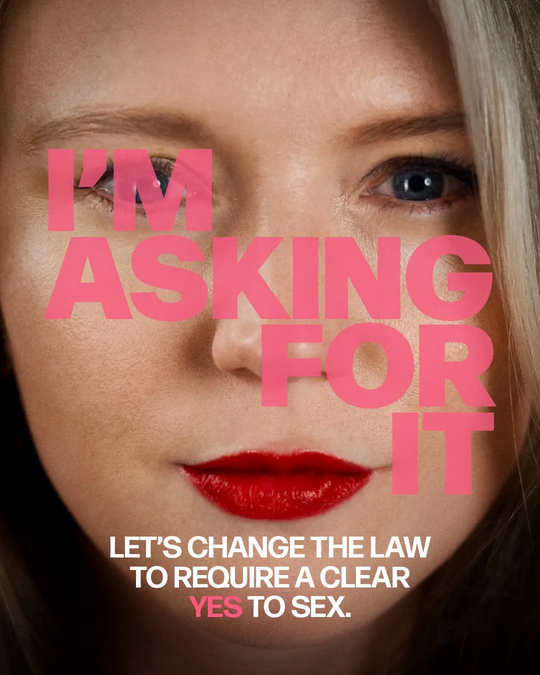
Not long ago, a British campaign for affirmative consent legislation featured images of women paired with the slogan “I’m asking for it“. The whole point, of course, is that they’re not asking for “it”. The phrase is meant to evoke men who justify their sexual assaults of women by claiming that the victim wanted to be raped. What the women are asking for is legislation to make it a criminal offence for a man to have a sexual encounter with a woman without eliciting an explicit “Yes” from her at every stage (how far we have moved from the relatively simple “No means no”).
The most striking of the ads features the face of Charlotte Proudman, the well-known feminist barrister and zealous anti-male advocate who once denounced a fellow lawyer for complimenting her LinkedIn photo. In the picture, Proudman confronts the viewer with a sexy, smoldering look and a slight half-smile. Her face is carefully made up to accentuate her feminine sexuality, with dark-tinted eyelashes and gleaming red lips outlined in vivid lip gloss. In order to object to men’s sexualization of women, Proudman has sexualized herself.
We are told that the campaign was “deliberately bold and intentionally provocative”. It was designed to “stop viewers in their tracks“, so that we would think about how women are mistreated under the law. Male viewers whose minds stray to sex are, one can only assume, to be brought up short, ashamed and convicted of sin.
The double messaging is deliberate — but confusing. Most people looking at Charlotte Proudman’s sex-kitten face will not, in my opinion, contemplate misogynistic attitudes or the scourge of sexual violence. On the contrary, most viewers will be “stopped in their tracks” by the overtness of Proudman’s sensual self-display. It seems odd that an ad claiming that women should not be seen to invite sexual advances features a woman who seems to be inviting sexual advances.
Feminists have for decades claimed that such sexualization has been forced on women to their detriment. In the fashion industry, in movies, and in daily life, according to feminist philosophers like Sandra Lee Bartky, men compel women to advertise their sexuality as their primary power, to redden their lips, assume sexual poses and flatter the voracious male gaze, becoming “object and prey for the man“.
For centuries, we’re told, patriarchal societies denied women the opportunity to do anything with their lives but live out male sexual fantasies, whether as virgin or whore, Madonna or muse. A male-defined culture made the woman accentuate her youth, shave her legs, remain svelte, and present herself for visual consumption, “living her body as seen by another, an anonymous patriarchal Other“: a degrading spectacle from which all women would be better off free.
Yet here is a campaign designed by feminists to support alleged rape victims, with the same (objectionable) self-presentation by the ad’s primary subject, who is obviously not posing against her will and obviously has many choices about how to present herself. The only difference, it seems, is that in this case, the woman’s self-display is entirely of her own defiant volition.
One wouldn’t think that would be sufficient for a diehard feminist like Proudman, or for any equality-minded modern woman with a thousand choices about what to do with her life.
When I was a little girl in the early 1970s, I took it for granted that self-respecting women wanted to be appreciated for the qualities of their minds and characters. One of the first slogans I remember was the somewhat puzzling “Love me for my mind, not my body”. At the time, around six or seven years old, I thought it would be nice to be loved for any reason. Only later did I understand the implication: to be loved for one’s body was not truly to be loved at all, for the body was a superficial, mutable aspect of the self, destined to deteriorate with time. Moreover, according to the general feminist perspective, the body was all that sexist men cared about, especially the sexual parts. This was objectification, the reduction of the whole woman with all she had to offer (her kindness, her wit, her unique thoughts) to a thing. It was shameful and degrading.
September 16, 2024
Anger sells – “Words like ‘wrong’, ‘bad’, ‘awful’, ‘hate’, ‘sick’, ‘fight’, and ‘scary’ each predict a 2.3% increase in click-through rates”
Rob Henderson explains the incentives that lead to provoking as much anger as possible among readers (and especially voters):

It seems like people are angrier than ever. According to a poll by CBS News, 84 percent of Americans believe we are angrier than previous generations. Another survey recently found that nine in ten Americans can name either a recent news event or something about American politics that made them angry, while only half could identify a recent news event or something about American politics that made them proud.
What explains this feeling of rage? One noteworthy reason is that exploiting anger is politically convenient.
The strategic use of anger in politics has transformed it from a natural human emotion into a weapon of division, with far-reaching consequences for our social cohesion and democratic governance.
According to Steven Webster, author of “American Rage: How Anger Shapes Our Politics” and assistant professor of political science at Indiana University, “Anger provides ample benefits to those politicians who are able to use it most skillfully”.
Indeed, across political settings, angry people are more likely to vote than those who are not angry. In other words, politicians who can stoke anger can use it to motivate their base. The angrier voters are at the opposing party, the more likely they are to show up to the polls to support their own party. As Webster puts it, “angry voters are loyal voters”.
Political anger has consequences that extend beyond how Americans view their governing institutions or the opposing political party. When American voters are angry about politics, they are inclined to avoid social interactions or social events where they are likely to come into contact with those whose political leanings differ from their own.
In a chapter titled “Emotions in Politics” published last year, the psychologists Florian van Leeuwen and Michael Bang Peterson suggest that along with other emotions, anger “seems to be a distinct strategy for increasing what one is entitled to in the minds of others”.
Provoking rage against selected groups is an effective way to promote unity in politics. Today, many Americans across the political spectrum are encouraged to feel they are being victimized. It’s no coincidence that one of Donald Trump’s go-to lines on the campaign trail is “They’re laughing at us”. Being laughed at induces humiliation, which often quickly transforms into rage.
In a notable historical illustration of a political movement using anger as a limitless source of ideological fuel, consider the case of the “Recalling Bitterness” campaign in Maoist China. In the 1960s, the communist dictator Mao Zedong grew worried that ordinary Chinese citizens were developing lukewarm attitudes about the socialist revolution. In response, the regime forced people into rituals in which they publicly announced how bad life was before they had been liberated. Mao ordered writers and artists to rewrite history through the lens of class struggle to suit the needs of his political agenda. Regime officials held meetings encouraging peasants to describe how much better life was now compared to pre-liberation, hoping to convince them that the revolution’s successes outnumbered its failures. The “devils” here were reactionaries, landlords, rich farmers, and counterrevolutionaries. Documenting the rituals of the Recalling Bitterness campaign, the historian Guo Wu has written, “Only poor peasants were allowed to speak; former landlords and rich peasants were silenced”.
September 13, 2024
QotD: Cargo cult thinking and status seeking
Flashing actual stacks of money is the crudest possible status display, and I can 99.9% guarantee you that anyone who does something like this on social media is engaged in some kind of criminal behavior. People who obtain wealth by honest means are not prone to such shameless ostentation, and this kind of cargo-cult behavior exhibits a level of stupidity that is not usually compatible with economic success.
Robert Stacy McCain, “The Cargo Cult Mentality”, The Other McCain, 2019-12-20.
September 9, 2024
QotD: Clothing
James Lileks, Screedblog, 2005-07-25.
August 30, 2024
The urge to power
At Mindset Shifts, Barry Brownstein explains why the urge to gain power over other people is particularly strong in those who don’t have meaningful lives of their own:

King Louis XIV, the “Sun King”.
Portrait by Hyacinthe Rigaud (1659-1743) sometime in 1700 or 1701 from the Louvre via Wikimedia Commons.
One of my more memorable exchanges with a student came in a principles of economics class. Part of the assignment for that week was chapters from Matt Ridley’s The Rational Optimist. Ridley compared the living standards of an average worker today with those of The Sun King, Louis XIV, in 1700. Some of my more ahistorical students were incredulous at Ridley’s description of the grinding poverty of the average person just a few centuries ago.
The King had an opulent lifestyle compared to others. Louis had an astonishing 498 workers preparing each of his meals. Yet his standard of living was still a fraction of what we experience today.
Ridley outlined the miracles of specialization and exchange in our time — an everyday cornucopia at the supermarket, modern communications and transportation, clothing to suit every taste. If we remove our blinders and see how many individuals provide services to us, Ridley concludes we have “far more than 498 servants at [our] immediate beck and call”.
Then, the memorable exchange occurred. One student shared that he would prefer to live in 1700, if he had more money than others and power over them. My first reaction was amusement; I thought the student was practicing his deadpan humor skills. He wasn’t. For him, having power was an attribute of a meaningful life.
If only my student’s mindset were an aberration.
During the reign of Louis XIV, French mathematician and philosopher Blaise Pascal diagnosed why some lust for power. In his Pensées, Pascal wrote, “I have often said that the sole cause of man’s unhappiness is that he does not know how to stay quietly in his room”. Pascal explained that, out of the inability to sit alone, arises the human tendency to seek power as a diversion.
Pascal asks us to imagine a king with “all the blessings with which you could be endowed”. A king, Pascal told us, if he has no “diversions” from his thinking, will “ponder and reflect on what he is”. Pascal’s hypothetical king will be miserable because he “is bound to start thinking of all the threats facing him, of possible revolts, finally of inescapable death and disease”.
“What people want is not the easy peaceful life that allows us to think of our unhappy condition.” That is why “war and high office are so popular”, Pascal argued.
Pascal argues individuals seek to be “diverted from thinking of what they are”. I would argue a better choice of words is what they have made of themselves.
I’ll let the reader decide how many modern politicians Pascal’s ideas apply to. With Pascal’s insight, we understand why conflict is a feature of politics and not a bug.
Pascal spares no one’s feelings. Some “seek external diversion and occupation, and this is the result of their constant sense of wretchedness”. For them, “rest proves intolerable because of the boredom it produces. [They] must get away from it and crave excitement.”
Let that sink in. A person able to exercise coercive power can use their morally undeveloped “wretched” mind to create endless misery for others merely because exercising power distracts them from their failures as human beings.
August 26, 2024
David Friedman – “my fargroup … are being attacked by my outgroup. My enemy’s enemy …”
I’m much of David Friedman‘s opinion on the candidates for both the Democratic and Republican parties in the current US presidential election … and I also find myself leaning more toward Trump even though his re-election would almost certainly be worse for Canada:

Donald Trump, surrounded by Secret Service agents, raises his fist after an attempt on his life during a campaign speech in Butler, PA on 13 July, 2024.
My opinion of the election is “a plague on both your houses”. Kamala Harris is an extreme representative of an ideology I have opposed for most of my life. Donald Trump has three major positions on two of which, immigration and trade, he manages to be even worse than his opponent. While I have some sympathy for his views on the third — I have been arguing against an interventionist foreign policy for something over fifty years now — I do not trust him to execute a consistent and competent alternative. His disinterest in whether what he says is true, extreme even for a politician, I find offensive.
That is my intellectual view of the matter. It is not my emotional view. Reading news stories and observing the effect on my feelings, I note that I am reacting like a Trump partisan. Poll results that look good for him make me happy, poll results that look bad for him make me sad. Accounts of outrageous statements by Trump or Vance I ignore — I don’t expect them to tell the truth. Accounts of demagoguery by Harris or Waltz arouse feelings of indignation. If Harris wins I will feel disappointed. If Trump wins I will feel relieved, at least until the first outrageous thing he does.
The explanation of my inconsistent reaction is provided by Scott Alexander in “I Can Tolerate Anything Except The Outgroup“, one of the best of his many good essays. In it he points out that someone’s outgroup, the group for whom he feels and expresses strongly negative views, is typically made up not of people distant from him, geographically and intellectually, but of people close. The outgroup of the Nazis was not their Japanese allies or the Chinese the Japanese were fighting, it was German Jews, people with the same language and, in most respects, the same appearance and culture. The outgroup of American leftists is not Muslim fundamentalists but American conservatives.
Conservatives have doubts about gay marriage. Muslim fundamentalists view homosexual intercourse as a capital offense.1 American conservatives would like their schools to be more tolerant of creationism. Muslim fundamentalists want their schools to teach the truth of Islam. And yet, when conservatives criticize Muslims, leftists defend them. When Muslims kill Jews and Jews respond by killing Muslims, it is the Muslims that the American leftists support, the Jews that they blame — although Israelis have much more in common, ideologically as well as culturally, with American leftists than Palestinians do.
We think of groups close to us in Near Mode, judging them on their merits as useful allies or dangerous enemies. We think of more distant groups in Far Mode – usually, we exoticize them. Sometimes it’s positive exoticization of the Noble Savage variety (understood so broadly that our treatment of Tibetans counts as an example of the trope). Other times it’s negative exoticization, treating them as cartoonish stereotypes of evil who are more funny or fascinating than repulsive. Take Genghis Khan – objectively he was one of the most evil people of all time, killing millions of victims, but since we think of him in Far Mode he becomes fascinating or even perversely admirable – “wow, that was one impressively bloodthirsty warlord”. (Scott Alexander, “Post-Partisanship Is Hyper-Partisanship“)
Conservatives are the leftists’ outgroup, Muslims their far group. The far group can be ignored; large parts of the world are more sexist and more racist than any part of America but invisible to progressives campaigning against sexism and racism. The far group can even be supported, at least if the outgroup is attacking it. My enemy’s enemy is my friend. Muslim fundamentalists. Hamas.
Kamala Harris is an American leftist. American leftists are my outgroup. Trump and Vance are American populists. I disagree with their views, in some cases more than I disagree with the views of American leftists, but I have nothing against them, just as I have nothing against believing Catholics or Orthodox Jews or Black Muslims or believers in Christian Science.
Trump and his movement are my fargroup. They are being attacked by my outgroup. My enemy’s enemy …
1. In some times and places Muslim culture has been tolerant of homosexuality; there are two famous medieval essays on the relative attractions of homosexual and heterosexual intercourse and quite a lot of poetry celebrating homosexual love. But the religious doctrine, which fundamentalists take seriously, holds homosexuality to be forbidden.
August 12, 2024
QotD: The key attraction of video games to young men
That would explain video game escapism/addiction amongst men. It’s a little world where there are predictable rules and outcomes and one can succeed much easier than in the unpredictable real world with ever-changing rules.
I think this is a really important point deserving of more attention.
Yes. Video games are a drug aimed straight at the receptor that is male need for agency. They’re a superstimulus for it in exactly the same way that pornography is a superstimulus for desire.
I don’t have a policy prescription about this or anything. But it’s a connection that matters.
ESR, Twitter, 2024-05-06.
August 11, 2024
Tears are still a powerful weapon for female politicians
Janice Fiamengo on the tactic available to — and resorted to frequently — only females in politics, turning on the waterworks to generate sympathy and support:
Recently, a friend sent me a news article that illustrates, in small, the world of Anglophone politics, in which notions of what is owed to women, who are understood to be far more sensitive and fragile than men, operate alongside stern interdictions against stating that women are in any manner unsuited for strenuous, high stress roles.
Last week, an ABC News report detailed years-old allegations against a former aide to Josh Shapiro, the Governor of Pennsylvania who was, at the time of the article, one of Kamala Harris’s touted VP possibilities (she has since chosen Tim Walz, Governor of Minnesota). Shapiro’s former staffer, Mike Vereb, who resigned in 2023 over a sexual harassment allegation, is said to have brought a woman to tears in 2018 with threats made over the phone (“You will be less than nothing by the time Josh and I get done with you”, he is alleged to have said).
The woman, who runs an advocacy group, was left “weeping and in shock standing alone in a parking lot”. She did not report the alleged incident until she heard about the aide’s resignation five years later.
[…]
With the staffer long gone from Shapiro’s administration, the story had legs only because it was about a man who made a woman cry.
The problem is that women do cry rather frequently in politics. And complain. And perform their sensitivity to criticisms, monikers, crude jokes, the faux terror of J6, and bantering innuendo. Far too often such women make politics about them as women and about the trouble men allegedly cause them.
Such was the case with Australian Prime Minister Julia Gillard, who earned plaudits from feminists in 2012 for a fury-filled speech in the House of Representatives about sexism, in which she accused the opposition leader of misogyny for a number of statements he’d made that were not at all misogynistic, including that women were likely under-represented in Australian institutions of power because men were “more adapted to exercise authority”. Gillard also said she was “personally offended” (a more serious state of affairs, one assumes, than simply being “offended”) by the opposition leader’s contention that abortion was “the easy way out”. (The text of her speech is here.) “Julia Gillard’s Attack on Sexism Hailed as Turning Point for Australian Women” ran one enthusiastic headline. And perhaps it was, signaling the point at which women in politics stopped thinking they should accommodate themselves to the rigors of public life, and decided that politicians must instead accommodate themselves to the rigors of women’s demands.
Even seemingly tough-as-nails Hillary Clinton has been allowed to go from interview to interview revisiting the now years-old indignity of her election loss in 2016, like a once-popular debutante who can’t believe she didn’t make the cheerleading squad. No man would ever be given such a prolonged pity party. Having contended for years that it was misogyny that prevented her from beating Donald Trump, she more recently pointed her finger at female voters’ failures of confidence: “They left me [in the final days of the campaign] because they just couldn’t take a risk on me, because as a woman, I’m supposed to be perfect“, she explained in May, 2024. No one seems to have informed Clinton that nothing reveals her crippling unsuitability for leadership than her embarrassing refusal to stop feeling sorry for herself.
And she is, alas, far from unique. Nicola Sturgeon, former First Minister of Scotland, sat and sobbed at last winter’s Covid-19 Inquiry in Edinburgh, deflecting critical questions about her government’s actions during the pandemic by proclaiming that she would carry the impact of them for as long as she lived. Forget the thousands of Scots who suffered or even died because of those decisions: the woman in charge was the one in need of compassion. Sturgeon had previously made a career of complaining about the sexism that allegedly put obstacles in the way of female politicians. Her focus on her own emotional discomfort at the Covid inquiry did more than any naysayers to indict the feminine style. How refreshing if either of these women could simply accept responsibility for their failures.


August 6, 2024
QotD: Malicious idiocy
Perhaps we should make it an Olympic event, with male, female, and trans competitions. It would be more fair than the other competitions for running, jumping, lifting weights, &c. No single country would dominate the sport, at least to begin with; some of the smallest nations could excel. Or if they didn’t, malicious idiots could charge the field, accusing judges and timekeepers of racism and hate crimes, adding to the loathely spectacle: Citius! Altius! Fortius!
David Warren, “Off & running”, Essays in Idleness, 2019-11-22.
[NR: This QotD has become much more timely than it was when I scheduled it for today a few months ago.]
August 4, 2024
“Generation loss” in the game Telephone … and in real life
Ted Gioia explains how you can tell if you’re living in what he calls a “doom loop”:
You might have played an old party game called Telephone — in which people sit in a circle, and whisper a simple phrase from ear to ear.
By the time the information has moved around the entire circle, the words have changed. That’s because people mishear and misinterpret.
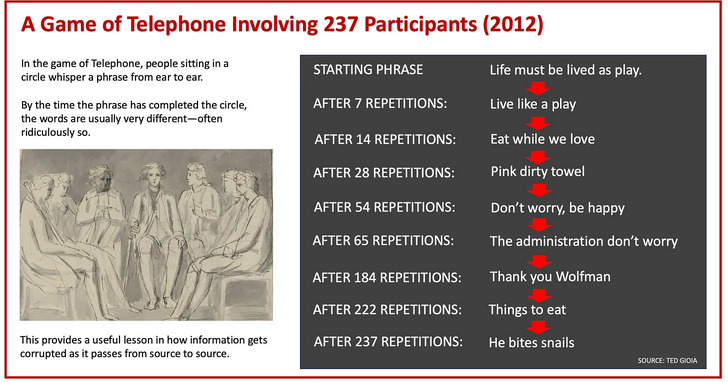
So when a game of Telephone was played in 2012 with 237 individuals, the starting phrase was: “Life must be lived by play” (a quote from Plato). But when it reached the end of the circle, the words had turned into: “He bites snails”.
Here’s how it progressed:
In other instances, people have started with the phrase “Only the good die young” and end up with “The three Vikings visit Christ”. Or “Today the library is hot” somehow morphs into “Sharon Stone is my girlfriend”.
Perhaps a degree of wish fulfillment enters into the game. Or as my mother used to say: “People hear what they want to hear”.
There’s a technical term for this process. It’s called generation loss.
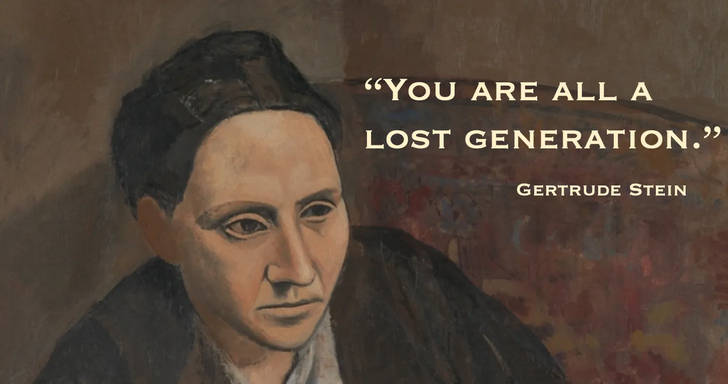
It has nothing to do with a lost generation — which is how Gertrude Stein described the Jazz Age. She famously told Ernest Hemingway: “You are all a lost generation”.
I’m not talking about those kinds of generations.
The generation loss we’re dealing with here refers to deteriorating data quality when a signal is repeated over and over again.
Each time it’s generated, the information gets a little more corrupted.
And it’s not just hearing that leads us astray. You can also measure generation loss if you make a photocopy of a photocopy. Each time you do it, the quality of the image gets worse. If you do it enough times, you can’t recognize what was in the original.
Even digital data — which is supposedly copied and pasted with perfection — deteriorates with each repetition.
Photos that are shared from account to account on Instagram get worse over time. In one experiment, a photo that was copied and reposted 90 times gradually turned into an unrecognizable blur.
August 2, 2024
QotD: The essential target of ideological propaganda
The Third Reich didn’t last long enough to figure it out, but in their 70-odd years the Soviets learned that “the masses” can be more or less ignored. They’re no threat to the regime. Your average Soviet “citizen” — Ivan Sixpack — would follow pretty much any rule, so long as he had a steady and predictable life course. That’s no slander on Ivan; it’s just the way people are. If you want proof, go look around — if I’d told you, back in the summer of 2019, about all the masks and the social distancing and the lockdowns and everything else, you’d have laughed at me. “There will be blood in the streets! No one will stand for it!”
The reaction of “the masses” (a term I hate; it’s patronizing, but it’ll have to do) to COVID was instructive: They either did as they were told, with nary a peep of complaint, or they simply ignored it … with nary a peep of complaint. From the rulers’ perspective, either one was fine, because they’re functionally the same thing. We all know that whatever the ruling class thought they were going to get out of the Kung Flu panic — and it’s not at all clear; we’ll get there — “public health”, as in the actual health of real members of the public, was nowhere on the list. As with “climate change” and all their other “crises”, their highly visible behavior showed how seriously they took it — which was, of course, not at all.
Indeed, from the rulers’ perspective, it was actually better that some large fraction of the underclass didn’t comply — that way, the mental energy of the Karens was channeled down, not up. Karen could start complaining about Whitmer, Newsom, and the rest not living by their own rules, and had she done so, that might’ve posed a problem for the rulers. But thanks to the maskless proles (and, of course, asshole class traitors like me), Karen always had a bunch of much softer targets to hector.
That’s the function of “propaganda” in my sense. It’s designed to create a narrative, the purpose of which is to channel dissatisfaction down the social scale.
What the Soviets learned, and their SJWs successors have internalized, is that you really only need a small cadre of “middle class” (for lack of a better term) producers to keep things running. Those are the targets of narrative-reinforcing propaganda.
Indeed, it’s only a subset of that already small fraction that needs to be propagandized. As the Soviets quickly learned, true technical experts are more or less ideology-proof. That’s because their technical expertise takes up all their time; they’ve oriented their personalities around it. You could read a novel like Red Plenty to get the sense of it (Z Man has a review somewhere if you want it), but I suggest a much easier path: Watch the fun old movie Boiler Room, with Giovanni Ribisi, Vin Diesel, and in a brief but memorable scene, Ben Affleck. I’m sure that seems odd — it’s a movie about sell-at-all-costs stockbrokers, based loosely on Jordan Belfort’s Stratton Oakmont scam; what could be more explicitly capitalist?
But note how they live: They own ludicrous cars and live in huge mansions, but the cars hardly get driven, and the mansions are unfurnished. There’s a scene where they all get together in Vin Diesel’s living room to watch a movie (Wall Street, natch). There’s a huge tv and a couch, but everything else is boxed up, and they’re eating takeout pizza. Giovanni Ribisi says something like “did you just move in this weekend?” and the other guys say no, he’s been living here for years, he just never got around to unpacking his stuff. That’s the mindset of the true technical intelligentsia. Those stockbrokers think they’re doing it for the money, and so they have the outward trappings of rich people, but they’re really doing it because that’s who they are — they’d be just as deliriously happy competing for subway tokens or scraps of confetti, so long as they had one more scrap than the guy on the next phone.
Given that, the only group that really needs to be propagandized is — you guessed it — Karen. The entire narrative of COVID was very obviously designed by hormonal cat ladies, for hormonal cat ladies. Cards on the table: Though I thought Kung Flu was overblown and ridiculous from the beginning, since I know a little history, I didn’t base my conclusions on my reading in the medical journals. I didn’t read medical journals, and unless you’re a doctor I bet you didn’t, either. My opposition to the Kung Flu panic was entirely visceral: THIS IS MEAN GIRL SHIT.
Severian, “Narrative Collapse III: Magic Masks”, Rotten Chestnuts, 2021-07-07.
August 1, 2024
“Donald Trump isn’t a real man, because Hulk Hogan”
It’s always appropriate to criticize public figures — it goes with the job — but you actually should find things to criticize when you do it, otherwise it comes across as lazy bitching:
I’m a charter member of the “no one is above criticism” club. Everyone is fair game. People who run for office are really fair game. So I think it’s just fine to criticize Donald Trump, and to criticize JD Vance, and to criticize Trump/Vance 2024.
But what’s so obvious, over and over again, is that the people writing the most insistent criticism are playing critic. They know that they’re supposed to say that Donald Trump is very very very bad, so they … do that? A lot? But the substance of the criticism tends, with remarkable frequency, to be a set of non-sequiturs and self-refuting rhetorical dead-ends. They’re criticizing because they’re supposed to, not because they have criticisms to offer.
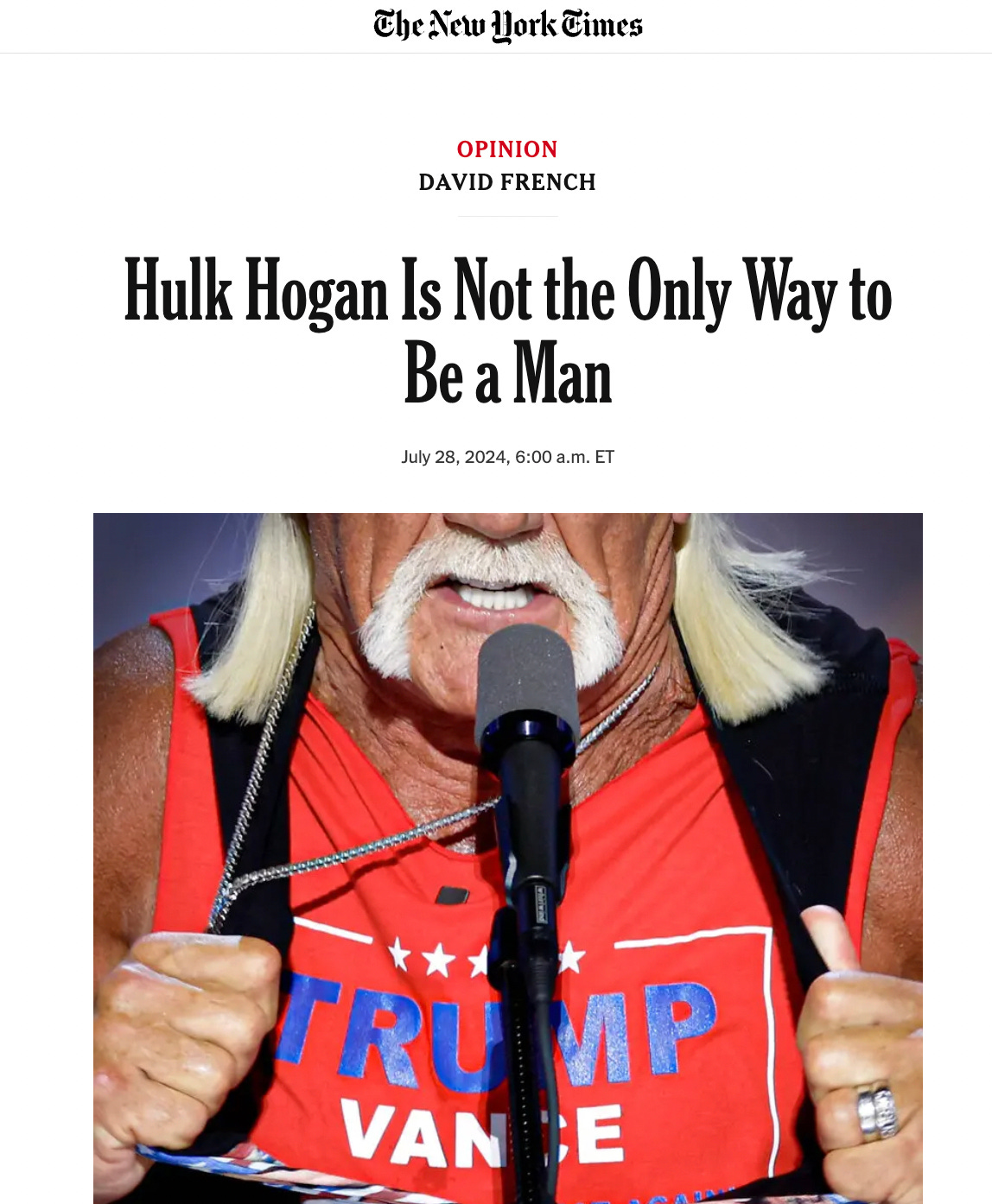
Take David French. Please. Here’s his latest: Donald Trump isn’t a real man, because Hulk Hogan.
The I-didn’t-think-this-through flavor of this piece can’t be exaggerated. It makes so little sense, so poorly, with such odd structure and framing, that it nears the level of Thomas Friedmanism. David French doesn’t know anything, or understand anything, but he really throws himself into it.
So.
Hulk Hogan, Kid Rock, and Dana White were at the Republican National Convention, French writes, so the Republicans are being macho, unlike Democrats, who are demonstrating a style of manhood that focuses on being kind, decent, and nurturing. Republican manhood is about complaints and empty rage; Democratic manhood is about building things and caring for others. Making the comparison concrete, French explicitly compares the macho grievance artist Trump to precisely four wonderfully gentle and caring men: Admiral William McRaven, the US Senator and former astronaut and fighter pilot Mark Kelly, “Mark Hertling, my former division commander in Iraq”, and the former Marine Corps General and Secretary of Defense James Mattis. Those four men are the model of a masculinity that nurtures, loves, and builds; Trump is the model of a masculinity that only destroys and tears down. David French hates machismo, so the list of men he admires is made up entirely of combat arms officers.
Do you … see the problem? Because David French doesn’t. At all. Donald Trump is a real estate developer, someone who spent his entire adult life actually building things:
It’s just fine to criticize Trump as a businessman, if you feel inclined to do that. But he’s a builder and a developer; that’s his actual background. He makes things. He spent his life making things. And his political message is about making things and protecting people who make things, whether you agree with the specifics of his policy arguments or not

QotD: Sex and dating in the internet dating age
In 1996, Helen Fielding’s Bridget Jones helped women realise that half the human race (men) might usefully be called “fuckwits” when it came to dating and romance. The dynamics of internet dating, with its illusion of graspable sexual paradise, has either created a new tsunami of apparent fuckwits, or it has made the sheer extent of them inescapable.
Meanwhile, the boredom and jadedness stitched into heavy use of apps (“nope”, “like”, “nope”, “nope”, “nope”, “like”) has produced a ubiquitous undercurrent of queasy unpleasantness. The result is that men, formerly seen as an alternating source of fun, trouble and heartbreak, become “men: ugh”. Women, once the promised land for many a Romeo, become bitches, gold-diggers, game-players, and, most significantly, for a depressing bloc known as “women: meh”.
This sexual stand-off, characterised by simmering distrust and putrid fatigue, oozes off internet dating portals. I’ve often found myself, after a night of binge-scrolling, surprised to remember that dating is filed under “romance”, which is supposed to be — at least at the start — a little about positive, fuzzy feelings or the potential to develop them.
Zoe Strimpel, “Why the young are falling out of love with sex”, UnHerd, 2019-11-25.
July 27, 2024
QotD: The academic “grinder”
Looking back on it, homeboy was more than a little “on the spectrum”, as the kids say nowadays, but he wasn’t a grinder. Nor do long hours, in themselves, make a grinder — med students, for instance, work in the neighborhood of 60-75 hours a week, but though there are lots of grinders in medical school, not all med students are grinders. Long hours in the lab just go with the territory.
Indeed, actually working hard is almost an exclusion criterion for grinder-ness. Grinders ostentatiously spend many, many hours hitting the books, but it’s almost literally hitting the books. They “work” the Latin way — lots of activity, almost no accomplishment. Put a big honking stack of the largest, mustiest tomes you can find in front of you in your study carrel. Pick one up, flip through it, take one note, then rotate it to the bottom of the stack. Do this for hours on end, always making sure that your stack is flush with the wall, so that everyone in the room can see how many books you have, and how diligently you’re “taking notes”. That’s a grinder.
And cheat your ass off, it goes without saying. In my day, when dinosaurs roamed the earth and “the Internet” was a way for Defense Department nerds to exchange missile schematics with one another, the preferred method was with a graphing calculator. Your dishwasher has more hard disk space than those things, but the mere presence of memory capacity made it ideal for cheating, providing you could come up with some elaborate shorthand to cram all the material in … and providing, of course, you could use it. My friends, you have never seen true comedy until you’ve seen some sweaty Chinese kid begging the teacher to be allowed to use his graphing calculator in Engrish class. Quick, what’s the cosine of MacBeth?
And speaking of begging, that’s the final diagnostic criterion. Have you polished so many apples, your fingers are permanently stained red? Are you so far up the guidance counselor’s ass that you’re banging your skull on her uvula? Have you kissed so much butt, you’ve got a mouth like a lamprey? Would you cheerfully murder your best friend’s dog if it would get you an extra 0.02 on your GPA? Then you, my friend, are a grinder.
Severian, “The Grinder Mindset [expanded]”, Rotten Chestnuts, 2021-06-22.


