
The transition may also have driven broader cultural shifts. In 1523, Fitzherbert’s Boke of Husbandrie gave a list of a housewife’s jobs (“What warkes a wyfe shulde do in generall”) that included the household’s cooking, cleaning, laundry, and childcare, all of which are typically part of modern housewifery, but also milking cows, taking grain to the miller, malting barley, making butter and cheese, raising pigs and poultry, gardening, growing hemp and flax and then spinning it, weaving, winnowing grain, making hay, cutting grain, selling her produce at market — and, as necessary, helping her husband to fill the dungcart, plow the fields, or load hay. Roles were still highly gendered, but compared to eighteenth and nineteenth century household manuals this is a remarkable amount of time spent out of the house, and the difference holds even when you compare the work hired maids were doing in both periods. Around the time of the advent of coal, though, our descriptions of women’s work increasingly portray it as contained within the walls of the home — or, at most, in the dairy or the poultry yard. Of course social transformations are never monocausal, and the increasing specialization and mechanization that moved some production out of the household probably nudged things along, but Goodman suggests that “the additional demands of running a coal-fired household might have also helped push the idea that a woman’s place is within the home”. After all, if your cleaning takes twice as long, there’s simply less time available for all that agricultural labor and small-scale commerce.
Jane Psmith, “REVIEW: The Domestic Revolution by Ruth Goodman”, Mr. and Mrs. Psmith’s Bookshelf, 2023-05-22.
August 22, 2024
QotD: The changing role of the Medieval housewife in England
August 13, 2024
QotD: The weird world of the Iliad
Homer (“Homer“) presents the gods as having unified identities, desires, and attributes, which of course you have to have in order to have any kind of coherent story but which is not at all the way the Greeks understood their gods before him (or even mostly after). The Greeks didn’t have a priestly caste with hereditary knowledge, or Vedas, or anything like that, so their religion is even more chaotic than most primitive religions. “The god” is a combination of the local cult with its rituals, the name, the myths, and the cultic image, and these could (and often did) spread separately from one another. The goddess with attributes reminiscent of the ancient Near Eastern “Potnia Theron” figure is Hera, Artemis, Aphrodite, Demeter, or Athena, depending on where you are. Aphrodite is born from the severed testicles of Ouranos but is also the daughter of Zeus and Dione. “Zeus” is the god worshipped with human sacrifice on an ash altar at Mt. Lykaion but also the god of the Bouphonia but also a chthonic snake deity. Eventually these all get linked together, much later, primarily by Homer and Hesiod, but even after the stories are codified — okay, this is the king of the gods, he’s got these kids and this shrewish wife, he’s mostly a weather deity — the ritual substrate remains. We still murder the ox and then try the axe for the crime, which has absolutely nothing to do with celestial kingship but it’s what you do. If you’re Athenian. Somewhere else they do something completely different.
I also really enjoyed this book, and I think for similar reasons to you. Because you’re right, at the end of the classical world it wasn’t just the philosophers. One major theme in Athenian drama is the conscious attempt to impose rationality/democracy/citizenship/freedom (all tied together in the Greek imagination) in place of the bloody, chthonic, archaic world of heredity.1 It’s an attempt at a transition, and one which gets a lot of attention I think in part because people read the Enlightenment back into it. But my favorite part of the The Ancient City is Fustel de Coulanges’s exploration of the other end of the process: where did all the weird inherited ritual came from in the first place?!
The short version of the answer is “the heroön“. Or as he puts it: “According to the oldest belief of the Italians and Greeks, the soul did not go into a foreign world to pass its second existence; it remained near men, and continued to live underground.” Everything else follows from here: the tomb is required to confine the dead man, the burial rituals are to please him and bind him to the place, the grave goods and regular libations are for his use, and he is the object of prayers. Fustel de Coulanges is incredibly well-read (that one sentence I quoted above cites Cicero’s Tusculan Disputations, “sub terra censebant reliquam vitam agi mortuorum“, plus Euripides’ Alcestis and Hecuba), and he references plenty of Vedic and later Hindu texts and practices too. I also immediately thought of the Rus’ funeral described by ibn Fadlan and retold in every single book about the Vikings, in which, after all the exciting sex and human sacrifice is over, the dead man’s nearest kinsman circles the funerary ship naked with his face carefully averted from it and his free hand covering his anus. This seems like precautions: there’s something in the ship-pyre that might be able, until the rites are completed, to get out.2 And obviously we now recognize tombs and burial as being very important to the common ancestors of the classical and Vedic worlds — from Marija Gimbutas’s kurgan hypothesis to the identification of the Proto-Indo-Europeans with the Yamnaya culture (Ямная = pit, as in pit-grave) — their funerary practices have always been core to how we understand them. But I’m really curious how any of this would have worked, practically, for pastoral nomads! Fustel de Coulanges makes it sound like you have your ancestor’s tomb in your back yard, more or less, which obviously isn’t entirely accurate when you’re rolling around the steppe in your wagon.
I’d also be interested to see an archeological perspective on his next section, about the sacred hearth. This is the precursor of Vesta/Hestia and also Vedic Agni, the reconstructed *H₁n̥gʷnis (fire as animating entity and active force) as opposed to *péh₂ur (fire as naturally occurring substance). I looked back through my copy of The Wheel, the Horse, and Language and (aside from a passing suggestion that the hearth-spirit’s genderswap might be due to the western Yamnaya’s generally having more female-inclusive ritual practices, possibly from the influence of the neighboring Tripolye culture), I didn’t find anything. I suppose this makes sense — you can’t really differentiate between the material remains of a ritual hearth and a “we’re cold and hungry” hearth, especially if people are also cooking on the ritual hearth so there’s not a clear division anyway. But if anyone has done it I’d like to see.
I don’t know enough of the historiography to know whether Fustel de Coulanges was saying something novel or contentious in the mid-19th century, but he seems to be basically in line with more recent scholarship even if he’s not trendy. But The Ancient City can be read as a work of political philosophy as well as ancient history!
Jane and John Psmith, “JOINT REVIEW: The Ancient City, by Numa Denis Fustel de Coulanges”, Mr. and Mrs. Psmith’s Bookshelf, 2023-02-20.
1. And of course that tension is extra intriguing because the dramas are always performed at one of these inherited rituals, in this case the city-wide Great Dionysia festival, although it was a relatively late addition to the ritual calendar. Incidentally it’s way less bizarre than the Attic “rustic” Dionysia which is all goat sacrifices and phallus processions. (There’s also the Agrionia in Boeotia which is about dissolution and inversion and nighttime madness, and another example of “the god” being a rather fluid concept.)
2. Neil Price, in his excellent Children of Ash and Elm, says that the archaeological evidence seems to confirm this:
“Most of the objects [in the Oseberg ship burial] were deposited with great care and attention, but at the very end most of the larger wooden items — the wagons, sleds, and so on — were literally thrown onto the foredeck, beautiful things just heaved over the side from ground level and being damaged in the process. The accessible end of the burial chamber was then sealed shut by hammering planks across the open gable, but using any old piece of wood that seems to have been at hand. The planks were just laid across at random — anything to fill the opening into the chamber where the dead lay. The nails were hammered in so fast one can see where the workers missed, denting the wood and bending or breaking off the nail heads.”
July 22, 2024
QotD: Post-apartheid South Africa
All of this brought tons of international condemnation onto the Zimbabwean regime, and a lot of countries looking for ways to pressure it to stop the atrocities. The glaring exception was Mbeki’s South Africa, which staunchly defended Zimbabwe for years as the killing and the starvation just kept ratcheting up. It’s unclear why they did this, beyond the ANC and ZANU-PF (the Zimbabwean ruling party) having a certain ideological and familial kinship, both being post-colonialist revolutionary parties that had overthrown white minority rule. But whatever the reason, this was the straw that finally caused Western politicians and celebrities to wake up a little bit and realize that South Africa was now ruled by thugs.
The second, even more catastrophic event that caused the South African government to lose the sheen of respectability was the AIDS epidemic and their response to it. The story of how Mbeki buried his head in the sand, embraced quack theories on the causes of AIDS, and condemned hundreds of thousands of people to avoidable deaths is well known at this point, but Johnson’s book is full of grimly hysterical details that turn the whole story into the darkest comedy you’ve ever seen.
For example: I had no idea that Mbeki was so ahead of his time in outsourcing his opinions to schizopoasters on the internet. According to his confidantes, at the height of the crisis the president was frequently staying up all night interacting pseudonymously with other cranks on conspiracy-minded forums (an important cautionary tale for all those … umm … friends of mine who enjoy dabbling in a conspiracy forum or two). These views were then laundered through a succession of bumbling and imbecilic health ministers such as Nkosazana Dlamini-Zuma or Mantombazana Tshabalala-Msimang who gave surreal press conferences extolling the healing powers of “Africanist” remedies such as potions made from garlic, beetroot, and potato.
Actually, the potions were a step up in some respects, the original recommendation from the South African government was that AIDS patients should consume “Virodene”, a toxic industrial solvent marketed by a husband-wife con-artist duo named Olga and Siegfried Visser. Later documents came to light revealing large and inexplicable money transfers between the Vissers and Tshabalala-Msiming. The Vissers then established a secret lab in Tanzania where they experimented on unsuspecting human subjects, engaged in bizarre sexual antics, and performed cryonics experiments on corpses. Despite this busy schedule, they also produced a constant stream of confidential memos on AIDS policy that were avidly consumed by Mbeki.
The horror of it all is that by this point there were very good drugs that could massively cut the risk of mother-child HIV transmission and somewhat reduced the odds of contracting the virus after a traumatic sexual encounter. There were a lot of traumatic sexual encounters. A contemporaneous survey found that around 60 percent of South Africans believed that forcing sex on somebody was not necessarily violence, and a common “Africanist” belief was that sex with a virgin could cure AIDS, all of which led to extreme levels of child rape. The government then did everything in its power to prevent the victims of these rapes from accessing drugs that could stave off a deadly disease. At first the excuse was that they were too expensive, then when the drug companies called that bluff and offered the drugs for free, it became that they caused “mutations”.
John Psmith, “REVIEW: South Africa’s Brave New World, by R.W. Johnson”, Mr. and Mrs. Psmith’s Bookshelf, 2023-03-20.
July 10, 2024
After 1177 B.C.
Jane Psmith reviews the follow-on book from Eric Kline’s bestseller about the Bronze Age Collapse, After 1177 B.C.: The Survival of Civilizations:
Sometime around 1150 BC, the dense network of politically, economically, and culturally interdependent states around the eastern Mediterranean collapsed. In 2014, GWU archaeologist Eric Cline wrote a book about it. And then, surprisingly, it became a bestseller.
Okay, maybe it’s not that much of a surprise: most people can recognize an obvious historical analogy when it hits them over the head, and the globalized1 state system of the Late Bronze Age has extremely clear parallels to the modern day. An interconnected and cosmopolitan world? Centralized state bureaucracy? High-level diplomacy between ruling elites? A technologically complex civilization enabled by extensive international trade along lengthy and elaborate supply chains? Well, gosh, that seems remarkably familiar. An audience that had just weathered a global financial crisis (and, later, a global pandemic) was perfectly poised to appreciate Cline’s exploration of the fragility of complex systems. No wonder it sold! (A copy entered the Psmith household in early 2020 for, uh, obvious reasons.)
Cline’s basic argument in the book was that the Collapse was due not to any single cause but to a “perfect storm” of calamities: drought and accompanying famine, earthquake, internal rebellion, external invasion. These were all problems that the civilizations of the Bronze Age Mediterranean had faced and survived in the past, but under their combined onslaught the most fragile parts of the system at last began buckle. When one society disintegrated, its sudden absence from the interconnected global economy became a new stressor on its surviving neighbors — until at last, domino-like, the whole thing came down.2 It would be decades, or in some places centuries, before the standard of living returned to anything like its previous level, and it would be nearly five hundred years before an international system as complex and sophisticated as the world of the Late Bronze Age emerged.
Now, a decade after his original book, Cline has a sequel exploring what happened after the Collapse. Which civilizations were able to rebound to something approaching their former glory, which barely managed to limp along into the Iron Age, and which vanished into the sands of time? And, more importantly, why?
This is a much more difficult story to tell. The original 1177 B.C. spent much of its page count on the zenith of Bronze Age civilization, the 15th through 13th centuries BC, to explain what it was that did the collapsing. It’s a sweeping tale, full of wonderful stories and fascinating digressions into the historicity of the Trojan War (yes) and the Exodus (not archeologically substantiated) as well as being a compelling portrait of a complicated set of societies. Cline’s narrative darts from Egypt to Assyria to the Aegean to the Hittites, treating each in turn as he moves forward through time towards what we all know is coming.
But chronological framing is impossible for the sequel. There is, definitionally — there can be — no grand narrative of regional divergence after the fall of a “world-system“. The fate of Mesopotamia is no longer linked to that of Greece; there are no more Cretan envoys in New Kingdom tomb reliefs, no more battles between the Hittite Great King and the wanax of a Mycenaean palatial center, no more Uzbek tin shipwrecked off the coast of Anatolia. Once the ties are cut, each story must stand alone, and accordingly Cline gives each region its own chapter.
Alas, this is a lot less fun to read.
1. For sufficiently small values of “globe”. But larger than you might expect!
2. The revised 2021 edition apparently gives a larger role to climate factors, especially the 3.2kya megadrought, but that’s not the one I read and anyway the other elements were still present.
July 8, 2024
QotD: The Potlatch
The point, of course, is to show off how rich you are by showing off how much crystallized labor you are able to destroy. This pattern is not an uncommon one across human societies — a lot of human and animal sacrifice, while ostensibly religious in motivation, has this sort of showing off as an undertone. But what makes the potlatch especially interesting is its competitive nature. The Indians believe that as the goods are consumed by the blaze, every other wealthy man is “shamed” unless he comes back and burns objects of equal or greater value. It’s value destruction as a contest, like a dollar auction for status where the final price is set on fire rather than being paid to somebody, a negative-sum machine for destroying economic surplus.
Good thing our culture is way too civilized to do anything like that.
I don’t remember when it was that you told me I had to read this book about VIP “models and bottles” service at nightclubs, but I’m glad you did because it’s sort of like the Large Hadron Collider but for human social practices. By analyzing behavior under these extreme conditions, certain patterns that are normally obfuscated (often deliberately so) emerge with stark clarity. Much of your research focuses on “disreputable exchange” — the ways people buy and sell things while hiding the fact that they’re buying or selling something. Have you been able to get the NSF to pay for a night out in South Beach yet?
Gabriel: I should start off by disclosing that I’m friends with Ashley. However I don’t think that biases my opinion since the reason we are friends is that I admire her work.
Potlatch is one of the most interesting cultural practices in the world and the keystone upon which both economic anthropology and economic sociology are built. Indeed, you left out just how amazing it is in that not only did the native peoples of the Pacific Northwest destroy property in the form of salmon, blankets, and copper; but also wealth in the form of human beings, as they would use the occasion to both free and kill slaves. To us 21st century WEIRD Americans, murdering a slave and manumitting a slave seem like opposites, because manumission is humane and human sacrifice is brutal. But from the logic of status competition, they are alike in that both demonstrate that one is so wealthy that one can afford to give up the value of some of one’s slaves. Thus we see that not only the Tlingit but also the Romans would both murder and free slaves in funerary contexts.1 Patterson’s Slavery and Social Death has some very interesting material on this and is generally the greatest work of comparative scholarship on economic institutions since Max Weber — I hope to review it with you or Jane some day.
Now imagine it’s your job to describe one of the most interesting things to have ever happened, a ritual of passive-aggressively inviting rivals to parties that gavage your guests and culminate in wealth bonfires and human sacrifice, and the only thing you find worth emphasizing about it is how mean the Canadian government was to suppress the practice. This is how the Gene Autry Museum here in Los Angeles describes it, and you see similar emphasis at other museums that follow the curatorial heuristic of maximizing pious status redistribution and involvement of the descendants of the community being described, while avoiding at all costs anything that would serve as such a near occasion of awesome as to lead your internal monologue to roll tape for the Basil Poledouris score to Conan the Barbarian.
So now that we know what potlatch 1.0 is, why do I describe the models and bottles scene as a douchebag potlatch? There’s no human sacrifice, and the rivalry is a bit more friendly, but otherwise bottle service has a lot in common with a traditional potlatch. Most obviously, it is a ritual of competitive feasting where powerful men show off how much they can waste. The nightclubs are well aware of this and actively encourage “bottle wars”, where different tables compete to see how many bottles they can order. The service the club offers is not intoxication, but the spectacle of other clubgoers (and the home audience on Instagram) seeing how much the customer can spend. And so they don’t merely send a busboy or a waitress to quietly deliver the bottle, as would be the case at Applebee’s, but a bottle girl carrying bottles festooned in sparkler fireworks and, in one particularly decadent instance, the manager dressed as a gladiator and riding a chariot pulled by busboys. And once the bottles are drained, the bottles remain at the table. At a normal bar or restaurant, uncleared dishes would be a sign of lazy staff, but at a bottle service club the debris is an accumulating trophy that makes visible to all the consumer’s glorious expenditure.2
John Psmith and Gabriel Rossman, “GUEST JOINT REVIEW: Very Important People, by Ashley Mears”, Mr. and Mrs. Psmith’s Bookshelf, 2024-03-04.
1. Gladatorial ludi were originally funerary in nature. And we know from the Lex Fufia Caninia that by 2 BC funerary manumission was considered to be in such an escalatory spiral that it would ruin estates absent sumptuary laws limiting the practice.
2. Another example of garbage as testament to the host’s opulent generosity is the “unswept floor” mosaic motif common to many Hellenistic and Roman triclinia.
June 16, 2024
QotD: Napoleon Bonaparte – the great man?
Remember, the real Napoleon was so impressive he literally caused a crisis in 19th century philosophy! Everybody had carefully worked out their little theories, later exemplified by Tolstoy, about how human agency doesn’t matter in history and everything is just the operation of vast impersonal forces like the grinding of tectonic plates, and then boom this guy shows up and the debate springs to life again. You know it’s real when two guys as different as Nietzsche and Dostoevsky are both grappling with what we can learn from somebody’s existence. And I think Raskolnikov’s unhealthy Napoleon fanboyism was supposed to be a bit of a satire of some very real intellectual currents among the European and Russian intelligentsia.
So what do you think? Does Napoleon vindicate the great man theory of history? I’m still working out my own answer to this, which I briefly allude to in my review of Zhuchkovsky’s book. Basically, I think we can transcend the traditional dichotomy by constructing a political/military analogue of the Schumpeter/Kirzner theory of entrepreneurship. Vast, impersonal forces (such as technological progress or structural economic changes) can create opportunities — in fact they’re pretty much the only thing that can, because the force required to reconfigure society is usually far beyond what any person or group can manage.
But once the opportunity is there, it takes a lot less raw power to act on it, assuming you can recognize it. Imagine a process of continental drift that slowly, slowly raises a mountain-sized boulder out of the ground, and every year it’s inching closer to this precipice, until finally it teeters on the edge. A human being could never have done that, it would be far too heavy, but once it’s up there, there might be a narrow window, a few precious moments, when a solid shove by somebody sufficiently perceptive and motivated can direct and harness this unimaginable force.
So the question is: what made Europe so ripe for Disruption (TM) at that moment? Obviously the French Revolution, and there were some pretty important changes in the nature of warfare too. What else?
Jane: Well, you know what I’m going to say: it’s the Enlightenment, stupid.
I was going to compare Napoleon to, say, Odoacer, but I don’t think the analogy actually holds. The Goths were conquerors from outside; their approach, their whole worldview, was very different from the Romans’.1 But Napoleon is extremely inside. The people he comes from are not actually all that different from the ancien régime — they’re feuding hill clans, but they’re aristocratic feuding hill clans — and yet he’s so thoroughly a creature of Enlightenment modernity that even when he’s engaging in the time-honored feuding hill clan pastime of resisting integration by the metropole he’s doing it by writing pamphlets. He might be a Corsican nationalist but he’s been intellectually colonized by France. Or, more accurately, by the elements of French culture that are in the process of undermining and overthrowing it.
I think you’re right about political entrepreneurship. (So here we see the Psmiths wimp out and answer the great man/impersonal force dichotomy “yes”.) It’s perhaps more neatly summed up by that famous Napoleon quip: “I saw the crown of France lying on the ground, so I picked it up with my sword”. Which: based. But also, if we’re going to continue his metaphor, he didn’t knock the crown onto the ground. Everything was already irredeemably broken before he got there. And this, I think, distinguishes him from the Germanic conquerors, who found something teetering and gave it a final push. Caesar, similarly, came up in the old order but dealt it its death blow.
But back to the Enlightenment: the crown is on the ground because the culture that held it up has fallen apart, and it’s fallen apart because gestating in its innards was an entirely different culture that’s finally burst its skin like a parasitic wasp and emerged into the light of day. A lazy reading of history sees Napoleon with a crown giving people titles and building palaces and goes “ooh, look, he’s just like the ancien régime“, but this is dumb. Napoleon is obsessed with modernizing and streamlining. He wants to wipe away the accumulated cruft of a thousand years of European history and build something smarter and cleaner and more rational. He’s just better at organization and psychology than the revolutionaries were. The French Revolution (and the total failure of the Directory) created the material conditions, but the entire intellectual milieu that made the French Revolution possible also made it possible for people to look at Napoleon and go “whoa, nice”.
Jane and John Psmith, “JOINT REVIEW: Napoleon the Great, by Andrew Roberts”, Mr. and Mrs. Psmith’s Bookshelf, 2023-01-21.
1. There’s some very interesting stuff on this, and about later efforts from both cultures to bridge the gap, in Bryan Ward-Perkins’ The Fall of Rome: And the End of Civilization.
June 1, 2024
QotD: When the chimneys rose in London
In Ruth Goodman’s telling, though, the greatest difference between coal and wood fires is the smoke. Smoke isn’t something we think much about these days: on the rare occasions I’m around a fire at all, I’m either outdoors (where the smoke dissipates rapidly except for a pleasant lingering aroma on my jacket) or in front of a fireplace with a good chimney that draws the smoke up and out of the house. However, a chimney also draws about 70% of the fire’s heat — not a problem if you’re in a centrally-heated modern home and enjoying the fire for ✨ambience✨, but a serious issue if it’s the main thing between your family and the Little Ice Age outdoors. Accordingly, premodern English homes didn’t have chimneys: the fire sat in a central hearth in the middle of the room, radiating heat in all directions, and the smoke slowly dissipated out of the unglazed windows and through the thatch of the roof. Goodman describes practical considerations of living with woodsmoke that never occurred to me:
In the relatively still milieu of an interior space, wood smoke creates a distinct and visible horizon, below which the air is fairly clear and above which asphyxiation is a real possibility. The height of this horizon line is critical to living without a chimney. The exact dynamics vary from building to building and from hour to hour as the weather outside changes. Winds can cause cross-draughts that stir things up; doors and shutters opening and closing can buffet smoke in various directions. … From my experiences managing fires in a multitude of buildings in many different weather conditions, I can attest to the annoyance of a small change in the angle of a propped-open door, the opening of a shutter or the shifting of a piece of furniture that you had placed just so to quiet the air. And as for people standing in doorways, don’t get me started.
One obvious adaptation was to live life low to the ground. On a warm day the smoke horizon might be relatively high, but on a cold damp one (of which, you may be aware, England has quite a lot) smoke hovers low enough that even sitting in a tall chair might well put your head right up into it. Far better to sit on a low stool, or, better yet, a nice soft insulating layer of rushes on the floor.
Chimneys did exist before the transition to coal, but given the cost of masonry and the additional fuel expenses, they were typically found only in the very wealthiest homes. Everyone else lived with a central hearth and if they could afford it added smoke management systems to their homes piecemeal. Among the available solutions were the reredos (a short half-height wall against which the fire was built and which would counteract drafts from doorways), the smoke hood (rather like our modern cooktop vent hood but without the fan, allowing some of the smoke to rise out of the living space without creating a draw on the heat), or the smoke bay (a method of constructing an upstairs room over only part of the downstairs that still allowed smoke to rise and dissipate through the roof). Wood smoke management was mostly a question of avoiding too great a concentration in places you wanted your face to be. The switch to coal changed this, though, because coal smoke is frankly foul stuff. It hangs lower than wood smoke, in part because it cools faster, and it’s full of sulfur compounds that combine with the water in your eyes and lungs to create a mild sulfuric acid; when your eyes water from the irritation, the stinging only gets worse. Burning coal in an unvented central hearth would have been painful and choking. If you already had one of the interim smoke management techniques of the wood-burning period — especially the smoke hood — you would have found adopting coal more appealing, but really, if you burned coal, you wanted a chimney. You probably already wanted a chimney, though; they had been a status symbol for centuries.
And indeed, chimneys went up all over London; their main disadvantage, aside from the cost of a major home renovation, had been the way they drew away the heat along with the smoke, but a coal fire’s greater energy output made that less of an issue. The other downside of the chimney’s draw, though, is the draft it creates at ground level. Again, this isn’t terribly noticeable today because most of us don’t spend a lot of time sitting in front of the fireplace (or indeed, sitting on the floor at all, unless we have small children), but pay attention next time you’re by an indoor wood fire and you will notice a flow of cold air for the first inch or two off the ground. All of a sudden, instead of putting your mattress directly on the drafty floor, you wanted a bedstead to lift it up — and a nice tall chair to sit on, and a table to pull your chair up to as well. There were further practical differences, too: because a chimney has to be built into a wall, it can’t heat as large an area as a central fire. This incentivized smaller rooms, which were further enabled by the fact that a coal fire can burn much longer without tending than a wood fire. A gentleman doesn’t have much use for small study where he can retreat to be alone with his books and papers if a servant is popping in every ten minutes to stir up the fire, but if the coals in the grate will burn for an hour or two untended he can have some real privacy. The premodern wood-burning home was a large open space where many members of the household, both masters and servants, went about their daily tasks; the coal-burning home gradually became a collection of smaller, furniture-filled spaces that individuals or small groups used for specific purposes. Nowhere is this shift more evident than in the word “hall”, which transitions from referring to something like Heorot to being a mere corridor between rooms.
Jane Psmith, “REVIEW: The Domestic Revolution by Ruth Goodman”, Mr. and Mrs. Psmith’s Bookshelf, 2023-05-22.
1. Brief ferrous metallurgy digression: aside from the rare, relatively pure iron found in meteors, all iron found in nature is in the form of ores like haematite, where the iron bound up with oxygen and other impurities like silicon and phosphorus (“slag”). Getting the iron out of the ore requires adding carbon (for the oxygen to bond with) and heat (to fuel the chemical reaction): Fe2O3 + C + slag → Fe + CO2 + slag. Before the adoption of the blast furnace, European iron came from bloomeries: basically a chimney full of fuel hot enough to cause a reduction reaction when ore is added to the top, removing the oxygen from the ore but leaving behind a mass of mixed iron and slag called a bloom. The bloom would then be heated and beaten and heated and beaten — the hot metal sticks together while the slag crumbles and breaks off — to leave behind a lump of nearly pure iron. (If you managed the temperature of your bloomery just right you could incorporate some of the carbon into the iron itself, producing steel, but this was difficult to manage and carbon was usually added to the iron afterwards to make things like armor and swords.) In a blast furnace, by contrast, the fuel and ore were mixed together and powerful blasts of air were forced through as the material moved down the furnace and the molten iron dripped out the bottom. From there it could be poured directly into molds and cast into the desired shape. This is obviously much faster and easier! But cast iron has much more carbon, which makes it very hard, lowers its melting point, and leaves it extremely brittle — you would never want a cast iron sword. (The behavior of various ferrous metals is determined by the way the non-metal atoms, especially carbon, interrupt the crystal structure of the iron. Wrought iron has less than .08% carbon by weight, modern “low carbon” steel between .05% and .3%, “high carbon” steel about 1.7%, and cast iron more than 3%.)
2. The sales of those cooking implements went on to provide the capital for further innovation: Darby’s son and grandson, two more Abrahams, also played important roles in the Industrial Revolution.
May 22, 2024
QotD: Are western democracies moving uniformly in the direction of “surface democracy”?
Is there something deeper at work here? There’s a theory, popular among the sorts of people who staff the technocracy, that this is all a perfectly innocent outgrowth of modern states being more complex and demanding to run. The thinking goes that it was fine to leave the government in the hands of yeoman farmers and urban proles a century ago, when the government didn’t do very much, but today the technical details of governance are beyond any but the most specialized professionals, so we need to leave it all to them.
I think this explanation has something going for it, I admire the structure of its argument, but it also can’t be the whole story. For starters, it treats the scope and nature of the state’s responsibilities as a fixed law of nature. Another way to frame this objection is that you can easily take the story I just told and reverse the causality — the common people used to rule, and so they created a government simple enough for them to understand and command; whereas today unelected legions of technocrats rule, and so they’ve created a government that plays to their strengths. There’s no a priori reason to prefer one of these explanations over the other. There needs to be a higher principle, a superseding reason that results in selecting one compatible ruler-state dyad over another. I think there is such a principle, we just have to get darker and more cynical.
John Psmith, “REVIEW: MITI and the Japanese Miracle by Chalmers Johnson”, Mr. and Mrs. Psmith’s Bookshelf, 2023-04-03.
May 16, 2024
QotD: Modern parenting in open-concept houses
But the real crime of most new construction isn’t the exterior details. It’s inside, and it’s walls. They’re missing.
Open floorplans are bad. They’re bad for entertaining and they’re bad for families. Sure, that photo looks great (if you’re allergic to color and texture) and the HGTV hosts love ’em, but imagine actually living in that room with children. Seriously, just try: how fast are the cushions coming off those couches? How fast are your neutrals drowned beneath colorful toys and backpacks? (Unless you’re inflicting the same sad beige color scheme on your children.) How much visual clutter can a room of that size accumulate, and how much help will a small child need just figuring out where to start tidying up?
How many times do you have to ask the monster truck vs. dinosaur battle by the fireplace to pipe down so you can talk to Daddy over here by the stove, for Pete’s sake?
There’s a school of American parenting that says every moment with your child should be spent intensively nurturing his or her precious individual development. At lunch, for instance, you should make eye contact with your ten-month-old and describe the texture and flavor of each food (perhaps in French!) while Baby carefully grinds it into her hair. Your child’s quiet drawing time will surely be enhanced by his mother hovering at his elbow: “Tell me about your picture, honey! Uh-huh, and how do we think the villagers feel about Gigantor devouring them? Gosh, you sure gave him some big teeth!” An open floorplan is a tremendous boon to this sort of parenting: your child is always visible, so you can always be engaged.
It is completely impossible to raise more than maybe two children this way.
I don’t know which way the causation goes — do parents who were already inclined to be a little more laid-back and hands-off find their lives have room for more kids, or does sheer number of children force you to alter your tactics? — but either way, small families and intensive parenting go together, and they live in an open-concept house with 1.64 children.
Walls and doors, on the other hand, are God’s greatest gift to large families. Of course it is wonderful to be together. It’s important to have spaces that will fit everyone. (We were very sad when it was no longer possible to pile everyone into a king-size bed, even with elbows.) But it’s just as important to be able to be apart: because your little brother is practicing piano while you’re trying to do algebra, or a blanket fort combines poorly with an elaborate board game, or just because LEGO spaceships are a noisy business and your mother is reading to your sisters. (Or, God forbid, reading a book herself.)
Because at the end of the day, houses are just the stage where life happens. This isn’t to say that the stage-dressing is irrelevant — there is real worth and value to surrounding ourselves with order and beauty, and understanding how your house or neighborhood got to be that way can illuminate new things about the world. But ultimately, what matters most is how you make it a home.
Jane Psmith, “REVIEW: A Field Guide to American Houses, by Virginia Savage McAlester”, Mr. and Mrs. Psmith’s Bookshelf, 2023-12-05.
April 26, 2024
QotD: The secret rulers of Japan
Remember, this may look like an economic planning bureaucracy, but it’s actually a secret samurai clan. So they’re constantly doing the kinds of stuff that any good feudal nobility does. For instance, the economic planning bureaucrats frequently cement their treaties by marrying off their sister/daughter/niece to a mentor or to a protegé. They also sometimes legally adopt each other, ancient Roman-style. Naturally they also have an extremely complicated set of rules governing their internal hierarchy, rights of deference, etc. But remember, this isn’t just a secret samurai clan, it’s also a government agency! Agencies have rules too — explicit rules written down in binders, rules governing promotion and succession and all the rest. Sometimes, the official rules and the secret rules conflict, butt against each other, and out of that friction something beautiful emerges.
The highest rank in MITI is “Vice-Minister” (the “Minister” is one of those elected political guys who don’t actually matter). But it’s also the case that somebody who’s been at MITI longer or who’s older than you (these are actually the same thing, because everybody joins at the same age) is strictly superior to you in seniority. But that can create a paradox! What happens if a young guy becomes Vice-Minister? He would then be more senior than his older colleagues by virtue of office, but they would be more senior by virtue of tenure, and that would mean either an official rule or a secret rule being broken. To resolve this impossible conflict, the instant a new Vice-Minister is selected, everybody who’s been in the bureaucracy longer than him resigns immediately, so that his absolute seniority is unambiguous and unquestionable. And then … the first act of the new Vice-Minister is to give everybody who fell on their swords powerful jobs as executives and board members of the biggest Japanese corporations. The entire process is called amakudari, which means “descent from heaven”.
Amakudari is really a win-win-win-win: the new Vice-Minister has unchallenged power within the agency and a whole host of new friends in the private sector, the guys who resigned all have cushy new jobs that come with better pay and perks, the companies that are descended upon now have an employee with great connections to the agency that controls their fates, and MITI as a gestalt entity can spread its tentacles throughout the economy, aided by cadres of alumni who think its way and help translate policy into reality.
John Psmith, “REVIEW: MITI and the Japanese Miracle by Chalmers Johnson”, Mr. and Mrs. Psmith’s Bookshelf, 2023-04-03.
April 18, 2024
“… the scary part of town, the place where the true freaks and degenerates hang out, is general topology“
John Psmith does his level best to make mathematics interesting to layfolk like you’n’me:
In our end of year post I threatened to write more math reviews, and multiple people in the comments egged me on. So now, with Jane laid up in the final stages of pregnancy, I have seized control of the Substack for a very special lightning round of math textbooks I recently enjoyed. No, wait! Don’t close the tab! I promise that some of these will be fun for non-mathematicians as well.
- Counterexamples in Topology, by Lynn Arthur Steen and J. Arthur Seebach Jr.
The mathematicians I have known included some eccentric characters. In fact when one considers research mathematicians as a class, it’s usually the normal people who are the exception. But there are degrees of weirdness. One of the most delightful things about the world is how fractal it is, and this extends to human hierarchies. Take any unusual group of people — frequent-flyers, monastics, the ultra-wealthy, members of genealogical societies — and zoom in on them, and it turns out there are even stranger or more elite subgroups buried within. This is true of mathematicians too, each subfield has its reputation, some of them regarded with awe, others with disdain. But ask any mathematician, “Who are the real weirdos? Who are the ones who are truly cracked?” The answer will be unanimous: it’s the topologists.
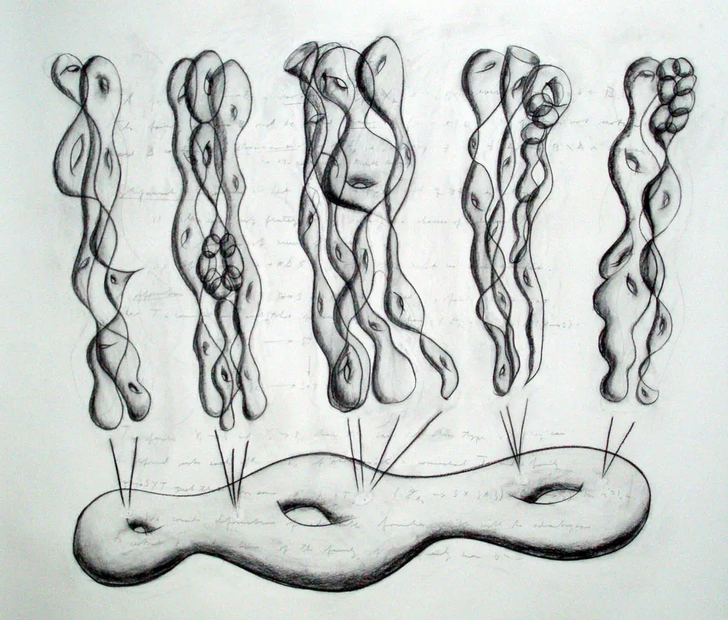
Topology is the study of spaces in the most abstract sense, so abstract that they may not even support a well-defined notion of distance (if your spaces are guaranteed to have distances, then you are now doing geometry rather than topology). Topology takes a coarser view of space: forget about curvature, distance, or really anything involving numbers at all. To a topologist, two points can be “near” each other or not, “connected” or not, and beyond that it doesn’t matter. This is the source of all the jokes about topologists mistaking donuts for coffee cups,1 but the kind of topology that studies multi-holed donuts, algebraic topology, is actually comparatively tame and normal. Also relatively normal is differential topology, which is the next neighborhood over from differential geometry, and which produces cool videos like this.
No, the scary part of town, the place where the true freaks and degenerates hang out, is general topology. General topology is where we go to figure out the basic definitions and frameworks that underlie the rest of topology. It’s about exploring what nearness and connectedness even are, and when mathematicians are trying to figure out what things are, that usually means probing the outer limits of what they can be. So general topology turns into the study of the most bizarre and deformed and disturbing spaces accessible to human cognition. No wonder its practitioners are a little weird.
Which brings me to this book, whose perversity is laid out right there in the title. It’s a big book of counterexamples to statements which seem obviously, intuitively correct. In general topology, things that seem intuitively correct are usually wrong:2 the field is notorious for proofs that almost work but twist out of your grasp at the last moment. A big book of counterexamples is exactly what you want for understanding why your proof that “all Xs are Ys and all Ys are Xs” falls flat. Seeing the logic fail is one thing, but seeing a concrete example of an X that is not a Y (or vice versa) brings it home with a satisfying finality.
But the real reason I love this book is the names, oh, the names. Let me flip through the table of contents with you: are “the Infinite Cage” and “the Wheel Without Its Hub” examples of topological spaces, or planes of the underworld? Are “Cantor’s Leaky Tent” and “Tychonoff’s Corkscrew” important counterexamples, or Level 2 wizard spells? I could spend hours idly leafing through this book, pondering these twisted and prosperous spaces, imagining them as worlds in themselves, imagining the bizarre sorts of creatures that might live there. Is this a math textbook or an RPG sourcebook? Trick question, they’re the same thing.
1. One of the proudest moments of my mathematical career was when I attended a faculty tea and a distinguished topologist asked me for a donut and I handed him a cup of coffee instead. Everybody lost it. Alas, I turned out to be much worse at math than I am at improvisational comedy, and my mathematical career ended shortly afterwards.
2. This is why we have the “separation axioms“. Every rung on that latter is the “well, actually …” to something that seems self-evident but isn’t.
April 12, 2024
QotD: Prepper fantasy versus prepper reality
The thing is these stories are totally ahistorical — the best that solitary survivors have ever managed was to survive, none of them have rebuilt civilization. As Jane notes in her review of BAP, the sandal-clad barbarians have generally been subjected to a “tyranny of the cousins” even more intrusive and meticulous than the gynocratic safetyism that Bronze Age Lifestyle offers an imaginative escape from. And as for the pioneers, Tanner Greer notes that:
Many imagine the great American man of the past as a prototypical rugged individual, neither tamed nor tameable, bestriding the wilderness and dealing out justice in lonesome silence. But this is a false myth. It bears little resemblance to the actual behavior of the American pioneer, nor to the kinds of behaviors and norms that an agentic culture would need to cultivate today. Instead, the primary ideal enshrined and ritualized as the mark of manhood was “publick usefuleness”, similar, if not quite identical, to the classical concept of virtus. American civilization was built not by rugged individuals but by rugged communities. Manhood was understood as the leadership of and service to these communities.
It would be too easy to end the review here, with the implication that the prepper identity is a fantasy of radical individualism and like all such fantasies, kinda dumb. But the thing is, the prepper world has by and large absorbed this critique and incorporated it into its theorizing. In contrast to the libertarian fantasies of the 1970s, second-wave prepperism (reformed prepperism?) is constantly talking about community, the importance of having friends you can trust, of cultivating deep social bonds with your neighbors, etc.
What Yu Gun reminds us is that this is still totally ahistorical, but this time in a way that indicts not only the preppers, but also a much broader swathe of our society. A man without a community is unnatural, but so is a community without leadership, hierarchy, and order. The prepper version of community is a vision of freely contracting individuals respecting each others’ autonomy while cooperating because it’s in their best interests. This is also the folk version of community that motivates much of our economic and legal regime. Scratch an American “communitarian”, and underneath it’s just another individualist.
If you hang out on prepper forums, a recurrent mantra is to “practice your preps”, that is to start living on the margin as if the apocalypse had already occurred. The purpose of this is to gain experience in the skills you’ll need after the end, and to work out the kinks in your routine now, while it’s still easy to make adjustments. Originally this meant practicing getting lost in the woods, using and maintaining your weapon of choice, eating some of your food stockpile, or whatever. In second-wave prepperism it means all that, plus a bunch of new stuff like hanging out with your neighbors, attending community barbecues, and whatever else it is that freely contracting individuals like to autonomously do while temporarily occupying the same space.
But for we third-wave preppers, it has to take on a very different meaning. Greer’s essay that I quoted above is mainly about how leadership and service in local-scale organizations served as training for leadership and service in much larger groups aimed at problems with much higher stakes. In other words, they were practicing their preps. One of the great secrets of leadership is that following and leading are actually closely related skills, and that practice at one of them transfers well to the other. This is difficult for we Americans to see, because an aversion to hierarchy is built into our national character, and consequently we operate with impoverished models of what it means to be in a position of authority or of subordination.
Long ago I read an article contrasting Western and Korean massively-multiplayer online role-playing games (MMORPGs). Even if you know nothing about computer games, you probably know that in most of them you are the hero, the chosen one, the child of destiny. Talk about fantasies of agency! MMORPGs thus have a tricky needle to thread — somehow all the thousands and thousands of players need to simultaneously be the chosen one, the child of destiny, etc., etc. And they mostly accomplish this by just rolling with it and asking everybody to suspend disbelief. But this article claimed that Korean MMORPGs are different — when players join these games, they’re randomly assigned a role. A tiny fraction might become kings or generals or children of destiny, with the power to decide the fates of peoples and kingdoms, but most are given a role as ordinary soldiers or porters or blacksmiths, and toil away at their in-game mundane tasks, without much ability to affect anything at all.
We like to imagine that after the bombs fall and the smoke clears we will emerge as the new Yu Gun, apportioning merit and assigning tasks. And perhaps you will indeed be called upon to do that, so you should prepare yourself to step up and do it. That preparation will involve some practice commanding others and some practice obeying others’ commands, because the two are inextricably bound together. But in life as in Korean video games, there’s isn’t very much room at the top. Far more likely, when the stage of history is set, we will be cast in a supporting role, like the Korean gamer assigned to role-play as a peasant or like Yu’s followers standing in orderly ranks. Let us not turn our noses up at this vocation, the poorly-behaved seldom make history.
John Psmith, “REVIEW: Medieval Chinese Warfare, 300-900 by David A. Graff”, Mr. and Mrs. Psmith’s Bookshelf, 2023-06-05.
April 4, 2024
QotD: What we mean by the term “indigenous”
But of course this is pedantic nitpicking (my speciality), because legally “indigenous” means “descended from the people who were there before European colonialism”: the Inuit are “indigenous” because they were in Newfoundland and Greenland when Martin Frobisher showed up, regardless of the fact that they had only arrived from western Alaska about five hundred years earlier. Indigineity in practice is not a factual claim, it’s a political one, based on the idea that the movements, mixtures, and wholesale destructions of populations since 1500 are qualitatively different from earlier ones. But the only real difference I see, aside from them being more recent, is that they were often less thorough — in large part because they were more recent. In many parts of the world, the Europeans were encountering dense populations of agriculturalists who had already moved into the area, killed or displaced the hunter-gatherers who lived there, and settled down. For instance, there’s a lot of French and English spoken in sub-Saharan Africa, but it hasn’t displaced the Bantu languages like they displaced the click languages. Spanish has made greater inroads in Central and South America, but there’s still a lot more pre-colonial ancestry among people there than there is pre-Bantu ancestry in Africa. I think these analogies work, because as far as I can tell the colonization of North America and Australia look a lot like the Early European Farmer and Bantu expansions (technologically advanced agriculturalists show up and replace pretty much everyone, genetically and culturally), while the colonization of Central and South America looks more like the Yamnaya expansion into Europe (a bunch of men show up, introduce exciting new disease that destabilizes an agricultural civilization,1 replace the language and heavily influence the culture, but mix with rather than replacing the population).
Some people argue that it makes sense to talk about European colonialism differently than other population expansions because it’s had a unique role in shaping the modern world, but I think that’s historically myopic: the spread of agriculture did far more to change people’s lives, the Yamnaya expansion also had a tremendous impact on the world, and I could go on. And of course the way it’s deployed is pretty disingenuous, because the trendier land acknowledgements become, the more the people being acknowledged start saying, “Well, are you going to give it back?” (Of course they’re not going to give it back.) It comes off as a sort of woke white man’s burden: of course they showed up and killed the people who were already here and took their stuff, but we’re civilized and ought to know better, so only we are blameworthy.
More reasonable, I think, is the idea that (some of) the direct descendants of the winners and losers in this episode of the Way Of The World are still around and still in positions of advantage or disadvantage based on its outcome, so it’s more salient than previous episodes. Even if, a thousand years ago, your ancestors rolled in and destroyed someone else’s culture, it still sucks when some third group shows up and destroys yours. It’s just, you know, a little embarrassing when you’ve spent a few decades couching your post-colonial objections in terms of how mean and unfair it is to do that, and then the aDNA reveals your own population’s past …
Reich gets into this a bit in his chapter on India, where it’s pretty clear that the archaeological and genetic evidence all point to a bunch of Indo-Iranian bros with steppe ancestry and chariots rolling down into the Indus Valley and replacing basically all the Y chromosomes, but his Indian coauthors (who had provided the DNA samples) didn’t want to imply that substantial Indian ancestry came from outside India. (In the end, the paper got written without speculating on the origins of the Ancestral North Indians and merely describing their similarity to other groups with steppe ancestry.) Being autochthonous is clearly very important to many peoples’ identities, in a way that’s hard to wrap your head around as an American or northern European: Americans because blah blah nation of immigrants blah, obviously, but a lot of northern European stories about ethnogenesis (particularly from the French, Germans, and English) draw heavily on historical Germanic tribal migrations and the notion of descent (at least in part) from invading conquerors.
One underlying theme in the book — a theme Reich doesn’t explicitly draw out but which really intrigued me — is the tension between theory and data in our attempts to understand the world. You wrote above about those two paradigms to explain the spread of prehistoric cultures, which the lingo terms “migrationism” (people moved into their neighbors’ territory and took their pots with them) and “diffusionism”2 (people had cool pots and their neighbors copied them), and which archaeologists tended to adopt for reasons that had as much to do with politics and ideology as with the actual facts on (in!) the ground. And you’re right that in most cases where we now have aDNA evidence, the migrationists were correct — in the case of the Yamnaya, most modern migrationists didn’t go nearly far enough — but it’s worth pointing out that all those 19th century Germans who got so excited about looking for the Proto-Indo-European Urheimat were just as driven by ideology as the 21st century Germans who resigned as Reich’s coauthors on a 2015 article where they thought the conclusions were too close to the work of Gustaf Kossinna (d. 1931), whose ideas had been popular under the Nazis. (They didn’t think the conclusions were incorrect, mind you, they just didn’t want to be associated with them.) But on the other hand, you need a theory to tell you where and how to look; you can’t just be a phenomenological petri dish waiting for some datum to hit you. This is sort of the Popperian story of How Science Works, but it’s more complex because there are all kinds of extra-scientific implications to the theories we construct around our data.
The migrationist/diffusionist debate is mostly settled, but it turns out there’s another issue looming where data and theory collide: the more we know about the structure and history of various populations, the more we realize that we should expect to find what Reich calls “substantial average biological differences” between them. A lot of these differences aren’t going to be along axes we think have moral implications — “people with Northern European ancestry are more likely to be tall” or “people with Tibetan ancestry tend to be better at functioning at high altitudes” isn’t a fraught claim. (Plus, it’s not clear that all the differences we’ve observed so far are because one population is uniformly better: many could be explained by greater variation within one population. Are people with West African ancestry overrepresented among sprinters because they’re 0.8 SD better at sprinting, or because the 33% higher genetic diversity among West Africans compared to people without recent African ancestry means you get more really good sprinters and more really bad ones?) But there are a lot of behavioral and cognitive traits where genes obviously play some role, but which we also feel are morally weighty — intelligence is the most obvious example, but impulsivity and the ability to delay gratification are also heritable, and there are probably lots of others. Reich is adorably optimistic about all this, especially for a book written in 2018, and suggests that it shouldn’t be a problem to simultaneously (1) recognize that members of Population A are statistically likely to be better at some thing than members of Population B, and (2) treat members of all populations as individuals and give them opportunities to succeed in all walks of life to the best of their personal abilities, whether the result of genetic predisposition or hard work. And I agree that this is a laudable goal! But for inspiration on how our society can both recognize average differences and enable individual achievement, Reich suggests we turn to our successes in doing this for … sex differences! Womp womp.
Jane Psmith and John Psmith, “JOINT REVIEW: Who We Are and How We Got Here, by David Reich”, Mr. and Mrs. Psmith’s Bookshelf, 2023-05-29.
1. aDNA works for microbes too, and it looks like Y. pestis, the plague, came from the steppe with the Yamnaya. It didn’t yet have the mutation that causes buboes, but the pneumonic version of the disease is plenty deadly, especially to the Early European Farmers who didn’t have any protection against it. In fact, as far as we can tell, in all of human history there have only been four unique introductions of plague from its natural reservoirs in the Central Asian steppe: the one that came with or slightly preceded the Yamnaya expansion around 5kya, the Plague of Justinian, the Black Death, and an outbreak that began in Yunnan in 1855. The waves of plague that wracked Europe throughout the medieval and early modern periods were just new pulses of the strain that had caused Black Death. Johannes Krause gets into this a bit in his A Short History of Humanity, which I didn’t actually care for because his treatment of historic pandemics and migrations is so heavily inflected with Current Year concerns, but I haven’t found a better treatment in a book so it’s worth checking it out from the library if you’re interested.
2. I cheated with that “pots not people” line in my earlier email; it usually gets (got?) trotted out not as a bit of epistemological modesty about what the archaeological record is capable of showing, but as a claim that the only movements involved were those of pots, not of people.
March 27, 2024
QotD: Roman imperial strategy
If deterrence fails and you have to fight, then the next best way to economize on force is by making somebody else do the fighting for you. In the late Republic and early Empire, much of Roman territory wasn’t “officially” under Roman rule. Instead, it was the preserve of dozens of petty and not-so-petty kingdoms that, on paper at least, were fully independent and co-equal sovereign entities.2 Rome actually went to some effort to keep up the charade: the client rulers were commonly referred to as “allies” [socii], and Rome took care never to directly tax or conscript their citizens. But, to be clear, it was a charade. If any of these “allies” ever wanted to leave the alliance or conduct any sort of independent foreign policy, he would not continue to be a king for long. Oftentimes the legions wouldn’t even have to show up — the terrified citizens of the client kingdom would overthrow and execute their wayward ruler themselves, in the hopes that Rome might thereby be induced not to make an example of the citizenry.
What was the point of all of this complicated kabuki theater? Once again, it’s about economy of force, this time on both the “input” and the “output” sides of the great machine of the state. On the input side: efficient government is hard to scale. Roman provincial governors were legendarily corrupt, and could get up to all kinds of mischief out there without supervision. Having a Roman ruling a whole bunch of non-Romans was also bound to cause resentment: it could lead to rebellions, or worse, tax-evasion. All of these problems were solved by pretending to have the barbarians be ruled by one of their own, a barbarian king. He could collect the taxes, and suppress revolts, and generally keep an eye on things. Moreover, as a fellow barbarian, he would know better how to keep his subjects in line, and would be less likely to commit an awkward cultural blunder. On the output side, he could also deal with border raids and other low-intensity threats. This exponentially magnified Roman military power, because it meant that instead of being stuck on garrison duty, spread out along the frontiers, the legions could be concentrated in a strategic reserve. They could then be deployed for “high intensity” operations in some remote part of the empire without worrying that they were thereby leaving the borders unguarded: operations like conquering new lands, or persuading a rebellious client kingdom that their interests lay with Rome.
If you can’t make somebody else do the fighting, then the next, next best thing is to carefully choose the time, circumstances, and location of the fight. Ideally you would muster a heavy concentration of your own forces and confront the enemy while they’re still dispersed. Ideally the ground would be thoroughly surveyed, well understood, and perhaps even prepared with static defenses. Ideally your own forces would have ample supply and good lines of communication, and your opponent would have neither of these things. It was to all these ends that in the second of the periods Luttwak surveys, the Romans built the limes3 — a massive system of defensive emplacements. These extended for thousands of miles around almost the entire frontier of the empire, but the most famous portion was Hadrian’s Wall.
John Psmith, “REVIEW: The Grand Strategy of the Roman Empire by Edward Luttwak”, Mr. and Mrs. Psmith’s Bookshelf, 2023-11-13.
1. This is actually also true of modern wars, and if you think you have an exception in mind, you may just not know the history that well. For instance, the current war in the Donbass wasn’t really a surprise invasion, but is best viewed as the latest and most violent stage of a conflict that’s been slowly ratcheting up for a decade.
2. Were you ever confused by who exactly this King Herod guy in the Gospel stories was? Why was there a king and also a Roman governor? He was precisely one of these client rulers!
3. Pronounced “lee-mays”, not like the fruit.
March 21, 2024
QotD: South Africa under Thabo Mbeki
Things look very different when political considerations force the majority of an organization to be underqualified (and there are simply not very many qualified or educated black South Africans today, and there were even fewer when these rules went into effect). A shock on that scale can lead to a total breakdown in function, and indeed this is precisely what happened to one government agency after another. Johnson notes that this issue, and particularly its effects on service provision to the rural poor, pit two constituencies against each other which many have tried to conflate, but are actually quite distinct. The immiserated black lower class (which the ANC purported to represent) didn’t benefit at all from affirmative action because they weren’t eligible for government jobs anyway, and they vastly preferred to have the whites running the water system if it meant their kids didn’t get cholera. The people actually benefited by Mbeki’s affirmative action policies were the wealthy and upwardly-mobile black urban bourgeoisie, a tiny minority of the country, but one that formed the core of Mbeki’s support.
That same small group of educated and well-connected black professionals was also the major beneficiary of Mbeki’s other signature economic policy: Black Economic Empowerment (BEE). Oversimplifying a bit, BEE was a program in which South African corporations were bullied or threatened into selling some or all of their shares at favorable prices to politically-connected black elites, who generally returned the favor by looting the company’s assets or otherwise running it into the ground (note that this is not the description you will find on Wikipedia). The whole thing was so astoundingly, revoltingly corrupt that even the ANC has had to back off and admit in the face of criticism from the left that something went wrong here.
What made BEE so “successful” is that it was actually far more consensual than you might have guessed from that description. In many cases, the white former owners of these corporations were looking around at the direction of the country and trying to find any possible excuse to unload their assets and get their money out. The trouble was that it was difficult to do that without seeming racist, because obviously racism was the only reason anybody could have doubts about the wisdom of the ANC. The genius of BEE is that it allowed these white elites to perform massive capital flight while simultaneously framing it as a grand anti-racist gesture and a mark of their confidence in the future of the country.
This is one particular instance of a more general phenomenon, which is that at this stage pretty much everybody was pretending that things were going great in South Africa, when things were clearly not, in fact, going great. But this was the late 90s and early 00s, the establishment media had a much tighter hold on information than it does today, and so long as nobody had an interest in the story getting out, it wasn’t going to get out. Everybody who mattered in South Africa wanted the story to be that the end of apartheid had resulted in a peaceful and harmonious society, and everybody outside South Africa who’d spent decades supporting and fundraising for the ANC wanted this to be the story too.
John Psmith, “REVIEW: South Africa’s Brave New World, by R.W. Johnson”, Mr. and Mrs. Psmith’s Bookshelf, 2023-03-20.


