Quotulatiousness

February 7, 2015

To the TERFs, “it is a genital form of blackface”

Filed under: Politics, USA — Tags: , , , , — Nicholas @ 03:00

Jim Goad on an unexpected new front that has opened up in the social justice wars:

This is a struggle — laden with a hilarious level of acrimony — between men who insist they’re women and women who insist that the most crucial part of being a woman involves popping out of your mother’s vagina with a vagina of your own. The latter group is disparagingly referred to as TERFs — Trans Exclusionary Radical Feminists — due to the fact that they feel male-to-female trannies are trying to party-crash their struggle against historical oppression. The TERFs argue that for men to pretend they’re women is insulting to real women. To them, it is a genital form of blackface.

The TERF worldview can be loosely summarized as follows: So-called “trans women” are actually privileged males who use such privilege in an attempt to co-opt women’s historical suffering without enduring any of the social stigma attendant to bleeding for five days a month without dying. They are essentially delusional men who wear dresses or, in some cases, mutilate their genitals in a near-suicidal quest to validate their delusions. Trannies should under no circumstances be able to use women’s bathrooms or attend events that are exclusively designed for women. For trannies to invade such female-designated “safe spaces” is at best intrusive, at worst yet another form of rape. Since “gender” is a social construct and “femininity” is a patriarchal imposition, transsexuals are merely reinforcing anti-female memes by aping sexist stereotypes of how women should behave. Therefore it is they, and not the TERFs, who are the true reactionaries.

Robert Anton Wilson famously said, “It only takes 20 years for a liberal to become a conservative without changing a single idea.” Whereas those who would now be defamed as TERFs were on the far bloody cutting edge of leftist politics a generation ago, they now find themselves outdated or, as the kids like to say, “irrelevant.” Without having changed a single idea, they find themselves labeled not as bold freedom warriors fighting the good fight against oppression but as hateful reactionaries who stand in the way of true progress.

One especially amusing bone of contention between the two groups of shaggy yipping poodles regards the vaginal authenticity of male-to-female transsexuals. Old-school feminist Germaine Greer recently asserted that trannies aren’t women because they don’t realize what it’s like “to have a big, hairy, smelly vagina.”

January 28, 2015

The great and the good gather at Davos

And Monty calls ’em exactly what they are:

Luckily, all is not lost. Our moral and ethical betters have gathered in Davos to light their cigars with hundred-dollar bills while mocking the tubercular bootblack who’s been pressed into service to keep their shoes looking spiffy while they chat and laugh and eat lobster canapes. Oh, wait, I read that wrong, sorry. They’re in Davos to discuss the pressing problem of Global Warming(tm). Because they’re so concerned about Global Warming(tm) that they felt compelled to fly their private jets to an upscale enclave in the Swiss Alps to talk about it. While making fun of the tubercular bootblack who’s spit-shining their wingtips.

Don’t get me wrong – I’m a big believer in ostentatious displays of wealth. If I had the money, I’d build a hundred-foot-high statue of myself made out of pure platinum and then hire homeless people to worship at it for no fewer than eight hours per day. (I’d pay them a fair wage, though. What’s the going rate for abject obeisance to a living God? I’ll have to look it up.) But this Davos thing is just…rank. It’s a collection of rich fart-sniffers who want to congratulate each other on how socially conscious they are, and how much they care about the Little People. (Except the tubercular bootblack, whom they often kick with their rich-guy shoes.)

January 9, 2015

A tough love approach to dealing with “microaggression” trauma

Filed under: Politics, USA — Tags: , , , , — Nicholas @ 04:00

Trigger warning: If you are constantly suffering microaggressions from the world at large, you probably need to read all of this post from Chris Hernandez:

I’ve reviewed these reports of “trauma”, and have reached a conclusion about them. I’m going to make a brief statement summarizing my conclusion. While I mean this in the nicest way possible, I don’t want victims of Microaggressions or supporters of Trigger Warnings to doubt my sincerity.

Fuck your trauma.

Yes, fuck your trauma. My sympathy for your suffering, whether that suffering was real or imaginary, ended when you demanded I change my life to avoid bringing up your bad memories. You don’t seem to have figured this out, but there is no “I must never be reminded of a negative experience” expectation in any culture anywhere on earth.

If your psyche is so fragile you fall apart when someone inadvertently reminds you of “trauma”, especially if that trauma consisted of you overreacting to a self-interpreted racial slur, you need therapy. You belong on a psychiatrist’s couch, not in college dictating what the rest of society can’t do, say or think. Get your own head right before you try to run other people’s lives. If you expect everyone around you to cater to your neurosis, forever, you’re what I’d call a “failure at life”, doomed to perpetual disappointment.

Oh, I should add: fuck my trauma too. I must be old-fashioned, but I always thought coming to terms with pain was part of growing up. I’ve never expected anyone to not knock on my door because it reminds me of that terrifying morning decades ago. I’ve never blown up at anyone for startling me with a camera flash (I’ve never even mentioned it to anyone who did). I’ve never expected anyone to not talk about Iraq or Afghanistan around me, even though some memories still hurt. I don’t need trigger warnings because a book might remind me of a murder victim I’ve seen.

And before anyone says it; being Hispanic doesn’t make me any more sympathetic to people who experience nonexistent, discriminatory “trauma”. Discrimination didn’t break me (or my parents, or grandparents). I’ve been discriminated against by whites for being Hispanic. I’ve been threatened by blacks for being white. I’ve been insulted by Hispanics for not being Hispanic enough. Big deal. None of that stopped me from doing anything I wanted to do. It wasn’t “trauma”. It was life.

January 5, 2015

Scott Aaronson on “white male privilege” as experienced at MIT

Filed under: Politics, USA — Tags: , , , , — Nicholas @ 04:00

Down in the comments on this post, Scott Aaronson gets extremely personal:

… You also say that men in STEM fields — unlike those in the humanities and social sciences — don’t even have the “requisite vocabulary” to discuss sex discrimination, since they haven’t read enough feminist literature. Here I can only speak for myself: I’ve read at least a dozen feminist books, of which my favorite was Andrea Dworkin’s Intercourse (I like howls of anguish much more than bureaucratic boilerplate, so in some sense, the more radical the feminist, the better I can relate). I check Feministing, and even radfem blogs like I Blame the Patriarchy. And yes, I’ve read many studies and task force reports about gender bias, and about the “privilege” and “entitlement” of the nerdy males that’s keeping women away from science.

Alas, as much as I try to understand other people’s perspectives, the first reference to my “male privilege” — my privilege! — is approximately where I get off the train, because it’s so alien to my actual lived experience. This is not, insanely, to suggest a lack of misogyny in the modern world! To whatever extent there is misogyny, one could say that there’s also “male privilege.” Rather it’s to suggest that, given what nerdy males have themselves had to endure in life, shaming them over their “male privilege” is a bad way to begin a conversation with them.

But I suspect the thought that being a nerdy male might not make me “privileged” — that it might even have put me into one of society’s least privileged classes — is completely alien to your way of seeing things. To have any hope of bridging the gargantuan chasm between us, I’m going to have to reveal something about my life, and it’s going to be embarrassing.

(sigh) Here’s the thing: I spent my formative years — basically, from the age of 12 until my mid-20s — feeling not “entitled,” not “privileged,” but terrified. I was terrified that one of my female classmates would somehow find out that I sexually desired her, and that the instant she did, I would be scorned, laughed at, called a creep and a weirdo, maybe even expelled from school or sent to prison. And furthermore, that the people who did these things to me would somehow be morally right to do them — even if I couldn’t understand how.

You can call that my personal psychological problem if you want, but it was strongly reinforced by everything I picked up from my environment: to take one example, the sexual-assault prevention workshops we had to attend regularly as undergrads, with their endless lists of all the forms of human interaction that “might be” sexual harassment or assault, and their refusal, ever, to specify anything that definitely wouldn’t be sexual harassment or assault. I left each of those workshops with enough fresh paranoia and self-hatred to last me through another year.

My recurring fantasy, through this period, was to have been born a woman, or a gay man, or best of all, completely asexual, so that I could simply devote my life to math, like my hero Paul Erdös did. Anything, really, other than the curse of having been born a heterosexual male, which for me, meant being consumed by desires that one couldn’t act on or even admit without running the risk of becoming an objectifier or a stalker or a harasser or some other creature of the darkness.

Of course, I was smart enough to realize that maybe this was silly, maybe I was overanalyzing things. So I scoured the feminist literature for any statement to the effect that my fears were as silly as I hoped they were. But I didn’t find any. On the contrary: I found reams of text about how even the most ordinary male/female interactions are filled with “microaggressions,” and how even the most “enlightened” males — especially the most “enlightened” males, in fact — are filled with hidden entitlement and privilege and a propensity to sexual violence that could burst forth at any moment.

Because of my fears — my fears of being “outed” as a nerdy heterosexual male, and therefore as a potential creep or sex criminal — I had constant suicidal thoughts. As Bertrand Russell wrote of his own adolescence: “I was put off from suicide only by the desire to learn more mathematics.”

At one point, I actually begged a psychiatrist to prescribe drugs that would chemically castrate me (I had researched which ones), because a life of mathematical asceticism was the only future that I could imagine for myself. The psychiatrist refused to prescribe them, but he also couldn’t suggest any alternative: my case genuinely stumped him. As well it might — for in some sense, there was nothing “wrong” with me. In a different social context — for example, that of my great-grandparents in the shtetl — I would have gotten married at an early age and been completely fine. (And after a decade of being coy about it, I suppose I’ve finally revealed the meaning of this blog’s title.) This is not, in any way, shape, or form, to suggest that I yearn for an era when women could be purchased as property. There were many times and places where marriages did not occur without both parties’ consent, but there was also a ritualized system of courtship that took much of the terror and mystery out of the process. Even that is not exactly what I “yearn” for; I merely say it’s what I felt “optimized” for.

All this time, I faced constant reminders that the males who didn’t spend months reading and reflecting about feminism and their own shortcomings — even the ones who went to the opposite extreme, who engaged in what you called “good old-fashioned ass-grabbery” — actually had success that way. The same girls who I was terrified would pepper-spray me and call the police if I looked in their direction, often responded to the crudest advances of the most Neanderthal of men by accepting those advances. Yet it was I, the nerd, and not the Neanderthals, who needed to check his privilege and examine his hidden entitlement! Contrary to what countless people have said, this is not intended to blame women for their choices — or even, really, to blame the Neanderthals. Rather, it’s intended to blame a culture that told male nerds since childhood that they’d be horrible people if they asked — even more horrible than if they didn’t ask! — thereby ceding the field to the Neanderthals by default.

So what happened to break me out of this death-spiral? Did I have an epiphany, where I realized that despite all appearances, it was I, the terrified nerd, who was wallowing in unearned male privilege, while those Neaderthal ass-grabbers were actually, on some deeper level, the compassionate feminists — and therefore, that both of us deserved everything we got?

No, there was no such revelation. All that happened was that I got older, and after years of hard work, I achieved some success in science, and that success boosted my self-confidence (at least now I had something worth living for), and the newfound confidence, besides making me more attractive, also made me able to (for example) ask a woman out, despite not being totally certain that my doing so would pass muster with a committee of radfems chaired by Andrea Dworkin — a prospect that was previously unthinkable to me. This, to my mind, “defiance” of feminism is the main reason why I was able to enjoy a few years of a normal, active dating life, which then led to meeting the woman who I married.

Now, the whole time I was struggling with this, I was also fighting a second battle: to maintain the liberal, enlightened, feminist ideals that I had held since childhood, against a powerful current pulling me away from them. I reminded myself, every day, that no, there’s no conspiracy to make the world a hell for shy male nerds. There are only individual women and men trying to play the cards they’re dealt, and the confluence of their interests sometimes leads to crappy outcomes. No woman “owes” male nerds anything; no woman deserves blame if she prefers the Neanderthals; everyone’s free choice demands respect.

That I managed to climb out of the pit with my feminist beliefs mostly intact, you might call a triumph of abstract reason over experience.

But I hope you now understand why I might feel “only” 97% on board with the program of feminism. I hope you understand why, despite my ironclad commitment to women’s reproductive choice and affirmative action and women’s rights in the developing world and getting girls excited about science, and despite my horror at rape and sexual assault and my compassion for the victims of those heinous crimes, I might react icily to the claim — for which I’ve seen not a shred of statistical evidence — that women are being kept out of science by the privileged, entitled culture of shy male nerds, which is worse than the culture of male doctors or male filmmakers or the males of any other profession. I believe you guys call this sort of thing “blaming the victim.” From my perspective, it serves only to shift blame from the Neanderthals and ass-grabbers onto some of society’s least privileged males, the ones who were themselves victims of bullying and derision, and who acquired enough toxic shame that way for appealing to their shame to be an effective way to manipulate their behavior. As I see it, whenever these nerdy males pull themselves out of the ditch the world has tossed them into, while still maintaining enlightened liberal beliefs, including in the inviolable rights of every woman and man, they don’t deserve blame for whatever feminist shortcomings they might still have. They deserve medals at the White House. This is obvious hyperbole.

H/T to Scott Alexander, who has much to say about both Aaronson’s painful confession and the rather over-the-top responses to it from the feminist community.

December 17, 2014

QotD: The mark of a true-born nobleman

Filed under: Britain, Military, Quotations — Tags: , , , — Nicholas @ 00:01

Now, no one in my life that I could remember had ever been so damned civil to me, except toad-eaters like Speedicut who didn’t count. I found myself liking his lordship, and did not realize that I was seeing him at his best. In this mood, he was a charming man enough, and looked well. He was taller than I, straight as a lance, and very slender, even to his hands. Although he was barely forty, he was already bald, with a bush of hair above either ear and magnificent whiskers. His nose was beaky and his eyes blue and prominent and unwinking — they looked out on the world with that serenity which marks the nobleman whose uttermost ancestor was born a nobleman, too. It is I the look that your parvenu would give half his fortune for, that unrufflable gaze of the spoiled child of fortune who knows with unshakeable certainty that he is right and that the world is exactly ordered for his satisfaction and pleasure. It is the look that makes underlings writhe and causes revolutions. I saw it then, and it remained changeless as long as I knew him, even through the roll-call beneath Causeway Heights when the grim silence as the names were shouted testified to the loss of five hundred of his command. ‘It was no fault of mine,’ he said then, and he didn’t just believe it; he knew it.

George MacDonald Fraser, Flashman, 1969.

November 26, 2014

The rising tide of microaggression activism at UCLA

Filed under: Politics, USA — Tags: , , , , — Nicholas @ 07:44

Heather Mac Donald looks at what she calls “The Microaggression Farce” at UCLA:

In November 2013, two dozen graduate students at the University of California at Los Angeles marched into an education class and announced a protest against its “hostile and unsafe climate for Scholars of Color.” The students had been victimized, they claimed, by racial “microaggression” — the hottest concept on campuses today, used to call out racism otherwise invisible to the naked eye. UCLA’s response to the sit-in was a travesty of justice. The education school sacrificed the reputation of a beloved and respected professor in order to placate a group of ignorant students making a specious charge of racism.

The pattern would repeat itself twice more at UCLA that fall: students would allege that they were victimized by racism, and the administration, rather than correcting the students’ misapprehension, penitently acceded to it. Colleges across the country behave no differently. As student claims of racial and gender mistreatment grow ever more unmoored from reality, campus grown-ups have abdicated their responsibility to cultivate an adult sense of perspective and common sense in their students. Instead, they are creating what tort law calls “eggshell plaintiffs” — preternaturally fragile individuals injured by the slightest collisions with life. The consequences will affect us for years to come.

UCLA education professor emeritus Val Rust was involved in multiculturalism long before the concept even existed. A pioneer in the field of comparative education, which studies different countries’ educational systems, Rust has spent over four decades mentoring students from around the world and assisting in international development efforts. He has received virtually every honor awarded by the Society of Comparative and International Education. His former students are unanimous in their praise for his compassion and integrity. “He’s been an amazing mentor to me,” says Cathryn Dhanatya, an assistant dean for research at the USC Rossiter School of Education. “I’ve never experienced anything remotely malicious or negative in terms of how he views students and how he wants them to succeed.” Rosalind Raby, director of the California Colleges for International Education, says that Rust pushes you to “reexamine your own thought processes. There is no one more sensitive to the issue of cross-cultural understanding.” A spring 2013 newsletter from UCLA’s ed school celebrated Rust’s career and featured numerous testimonials about his warmth and support for students.

It was therefore ironic that Rust’s graduate-level class in dissertation preparation was the target of student protest just a few months later — ironic, but in the fevered context of the UCLA education school, not surprising. The school, which trumpets its “social-justice” mission at every opportunity, is a cauldron of simmering racial tensions. Students specializing in “critical race theory” — an intellectually vacuous import from law schools — play the race card incessantly against their fellow students and their professors, leading to an atmosphere of nervous self-censorship. Foreign students are particularly shell-shocked by the school’s climate. “The Asians are just terrified,” says a recent graduate. “They walk into this hyper-racialized environment and have no idea what’s going on. Their attitude in class is: ‘I don’t want to talk. Please don’t make me talk!’”

November 13, 2014

“Class matters far less than it used to in the 19th century. Citizenship matters far more.”

Filed under: Britain, Economics, History — Tags: , — Nicholas @ 00:02

Tim Harford — white, male Oxford grad and child of Oxbridge-educated parents — checks his privilege:

All these accidents of birth are important. But there’s a more important one: citizenship. Gillian, Simon and I are all British citizens. Financially speaking, this is a greater privilege than all the others combined.

Imagine lining up everyone in the world from the poorest to the richest, each standing beside a pile of money that represents his or her annual income. The world is a very unequal place: those in the top 1 per cent have vastly more than those in the bottom 1 per cent – you need about $35,000 after taxes to make that cut-off and be one of the 70 million richest people in the world. If that seems low, it’s $140,000 after taxes for a family of four – and it is also about 100 times more than the world’s poorest people have.

What determines who is at the richer end of that curve is, mostly, living in a rich country. Branko Milanovic, a visiting presidential professor at City University New York and author of The Haves and the Have-Nots, calculates that about 80 per cent of global inequality is the result of inequality between rich nations and poor nations. Only 20 per cent is the result of inequality between rich and poor within nations. […]

That might seem obvious but it’s often ignored in the conversations we have about inequality. And things used to be very different. In 1820, the UK had about three times the per capita income of countries such as China and India, and perhaps four times that of the poorest countries. The gap between rich countries and the rest has since grown. Today the US has about five times the per capita income of China, 10 times that of India and 50 times that of the poorest countries. (These gaps could be made to look even bigger by not adjusting for lower prices in China and India.) Being a citizen of the US, the EU or Japan is an extraordinary economic privilege, one of a dramatically different scale than in the 19th century.

October 30, 2014

Words mean exactly what we want them to mean, except when we don’t

Filed under: Media — Tags: , , — Nicholas @ 08:10

In a post from earlier this year, Scott Alexander discusses a common example of what has been described as a “motte-and-bailey” argument:

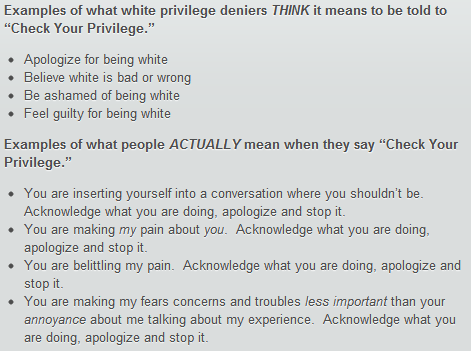
I recently learned there is a term for the thing social justice does. But first, a png from racism school dot tumblr dot com.

Check your privilege from Tumblr

So, it turns out that privilege gets used perfectly reasonably. All it means is that you’re interjecting yourself into other people’s conversations and demanding their pain be about you. I think I speak for all straight white men when I say that sounds really bad and if I was doing it I’m sorry and will try to avoid ever doing it again. Problem solved, right? Can’t believe that took us however many centuries to sort out.

A sinking feeling tells me it probably isn’t that easy.

In the comments section of the last disaster of a social justice post on my blog, someone started talking about how much they hated the term “mansplaining”, and someone else popped in to — ironically — explain what “mansplaining” was and why it was a valuable concept that couldn’t be dismissed so easily. Their explanation was lucid and reasonable. At this point I jumped in and commented:

    I feel like every single term in social justice terminology has a totally unobjectionable and obviously important meaning — and then is actually used a completely different way.

    The closest analogy I can think of is those religious people who say “God is just another word for the order and beauty in the Universe” — and then later pray to God to smite their enemies. And if you criticize them for doing the latter, they say “But God just means there is order and beauty in the universe, surely you’re not objecting to that?”

    The result is that people can accuse people of “privilege” or “mansplaining” no matter what they do, and then when people criticize the concept of “privilege” they retreat back to “but ‘privilege’ just means you’re interrupting women in a women-only safe space. Surely no one can object to criticizing people who do that?”

    …even though I get accused of “privilege” for writing things on my blog, even though there’s no possible way that could be “interrupting” or “in a women only safe space”.

    When you bring this up, people just deny they’re doing it and call you paranoid.

    When you record examples of yourself and others getting accused of privilege or mansplaining, and show people the list, and point out that exactly zero percent of them are anything remotely related to “interrupting women in a women-only safe space” and one hundred percent are “making a correct argument that somebody wants to shut down”, then your interlocutor can just say “You’re deliberately only engaging with straw-man feminists who don’t represent the strongest part of the movement, you can’t hold me responsible for what they do” and continue to insist that anyone who is upset by the uses of the word “privilege” just doesn’t understand that it’s wrong to interrupt women in safe spaces.

    I have yet to find a good way around this tactic.

My suspicion about the gif from racism school dot tumblr dot com is that the statements on the top show the ways the majority of people will encounter “privilege” actually being used, and the statements on the bottom show the uncontroversial truisms that people will defensively claim “privilege” means if anyone calls them on it or challenges them. As such it should be taken as a sort of weird Rosetta Stone of social justicing, and I can only hope that similarly illustrative explanations are made of other equally charged terms.

H/T to Sam Bowman for the link.

July 19, 2014

Privacy laws are not intended to benefit you

Filed under: Bureaucracy, Law — Tags: , , — Nicholas @ 11:17

It’s been my constant experience that laws that are purported to “protect” my privacy always seem to restrict me from being given information that doesn’t seem to merit extra protection (for example, my son’s university administration goes way out of the way to protect his privacy … to the point they barely acknowledge that I might possibly have any interest in knowing anything about him). The effect of most “privacy” laws is to allow bureaucrats to prevent outsiders from being given any information at all. Anything they don’t want to share now seems to be protected by nebulous “privacy concerns” (whether real or imaginary). It’s not just my paranoia, however, as Stewart Baker points out:

It’s time once again to point out that privacy laws, with their vague standards and selective enforcement, are more likely to serve privilege than to protect privacy. The latest to learn that lesson are patients mistreated by the Veterans Administration and the whistleblowers who sought to help them.

[…]

Misuse of privacy law is now so common that I’ve begun issuing annual awards for the worst offenders — the Privies. The Veterans Administration has officially earned a nomination for a 2015 Privy under the category “We All Got To Serve Someone: Worst Use of Privacy Law to Serve Power and Privilege.”

June 15, 2014

QotD: Shut up – it’s your right and (for some) your privilege

Filed under: Law, Liberty, Quotations, USA — Tags: , , , , — Nicholas @ 08:54

“Privilege” is a term that’s overused and misused in modern political discourse. Too often it’s used like a crass “shut up, I win” button in an argument. But “privilege” is sometimes an apt descriptive term of a human phenomenon: a person’s evaluation of a situation (like interaction with law enforcement) is colored by his or her own experiences, and those experiences are usually circumscribed by that person’s cultural identity and wealth. Any criminal defense attorney who has served affluent clients is familiar with this: such clients often conclude that they are a victim of a conspiracy, or of a “rogue cop” or “loose cannon prosecutor,” because their life experiences lead them to assume that the system can’t possibly treat all people the way they are being treated. By contrast, clients who have lived in poverty (or clients who are African-American or Latino) tend to recognize outrageous conduct in their case as the system working the way the system typically works — business as usual. In my post about the prosecution and death of Aaron Swartz, I argued that Swartz’ community showed such privilege in its reaction to his prosecution, seeing some sort of singular conspiracy where others saw the banal grinding of the system’s unfeeling wheels.

My advice to shut up is colored, in part, by privilege. I was reminded of this yesterday when Los Angeles County Sheriff’s Deputies searched Justin Bieber’s house. I praised Bieber for shutting up and declining to talk to the cops, and joked that criminal defense attorneys could shame clients into better practices by asking why they aren’t smarter than Justin Bieber.

But Justin Bieber and I — and many of my clients — share a crucial quality: we’re affluent and fortunate. This privilege makes us better able to endure the potential downside risks of shutting up. If we get arrested on a petty or bogus charge by a pissed-off cop, we can make bail. We won’t spend weeks or months in custody on that bogus charge because we can’t scrape together a few thousand dollars. Maybe we’ll spend the weekend in jail, because cops love to arrest you Friday afternoon, but we’ll get out in a few days at most, and in the meantime we won’t lose our jobs. Because we have families and support systems, if we do get thrown in jail on a bogus job by an angry cop, the Department of Child and Family Services won’t take away our children, plunging us into another broken system we have neither the money nor the knowledge to navigate. If the cops tow or impound our car, we can afford to pay the few hundred to few thousand dollars to get it out, and we won’t lose our jobs for lack of transportation. Even if we do lose our jobs because of a bogus and retaliatory arrest, we have savings, and families with savings, and we won’t swiftly lose our homes. If the police choose to retaliate against our silence with petty tickets and infractions and fines rather than arrest, we can fight them or absorb them.

That’s a privilege. Poor people don’t have it. Poor people live on the razor’s edge, and a bogus retaliatory arrest can destroy them. Retaliatory and capricious enforcement of petty crimes and infractions can destroy them financially. Police wield disproportionate power over them, and the criminal justice system and its agendas (like the War on Drugs) disproportionately impacts them. Police are more likely to use force against poor people and for the most part can do so without any significant risk of discipline.

When you and I weigh the downside risks of shutting up against the downside risks of talking, our downside risks are milder, and can be endured. People without our resources face a must starker choice: talk, and incriminate themselves, or shut up, and face an array of consequences they may not be equipped to survive.

Ken White, “The Privilege To Shut Up”, Popehat, 2014-01-15

May 16, 2014

Improving “privilege awareness” at Harvard

Filed under: Education, Randomness, USA — Tags: , , — Nicholas @ 08:02

Conor Friedersdorf talks about a new privilege awareness exercise for new grad students at Harvard’s John F. Kennedy School of Government:

Such exercises are not without insight or merit (though I find it hard to believe that first-year graduate students at Harvard haven’t encountered this sort of thing before). It surprises me not at all that Harvard insiders would craft the exercise to highlight where they ostensibly stand relative to their fellow Harvard classmates.

As a Harvard outsider who will one day live under a governing elite populated by today’s KSG first-years, I’d only ask for one addition to the “step forward, step back” exercise. Prior to the day it is conducted, KSG should take out some ads in local media: $50 dollars available for the first 500 non-Harvard students to show up at the campus football field at an appointed time. Let them gather, black, white and brown; men and women; straight and gay. The hoi poloi and the KSG freshmen should all mass together behind one end zone. Then the stadium announcer should say, “If you’re not a Harvard student, stay where you are. And if you are a Harvard student, take 95 steps forward, until you’re at the 5 yard line by the far end zone.”

Once all the KSG freshmen are lined up straight at that 5 yard line, everyone can do the “step-forward, step-back” exercise as before. I submit that my augmented approach will afford a more accurate understanding of privilege as it operates at Harvard.

March 9, 2014

More on that “cultural appropriation” meme

Filed under: Media, Middle East, Politics — Tags: , , , , — Nicholas @ 10:45

A couple of days back, I linked to a Salon article where an Arab woman was expressing her anguish and hurt that non-Arabs were appropriating belly dancing and how this was something she just couldn’t stand to see. Eugene Volokh responds in the Washington Post, asking “What would Salon think of an article called, ‘Why I can’t stand Asian musicians who play Beethoven’?”:

Appropriation — the horror! People treating artistic genres as if they were great ideas that are part of the common stock of humanity, available for all humanity to use, rather than the exclusive property of some particular race or ethnic group. What atrocity will the culturally insensitive appropriators think of next? East Asian cellists? Swedish chess players? The Japanese putting on Shakespeare? Jews playing Christians’ Christian music, such as Mozart’s masses? Arriviste Jewish physicists using work done for centuries by Christians? Russian Jews writing about Anglo-American law? Indians writing computer programs, using languages and concepts pioneered by Americans and Europeans? Japanese companies selling the most delicious custard cream puffs? Shame, shame, shame.

But, wait: Maybe — and I know this is a radical thought — artists, whether high or low, should be able to work in whatever artistic fields they want to work in. Maybe they should even be able to work in those fields regardless of their skin color or the place from which their ancestors came.

Maybe telling people that they can’t work in some field because they have the wrong color or ancestry would be … rats, I don’t know what to call it. If only there were an adjective that could be used to mean “telling people that they mustn’t do something, because of their race or ethnic origin.”

March 7, 2014

White belly dancers are “appropriating” inappropriately, says Salon writer

Filed under: Media, Middle East, Politics — Tags: , , , , , — Nicholas @ 09:08

That vast invisible knapsack of white privilege is even deeper and more capacious than we thought: Randa Jarrar writes that the sight of white belly dancers is something she cannot stand:

Google the term “belly dance” and the first images the search engine offers are of white women in flowing, diaphanous skirts, playing at brownness. How did this become acceptable?

The term “belly dance” itself is a Western one. In Arabic, this kind of dance is called Raqs Sharqi, or Eastern dance. Belly dance, as it is known and practiced in the West, has its roots in, and a long history of, white appropriation of Eastern dance. As early as the 1890s in the U.S., white “side-show sheikhs” managed dance troupes of white women, who performed belly dance at world’s fairs (fun trivia: Mark Twain made a short film of a belly dancer at the 1893 fair). Many white women who presently practice belly dance are continuing this century-old tradition of appropriation, whether they are willing to view their practice this way or not.

[…]

“It’s Arab face,” my friend Nadine once said, pointing at an invitation from a white acquaintance of hers. The invitation was printed on card stock and featured the woman and a dozen of her white friends dressed in Orientalist garb with eye makeup caked on for full kohl effect and glittery accessories. We wanted to call these women up and say, “How is this OK? Would you wear a dashiki and rock waspafarian dreads and take up African dance publicly? Wait,” we’d probably say, “don’t answer that.”

The most disturbing thing is when these women take up Arabic performance names — Suzy McCue becomes Samirah Layali. This name and others like it make no sense in Arabic. This, in my estimation, completes the brownface Orientalist façade. A name. A crowning. A final consecration of all the wrongs that lead up to the naming.

Women I have confronted about this have said, “But I have been dancing for 15 years! This is something I have built a huge community on.” These women are more interested in their investment in belly dancing than in questioning and examining how their appropriation of the art causes others harm. To them, I can only say, I’m sure there are people who have been unwittingly racist for 15 years. It’s not too late. Find another form of self-expression. Make sure you’re not appropriating someone else’s.

H/T to Steve Muhlberger, who wondered “what kind of purity test will would-be dancers have to pass?”

February 24, 2014

QotD: Privilege, intersectionality and feminism

While working-class left-wing political activism was always about fighting the powerful, treating people how you would wish to be treated and believing that we’re all basically the same, modern, non-working-class left-wing politics is about… other stuff. Class guilt, sexual kinks, personal prejudice and repressed lust for power. The trade union movement gave us brother Bill Morris and Mrs Desai; the diversity movement has given us a rainbow coalition of cranks and charlatans. Which has, in turn, has given us intersectionality.

Intersectionality may well sound like some unfortunate bowel complaint resulting in copious use of a colostomy bag, and indeed it does contain a large amount of ordure. Wikipedia defines it as ‘the study of intersections between different disenfranchised groups or groups of minorities; specifically, the study of the interactions of multiple systems of oppression or discrimination’, which seems rather mature and dignified. In reality, it seeks to make a manifesto out of the nastiest bits of Mean Girls, wherein non-white feminists especially are encouraged to bypass the obvious task of tackling the patriarchy’s power in favour of bitching about white women’s perceived privilege in terms of hair texture and body shape. Think of all those episodes of Jerry Springer where two women who look like Victoria’s Secret models — one black, one white — bitch-fight over a man who resembles a Jerusalem artichoke, sitting smugly in the middle, and you have the end result of intersectionality made all too foul flesh. It may have been intended as a way for disabled women of colour to address such allegedly white-ableist-feminist-specific issues as equal pay, but it’s ended up as a screaming, squawking, grievance-hawking shambles.

The supreme irony of intersectionality is that it both barracks ‘traditional’ feminists for ignoring the issues of differently abled and differently ethnic women while at the same time telling them they have no right to discuss them because they don’t understand them — a veritable Pushmi-Pullyu of a political movement. Entering the crazy world of intersectionality is quite like being locked in a hall of mirrors with a borderline personality disorder coach party. ‘Stop looking at me funny! Why are you ignoring me? Go away, I hate you! Come back, how dare you reject me!’ It’s politics, Jim, but certainly not as my dear old dad knew it.

Julie Burchill, “Don’t you dare tell me to check my privilege: Today’s left is a competition in shouting one another down”, The Spectator, 2014-02-22

February 8, 2014

The utopian bubble of elite university students

Filed under: Politics, USA — Tags: , , , , — Nicholas @ 10:34

Jonah Goldberg on the “ideal” lifestyle of students at elite universities:

There’s a certain kind of elite student who takes himself very, very seriously. Raised on a suite of educational TV shows and books that insist he is the most special person in the world — studies confirm that Generation Y is the most egocentric and self-regarding generation in our history — he is away from home for the first time, enjoying his first experience of freedom from his parents. Those same parents are paying for his education, which he considers his birthright. Shelter is provided for him. Janitors and maids clean up after him. Security guards protect him. Cooks shop for him and prepare his food. The health center provides him medical care and condoms aplenty. Administrators slave away at finding new ways for him to have fun in his free time. He drinks with abandon when he wants to, and the consequences of his bacchanalia are usually somewhere between mild and nonexistent. Sex is as abundant as it is varied. If he does not espouse any noticeably conservative or Christian attitudes, his every utterance in the classroom is celebrated as a “valuable perspective.” All that is demanded of him is that he pursue his interests and, perhaps, “find himself” along the way. His ethical training amounts to a prohibition on bruising the overripe self-esteem of another person, particularly a person in good standing with the Coalition of the Oppressed (blacks, Latinos, Muslims, women, gays, lesbians, transsexuals, et al.). Such offenses are dubbed hate crimes and are punished in a style perfected in Lenin’s utopia: through the politicized psychiatry known as “sensitivity training.”

But even as this sensitivity is being cultivated, the student is stuffed to the gills with cant about the corruption of “the system,” i.e., the real world just outside the gates of his educational Shangri-La. He is taught that it is brave to be “subversive” and cowardly to be “conformist.” Administrators encourage kitschy reenactments of 1960s radicalism by celebrating protest as part of a well-rounded education — so long as the students are protesting approved targets, those being the iniquities of “the system.” There is much Orwellian muchness to it all, since these play-acting protests and purportedly rebellious denunciations of the status quo are in fact the height of conformity.

But it is a comfortable conformity, and this student — who in all likelihood will go into a profession at the pinnacle of the commanding heights of our culture — looks at this Potemkin world and thinks it is the way things are supposed to be. He feels freer than he ever has or ever will again, but that freedom is illusory. He is, in fact, a dependent: All his fundamental needs are met and paid for by others. This is what the political theorists call positive liberty — when someone else gives you a whole pile of stuff so you can be “free” to do whatever you want.

« Newer PostsOlder Posts »

Powered by WordPress


