Quotulatiousness

May 20, 2013

Neil Reynolds, RIP

Filed under: Cancon, Liberty, Media — Tags: , , , — Nicholas @ 08:25

Although he was much better known for his career in journalism, I first got to know Neil Reynolds when he joined the Libertarian Party of Canada to contest the 1982 by-election in Leeds-Grenville. Here is his obituary from the Kingston Whig-Standard:

Neil Reynolds is being remembered Sunday night as one of the top editors in Canadian newspaper history, and for being the person responsible for turning the Whig-Standard into a great small-city daily that won national awards and international recognition.

Reynolds died on Sunday in Ottawa. He was 72.

“He was the great editor of Canada from the mid-’70s to the early-2000s because of his ability to improve papers,” said Harvey Schachter, who became editor of the Whig after Reynolds’ departure in 1992.

Reynolds had been city editor of the Toronto Star in 1974 when he suddenly left to return to Kingston and take on an editing job with the Whig-Standard. By 1978 he was planning to move on when publisher and Whig owner Michael Davies offered him the top newsroom job.

Reynolds promptly hired Schachter, Michael Cobden and Norris McDonald to fill out the editors’ ranks.

“The Whig was really the start,” said Schachter. “Why the Whig stood out is he took it from a pretty mundane paper to being the top small-town paper in North America.”

Reynolds’ political career didn’t last long, as he joined the LPC in 1982, held the party leadership for a year, then returned to full-time journalism. His Wikipedia page says that his 13.4% of the vote in that by-election was the highest percentage of the vote achieved by an LPC candidate.

May 13, 2013

Ontario’s other quasi-monopoly, The Beer Store

Filed under: Business, Cancon, Government — Tags: , , , — Nicholas @ 09:16

Anthony Matijas discusses the privately owned organization that controls the majority of beer sales in Ontario:

The Beer Store’s employees will not be going on strike because they are not public sector employees. That may seem obvious to some, but according to an independent survey cited by a government report, 60% of people in Ontario believe The Beer Store to be a state-run entity. No doubt they benefit from the confusion, which may placate customers wondering why they pay so much more for beer than districts such as Quebec and New York state, where beer is sold in corner stores. The Beer Store fosters this ambiguity by designing their stores to be about as welcoming as a Service Ontario outlet.

In fact, the retailer is co-owned by three of Canada’s largest brewers, Molson, Labatt’s, and Sleeman, none of which are entirely Canadian companies. Molson merged with Coors of Denver in 2005, Labatt’s is owned by Anheuser-Busch InBev of Belgium, and Sleeman is owned by Sapporo of Japan. Aside from the LCBO, which enjoys a far more modest market share and generally does not supply restaurants and bars — and microbreweries, which are allowed to sell retail beer only on premises — The Beer Store maintains a government-protected monopoly.

[. . .]

Meanwhile, brewers who aren’t part of the beer cartel must pay what they describe as exorbitant listing prices to have their products placed in Beer Store locations and, once they do, their visibility is generally limited to a coaster-sized listing on the wall, often nowhere near eye-level. Anyone who doesn’t live next door to a Beer Store is likely to pass several billboards for multinational swill on the way and, not frequenting an LCBO, one may not be aware of the many local craft beers available. Those who are near-sighted, and have forgotten their corrective eyewear, may just end up walking out of there with a two-four of Coors Light and a sad look in their eyes.

Revoking Beer Store exceptionalism should be a matter all Ontarians could agree upon, regardless of ideology. A state sponsored monopoly defies the free-market principles of conservatives, while special privileges for multinational corporations should not sit well with supporters of either one of the left-of-centre parties. Furthermore, the largely foreign ownership of Canada’s big breweries means that The Beer Store in no way compliments the economic nationalist tendencies of the NDP.

May 9, 2013

Let ’em strike!

Filed under: Business, Cancon, Government — Tags: , , , — Nicholas @ 09:00

We’re in the final week before the LCBO is threatening a strike. Michael Pinkus suggests we should let ’em walk:

For the third time in a decade the LCBO is holding Ontario hostage — and just like they did in 2005 and 2009 when the threat of a strike was on the table, they’ll be an 11th hour (more like on the 11th hour and 59 minute mark) resolution where the LCBO employees get everything they want because the province does not want to lose the revenue the LCBO brings into the province. Screw the teachers, they take money out of the system, but the LCBO brings it in, so they should get whatever they ask for, right? It’s the approach taken by every government who has “stared down” the LCBO, and lost. Not that I’m necessarily for the teachers, but if it’s a choice between educating our youth or feeding our appetite for liquor I know which side I fall on … and so would any right minded Ontarian — it’s the booze that wins out every time.

And just like in 2005 and 2009 the LCBO will make a ton of money in the days before the “strike”. It’ll be a feeding frenzy of mammoth proportions in the aisles, right up to the last hour. Shelves will be decimated as people stock up for what surely will be touted as long, drawn out labour strife … that’ll never come. And why do I say that? Because any right thinking Ontarian knows that if the LCBO goes on strike it means more than loss of revenue to the province, or an inability to get out of country booze … it means the end of the LCBO (and everyone involved knows that).

Take a peak around us privatization is today’s buzz-word and it’s all around us. In our own country, to the south, in Europe — at corner stores, in supermarkets and in specialty stores … heck even Pennsylvania is getting into the act of loosening their liquor laws (and nobody thought that day would come) — but not here in NO-FUN-Tario, a have not province … we sit under the rules and thumb of the Liquor Control Board. If they go on strike questions will be raised as to why we have a provincially run system, why we support unionized workers, or why we can’t be more liberal with our booze (plus you just know some idiot will want to declare it an essential service). So it does not behoove the LCBO to walk off the job and the government won’t allow it because they’ll be tough questions to answer. So don’t go betting the farm on a labour dispute and seeing picket sign toting employees at the local Board store — this one will end like all the others, with the LCBO threatening to walk out, a mass throng of buyers the day before, and the sun rising to a new dawn the next day with a new deal for LCBO employees … and all will be right in Ontario for another 4 years … when we’ll do it all again.

Update: A report in the Toronto Star claims that Ontario could earn a $1 billion windfall by allowing private liquor stores into the province:

“If the Ontario liquor industry mirrored ours in B.C., instead of $1.6 billion going to government, that number could be around $2.7 billion,” he states in his 15-page speech, which highlights the pluses for locally produced wines, beers and spirits.

With 635 stores and 219 convenience store locations in rural and northern Ontario, the LCBO last year reported net sales of $4.71 billion — up $218 million — and handed over to the Ontario treasury an all-time high of $1.63 billion, not including taxes.

“If Ontario allowed private liquor stores, consumers would have access to hundreds of new VQA wines, craft beers and spirits.”

His comments come at a time when the LCBO plans to spend $100 million on expansion, including express outlets in 10 large grocery stores and expanded VQA sales, and while Tory Leader Tim Hudak calls for the booze monopoly to be privatized and for beer and wine to be sold in corner stores.

“A bit of competition makes the world go round . . . I think now that we are (in) 2013 it’s time for some change,” Hudak told reporters at Queen’s Park.

B.C. has had a mix of private and public liquor stores “to create better choices for producers to sell and for consumers to buy,” Baillie said.

Ontario currently does allow a tiny number of private wine stores to operate, but under incredibly restrictive conditions. For one thing, they’re only allowed to be located in areas the LCBO has determined are “underserved”, they may only sell wine from a single winery or winery group, and the number of stores is limited to the licenses that were granted to certain wineries before 1993.

Oh, and the kicker to all those restriction? If you manage to put in a store in an “underserved” area and make a profit? The LCBO can then turn around and re-designate your area to invalidate your license or place one of their own stores in the area and take away the business you’ve built up. Catch-22.

April 23, 2013

What we know (so far) about the would-be Via bombers

Filed under: Cancon, Law, Railways — Tags: , , , , , , , — Nicholas @ 09:18

Maclean’s has a summary pulling together files from Nicholas Köhler, Charlie Gillis, Michael Friscolanti and Martin Patriquin on what is known about the two men arrested yesterday in a plot to commit an act of terror on a Canadian passenger train:

One of the men, Raed Jaser, is believed to have grown up in a Palestinian family with Jordanian roots. Court records seem to indicate he went on to a troubled history in Toronto, where authorities arrested him after a months’-long investigation they say ultimately leads back to al-Qaeda elements in Iran.

Although he is not a Canadian citizen, Jaser, 35, appears to have been in Ontario for at least two decades.

In October 1995, a man with the same name and year of birth was criminally charged in Newmarket, Ont., with fraud under $5,000 (the charge was withdrawn a year later). In December 2000, a week after his 24th birthday, Jaser was arrested and charged again, this time with uttering threats. Although court records show he was convicted of that charge, it’s not clear what sentence he received.

[. . .]

Details about the other man police say was involved in the plot, [Chiheb] Esseghaier, a resident of Montreal, are also coming into focus. A highly trained engineer, he had the resumé of an academic poised to go places.

As recently as last month he was publishing research papers.

The March 2013 edition of journal Biosensors and Bioelectronics published a paper on advanced HIV detection by Esseghaier, Mohammed Zourob and a fellow PhD student named Andy Ng.

According to his CV, Esseghaier was born in Tunisia. He received an engineering degree from Institut Tunisia’s National des Sciences Appliquées et de Technologie in 2007, with his masters degree following in 2008. He then moved to Université de Sherbrooke to research “SPR biosensor and gallium arsenide semi-conductor biofunctionnalization.” In November 2010, he joined Institut National de la Recherche Scientifique (INRS), a graduate institution associated with the Université du Québec.

April 11, 2013

Ontario’s LCBO workers vote in favour of a strike

Filed under: Bureaucracy, Cancon, Government — Tags: , , , , , — Nicholas @ 08:50

Michael Pinkus is looking forward to a potential LCBO strike:

Call me an anarchist but I want the LCBO to go on a nice, big, long strike. And by the time you read this newsletter I am 100% sure that the sheeple of the LCBO will have given their bargaining team the go ahead for strike action. Now the LCBO’s contract was up on March 31, 2013 — which means currently the guys and gals roaming, stocking and generally keeping track of the aisles are without a legal contract with the provincial liquor board. I’m not about to get into the nitty-gritty of the contract negotiations, but when I read in the Liquor Board Employees Division (LBED) Bargaining Bulletin: “The offer we received from management can only be described in one word: Outrageous!” — well I just felt that I had to look a little deeper to see how the LCBO was screwing their own people (which is a nice change from the people of Ontario they screw daily).

What outrage would I find on the pages of the LCBO’s proposal? Are they locking the doors and throwing employees out on their ears? Are they proposing actual punishment for selling to minors (like the sting David Menzies did in July of 2012)? Will there be repercussions for doing a bad job, breaking the law, real penalties?

Now I have met, had dealings with, and actually, once upon a time, worked alongside some very good LCBO employees, most of them casual part-timers — but I can tell you that for every one good one there’s two that are lazy, surly and just generally people you don’t want to deal with in a retail situation — and sadly, those are the one’s you are likely to remember. So from the LBED Bargain Bulletin dated March 1, 2013 here are 2 of the 9 crazy demands the LCBO is making of their employees and the Union’s response to those “outrageous” proposals (I highlight my favs, but you can read the full bulletin here):

[. . .]

But who really suffers from an LCBO strike? California, Spain, Italy, France, Australia, Chile, in other words import wines and liquor producers, who can ONLY sell through the Province run monopoly, and they’ll be demanding the LCBO settle so their products get into the hands of Ontarians instead of sitting idly in warehouses collecting dust. Meanwhile local producers could see a boon as Ontarians thirst for wine is not met by the LCBO but instead by in-province wineries. Tourism to wine producing areas should also see an uptick; instead of visiting Grandma on a Saturday afternoon the family would pile into the car (with Grandma) to tour the highways and bi-ways of Ontario wine country. A long LCBO walk could mean that Ontarians finally get the taste for their homegrown wines en masse and will then demand greater access — one weekend away is quaint, but having to make the trek each and every weekend may prove too much. And with that kind of demand we could see movement in this province towards a freer market system with independent and corner wine stores. Maybe the government will get tired of having to pay all those wages, negotiating with an inflexible union and decide to sell off the LCBO — preferring instead to reap the rewards from taxes instead of paying the price of labour unrest … sigh, wouldn’t that be nice?!? As for the employees, the good ones will have no trouble finding a job in the public sector [I think Michael means private sector here], many in the same kind of newly created positions. The others? Well they’ll just go back to ditch digging where they belonged in the first place.

April 8, 2013

“‘Cash for sick days’ doesn’t have the same populist appeal”

Filed under: Cancon, Economics, Education, Government — Tags: , , — Nicholas @ 12:52

In the Globe and Mail, Barrie McKenna explains why there’s a widening fairness gap between public employees and everyone else:

The seven-month-long dispute [between the Ontario government and public school teachers] has exposed something much more disquieting: the widening fairness gap in the Canadian workplace. Thousands of public sector workers enjoy high salaries, guaranteed pensions and special perks that other Canadians will never get, regardless of how long or hard they work.

Public sector workers argue they’ve earned these gains through decades of tough negotiations with employers. And once promised, governments should not unilaterally revoke them. Fair enough. But it’s not an argument that’s likely to sway many Canadians, who exist in a parallel universe.

The ability to bank and monetize sick days is virtually unheard of in the private sector. Less than 3 per cent of the 1,336 private sector plans in Mercer Canada Ltd.’s client database allow employees to bank sick days, according to figures supplied to The Globe and Mail. That compares to 28 per cent of the 407 government plans tracked by the benefits consultant.

No wonder Ontario teachers chanted “respect teachers, respect collective bargaining,” while they suspended school sports, plays and other extracurricular activities for millions of students in recent months. “Cash for sick days” doesn’t have the same populist appeal.

February 15, 2013

No wonder many Canadians skip jury duty

Filed under: Cancon, Law — Tags: , , , , — Nicholas @ 11:18

I’ve only ever been summoned for jury duty once, and that was about 20 years ago (I was lucky to not be in the pool for the Homolka case, which was in the courts at that time). I showed up on Monday morning, sat around reading my book for a couple of hours, then was dismissed. Repeat on Tuesday and Wednesday, then we were told our services wouldn’t be needed for the rest of the week. I was lucky not to lose any pay for performing my “civic duty” thanks to my employer-of-the-time, but most people are not so fortunate:

Let’s talk about jury duty. That much-despised civic responsibility in which we are asked to play a role in one of the world’s best justice systems.

Being summoned is viewed by many as an unwelcome interruption of their daily lives and, often, a punishing financial burden. It is ignored by hundreds, if not thousands, of Canadian every year.

And why? Well, most suggest a mix of lost wages and low compensation plays a role in it. Not to mention the hassle of having to listen to people talk all day long. But is it really worth chasing and punishing those who refuse to serve? And if so, shouldn’t something be done to make serving less punishing?

How bad is the pay? Pretty bad indeed:

Those selected to serve on jury duty have no protection from lost wages, although their employer is legally mandated to give them time off. And the compensation they receive is minimal.

So how much do jurors get paid? It is not a lot.

In Nova Scotia, jurors receive $40 a day plus mileage. Ontario pays jurors $40 a day once they have served more than 10 days, and $100 for every day over 49.

Alberta provides $50 per day of service, as well as travel expenses and possibly accommodations. The Northwest Territories gratefully pays $80 per day.

Quebec jury members get a much more generous deal:

Quebec residents called to participate in jury selection receive the cost of public transit or mileage and parking costs. They can also receive more than $45 for meals and as much as $138 to cover overnight accommodations.

Those selected to be a juror receive $103 for every day of the hearing and deliberations. That amount increases to $160 on the 57th day of service.

There are bonuses for working into the night and for Sundays and holidays, childcare allowances and psychological therapy after the trial.

H/T to Bob Tarantino for the link.

February 14, 2013

The LCBO crowds out another private business

Filed under: Cancon, Economics, Media, Wine — Tags: , , , — Nicholas @ 09:50

In the latest Ontario Wine Review, Michael Pinkus writes an obituary for Wine Access magazine and hurls “J’accuse!” at the Ontario government’s liquor monopoly for the murder:

Now there are some of you out there who will be asking how can the Ontario Liquor Monopoly put an Alberta-based magazine out of business — well it’s actually quite simple, if you’re willing to connect the dots: if you only have a certain amount of advertising dollars to spend in Canada how much are you going to allocate to the largest population in the country (Ontario); even more to the point, how much do you put into the Liquor Board willing to buy more product if you’ll spend more of your ad budget with them versus a magazine that might (or might not) increase your sales.

I have long advocated for the LCBO to cease publication of this magazine. Don’t get me wrong, it’s a beauty of a publication — my wife fawns over the pictures every issue — but it’s a publication that competes against private enterprise, and the LCBO is after all an extension of the government — so what I, and many others have said is unfortunately true: the government in essence, taking thousands of dollars out of the hands of the companies that pay taxes, their own populace, and competing against them. Sure I hear many of you saying “finally my tax dollars hard at work”: but ask yourself this question: how would you like the government competing against your business?

People don’t see the problem with Food & Drink magazine because they aren’t in the publishing business and are not affected by its publication, but consider these numbers: in the Holiday 2011 issue of said magazine, an almost Sears catalogue sized edition, there were 308 pages total, 140 of those were advertising (not including product placement and promotions within editorial / advertorial which is no doubt paid for as well — and don’t forget the 6 hefty inserts included inside the plastic wrapper) … that’s money that was not spent with privately run magazines that could have, and most likely, would have. Here are some more numbers to boggle the mind. According to the Luxury Media Sales website a full page in F&D magazine is $20,588 (2012 rate) — that’s a lot of money the government of Ontario is taking from their tax paying private enterprise magazines (in a democratic, free market system — who would believe the government is competing against their own populace). Think about that kind of money funneling out of your business sector, your chosen profession or what you do for a living (it’s close to 3 million dollars – 140 x $20,588) … do you think you’d be making the kind of money you are now? Would you welcome that kind of competition? And before you crassly answer “sure, the government can’t do anything right” also put in the fact that they’re the biggest game in town and control what you sell. The nightmare scenario is the closing of your business due to unfair competition and lack of revenue (but it’s the government, so what can you do) — in the publishing game you just shuttered a magazine because of lack of revenue and unfair competition. If you’re RedPoint Media you close down Wine Access magazine.

So, in Clue fashion, who killed Wine Access? It was Colonel LCBO, in the wine cellar, with the government monopoly privilege.

February 5, 2013

Ontario facing fiscal crisis that is worse than California’s

Filed under: Cancon, Economics, Government — Tags: , , , , — Nicholas @ 12:17

In the Financial Post, Jason Clemens and Niels Veldhuis look at the under-reported fiscal problems Ontario has to deal with … and soon:

‘I do not want Ontario to become like California,” Ontario Finance Minister Dwight Duncan once proclaimed. And it’s not hard to understand why — California is a fiscal nightmare. It has the lowest bond rating in the United States and its own treasurer, Bill Lockyer, referred to the state budget as “a fiscal train wreck.”

Yet, despite all that is said about California’s finances in the media and financial markets, Ontario is in much worse shape.

Back in 2002-03, the fiscal year before the governing Liberals took office, Ontario’s net debt (assets minus liabilities) stood at $132.6-billion. In the ensuing decade, the province’s debt ballooned by almost 78% to $235.6-billion (2011-12). Most worrying, however, is that if Ontario continues on its current path (status quo in terms of spending and revenues), its debt will balloon to over $550-billion (66% of GDP) by the end of the decade (2019-20).

[. . .]

On a per-person basis, Ontario’s bonded debt (the concept of net debt is not used in U.S. public accounting) currently stands at nearly $18,000, over four-and-a-half times that of California at $3,800. As a share of the economy, Ontario’s debt (38.6%) is more than five times that of the Golden State (7.7% of GDP). This is a stunning difference in the burden of debt, particularly given the attention and concern focused on California compared with Ontario.

While the two jurisdictions face similar average interest rates for their debt, the large difference in the stock of the debt means equally large differences in interest costs. Specifically, Ontario spends almost double what California does on interest costs in dollar terms and a little over three times what California spends as a share of the revenues collected, 8.9% compared to 2.8% of revenues. This is money that could have been spent on health care, education, public safety.

January 24, 2013

Dalton McGuinty, custom-tailored for Ontario politics

Filed under: Books, Cancon, Media, Politics — Tags: , , — Nicholas @ 09:59

Chris Selley discusses a new book on Dalton McGuinty, which raises more questions about the soon-to-be-former Premier than it answers. For example, I would never in a million years have guessed that McGuinty once held views like this:

And we learn that Mr. McGuinty, upon entering politics after his father’s death, was widely seen as cut from the same cloth: “the odd duck from Ottawa South with the socially conservative views [who] could have fit quite comfortably into the [Progressive Conservative] caucus,” as Mr. Coyle puts it. He was the guy who voted against same-sex spousal benefits in 1994, bemoaned Ontario’s soaring debt levels and preached self-reliant smaller government.

“Too many people today have come to view government as the first resort instead of the last resort,” he wrote in a 1994 op-ed. “Most forget that our first schools, universities, hospitals and all forerunners to our modern social programs were not run or even funded by government. These services were provided by individual volunteers and charitable organizations.”

To strongly disagree with the original author — someone with views like that would most certainly not have fit with the Progressive Conservative caucus of the day: Ontario PCs were almost interchangeable with Ontario Liberals and “self reliance” and “small government” were radical, beyond-the-pale notions that had no place in either caucus. Such heresies belonged out with the uncivilized cowboys of Alberta (or even Texas), not in the smug, comfortable centre-of-the-universe nexus of Ontario politics.

Mr. McGuinty finishes his journey as pretty much the opposite of all of the foregoing, as the paragon of a mushy Canadian progressive nanny statist. One former MPP suggests to Mr. Coyle that this is simple a matter of “growing up” — but this is an absurd dramatic licence we afford only to politicians. Normal people’s views don’t change that much between the ages of 40 and 60 without some epiphanous triggering event.

Ideology aside, the “evolution” Mr. Coyle describes will be interesting enough for political junkies, but it’s not very revelatory: At first Mr. McGuinty was an introverted and not-very-organized politician; he won the party leadership more or less by accident; and eventually, with some savvy backroom help, he developed into a well-organized, professional, bog-standard progressive Canadian politician with all the advantages that entails.

Had Mr. McGuinty been an evangelical, of course, he never would have gotten away with this: The less of a social-conservative agenda Stephen Harper & Co. pursue, the bigger government gets under their watch, the more they are accused of plotting a theocratic small-government revolution. But conservative Catholics can publicly transform into liberal Catholics entirely in less than two decades, and they will almost always get the benefit of the doubt.

The LCBO’s tentative, faltering steps to allowing wider sales of wine

Filed under: Bureaucracy, Cancon, Wine — Tags: , , , , , — Nicholas @ 09:39

In the latest Ontario Wine Review, Michael Pinkus pours scorn on the LCBO’s latest attempt to fend off an actual competitive market:

The LCBO is about money and profits — and about control. I know I will have people freaking out at me for saying this but I want you to ask yourself “why?” Why would the LCBO suddenly decide that grocery stores are the place to put locations? Doesn’t sound all that smart to me — and not what we asked for. We asked for the right to pick up booze and bread in the same place — the government has said fine but you’ll still have to visit two cashiers and wait in line. Heck, I could have gone across to the mall parking lot to the LCBO location, got a bigger selection than in that tiny kiosk they’ll most likely rent and I still would have had to stand in line at a different cashier — where’s the convenience?

Plus we already have Wine Rack and Wine Shoppe locations in grocery stores … and therein lies the rub (as Shakespeare would say). The LCBO already knows those stores are profitable, the “pilot project” is done, there’s no study needed, Vincor and Peller have already done the research (and if you don’t think the LCBO has had a look at those numbers you’ve got another surprise coming) — this is just another way for the LCBO to compete with those two companies — and by extension, the wineries of Ontario. [Ed. Note: just in case you don’t know Peller and Vincor hold the majority of private liquor store licenses in the province — something they acquired before 1988 when free trade came in].

“… and will also create new VQA boutiques for Ontario wines inside five of its own stores.” A novel idea? I don’t think so. They have one in St. Catharines already (of all places), and what do you want to bet the LCBO will place these new “boutiques” where they are most needed like Niagara, Prince Edward County and Windsor where wineries already exist — no better way to compete with your competition than on their own turf.

January 15, 2013

HMCS Athabaskan finally makes port

Filed under: Cancon, Military — Tags: , , , , , — Nicholas @ 10:04

As reported more than a week ago, HMCS Athabaskan has been having issues getting back home to Halifax. She had been refitting at Seaway Marine and Industrial Inc. in Welland, Ontario, but the work had been extended longer than planned due to issues discovered while the work was underway. Instead of being back in service by the end of the year, the ship had to be towed back to Halifax with the work incomplete.

On the way, the tow line broke and HMCS Athabaskan drifted for several hours off Scatarie Island. At some point, the ship took additional damage (the darkened areas around the hull number below):

HMCS Athabaskan under tow in Halifax
(Screencap image detail from Halifax Shipping News)

January 10, 2013

Recapping the awful legal conditions for Ontario wineries

Filed under: Bureaucracy, Business, Cancon, Law, Wine — Tags: , , — Nicholas @ 09:44

In the latest issue of Ontario Wine Review, Michael Pinkus explains why the outcome of the last provincial election dashed a lot of hopes in the Ontario wine industry:

Give an Ontario winery the chance to vent its spleen, especially about the recent provincial election and the future of the wine industry in the province, and you can sit back, pour a glass and listen to what has been described as “years of frustration”. Ontario remains one of the most backward places to make and sell wine and the rules and regulations are just so 1920s (the decade our monopoly was formed). One of the most telling problems about our system is how many winery principals are afraid to go on the record with their comments. “I will ask to remain anonymous as quite frankly I am afraid of LCBO backlash. We are spending more and more time getting to know the LCBO system [as one of the only ways to grow our business] … and I am sure with one phone call the buyers will drop us … without the LCBO we are screwed.” Now, you would think we were discussing selling forbidden information in communist Russia or talking against the state in Stasi-controlled Cold War Germany, instead of discussing election results in a “free” country like Canada. [. . .]

“We are definitely one of the worst regulated wine industries in the world. No other jurisdiction has supply-managed grapes and government-owned monopoly distribution (a system designed to fast-track imported wine into Ontario). In fact, I am hard pressed to think of any other industry in Canada that has this type of anachronistic regulatory burden. Off the top of my mind, a list of products more dangerous than 100% grown Ontario wine that are less regulated: hunting rifles, cigarettes, pseudoephedrine, ATVs, fast food, pointy sticks, etc.” (AWP)

So what can you as a consumer do about this situation? First of all, you can of course become more informed, look into why you can’t order wines from other provinces, question, and why you can’t buy local wines at wine shows or farmers’ markets. Find out why wineries are limited to where they can sell their wines and why only a handful of wineries are making money hand-over-fist because of the ability to blend foreign wine with domestic wine (yet over 98% of wineries cannot use that practice) and why those same wineries can sell wine in off-site stores, while smaller un-grandfathered post-1993 wineries struggle to sell wines in one of three places: their cellar door, restaurants and the restrictive LCBO. Many wineries won’t go on the record against the biggest wine buyer in Ontario (so much for free speech).

[. . .]

Problem One are direct sales to restaurants and other licensee holders (banquet halls, etc). One AWP says OMAFRA (Ontario Ministry of Agriculture, Food and Rural Affairs) puts ridiculous regulations in place. “If I sell a bottle of wine at the winery for $10.00 (including all taxes etc), I get to keep $7.55 of that. If I deliver that wine to a restaurant, I get to keep $4.03, rather than $7.55. Although LCBO has not touched that bottle, I have to pay the equivalent of LCBO warehousing charges. This overhead is not warranted as cost recovery by LCBO, as its only responsibility is the audit of winery reports.”

Remember the LCBO had nothing to do with the sale, yet it makes money on it.

Problem Two is that market share is actually declining. According to numbers obtained by the Winery and Grower Alliance of Ontario (WGAO), Ontario’s market share of wine, in its own market place, is actually declining — although an agreement made years ago stated that the LCBO would work towards a 50% target for Ontario market share compared with imported wine. The numbers show a different story. In 2010/2011, imports had 61% of the market, while Ontario had only 39%, of which 29% were International-Canadian blends (the old Cellared in Canada) … leaving Ontario VQA wine (100% Ontario product) with a measly 10% (WGAO newsletter — August 2011) … Ontario is losing ground in its own market — and that’s not because of low quality wines, that’s because access to market is curbed. Says one winery principal on the subject: “The present situation is choking the wine industry in Ontario” while another says, “it is very apparent that the LCBO is unable or not interested in growing the VQA wine industry.”

January 7, 2013

“[N]o person in Canada stands above or outside of the law”

Filed under: Cancon, Law, Liberty, Media, Railways — Tags: , , , , — Nicholas @ 15:09

Christie Blatchford on the inability of Canadian police to shut down protests by First Nations groups that violated the law:

Saying “I do not get it,” an Ontario Superior Court judge Monday bemoaned the passivity of Ontario police forces on illegal native barricades and issued a lament for the state of law-and-order in the nation.

“…no person in Canada stands above or outside of the law,” Judge David Brown said in a decision that was alternately bewildered and plaintive.

“Although that principle of the rule of law is simple, at the same time it is fragile. Without Canadians sharing a public expectation of obeying the law, the rule of law will shatter.”

Judge Brown was formally giving his reasons for having granted CN Rail an emergency injunction last Saturday night, when the railway rushed to court when Idle No More protesters blocked the Wymans Road crossing on the main line between Toronto and Montreal.

January 4, 2013

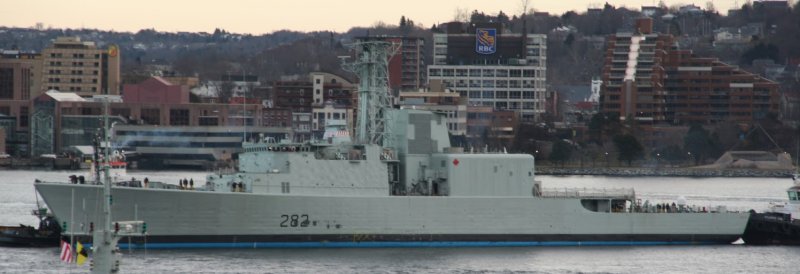
HMCS Athabaskan damaged while under tow

Filed under: Cancon, Military — Tags: , , , , , — Nicholas @ 00:01

One of the Royal Canadian Navy’s destroyers was supposed to have finished a refitting back in November, but due to delays in the work had to be towed back to Halifax. On the way, further problems arose:

A navy destroyer moored in Cape Breton has been damaged and was set adrift while under tow after problems arose with repair work carried out at an Ontario dockyard, the military said Thursday.

HMCS Athabaskan drifted for several hours off Scatarie Island on Friday after the tow line broke, said Capt. Doug Kierstead of the Royal Canadian Navy in Halifax.

Kierstead said there is damage to the hull behind the ship’s identifying numbers, though he declined to say what the damage was and how it came about.

“At this point all I can say is that we are aware that there is damage visible,” Kierstead said in an interview.

He said the vessel was supposed to have undergone a routine refit by the end of November last year and was expected to be capable of sailing after that work was completed at Seaway Marine and Industrial Inc. in Welland, Ont.

HMCS Athabaskan 282
Photo from Wikimedia

« Newer PostsOlder Posts »

Powered by WordPress