
It was often said that a journalist writing about a foreign country ought to stay either three days or three years: the former for strength of impression, or that latter for depth of knowledge.
I was a three-day man in that period of my life when newspapers would occasionally ask me to report on some revolution, civil war, social upheaval or other unusual event (I once went on a daytrip to India from Europe).
Given the circumstances, I gathered much of my information from the taxi-driver from the airport to the hotel where all the other journalists were staying. They did likewise, and in many an article, even in serious publications, a journalist has acted as a mere amanuensis for a taxi-driver.
I am far from decrying this genre of journalism: in my experience, taxi-drivers are exceptionally sensible and level-headed men, intelligent and well-informed but not educated, or rather not indoctrinated into believing the most obvious nonsense by having attended western-type establishments of supposedly higher learning.
Knowing that a journalist is a bird of passage, they did not fear, even in dictatorships, to speak the truth as they saw it: and generally they had seen a lot. With the advent of the mobile phone that hears everything and erases nothing, they may since have become more cautious. I don’t know: no one sends me anywhere these days.
Theodore Dalrymple, “On Taxi Cab Drivers, Barbers, and Learning the Truth”, The Iconoclast, 2021-06-21.
November 2, 2021
QotD: The foreign journalist’s best local source, the cabbie
October 26, 2021
“…watching The Media spin for Brandon; it’s just so Pravda-licious”
Severian manages to find entertainment in the full-blown propagandization of “The Media”, especially during the course of the Wuhan Coronavirus pandemic:

Wuhan Institute of Virology.
Wikimedia Commons.
Back when the Kung Flu nonsense first started, I took it quasi-seriously. Let me clarify: Like America’s greatest philosopher, I assume that everything in the newspaper is 90% bullshit, and I read it because it entertains me. Nonetheless, the bullshit operates on several levels, and it’s important to distinguish between them if you want to extract more than entertainment from it. In the case of Covid, back in the earliest days, I assumed that the bullshit was more top tier — that is, that it was mostly ignorance.
Media people are stupid. We all know that, but unless you’ve been around them (or their inbred, banjo-picking cousins, academics) recently, you probably don’t realize just how stupid they actually are. Remember Michael Crichton’s bit about “Gell-Mann Amnesia“? He said that The Media are so dumb, they routinely get important things not just wrong, but completely backwards: The headline would read the equivalent of “Wet Streets Cause Rain”.
And to be fair to The Media — I know, I know, but again, if you want anything more than a chuckle from the propaganda, you must try — it really did seem to be more ignorance than anything. I’m the kind of guy who needs to pull off a sock every time he has to count past ten, but compared to everyone in The Media I’m Euclid himself. I could see right away that the numbers they were spouting would make Kung Flu exponentially more lethal than even the Black Plague, which would, you know, tend to show up on satellite reconnaissance. And since there’s this thing called “Google Earth” …
But even though I knew right away you’d need to scale back their projections by a factor of about eleventy billion, that wasn’t the end of it, because even doing the necessary mental math to scale it down by eleventy billion — take the cosine, carry the one, divide by zero — it still looked pretty bad. But not “pretty bad” in a factual way. Rather, pretty bad in a second-level bullshit way, the mere propaganda way.
Those were the days, you might recall, when — out of the blue, on a dime — the Official Story changed from “China categorically denies there’s any such thing as germs, much less this particular strain of flu” to “OMG, the Chinese are welding apartment doors shut as people keel over in the streets.” Accompanied, in some cases — and good luck finding those video clips now — with grainy little movies of obvious actors keeling over so hammily, Al Pacino himself would tell them to tone it down. Pravda et al would never have been so crude, but those guys were pros, and as bad as the USSR was, affront-to-basic-intelligence-wise, this is Clown World.
Sure enough, the stories soon came out that China had cornered the market on PPE gear. It was an obvious short con, but remember: Clown World.
This — the CCP cornering the PPE market — soon prompted the third level of Media bullshit, the ideological level. Not content to merely take orders from their Chinese paymasters, the Media, being ideology-addled prize graduates of American “higher” “education”, started taking it upon themselves to lecture us for our own good. Masks, which were once bad, were now good, and if one mask was good, then two were even better! Thus the flood of stories like the one covered at the old RC, where the woman went on about swabbing her eyelids with disinfectant and whatnot. They got their chance to hector us for our own good, and they will never turn that down.
October 14, 2021
QotD: Americans’ perception of foreign economic threats
And when it does Americans will learn nothing from their most recent mistake. If people really understood sound economics, they would not continue to make this same mistake again and again.
Robert Higgs, “China — Americans’ Economic Bugaboo du Jour”, The Beacon, 2018-12-19.
September 1, 2021
Larry Elder’s campaign for governor hit with accusations of “white supremacism”
In City Journal, Heather Mac Donald looks at the recent hysterical attacks on gubernatorial hopeful Larry Elder based on the notion that he is somehow a kind of stalking horse for white supremacists:
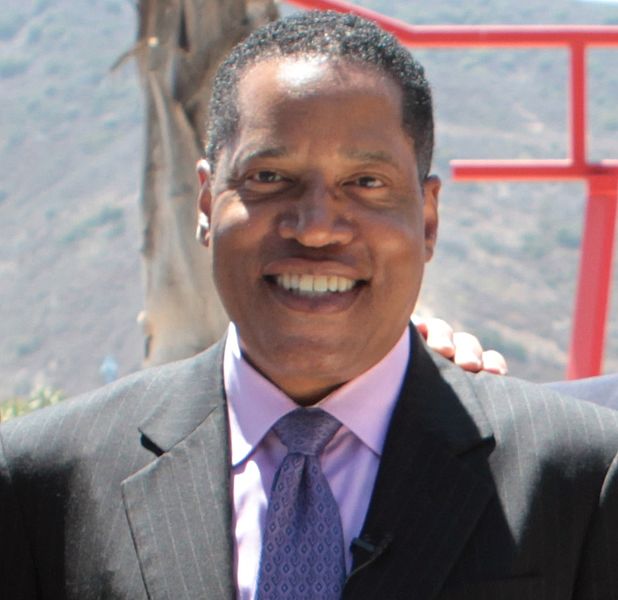
Larry Elder at Camp Pendleton for the ceremony presenting the Congressional Gold Medal posthumously to his father, Staff Sergeant Randolph Elder, U.S.M.C., 16 August, 2013.
US Government photo in the public domain via Wikimedia Commons.
The possibility that Larry Elder may win California’s recall election against Governor Gavin Newsom is generating acute anxiety in the mainstream media and among the activist Left. Elder’s foes are responding with their favored means of destruction: by playing the race card. Never mind that the nationally syndicated talk show host is black. A series of opinion columns and editorials have accused him of being a white supremacist, or at the very least a shill for other white supremacists. Elect Elder and California will reinstate Jim Crow, state senator Sydney Kamlager, a Democrat from Los Angeles, has warned.
The media have focused particularly on Elder’s views about crime and policing. The self-described “Sage from South-Central” maintains that criminals, not the police, are the biggest threat in the black community. According to Elder, the false narrative about lethal police racism has only led to more black homicide deaths. “When you reduce the possibility of a bad guy getting caught, getting convicted and getting incarcerated, guess what? Crime goes up,” he said recently at a campaign event in Orange County.
Elder also rejects the charge that white civilians are gunning down blacks, as LeBron James maintained in a tweet during the George Floyd riots: “We are literally hunted everyday, every time we step outside the comfort of our homes.” Elder has a different take. If a “young black man is eight times more likely to be killed by another young black man than [by] a young white man,” Elder told the Orange County Republicans, then “systemic racism is not the problem.”
Such statements are anathema to the establishment Left, deeply invested as it is in the idea that blacks have little agency in the face of ubiquitous white racism. Few subjects are more taboo in elite discourse than the elevated rate of crime among blacks, as it suggests cultural pathologies that — at the very least — complicate the victim narrative. To the Left, black crime is little more than a racist fiction. Los Angeles Times columnist Jean Guerrero claims that the crime statistics Elder has cited “over the decades to support his views and policy proposals are misleading, if not outright false, casting Black people as unusually crime-prone.” Black people are not “more inclined toward violent crimes,” nor do blacks “disproportionately victimize whites,” Guerrero wrote, citing Columbia law professor Jeffrey Fagan and other criminal experts. (Fagan was the plaintiff’s expert in a trilogy of lawsuits against the New York Police Department in the 2010s.) Fellow Times columnist Erika Smith sneered that Elder “keeps trotting out statistics that purport to show that Black people are particularly prone to murdering one another.”
Unfortunately for Elder’s critics, the statistics showing vastly disproportionate rates of black crime and victimization come from some of the Left’s favorite sources. CDC data show that in 2015, for example, the homicide victimization rate for blacks aged 10–34 (37.5 per 100,000) was 13 times the rate for whites (2.9 per 100,000). That disparity is undoubtedly much greater now, given the record-breaking increase in homicides since the George Floyd riots — an increase disproportionately affecting blacks.
Those black victims of homicide are not being killed by cops or whites. They are being killed by other blacks. In Los Angeles, blacks this year have committed 46 percent of homicides whose offender is known, even though they are just 9 percent of the Los Angeles population. Whites make up 28 percent of the Los Angeles population but have committed 4 percent of homicides, mostly involving domestic violence. These data, reported by the Los Angeles Times, mean that a black Angeleno is 35 times more likely to commit a homicide than a white Angeleno. Homicide data are the gold standard for crime statistics. Alas for Jeffrey Fagan and the Los Angeles Times‘s other experts, the statistical conclusion that blacks are “more inclined toward violent crimes” is indisputable.
August 25, 2021
QotD: What Hamas says versus how western media reports what they said
“We will kill the sons of pigs and apes like the great Hitler.”
Western reporter: “So what you’re saying is that you object to right-wing Israeli politicians like Netanyahu.”
“We want an Islamic state governed by sharia.”
Western reporter: “Democracy, one-person, one-vote, religious freedom for all. Got it.”
“We thank our great friends in Iran for their money, missiles, and bombs.”
Western Reporter: “Hamas insists on being a grassroots Palestinian movement not dependent on foreign support.”David Bernstein, “It must be frustrating being a Hamas spokesman”, Instapundit, 2021-05-22.
August 23, 2021
The dying media’s strange obsession with the Green Party
The Green Party gets far more media attention in Canada than their vote totals or influence on goverment policy could possibly justify. Their ongoing attempts to commit media character assassination of their own leader might be the first time in living memory that the party’s antics might — might — justify it. The Line explains some of the dramedy in Greentopia:

“Annamie Paul with Green Party of Canada supporters” by Annamie Paul is licensed under CC BY-SA 4.0


One of us, just a couple of days ago, was standing around in our increasingly tattered casual wear and making a sandwich with the TV on in the background. A local news channel was showing Green party leader Annamie Paul speaking. So we changed the channel, because the Greens are irrelevant. But the next channel was also showing the same feed. We tried two others. It was all the same goddamned feed. And two of those networks were national. Viewers from coast to coast had a chance to hear, for an extended period, from a woman so thoroughly doomed that she’s not even pretending to run a national campaign. All she can muster is an attempt to win her seat in downtown Toronto.
Look, we don’t know who needs to hear this, but at the national level, the Greens are zeroes. Sorry, not sorry. Frankly, the Greens have long gotten too much attention in Canadian politics, which is a result of a few quirky things all aligning in their favour: Elizabeth May’s admittedly effective relentless self-promotion, the coffer-stuffing effect of the per-vote-wage subsidy, and, the politeness of Canadian media leaders who felt awkward saying no to Lizzie.
This is not to say that there are not serious Greens, nor that the Green party has not put forward some serious policy proposals. There are, and they have. The issue is that under our electoral system, the Greens don’t matter. And their strident complaining about their irrelevancy doesn’t actually make them relevant.
We glanced at recent vote tallies. The Greens generally get around five per cent or so, sometimes a point or two higher, sometimes a point or two lower. That ain’t nothing. But it is not enough to make them a meaningful electoral force in anything but a tiny handful of seats — or in really weird, bizarre vote-splitting scenarios, and those are very rare. We don’t believe there’s some magic level of popular support at which a party deserves serious consideration or not, it all depends on the context. The Bloc doesn’t get a ton of votes, either (though never less than the Greens), but since they only run candidates in Quebec, their efficient vote means they have a pretty consistently good chance of winning enough seats to matter in parliament. The Greens … don’t.
And that is in normal times. These aren’t normal times. Annamie Paul is a perfectly serious, credible person. The fact that her party is trying to back a cement truck over her in full view of 38 million witnesses simply confirms our instinct to ignore the party she leads. Most elections, you could argue that it’s a shame that the Greens don’t have an actual chance. This election, we’re thanking God for it.
Deciding how much attention to give a candidate or party is usually pretty easy. Outside Quebec, the big three — Tories, Liberals and NDP — get proper coverage, within the context of local circumstances and the dynamics of individual campaigns (ignoring a CPC also-ran in deepest Toronto isn’t going to break any hearts, nor the sacrificial Liberal in rural Alberta). The gamut of weirdo fringe parties are basically ignored. In Quebec, the Bloc warrants consideration alongside the big three.
What screws all this up, though, are the Greens and the People’s Party. They don’t warrant serious consideration, per se, but they will draw a fair number of voters. What to do with these?
July 27, 2021
Kurt Schlicter on the gimps of the White House press corps
At TownHall, Kurt Schlicter expresses his disregard for the media who are supposed to be covering the White House and are voluntarily muzzling themselves and acting more like the ministry of propaganda than the free press. At least in Canada, they have the excuse that they’re paid prostitutes for whatever their federal pimps want them to say … in the United States that’s not (yet) the case:
You gotta love the lib reporters meekly accepting the delicious iron discipline of black-clad Mistress Psaki as she demands “Why do you need to have that information?” when asked about the number of infectos in the petri dish that is the * White House. The only way that kink-fest could have been more on the nose with regard to who our esteemed journalismers actually are is if her severe black outfit was vinyl. Apparently, getting flogged by the Democrat dominatrix turns their collective crank because they just took it. They always just take it. And our Fourth Estate will eagerly beg for more.
Now, it’s not even the gross double standard at play here that’s significant – imagine the fussy fury of the lib-simps if one of Trump’s vanilla spokespeople publicly abused them like that. We’ve learned that the lib-press is immune to shame, at least the kind that comes from having their rank hypocrisy exposed by conservatives. No, it’s that when their Dem domme cracks the whip, they just take it, meekly, obediently, like the groveling submissives they are.
Someday, someone will look back on this pathetic abdication of the media’s dignity and write a history of how the ink-stained wretches of the past became the craven conformists of today, and how now they revel in their own subjugation. Call it 50 Shades of the Gray Lady; when you read the hot scene in the forbidden White House press playroom at page 247, you’ll want to draw a warm bubble bath, light a lavender-scented candle, and pour yourself a goblet of Trader Joe’s screw-top chardonnay. Grrrrrrrr.
Imagine being these people. You can’t? Okay, then take a shot of Dickel Rye and try again to imagine being these people. They all grew up wanting to be the crusading Woodward and/or Bernstein – who themselves were less ace reporters than eager conduits for a disgruntled bureaucrat hack who exploited the callow correspondents to settle his personal scores – and instead they grew up to be the Gimp in the less interesting version of Pulp Fiction that is the DC milieu.
They aren’t breaking stories. They aren’t uncovering wrongdoing. They certainly are not comforting the afflicted or afflicting the comfortable. They are the ruling caste’s janitors. They are drones, thralls to their elite masters, marching in grim conformity in step to the official narrative, never complaining, never questioning, never dissenting. These are licensed, registered, regime journalists.
QotD: Walter Duranty’s Pulitzer
He won the Pulitzer Prize in 1934 for his reporting, but ever since 1990, when a biography of him was published that emphasized the extent of his mendacity, there have been efforts to have the prize symbolically rescinded (Duranty died in 1957).
A man may be honestly mistaken, but Duranty had knowingly and persistently lied about matters of world importance. At the very least he deserved the sack rather than a prestigious award, but was never called to account during his lifetime; and the Pulitzer committee has twice decided that the award should not be withdrawn.
I can see the argument for rescinding the prize because Duranty’s conduct was truly despicable, and the prize had been for what, morally, was a great crime.
But there is also an argument for not rescinding it, for the posthumous withdrawal of an award can look like an attempt to rewrite the history of the awarding authority by an act of auto-absolution. An admission that the Pulitzer committee had made a terrible error of judgment might have been sufficient.
Theodore Dalrymple, “Richard Dawkins Punished for Inviting Us to Think”, The Iconoclast, 2021-04-24.
July 25, 2021
QotD: The Two Rules of Modern Journalism
RULE # 2: Rule # 1 only applies to Republicans.
(And to anybody leaning conservative.)
For Democrats and leftists, the typical query is more along the lines of “pray enlighten us to your glorious plans for fundamentally transforming the United States of America (we will be quiet now).” (Close second: “kindly tell us how much people have suffered, and are still suffering, in this dreadful country of ours.”)
Erik, “The Two Rules of Modern Journalism”, ¡No Pasarán!, 2021-04-16.
July 24, 2021
Boris Johnson as a character-brought-to-life from Evelyn Waugh’s Scoop
In The Critic, Robert Hutton explains why so many members of the British press find Waugh’s satire of their trade so compelling:

Boris Johnson, Secretary of State for Foreign and Commonwealth Affairs at an informal meeting of the Foreign Affairs Council on 15 February 2018.
Photo by Velislav Nikolov via Wikimedia Commons.
For a British reporter, Scoop is the holy text of the job. One of the enduring mysteries of journalism is that a trade which employs large numbers of skilled writers, and puts them into interesting situations every day, has been the subject of so few really good novels. Scoop was written as satire, but eight decades after it was published, and after the industry has gone through two technological revolutions, it remains the best description of UK journalistic life.
While parts of the job have changed — copy is no longer filed in an abbreviated telegramese to reduce transmission costs — much remains the same. Anxious newspaper executives still live in terror of capricious proprietors. Reporters still enjoy a strange fellowship of simultaneous competition and cooperation. Entertaining readers remains as important as informing them.
So how does the current British PM fit into all of this? Well, Boris had been a journalist:
Which brings us to Boris Johnson. As well as being Britain’s most successful politician, the prime minister has long been one of the country’s highest-paid journalists, a job he did entirely in the Scoop mould. His sympathetic biographer, Andrew Gimson, describes how, posted to Brussels, Johnson delighted in producing stories that were more entertaining than accurate. It was not that he was opposed to writing accurate stories, but he didn’t see it as in any way essential.
The Scoop character Johnson most resembles isn’t the hero — Boot is too naïve, his reports too close to reality. Nor is the press corps regulars, Corker, Shumble, Whelper and Pigge, who huddle in the same hotel, lest they will be beaten on a story. Johnson, both as journalist and politician, has generally preferred to hunt alone. We must look to the man Boot replaced at the Beast, foreign correspondent Sir Jocelyn Hitchcock.
Like Johnson, who was hazy on the outcome of the Battle of Stalingrad, Sir Jocelyn is more confident than he should be about history (“He was wrong about the Battle of Hastings,” says Lord Copper. “It was 1066. I looked it up”). He hides in his hotel room before filing an entirely imaginary interview — something else for which Johnson has form. Sir Jocelyn was, pleasingly, modelled on Sir Percival Phillips, a correspondent for the Daily Telegraph, which would later employ Johnson.
Sir Jocelyn’s fabrications didn’t hold him back, and Johnson’s propelled him to the front rank of journalism, then into politics, where he exhibits the same behaviour: the pursuit of a higher “truth” unburdened by facts, the deadline mentality, the reluctance to correct mistakes, the assumption that someone else should pick up the bill. Johnson was neither the kind of journalist nor a prime minister who would read a study on, say, pandemic preparedness. A leaked document from his first months in the job showed him describing Cameron as a “girly swot” for wanting to show that MPs were hard at work.
July 22, 2021
Conservative cancel culture?
Kurt Schlichter addresses the notion that “cancel culture” is alive and well among conservatives as much as it is among progressives:

“A little Black Rifle Coffee pour over this morning.” by jonmrogers is licensed under CC BY 2.0
Is there a conservative cancel culture? No. What there is now is a consensus among conservatives that we will refuse to subsidize institutions and entities that hate us. “Cancel culture,” properly understood – in this time of words meaning whatever they need to mean at any given moment, I’m going to have to insist on fixed definitions – is the attempt to use formal and informal sanctions to stop people from expressing dissenting views. But conservatives don’t care what the conservatives who cry about it when they are caught shafting us – hi Kristi! – think; conservatives care about what these people do or don’t do. Labeling our rejection of squishes and RINOs as “cancel culture” is a cheesy attempt to stop us from insisting that conservatives actually conserve. If the left, and the GOPuffballs, want to call this act of self-preservation “cancel culture” and shame us into unilateral disarmament in the name of some sort of pseudo-consistency, let them try. We’re not tying ourselves up with alleged “principles” anymore; ideological bondage is not our scene.
[…]
There was a certain coffee company created by vets that embraced a kind of vet-bro/gun vibe and it worked hard to cultivate a following in the conservative community. And then they stamped their combat boots hard on their own tender beans. Black Rifle Coffee Company’s problem provides an important lesson not just for companies seeking to operate on the conservative tip, but for GOP politicians as well.
What happened? BRCC gave an interview to The New York Times that many cons saw as taking sides against us conservatives. Did it or didn’t it take sides against us? The company denies it and is trying to repair the damage, but the facts of the case are not the point we are discussing here – the point is how conservatives, the cheated-on wives of American politics, reacted when they felt, rightly or wrongly, betrayed.
The conservatives went nuclear. Here’s the thing a lot of people seem to not understand. No faction has been screwed over by its own side more than conservatives. How many politicians, when they had the power to do the conservative things they ran on, opted for favorable WaPo coverage over keeping their promises? The incentives to cooperate are huge … like coverage in the DC paper of record explaining how one has “grown”. But we’re done with the bait-and-switch. We’re super-sensitive and super-suspicious, because we’ve been burned before.
So, conservatives have a hair trigger for perceived betrayal – if they even suspect it, they go off. Those seeking our support should act accordingly, as cons have been serially betrayed for decades. Take W, please, back to his ranch to paint his paintings. But before you do, remember what he did to all of us who defended him when he refused to defend himself – he talked smack about us as he partied with his new pals the Clintons and Obamas.
The Ahoy Crew used to at least pretend to be with us – Cap’n Bill Kristol, David Aptly-Named French, Jonah Heavy G Goldberg, and the rest turned on us the second they perceived their sinecures were in peril due to our swelling demand for actual victory.
Them or us. Pick one. But you can’t choose both, or neither.
Update: The CEO of the company is either in desperate damage control mode or genuinely upset at the misrepresentation of his views by the New York Times:
Let’s get the air cleared right away. Black Rifle Coffee’s founder and CEO has spoken out and is disputing how his comments were presented by the New York Times and represented by those reacting to the article, who were led to believe that Black Rifle Coffee bashed conservatives.
Evan Hafer decided to set the record straight regarding the “significant amount of misinformation being put out on the internet” about Black Rifle Coffee and about statements that he has made.
Hafer quickly debunked the notion that he made derogatory remarks about BRCC’s customers or conservatives and then proceeded to explain how the New York Times deliberately twisted his words and took them out of context. According to Hafer, his conversation with the NYT Magazine reporter was in the context of racism and anti-Semitism in America in light of Hafer being the target of an organized attack last year because of “my last name and my heritage.”
“We were purely discussing that,” Hafer says, and he was not conflating those groups with conservatives.
“The New York Times, as we know, the chances of them being objective were fairly slim, but we gave them the opportunity,” he added. He went on to mention veterans issues he hoped to bring attention to. But, unfortunately, the New York Times chose to go with “the salacious headline” about the company instead.
Hafer reiterated that racists and anti-Semites have no place in his company.
July 20, 2021
Kurt Westergaard, RIP
Mark Steyn on the life and work of cartoonist Kurt Westergaard:
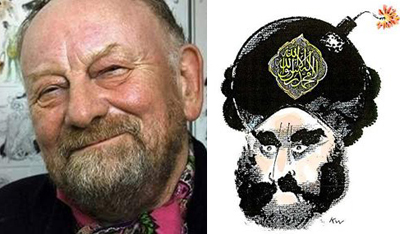
Kurt Westergaard and I were successive winners of the Danish Free Press Society’s Sappho Award. I was very flattered to find myself in his company, but couldn’t honestly say I deserved to be. Kurt was one of the bravest men of our time – not because he was inclined to bravery, but simply because, when it was required, he met the challenge and never backed down.
Sixteen years ago Flemming Rose of the Danish newspaper Jyllands-Posten decided to conduct a thought experiment in public after an author casually revealed that he couldn’t find any Danish artist willing to illustrate his book about “the Prophet Mohammed” (as the BBC now routinely styles him). So Flemming called twelve cartoonists and invited them to depict the late Prophet. Kurt Westergaard’s cartoon was the memorable one, and the one you recall as the years roll by. It was a pithy visual jest: Mohammed’s turban as a bomb with a lit fuse. See picture at top right.
“I attempted to show that terrorists get their spiritual ammunition from parts of Islam, and with this spiritual ammunition, and with dynamite and other explosives, they kill people,” Kurt told my old newspaper The National Post a few years back. “I showed this in a cartoon and what happened? They want to kill me, so I think I was right.”
An otherwise courtly, cultured Dane, Kurt Westergaard had a somewhat arresting dress code, preferring le rouge et le noir, the colors of anarchists, although, as a practical matter, it’s hard for a man of advanced years to carry off red trousers, whatever his motivation. He would qualify his pantaloons by explaining that he was not a political anarchist but a cultural one. Still, one can gather from the garb alone that Westergaard was no “right-winger”. Like most of the men and women I have shared a stage with in Europe this century, he was an old Sixties radical sufficiently principled to think the same kind of jokes he’d applied to church, monarchy, parliament and every other societal institution should also be applied to Islam. He never wanted to be a “free speech hero”, but gamely bore the burthen once it had been dropped on him. He certainly never wanted to be world-famous, albeit more so in Mogadishu than Manhattan and Lahore than Los Angeles. It cost him a comfortable retirement, weakened his health, and an ever more craven culture denied him the consolations of monetary exploitation. When I expressed sympathy, he laughed and said he’d do the same cartoon all over again even knowing what he was in for.
The blood lust began with a trio of imams on the make shopping the twelve cartoons (plus three cruder fakes) round the Muslim world, and leaving it to the usual Islamonutters to take it from there: In nothing flat, over two hundred people were dead – which meant that CNN & Co were obliged to cover the story. They did so by modifying Westergaard’s cartoon, with Mohammed’s face pixilated, as if he’d entered the witness protection programme. If only. In reality, it was that dwindling band of people who believe in free speech – and, indeed, free speech itself – that found itself in the witness protection programme.
July 16, 2021
Do US intelligence agencies only work on domestic surveillance these days?
Matt Taibbi discusses the (recent?) US intelligence agencies’ apparent concentration on domestic “enemies” like Republicans, Jewish organizations, conservative broadcasters, and US Presidents and their appointed officials:

The scene was perfectly representative of what the erstwhile “liberal” press has become: collections of current and former enforcement types, masquerading as journalists, engaged in patriotic denunciations of critics and rote recitals of quasi-official statements.
Not that it matters to [Fox TV host Tucker] Carlson’s critics, but odds favor the NSA scandal being true. An extraordinarily rich recent history of illegal, politically-directed leaks has gone mostly uncovered, in another glaring recent press failure that itself is part of this story.
It’s admitted. Go back to December, 2015, and you’ll find a Wall Street Journal story by Adam Entous and Danny Yadron quoting senior government officials copping to the fact that the Obama White House reviewed intercepts of conversations between “U.S lawmakers and American-Jewish groups.”
The White House in that case was anxious to know what congressional opponents to Obama’s Iran deal were thinking, and peeked in the electronic cookie jar to get an advance preview at such “incidentally” collected info. This prompted what one official called an “Oh, shit” moment, when they realized that what they’d done might result in “the executive branch being accused of spying.”
After Obama left office, illegal leaks of classified intercepts became commonplace. Many, including the famed January, 2017 leak of conversations between Michael Flynn and Russian ambassador Sergei Kislyak, were key elements of major, news-cycle-dominating bombshells. Others, like “Russian ambassador told Moscow that Kushner wanted secret communications channel with Kremlin,” or news that former National Security Adviser Susan Rice unmasked the identities of senior Trump officials in foreign intercepts, were openly violative of the prohibition against disclosing the existence of such surveillance, let alone the contents.
These leaks tended to go to the same small coterie of reporters at outlets like the Washington Post, New York Times, and CNN, and not one prompted blowback. This was a major forgotten element of the Reality Winner story. Winner, a relatively low-level contractor acting on her own, was caught, charged, and jailed with extraordinary speed after leaking an NSA document about Russian interference to the Intercept. But these dozens of similar violations by senior intelligence officials, mainly in leaks about Trump, went not just unpunished but un-investigated. As Winner’s lawyer, Titus Nichols, told me years ago, his client’s case was “about low-hanging fruit.”
June 17, 2021
QotD: Declaring war on the Upper-Class Media
67% of US families watch the Super Bowl — what percent of New York Times editors and reporters do? 20% of Americans go to religious services weekly — how many of those work for the New York Times? How come 96% of political donations from journalists go to Democrats? Your job is to take a page from the Democratic playbook and insist there is no reason any of this could be true except systemic classism, that any other explanation is offensive, and it’s the upper-class media’s moral duty to do something about this immediately. Until they do so you are absolutely justified in ignoring them and trusting less bigoted and exclusionary sources (I hear Substack is pretty good!)
Insist that working-class people have the right to communicate with each other without interference from upper-class gatekeepers. Make sure people know every single fact about @Jack and what a completely ridiculous person he is, and point out that somehow this is the guy who decides what you’re allowed to communicate with your Twitter friends. Every time tech companies censor social media, even if they’re censoring left-wing views, call their CEOs in for long and annoying Congressional hearings where you use the words “Silicon Valley elites” a lot.
Scott Alexander, “A Modest Proposal For Republicans: Use The Word ‘Class'”, Astral Codex Ten, 2021-02-26.
June 10, 2021
QotD: “Defending” democracy using totalitarian methods
These people don’t see that if you encourage totalitarian methods, the time may come when they will be used against you instead of for you. Make a habit of imprisoning Fascists without trial, and perhaps the process won’t stop at Fascists. Soon after the suppressed Daily Worker had been reinstated, I was lecturing to a workingmen’s college in South London. The audience were working-class and lower-middle class intellectuals — the same sort of audience that one used to meet at Left Book Club branches. The lecture had touched on the freedom of the press, and at the end, to my astonishment, several questioners stood up and asked me: Did I not think that the lifting of the ban on the Daily Worker was a great mistake? When asked why, they said that it was a paper of doubtful loyalty and ought not to be tolerated in war time. I found myself defending the Daily Worker, which has gone out of its way to libel me more than once. But where had these people learned this essentially totalitarian outlook? Pretty certainly they had learned it from the Communists themselves! Tolerance and decency are deeply rooted in England, but they are not indestructible, and they have to be kept alive partly by conscious effort. The result of preaching totalitarian doctrines is to weaken the instinct by means of which free peoples know what is or is not dangerous. The case of Mosley illustrates this. In 1940 it was perfectly right to intern Mosley, whether or not he had committed any technical crime. We were fighting for our lives and could not allow a possible quisling to go free. To keep him shut up, without trial, in 1943 was an outrage. The general failure to see this was a bad symptom, though it is true that the agitation against Mosley’s release was partly factitious and partly a rationalisation of other discontents. But how much of the present slide towards Fascist ways of thought is traceable to the “anti-Fascism” of the past ten years and the unscrupulousness it has entailed?
George Orwell, Unpublished Preface to Animal Farm, 1945.


