Quotulatiousness

July 4, 2011

Britain’s overdue defence reforms

Filed under: Britain, Bureaucracy, Military — Tags: , , — Nicholas @ 09:30

Britain has, proportional to American forces, four times the number of general officers. This is a visible sign of an unbalanced force. The current government has announced some changes that may begin to correct this problem:

George Osborne, the chancellor of the exchequer, reportedly observed that the defence budget was “the most chaotic, the most disorganised, the most overcommitted.” In addition to the 8% cut in its funding (over four years) demanded as part of the government’s fiscal-austerity plan, the Ministry of Defence (MoD) has somehow to close an unfunded liability of £38 billion ($61 billion) up to 2020. This week, just before announcing a major shake-up of the way his department and the armed forces are run, Dr Fox said: “The future defence programme was worse than a delusion — it was a deliberate lie.”

The problem with correcting long-term issues like those in the MoD is that you have to maintain the active forces at a minimum level of effectiveness while addressing issues that may have been developing for a generation. I’ve mentioned in earlier posts how the most effective arm of the British forces in the last ten years has clearly been the Royal Air Force — not so much for their performance of their military duties, but for the skill with which they outmatched the army and the Royal Navy in bureaucratic infighting. The RN has been gutted, losing their force projection capabilities (the aircraft carriers), the army has been left over-extended and lacking airlift capabilities, while the RAF has kept their core anti-Soviet flying white elephants almost completely untouched by budget cuts.

At the heart of Lord Levene’s plan is a new slimmed-down Defence Board, the MoD’s senior decision-making body, which will be chaired by the secretary of state and will no longer include the three service chiefs. There will be a fresh emphasis on integrating the armed forces through the establishment of a Joint Forces Command led by a four-star officer. That will bring together capabilities such as logistics, planning, intelligence, cyber and some equipment purchases. Dr Fox sees the Joint Forces Command as both an important organisation in its own right and a symbol of the ethos of co-operation and flexibility he wants to cultivate.

One consequence is that the role of the three service chiefs in influencing departmental strategy and resource allocations will be sharply reduced. They will be kept busy by being given greater responsibility for managing their own budgets. Lord Levene also wants to see a halt to the merry-go-round of staff changes that undermines accountability by insisting that senior military and civilian staff should stay in their posts for at least four years.

June 17, 2011

Argentina: British PM “stupid” about the Falkland Islands

Filed under: Americas, Britain, Military — Tags: , , , , — Nicholas @ 09:39

Remember when the Royal Navy got gutted, reducing their ability to project force outside European waters? It appears that Argentina has drawn the obvious conclusion that the Falkland Islands are now back in play:

The Argentinian president has criticised David Cameron for insisting the Falkland Islands should remain a British territory.

Cristina Kirchner described the prime minister as “arrogant” and said his comments were an “expression of mediocrity and almost of stupidity”.

Cameron had been prompted by Conservative MP Andrew Rosindell during prime minister’s questions to remind Barack Obama that the British government would not accept any kind of negotiations over the south Atlantic islands, over which Argentina and Britain fought a 10-week war in 1982.

Cameron told the Commons: “I would say this: as long as the Falkland Islands want to be sovereign British territory, they should remain sovereign British territory — full stop, end of story.”

In her criticism of his comments, Kirchner said Britain “continues to be a crude colonial power in decline”.

Well, Mr. Cameron, you’ve given Argentina a ten-year window of opportunity here between your (in my opinion stupid) scrapping your last carriers and getting rid of their Harrier aircraft and the time that your next carrier comes into service. By the time you have HMS Queen Elizabeth in commission and with a full complement of aircraft, the Falkland Islands will likely be under Argentinian control.

If the government of Ronald Reagan had to be pushed into supporting Britain in 1982, there’s absolutely no chance that Barack Obama will lift a finger to help Britain in 2012 — in fact, it’s much more likely that Obama will decide that Argentina is more deserving of American help anyway.

June 10, 2011

Royal Navy still regrets decision to retire their aircraft carriers

Filed under: Africa, Britain — Tags: , , — Nicholas @ 12:56

With a significant portion of the Royal Navy deployed in the Mediterranean, the hasty decision to take HMS Ark Royal out of service looks even dumber now:

Just at the very moment that the decisions of the October 2010 “Strategic Defence Review” start to bite, the Royal Navy is being asked by government to do more than ever. With the crisis in Libya and the Middle East showing no signs of ending, RN warships are spread thin across the globe. A quick snapshot of the fleet shows the pace of operations. With such a tiny fleet, our naval ports are almost empty and there are few vessels able to provide reliefs should the Libya crisis continue or escalate.

RN ships involved in Operation Ellamy off Libya include HMS Ocean, HMS Albion, HMS Sutherland, HMS Liverpool, HMS Brocklesby and HMS Bangor and HMS Triumph. The RFA is playing an increasing role with RFA Fort Rosalie, RFA Wave Knight supporting them. RFA Argus, RFA Fort Victoria and RFA Cardigan Bay are ready off Yemen should UK citizens need to be evacuated. RN patrols in the Arabian Gulf continue (as they have since 1980) with HMS St Albans sailing this week to relieve HMS Iron Duke in addition to the 4 permanently deployed RN minehunters in the Gulf. HMS Richmond is involved in exercises in the Far East and HMS Edinburgh has sailed to relieve HMS York in the South Atlantic along with HMS Scott. RFA Wave Knight is in the Caribbean ready to provide relief in case of hurricanes.

That fleet is spread very thin indeed. If something else happens, the Royal Navy probably can’t provide any significant forces to address it: there aren’t any more ships to send.

June 9, 2011

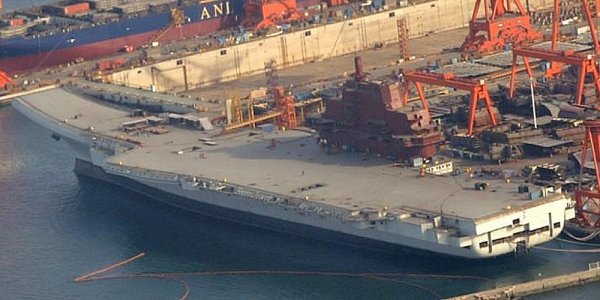
Is the Shi Lang a naval “Potemkin Village”?

Filed under: China, Military, Russia — Tags: , , , , — Nicholas @ 17:30

David Axe is not losing any sleep over the soon-to-be commissioned Chinese carrier Shi Lang:

Leaving aside her modest size compared to American carriers, her incomplete air wing and escort force and the fact that she’ll sail without the company of allied flattops, Shi Lang could be even less of a threat than her striking appearance implies. Shi Lang’s greatest potential weakness could be under her skin, in her Ukrainian-supplied engines.

Powerplants — that is, jet engines for airplanes, turbines for ships — are some of the most complex, expensive and potentially troublesome components of any weapon system. Just ask the designers of the Pentagon’s F-35 stealth fighter and the U.S. Navy’s San Antonio-class amphibious ships. Both have been nearly sidelined by engine woes.

China has struggled for years to design and build adequate powerplants for its ships and aircraft. Although Chinese aerospace firms are increasingly adept at manufacturing airframes, they still have not mastered motors. That’s why the new WZ-10 attack helicopter was delayed nearly a decade, and why there appear to be two different prototypes for the J-20 stealth fighter. One flies with reliable Russian-made AL-31F engines; the other apparently uses a less trustworthy Chinese design, the WS-10A.

For Shi Lang, China reportedly purchased turbines from Ukraine. Though surely superior to any ship engines China could have produced on its own, the Ukrainian models might still be unreliable by Western standards. Russia’s Kuznetsov, also fitted with Ukrainian turbines, has long suffered propulsion problems that have forced her to spend most of her 30-year career tied to a pier for maintenance. When she does sail, a large tugboat usually tags along, just in case the carrier breaks down.

If Shi Lang is anything like her sister, she could turn out to be a naval version of the mythical “Potemkin village” — an impressive facade over a rickety interior.

H/T to Nicholas “Ghost of a Flea” Packwood for the link.

June 8, 2011

China admits it’s hard to hide 1000ft-long aircraft carrier

Filed under: China, Military, Pacific — Tags: , , — Nicholas @ 07:44

China has finally gotten around to acknowledging that they’re rebuilding the former Soviet aircraft carrier for use by their navy:

Gen Chen Bingde refused to say when the carrier — a remodelled Soviet-era vessel, the Varyag — would be ready.

A member of his staff said the carrier would pose no threat to other nations.

The 300m (990ft) carrier, which is being built in the north-east port of Dalian, has been one of China’s worst-kept secrets, analysts say.

Gen Chen made his comments to the Chinese-language Hong Kong Commercial Daily newspaper.

Although the Chinese say that the ship, once ready for operations, won’t enter other countries’ territorial waters, keep in mind that China doesn’t have the same idea about maritime rights as others in the South China Sea region:

Earlier posts about the Shi Lang (nee Varyag) here.

June 3, 2011

China’s first aircraft carrier edges closer to readiness

Filed under: China, Military, Russia, Weapons — Tags: , , , — Nicholas @ 10:25

The Chinese navy is a bit closer to having an operational aircraft carrier, as the Shi Lang (formerly Varyag in Russian service) is being equipped with radar and weapons:

In the last month, the new Chinese aircraft carrier, the Shi Lang (formerly Varyag) has had several major electronic systems, and its first weapons, installed. The most notable electronic item to show up are the four AESA radar panels. This is a state-of-the-art radar similar to the one used in the American Aegis system. There were a lot of other electronic items being carried into the Shi Lang, indicating that the ship will be equipped with extensive networked computers and communications systems.

The two main weapons were also installed. One was a new version of the older, Type 730 seven barrel, 30mm close-in anti-missile automatic cannon. Operating like the American Phalanx, the new version of the Type 730 seen on the Shi Lang had ten barrels. The other weapon was the FL-3000N anti-missile systems. These are similar to the American RAM anti-missile missile system, except that they come in a 24 missile launcher and are less accurate. FL-3000N was only introduced three years ago, and uses smaller missiles than RAM. The two meter long FL-3000N missiles have a max range of nine kilometers (about half that for very fast incoming missiles). The 120mm, two meter long missiles now use a similar guidance system to RAM, but are not as agile in flight.

[. . .]

The Shi Lang/Varyag is one of the Kuznetsov class carriers that Russia began building in the 1980s. Originally the Kuznetsovs were to be 90,000 ton, nuclear powered ships, similar to American carriers (complete with steam catapults). Instead, because of the high cost, and the complexity of modern (American style) carriers, the Russians were forced to scale back their plans, and ended up with 65,000 ton (full load) ships that lacked steam catapults, and used a ski jump type flight deck instead. Nuclear power was dropped, but the Kuznetsov class was still a formidable design. The 323 meter (thousand foot) long ship normally carries a dozen navalized Su-27s (called Su-33s), 14 Ka-27PL anti-submarine helicopters, two electronic warfare helicopters and two search and rescue helicopters. But the ship was meant to regularly carry 36 Su-33s and sixteen helicopters. The ship carries 2,500 tons of aviation fuel, allowing it to generate 500-1,000 aircraft and helicopter sorties. Crew size is 2,500 (or 3,000 with a full aircraft load.) Only two ships of this class exist; the original Kuznetsov, which is in Russian service, and the Varyag. Like most modern carriers, the only weapons carried are anti-missile systems like Phalanx and FL-3000N, plus some heavy machine-guns (which are often kept inside the ship, and mounted outside only when needed.) However, Russian practice was been to sometimes install long range anti-ship missiles as well. China may also do this with Shi Lang.

June 2, 2011

When shipyards produce pork instead of effective ships for the Navy

Filed under: Military, Politics, USA — Tags: , , , , — Nicholas @ 12:07

Shipbuilding for the navy has traditionally been a good source of pork for politicians to dole out as their political fortunes require. The US Navy is having monumental problems with the quality of ships, but the problem isn’t easy to fix:

The U.S. Navy continues to have serious problems with shoddy shipbuilders. The latest incident involved a support ship, the 12,000 ton, 172 meter (534 foot) long radar ship, the Howard O. Lorenzen. The ship recently failed its acceptance tests. The Lorenzen was built to carry a special, billion dollar, radar used to track ICBM tests. This tracking activity also supports verification of missile and nuclear weapons treaty compliance. The Lorenzen replaces a similar ship that is over 30 years old. The acceptance tests found serious problems with the steering, electrical system, damage control, anchor control, and aviation (helicopter) facilities. The yard that built the Lorenzen, VT Halter Marine, builds military and civilian ships, and has had problems with some of the other military ships it has built recently. Like the Lorenzen, the other ships were late, over budget and suffered quality control problems.

[. . .]

While the admirals are correct in blaming the shipyards for many of the problems, the navy shares a lot of the blame as well. It is, after all, the navy that draws up the contracts, and supplies inspectors during construction. However, inspectors are regularly deceived and lied to (about the quality of work and supervision and known defects being fixed). While Congressional interference can be blamed as well, in the end, it’s the navy that has the most to say, and do, about how the ships are built. The problem is, admirals who stand up and take on the contractors and politicians put their careers on the line. The ship builder deploys a large number of lobbyists and has many key politicians as allies.

[. . .]

The problems with nuclear subs and carriers were minor compared to the LPD 17 travails. Still, the sheer extent of the problems, across so many ships, is very disturbing. This may be why a growing number of admirals are willing to take career risks, and try for some fundamental reform, and finally fix the “system” that turns out more problems than warships. Victory is not assured. The shipyards and their suppliers have powerful allies in Congress. All that money translates into votes that gets incumbent politicians reelected. Congress is not inclined to attack this kind of patronage and pork, since nearly all members of Congress depend on it. The admirals can openly complain, but offended legislators can quietly cripple the careers of those critics. The smart money is betting against the good guys here. So far, the smart money is right. But the bad builder mess is so vast, expensive and messy that even many politicians are calling for some fundamental changes.

The poster children for defective ships is the San Antonio LPD 17 class of amphibious ships.

May 30, 2011

Formal review for Canadian defence policies?

Filed under: Cancon, Military — Tags: , , , , — Nicholas @ 08:46

David Pugliese has word that the “fully funded” Canada First Defence Strategy is going to be reviewed starting in late June:

Some are calling this a “Canada First Reset.” This review would look at what by how much this strategy is underfunded and how should DND proceed in the future on CFDS, according to sources. It was described to Defence Watch as a “step-back to look at the strategy” and an examination of what aspects of the plan — mainly within procurement — need to be dropped (something like….maybe JUSTAS) because of the lack of money.

My reaction? It’s all very interesting to say the least. That’s because the basis of this review team goes against what has been a DND/CF mantra for three years now: that is the Canada First Defence Strategy is fully funded.

Numerous generals and DND bureaucrats are on record stating that in no uncertain terms. No question about it. Period, full stop.

You may remember that a few defence analysts suggested the strategy was not proper funded and that the many projects outlined in the document wouldn’t see the light of day.

But those claims were dismissed outright.

Will a CFDS review committee even get off the ground considering that it has the potential to embarrass the government?

If the minister had been replaced, this might make some political sense: it’s a good opportunity to get in some significant change and the previous minister gets the “blame” for the change being necessary. Peter MacKay stayed on at the ministry, so that’s not the answer. It’s possible that the government, now in safe majority territory, can bear the burden of critically reviewing the CFDS without feeling the risk of triggering an election.

The CFDS was originally drawn up as a plan to address impending retirement of much of the Canadian Forces’ major equipment:

Over the next 20 years, six of the CF’s core equipment fleets will reach the end of their operational lives and will need to be replaced. These include destroyers, frigates, maritime patrol aircraft, fixed-wing search and rescue aircraft, next-generation fighter aircraft, and a new family of land combat vehicles and systems.

The question about whether the CFDS is fully funded, therefore, is key to addressing the real equipment replacement schedule. If the money isn’t there, something has to give.

May 25, 2011

How to cope with rapidly changing technology, Victorian style

Filed under: Britain, History, Military, Technology, Weapons — Tags: , , , — Nicholas @ 00:04

I just finished reading John Beeler’s Birth of the Battleship: British Capital Ship Design 1870-1881, which looks at a time where all the accepted norms of the previous three hundred years were all upset overnight.

In 1815, the Royal Navy was the unchallenged Mistress of the Seas: the most powerful navy in the world. France, the greatest threat to England and her trading empire, had just been destroyed as a military and naval power. The United States had survived the war, but had effectively been neutralized on the sea through much hard fighting. No other rival appeared close to challenging England’s primacy.

Fifty years later, the stasis is being broken technologically. Wind power is giving way to steam. Solid shell cannon are starting to give way to both larger and more complex weapons. Iron is starting to supplant oak as the material of choice for shipbuilding. The renowned duel between USS Monitor and CSS Virginia (formerly the USS Merrimac) sets all the major navies of the world busy considering how to protect their existing fleets and merchant vessels against the new threat of the ironclad.

The English government is suddenly faced with the stark reality that their entire fleet has become or is about to become obsolete. Neither Monitor nor Virginia are ocean-going ships, but the message is clear that no wooden vessel has a prayer of survival against the modern steam-powered ironclad. And even the greatest economic power in the world can’t replace an entire fleet overnight.

The Admiralty couldn’t depend on past experience for guidance, as everything they’d done for hundreds of years was now undecided: what kind of ships do you need to build? How will they be armed? How will they be armoured? How will they be propelled? Bureaucracies are, by nature, not well equipped to face challenges like this. The Royal Navy, from the late 1860’s until the late 1880’s struggled with finding the correct answer, or combination of answers, to meet the needs of the day.

I admit that my interest in British Imperial history fades very quickly after 1815 and only starts to pick up again in the 1870’s, and what little I’d retained of the reading I’d done left me with much disdain for the obvious pattern of muddle and stop-gap planning that clearly defined the Royal Navy’s approach to maintaining the fleet during that time period. I was very wrong in my assumptions, but I was far from alone.

To start with, I assumed that the retention of full sailing rig on steam-powered ships proved the raw incompetence of the Admiralty and their ship designers. What I failed to understand was that there were really two different navies operating under the same flag: the home fleet — close to home port with easy access to coal, drydock, and re-supply — and the colonial fleet which had none of those advantages. Merchant vessels of the 1850-1870 era could depend on refuelling at each end of their scheduled journeys (between fully equipped ports), while the Royal Navy could not. The steam engines of that time period were very inefficient and prone to breakdown: lose your engine in the Indian Ocean or the South Atlantic and you were almost certain to be lost. Sail was essential for Royal Navy ships outside home waters.

Iron as armour was a major step forward, but not without costs: it is far heavier than wood and because you needed it to protect the above-the-waterline essentials of the ship, it made it much harder to ensure that the ship would be stable and sufficiently buoyant in heavy seas (see the story of HMS Captain for an example of what could happen otherwise). It’s always been a rule of thumb in military affairs that you can’t protect everything: by trying to protect everything, you spread your forces (or your armour) too thin and you end up being too weak everywhere. This holds true especially for ship’s armour.

At the same time that you need to add armour to protect the ship, you also need to mount heavier, larger guns. Between placing your order with the shipyard for a new ship, the metallurgical wizards may have (and frequently did) come up with bigger, better guns that could defeat the armour on your not-yet-launched ship. Oh, and you now needed to revise the design of the ship to carry the newer, heavier guns, too.

The ship designers were in a race with the gun designers to see who could defeat the latest design by the other group. It’s no wonder that ships could become obsolete between ordering and coming into service: sometimes, they could become obsolete before launch.

The weapons themselves were undergoing change at a relatively unprecedented rate. As late at the mid-1870’s, a good case could be made for muzzle-loading cannon being mounted on warships: until the gas seal of the breech-loader could be made safe, muzzle-loaders had an advantage of not killing their own crews at distressingly high frequency. Once that technological handicap had been overcome, then the argument came down to the best way to mount the weapons: turrets or barbettes.

To the modern eye, the answer is obvious, but to the men responsible for making the decisions, it was far from obvious that the turret was the better answer. Turrets are heavier than barbettes and required clearer fields of fire (few masted-and-rigged ships could also carry turrets), and also generally required the turret to be mounted higher on the superstructure, which made the ship more top-heavy than an equivalent barbette vessel.

The other weapon controversy at the time was what the primary weapons of the battlefleet would be: gun, torpedo, or ram. The argument for the ram was the weakest, although CSS Virginia had done more damage to the Union fleet with her ram than with her guns. The torpedo was still in the transition stage from something that had to be physically pushed against an enemy ship (like a ram with an explosive charge) and the more modern notion of a self-propelled, unmanned weapon. Perhaps the argument was sealed by the accidental sinking of the HMS Victoria less than a decade later (a less-than-charitable interpretation of the event was fictionalized in Kind Hearts and Coronets in 1949).

In some ways it’s remarkable that the hidebound bureaucrats could keep up in the world’s first real arms race . . . and not only keep up, but stay (slightly) ahead. Each new class of battleship had to be equal to or better than the latest French, German, or Italian ships, yet also stay within fairly strict length, breadth, and displacement limits without going (too far) over budget. Oh, and also be capable of adaptation to whatever new naval gun had been introduced in the time between the ships being laid down and being brought into commission.

To the modern eye, even of someone who followed the general trend of naval technology, the Royal Navy of the early 1880’s looks like a random collection of misfit ships. What isn’t apparent is how much worse the picture could have been. Aside from the bombardment of Alexandria, the Royal Navy of Victoria’s reign exercised a policing rather than a strictly military role: they didn’t need to fight too often because they were clearly stronger than any potential adversaries.

May 20, 2011

Britain’s Type 45 destroyers finally get main armament

Filed under: Britain, Military, Weapons — Tags: , — Nicholas @ 14:29

Back in October, I linked to an article which told the sad story of the Royal Navy’s most expensive class of unarmed warships, the Type 45 destroyers. In November, I linked to another sad story about the £1.1bn+ lead ship of this class breaking down in mid-Atlantic and having to make an emergency stop in Halifax for repairs.

In the first bit of good news about the Type 45’s, they’re now finally getting their primary missile systems into service:

HMS Daring, first of the £1.1bn+ Type 45 destroyers now coming into service with the Royal Navy, has finally fired her primary (and only significant) armament, the Sea Viper missile system.

The glad news comes five years after the ship was launched, three years after she was accepted into the Royal Navy and well into the tenure of her third commanding officer.

It’s not all good news, however, as the Sea Viper may not be the wonder weapon it’s been implied to be:

Stripping away the hype, Sea Viper has never been tested against a supersonic target and there are no plans to do so — meaning that it would be a brave decision indeed to rely on it against supersonic threats in combat. (The system’s first four trials even against subsonics saw two failures.)

Sea Viper’s French-made Aster missiles can probably reach out to 75 miles, but the inescapable curvature of the Earth means that the Sampson masthead fire control radar can’t lock on to a low-flying target until it is within 20 miles or so. Various modern and indeed not-so-modern anti-shipping missiles (eg the “Klub”, “Sunburn” and “Brahmos”) are both low-flying and supersonic.

Then there are some serious gaps in the Sea Viper’s (and thus the Type 45s’) capabilities. The system cannot attack surface targets, meaning that the Royal Navy’s new and cripplingly expensive destroyers will be almost powerless against properly-equipped warships or even quite minor gunboats and the like.

May 15, 2011

US had prepared to fight Pakistan over Bin Laden raid

Filed under: Asia, Military, USA — Tags: , , , , , — Nicholas @ 12:16

Strategy Page reports that the US military had made contingency plans to cover Pakistani military intervention in the raid that killed Osama bin Laden:

On May 2nd, the United States was prepared to go to war with Pakistan. The American raid on that day, which killed Osama bin Laden and seized a huge mass of al Qaeda data from his Pakistani hideout, was carried out without informing Pakistan beforehand. Although Pakistan had years earlier agreed that the U.S. could enter Pakistani territory in hot pursuit of terrorists fleeing Afghanistan, or to grab high ranking al Qaeda leaders, it was always assumed that the U.S. would let the Pakistani military know what was coming. But because the Pakistani government was full of bin Laden fans, the U.S. did not inform Pakistan about the raid until it was underway. Apparently, that message included a reminder that if the U.S. troops in the bin Laden compound were attacked by Pakistani forces, there would be instant, and far-reaching, consequences.

The extent of those consequences have since been pieced together, from unclassified information. By May 2nd, the U.S. had assembled a huge naval and air force in the region, that was pointed at Pakistan. This force would attack any Pakistani troops or warplanes that went after the U.S. forces in the bin Laden compound, or who might be able to do so. The U.S. had assembled three aircraft carriers, hundreds of air force aircraft in Afghanistan and the Persian Gulf, and dozens of helicopters, and thousands of troops, in Afghanistan. Most of these troops didn’t know what they were alerted for. Such alerts happen all the time, often for no reason (as far as the troops are concerned.) But this time, as word of the bin Laden raid got out, it became obvious (at least to those who know how these things work) that the alerts throughout the region were to prepare for the possible need to quickly get the American raiders out, and destroy any Pakistani forces that sought to interfere.

May 14, 2011

The woes of the USS San Antonio

Filed under: Military, USA — Tags: , , , — Nicholas @ 09:54

What do you do when you buy a lemon? What if the lemon isn’t the anomaly, but the standard?

Some warships are cursed. They just don’t work right. When this happens to an automobile, you call it a lemon. But a defective warship is a more serious matter, and the U.S. Navy now fears it has an entire class of ships that is cursed. For the last five years, ever since the USS San Antonio, the first of the LPD 17 class amphibious ships entered service, there has been one problem after another. It began during sea trials, and there is no end in sight. Worse, all four subsequent LPD 17s to enter service exhibit similar problems. Most of the woes were created by poor workmanship and inadequate quality control by the builder. Contributing to these problems there are some poor design decisions and inadequate maintenance practices by the crew. But most of the problems occurred in the shipyard, while the ships were being built. The U.S. Navy sees this as symptomatic of what is wrong with the handful of yards that build most of American warships. This is especially embarrassing when compared to how well foreign shipyards produce similar warships.

Originally, the plan was for twelve LPD 17s to replace 41 smaller, older and worn out amphibious ships. Five LPD 17s have been built, four are under construction and another has been ordered. When the USS San Antonio entered service it was suddenly discovered that the builders had done a very shoddy job. It took the better part of a year to get the ship in shape. The second of the class, the USS New Orleans, was also riddled with defects that required several hundred million dollars to fix. This pattern of shoddy workmanship, incompetent management and outright lies (from the ship builders) continued, and resulted the order being cut to eleven ships. To add insult to injury, the last ship in the class is being named after politician John P. Murtha, who is generally hated by soldiers and marines for the way he politically exploited and defamed the troops who served in Iraq and Afghanistan. This is particularly painful because the LPD 17s carry marines into combat.

Many consider the San Antonio class as a poster child for all that’s wrong with American warship construction efforts. The ships are being delivered late, and hundreds of millions of dollars over budget. The list of problems with the ships is long, embarrassing and seemingly without end. Although the San Antonio did get into service, it was then brought in for more inspections and sea trials, and failed miserably. Repairs are still underway to catch all the shipyard errors.


Detail from original image at Wikimedia.org.

Even more information on the long list of issues with the lead ship of the class here. According to the official website, the ship is “currently under going engine maintenance at Earl Industries shipyard in Portsmouth, VA”.

April 28, 2011

Bill for Royal Navy’s new carriers continues to rise

Filed under: Britain, Military, Technology — Tags: , — Nicholas @ 11:26

In news that will surprise nobody who has any familiarity with military equipment purchases, the Royal Navy’s new aircraft carriers are now expected to cost at least another £1bn:

The cost of building two new aircraft carriers for the navy has soared again and could eventually total £7bn.

The latest increases follow a series of costly delays and are largely the result of a decision in last year’s defence review to equip HMS Prince of Wales with aircraft catapults and traps. It is the second of the carriers due to enter into service by 2020.

The first carrier, HMS Queen Elizabeth, will be mothballed when it is completed, leaving Britain without a carrier able to take aircraft for 10 years.

The carriers were officially estimated to cost less than £4bn when they were announced in 2007. The estimate rose to £5bn last year after the Ministry of Defence decided to delay the construction programme to put off costs. Short-term savings led to cost increases in the longer term.

It’d be absolutely normal for the British government to decide to delay the ships’ completion even longer, raising total costs but stretching the purchase out over more budget years. It’s a common false economy, and it’s one of the reasons that military equipment manufacturers have to build possible delay costs into their plans.

April 20, 2011

Railgun in the US Navy’s future?

Filed under: Military, Technology, Weapons — Tags: , — Nicholas @ 13:21

H/T to Cory Doctorow for the link.

April 10, 2011

Canada’s peaceful submarines

Filed under: Britain, Cancon, Military, Technology, Weapons — Tags: , , — Nicholas @ 11:02

Apparently, the navy’s purchase of used British submarines has still not been completed: the boats are in our hands, but they’re still unarmed:

The country’s stock of second-hand submarines — already beleaguered with repairs and upgrades — is incapable of firing the MK-48 torpedoes they currently own.

When Canada purchased its current fleet of four submarines from Britain in 1998, they were fitted for British torpedoes. At the time, Canada was heavily invested with the modern MK-48 torpedo system and did not want to abandon it.

Like any shopper trying to justify a second-hand purchase in the face of an obstacle, they figured it was still a good deal. They “Canadianized” the submarines, but, 13 year later, they still haven’t got around to the “weaponization” part.

“The Canadian Forces has always intended for the Victoria Class submarines to carry and fire the Mark 48 torpedo,” wrote Denise LaViolette, the director of navy public affairs, in an email. “Initial weapons certification will be progressed early in 2012 in HMCS Victoria for Pacific operations followed that year by HMCS Windsor for Atlantic operations.”

I noted the lack of torpedo armament on the Canadian sub fleet back in 2004. I had no clue that they’d still be unarmed in 2011!

Later that same year, I said:

As I’ve said in other posts, I’m not a former Navy person, so my knowledge of the situation is neither broad nor deep. I’m moderately well-read on naval mattters, but that’s the limit. On that basis, I thought the purchase of the Upholder subs was a brilliant solution for both the Canadian and Royal Navies: we got a heck of a deal and they got the subs off their inventory. It really did look like a win-win, and both sides thought they’d gotten the better of the bargain.

In the long run, this may still turn out to be true. I certainly hope so.

As several others have noted, until we find out exactly what happened on HMCS Chicoutimi, we can’t make any determination about whether the subs are going to be safe and effective vessels for our navy. And, as Bruce R. pointed out the other day, if we want to retain any claims of sovereignty over the coastal waters of this huge country, we need those subs in the water now.

Well, the subs have been in the water for several years, but without torpedoes, they’re not fully functional.

Update, 12 April: Strategy Page has a useful summary of the history of the Upholder/Victoria class submarines:

It all began in the 1990s, when Canada wanted to replace its 1960s era diesel-electric subs. This did not seem possible, because the cost of new boats would have been about half a billion dollars each. Britain, however, had four slightly used Upholder class diesel-electric subs that it was willing to part with for $188 million each. Britain had built these boats in the late 1980s, put them in service between 1990 and 1993, but then mothballed them shortly thereafter when it decided to go with an all-nuclear submarine fleet.

So the deal was made in 1998, with delivery of the Upholders to begin in 2000. Canada decommissioned its Oberons in 2000, then discovered that the British boats needed more work (fixing flaws, installing Canadian equipment) than anticipated. It wasn’t until 2004 that the subs were ready, and that one year one of them was damaged by fire, while at sea. This boat is to be back in service next year. By the end of this year, three boats should be back in service. Maybe.

[. . .]

The problem is that the subs were bought without a through enough examination. It was later found that most major systems had problems and defects that had to be fixed (at considerable expense). Thus these boats have spent most of their time, during the last decade, undergoing repairs or upgrades. The final fix will be to get the torpedo tubes working. In any event, a Canadian [submarine] has never fired a torpedo in combat, mainly because the Canadian Navy did not get subs until the 1960s. Lots of Canadian surface ships have fired torpedoes in combat, but the last time that happened was in 1945. The sole operational Victoria class boat is on patrol in the Pacific, listening for trouble which, if found, will be reported to the proper authorities.

« Newer PostsOlder Posts »

Powered by WordPress