Quotulatiousness

April 13, 2020

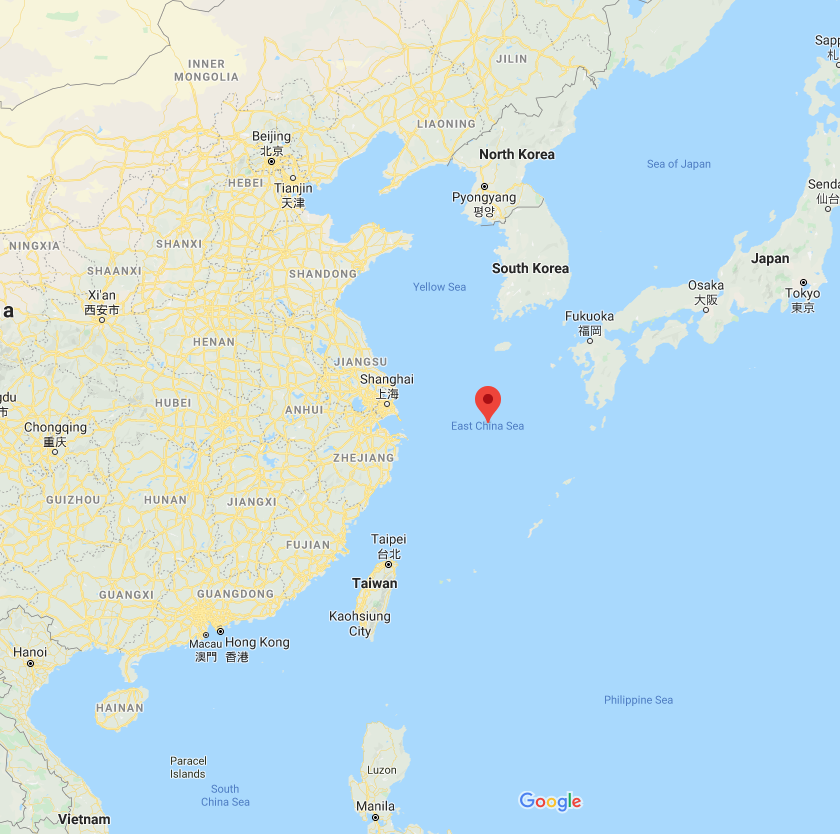
Increasing hazards to navigation in the East China Sea

Filed under: Asia, China, Japan, Military — Tags: , , , , , , — Nicholas @ 05:00

It’s odd that all the increased collisions seem to involve Chinese vessels:
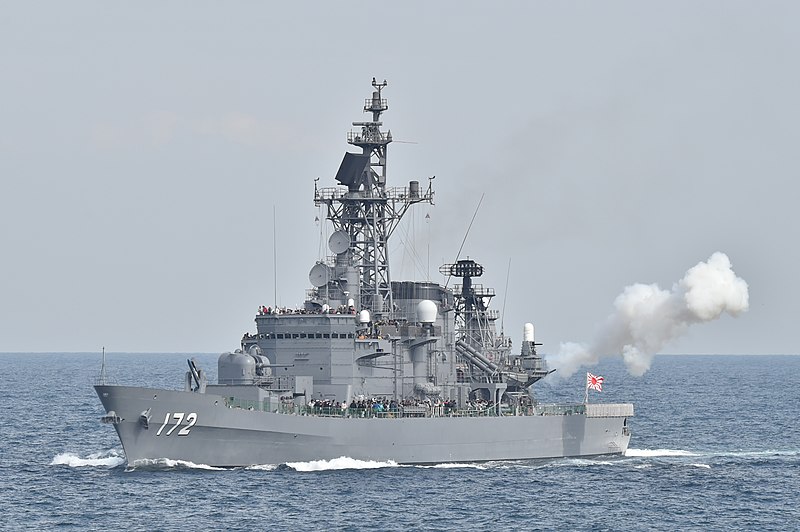
Japanese Maritime Self-Defence Force ship JS Shimakaze (DDG-172), the second ship of the Hatakaze class, commissioned in 1988. She was slightly damaged in a collision with a Chinese fishing boat in the East China Sea on 30 March 2020.
Image via Wikimedia Commons.

Sci-fi genius Robert Heinlein warned readers never to attribute to villainy behavior that was adequately explained by stupidity. In other words, he believed malice should be the explanation of last resort for puzzling conduct on the part of people or groups of people; it shouldn’t be the default. Better to hunt for more benign explanations first. With apologies to Heinlein, I would amend his “razor,” or heuristic, slightly. It’s too narrow. There are other candidates than stupidity or purposeful villainy to account for misconduct. Factors like incompetence, bureaucratic inertia, and sheer accident form — and sometimes deform — human thought and action. They belong on the stupidity side of Heinlein’s ledger.

How about this: Never attribute to villainy behavior that can be adequately explained by human failings. That preserves the essence of Heinlein’s razor while widening its scope to fit reality.

Let’s use his revised heuristic to evaluate the Sino-Japanese collision. It’s certainly possible the mishap came about by accident. It took place at night, in crowded waters. If the U.S. Navy collisions of 2017 taught us nothing else, it’s that the crews of even frontline warships can suffer from a host of maladies, from overwork to shoddy personnel practices to doctrinal or training shortfalls. No amount of high technology — whether it’s Aegis radar or satellite navigation — can altogether forestall human error. It may be that the Japanese crew, the Chinese crew, or both blundered around in the dark and came to grief. By Heinlein’s lights that’s the generous and proper assumption until the facts become known. If they do.

Nevertheless, a silent corollary has to be appended to Heinlein’s razor: But don’t rule out villainy, either.

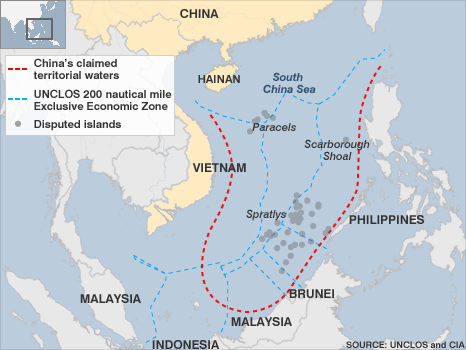
Especially when it comes to the Chinese Communist Party (CCP). For decades Beijing has made militiamen embedded in the Chinese fishing fleet an arm of maritime strategy. The maritime militia is an irregular adjunct to regular naval forces, including the People’s Liberation Army Navy (PLA Navy) and especially the musclebound China Coast Guard fielded over the past decade. Beijing touted the militia’s combat prowess as long ago as 1974, when Chinese naval forces wrested a tottering South Vietnam’s holdings in the Paracel Islands from it in a brief but bloody sea battle. Militia craft backed by the coast guard have been a fixture in the South China Sea ever since 2009, when Beijing declared “indisputable sovereignty” over the vast majority of that body of water — including seas allocated to its neighbors by treaty. The irregular force went into overdrive in 2012 during the standoff with the Philippine Navy and Coast Guard at Scarborough Shoal, deep within the Philippines’ exclusive economic zone. Fishing craft flood the zone in CCP-claimed waters and dare local coast guards or navies to repulse them. If the locals resist, the China Coast Guard backs up the militia. PLA regular forces provide a backstop should things go awry.
H/T to Blazing Cat Fur for the link.
April 9, 2020

The (former) captain of USS Theodore Roosevelt

Filed under: Media, Military, USA — Tags: , , , , , — Nicholas @ 05:00

Another example of how civilians interpret an action in a radically different way than the military does (and must):

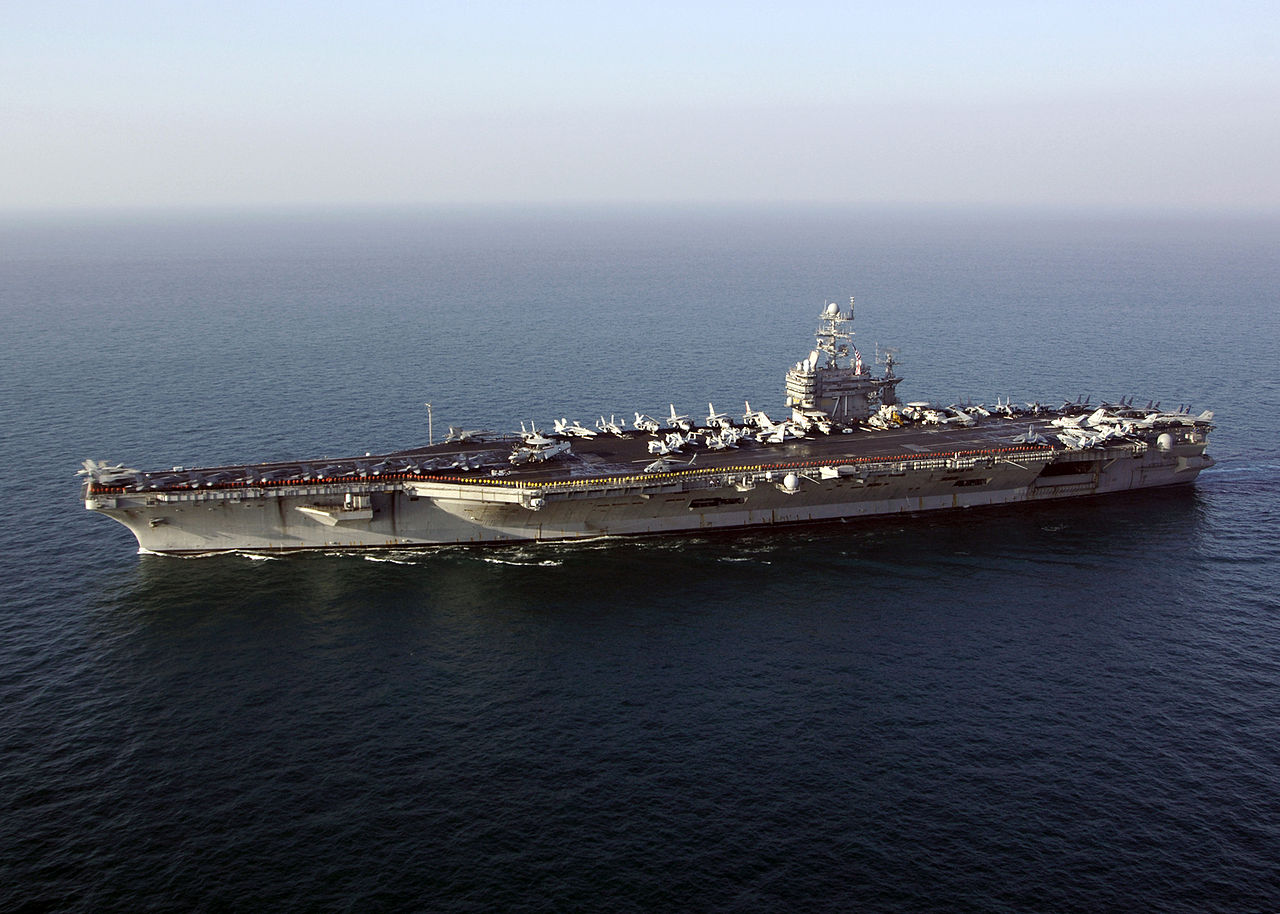
The Nimitz-class aircraft carrier USS Theodore Roosevelt (CVN 71) underway in the Persian Gulf, 3 December 2005.
U.S. Navy photo by Photographer’s Mate 2nd Class Matthew Bash via Wikimedia Commons.

Okay, about this USS Teddy Roosevelt captain …

No, he’s not some sort of rebel hero who fought the power for his sailors and stuff because only he gave a damn about them. That’s crap, and […] I am not happy to see him get canned. I was an O6 myself, and I would prefer O6s, as a rule, not end up fired. But that was the only course of action available to the SecNav. The guy screwed up, big time.

To believe this CAPT Crozier guy is a hero, you have to believe stupid and wrong things which you should not believe due to their stupidness and wrongness.

You have to believe that the Navy “didn’t care” about sick sailors. Libs take this further to imply that the Navy “didn’t care” about sick sailors because that would have made Trump angry.

This is, as I said, stupid and wrong.

The Navy brass has several things to think about, and there is an order of priority among those things. The priority order is 1) the mission and then 2) the sailors. Notice the order? One of the unique aspects of the military is that it is one of the very few institutions where the lives of its members are expressly and deliberately subordinated to the mission. An aircraft carrier is a major strategic asset, almost incalculably major. And this captain wanted to take it offline. Now, that could have been the decision. Command is about making tough decisions, but it was not his decision. Once he gave his input to his bosses, what he thought meant nothing.

Nothing.

We elect a commander-in-chief to make those decisions. He delegates them in a clear order of precedence to his subordinates. So, CAPT Crozier was not defying admirals or even Trump when he decided he should make the decision. He was defying you and me.

The chain of command is a thing, as he found out when he got his walking papers. And it did not stop being a thing when he did not like the orders it gave him.

If your sailors are your number one priority, you frankly have no business being in command. The mission is the number one priority. That’s hard, and no fun, but [it’s] true. And that’s not an excuse to abuse or neglect your men — far from it. But it is a recognition that you have a mission and that is your priority.

Corzier was the captain of the carrier. There was an admiral down the hall — literally — who was his boss as task force commander. Why did he not go to the admiral? Or maybe he did go to the admiral and didn’t like the answer he got. Your commander disagreed with you? Gee, welcome to military service. Salute and drive on.

There’s no scenario where he’s right on this.

April 5, 2020

China’s geostrategic box

ESR looks at the concerns that China may be considering starting a war with the United States in the wake of the Wuhan Coronavirus:

To understand how limited the PRC’s war options are, we can start with a grasp on how difficult and unsatisfying any war of conquest would be due to the geographic box China is in. The obstacles around it are formidable.

To the south, the Himalayan massif makes all of South Asia other than a narrow coastal plain on the Southeast Asian peninsula inaccessible to serious troop movements. There are no roads or rail links. The last time the Chinese tried pushing in that direction, in 1979, they were unable to sustain an offensive at any distance from their railheads and withdrew after less than a month. Their war aim – forcing the North Vietnamese to withdraw its troops from Cambodia – failed.

To the west, the vastness and comparatively undeveloped state of China’s western hinterland is a serious logistical problem before one even gets to the border. At the borders, the Tien Shan and Pamir ranges present a barrier almost as formidable as the Himalayas. External road and rail links are poor and would be easily interdicted.

To the north, movement would be easier. It might be just within logistical possibility for the PLA to march into Siberia. The problem with this idea is that once you’ve conquered Siberia, what you have is … Siberia. Most of it, except for a small area in the south coastal region of Primorsky Kraye, is so cold that cities aren’t viable without food imports from outside the region. Set this against the risks of invading a nuclear-armed Russia and you don’t have a winning proposition.

To the east is the South China Sea. The brute fact constraining the PRC’s ambitions in that direction is that mass movement of troops by sea is risky and difficult. I recently did the math on Chinese sealift craft and despite an expensive buildup since the 1980s they don’t have the capacity to move even a single division-sized formation over ocean. Ain’t nobody going to take Taiwan with one division, they’ve has too much time to prepare and fortify over the last 60 years.

The PRC leadership is evil and ruthless, but it’s also cautious and historically literate and can read maps. Accordingly, the People’s Liberation Army is designed not to take territory but to hold the territory the PRC already has. Its mission is not conquest but the suppression of regional warlordism inside China itself. The capability for the PLA to wage serious expeditionary warfare doesn’t exist, and can’t be built in the near-term future.

It’s often said that the danger of aggressive war by China is a function of the huge excess of young men produced by covert sexual selection and the one-child policy. But to expend those young men usefully you need to get them to where they can fight and are motivated by some prospect of seizing the wives unavailable for them at home. The PRC can’t do that.

The military threat from China is, therefore, a function of what it can do with its navy, its airpower, and its missiles. And what it can do with those against the U.S. is upper-bounded by the fact that the U.S. has nuclear weapons and would be certain to respond to a PRC nuclear or EMP attack on the U.S. mainland by smashing Chinese cities into radioactive rubble.

Within the constraints of conventional warfare waged by navy and air force it is difficult to imagine an achievable set of PRC war aims that gains more than it costs.

It’s possible — even likely — that the Chinese military has something like the oft-rumoured “ship-killer missiles” that might be able to cripple or sink an American carrier … if it was in range. That makes the South China Sea, the East China Sea, and the west coast of Japan a possible no-go area for US Navy carrier strike groups. A good defensive weapon system to have on hand in case relations with the outside world go “hot”, but not a strategic game-changer. Nobody would be likely to consider anything as dangerous as a seaborne invasion of mainland China, even without the threat of wonder weapons like the ship-killer. And good defensive weapons won’t secure the trade routes that China depends on outside coastal waters.

In a lot of ways your strategic situation is like a scaled-up version of Japan’s in 1941 – you could seize the initiative with a Pearl-Harbor-like initial shock, but you can’t wage a long war because without sealane control you’ll run out of key feedstocks and even food rather rapidly. And unlike the Japanese in 1941, you don’t have the kind of serious blue-water navy that you’d need for sealane control outside the First Island Chain – not with just two carriers you don’t.

There is one way an aggressive naval war could work out in your favor anyway. You can count on the U.S.’s media establishment to be pulling for the U.S. to lose any war it’s in, especially against a Communist or Socialist country. If your war goals are limited to ending U.S. naval power projection in the Western Pacific, playing for a rapid morale collapse orchestrated by agents of influence in the U.S. is not completely unrealistic.

It’s playing with fire, though. One problem is that before you launch your attack you don’t know that your sucker punch will actually work. Another is that, as the Japanese found out after Pearl Harbor, the American public may react to tragic losses with Jacksonian fury. If that happens, you’re seriously screwed. The war will end with your unconditional surrender, and not sooner.

Update: Bone-headed typo in the headline fixed. It’s funny how you can’t see ’em until just after you click the Save button…

March 29, 2020

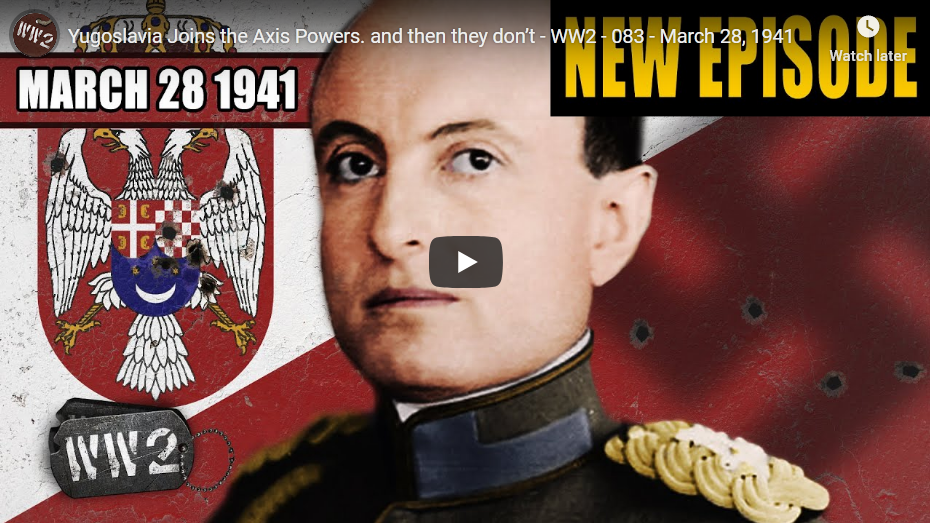
Yugoslavia Joins the Axis Powers. and then they don’t – WW2 – 083 – March 28, 1941

Filed under: China, Europe, Germany, History, Italy, Japan, Military, WW2 — Tags: , , , , , — Nicholas @ 06:00

World War Two
Published 28 Mar 2020

Yugoslavia joins the Axis powers, which then triggers a pro-Allied coup, angering Hitler. Meanwhile, the Italians fail to outsmart the British as the Japanese hope to capitalise on their superior army.

Join us on Patreon: https://www.patreon.com/TimeGhostHistory
Or join The TimeGhost Army directly at: https://timeghost.tv

Follow WW2 day by day on Instagram @World_war_two_realtime https://www.instagram.com/world_war_t…
Between 2 Wars: https://www.youtube.com/playlist?list=PLrG5J-K5AYAU1R-HeWSfY2D1jy_sEssNG
Source list: http://bit.ly/WW2sources

Written and Hosted by: Indy Neidell
Produced and Directed by: Spartacus Olsson and Astrid Deinhard
Executive Producers: Bodo Rittenauer, Astrid Deinhard, Indy Neidell, Spartacus Olsson
Creative Producer: Joram Appel
Post-Production Director: Wieke Kapteijns
Research by: Indy Neidell
Edited by: Iryna Dulka
Map animations: Eastory (https://www.youtube.com/c/eastory)

Colorizations by:
– Julius Jääskeläinen – https://www.facebook.com/JJcolorization/
– Daniel Weiss
– Owen Robinson – https://www.instagram.com/owen.colori…
– Dememorabilia – https://www.instagram.com/dememorabilia/

Sources:
– Bundesarchiv
– Wellcome Images
– Narodowe Archiwum Cyfrowe
– Војни архив
– Istorijski arhiv u Pančevu
– IWM: H 10922, A 10274
– Littorio class Battleship drawing by David Orlović from Wikimedia
– Italian heavy cruiser Pola drawing by K.E.Sergeev
– Prison icon by FORMGUT. from the Noun Project

Archive by Screenocean/Reuters https://www.screenocean.com.

A TimeGhost chronological documentary produced by OnLion Entertainment GmbH.

From the comments:

World War Two
2 days ago (edited)
NOTE BY INDY: I researched and wrote this episode in January. Since then I have done deep research on the fighting for Greece and Crete, as well as the Barbarossa planning. I can now say unequivocally that I do NOT believe the actions in Yugoslavia had anything to do with Hitler changing the start of Barbarossa.

I hope everyone is doing well and staying safe in these tumultuous times. Indy was meant to fly back to Stockholm after a very full week of shooting, but his flight was changed to an earlier time (which they didn’t tell him), so now he’s “stuck” in the studio in Bavaria. He hopes to be able to fly back soon, but until then we’re writing and shooting a few more episodes for you. We hope we’re able to bring you all some distraction, relief or perspective. Stay safe!
Cheers, Joram

March 23, 2020

Naval strategy versus naval tactics in the Battle of the Atlantic

Ted Campbell outlines how the Battle of the Atlantic was fought between the Kriegsmarine and the Royal Navy (and the Royal Canadian Navy and, eventually, the United States Navy) in World War 2:

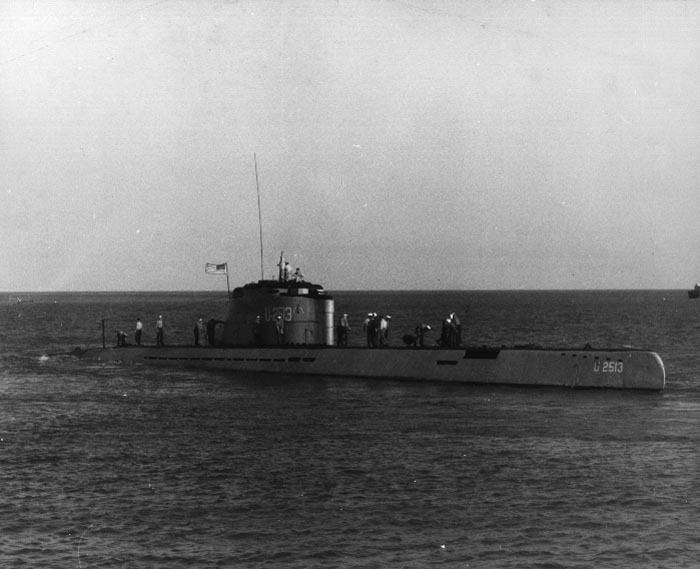
U-2513 in US Navy control off Key West, Florida – 30 October 1946

… there is a rather thick, and quite blurry line between naval strategy and naval tactics. One Army.ca member used the Battle of the Atlantic to distinguish between two doctrines:

  • Sea control ~ which was practised by the 2nd World War allies ~ mostly British Admirals Percy Noble and Max Horton in Britain and Canadian Rear Admiral Leonard Murray in St John’s and Halifax; and
  • Sea denial ~ which was practised by German Admiral Karl Dönitz.

The difference between the two tactical doctrines was very clear. The strategic aims were equally clear:

  • Admiral Dönitz wanted to knock Britain out of the war ~ something that he (and Churchill) understood could be done by starving Britain into submission by preventing food, fuel and ammunition from reaching Britain from North America. (We can be eternally grateful that Adolph Hitler did not share Dönitz’ strategic vision and listened, instead, to lesser men and his own, inept, instincts); and
  • Prime Minister Churchill, who really did say that “the only thing that ever really frightened me during the war was the U-boat peril“, who wanted to keep Britain fighting, at the very least resisting, until the Americans could, finally, be persuaded to come to the rescue.

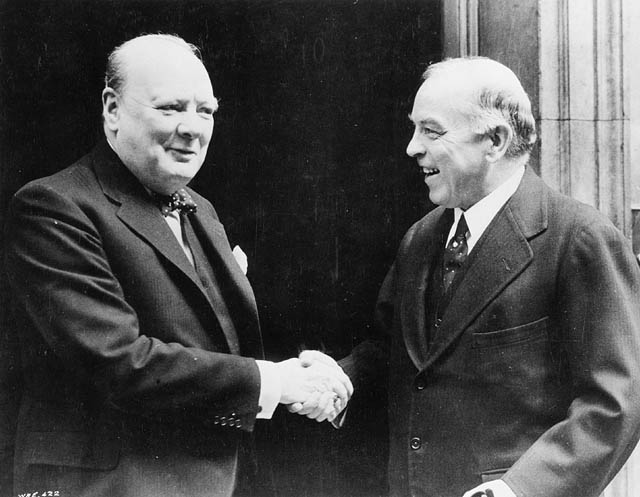
Prime Minister Winston Churchill greets Canadian PM William Lyon Mackenzie King, 1941.
Photo from Library and Archives Canada (reference number C-047565) via Wikimedia Commons.

Canada’s Prime Minister Mackenzie King did have a grand strategy of his own. It was to do as much as possible while operating with the lowest possible risk of casualties ~ the conscription crisis of 1917 was, always, uppermost in his mind and he was, therefore, terrified of casualties. He mightily approved of the Navy doing a HUGE share in the Battle of the Atlantic ~ especially by building ships in Canadian yards and escorting convoys which he hoped would be a low-risk affair.

Churchill’s grand strategy was based on Britain surviving … there was, I believe, a “worst case” scenario in which the British Isles were occupied and the King and his government went to Canada or even India. But that has always seemed to me to be a sort of fantasy. The United Kingdom, without the British Isles, made no sense.

    (While I believe that Rudolph Hess was, as they say, a few fries short of a happy meal, I think that he and several people in Germany believed that it might be possible to negotiate a peace with Britain which many felt was a necessary precursor to a successful campaign against Russia. The Battle of Britain (die Luftschlacht um England, September 1940 to June 1941) was, clearly, not going in Germany’s favour. Late in 1940, the Nazi high command had been forced to send a German Army formation to Libya to prevent a complete rout of the Italians. Malta still held out, meaning that Britain had air cover throughout the Mediterranean. In short, Britain was not going to go down unless it could be starved into submission ~ and in the spring of 1941, the Battle of the Atlantic was going in Germany’s favour. There was, in other words, some reason for Germans to believe that an armistice might be possible ~ freeing up all of Germany’s power to be used against the USSR.)

    (But things were changing for the Allies, too. At just about the same time as Hess was flying to Scotland, then Commodore Leonard Murray of the Royal Canadian Navy, who had been in England on other duties, had met with and persuaded Admiral Sir Percy Noble, who liked Murray and had been his commander in earlier years, that a new convoy escort force should be established in Newfoundland and that it should be a largely Canadian force (with British, Dutch, Norwegian and Polish ships under command, too) and that it should be commanded by a Canadian officer. Admiral Noble insisted, to Canada, that Murray, who he liked, personally, and who had written, extensively, on convoy operations in the 1920s and ’30s, must be that commander. The establishment of the Newfoundland Escort Force, which would be more appropriately renamed the Mid Ocean Escort Force in 1942, was a key decision at the much-debated operational level of war which put an expert tactician (Murray) in command of a major force and allowed him (and Noble) to move closer to achieving Churchill’s strategic aim. The Battle of the Atlantic was not won in 1941, but it seemed to Churchill, Noble and Murray that they were a lot less likely to lose it, even without the Americans.)

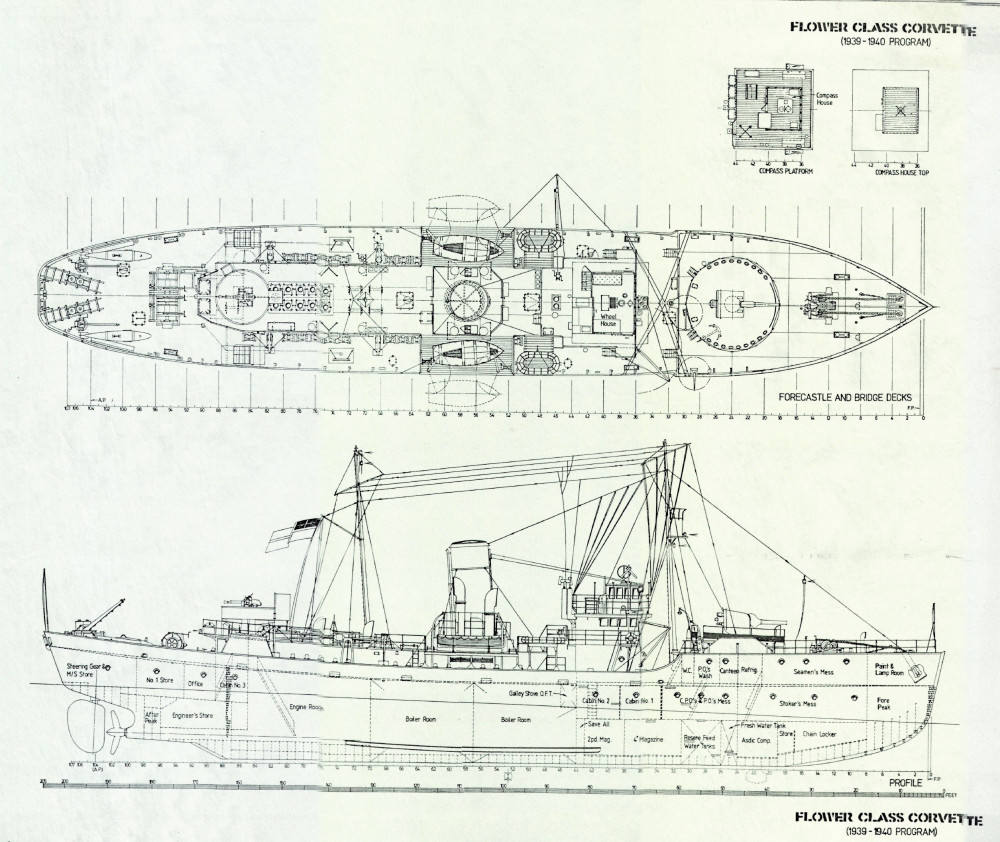
Diagram of the early Flower-class corvettes, via Lt. Mike Dunbar (https://visualfix.wordpress.com/2017/04/12/dreadful-wale-4/)

Anyway, the boundaries of strategy vs. the operational art vs. tactics were as thick and blurry in 1941 as they are today. The decision, taken in 1939, for example, to build little corvettes in the many British and Canadian yards that could not build a real warship was, in retrospect, a key strategic choice, but it was, at the time, totally materialist: just a commonsense, engineer solution to an operational problem ~ lack of ships. Ditto for the eventual decision, which had to be made by Churchill, himself, to reassign some of the big, long-range, Lancaster heavy bombers to Coastal Command. It was, once again, with the benefit of hindsight, a key strategic move, but at the time it would likely have seemed, to Capt(N) Hugues Canuel, the author of that Canadian Naval Review essay, to be materialistic, more concerned with how to use the resources available than with deciding what is needed.

I agree with Capt(N) Canuel that, by and large, Canadians have left strategic and even operational level thinking to first, the British and more recently the American admirals ~ Rear Admiral Murray being known, in the 1930s and early 1940s as a notable exception.

March 8, 2020

Britain’s Post-WWII Naval Decline

Filed under: Britain, History, Military — Tags: , , , , , , — Nicholas @ 03:00

Sal Viscuso
Published 1 Dec 2013

Max Hastings describes the declining British post-WWII role in global affairs.

March 4, 2020

England’s Secret Weapon: The Two Million Ton Megacarrier Made of Ice

Filed under: Britain, History, Military, Technology, WW2 — Tags: , , , , — Nicholas @ 02:00

Today I Found Out
Published 16 Feb 2018

If you happen to like our videos and have a few bucks to spare to support our efforts, check out our Patreon page where we’ve got a variety of perks for our Patrons, including Simon’s voice on your GPS and the ever requested Simon Whistler whistling package: https://www.patreon.com/TodayIFoundOut

This video is sponsored by World of Warships

In this video:

Britain was taking a beating from the German ships and submarines and were looking for something to build a ship out of that couldn’t be destroyed by torpedoes, or at least could take a major pounding without incurring a fatal amount of damage. With steel and aluminum in short supply, Allied scientists and engineers were encouraged to come up with alternative materials and weapons.

Want the text version?: http://www.todayifoundout.com/index.p…

February 27, 2020

Winston Churchill Biography: In the Darkest Hour

Filed under: Africa, Britain, History, Military, WW2 — Tags: , , , , , — Nicholas @ 02:00

Biographics
Published 13 Feb 2018

We imagine Winston Churchill with his signature cane, drinking scotch whiskey, and puffing on a Cuban cigar. His mouth is downturned, and his voice is gruff and his words pointed. This is the image Hollywood portrays but it is a mere caricature of the flesh and blood version. Who was Winston Churchill? In Britain’s “darkest hour,” Churchill led his country from the brink of Nazi conquest by forging an alliance with the U.S. and Russia. He had many critics, and made mistakes on a grand scale. Yet, above it all, possessed an unwavering belief in his own power. To his beloved country he offered his “blood, toil, tears and sweat.”

Visit our companion website for more: http://biographics.org

Credits:
Host – Simon Whistler
Author – Crystal Sullivan
Producer – Samuel Avila
Executive Producer – Shell Harris

Business inquiries to biographics.email@gmail.com

Biographies by the book, get Winston Churchill’s biography from Amazon: http://amzn.to/2EAfh7b

February 26, 2020

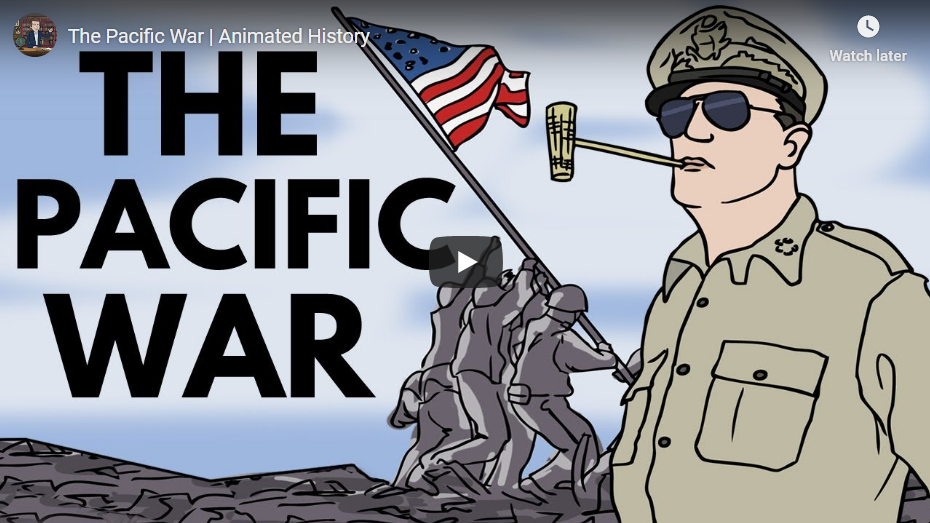
The Pacific War | Animated History

Filed under: History, Japan, Military, Pacific, USA, WW2 — Tags: , , , , , — Nicholas @ 04:00

The Armchair Historian
Published 15 Jun 2018

Huge thanks to Kan Shimada for the Japanese translation!

Our Website: https://www.thearmchairhistorian.com/

Our Twitter: https://twitter.com/ArmchairHist

This video has been sponsored and approved by Oasis Games

Sources:
The Pacific War Companion: From Pearl Harbor to Hiroshima, Daniel Marston (editor)
Iwo Jima: World War II Veterans Remember the Greatest Battle of the Pacific, Larry Smith
Hell is Upon Us: D-Day in the Pacific, Victor Brooks
Eyewitness Pacific Theater, Firsthand Accounts of the War in the Pacific from Pearl Harbor to the Atomic Bombs, John T. Kuehn and D.M. Giangreco
Lost in the Pacific: Epic Firsthand Accounts of WWII Survival Against Impossible Odds, L. Douglas Keeney (Editor)

This rather short-changes the Australian contribution to MacArthur’s campaigns in the southwest Pacific theatre, but it is a survey and can only cover so much of such a massive conflict.

February 23, 2020

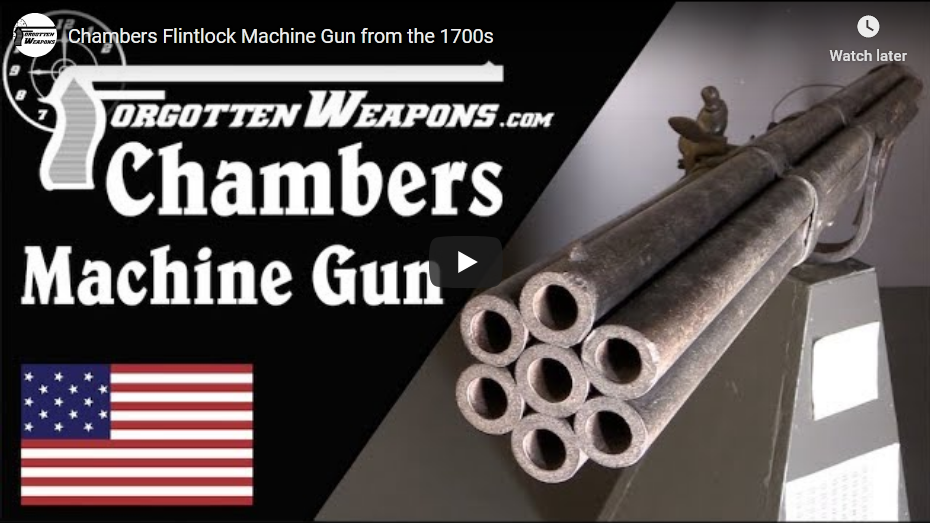
Chambers Flintlock Machine Gun from the 1700s

Filed under: History, Military, USA, Weapons — Tags: , , , , , — Nicholas @ 02:00

Forgotten Weapons
Published 8 Nov 2019

http://www.patreon.com/ForgottenWeapons

Cool Forgotten Weapons merch! http://shop.bbtv.com/collections/forg…

Joseph Chambers invented a repeating flintlock weapon in the 1790s, and I think it is appropriate to consider it a “machine gun”. The design used a series of superposed charges in one or more barrels, with specially designed bullets that has hollow central tubes through them. This would allow the fire from a detonation charge to transit through a bullet at the rear and set off a subsequent charge. The result was a single trigger pull to use a flintlock action to start an unstoppable series of shots. Chambers made pistol and musket versions, as well as a full-on mounted machine gun.

He submitted his design to the fledgling US War Department in 1792, but it was not accepted. He brought the guns back to their attention when the War of 1812 was declared, and this time he found an eager client in the United States Navy. More than 50 of the machine guns were built and purchased to use on Navy warships. This version had 7 barrels, each loaded with 32 rounds, for a total of 224 shots, at (apparently) about a 120 round/minute rate of fire. The British found out about the guns and made some effort to reverse engineer them, and there was also interest in France, the Netherlands, and Spain. Ultimately, the potential unreliability of the system prevented more widespread adoption, but the gun is a fascinating example of early automatic firearms.

For more information, see Andrew Fagal’s article:
https://ageofrevolutions.com/2016/10/…

Thanks to the Liege Arms Museum for access to film this for you! If you are in Belgium, definitely plan to stop into the museum, part of the Grand Curtius. They have a very good selection of interesting and unusual arms on display.

https://www.grandcurtius.be

Contact:
Forgotten Weapons
6281 N. Oracle #36270
Tucson, AZ 85704

February 21, 2020

“Back in Control” – The Falklands War – Sabaton History 055 [Official]

Sabaton History
Published 20 Feb 2020

1982, on a group of islands far, far away from Great Britain. After the military junta of Argentinian Army General Leopoldo Galtieri had publicly declared that the Falkland Islands (Malvinas) were rightfully part of Argentinian territory, an invasion force succeeded in wrestling control away from their British owners. However Great Britain would not simply stand by and give the Falklands up. Instead a British task-force would make its way down to the Falklands, in an attempt to take back control of the islands by force. What followed was an undeclared war of 10 weeks, where British carriers and commandos fought against the entrenched Argentinian ground-forces for the ownership of the islands.

Support Sabaton History on Patreon: https://www.patreon.com/sabatonhistory

Listen to “Back in Control” on the album Attero Dominatus:
CD: http://bit.ly/AtteroDominatusStore
Spotify: http://bit.ly/AtteroDominatusSpotify
Apple Music: http://bit.ly/AtteroDominatusAppleMusic
iTunes: http://bit.ly/AtteroDominatusiTunes
Amazon: http://bit.ly/AtteroDominatusAmzn
Google Play: http://bit.ly/AtteroDominatusGooglePlay

Check out the trailer for Sabaton’s new album ‘The Great War’ right here: https://www.youtube.com/watch?v=HCZP1…

Watch more videos on the Sabaton YouTube channel: https://www.youtube.com/user/Sabaton?…
Listen to Sabaton on Spotify: http://smarturl.it/SabatonSpotify
Official Sabaton Merchandise Shop: http://bit.ly/SabatonOfficialShop

Hosted by: Indy Neidell
Written by: Markus Linke and Indy Neidell
Directed by: Astrid Deinhard and Wieke Kapteijns
Produced by: Pär Sundström, Astrid Deinhard and Spartacus Olsson
Creative Producer: Joram Appel
Executive Producers: Pär Sundström, Joakim Broden, Tomas Sunmo, Indy Neidell, Astrid Deinhard, and Spartacus Olsson
Post-Production Director: Wieke Kapteijns
Edited by: Iryna Dulka
Sound Editing by: Marek Kaminski
Maps by: Eastory – https://www.youtube.com/c/eastory

Archive by: Reuters/Screenocean https://www.screenocean.com
Music by Sabaton.

Sources:
– Casa Rosada (Argentina Presidency of the Nation)
– Gobierno de Argentina (Government of Argentina) – Argentina.gob.ar
– Ken Griffiths from Wikimedia Commons
– Armada Argentina on Flickr
HMS Invincible in 1980, HMS Hermes in 1977, credit: Hugh Llewelyn on Flickr
– IWM: FKD 186, FKD 357, FKD 677, IWM FKD 138, FKD 185, FKD 2743, FKD 168, FKD 435, FKD 182, FKD 319, FKD 2744, FKD 71, FKD 217, FKD 107, FKD 321, FKD 349, FKD 345, FKD 2755, FKD 108, FKD 2028, FKD 2750, FKD 2051, FKD 2040, FKD 176, FKD 314, FKD 427
– IWM ART: 15530 33, 15530 56, 15530 10, 15530 10
– National Army Museum: 164752, 107649

An OnLion Entertainment GmbH and Raging Beaver Publishing AB co-Production.

© Raging Beaver Publishing AB, 2019 – all rights reserved.

February 19, 2020

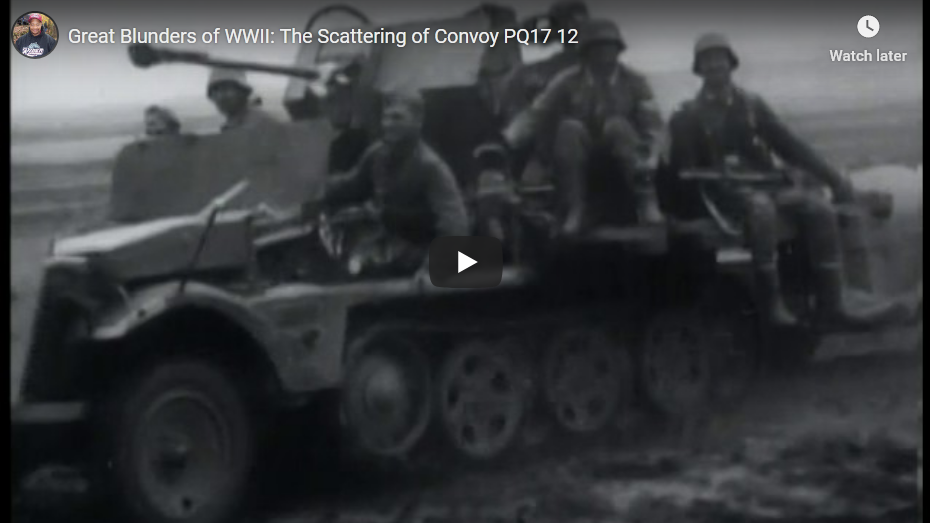
Great Blunders of WWII: The Scattering of Convoy PQ17

Filed under: Britain, Germany, History, Military, Russia, WW2 — Tags: , , , , , — Nicholas @ 06:00

Anthony Coleman
Published 4 Nov 2016

From the History Channel DVD series Great Blunders of WWII.

This is of interest for many reasons, but particularly because my late father-in-law served in the Royal Navy on the Arctic convoys and spent a full winter in the Soviet Union when his convoy couldn’t return before the ice closed the convoy route.

February 14, 2020

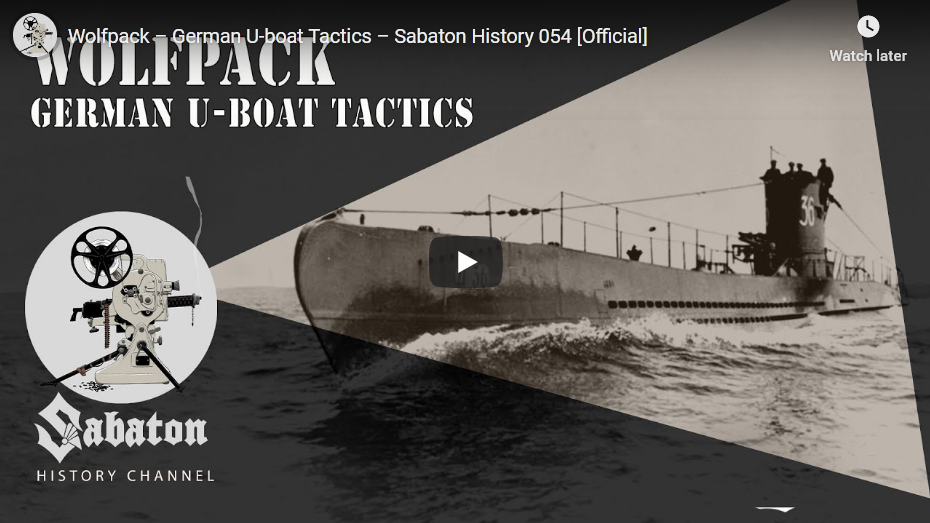
“Wolfpack” – German U-boat Tactics – Sabaton History 054 [Official]

Filed under: Germany, History, Media, Military, WW2 — Tags: , , , , , — Nicholas @ 04:00

Sabaton History
Published 13 Feb 2020

The Battle of Britain had saved the United Kingdom from imminent invasion by the German Wehrmacht, however the war was far from over. To destroy Britain’s economic capabilities to wage war, the German Kriegsmarine had to win the tonnage war in the North Atlantic. The German submarines — the U-Boote, were sent out to hunt. As the British Royal Navy returned to the convoy system to protect its merchant fleet, the Germans as well began organizing their submarines in groups to attack in unison. These hunter-killer teams, the Wolfpacks, would soon haunt the depths of the North Atlantic.

Support Sabaton History on Patreon: https://www.patreon.com/sabatonhistory

Listen to “Wolfpack” on the album Primo Victoria:
CD: http://bit.ly/PrimoVictoriaStore
Spotify: http://bit.ly/PrimoVictoriaSpotify
Apple Music: http://bit.ly/PrimoVictoriaAppleMusic
iTunes: http://bit.ly/PrimoVictoriaiTunes
Amazon: http://bit.ly/PrimoVictoriaAmzn
Google Play: http://bit.ly/PrimoVictoriaGooglePlay

Check out the trailer for Sabaton’s new album The Great War right here: https://www.youtube.com/watch?v=HCZP1…

Listen to Sabaton on Spotify: http://smarturl.it/SabatonSpotify
Official Sabaton Merchandise Shop: http://bit.ly/SabatonOfficialShop

Hosted by: Indy Neidell
Written by: Markus Linke and Indy Neidell
Directed by: Astrid Deinhard and Wieke Kapteijns
Produced by: Pär Sundström, Astrid Deinhard and Spartacus Olsson
Creative Producer: Joram Appel
Executive Producers: Pär Sundström, Joakim Broden, Tomas Sunmo, Indy Neidell, Astrid Deinhard, and Spartacus Olsson
Post-Production Director: Wieke Kapteijns
Edited by: Iryna Dulka
Sound Editing by: Marek Kaminski
Maps by: Eastory – https://www.youtube.com/c/eastory

Archive by: Reuters/Screenocean https://www.screenocean.com
Music by Sabaton.

Colorizations:
– Olga Shirnina, a.k.a. Klimbim – https://klimbim2014.wordpress.com/

Sources:
– IWM: HU 16546, A 30292
– Bundesarchiv
– Otis Historical Archives, National Museum of Health and Medicine
– Narodowe Archiwum Cyfrowe
– Canadian ship being attacked, photo courtesy of the Government of Canada, https://www.canada.ca/en/navy/service…

An OnLion Entertainment GmbH and Raging Beaver Publishing AB co-Production.

© Raging Beaver Publishing AB, 2019 – all rights reserved.

February 11, 2020

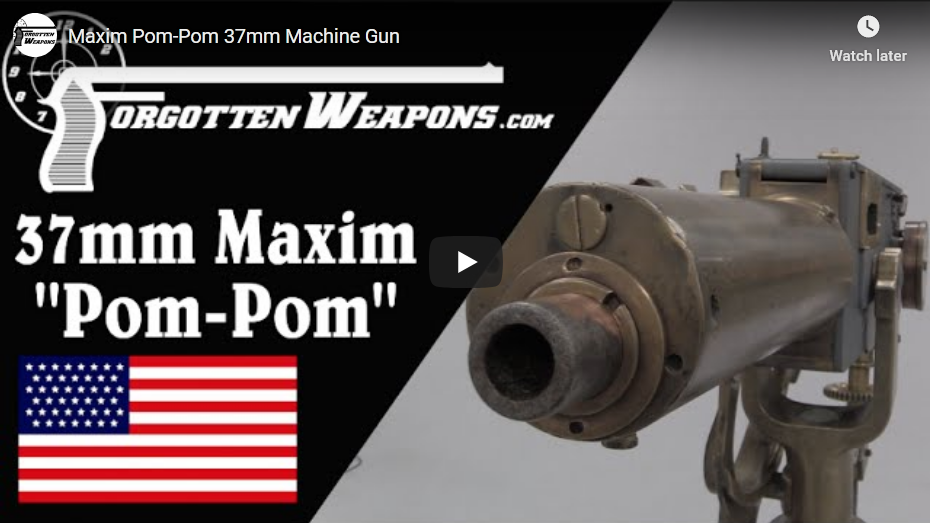
Maxim Pom-Pom 37mm Machine Gun

Filed under: History, Military, USA, Weapons, WW1 — Tags: , , , , , , — Nicholas @ 02:00

Forgotten Weapons
Published 13 Sep 2016

Failed to sell at auction.

“Pom-Pom” was the name given to the 37mm Maxim gun by the Boers of South Africa, based on the gun’s sound. It was a Maxim machine gun scaled up to the quite impressive 37mm caliber, intended primarily for naval use defending large vessels against small torpedo boats. This particular example is serial number 2024, made in 1889 and then sold three times before being ultimately purchased by the United States Coast Guard and installed on the USS Manning (along with a second gun, number 2026). The Manning was promptly put into military service by the Navy and steamed down to Cuba, where it participated in the first bombardment of Cuba during the Spanish-American War.

These 37mm guns could fire a wide variety of projectiles, including solid rounds which could pierce an inch (25mm) of iron armor at 100 yards and hollow rounds filled with black powder and fused to explode on impact. During World War One, they would be pushed into anti-aircraft service, with the explosive rounds being extremely effective on early aircraft (when you could get a hit, anyway).

Related:
Bethlehem Steel 37mm Gun: https://www.youtube.com/watch?v=abEq7…
Vickers 2.95″ Mountain Gun: https://www.youtube.com/watch?v=-b53i…
Maxim lMG08/15: https://www.youtube.com/watch?v=Gbt1_…

February 5, 2020

Submarine Warfare WW1 vs WW2 – Differences & Commonalities

Filed under: Britain, Germany, History, Military, WW1, WW2 — Tags: , , , — Nicholas @ 04:00

Military History Visualized
Published 15 Nov 2016

A comprehensive view that compares submarine warfare in the First and Second World Wars. Due to the lack of a submarine warfare in the Pacific in World War 1, the Pacific isn’t covered at all, but there will be an episode on it in the future.

Military History Visualized provides a series of short narrative and visual presentations like documentaries based on academic literature or sometimes primary sources. Videos are intended as introduction to military history, but also contain a lot of details for history buffs. Since the aim is to keep the episodes short and comprehensive some details are often cut.

» HOW YOU CAN SUPPORT MILITARY HISTORY VISUALIZED «
(A) You can support my channel on Patreon: https://www.patreon.com/join/mhv

(B) Alternatively, you can also buy “Spoils of War” (merchandise) in my online shop: https://www.redbubble.com/people/mhvi…

» SOURCES & LINKS «

Milner, Marc: “The Atlantic War, 1939-1945”; in: Cambridge History of the Second World War, Volume 1

Blair, Clay: Hitler’s U-Boat War – The Hunters 1939-1942

Owen, David: Anti-Submarine Warfare – An Illustrated History

Germany & The Second World War – Volume VI

Germany & The Second World War – Volume II

Breemer, Jan S.: “Defeating the U-boat. Inventing Antisubmarine Warfare”. Naval War College Newport Papers 36
https://www.usnwc.edu/getattachment/e…

Das Deutsche Reich und der Zweite Weltkrieg – Band VI.

Das Deutsche Reich und der Zweite Weltkrieg – Band II.

Rahn, Werner: “Die Deutsche Seekriegsfürung 1943 bis 1945”; in: Das Deutsche Reich & der Zweite Weltkrieg, Band X/1, S. 3-276

Erster Weltkrieg – Zweiter Weltkrieg: Ein Vergleich.

U-boat losses by cause
https://web.archive.org/web/201006112…

Differences German U-Boat Design WW1 vs. WW2
https://www.reddit.com/r/AskHistorian…

» CREDITS & SPECIAL THX «
Song: Ethan Meixsell – “Demilitarized Zone”

« Newer PostsOlder Posts »

Powered by WordPress