Drachinifel
Published 11 Nov 2020Today we look at the start of the salvage efforts in the aftermath of the attack on Pearl Harbour.
Sources:
www.amazon.co.uk/gp/product/B00C0JIXJO
https://www.history.navy.mil/our-coll…
www.amazon.co.uk/Pearl-Harbor-Fleet-Salvage-Appraisal/dp/0898755654
www.amazon.co.uk/Descent-into-Darkness-Harbour-Divers/dp/0891417451Free naval photos and more – www.drachinifel.co.uk
Want to support the channel? – https://www.patreon.com/Drachinifel
Want a shirt/mug/hoodie – https://shop.spreadshirt.com/drachini…
Want a poster? – https://www.etsy.com/uk/shop/Drachinifel
Want to talk about ships? https://discord.gg/TYu88mt
Want to get some books? www.amazon.co.uk/shop/drachinifelDrydock
Episodes in podcast format – https://soundcloud.com/user-21912004
December 9, 2020
The Salvage of Pearl Harbor Pt 1 – The Smoke Clears
December 7, 2020
E.01 – Enter Japan – Pearl Harbor – WW2 – 120 A – December 7, 1941
World War Two
Published 7 Dec 2020Powered by World of Warships – https://wo.ws/PearlHarbor – Register now to receive an exclusive bonus!
In this episode: Japan’s meticulous planning and preparation made it possible to surprise the Americans at Pearl Harbor. Alert on Oahu is largely nonexistent. It is the deep breath before the plunge.
Join us on Patreon: https://www.patreon.com/TimeGhostHistory
Or join The TimeGhost Army directly at: https://timeghost.tvFollow WW2 day by day on Instagram @ww2_day_by_day – https://www.instagram.com/ww2_day_by_day
Between 2 Wars: https://www.youtube.com/playlist?list…
Source list: http://bit.ly/WW2sourcesHosted by: Indy Neidell
Written by: Spartacus Olsson and Indy Neidell
Directed by: Wieke Kapteijns
Executive Producers: Astrid Deinhard, Indy Neidell, Spartacus Olsson, Bodo Rittenauer
Produced by: Astrid Deinhard and Spartacus Olsson
Co-Producers: Maria Kyhle and Francis van Berkel
Edited by: Iryna Dulka
Set Design by: Astrid Deinhard
Graphic Design by: Mikolaj Uchman
Map Animations by: Daniel Haczyk and Eastory
Assistant Editors: Miki Cackowski, Daniel Weiss, Karolina Dołega
Still Colorizers: Adrien Fillon, Norman Stewart, Jaris Almazani, Daniel Weiss, Mikolaj Uchman, Carlos Ortega Pereira
Research by: Indy Neidell, Spartacus Olsson, Markus Linke, Wieke Kapteijns, Bastian Gaete, Lewis Braithwaite, Tim Smith, Ian Irungu
Sound Design by: Marek Kamiński
Dogfights by: Daniel Weiss, Bastian Gaete, Ian Sowden, Dennis StepanovVoices:
Mitsuo Fuchida – Daniel Grieb
Ada Peggy Olsson – Shani Neidell Beard
Iyōzō Fujita – Emi Celis
James Anderson – Emi Celis
Dorinda Stagner – Zora Johnson
Jack Kelley – Ryan Socash
James McClelland – Spartacus Olsson
Phil Rasmussen – Spartacus Olsson
Dan Wentrcek – Dennis Stepanov
Thompson Izawa – Samir Mechel
Robert Isacksen – Ian Sowden
Joseph K. Taussig Jr. – Tim Smith
James Cory – Ryan TeboFilm colorization by: Ricks Film Restoration
Naval Gameplay by: World of Warships
Archive material provided by: Reuters/ScreenoceanA TimeGhost chronological documentary produced by OnLion Entertainment GmbH.
From the comments:
World War Two
1 hour ago (edited)
When we set out to do this crazy project we thought we wanted to try some really new things. As anyone knows that follows us regularly, our first and foremost goal is remembrance — to shine a light on our past and learn form our ancestors’ mistakes and achievements. We try our best to do that with a dedication to facts and details liberated from partisan, or ideological historiography. For this purpose, the attack on Pearl Harbor serves very well. It is a compact event over only a few hours that is spectacular in its nature, tragic in its effect, gripping in its drama, and has tremendous impact on WW2 on all fronts. It is also an event that is often simplified to the point of misunderstanding, has been woven into national mythology, and given rise to some pretty nutty conspiracy myths. Simply put: the Attack on Pearl Harbor is short enough, exciting enough, and misunderstood enough for us to do a limited series like this.But more than that we also wanted to try some new technical and narrative things. Since we started doing historical documentaries with the Great War in 2014 we have tried to be on the forefront of pioneering new ways of creating historiography for the modern media world. Narratively, we have dedicated ourselves to chronologies, which in historiography is nothing new, but it is new in the world of film documentaries (at least to the level we do it) — so we thought; “heck what if we go down to minute by minute for this” — well we did and it taught us an enormous amount about Pearl Harbor, but also about how we can write. We will get back to that in further comment on the series. As for technology, it truly is technology that enables our work, well any media — for us it is social media, affordable ways to capture film, global virtual remote working spaces, digital research opportunities, digital film archives, and so on.
Two areas we had not been able to venture into was recreation of scenes using computer graphics and colorization of moving images. Using a gaming engine to create animation is also nothing new, but usually very, very expensive because you have to first create the world, the assets and the characters for your recreation. But for Pearl Harbor, World of Warships https://worldofwarships.com and World of Warplanes https://worldofwarplanes.com opened an opportunity to do this on a new scale at a cost that is only a fraction of what it usually costs. Along the way we also got to know Ricks Film Restorations (https://bit.ly/ricksfilmresorations and https://www.youtube.com/user/Rick88888888) who use AI technology to enhance and colorize film footage. While both of these technologies are only at the beginning of their potential, we think the results are spectacular. More than anything it has enabled us to enhance the emotional and visual experience for this series to a level we never reached before. Last but not least it enabled us to use the financial contributions of the TimeGhost Army, and World of Warships to create five hours of content for less than 1/50th — only 2% — of what it would cost to do with traditional means.
creatingstuff
In the Name of the entire TimeGhost Team,
Astrid, Indy, Spartacus, and WiekeEpisode Guide:
This is a 10 episode limited series within our weekly coverage of WW2 — to see the immediate events leading up to this day watch episode 119 from December 5, https://youtu.be/DYUzmBuX-6Y. Some of the events covered briefly as they start on this day, such as the invasions in the West Pacific will be covered in more detail in the coming weeks, especially in episode 120K (the 11th episode this week).coming out on December 12.The playlist to get all these episodes in one go is here: https://bit.ly/Pearl-min-by-min
USS Pennsylvania and Pearl Harbor
The History Guy: History Deserves to Be Remembered
Published 22 Apr 2019USS Pennsylvania was in dry dock when the attack came at Pearl Harbor. The History Guy remembers part of her history that may have been forgotten.
This episode was originally posted December 7, 2017. It has been updated to correct some errors in the original, and new footage of USS Pennsylvania has been added.
This is original content based on research by The History Guy. Images in the Public Domain are carefully selected and provide illustration. As images of actual events are sometimes not available, images of similar objects and events are used for illustration.
All events are portrayed in historical context and for educational purposes. No images or content are primarily intended to shock and disgust. Those who do not learn from history are doomed to repeat it. Non censuram.
Find The History Guy at:
Patreon: https://www.patreon.com/TheHistoryGuy
The History Guy: History Deserves to Be Remembered is the place to find short snippets of forgotten history from five to fifteen minutes long. If you like history too, this is the channel for you.
Awesome The History Guy merchandise is available at:
https://teespring.com/stores/the-hist…Script by THG
#ushistory #thehistoryguy #usspennsylvania
December 4, 2020
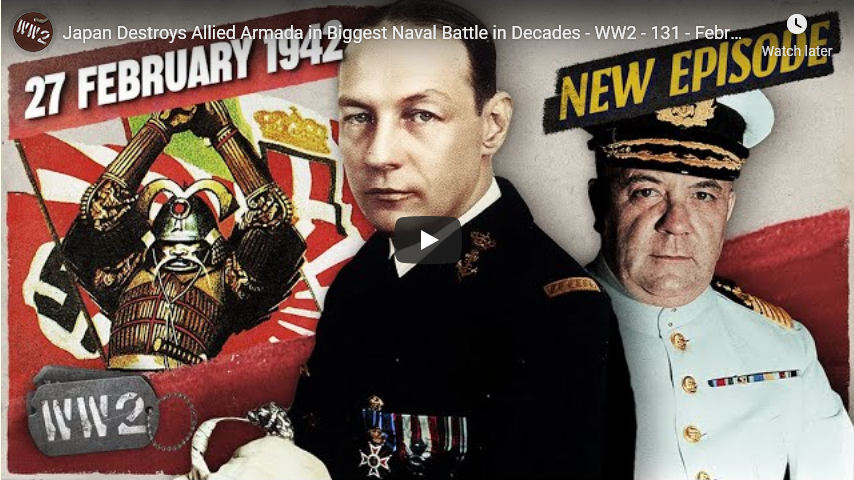
A Japanese Bureaucratic Mess – WW2 Special
World War Two
Published 3 Dec 2020Contrary to popular belief, Imperial Japan was not an absolute monarchy marching (or sailing) to war with singular vision and purpose. Rather, it was a dysfunctional government of competing factions, players and interests.
Join us on Patreon: https://www.patreon.com/TimeGhostHistory
Or join The TimeGhost Army directly at: https://timeghost.tvFollow WW2 day by day on Instagram @ww2_day_by_day – https://www.instagram.com/ww2_day_by_day
Between 2 Wars: https://www.youtube.com/playlist?list…
Source list: http://bit.ly/WW2sourcesWritten and Hosted by: Indy Neidell
Director: Astrid Deinhard
Producers: Astrid Deinhard and Spartacus Olsson
Executive Producers: Astrid Deinhard, Indy Neidell, Spartacus Olsson, Bodo Rittenauer
Creative Producer: Maria Kyhle
Post-Production Director: Wieke Kapteijns
Research by: Indy Neidell
Edited by: Michał Zbojna
Sound design: Marek Kamiński
Map animations: Eastory (https://www.youtube.com/c/eastory)Colorizations by:
Julius Jääskeläinen – https://www.facebook.com/JJcolorization/
Jaris Almazani (Artistic Man) – https://instagram.com/artistic.man?ig…Sources:
From the Noun Project: company soldiers by Andrei Yushchenko, Government by Nithinan Tatah, Shiro by Simon Child, War by Nhor, House by Eucalyp from the Noun ProjectSoundtracks from the Epidemic Sound:
“ES_Paths of a Samurai” – Mandala Dreams
“ES_Sights of the Tokyo Tower” – Sight of Wonders
“ES_The Bloom of Cherry Blossoms” – Sight of Wonders
“ES_Immovable As The Mountain” – Yi Nantiro
“ES_Pacific Shores” – Mandala DreamsArchive by Screenocean/Reuters https://www.screenocean.com.
A TimeGhost chronological documentary produced by OnLion Entertainment GmbH.
November 25, 2020
QotD: Tonnage measurement(s)
The easiest tonnage to understand is displacement tonnage. This is the actual weight of the ship, called displacement because the weight of the ship is equal to the amount of water it displaces, per Archimedes’ principle. Of course, the displacement of a ship can change greatly depending on what’s aboard, so several different displacements are often used. A good reference will give three values, light, normal, and full. Light is basically an empty ship. There are some technical details, but in essence it’s what the ship weighs if we take all the people, fuel, cargo, ammunition, and supplies out of it. Full displacement is exactly what you’d expect from the name. The ship is as heavy as it’s ever going to be, with full fuel, ammo, and cargo. Normal is essentially a ship with full cargo and crew, but two-thirds fuel and ammunition. On warships, it’s common for light displacement to be 75% or so of full displacement, so it’s obvious that a poor choice of reference numbers can cause confusion about the actual sizes of the ships in question. Displacement tonnage in non-metric references is always given in long tons of 2,240 lb each. This is to allow easy conversion, as a long ton of salt water has a volume of almost exactly 35 cubic feet.
Displacement tonnage is the only tonnage value commonly used for warships, while merchant ships use a completely different set of tonnages, usually deadweight tons, gross tons, and net tons. Deadweight tonnage is at least an actual measure of weight, and specifies how much cargo the ship is able to carry, excluding the weight of the ship itself. Gross tonnage and net tonnage are both basically volumetric measures, specified using complicated formulas. Gross tonnage is based on the total volume of all enclosed spaces of the ship, while net tonnage is based only on the volume of the spaces that carry cargo or passengers. These values are used to calculate things like port duties and what regulations apply to the ship. They replaced gross and net register tons, which were also volumetric, of 100 cubic feet to the ton. These were based on a phenomenally complicated set of rules to determine what spaces were and weren’t counted, with shipowners trying to game the system and drive down their tonnage. Worse, different countries had different regulations on what counted under each value, so in 1969, register tonnages were abolished and replaced with the existing system.
While distance, speed, and “tonnage” measurements are the most prominent nautical idiosyncracies, there are a few other values that bear mentioning. The maximum width of a ship is the beam, apparently from the beams that used to run across ships during the days of sail. Draft (or draught) is how deep the hull is below the waterline. This is a very important number to make sure the ship doesn’t run aground, but it varies continually with the amount of stuff on the ship. Air draft is sometimes used for height above the water, important for clearing bridges and the like. Length, much like tonnage, comes in several values. The obvious one is length over all, LOA, which is exactly what it sounds like, measured from the furthest forward to the furthest aft point on the ship. This is obviously useful, but for hydrodynamic purposes another value, waterline length (LWL), is what the designer cares about. The last value is length between perpendiculars (LBP), measured between the vertical stem (bow) post and the vertical stern post. This is another value that was developed for civilian use. Some ships of a given LOA have a great deal of overhang at bow and stern, making them much smaller than other ships with the same nominal LOA. Using LWL is not a good solution, as it varies with draft. LBP solves both of these problems, but isn’t of great importance to warships.
Bean, “Nautical Measurements”, Naval Gazing, 2018-08-10.
November 22, 2020
Enfield MkI Revolver: Merwin Meets Webley (Sort Of)
Forgotten Weapons
Published 23 Aug 2018http://www.patreon.com/ForgottenWeapons
Cool Forgotten Weapons merch! http://shop.bbtv.com/collections/forg…
Adopted in 1880 to replace the Adams revolver, the Enfield MkI was based on an extraction system patented in the 1870s by Owen Jones of Philadelphia. This was similar in practice to the Merwin & Hulbert, with the barrel and cylinder hinging forward while the cartridge cases were held to the back of the frame. This system allowed empty cases to drop free (except the 6 o’clock position one, which often stuck) while retaining any unfired cartridges in the cylinder. Because the extractor star was fixed to the frame, the piece had to be loaded one round at a time through a loading gate (again, like the Merwin & Hulbert).
In 1882 a number of improvements were made to the design and lockwork, including features to prevent the cylinder from rotating freely and to disconnect the hammer when the loading gate was open. This was adopted as the MkII in 1882. A further change was made in 1887, following the death of a Royal Navy sailor whose gun fell out of its holster and discharged upon hitting the hammer. A new safety mechanism was added to prevent this from happening again, and most guns in service were retrofitted with it.
The Enfield was generally not well received, as it was heavy and a bit awkward to handle. It was issued to the Army, Navy, and RCMP, but replaced by the first adopted Webley top-break revolvers in the late 1880s (Enfield MkII production ceased in 1889). Unlike the Webleys and other private-production guns, there was never a civilian version of the Enfield MkI or MkII made, and they are scarcer to find today as a result.
If you enjoy Forgotten Weapons, check out its sister channel, InRangeTV! http://www.youtube.com/InRangeTVShow
Contact:
Forgotten Weapons
6281 N Oracle #36270
Tucson, AZ 85704
November 16, 2020
Remembrance Special – The Pursuit of the Light Cruisers
Historigraph
Published 15 Nov 2020Released on Volkstrauertag and to mark all of the various Remembrance Days around the world, this is the story of the pursuit of the light cruisers and a tribute to those who lost their lives.
Get the full story of the Battle of the Falkland Islands here: https://youtu.be/cBCCnqiVOUk
This video is unmonetised for me due to the music I included at the end (any ads you see are for copyright holders). If you wanted to support me to make more videos without relying on ads or sponsorship, I’d appreciate it if you checked out my Patreon https://www.patreon.com/historigraph
Buy Historigraph Posters here! teespring.com/stores/historigraph
#BattleOfTheFalklandIslands #Historigraph #CuriosityStream
► Twitch: https://www.twitch.tv/addaway
► Twitter: https://twitter.com/historigraph
► Instagram: https://www.instagram.com/historigraph
November 15, 2020
November 11, 2020
In memoriam
A simple recognition of some of our family members who served in the First and Second World Wars:
The Great War
Private William Penman, Scots Guards, died 16 May, 1915 at Le Touret, age 25
(Elizabeth’s great uncle)- Private Archibald Turner Mulholland, Argyll & Sutherland Highlanders, mortally wounded 25 September, 1915 at Loos, age 27
(Elizabeth’s great uncle) - Private David Buller, Highland Light Infantry, died 21 October, 1915 at Loos, age 35
(Elizabeth’s great grandfather) - Private Harold Edgar Brand, East Yorkshire Regiment. died 4 June, 1917 at Tournai.
(My first cousin, three times removed) - Private Walter Porteous, Durham Light Infantry, died 4 October, 1917 at Passchendaele, age 18
(my great uncle) - Corporal John Mulholland, Argyll & Sutherland Highlanders, wounded 2 September, 1914 (shortly before the First Battle of the Aisne), wounded again 29 June, 1918, lived through the war.
(Elizabeth’s great uncle)
The Second World War
- Flying Officer Richard Porteous, RAF, survived the defeat in Malaya and lived through the war
(my great uncle) - Able Seaman John Penman, RN, served in the Defensively Equipped Merchant fleet on the Murmansk Run (and other convoy routes), lived through the war
(Elizabeth’s father) - Private Archie Black (commissioned after the war and retired as a Major), Gordon Highlanders, captured at Singapore (aged 15) and survived a Japanese POW camp
(Elizabeth’s uncle) - Elizabeth Buller, “Lumberjill” in the Women’s Land Army in Scotland through the war.
(Elizabeth’s mother) - Trooper Leslie Taplan Russon, 3rd Royal Tank Regiment, died at Tobruk, 19 December, 1942 (aged 23).
Leslie was my father’s first cousin, once removed (and therefore my first cousin, twice removed).
For the curious, the Commonwealth War Graves Commission the Royal British Legion, and the Library and Archives Canada WW1 and WW2 records site provide search engines you can use to look up your family name. The RBL’s Every One Remembered site shows you everyone who died in the Great War in British or Empire service (Canadians, Australians, New Zealanders, South Africans and other Imperial countries). The CWGC site also includes those who died in the Second World War. Library and Archives Canada allows searches of the Canadian Expeditionary Force and the Royal Newfoundland Regiment for all who served during WW1, and including those who volunteered for the CEF but were not accepted.
In Flanders fields the poppies blow
Between the crosses row on row,
That mark our place; and in the sky
The larks, still bravely singing, fly
Scarce heard amid the guns below.We are the Dead. Short days ago
We lived, felt dawn, saw sunset glow,
Loved and were loved, and now we lie
In Flanders fields.Take up our quarrel with the foe:
To you from failing hands we throw
The torch; be yours to hold it high.
If ye break faith with us who die
We shall not sleep, though poppies grow
In Flanders fields.Lieutenant Colonel John McCrae, MD Canadian Army Medical Corps (1872-1918)
November 9, 2020
Falklands 1914: Von Spee’s Last Stand
Historigraph
Published 7 Nov 2020For unlimited access to the world’s top documentaries and 25% off between 16 Nov and 3 Jan, check out https://curiositystream.thld.co/histo…
Support the channel on Patreon: https://www.patreon.com/historigraph
Buy Historigraph Posters here! teespring.com/stores/historigraph#BattleOfTheFalklandIslands #Historigraph #CuriosityStream
► Twitch: https://www.twitch.tv/addaway
► Twitter: https://twitter.com/historigraph
► Instagram: https://www.instagram.com/historigraph
October 23, 2020
QotD: Every military organization
Regardless of T.O., all military bureaucracies consist of a Surprise Party Department, a Practical Joke Department, and a Fairy Godmother Department. The first two process most matters as the third is very small; the Fairy Godmother Department is one elderly female GS-5 clerk usually out on sick leave.
Robert A. Heinlein, Glory Road, 1963.
October 14, 2020
Wolfpack Killers – U-Boat Tactics – WW2 Special
World War Two
Published 13 Oct 2020German U-Boats were a big threat to Allied shipping across the Atlantic. New inventions and tactics triggered a race to outsmart the opponent, dramatically changing the tides of the Battle of the Atlantic every few months.
Join us on Patreon: https://www.patreon.com/TimeGhostHistory
Or join The TimeGhost Army directly at: https://timeghost.tvFollow WW2 day by day on Instagram @ww2_day_by_day – https://www.instagram.com/ww2_day_by_day
Between 2 Wars: https://www.youtube.com/playlist?list…
Source list: http://bit.ly/WW2sourcesHosted by: Indy Neidell
Written by: Joram Appel
Director: Astrid Deinhard
Producers: Astrid Deinhard and Spartacus Olsson
Executive Producers: Astrid Deinhard, Indy Neidell, Spartacus Olsson, Bodo Rittenauer
Creative Producer: Maria Kyhle
Post-Production Director: Wieke Kapteijns
Research by: Joram Appel
Edited by: Miki Cackowski
Sound design: Marek Kamiński
Map animations: Eastory (https://www.youtube.com/c/eastory)Colorizations by:
https://www.instagram.com/dememorabilia/
Julius Jääskeläinen – https://www.facebook.com/JJcolorization/Sources:
Pugsley, William H./Library and Archives Canada/PA-139273
Bundesarchiv
Narodowe Archiwum Cyfrowe
IWM CH 15219, A 31092, FL 3259
Bletchley Park Trust
from the Noun Project: Cargo Ship by Locad, explosion by Nico TzogalisSoundtrack from the Epidemic Sound:
Johannes Bornlof – “The Inspector 4”
Reynard Seidel – “Deflection”
Johannes Bornlof – “Deviation In Time”
Hakan Eriksson – “Epic Adventure Theme 3”
Johannes Bornlof – “Death And Glory 3”
Phoenix Tail – “At the Front”Archive by Screenocean/Reuters https://www.screenocean.com.
A TimeGhost chronological documentary produced by OnLion Entertainment GmbH.
From the comments:
World War Two
1 day ago
The episode covers some of Otto Kretschmer’s 11 Points of Submarine Warfare. Here’s the full list:1. Efficient lookouts are of prime importance.
2. It is essential not simply to spot the target, but to spot it in good time.
3. Lone ships should be attacked on the surface with gunfire in order to save expensive torpedoes.
4. Survivors should be assisted where possible.
5. Convoys should only be attacked in daylight if it is not feasible to wait for nightfall.
6. Attack at night from the dark side of the convoy, so that the target is silhouetted and the submarine is in shadow.
7. When there is little or no moonlight, attack from the windward side [to avoid a visible white bow-wave when motoring into the wind].
8. Fire one torpedo per target, not fanned salvoes.
9. Fire at close range.
10. Once the attack is launched, do not submerge except in circumstances of dire necessity. Remember that on the surface it is easier for you to spot the enemy than for the enemy to spot you.
11. Dive only for two hours before dawn each day, to rest the crew, sweep with the sound detection equipment, etc.; otherwise, remain on the surface.
October 10, 2020
A century on, Greece and Turkey are back at daggers drawn
John Psaropoulos on the ever-more-heightened tension in the Aegean Sea as Turkey looks to muscle in on Greek-claimed waters in search of natural gas (or a fight):
Last summer, Greece and Turkey came closer to war than they have done since 1974, when Turkey invaded Cyprus. The drama began to unfold on 21 July, when Turkey announced it was sending a seismic survey ship, the Oruc Reis, to look for oil and gas in areas the UN Law of the Sea awards to Greece.
Within hours, the Greek and Turkish navies had deployed throughout the Aegean and east of Crete. They remained so for two months. Greek helicopters pinned down Turkish submarines off the island of Evia. Frigates shadowed each other so closely, that on 12 August two of them collided when a Turkish frigate performed a manoeuvre across the bows of a Greek one. Greek and Turkish F-16s intercepted each other between Crete and Cyprus. Greece came close to invoking the European Union’s mutual defence clause.
On 13 September, Turkey withdrew the Oruc Reis, ostensibly for maintenance, and redeployed its navy. In the coming days, Greece and Turkey are to resume talks abandoned four and a half years ago on carving out their continental shelves – vast swathes of the east Mediterranean where they may exercise exclusive commercial rights to exploit undersea resources.
For now, there is de-escalation, but expectations for the outcome of these talks are low.
“Right now, Turkey doesn’t consider itself an extension of the West. It doesn’t consider that it has commitments and responsibilities towards the West,” says Konstantinos Filis, who directs the Institute of International Relations in Athens. “It believes it is an autonomous power in the region, that it is very potent, and that all its neighbours should respect it. The Turkish leadership doesn’t appear to be prepared for compromises with neighbours it considers inferior.”
The east Mediterranean is where the world’s most significant natural gas discoveries have occurred since the turn of the millennium. Israel and Egypt are now energy independent. Cyprus soon hopes to be. But Greece potentially dwarfs them all.
Seismic explorations it conducted six years ago suggest that Greece has natural gas reserves of 70-90 trillion cubic feet – as much as Israel, Egypt and Cyprus have discovered combined, with a pre-Covid-19 market value of about $200 billion. Assuming gas is viable for the next 25 years, Greece’s reserves, if proven, would cover its energy needs and turn gas into a lucrative export to the European Union. As much as a third of the value of the gas would go to the Greek state in taxes and royalties, allowing it to pay off a fifth of its external debt, now approaching twice its GDP.
This is clearly a future Turkey, with eight times Greece’s population and four times its economy, would rather claim for itself. Legally, it cannot do so. Under the rules of the UN’s Law of the Sea (UNCLOS), the lion’s share of east Mediterranean waters goes to Greece and Cyprus. Recep Tayyip Erdogan, Turkey’s leader for the past 18 years, feels that the Greeks are hemming him in.
September 20, 2020
QotD: The anti-slavery movement
“William Wilberforce,” writes Eric Metaxas in his book Amazing Grace, “was the happy victim of his own success. He was like someone who against all odds finds the cure for a horrible disease that’s ravaging the world, and the cure is so overwhelmingly successful that it vanquishes the disease completely. No one suffers from it again — and within a generation or two no one remembers it ever existed.”
What did Wilberforce “cure”? Two centuries ago, on March 25th 1807, one very persistent British backbencher secured the passage by Parliament of an Act for the Abolition of the Slave Trade throughout His Majesty’s realms and territories. It’s not that no one remembers the disease ever existed, but that we recall it as a kind of freak pandemic — a SARS or bird flu that flares up and whirrs round the world and is then eradicated. The American education system teaches it as such — as a kind of wicked perversion the Atlantic settlers had conjured out of their own ambition.
In reality, it was more like the common cold — a fact of life. The institution predates the word’s etymology, from the Slavs brought from eastern Europe to the glittering metropolis of Rome. It predates by some millennia the earliest laws, such as the Code of Hammurabi in Mesopotamia. The first legally recognized slave in the American colonies was owned by a black man who had himself arrived as an indentured servant. The first slave owners on the North American continent were hunter-gatherers. As Metaxas puts it, “Slavery was as accepted as birth and marriage and death, was so woven into the tapestry of human history that you could barely see its threads, much less pull them out. Everywhere on the globe, for 5,000 years, the idea of human civilization without slavery was unimaginable.”
Mark Steyn, The [Un]documented Mark Steyn, 2014.
September 11, 2020
JS Izumo, Japan’s largest warship
AMANO Jun-ichi
Published 12 Jun 2016https://en.wikipedia.org/wiki/JS_Izumo
At open-house of the Japan Maritime Self-Defense Force Yokosuka Naval Base.
On June 11, 2016.#JMSDF #MSDF
From the Wikipedia entry:
JS Izumo (DDH-183) is a helicopter carrier with a planned future conversion into an aircraft carrier. Officially classified as a multi-purpose operation destroyer, she is the lead ship in the Izumo class of the Japan Maritime Self-Defense Force (JMSDF). She is the second warship to be named for Izumo Province, with the previous ship being the armoured cruiser Izumo (1898).
The ruling Liberal Democrat Party announced in May 2018 that it favours converting Izumo to operate fixed-wing aircraft. The conversion was confirmed in December 2018 when Japan announced the change of its defense guidelines. Upon the completion of the process, Izumo will be the first Japanese aircraft carrier since World War II.