Quotulatiousness

January 30, 2022

“I stand corrected. All retail sucks, not just book retail”

Filed under: Books, Business, Economics — Tags: , — Nicholas @ 03:00

Following up to the issue of book store-to-publisher returns last week (here), Kenneth Whyte discovered that other retailers are not that different from the book business after all:

“Indigo Books and Music” by Open Grid Scheduler / Grid Engine is licensed under CC0 1.0

Last week I wrote about the horrible, wasteful publishing-wide policy of booksellers returning unsold books for full refunds rather than putting them on sale. Some 30 percent of books in stores are sent back to publishers who bury, pulp, or remainder them. I compared this practice to other retail sectors:

    If I were in the ugly sweater business, I’d sell 500 ugly sweaters to Saks at $200-a-piece. Saks pays me 500x$200=$100,000, marks the ugly sweaters up to $500, and lays them out on tidy glass shelves under track lighting. Whatever is left after the Christmas season is marked down to half price on crowded sales racks. If Saks still has some ugly sweaters in January, it will ship them to the outlet store where they’re offered at still greater discounts.

Our friend, author and regular SHuSH reader Ken McGoogan, sent my comments to a mature student he teaches. She comes from the fashion industry and says it’s not so simple:

    The reality is, if Saks cannot sell that ugly sweater, they will ask for mark-down money from the brand (the wholesaler) who sold them that ugly sweater. If the brand is not willing to give Saks that mark-down money, they will never carry anything from the brand again. Is mark-down money better than returns? Honestly, it’s not that much better. The amount of the mark-down money is an often shocking figure. And this is not just for Saks, all big retailers do it, without exception.

    Barnes & Noble or Chapters are just like department stores. The business model is the same. The only thing is, if the readers found out how much waste the book returns are generating every year, it’ll be a big turn off for the customers. They’d rather force themselves to read e-books or audio books than be part of the wasteful culture. Especially for the younger generation, they are buying less garments because of the fashion industry’s wasteful level. Fyi, a lot of new clothes and unsold inventories are burned every year as they are running out of storage spaces.

I stand corrected. All retail sucks, not just book retail. And the book industry had better sort this out before the aforementioned younger generation begins to focus on it.

January 23, 2022

The oddity of the bookselling business

Filed under: Books, Business, Economics — Tags: , , — Nicholas @ 03:00

Unlike so many other retail operations, book stores have a different sales cycle because they can generally return unsold books (in good condition) to the publisher for a full refund. This means that 30% or more of the books on the shelf at Christmas will be shipped back to the publisher early in the new year, only to appear again on the discount shelves a year or two later for a fraction of the original retail price (and often in rather worse shape for all the additional handling). In the latest SHuSH newsletter, Kennethy Whyte calls this the worst problem in book publishing:

“Indigo Books and Music” by Open Grid Scheduler / Grid Engine is licensed under CC0 1.0

Book publishing doesn’t work like most other retail businesses. If I were in the ugly sweater business, I’d sell 500 ugly sweaters to Saks at $200-a-piece. Saks pays me 500x$200=$100,000, marks the ugly sweaters up to $500, and lays them out on tidy glass shelves under track lighting. Whatever is left after the Christmas season is marked down to half price on crowded sales racks. If Saks still has some ugly sweaters in January, it will ship them to the outlet store where they’re offered at still greater discounts.

What happens to them if they don’t sell at the outlet doesn’t interest me because I’ve got my $100,000. If Saks ordered far too many ugly sweaters, that’s Saks’ problem.

In the book world, I sell 1,000 copies of a book to a retail chain like Barnes & Indigo for $15-a-piece, half the retail price. Barnes & Indigo pays me 1,000x$15=$15,000 and maybe puts some of the books on a front table, or maybe buries them on a bottom shelf in the darkest corner of the store. I might sell a two hundred, four hundred, or six hundred copies.

Let’s be generous and say 600 sell at Barnes & Indigo through the autumn and over the holidays. Come January, the store doesn’t put the remaining stock on sale: it packs up the unsold 400 and ships them back to me for a full refund. The 400 returns, or at least those of them that aren’t crumpled or coffee-stained, go back into the warehouse, which charges me fees to process the returns and more fees to store them. Sometime later, I get a notice of the returns and regret that extra glass of wine I ordered at dinner the night I thought I sold Barnes & Indigo $15,000 worth of books when, in fact, I only sold $9,000 worth of books, perhaps leaving me under-water on that particular title. I also regret boasting of the $15,000 sale to the author, who probably did some royalty math in his head and thought he was getting 40% more than he’ll actually receive.

Returns at publishing houses run somewhere between 25% and 30% annually, across all titles. That’s despite Amazon with its ruthlessly efficient algorithms seldom buying many more copies than it needs, and despite ebooks and audiobooks (which amount to a quarter of sales for many publishers) having almost zero returns.

Millions of books are returned to publishers at this time of year. Sales are slower in January and February, so bookstores hurriedly return all their remaining holiday-season stock and whatever else hasn’t moved to keep themselves in cash. Some of the returns go back into storage. Eventually, most are remaindered, or pulped, or buried. It’s a colossal waste of paper and ink, a headache in terms of shipping/handling/accounting, and dispiriting as heck. You might think you had a great year, hit all your sales targets, exceeded them, even, and then in about the third week of January begins the drip drip drip of returns, and it continues steadily through March. That’s if you’re lucky and it’s drips, not waves. And while the returns are concentrated in the first quarter, your books are returnable year-round, so even a pleasant summer afternoon can be ruined by the unexpected arrival of a pallet of unwanted stock.

January 12, 2022

QotD: Baumol’s cost disease in architecture and furniture

Filed under: Architecture, Economics, History, Quotations — Tags: , , , — Nicholas @ 01:00

Remember, the Baumol effect [Wiki] happens when new technology makes some industries more productive. Since the high-tech industries are so lucrative, wages go up. Then low-tech industries have to raise their wages so that their workers don’t all desert them for the high-tech industries. But since low-tech industries aren’t improving their productivity, they just because more expensive, full stop.

If stonemasonry is a low-tech industry, and new high-tech industries are arising all around it, stonemason wages could get prohibitively high (compared to everything else) until nobody wants to hire them anymore. This would create pressure for architectural styles that require as little masonry (or, generalized, human labor) as possible.

This has gotten me thinking about furniture.

I got a new place recently and have been looking for furnishings. Sometimes I look at people’s furniture Pinterests. If Pinterest is any kind of representative window into the soul of the modern furniture-enthusiast, people really like Art Nouveau. […] As far as I can tell, you can’t buy any of these anywhere — they’re a combination of antiques and concept pieces. The people who pin these and pine after these end up getting minimalist Scandinavian furniture with names like UJLIBLÖK, just like everyone else.

Anything that even comes close to the above costs high four to five digits. I don’t know if this is because it’s antique, because it requires more labor, or both.

I’m harping on furniture because it avoids a lot of the complicating factors in architecture. There isn’t some vague collection of “elites” making our furniture decisions. It’s a pretty free market! There are lots of normal middle-class people spending big chunks of money on furniture, lots of them really really like the old stuff, and the old stuff is still either unavailable or unaffordable. It seems like it used to be affordable — it wasn’t just kings and dukes who had the old Art Nouveau stuff — but for some reason that’s changed. I think Baumol effects offer a tidy explanation here, and if we use them to explain furniture, then they start looking really attractive for architecture.

I want this one to be true, because it exonerates our civilization. If we could make things like the Art Nouveau furniture above, or the Taj Mahal, relatively cheaply and easily, then the question of why we aren’t doing that demands an answer. If it’s just a quirk of basic economics, then our civilization is fine, and maybe we can hope that stoneworking technology advances to the point where we can do this kind of thing again cheaply.

Scott Alexander, “Highlights From The Comments On Modern Architecture”, Astral Codex Ten, 2021-10-04.

December 26, 2021

Repost – The market failure of Christmas

Filed under: Economics — Tags: , , — Nicholas @ 03:00

Not to encourage miserliness and general miserability at Christmastime, but here’s a realistic take on the deadweight loss of Christmas gift-giving:

Christmas gifts under the tree.
Photo by Kelvin Kay via Wikimedia Commons.

In strict economic terms, the most efficient gift is cold, hard cash, but exchanging equivalent sums of money lacks festive spirit and so people take their chance on the high street. This is where the market fails. Buyers have sub-optimal information about your wants and less incentive than you to maximise utility. They cannot always be sure that you do not already have the gift they have in mind, nor do they know if someone else is planning to give you the same thing. And since the joy is in the giving, they might be more interested in eliciting a fleeting sense of amusement when the present is opened than in providing lasting satisfaction. This is where Billy Bass comes in.

But note the reason for this inefficient spending. Resources are misallocated because one person has to decide what someone else wants without having the knowledge or incentive to spend as carefully as they would if buying for themselves. The market failure of Christmas is therefore an example of what happens when other people spend money on our behalf. The best person to buy things for you is you. Your friends and family might make a decent stab at it. Distant bureaucrats who have never met us — and who are spending other people’s money — perhaps can’t.

So when you open your presents next week and find yourself with another garish tie or an awful bottle of perfume, consider this: If your loved ones don’t know you well enough to make spending choices for you, what chance does the government have?

December 23, 2021

Repost — The lousy economics of gift-giving

Filed under: Economics — Tags: , , — Nicholas @ 03:00

Tim Worstall explains why gift-giving at Christmas is so economically inefficient:

Christmas gifts under the tree.
Photo by Kelvin Kay via Wikimedia Commons.

The point being made is dual, that individuals have agency and that utility is entirely personal.

To unravel that jargon.

Individuals, peeps, are able to make choices. We delight in making choices in fact, “agency” is the opposite of “anomie”, that feeling that society determines what we may or can do that so depresses the human spirits. We get to choose to get up at 6 am or 8. Have coffee or tea when we do. Go buy the latest platters from the newly popular beat combo, pay the ‘leccie bill or have the coffee out at an emporium.

Having choices, making them, makes people happier.

Secondly, utility. The result of those choices, which of them will maximise happiness, is different for each and every individual. Sure, we can aggregate some of them – food is usually pretty high up everyones’ list, that first litre of water a day tops most. But the higher up Maslow’s Pyramid we go the more tastes – and thus happiness devoured – differ.

So, we make humans happier by their having the choice to do what they want, not what others think they should want or have.

Thus, give people cash at Christmas not socks.

Balancing that is the obvious point that the care and attention with which a present is considered is part of that consumption of happiness. The boyfriend who actually listens to the type of clothing desired and goes gets it provides that joy that a bloke has, for once, been listening. Or the book that would never have been individually considered but was chosen because it might – and does.

Sure.

But the point isn’t about Christmas at all. That’s a way of wrapping the point so it can be left underneath the tree of knowledge.

October 9, 2021

The incredible growth of London after 1550

Filed under: Britain, Economics, History — Tags: , , , , — Nicholas @ 03:00

In the latest Age of Invention newsletter, Anton Howes considers some alternative explanations for London’s spectacular growth beginning in the reign of Queen Elizabeth I:

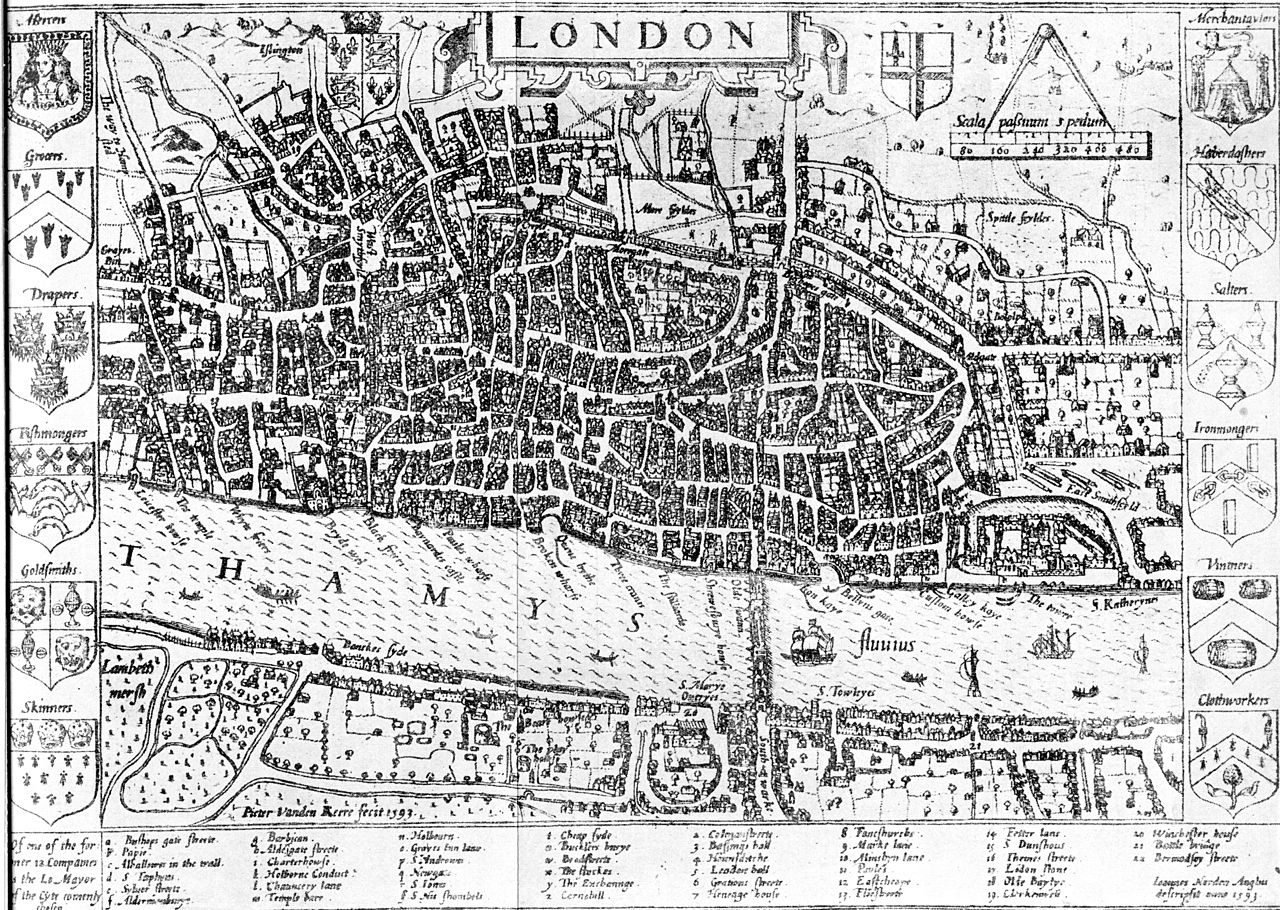
John Norden’s map of London in 1593. There is only one bridge across the Thames, but parts of Southwark on the south bank of the river have been developed.
Wikimedia Commons.

As regular readers will know, I’ve lately been obsessed with England’s various economic transformations between 1550 and 1650 — the dramatic eightfold growth of London, in particular, and the fall in the proportion of workers engaged in agriculture despite the growth of the overall population.

As I’ve argued before, I think that the original stimulus for many of these changes was the increased trading range of English overseas merchants. Thanks to advances in navigational techniques, they were able to find new markets and higher prices for their exports, particularly in the Mediterranean and then farter afield. And they were able to buy England’s imports much more cheaply, by going directly to their source. Although the total value of imports rose dramatically — by 150% in just 1600-38 — the value of exports seems to have risen by even more, as there’s plenty of evidence to suggest that for most of the period England had a trade surplus. The supply of money increased, even though Britain had no major gold or silver mines of its own.

The growing commerce was the major spur to London’s growth, with English merchants spending their profits in the city, and ever-cheaper and more varied luxury imports enticing the nobility from their country estates. Altogether, the concentration of people and wealth in London must have resulted in all sorts of spill-over effects to further drive its growth. After the initial push from overseas trade, I suspect that by the late seventeenth century the city was large enough that it was running on its own steam.

But on twitter, economic historian Joe Francis offered a slightly different narrative. Although he agrees that a change to overseas trade was the prime mover, he suggests that the trade itself was too small as a proportion of the economy to account for much of London’s growth. I disagree, for various reasons that I won’t go into now, but Joe brought to my attention various changes on the monetary side. Inspired by the work of Nuno Palma, he suspects that it was not the trade per se, but the fact of an export surplus that was doing the heavy lifting, by increasing the country’s money supply.

An increased money supply should have facilitated England’s internal trades, reducing their costs, and allowing for greater regional specialisation. Joe essentially thinks that I’ve got the mechanism slightly back to front: instead of London’s growing demands having reshaped the countryside, he contends that the specialisation of the entire country is what allowed for the better allocation of economic resources and workers to where they were most productive — a process from which a large city like London quite naturally then emerged.

I have some doubts about whether this process could really have been led from the countryside. The regional specialisation that we see in agriculture, for example, only really starts to become obvious from the 1600s onwards, by which stage London’s population had already begun to balloon from a puny 50,000 in 1550, to 200,000 and rising. I also haven’t found much evidence of other internal trade costs falling. Internal transportation — by packhorse, river, or down the coast — doesn’t seem to have become all that more efficient. Roads and waggon services don’t show much sign of improvement until the eighteenth century, and not many rivers were made more navigable before the mid-seventeenth century either. This is not to say that England’s internal trade didn’t increase. It certainly did, as London sucked in food and fuel in ever larger quantities, and from farther and farther afield. But it still looks like this was led by London demand, rather than by falling costs elsewhere.

Besides, the influxes of bullion from abroad would have all been channelled through London first, along with most of the country’s trade. To the extent that monetisation made a difference to the costs of trade then, this would have made a difference first in the city, before emanating out to its main suppliers, and then outwards. I thus see the Palma narrative as potentially complementary to my own.

October 5, 2021

QotD: Entrepreneurship

Filed under: Business, Economics, Quotations — Tags: , , — Nicholas @ 01:00

If entrepreneurs see value in the […] economic landscape, and perceive there are rich profits to be made in turning around businesses and then flogging them off, it is very good news indeed for the country’s economy. By releasing capital from uneconomic areas and focussing it on lucrative new bits, the overall pie gets bigger, jobs get created, and productivity is also increased.

In fact, one could almost create a new economic law: the amount of abuse raining down on entrepreneurs is directly proportional to the good they do. I haven’t seen much reason to doubt this law yet.

Johnathan Pearce, “Gordon Gekko goes to Germany”, Samizdata.net, 2005-05-05.

July 19, 2021

Talk is cheap, as a pizza chain CEO demonstrates brilliantly

Filed under: Business, Economics, USA — Tags: , , , , , — Nicholas @ 03:00

John Miltimore examines the claims of the CEO of the &pizza chain in the Washington DC area that his stores have no problem getting staff because he pays them a “living wage”:

As far as PR goes, Lastoria gets an A+. He was profiled by Business Insider, CBS News, and other media outlets. His economics grade, however, is another story.

First, the notion that &pizza’s wages are uniquely generous is wrong. The minimum wage in the nation’s capital, after all, is $15.20. Considering that Washington, DC has one of the highest costs of living in the US, it’s not unreasonable to assume that &pizza is paying workers what amounts to the market wage of their labor (i.e. the price they’d get in the absence of a wage floor). This is a stark contrast to other parts of the United States. Fifteen dollars in DC translates to roughly $24 in Florida, $25 in Alabama and Tennessee, $26 in New Mexico, and $27 in Louisiana.

Second, Lastoria decries the alleged “shortage of business owners willing to pay a living wage.” But it should be pointed out that &pizza is one of those businesses.

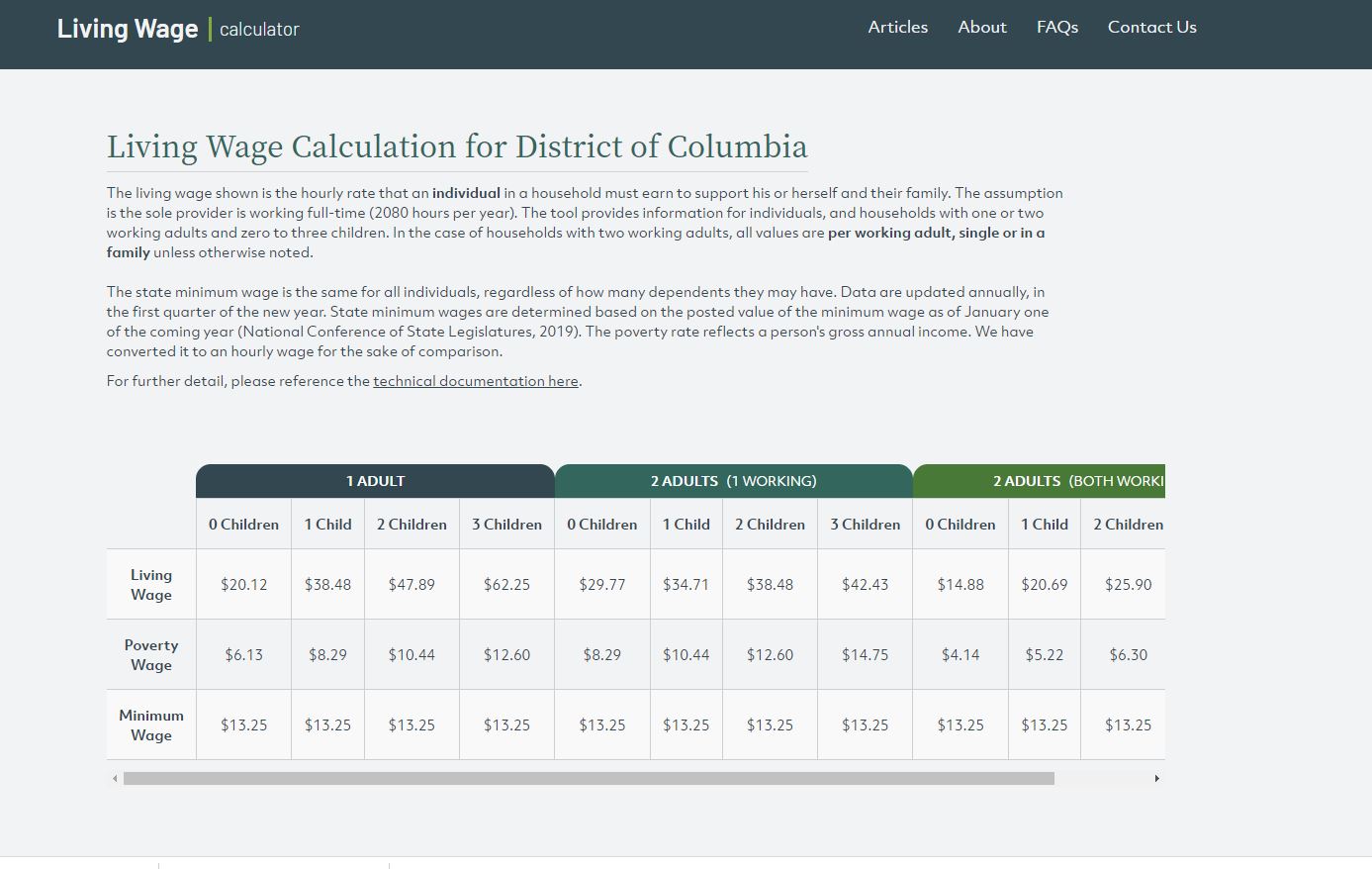
While there is no objective standard to determine what a living wage actually is, MIT has a Living Wage Calculator that allows readers to compute living wages based on the formula created by Dr. Amy K. Glasmeier.

To say that &pizza doesn’t pay its employees a “living wage” is an understatement. The living wage for a single mom with one child is $38.48 in Washington DC. For a single mother with two children, it’s $47.89. Indeed, even for a married couple with just one child, the living wage is $20.69 — nearly $5 an hour more than the average pay of Lastoria’s workers. (It’s unclear why Lastoria is having fewer problems hiring workers than other businesses, but it’s most likely attributable to local factors, such as the fact that he’s servicing nine of the twenty wealthiest counties in America.)

Finally, Lastoria’s claim that higher wages increase productivity enough to improve a company’s bottom line — the efficiency wage hypothesis — has problems logically and empirically. First, it implies that companies not currently paying an efficiency wage are willing to take less profit simply to make workers poorer. Moreover, efficiency wages have been shown to reduce employment, similar to minimum wage laws.

Lastoria might see the $16 an hour average wage as exceedingly generous — especially when he compares it to lower nominal wages paid in other parts of the country — but it’s a far cry from a “living wage”, according to the model used by living wage advocates.

I asked Lastoria how he’d respond to those who say restaurants like his should be required to pay each worker a living wage. He didn’t respond.

April 18, 2021

QotD: Two centuries on, Ricardo still right

Filed under: Economics, Quotations — Tags: , — Nicholas @ 01:00

One of David Ricardo’s foundational assertions was the law of one price. That tradeable goods will cost the same, when their transport costs are included, in different places. The insight being that if they weren’t then people would buy in one, sell in the other, thereby equalising prices. A reasonable corollary to this idea is that exchange rates should move based upon purchasing parity or interest rate parity. The second is because people can move their money, just like anything else, to arbitrage between prices – here, the interest rate. The other because, well, that’s what arbitrage will do, equalise those PPP exchange rates. Not wholly, not perfectly, but roughly enough.

Tim Worstall, “Ricardo Still Right 201 Years Later”, Continental Telegraph, 2018-11-01.

April 17, 2021

Considering the costs and benefits of extreme specialization

Filed under: Economics — Tags: , , , , — Nicholas @ 03:00

In the latest post on Matt Gurney’s Code 47 Substack blog, he considers the trade-off between population density and the range of specialization that can be supported at various densities:

“Model A Ford in front of Gilmore’s historic Shell gas station” by Corvair Owner is licensed under CC BY-SA 2.0

I wish I remembered where I read this. It was a book I was blowing through for a university paper; only one chapter was really of interest to me when I was trawling for footnotes but I stumbled upon an interesting section that talked about services and specialization in a modern economy. The author offered a simple explanation of service specialization that I’ve never forgotten. Imagine a village with 100 people, the author said. Now imagine what services are available there. There’s probably a gas station, and maybe you can get a few services done to your car there, too. Basic repairs. Tire rotations. Oil changes. Things like that. There’s probably also a convenience store, and the store might also have a place to send or receive mail, or maybe even to rent a movie. (Back when that was a thing we did.) You might have a coffee shop of some kind, maybe a diner. But that’s marginal. You almost certainly don’t have a school, full post office, bank branch or medical centre of any kind. Not in a village of 100 people.

When you itemize out all the services you can get, it’s probably about five or maybe 10 — gas pumped, tires changed, oil changed, basic engine repairs, store clerk, movie rental, mail sent and received. Maybe someone to pour you a cup of coffee and get you a sandwich — but only maybe. The point isn’t to be precise in our list or count, but just to contemplate the relationship between the population and the number and type of available services.

Now scale that village up 10 fold, the author said. Now it’s a town of 1,000. The number of services explodes. You still have everything you did before. But now you’ve also got specialized shops, restaurants, a bank or two (and all the services they provide), probably a house of worship, medical services of various kinds (including eye care, dentistry, etc), personal-care services, better access to home and lawn care, various repair and maintenance service, technical services, a post office … the list goes on. You also start to see competition and the efficiency that brings — our village of 100 would have a gas station and a convenience store (quite possibly at the same location!). But our town of 1,000 would have a few of each. You’d get more services, and start to see prices dropping for the commonly available offerings.

You get the idea — the more you scale up a population, the more specialized services that are available and the more accessible they become. And this includes not just categories of service, but also increasing degrees of specialization. Our village of 100 probably has no full-time doctor. Our town of 1,000 probably has a family physician. But after we bump things up to 10,000, 100,000 and then a million people, we’re getting not just doctors, but highly trained, specialized physicians, surgeons and diagnosticians. Our town of 1,000 has a dentist, but our city of a million has dental surgeons who’ve specialized in repairing specific kinds of trauma and injury.

Anyway. I don’t remember what book this was from. But I do remember this short section. I think about it a lot. We Canadians of 2021 are, for the most part, hyper-specialized. I’ve written columns about this before, including this one from 2019, which I’m going to quote liberally below:

    Human history is, in one simplified viewing, the story of specialization. As our technology advanced, a smaller and smaller share of the labour pool was required just to keep everyone alive. Perhaps the easiest way to summarize this is to note that 150 years ago, even in the most advanced industrial countries, something close to 50 per cent of the population was directly engaged in agriculture — half the people tilled fields so the other half could eat. Today, in both Canada and the United States, it’s closer to two per cent — one person’s efforts feed 49 others. Those 49 can pursue any of the thousands of specialized jobs that allow our technological civilization to exist. … Those 49 people are our artists and doctors and scientists and teachers. Human advancement depends on this — a civilization that’s scrambling to feed itself doesn’t build particle colliders or invent new neonatal surgeries and cancer-stopping wonderdrugs.

I stand by those remarks. But I’ve been pondering them of late with a different perspective. I’ve spent much of this week talking with doctors and medical experts in Ontario, where the third wave of COVID-19 is threatening to overwhelm the health-care system, with tragic results. And one recurring theme that comes up in these conversations is how this disaster is going to take place almost entirely out of public view. There won’t be any general mobilizations or widespread damage. People are going to die, behind closed doors or tent flaps, and other people will be forever scarred by their inability to save those people. But for most of us — those who aren’t sick, or highly specialized medical professionals — life is going to be something reasonably close to normal.

April 12, 2021

QotD: Four lessons on free trade

Filed under: Cancon, Economics, Quotations — Tags: , , — Nicholas @ 01:00

Here are the main points of the Bank of Canada’s lessons in free trade. It starts off with a bang. “Trade is dominating the news these days. With the barrage of headlines and the talk about protectionism and tariffs, it’s easy to forget that much of our economic growth and prosperity comes from international trade.”

Below are the lessons, taken almost entirely verbatim from the bank’s online lesson (except where I’ve provided a bit of additional description). It’s a terrific lesson and all within a mere 1,400 words and a short video.

Lesson 1: All parties reap the rewards of free trade.

Specialization means focusing on what each country produces most efficiently and trading for the rest. And because specialization is more efficient, it creates more wealth than if each country tried to do it all on its own. International trade is no different from domestic specialization and internal trade — few of us grow our own food or do our own dry cleaning. Instead, we specialize and trade. The lesson includes a short cartoon video featuring “Mark and Lucy” — aimed at kids but worth a presidential view — that explains the concepts of comparative advantage and opportunity costs.

Lesson 2: Trade protectionism makes everyone worse off.

While freer trade — in both exports and imports — makes us better off, the opposite is also true. Barriers to free trade, such as tariffs, have a negative impact on our economic well being.

Lesson 3: The pie isn’t divided equally.

Freer trade has raised incomes across the global economy, but it has not benefited everyone. Countries engaged in free trade are better off overall, but some sectors and communities within countries have suffered. Governments have used policies such as ongoing learning and retraining programs to help affected workers adjust. This a better approach than shrinking the pie through trade protection. That would be worse for everyone.

Lesson 4: Trade deficits and surpluses are not a scorecard.

It’s important to debunk the myth that cheap imports are the cause of all the pain and that a trade deficit with another country is a bad thing. Looking at trade balances between a country and its trade partners, we should expect to see surpluses with some and deficits with others. This is specialization in action.

Terence Corcoran, “Amazing! Canada has one government department that actually comprehends free trade!”, Financial Post, 2018-10-04.

March 6, 2021

QotD: Why “the rich” benefit more from tax cuts

Filed under: Economics, Government, Quotations — Tags: , , , , — Nicholas @ 01:00

It might be worth our giving a little explanation to The Guardian about how tax systems work. We impose taxes upon certain things. Activities, transactions, even at times unsuccessfully upon mere existence as with the poll tax. These taxes are then paid by those who indulge in such activities, perform such transactions, have the temerity to exist. If we then decide to cut the tax rate or level on an activity, type of transaction or mode of existence then it will be those who formerly paid the tax on such who benefit from the tax cut on such. This shouldn’t be all that difficult for people to understand but we do seem to have an entire newspaper devoted to not grasping the point […]

There is that objectionable idea that not taxing something is a giveaway. The root presumption there is that everything belongs to the State and we’re lucky it allows us to keep anything to deploy as we desire and not as those who stay awake in committee do. This is not an assumption that leads to a free country nor populace, nor a liberal society.

But it’s also to miss that logical point, that if income tax is to be reduced then it must be those currently paying income tax who benefit from not doing so in the future under the new rates. […] The low paid cough up hardly anything in income tax. Therefore the low paid gain hardly anything from income tax being reduced. This should be obvious.

Tim Worstall, “Budget Revelation – Those Who Pay Income Tax Benefit From Income Tax Cuts”, Continental Telegraph, 2018-10-30.

February 16, 2021

Reduce, re-use, recycle … reject

Filed under: China, Economics, Environment, Government, Media, USA — Tags: , , , , — Nicholas @ 03:00

John Miltimore rounds up several recent stories about American cities backing away from their elaborate, expensive, and wasteful recycling programs. We’ve had three generations of kids brought up indoctrinated into the belief that recycling was not only a good idea, but that it had almost mystical qualities and that it was essential to “saving the world”. The economic facts strongly contradict that, and have always revealed the inefficiencies and outright waste produced by even the best-run municipal recycling programs.

China, perhaps the largest buyer of US recyclables, stopped accepting them in 2018. Other countries, such as Thailand and India, have increased imports, but not in sufficient tonnage to alleviate the mounting costs cities are facing.

“We are in a crisis moment in the recycling movement right now,” Fiona Ma, the treasurer of California, told the Times.

Cost is the key word. Like any activity or service, recycling is an economic activity. The dirty little secret is that the benefits of recycling have been dubious for some time.

“Recycling has been dysfunctional for a long time,” Mitch Hedlund, executive director of Recycle Across America, told The Times.

[…]

And then there are the energy and resources that go into recycling. How much water do Americans spend annually rinsing items that end up in a landfill? How much fuel is spent deploying fleets of barges and trucks across highways and oceans, carrying tons of garbage to be processed at facilities that belch their own emissions?

The data on this front is thin, and results on the environmental effectiveness of recycling vary based on the material being recycled. Yet all of this presumes the recyclables are not being cleaned and shipped only to be buried in a landfill, like so much of it is today. This, Mises would say, is planned chaos, the inevitable result of central planners making decisions instead of consumers through free markets.

Most market economists, Reed points out, “by nature, philosophy, and experience” a bunch skeptical of centrally planned schemes that supplant choice, were wise to the dynamics of recycling from the beginning.

In a 2004 episode of Penn & Teller’s Bullshit, they discussed recycling:

February 11, 2021

Tom Brady’s Super Bowl success has outlasted many titans of corporate America

Filed under: Business, Economics, Football, History, USA — Tags: , , , , , — Nicholas @ 05:00

Despite the headline, this isn’t really about the NFL, Tom Brady or the S*per B*wl, it’s about a key factor in free market economies: creative destruction.

“Blockbuster store closing sale” by Consumerist Dot Com is licensed under CC BY 2.0

Consider some of the names that bought Super Bowl airtime during Brady’s first rodeo in January 2002: AOL, Blockbuster, Radio Shack, Circuit City, CompUSA, Sears, Yahoo, VoiceStream Wireless, and Gateway Computers.

The Titans of Yesterday

Notice a theme? That list features some companies we saw in Captain Marvel, the 2019 hit movie that nailed 90s nostalgia and reminded us how fast the world had changed. Like when Blockbuster Video stores were still a thing.

For those who may not recall, when Brady was winning his first Super Bowl, Blockbuster was approaching its peak. In 2004, it operated 9,094 stores and employed some 84,300 people. The company was pulling in $6 billion in revenue annually and looked invincible. Today, a single Blockbuster store remains open — in the world.

Remember RadioShack? Once upon a time, it seemed as if you could find one of their brick-and-mortar stores in every corner of the USA. Not anymore. In 2015, RadioShack filed for Chapter 11 bankruptcy, in large part because of those many store locations, which cannibalized revenues.

Sears, one of the historic giants of retail, managed to make it to 2018 before announcing its bankruptcy. Its stores continue to close so fast, it’s hard to tell how many remain in operation. (The best guess is about 60.)

It’s sometimes difficult to remember that the titans of industry aren’t always the same companies from year to year, and the sector-dominating company today might well be begging for a bailout (or demanding protection from uppity new competitors) only a few years down the way.

Some might see the collapse of Blockbuster, Sears and company as a sign of something terribly wrong with our economic system. After all, Blockbuster alone paid rent at tens of thousands of properties and employed tens of thousands of workers. Sears was the largest American retailer (by far) for decades.

Watching the companies we once shopped at flounder and fail can be surprising, jarring even. But a closer look shows this cycle is not unusual and is actually the sign of a healthy market economy, not a dysfunctional one. What may seem like pure destruction actually clears the way for economic innovation and renewal. “Creative destruction” is how the economist Joseph Schumpeter (1880-1950) characterized business failure in a free market.

As economist Mark Perry points out, companies on top have a very hard time staying on top. Perry, a scholar at the American Enterprise institute and a professor of economics at the University of Michigan’s Flint campus, compared the 1955 Fortune 500 companies to the 2019 Fortune 500. He found that just 52 were still on the list six decades later.

I spent most of my working career in the software business, and many of the companies I’ve worked for over the years aren’t in business any more (my first job out of school was with Northern Telecom … remember them?). Software is a particularly fast-cycling industry, but it’s true of the economy as a whole at a slightly more sedate pace.

January 28, 2021

Japan’s Big Asian Gamble – WW2 Special

Filed under: Asia, Economics, History, Japan, Military, Pacific, WW2 — Tags: , , — Nicholas @ 04:00

World War Two
Published 27 Jan 2021

Access to scarce natural resources and labor was a big reason for the Japanese to invade numerous South-East asian countries. But was that necessary? And did the benefits outweigh the risk? Let’s find out!

Join us on Patreon: https://www.patreon.com/TimeGhostHistory

Hosted by: Indy Neidell
Written by: Joram Appel
Director: Astrid Deinhard
Producers: Astrid Deinhard and Spartacus Olsson
Executive Producers: Astrid Deinhard, Indy Neidell, Spartacus Olsson, Bodo Rittenauer
Creative Producer: Maria Kyhle
Post-Production Director: Wieke Kapteijns
Research by: Joram Appel
Image Research by: Michał Zbojna
Edited by: Michał Zbojna
Sound design: Marek Kamiński

Colorizations:
Julius Jääskeläinen – https://www.facebook.com/JJcolorization/

Icons from The Noun Project:
asia by Ted Grajeda
clothing by Adnen Kadri
Coal by Eucalyp
Wire by Arthur Shlain
noun_Wool_2842881
noun_rock_12609
noun_rock_481051
noun_hemp_2183488
Iron Ingot by Jetro Cabau Quirós
rock by Bakunetsu Kaito
Medicine by Ladalle CS
noun_rock_481016
noun_silk_3492403
noun_Oil_3319962
Paper by Sergey Demushkin
rock by Aline Escobar
tire by Juan León
soap by Roman
noun_Wood_2177037
noun_Metal_3369307
rock by Bakunetsu Kaito
noun_Mineral_3517065

Soundtracks from Epidemic Sound:
“Sights of the Tokyo Tower” – Sight of Wonders
“Paths of a Samurai” – Mandala Dreams
“Pacific Shores” – Mandala Dreams
“Sights of the Tokyo Tower” – Sight of Wonders
“Save Her” – Jon Bjork

Sources:

Archive by Screenocean/Reuters https://www.screenocean.com.

A TimeGhost chronological documentary produced by OnLion Entertainment GmbH.

From the comments:

World War Two
4 hours ago
Japan wasn’t the only nation that went to war over Asia’s natural resources. Indonesia was a big source of wealth for the Dutch ever since it became a colony, so The Netherlands went to war after World War Two, when the Indonesians declared their independence. We have made a whole series about the Indonesian War of Independence, including a prologue covering the colonial context (including WW2 occupation) of Indonesia. You can watch that prologue right here: https://youtu.be/IkKJSRaeOik

« Newer PostsOlder Posts »

Powered by WordPress