Quotulatiousness

June 4, 2021

“I’m talking about the Pride flag. That omnipresent rainbow eyesore. A virtue-signal made cloth.”

Filed under: Britain, Politics — Tags: , , , — Nicholas @ 05:00

Brendan O’Neill seems to have had it up to here with the rainbow flag being used everywhere at all times, the unbearable annoyingness of Pride:
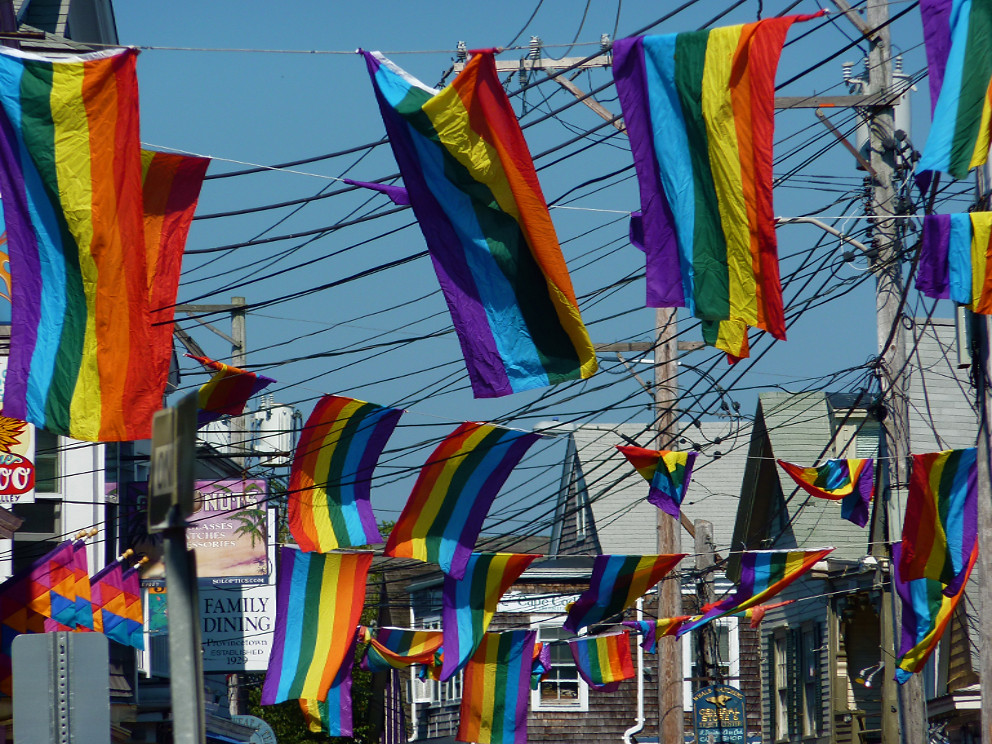
“Pride Flags, Commercial Street, Provincetown, Credit: Tim Grafft/MOTT” by Massachusetts Office of Travel & Tourism is licensed under CC BY-ND 2.0

I see the flag-shaggers are out in force. No, not working-class people who hang the Union flag from their living-room window as an expression of pride in their nation. I’m talking about the Pride flag. That omnipresent rainbow eyesore. A virtue-signal made cloth. The flag no one can escape. Yep, it’s Pride Month, which means that everywhere you go for the next four weeks – the bank, the supermarket, Maccy D’s – you’ll have this flag waved in your face to remind you not to be such a horrible, homophobic piece of shit. Happy Pride Month!

God, Pride has become annoying. It’s so gratingly ubiquitous. I haven’t seen this much smug flag-waving since 100,000 Guardian readers wrapped in the EU colours, tears streaking their blue-painted faces, descended on Whitehall to demand the cancellation of stupid northern people’s votes. And yet the people who cry “flag-shagger!” every time Keir Starmer stands stiffly next to the Union flag, or when Robert Jenrick goes on TV with a backdrop of showy British memorabilia, are curiously silent about the adorning of every building in the land with the bloody Pride flag.

You can’t move for rainbows right now. The Pride flag will flutter from town halls across the country. Some schools in Scotland will fly the flag for the whole month. I can’t be the only person who found the photo of school pupils wearing Pride face masks beneath a vast Pride flag somewhat chilling. It’s borderline cultish. Go to a cashpoint machine and you’ll be told about Pride. Coutts Bank on The Strand in London once painted its entire facade in the Pride colours. That was a very expensive way of saying: “We’re nice, I swear.”

Cops will wear Pride-coloured badges. They’ll do dad-dancing at Pride marches and everyone will go wild for it (except the Daily Mail probably). The army is getting in on the act. It is using Pride Month to showcase its British Army LGBT+ Network. If this doesn’t become a meme featuring someone in the Middle East saying “They say the next bombs will be dropped by people who believe in gay rights! Don’t you love progress!”, I will lose all faith in the internet. Even the Beano is flag-shagging. It posted a comic strip featuring Dennis the Menace in a Pride-coloured jumper. I preferred him when he was bullying Walter the Softy.

Snacks are propaganda now, too. Who can forget M&S’s Pride sandwich, which was basically a club sandwich with added guacamole (“Gays like guacamole, right?”). McDonald’s has created Rainbow-coloured boxes for its French fries, which was definitely one of the key demands of the radicals who took part in the Stonewall riot of 1969 that Pride is meant to commemorate. Skittles surely caused even Pride aficionados’ eyes to roll when they released limited-edition white versions of their sweets, because “we are giving up our rainbow to show support for the LGBTQ+ community”. (It is testament to the insanity of intersectionalism that the only complaint about this conceited act of corporate virtue-signalling was that the sweets were white.)

May 12, 2021

The World’s First Lady – Eleanor Roosevelt – WW2 Biography Special

Filed under: History, USA, WW2 — Tags: , , , , — Nicholas @ 04:00

World War Two
Published 11 May 2021

She is much more than the wife of President Franklin D. Roosevelt and once she tasted political life, she soon followed her own interests, changing what it means to be a politician’s wife.
(more…)

April 18, 2021

Take a moment to reflect on the plight of those poor, alienated students at Haverford College in Pennsylvania

Filed under: Education, Health, USA — Tags: , , , , , , — Nicholas @ 03:00

In Quillette, Jonathan Kay outlines some of the issues faced by the students of an expensive elite academic institution and how it impacts their mental health:

In December, I wrote a detailed report for Quillette about the race-based social panic that had recently erupted at Haverford College in Pennsylvania. One of the reasons why the meltdown seemed so surreal, I noted, is that this elite school appears to the outside world as picturesque and serene. The average annual cost of attendance is about US$76,000. And most of these students live extremely privileged lives, insulated (physically and otherwise) from what any normal person would regard as suffering. Nor is there much in the way of substantive political discord on campus. According to survey results released in late 2019, 79 percent of Haverford students self-identify as politically liberal, while only 3.5 percent self-identify as conservative. It’s as close to an ideological monoculture as you can find outside of a monastery or cult. On paper, it resembles one of those utopian micro-societies conceived by science-fiction writers or 19th-century social theorists.

The survey results I’m alluding to originate with Haverford’s “Clearness Committee,” an excellent resource for anyone seeking to understand the attitudes of students at hyper-progressive schools. The most recent Clearness survey, completed by more than two-thirds of Haverford students in 2019, contained 133 survey questions pertaining to everything from how much students sleep, to how many friends they have, to how they feel about campus jocks. There is also a substantial section dedicated to the theme of “marginalization.” Amazingly, 43 percent of respondents said they felt personally marginalized on campus because of some aspect of their identity. This included 61 percent of gay students, and more than 90 percent of trans students.

This is an odd-seeming result given the sheer number of LGBT individuals on Haverford’s campus. No fewer than 31 percent of student respondents identified themselves as something other than straight. In regard to gender, almost six percent self-identified as trans or some variant of non-binary. Both of these percentages exceed the overall American average by an order of decimal magnitude. Despite having only about 1,300 students (smaller than many public high schools), Haverford has a resource center for LGBT students, a pro-LGBT hiring policy, an LGBT studies program, dedicated LGBT living arrangements, a health insurance policy that covers hormone replacement therapy, and numerous other resources. Outside of other similarly liberal campuses, it is hard to imagine a more welcoming environment for LGBT youth anywhere on the planet.

It’s also telling that self-reported marginalization rates for Haverford’s gay students are almost identical to those for self-described bisexuals (62 percent) and asexuals (59 percent); and that the rate for students who self-identify under the loose category of “non-binary” (89 percent) is almost identical to the rate for students who, being trans, experience actual gender dysphoria (91 percent). The report authors conclude that there is “a series of immediate crises facing Haverford’s transgender population.” Yet despite the abundant write-in information supplied by surveyed students, no real evidence of these crises appears. What we get instead are vague testimonials about perceived attitudes and atmosphere. (“As a nonbinary person, athletics is inherently exclusive because it is gendered. We need to put that phrase to rest and start talking about the real divisions on campus—such as who feels comfortable going to parties hosted by athletes and who doesn’t.”) Even amidst the melodramatic throes of last year’s student strike, at a time when every imaginable identity-based grievance was described in lengthy student manifestos, no one could point to a single recent incident of real homophobia or transphobia targeting Haverford students.

April 16, 2021

The continued evolution of the Marxist class struggle – “Goodbye the working class, hello to the wokeing class”

Filed under: History, Politics — Tags: , , , , , , — Nicholas @ 03:00

Arthur Chrenkoff provides some background on the evolution of Marxist thought as they abandon efforts to rouse the working classes of the west against their capitalist oppressors and switch to attempting to rouse the “wokeing class” against their deplorable racist, homophobic, transphobic, sexist white male cisgendered oppressors:

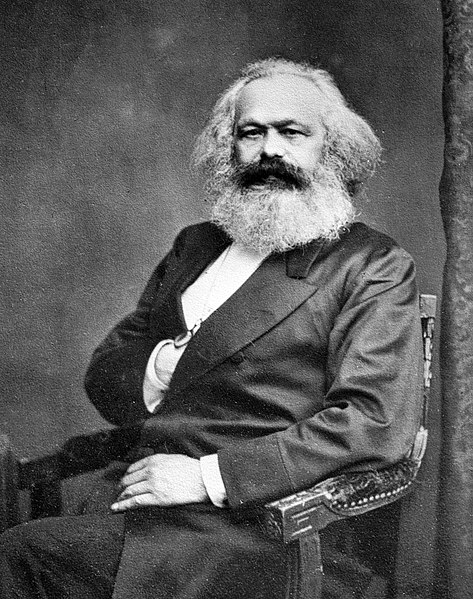
In developing his philosophy, Karl Marx posited human history as a struggle of two sections of society: the minority who hold the all power and the powerless majority. In Marx’s time, the minority was termed the capitalist class, the bourgeoisie, or simply The Capital, those controlling (owning and benefitting from) the means of production, while the majority was called the working class, or the proletariat, the masses who sell their labour, and whose collective toil makes the capitalists rich. The essential dynamic of a society is one of power: who has it and who doesn’t, and how it’s exercised (or as Lenin said, “who whom?”). It’s a zero sum equation: all or nothing, the one or the other, the powerful and the powerless, the oppressors and the oppressed. There is a moral dimension to this dichotomy: the former, by virtue of their position, are the villains, the latter the virtuous. It’s also absolutist: the individual doesn’t matter and individuality is an irrelevant illusion; you are the class to which you belong.

One of the most important aspects of this group dynamic is that the dominant class uses its position and power to shape the society in accordance with its needs. Thus, all the institutions, laws, traditions and phenomena reflect the interests of the ruling class; they are designed to benefit them and only them and keep their power entrenched. And what benefits one class invariably harms the other: the masses. You can thus say that in a capitalist society everything’s classist.

The twentieth century dashed the hopes of Marx’s disciples that the proletariat would revolt against and overthrow their capitalist oppressors. The working class was bought off with better working conditions and rising incomes: a house, a car, and a football game. While elsewhere communism triumphed through coups and foreign invasions, in the Western world genuine revolutions did not happen; capitalism is still around. While the working class might have disappointed and let down Marxists, the basic Marxist thinking has not changed: the society is divided into two mutually hostile groups, the oppressors and the oppressed. Now we just need to find the different oppressed and we’ll have another crack at destroying capitalism and creating our socialist utopia. Out with the purely economic divisions, in with racial, gender and sexual ones. Goodbye the working class, hello to the wokeing class.

Fast forward to 2021, and the neo-Marxist struggle continues to gather wind in its sail. On the one side the power-holders: white, male, straight; on the other the powerless: women, people of colour, other sexualities. The actors might have been changed but the essential drama remains the same: the struggle of the virtuous but powerless oppressed majority against their dastardly rulers and the system created for their benefit and everyone else’s disadvantage. Just as in the past every aspect of society was biased against and harmful to the proletariat, so now it is against the proletariat 2.0: everything’s racist – and sexist, and homophobic and transphobic. This is also why the activists describe racism as “systemic”; not because there are still Jim Crow laws in existence, and legal segregation and discrimination, but because the system created by the “white” society by its very nature must be oppressive and hostile to anyone non-white. Piecemeal fixing problems and gradual reforms are useless; the only solution is a radical societal transformation that elevates the oppressed and casts down the oppressors.

March 26, 2021

When the science becomes problematic to the narrative

Filed under: Health, Media, Politics, Science, USA — Tags: , , , , — Nicholas @ 03:00

Alexander Riley looks at a few of those awkward points where actual “scientific” science conficts with the deeply held beliefs of the “I heart SCIENCE!” community:

… human and nature cannot so easily be pried apart. The evidence of the biological reality of the sex difference — not just in gonads and sex cells, but in personality characteristics and behavioral profiles, on average — is overwhelming, and science is daily producing more. Male and female brains are structurally different in ways that map on to the emerging neuroscientific knowledge on how brain structure affects behavior and capabilities. The feminist claim that these differences are wholly a product of socialization becomes more implausible the more we know. In societies where egalitarian gender ideology is arguably most widespread, such as in Northern Europe, there has been no disappearance of traditional sex differences in choices concerning careers. Men are still overrepresented in fields that focus on systems and objects, and women are still the overwhelming majority in fields dedicated to extensive human interaction and social services.

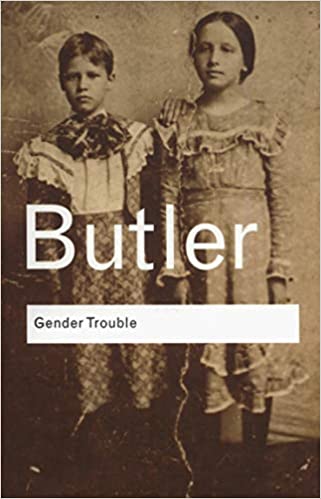
The radical spirit of ’90s feminism represented by [author Judith Butler’s] Gender Trouble did not stop at “deconstructing” gender in the effort to move toward a world in which gender roles are divorced from biological sex. Sex too had to be subjected to such “problematization.” Radicals used the writing of Anne Fausto-Sterling, a biologist who admitted her work was fundamentally shaped by her “1960s street-activist heart,” to suggest that the sex binary was also an oversimplified social construction. Fausto-Sterling insisted there are at least five sexes: males, females, “true hermaphrodites” with one testis and one ovary, male pseudohermaphrodites with testes and “some aspects of female genitalia” but no ovaries, and female pseudohermaphrodites with ovaries and “some aspects of male genitalia” but no testes. Perhaps, she asserted, several of every hundred people might be in one of the three intersex categories, with — the clincher — an “infinitely malleable continuum” between them.

It was quickly pointed out that Fausto-Sterling had been deceptive in her estimate of the frequency of intersexuality. Leonard Sax, in the Journal of Sex Research, noted that she had counted phenomena such as Klinefelter’s Syndrome (biological males with an extra X chromosome), Turner’s Syndrome (biological females with only one X chromosome), and several other conditions typically not recognized as intersex. One of these alone — late-onset congenital adrenal hyperplasia (LOCAH), which involves the overproduction of adrenal androgens — accounts for 90 percent of Fausto-Sterling’s claimed figure of 1.7 percent of the population that is intersex. But LOCAH is not an intersex phenomenon. Many individuals who have it are never diagnosed because the symptoms are so mild, and all who have it are born with typical male or female genitalia that correspond to the male and female genotypes. Nearly all such individuals go through puberty with the typical sexual development for their genotype, as the condition generally does not manifest in women until the early 20s and in men much later. The true estimate of intersex individuals, Sax argued, is roughly 0.018%, about 100 times lower than Fausto-Sterling’s estimate. That is, more than 99.98% of humans are clearly either male or female in terms of biological sex.

But the attack on “standard sex difference science” was undeterred by this decimation of Fausto-Sterling’s case. In Gender Trouble, Butler criticized the work of an MIT group that had just discovered the region on the Y chromosome responsible for sex differentiation, claiming these scientists ultimately had to invoke cultural symbols of patriarchy to legitimate their explanations. In her view, this betrayed the very notion of an objective science of sex difference. We are always trapped in culture, she wrote, which means we are always trapped in patriarchy. A science of sex is impossible. Radical sex/gender ideology attacked science as male knowledge and elevated female knowledge as superior on the basis that women as a class were treated as inferior. Like blacks and other powerless groups, women — at least, women with a feminist outlook — could critically understand the point of view of men and supplement its lacunae with the fuller vision of the female perspective. Marx made similar claims about the superiority of working-class consciousness, though he did not attempt to cast the very notion of science as a tool of oppression.

The MIT group’s finding that what we now know as the SRY gene determines sex is universally accepted science today, and Butler’s ideological criticism has aged poorly in scientifically literate circles. So has her wild overestimation that perhaps one in ten people is outside the normal sex binary.

March 19, 2021

Cancel culture victims on the left

Filed under: Media, Politics, USA — Tags: , , , — Nicholas @ 03:00

In Quillette, Jonathan Kay looks at the attempt to cancel Jesse Singal who has repeatedly failed to follow the “party line” on Trans issues for several years:

One of the odd-seeming aspects of progressive cancel culture is that many of the figures targeted by mobs aren’t especially conservative in their views. Rather, the victims tend to be heterodox liberals who simply offer a dissenting opinion on one or more compartmentalized issues — since these liberal targets tend to operate in left-leaning professional and social milieus through which a mob can exercise leverage and demand concessions. There are numerous popular writers and broadcasters who promote deeply conservative themes without attracting any notice from cancel mobs — even as lifelong leftists within such niche genres as Young Adult fiction, LGBT theatre, and knitting-trade journalism are excommunicated on the basis of minor verbal infractions.

In some notable mobbings chronicled by Quillette, in fact, the targeted dissenter wasn’t even offering an opinion per se, but merely highlighting facts we’re all expected to ignore. James Damore wasn’t fired by Google because he gratuitously insulted women, but because he pointed out real differences between the sexes. In Canadian literary circles, Margaret Atwood became reviled among a progressive fringe when she argued (correctly, as it turns out) that falsely accused novelist Steven Galloway should have received due process before being tarred as a rapist. If you grovel enough, woke mobs might eventually forgive you for being wrong — but never for being right.

On the issue of gender, a particularly interesting case study centres on Jesse Singal, a mild-mannered and amiable (I’ve met him) New York-based journalist, book author, and podcaster whom Quillette readers may remember from his 2019 appearance on our own show. As early as 2016, well before the culture war over trans rights reached its crescendo, Singal authored a ground-breaking New York magazine exposé on the cynical takedown of eminent Toronto psychologist Dr. Kenneth Zucker (who was subsequently paid more than half a million dollars by his former employer, the Centre for Addiction and Mental Health, as part of a legal settlement relating to its part in that smear campaign). Two years later, Singal wrote an impeccably researched cover story for the Atlantic titled “When Children Say They’re Trans” — one of the most widely discussed features in the magazine’s recent history. In these articles, and on social media, Singal has dealt with the issue of gender dysphoria with care and sensitivity, documenting the challenges faced by those experiencing the condition. And while he is the furthest thing from an actual transphobe, he acknowledges the plain fact that some children who present as trans later “desist” to an identity that accords with their biological sex.

As anyone who follows this issue closely can guess, Singal’s measured approach doesn’t always sit well with progressive activist and journalistic subcultures, wherein the approved view is that any child’s expression of trans identity must summarily be “affirmed” by parents, educators, and therapists. Within these circles, Singal himself has written, “desistance isn’t viewed as a phenomenon we’ve yet to fully understand and quantify but rather as a myth to be dispelled. Those who raise the subject of desistance are often believed to have nefarious motives — the liberal outlet ThinkProgress, for example, referred to desistance research as ‘the pernicious junk science stalking trans kids’ … But the evidence that desistance occurs is overwhelming.”

We know from experienced psychotherapists in this area that children can present as trans for all sorts of reasons, sometimes related to trauma, sexual anxieties, or comorbid mental-health conditions. In some cases, the dysphoria is permanent, but in other cases, it isn’t (which is why the analogy with sexual orientation is misleading). Certainly, the idea that desistance is some kind of transphobic “myth” has now itself been shown to be a myth: In late 2020, British jurists upheld desister Keira Bell’s claim that the country’s Gender Identity Development Service had improperly rushed her through a medical reassignment process, at age 16, without proper safeguards. At the age of 23, Bell now is recovering from the after-effects of these treatments — including a needless double mastectomy — and confronts a lifetime of possible medical complications.

As we wrote in a recent Quillette editorial about Bell, it won’t just be doctors and politicians whose actions will be judged in relation to the excesses surrounding the transition of young people, but also those many journalists who’ve chosen to prioritize political fashion over journalistic integrity. Singal stands out as one of the few honourable exceptions. Indeed, Bell’s case is exactly the sort of tragedy that he’s consistently warned about over the past five years. To a certain kind of ideologue, such prescience is unforgiveable.

March 6, 2021

History-Makers: Sappho

Filed under: Europe, Greece, History, Humour — Tags: , , , — Nicholas @ 06:00

Overly Sarcastic Productions
Published 5 Mar 2021

It’s no use, dear algorithm, I cannot research, for Sappho has crushed me with longing for lost poetry!

SOURCES & Further Reading: Sappho: fragments by Jonathan Goldberg, “Girl, Interrupted: Who Was Sappho?” for The New Yorker by Daniel Mendelsohn (https://www.newyorker.com/magazine/20…​), “Sappho” from The Poetry Foundation (https://www.poetryfoundation.org/poet…​)

Our content is intended for teenage audiences and up.

PATREON: https://www.Patreon.com/OSP​

PODCAST: https://overlysarcasticpodcast.transi…​

DISCORD: https://discord.gg/osp

MERCH LINKS: http://rdbl.co/osp​

OUR WEBSITE: https://www.OverlySarcasticProductions.com
Find us on Twitter https://www.Twitter.com/OSPYouTube​
Find us on Reddit https://www.Reddit.com/r/OSP/

December 15, 2020

QotD: TedX

Filed under: Britain, Humour, Politics, Quotations — Tags: , , , , , — Nicholas @ 01:00

TedX, a non-official version of the sanctimonious ubiquitous Ted Talks programme, is more inclusive than official Ted because they have added a random letter ‘X’ into the word. On an unrelated note, TedX London have decided to start using the totally real and not at all just made-up word “Womxn” when they talk about members of the female persuasion, chapettes, fillies, gels, y’know, charming, delightful, non-men – them. They told a normal person bigot on Twitter who asked why they were using the word “womxn”: “No, that’s not a typo: ‘womxn’ is a spelling of ‘women’ that’s more inclusive and progressive. The term sheds light on the prejudice, discrimination, and institutional barriers womxn have faced, and explicitly includes non-cisgender women.” But are TedX really the inclusive group they claim to be? Trans Media Watch, a pro-trans lobby group told the BBC it would never use the word Womxn: “because we feel it’s important for people to recognise that trans women are women. Trans women aren’t a special, separate category.” So it turns out “women” is the most inclusive term after all. If TedX London hasn’t been cancelled by the end of the week then Twitter’s not what it was.

David Scullion, “UN-Believable”, The Critic, 2020-09-09.

November 22, 2020

Douglas Murray’s Bosie: The Tragic Life of Lord Alfred Douglas

Filed under: Books, Britain, History, Law — Tags: , , , , — Nicholas @ 03:00

Melanie McDonagh reviews the re-released early work by Douglas Murray:

It would probably have been better for Lord Alfred Douglas to have died young. Had he died when he was still beautiful and youthful looking, he would have remained forever the gilded youth Oscar Wilde loved. That golden Alfred Douglas survives in the famous photograph on the front of Douglas Murray’s book, with Wilde sitting near Bosie, his arm extended behind the boy with something like possessiveness. Instead the boy survived until 1945, worn, lonely and poverty-stricken, his looks withered, his nose pinched, contemptuous of modernity, but still with a redemptive, blistering integrity.

Twenty years after it was first written, Douglas Murray has reissued his fine biography of Bosie: his first book, written in his gap year before he went to Oxford. Looking back now on his precocious work, he thinks he overdid a little his enthusiasm for Douglas’s poetry, understated his toxic anti-Semitism and didn’t quite do justice to the pederastic element of his early sexuality – as Bosie preferred to put it, his tastes were for youth and softness. In practice this could mean 14-year-old boys, even younger, at a time when he and Wilde had reunited following Wilde’s release from prison. Actually, I think Murray’s original estimate of Alfred Douglas’s sonnets was absolutely right; they vary in quality, but as he said, at their best they equalled the poets he most venerated.

Trouble is, not many people think of Alfred Douglas as a poet, even though they might unknowingly quote perhaps his most famous line, about the love that dares not speak its name. But there were literary critics in his own day who compared him to Shakespeare as a writer of sonnets. Remarkably he has fallen almost entirely off the literary radar now, known only as a player in Wilde’s drama, and it is a pity that the success of this biography hasn’t changed that.

One of the services Douglas Murray performs in his biography is simply to reproduce some of his finest verses so we can judge it for ourselves. Indeed, while writing the book he managed to persuade the Home Office to release the copybook in which Alfred Douglas wrote his prison verses, In Excelsis, which the authorities refused to do in his lifetime.

Even in his own time, most people thought of him as the lover of Oscar Wilde, a byword for a bugger, the boy who brought about Wilde’s destruction through the vengeful malice of his unbalanced father. That perception was powerfully reinforced by Wilde’s terrible letter written from prison, De Profundis, in which he empties his bitterness against the youth he loved in an outpouring of emotion which was in many respects unjust and untrue, especially about Bosie’s financial support for Wilde. Fatally, the letter was never given to him by Robert Ross, Wilde’s friend, and only released in full during a devastating court case.

November 21, 2020

QotD: Using a “wokescreen”

Filed under: Media, Politics, Quotations, Religion — Tags: , , , , — Nicholas @ 01:00

To better understand the era we are living through, it might help to first understand the nature of the “wokescreen”. Like those billowy emissions of dry-ice in a 1980s pop video, this device is useful if you want to hide bad and egregious behaviour from public view.

It is, essentially, a new iteration of an old rule: the one stating that the person commonly to be found complaining most vociferously about a particular vice is the one disproportionately likely to be guilty of said vice.

Through decades past, this rule applied to people who were literally in the clerical class. It was, for instance (see the late Cardinal Keith O’Brien), the priest or bishop who denounced homosexuality in the most vociferous terms who would turn out to have their own peculiar interpretation of “the laying on of hands”, tending to revolve around the knees of young male seminarians.

And there is sense in this of course. Through overt displays of moral opprobrium, the petitioner imagines that everyone’s attention will be diverted. Through stressing their virtue overmuch, however, such people raise a perceptible flag to anyone with an eye for human hypocrisy.

Today, of course, the clerical class is not the clergy. It is generally a rich, massively protected, metropolitan and often corporate or corporate-backed class which poses as the defender and then enforcer of all the easiest, least-controversial causes of the time. These shift, naturally, but today a person who wishes to cloak themselves in virtue will talk up their “anti-racism” credentials; will talk about “feminism” as though women’s rights have only just occurred to them; they will stress their green credentials; and of course they will rush to the defence of anyone who claims to identify as a tree or a hedgerow and assert that said person’s right to so identify is not just ancient and long-established but biologically incontrovertible. All give off immense warning-signs.

Douglas Murray, “Do you know what a wokescreen is?”, UnHerd, 2020-08-13.

November 17, 2020

QotD: Prejudice

Filed under: Politics, Quotations, Religion, USA — Tags: , , , , , — Nicholas @ 01:00

For instance, when an Islamic terrorist murders people, there’s an instant rush to fret over and condemn any sort of “anti-Muslim backlash.” Never mind that such backlashes have been vastly rarer than we’re usually told, the principle is correct: It is wrong to blame innocent Muslims for the things other Muslims did.

Or just think about how much ink has been spilled arguing that it is unfair and unjust to assume that one black youth is a criminal or a threat just because he resembles in some way a negative stereotype. I’m not mocking this argument; I am agreeing with it.

As I’ve been saying until I’m blue in the face on my book tour, one of the greatest things about this country is the ideal — always in tension with the lesser devils of our natures — that says we should take people as we find them. My objection to identity politics is that it reduces millions of people to a single attribute or grievance. It assumes that, simply by accident of birth, some people are more noble or more evil than others.

If you think that all you need to know about an African-American person to size up his character or humanity is his skin color, then you’re a racist. […]

You can run similar thought experiments about virtually any group. If all you need to know about Oscar Wilde is that he was a gay dude, just like Richard Simmons or Milo what’s-his-name, you’re a bigot. If Meyer Lansky and Albert Einstein are merely two Jews to you, you’re an anti-Semite. If Margaret Thatcher, Joan of Arc, and Lizzie Borden are just three chicks, you’re a sexist.

And again, historically, this is mostly a left-wing or liberal (both in the classical and modern senses of the word) insight. But for some bizarre reason, for many people, this idea evaporates like water off a hot skillet when you replace any of these categories with “white” or, very often, “male.”

Suddenly fancy words and phrases fly like sawdust from a wood chipper: “structures of oppression!” “decontextualized!” “ahistoricized!” etc. It’s all so clever and complicated. The same people who take to the streets at the slightest suggestion that Muslims can be judged by the evil deeds of other Muslims will lecture and harangue you for hours, mob you on Twitter, or condescendingly dismiss you for not understanding that all white people have it coming.

I am not denying the history of white racism in America. I’m more than eager to acknowledge it. But what these people are basically saying is that you can say bigoted things about all white people based on things other white people have done. And spare me the argument that some 70-hour-a-week truck driver in Appalachia has it coming because he’s a grand beneficiary of white supremacy.

Jonah Goldberg, “The G-File”, National Review, 2018-08-03.

November 14, 2020

“… we all know that Wrong Opinions Are No Longer Allowed On The Internet”

Filed under: Health, Media, Politics — Tags: , , , , , , — Nicholas @ 05:00

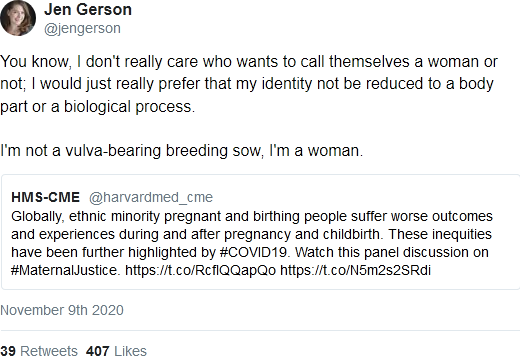
Jen Gerson has some Wrong Opinions that she shared On The Internet, so Dr. Bradley Mitchelmore, BSc. (Pharm), ACPR, PharmD, RPh has has taken it upon himself to try to get her cancelled:

Firstly, to explain how this little gem fell into my lap, some context is required. While I was avoiding the interminably dull task of invoicing our fine writers of The Line the other day, I threw out a position that some might find controversial.

That is, I find the trend towards identifying women by terms like “birthing people,” “menstruators,” “front-hole possessors” and “uterus bearers,” to be both reductive and offensive. I have no objection to finding more inclusive language for circumstances in which we want to acknowledge trans and non-binary people (ie; a phrase like “pregnant people” seems clunky, but inoffensive to me); but to date, all of this new language reduces the class of “women” to either a biological function or a bodily part.

Pregnancy is a particularly sensitive topic for a lot of women because, for most of us, the process is terrifying. To go through childbirth is the most profound loss of bodily autonomy imaginable and many women I know struggle with the after effects of feeling as if we’ve been treated like interchangeable breeding sows by some doctors and nurses. If a doctor started calling me a “birther” or a “uterus-bearer” while stretching my cervix apart knuckles-deep with two fingers, my response would not be welcoming.

I also don’t think it’s a coincidence that linguistic shifts that re-frame an entire biological sex class as “breeders” only ever seems to target one sex. Very few well-intentioned and committed activists are waging war online over the definition of “men.”

A lot of this is misogyny gilded in progressive language. And very few women want to stand up to the misogyny on the “pro-woman” team, nor suffer the consequences of pissing that team off. So most stay silent until they see a tweet like the one above, at which point they flood my DMs with private statements of support and relief. I’m happy to serve as a psychological outlet in that regard, but I’ll show you in a moment why they’re so afraid to say what they think.

Anyway, this is all just my opinion. I’m not married to it. If the trend comes around to allowing us to call all “male-bodied” people “dicks,” I might reconsider the position entirely. But we all know that Wrong Opinions Are No Longer Allowed On The Internet and therefore a doctor jumped in with one of the most delightfully fatuous replies I’ve ever received.

November 8, 2020

“… participants in men’s sport, on average, out-perform participants in women’s sports, current science is unable to isolate why this is the case”

Filed under: Health, Politics, Sports — Tags: , , , , , — Nicholas @ 03:00

Barbara Kay is not in favour of clearly misogynistic sports policies:

2016 high school boys compared to 2016 Olympic Women’s Finalists.
Source: http://boysvswomen.com/#/

No hormone treatment is required, says the EWG, because being male or female is not dependent on biology but on one’s feelings: “(It) is recognized that transfemales are not males who become females. Rather these are people who have always been psychologically female.” Furthermore, these individuals must be allowed to participate in “the gender with which they feel most comfortable and safe, which may not be the same in each sport or consistent in subsequent seasons.” Your eyes do not deceive you. First they justified trans women competing with women because they had “always” felt they were female. Then they say the “always” female trans athlete might “be” male for certain sports or at different times.

It gets worse.

They say that although “participants in men’s sport, on average, out-perform participants in women’s sports, current science is unable to isolate why this is the case.” This is nonsense on two counts. First, there is no “on average” about it. Virtually all high-performance male athletes out-perform all high-performance female athletes. And second, even in 2014, abundant scientific data “to isolate why this is the case” was readily, even effortlessly (#Google!) available.

Data or no data, a statement in the document itself makes clear that the ideological fix was in from the get-go: “The Expert Working Group held strongly to the principle that the inclusion of all athletes, based on the fundamental human right of gender self-determination overrides any consideration of potential competitive advantage.”

Needless to say, but it must be said anyway: Male athletes have nothing whatsoever to fear in competing with trans male athletes. This is a problem for female athletes only, which seems not to trouble the CCES at all. I’m not a feminist, but I know a misogynistic sport policy when I see it. Quis custodiet ipsos custodes?

November 2, 2020

In the University of Michigan’s Sexual Health Certificate Program, “mainstream sexual health issues that affect wide swaths of the population, such as marriage, reproduction, and family life, were treated as niche topics”

Filed under: Education, Health, Politics, USA — Tags: , , , , , , — Nicholas @ 05:00

In Quillette, Tim Courtois explains what the University of Michigan’s Sexual Health Certificate Program is actually intended to teach:

When I signed up for the University of Michigan’s unique, year-long “Sexual Health Certificate Program” (SHCP), however, I truly did believe the experience would be both professionally and intellectually rewarding. I care about sexuality. I know that it is a fundamental component of the human search for joy and meaning. As a Michigan-based psychotherapist and licensed professional counselor, I wanted to deepen my understanding of sexuality, and become better equipped to provide care for the many clients who come to me with issues related to sexual health. The American Association of Sexuality Educators, Counselors, and Therapists sounded like the perfect fit for me, and the idea of becoming an AASECT-certified sex therapist appealed to me. I applied and was accepted for the 2019-2020 cohort. When I showed up, my class included participants from around the world — including Iceland, Egypt, Lebanon, and China — just as you’d expect at the kind of high-value, authoritative program that we all believed we’d signed up for.
The doubts started to creep in early, though — on day one, to be exact. Our first classroom module was titled “Sexual Attitude Reassessment.” I amused myself with the thought that this sounded like an unsettling euphemism for a brainwashing session. Sadly, that’s what it was.

It quickly became clear that the issue of sexuality — the ostensible subject — often would serve merely as a pretext for more general harangues about society, and the urgent need to remake it according to AASECT’s ideological blueprint. In a keynote lecture entitled “Why Fetishism Matters,” the speaker argued that the world we inhabit is socially constructed, and told us (with what now seems like admirable candor), “I’m not neutral. I’m here to recruit you to a particular point of view about how kink should be valued.” The same speaker said that he’d been accused of teaching students that any form of sexual behavior is acceptable as long as there is consent from all parties. “Yes, that’s exactly right,” he said. Clearly, our attitude “reassessment” was well underway.
From the get-go, the scientific content was mostly superficial, and was often undercut by claims that the very idea of truth is a harmful (and even oppressive) construct. The teaching was not so much impartial and informative as it was evangelistic. Yet it was also self-contradictory: Declarations that there are no real “correct” moral values were uttered (without irony) alongside absolutist proclamations about the correct way to understand sex — and morality.

As I learned, “Sexual Attitude Reassessment” (SAR) is an established term in the field, one that is often used to describe curriculum content that serves to educate sexual-health professionals about the wide range of sexual experiences that they may encounter among clients. The object is to ensure they won’t be shocked when such encounters occur, and to invite them to reassess their judgments and assumptions about various expressions of sexuality. These are valid and important goals. Unfortunately, the SAR in the SHCP descended into an exercise in overstimulation and desensitization — specifically, two full days of pornographic videos and interviews. At times, it felt like the famous brainwashing scene from A Clockwork Orange. There was a series of videos of people masturbating (one of which involved a strange interaction with a cat), a woman with “objectiphilia” who had a sexual attraction to her church pipe organ, various sadomasochistic acts, and a presentation on polyamory designed to make it clear that the polyamorous lifestyle is healthy, wholesome, and problem-free.

The focus on BDSM was a particular fixation throughout the program. In the SAR, we were shown videos of a woman meticulously applying genital clamps to the scrotum of a willing man, and a dominatrix teaching a class how to properly beat people while demonstrating on an eager participant. We also watched an interview with a sex-dungeon “dom” (the male equivalent of a dominatrix) who described one of his experiences: His client had instructed him, as the dom recounted it, “I want you to bind me and then beat me until I scream. And no matter how much I scream or beg you to stop, I want you to keep beating me.” The dom did as he was told, continuing the beatings through the customer’s begging and pleading, until the client went totally limp and silent, seeming to dissociate. At this point, the dom unbound the man, who then began to weep uncontrollably in the dom’s arms.

BDSM is a real and active sexual subculture, and I don’t object to its inclusion in the course materials. But I was shocked to see how much further the professors in the program took things, insisting that BDSM behaviors — up to and including the sexual “Fight Club” style of behavior described above — must be uncritically viewed as wholesome and beautiful. Students learned to sing from the same psalm book, with one memorably exclaiming “I’m so inspired by the wisdom and beauty in the BDSM community!” and insisting that the behavioral codes observed among BDSM participants can help us create a similar climate of safety and respect “in all our relationships.”

The program was focused on an agenda of “centering” the experience of minorities — in this case, sexual minorities. This meant that huge portions of time in class after class were spent focusing on BDSM, LGBTQIA+ issues, and polyamory, not to mention the obligatory discussions of oppression and privilege that were shoehorned into every discussion. Meanwhile, mainstream sexual health issues that affect wide swaths of the population, such as marriage, reproduction, and family life, were treated as niche topics. Further, while many Americans view sexuality through the prism of faith, religion hardly came up at all. And when it did, it was typically so that religious values could be denigrated. Even the few religious people in the program got the message: Whenever any made passing reference to their own observant religiosity, it was usually in a spirit of shame or penance.

In a few brief web searches to find a public domain or Creative Commons image to use for this post, I realized that web search engines offer “safe” options for a reason…

October 4, 2020

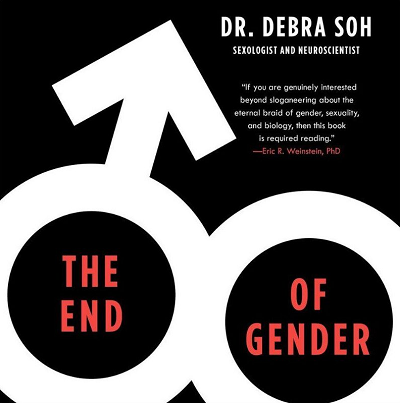
The End of Gender by Dr. Debra Soh

Filed under: Books — Tags: , , , — Nicholas @ 03:00

In The Critic, Louise Perry reviews Debra Soh’s recent book The End of Gender:

Contrary to what is commonly believed, sex is defined not by chromosomes or our genitals or hormonal profiles, but by gametes, which are mature reproductive cells. There are only two types of gametes: small ones called sperm that are produced by males, and large ones called eggs that are produced by females. There are no intermediate types of gametes between egg and sperm cells. Sex is therefore binary. It is not a spectrum.

The chapters in the first two thirds of the book are mostly concerned with the transgender movement. Soh works through trans activist claims with admirable thoroughness — no, not all people with gender dysphoria will benefit from transitioning; yes, natal males do have a physical advantage over natal females in sports; no, not all trans people are motivated to transition for the same reasons.

This last point is particularly explosive in political terms, but there is no doubt that Soh is on firm ground scientifically. Researchers have long been aware of the existence of two distinct categories of trans women — that is, natal males who identify as women. One group — sometimes called “homosexual transsexuals” — usually transition at a young age, have sexual relationships exclusively with men, and tend to be stereotypically feminine from childhood.

Another group — known as “autogynephiles” — have a very different profile: transitioning later, usually having sexual relationships exclusively with women, and often living as conventionally masculine men until they begin the transition process. And this second group are motivated to transition as a result of autogynephilia (sexual arousal at the idea of being a woman), a fact that trans activists are reluctant to acknowledge, preferring, as Soh puts it, “to neutralise the sexual aspect of their wishes to transition”. But she attempts an optimistic argument for tolerance:

    In our sex-negative culture, trans women’s concerns are dismissed as a sexual fetish if anything about transitioning relates to sexual desire … I advocate for compassion and not being judgmental.

Soh, who writes for Playboy and other outlets, describes herself as sex-positive and supports destigmatising all discussion of sexual desire. Although I sometimes grew bored with the regular detours in which Soh writes about how much she loves going clubbing with her gay friends, or describes the confiding relationships she has formed with the parents of trans-identifying children, I understand the purpose of these sections: reassurance. This is a book written by a liberal for liberals, which prescribes a medicinal dose of yet more liberalism — more tolerance, more scientific inquiry, and more intellectual diversity. And liberal readers will no doubt be comforted that Soh’s live-and-let-live framing allows them to play the role of open-minded progressive, rather than (as trans activists would have it) bigoted reactionary.

« Newer PostsOlder Posts »

Powered by WordPress