Quotulatiousness

April 18, 2011

Malinvestment the next big problem for China?

Filed under: China, Economics, Government — Tags: , , — Nicholas @ 09:54

Nouriel Roubini thinks that the Chinese central planners are missing the clues about overinvestment in their infrastructure binge:

China’s economy is overheating now, but, over time, its current overinvestment will prove deflationary both domestically and globally. Once increasing fixed investment becomes impossible — most likely after 2013 — China is poised for a sharp slowdown. Instead of focusing on securing a soft landing today, Chinese policymakers should be worrying about the brick wall that economic growth may hit in the second half of the quinquennium.

Despite the rhetoric of the new Five-Year Plan — which, like the previous one, aims to increase the share of consumption in GDP — the path of least resistance is the status quo. The new plan’s details reveal continued reliance on investment, including public housing, to support growth, rather than faster currency appreciation, substantial fiscal transfers to households, taxation and/or privatization of state-owned enterprises (SOEs), liberalization of the household registration (hukou) system, or an easing of financial repression.

China has grown for the last few decades on the back of export-led industrialization and a weak currency, which have resulted in high corporate and household savings rates and reliance on net exports and fixed investment (infrastructure, real estate, and industrial capacity for import-competing and export sectors). When net exports collapsed in 2008-09 from 11 percent of GDP to 5 percent, China’s leader reacted by further increasing the fixed-investment share of GDP from 42 percent to 47 percent.

Thus, China did not suffer a severe recession — as occurred in Japan, Germany, and elsewhere in emerging Asia in 2009 — only because fixed investment exploded. And the fixed-investment share of GDP has increased further in 2010-2011, to almost 50 percent.

The problem, of course, is that no country can be productive enough to reinvest 50 percent of GDP in new capital stock without eventually facing immense overcapacity and a staggering nonperforming loan problem. China is rife with overinvestment in physical capital, infrastructure, and property. To a visitor, this is evident in sleek but empty airports and bullet trains (which will reduce the need for the 45 planned airports), highways to nowhere, thousands of colossal new central and provincial government buildings, ghost towns, and brand-new aluminum smelters kept closed to prevent global prices from plunging.

H/T to Publius for the link.

April 17, 2011

China’s real estate bubble

Filed under: China, Economics, Government — Tags: , , , — Nicholas @ 09:24

March 23, 2011

Latest outlet for excess Chinese investment money: Bordeaux wineries

Filed under: China, Economics, Europe, France, Wine — Tags: — Nicholas @ 07:53

Running out of interesting investment opportunities? Some Chinese investors are moving into French wineries:

Walking among the ancient vines at Château de Malle, De Bournazel said many families struggled to make ends meet. “Nobody sells for pleasure, but you would struggle to find a chateau that wouldn’t sell for the right price. It’s sad, but I’d rather see families sell to the Chinese than tear themselves apart trying to keep a property.”

Rather than being viewed as conquerors, Chinese wine buyers are seen as saviours of the region — last year China overtook both Germany and the UK to become Bordeaux’s biggest customer, with exports growing by 67%. Bernard Farges, president of the Conseil Interprofessionnel du Vin de Bordeaux (CIVB), the body representing its wine growers and buyers, said Chinese investors buying vineyards would boost exports further.

“These are businessmen who believe in their investment, who are opening doors to a new market and ploughing money into properties to make great wine,” he said.

Others argue that the Chinese are simply the latest in a long line of foreign investors — including the Dutch, the English and the Danes — in Bordeaux.

That last part is certainly true: although you may not realize it, many of the wineries in the Bordeaux region have been foreign-owned for generations. The nationality of the foreign owners may change, but the principal is the same.

Of course, regardless of ownership, if the investors don’t maintain the property, they risk ruining their chances of benefitting from the purchase:

Not everyone is supportive of this new breed of Bordelais. Patrick Etineau recently sold Château de la Salle to a Chinese investor amid a storm of acrimony. “I found them very condescending,” he said. “They have the money and they think we are in penury.”

He says since the chateau was sold in January the vines have been left largely untended. “I was happy to sell, because I couldn’t maintain the property, but now I have the impression that they don’t care at all. We used to make beautiful wine, but this year I fear it will only be fit for the pigs.”

January 24, 2011

Investing in fine wine doesn’t diversify your portfolio

Filed under: Economics, Wine — Tags: , — Nicholas @ 08:31

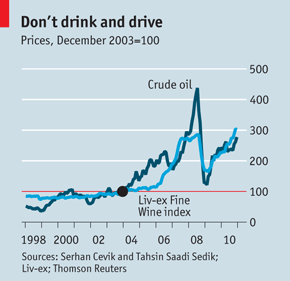
Following up to this post, The Economist agrees that fine wine tracks too closely to the price of oil to offer much diversification for investors:

A bottle of Château Pétrus ’82 can cost over $5,000, whereas the equivalent volume of crude oil sells for less than 50 cents. Château Brent may taste a tad rough, yet fine wine and crude oil have more in common than you might think. Their prices have risen and fallen in step in recent years (see chart).

Wine experts usually explain price movements by supply-side factors such as the effects of the weather and age, but research by Serhan Cevik and Tahsin Saadi Sedik, economists at the IMF, finds that supply has only a small impact on prices. Instead, fast economic growth in emerging economies has been much more important in recent years — as is the case for oil and other commodity prices.



Between 1998 and 2010 there was a correlation of over 90% between changes in oil and wine prices.

January 15, 2011

Fine wine as an investment

Filed under: Economics, Wine — Tags: , — Nicholas @ 09:54

While I personally think wine is a terrible choice for an investment vehicle, I’m at odds with a lot of people with more money than sense who choose to diversify their investments to include fine wine. However, it may not be the best kind of diversification:

The search for safe investments and risk hedging has apparently led some in recent years to start investing in fine wines. “In the past, one of the attractions of fine wine as an asset was its non-correlation with mainstream financial markets,” wrote the Financial Times‘ John Stimfig in 2009. “This provided investors with valuable portfolio diversification.” What could be less closely linked to the Fed funds rate than whether or not it was a good year for Bordeaux? But now the FT reports that a new paper by two IMF economists, Serhan Cevik and Tahsin Saadi Sedik, says that if this were ever true, it’s not anymore. Fine wine prices are just like oil, they find: they go up or down depending on how the rest of the economy is doing.

June 7, 2010

QotD: Investing in well-managed companies

Filed under: Economics, Humour, Quotations — Tags: , , , — Nicholas @ 13:57

When companies make money, we assume they are well-managed. That perception is reinforced by the CEOs of those companies who are happy to tell you all the clever things they did to make it happen. The problem with relying on this source of information is that CEOs are highly skilled in a special form of lying called leadership. Leadership involves convincing employees and investors that the CEO has something called a vision, a type of optimistic hallucination that can come true only in an environment in which the CEO is massively overcompensated and the employees have learned to be less selfish.

Scott Adams, “Betting on the Bad Guys”, Wall Street Journal, 2010-06-07

« Newer Posts

Powered by WordPress