Quotulatiousness

February 2, 2022

QotD: Breaking the trench stalemate with Stormtroopers (Stoßtruppen)

One way to respond to a novel tactical problem is with novel tactics. And the impetus for this kind of thinking is fairly clear: if your own artillery is the problem digging you into a hole, then find a way to use less of it.

The mature form of this tactical framework is often called “Hutier” tactics, after German general Oskar Emil von Hitier, though he was hardly the sole or even chief inventor of the method. In its mature form, the technique went thusly: instead of attacking with large waves of infantry which cleared each objective in sequential order, attacks ought to be proceeded by smaller units, carefully trained with the layout of the enemy positions. Those units, rather than having a very rigid plan of attack, would be given those general objectives and left to figure for themselves how to accomplish them (“mission tactics” or Auftragstaktik), giving them more freedom to make decisions based on local conditions and the ground.

These elite spearhead units, called Stoßtruppen or “Stormtroopers” were well equipped (in particular with a higher amount of automatic firearms and hand grenades, along with flamethrowers). Importantly, they were directed to bypass enemy strong-points and keep moving forward to meet their objectives. The idea here was that the follow-up waves of normal infantry could do the slow work of clearing out points where enemy resistance was strong, but the stormtroopers should aim to push as deeply as possible as rapidly as possible to disorient the defenders and rapidly envelop what defenses remained.

These sets of infantry tactics were in turn combined with the hurricane barrage, a style of artillery use which focused on much shorter but more intense artillery barrages, particularly associated with Colonel Georg “Breakthrough” Bruchmüller. Rather than attempting to pulverize defenses out of existence, the hurricane barrage was designed merely to force enemies into their dugouts and disorient the defenders; much of the fire was directed at longer ranges to disrupt roads and artillery in the enemy rear. The short barrage left the ground relatively more intact. Meanwhile, those elite infiltration units could be trained to follow the creeping barrage very closely (being instructed, for instance, to run into the shell explosions, since as the barrage advantages, no gun should ever strike the same spot twice; a fresh shell-hole was, in theory, safe). Attentive readers will recognize the basic foundations of the “move fast, disorient the enemy” methods of the “modern system” here.

So did infiltration tactics break the trench stalemate? No.

First, it is necessary to note that while infiltration tactics were perhaps most fully developed by the Germans, they were not unique to them. The French were experimenting with many of the same ideas at the same time. For instance, basic principles of infiltration were being published by the French General Headquarters as early as April, 1915. André Laffargue, a French infantry captain, actually published a pamphlet, which was fairly widely distributed in both the French and British armies by the end of 1915 and in the American army in 1916, on exactly this sort of method. In many cases, like at the Second Battle of Artois, these French tactics bore significant fruit with big advances, but ran into the problem that the gains were almost invariably lost in the face of German counter-attacks. The Russians, particularly under Aleksei Brusilov, also started using some of these techniques, although Brusilov was as much making a virtue of necessity as the Russians just didn’t have that much artillery or shells and had to make due with less and Russian commanders (including Brusilov!) seem to have only unevenly taken the lessons of his successes.

The problem here is speed: infiltration tactics could absolutely more efficiently overrun the front enemy lines and even potentially defeat multiple layers of a defense-in-depth. But after that was done and the shock of the initial push wore off, you were still facing the same calculus: the attacker’s reinforcements, shells, artillery and supplies had to cross broken ground to reach the new front lines, while the defender’s counter-attack could ride railways, move over undamaged roads and then through prepared communications trenches. In the race between leg infantry and trains, the trains always won. On the Eastern Front or against the Italians fighting under the Worst General In History at Caporetto (1917), the already badly weakened enemy might simply collapse, producing massive gains (but even at Caporetto, no breakthrough – shoving the enemy is not a breakthrough, to qualify as a breakthrough, you need to get to the “green fields beyond” that is open ground undefended by the enemy), but against a determined foe, as with the 1918 Spring Offensives, these tactics, absent any other factor, simply knocked big salients in the line. Salients which were, in the event, harder to defend and brought the Germans no closer to victory. Eventually – often quite rapidly – the front stabilized again and the deadlock reasserted itself. Restoring maneuver, the actual end-goal of these tactics, remained out of reach.

Bret Devereaux, “Collections: No Man’s Land, Part II: Breaking the Stalemate”, A Collection of Unmitigated Pedantry, 2021-09-24.


January 31, 2022

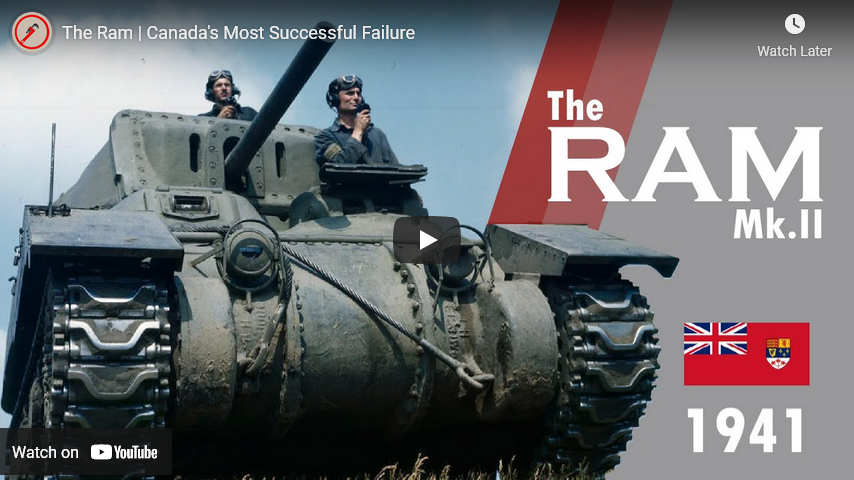
The Ram | Canada’s Most Successful Failure

Filed under: Cancon, History, Military, Weapons, WW2 — Tags: , , , , , , — Nicholas @ 02:00

Red Wrench Films
Published 4 Dec 2020

A Canadian Franken-tank that pre-dated the M4 Sherman, the Ram would be an icon of Canada’s industry in the early war years. Ultimately a failure as a battle tank, variants of the vehicle would see combat in Normandy and beyond, as the Kangaroo APC which revolutionised mechanised warfare in 1944 and 1945.

Any feedback is greatly appreciated, I’m always trying to improve.

Any suggestions for the next video? Leave it down in the comments or message me. 🙂

((Like and subscribe))

Please note that the footage I can find on these vehicles is scarce and sometimes the video will not match properly or will perhaps be slightly inaccurate.

Sources:
https://tanks-encyclopedia.com/ww2/ca…
https://www.dday-overlord.com/en/mate…
https://www.friends-amis.org/index.ph…
http://panzerserra.blogspot.com/2015/…

Intuit256 by Kevin MacLeod is licensed under a Creative Commons Attribution 4.0 licence. https://creativecommons.org/licenses/…
Source: http://incompetech.com/music/royalty-…
Artist: http://incompetech.com/

QotD: Weird attempts to violate the Efficient Markets Hypothesis

Filed under: Books, Business, Quotations — Tags: , , , , — Nicholas @ 01:00

There’s a lot more to this book, but it all seems to be pointing at the same central, hard-to-describe idea. Something like “All progress comes from violations of the efficient market hypothesis, so you had better believe these are possible, and you had better get good at finding them.”

The book begins and ends with a celebration of contrarianism. Contrarians are the only people who will ever be able to violate the EMH. Not every weird thing nobody else is doing will earn you a billion dollars, but every billion-dollar plan has to involve a weird thing nobody else is doing.

Unfortunately, “attempt to find violations of the EMH” is not a weird thing nobody else is doing. Half of Silicon Valley has read Zero To One by now. Weirdness is anti-inductive. If everyone else knows weirdness wins, good luck being weirder than everyone else.

Thiel describes how his venture capital firm would auto-reject anyone who came in wearing a suit. He explains this was a cultural indicator: MBAs wear suits, techies dress casually, and the best tech companies are built by techies coming out of tech culture. This all seems reasonable enough.

But I have heard other people take this strategy too far. They say suit-wearers are boring conformist people who think they have to look good; T-shirt-wearers are bold contrarians who expect to be judged by their ideas alone. Obviously this doesn’t work. Obviously as soon as this gets out – and it must have gotten out, I’ve never been within a mile of the tech industry and even I know it – every conformist putting image over substance starts wearing a t-shirt and jeans.

When everybody is already trying to be weird, who wins?

Part of the answer is must be that being weird is a skill like any other skill. Or rather, it’s very easy to go to an interview with Peter Thiel wearing a clown suit, and it will certainly make you stand out. But will it be “contrarian”? Or will it just be random? Anyone can conceive of the idea of wearing a clown suit; it doesn’t demonstrate anything out of the ordinary except perhaps unusual courage. The real difficulty is to be interestingly contrarian and, if possible, correct.

(I wrote that paragraph, and then I remembered that I know one person high up in Peter Thiel’s organization, and he dresses like a pirate during random non-pirate-related social situations. I always assumed he didn’t do this in front of Peter Thiel, but I just realized I have no evidence for that. If this advice lands you a job at Thiel Capital, please remember me after you’ve made your first million.)

Scott Alexander, “Book Review: Zero to One”, Slate Star Codex, 2019-01-31.

January 27, 2022

What Would Ross Do? The .280 Military Match M10 Rifle

Filed under: Cancon, History, Military, Weapons — Tags: , , , , — Nicholas @ 02:00

Forgotten Weapons
Published 15 Sep 2021

http://www.patreon.com/ForgottenWeapons

https://www.floatplane.com/channel/Fo…

Cool Forgotten Weapons merch! http://shop.forgottenweapons.com

There were many different versions of the Ross straight-pull bolt action rifle made and adopted by the Canadian military. However, the version that Sir Charles Ross thought would be best was only ever made as a small run of prototypes. This rifle was called the Military Match M10, in .280 Ross caliber.

The .280 Ross was a powerful cartridge on par with 7mm Remington Magnum, firing a 140 grain bullet at 3000 fps. This made it very flat-shooting, which Ross saw as ideal for minimizing range estimation errors. Ross’ military experience had been in the Boer War, where long range individual marksmanship was perhaps as important as in any other modern military conflict. For his ideal rifle, he used his M1910 action with a Mauser-style 5-round double-column flush magazine, a finely adjustable rear sight with an aperture for precision shooting but also a notch sight for snap shots. He gave a it a 26 inch barrel — longer than many of the rifles being adopted in the early 1900s, but long enough to have good ballistics and a very long sight radius.

Ross presented his rifle to the Canadian and British militaries, but it was not accepted, because of the British retention of the .303 cartridge if for no other reason. Only about two dozen were made, with serial numbers in the 102XX range. Only perhaps half of those still exist today, and it’s a rare treat to be able to examine this one!

Contact:
Forgotten Weapons
6281 N. Oracle 36270
Tucson, AZ 85740

January 9, 2022

QotD: Secrets in plain sight

Filed under: Business, Quotations, Science, Technology — Tags: , , — Nicholas @ 02:00

One such trend – which Thiel approaches in a lot of different equivalent ways – is the loss of belief in secrets. People no longer believe that there are important things that they don’t know, but which they could discover if they tried a little harder.

Past scientific discoveries came from a belief in secrets. Isaac Newton wondered why apples fell, thought “Maybe if I work really hard on this problem, I can discover something nobody has ever learned before”, and then set out to do it. Modern people aren’t just less likely to think this way. They’re actively discouraged from it by a culture which mocks the story of Newton as “the myth of the lone genius”, and tells young people that even thinking about this risks promoting a regressive political agenda. Nowadays people get told that if they think they’ve figured out something about gravity, they’re probably a crackpot. Instead, they should wait for very large government-funded programs full of well-credentialled people to make incremental advances.

Good startups require a belief in secrets, where “secret” is equivalent to “violation of the efficient market hypothesis”. You believe you’ve discovered something that nobody else has: for example, that if you set up an online bookstore in such-and-such a way today, in thirty years you’ll be richer than God. This is an outrageously arrogant claim: that you have spotted a hundred-billion-dollar bill lying on the sidewalk that everyone else has missed. But only people who believe something like it can noncoincidentally found great companies. You must believe there are lucrative secrets hidden in plain sight.

Scott Alexander, “Book Review: Zero to One”, Slate Star Codex, 2019-01-31.

January 7, 2022

The Most Important Invention of the 20th Century: Transistors

Filed under: History, Science, Technology, USA — Tags: , , — Nicholas @ 02:00

The History Guy: History Deserves to Be Remembered
Published 23 Dec 2019

On December 23, 1947, three researchers at Bell labs demonstrated a new device to colleagues. The device, a solid-state replacement for the audion tube, represented the pinnacle of the quest to provide amplification of electronic communication. The History Guy recalls the path that brought us what one engineer describes as “The world’s most important thing.”

This is original content based on research by The History Guy. Images in the Public Domain are carefully selected and provide illustration. As images of actual events are sometimes not available, images of similar objects and events are used for illustration.

All events are portrayed in historical context and for educational purposes. No images or content are primarily intended to shock and disgust. Those who do not learn from history are doomed to repeat it. Non censuram.

Find The History Guy at:

Patreon: https://www.patreon.com/TheHistoryGuy

The History Guy: History Deserves to Be Remembered is the place to find short snippets of forgotten history from five to fifteen minutes long. If you like history too, this is the channel for you.

Awesome The History Guy merchandise is available at:
teespring.com/stores/the-history-guy

Script by THG

#ushistory #thehistoryguy #invention

January 3, 2022

Testing Gyrojet ROCKET GUNS – Why were they a commercial failure?

Filed under: History, Technology, USA, Weapons — Tags: , , , , — Nicholas @ 02:00

TAOFLEDERMAUS
Published 10 Jun 2018

We were able to make the impossible happen: test out two rare Gyrojet rocket guns. Remarkably, instead of just taking one or two shots, we were able to take 4 shots. We were able to learn a lot with these limited test still.

Check out Sean’s Youtube channel:
https://www.youtube.com/c/ReallyGreatGear

If you want to own an amazing book about the MBA Gyrojets:
http://www.gyrojet.net/

Special thanks for our Patreon supporters. We could not have done this without you.
https://www.patreon.com/taofledermaus

Music:
https://www.youtube.com/watch?v=CRli8…
https://www.youtube.com/watch?v=cKPUn…

December 15, 2021

Why Real Wasabi Is So Expensive | So Expensive

Filed under: Britain, Business, Environment, Food, Japan — Tags: , — Nicholas @ 02:00

Business Insider
Published 19 Jan 2019

The green paste you’ve been eating with your sushi isn’t really wasabi. If you check the ingredients on the packet, you might see a mixture of sweetener, horseradish and perhaps a small percentage of the real thing. Real wasabi is hard to come across and it can cost $250 per kilo. So what actually is wasabi, and why is it so expensive?

For more from The Wasabi Company, go to: https://www.thewasabicompany.co.uk/

——————————————————

#Wasabi #Expensive #BusinessInsider

Business Insider tells you all you need to know about business, finance, tech, retail, and more.
BI on Instagram: https://read.bi/2Q2D29T
BI on Twitter: https://read.bi/2xCnzGF

December 14, 2021

Chatellerault M24/29: France’s New Wave of Post-WWI Small Arms

Filed under: France, History, Military, Weapons, WW2 — Tags: , , , , , — Nicholas @ 02:00

Forgotten Weapons
Published 26 Aug 2017

France fought the Great War with an array of weapons which were all sub-par in one way or another — the Lebel rifle was obsolescent by 1914, the Berthier was a cavalry carbine forced into rifle service, the Chauchat was an emergency wartime design optimized for production volume instead of quality, and the handguns were a mixture of old revolvers and desperate imports from Spain. Once the war finally ended, the French military would move to replace the whole lot with new and modern arms.

This would begin by finally replacing the 8mm Lebel cartridge with a non-tapered, rimless cartridge — something that would be well suited to use in magazines and repeating arms. Simultaneously, a new light machine gun would be found, as this was deemed to most important improvement to be made. The cartridge was adopted in 1924 as the 7.5x58mm, but it would soon be realized that there was a critical problem with that round. The French military had a large supply of German arms taken as war reparations, and the new 7.5mm cartridge looked very similar to the 8x57mm Mauser cartridge. Worse, the Mauser round would chamber and fire in the new French chambers, causing serious damage to guns when the 8mm bullet was squeezed down to 7.5mm. To fix this issue, the French cut their cartridge down by 4mm, resulting in the 1929 adoption of the 7.5x54mm round — the chamber of which would no longer fit a German 8mm round.

As for the machine gun, the first choice was to simply adopt the Browning BAR — but France insisted on obtaining the technical data package and producing the guns in France, and they could not come to an agreement with Colt over the price of such a license. So, the French held trials of other guns, looking at virtually everything then available. In the aftermath of the trials, it was decided that the Chatellerault arsenal could design its own weapon using the best features of the other existing guns. The arsenal rather quickly produced prototypes, and they were adopted in 1924 (and then updated to use the shorter version of the 7.5mm cartridge in 1929).

The Chatellerault M24/29 is a quite good weapon, especially considering how early it was designed. It uses a tilting bolt and a top-mounted 25 round magazine. It has two triggers, the front one firing in semiautomatic and the rear one in fully automatic. The wooden front handguard allows for fire from the hip or shoulder if desired, and a set of thorough dust covers keep the gun free from ingress of mud or dirt. About 188,000 would be manufactured, and it would stay in service for many decades.

http://www.patreon.com/ForgottenWeapons

Cool Forgotten Weapons merch! http://shop.bbtv.com/collections/forg…

If you enjoy Forgotten Weapons, check out its sister channel, InRangeTV! http://www.youtube.com/InRangeTVShow

December 4, 2021

How mail trains collected letters without stopping – Post Trains

Filed under: Britain, History, Railways, USA — Tags: , — Nicholas @ 02:00

Train of Thought
Published 3 Dec 2021

In this video, we take a look at how post trains would collect and deliver mail without the need to stop, mostly by yeeting the post out of the train

This video falls under the fair use act of 1976.

November 21, 2021

SA80 History: XL60 Series in 4.85mm

Filed under: Britain, History, Military, Weapons — Tags: , , , , , , — Nicholas @ 02:00

Forgotten Weapons
Published 10 May 2017

Armament Research Services (ARES) is a specialist technical intelligence consultancy, offering expertise and analysis to a range of government and non-government entities in the arms and munitions field. For detailed photos of the guns in this video, don’t miss the ARES companion blog post:

http://armamentresearch.com/british-e…

Once the basic configuration of the new British rifle was determined, the next step was to build a series of prototypes. The design that took form was basically a bullpup copy of the Armalite AR-18. The design team at Enfield were mostly senior draftsmen, with virtually no firearms experience among them. To make things worse, most of the design team was regularly rotated onto other projects, preventing them from developing any project experience on the rifle.

Several prototype batches were made (typically of a dozen guns each, both IWs and LSWs), all in the unique British 4.85x49mm cartridge, with a variety of different feature sets. Through the different patterns, configurations would change on the safety (push button vs lever) fire selector (push button vs lever), and magazine catch (straight-in side lever vs rock-in side lever vs rock-in rear paddle). At this time, plans still existed to make both left- and right-handed versions of the final gun, so prototypes of both were manufactured.

Because cost-cutting measures had not yet been forced on the project, these XL-60 series guns were generally reliable, at least in normal conditions. They are quite comfortable to fire, with a cartridge very similar to the 5.56mm NATO in practical terms. There is nothing particularly wrong with that cartridge, but it would be dropped when it lost NATO trials to the Belgian SS109 … but we will address that in the next episode of the SA80 history.

http://www.patreon.com/ForgottenWeapons

Cool Forgotten Weapons merch! http://shop.bbtv.com/collections/forg…

If you enjoy Forgotten Weapons, check out its sister channel, InRangeTV! http://www.youtube.com/InRangeTVShow

November 18, 2021

All the Guns on a T-62 Tank (with Nicholas Moran, the Chieftain)

Forgotten Weapons
Published 5 Aug 2021

Try out World of Tanks with a special bonus tank using this link!

https://tanks.ly/3dqGoBL

Today Nicholas Moran (the Chieftain) and I are at Battlefield Vegas courtesy of Wargaming.net, to show you around a Soviet T-62 and all its various armaments. This particular T-62 was built in 1971 or 1972 and initially sold to Syria. It saw combat in the Valley of Tears in 1973, but survived as was eventually transferred to Lebanese ownership. From there is was captured by Israel and eventually imported into the United States via the UK. The T-62 was the last of the “simple” WW2-style Soviet tanks, and equipped with an extremely effective 115mm smoothbore main gun. In addition to that cannon, we will discuss and shoot the coaxial PKT machine gun and the loader’s antiaircraft DShKM heavy machine gun.

If you enjoy this video, check out World of Tanks – and maybe they will send Nicholas and I back again to do the same thing yet again on a third tank!

For videos on the detail of tanks like this one, check out The Chieftain:
https://www.youtube.com/user/WorldOfT…
https://www.youtube.com/channel/UCp4j…

0:00:00 – Introduction
0:06:02 – Coaxial PKT
0:13:12 – Antiaircraft DShKM
0:20:25 – 115mm Main Gun
0:28:43 – Firing the main gun

Contact:
Forgotten Weapons
6281 N. Oracle 36270
Tucson, AZ 85740

October 25, 2021

P90: FN’s Bullpup PDW

Filed under: Europe, History, Military, Weapons — Tags: , , , , , , , — Nicholas @ 02:00

Forgotten Weapons
Published 2 Jul 2021

http://www.patreon.com/ForgottenWeapons

https://www.floatplane.com/channel/Fo…

Cool Forgotten Weapons merch! http://shop.forgottenweapons.com

FN began developing the P90 in the late 1980s, actually preceding the NATO requirement that it would eventually compete for. The idea of the P90 was to develop a weapon for secondary troops to replace 9mm pistols and SMGs. There was an anticipated threat of Russian paratroops wearing armor that could defeat 9mm ball. The P90 was intended to be a light and handy weapon that was easily controllable without a tremendous about of training, and could defeat that sort of body armor.

The result was the 5.7x28mm cartridge, firing a 31 grain armor-piercing bullet at 2350 fps. This was combined with a simple blowback action and a Hall-style 50-round magazine in a fully ambidextrous, bullpup layout. The gun was introduced onto the market in 1990, and has been widely purchased by security and special operations organizations. In its original intended role for support troops, it has only been adopted by Belgium.

Contact:
Forgotten Weapons
6281 N. Oracle 36270
Tucson, AZ 85740

October 23, 2021

The English Statute of Monopolies gets far more credit than it actually deserves

The Statute of Monopolies (1624) is often said to have been critical in helping to start England on the road to the Industrial Revolution, but in the latest Age of Invention newsletter Anton Howes argues it is far more complicated than it seems:

Letters Patent Issued by Queen Victoria, 1839. On 15 June 1839 Captain William Hobson was officially appointed by Queen Victoria to be Lieutenant Governor General of New Zealand. Hobson (1792 – 1842) was thus the first Governor of New Zealand.
Constitutional Records group of Archives NZ via Wikimedia Commons.

One of the most frequently mentioned landmarks in the history of intellectual property is the Statute of Monopolies, passed by the English parliament in 1624. I’ve often seen it lauded as the beginning of the system of patents for invention, or the first patent law. I remember giving a talk a few years ago where I downplayed the role of formal institutions in encouraging the Industrial Revolution, prompting an outraged economist in the audience to point to the law as a sort of gotcha — “here’s a better explanation: with patents you incentivise invention, and the Brits had just invented patents”.

Which is all to illustrate that the Statute of Monopolies is often fundamentally misunderstood. So what, exactly, did it actually do? It’s a tale of opportunism, corruption, and court intrigue, with some actual innovation inbetween. The whole saga ended Francis Bacon’s political career, led to a major constitutional crisis, and set the scene for how inventors were to behave and act for well over a century. In this first part, I’ll give the context you’ll need to really appreciate what was going on, and I’ll publish the rest in the weeks to come.

First off, the Statute of Monopolies was certainly not the first patent law. Venice’s senate had enacted a law on monopolies for invention as early as 1474. But even then, we shouldn’t be looking for statutes at all. The history of patents does not begin in 1474, but much earlier, with plenty of monopolies over new inventions having already been granted by the ruling grand council of Venice, and by the authorities of other Italian cities like Florence. The key thing to recognise about early patents is that they were not a creation of parliaments or their statutes, but of those in charge. They were the creation of sovereigns, a creature of kings and queens (or in the case of republics like Venice, of governing councils).

As regular readers of this newsletter might remember, patent monopolies for invention had already had long history in England, well before 1624. Patents in general were a very ordinary tool of English monarchs, used to communicate their will. By issuing letters patent, monarchs essentially issued public orders, open for everyone to see. (Think “patently”, as in clearly or obvious, which comes from the same root.) Monarchs used letters patent to grant titles and lands, appoint or remove people as officials, extend royal protections to foreign immigrants, incorporate cities, guilds, even theatre troupes — in general, just to rule.

And, eventually, English monarchs copied the Venetians by issuing letters patent to grant temporary monopolies to particular people, to encourage them to make discoveries, publish books, or introduce new industries or inventions to the realm. It’s only over the passage of centuries that we’ve come to refer to patents for invention — a mere subset of letters patent, and really even a mere subset of patent monopolies for all sorts of other creative work — as simply patents. Intellectual property was thus a ruler-granted privilege, created in the same way that a town gains the official status of a city, or a commoner becomes a knight. English monarchs began granting monopolies for discovering new territories and trade routes from 1496, for printing certain books from 1512, and for introducing new industries or inventions from 1552 (with one weird isolated exception from as early as 1449).

October 22, 2021

The Vehicle That Will Win World War Two – WW2 Special

Filed under: History, Military, Technology, USA, WW2 — Tags: , , , , , — Nicholas @ 04:00

World War Two
Published 21 Oct 2021

The Higgins Landing Craft, Higgins Boat, Landing Craft, or whatever you would like to call it, is one of the most important vehicles of the Second World War — perhaps just as much as tanks, planes, and warships. In a war full of amphibious invasions, landing on beaches in a safer and more efficient way is crucial to victory. So let’s find out the history of this war machine and its use by the World War Two allies.
(more…)

« Newer PostsOlder Posts »

Powered by WordPress