
Polyus Studios
Published 29 Jul 2022Don’t forget to like the video and subscribe to my channel!
Support me on Patreon – https://www.patreon.com/polyusstudiosToday, navies across the world use an ingenious system to land helicopters on the rolling deck of a ship at sea. It enabled the powerful helicopter-destroyer combination that has become the dominant form of at sea anti-submarine warfare. It’s the “helicopter haul down and rapid securing device”, more commonly known as Beartrap. This device may be little known to the public, but it stands as one of the greatest contributions Canada has ever made to naval aviation, and ushered in the age of helicopters at sea.
(more…)
July 30, 2022
Beartrap: The Best Way To Land A Big Helicopter On A Small Ship At Sea
Comments Off on Beartrap: The Best Way To Land A Big Helicopter On A Small Ship At Sea
July 24, 2022
Stoner 63A Automatic Rifle – The Original Modular Weapon
Forgotten Weapons
Published 17 Mar 2018The Stoner 63 was a remarkably advanced and clever modular firearm designed by Eugene Stoner (along with Bob Fremont and Jim Sullivan) after he left Armalite. This was tested by DARPA and the US Marine Corps in 1963, and showed significant potential — enough that the US Navy SEALs adopted it and kept it in service into the 1980s. It was a fantastic balance of weight and controllability, offering a belt-fed 5.56mm platform at less than half the weight of the M60. The other fundamental characteristic of the Stoner 63 was modularity. It was built around a single universal receiver component which could be configured into a multitude of different configurations, from carbine to medium machine gun. Today we have one of the rarer configurations, an Automatic Rifle type. In addition, today’s rifle is actually a Stoner 63A, the improved version introduced in 1966 to resolve some of the problems that had been found in the original.
Ultimately, the Stoner system was able to achieve its remarkably light weight by sacrificing durability. The weapon was engineered extremely well and was not a danger to itself (like, for example, the FG-42), but it was prone to damage when mishandled by the average grunt. This would limit its application to elite units like the SEALs, who were willing to devote the necessary care to the maintenance and operation of the guns in exchange for the excellent handling characteristics it offered.
(more…)
Comments Off on Stoner 63A Automatic Rifle – The Original Modular Weapon
July 22, 2022
QotD: Spoiler – there was no technological solution to trench warfare in WW1
On the one hand, the later myth that the German army hadn’t been defeated in the field was nonsense – they had been beat almost along the entire front, falling back everywhere. Allied victory was, by November, an inevitability and the only question was how much blood would be spilled before it happened. On the other hand, had the German army opted to fight to the last, that victory would have been very slow in coming and Foch’s expectation that a final peace might wait until 1920 (and presumably several million more dead) might well have been accurate. On the freakishly mutated third hand, it also seems a bit off to say that [the French doctrine of] Methodical Battle had won the day; it represented at best an incremental improvement in the science of trench warfare which, absent the blockade, potentially endless American manpower and production (comparatively little of which actually fought compared to the British and the French, even just taking the last Hundred Days) and German exhaustion might not have borne fruit for years, if ever.
All of which is to say, again, that the problem facing generals – German, French, British and later American – on the Western Front (and also Italian and Austrian generals on the Italian front) was effectively unsolvable with the technologies at the time. Methodical Battle probably represented the best that could be done with the technology of the time. The technologies that would have enabled actually breaking the trench stalemate were decades away in their maturity: tanks that could be paired with motorized infantry to create fast moving forces, aircraft that could effectively deliver close air support, cheaper, smaller radios which could coordinate those operations and so on. These were not small development problems that could have been solved with a bit more focus and funding but major complexes of multiple interlocking engineering problems combined with multiple necessary doctrinal revolutions which were in turn premised on technologies that didn’t exist yet which even in the heat of war would have taken many more years to solve; one need merely look at the progression of design in interwar tanks to see all of the problems and variations that needed to be developed and refined to see that even a legion of genius engineers would have required far more time than the war allowed.
It is easy to sit in judgement over the policy makers and generals of the war – and again, to be fair, some of those men made terrible decisions out of a mix of incompetence, malice and indifference (though I am fascinated how, in the Anglophone world, so much of the opprobrium is focused on British generals when frankly probably no British commander even makes the bottom five worst generals. Most lists of “worst generals” are really just “generals people have heard of” with little regard to their actual records and so you see baffling choices like placing Joseph Joffre who stopped the German offensive in 1914 on such lists while leaving Helmuth von Moltke who botched the offensive off of them. Robert Doughty does a good job of pointing out that men like Haig and Foch who were supposedly such incompetent generals in 1915 and 1916 show remarkable skill in 1918).
But the problem these generals faced was fundamentally beyond their ability or anyone’s ability to solve. We didn’t get into it here, but every conceivable secondary theater of war was also tried, along with naval actions, submarines, propaganda, and internal agitation. This on top of the invention of entirely new branches of the army (armor! air!) and the development of almost entirely new sciences to facilitate those branches. Did the generals of WWI solve the trench stalemate? No. But I’d argue no one could have.
Bret Devereaux, “Collections: No Man’s Land, Part II: Breaking the Stalemate”, A Collection of Unmitigated Pedantry, 2021-09-24.
Comments Off on QotD: Spoiler – there was no technological solution to trench warfare in WW1
July 17, 2022
Earlier almost-steam-engine developments
In the latest Age of Invention newsletter, Anton Howes picks up the story of the development of the steam engine (part one was linked here):
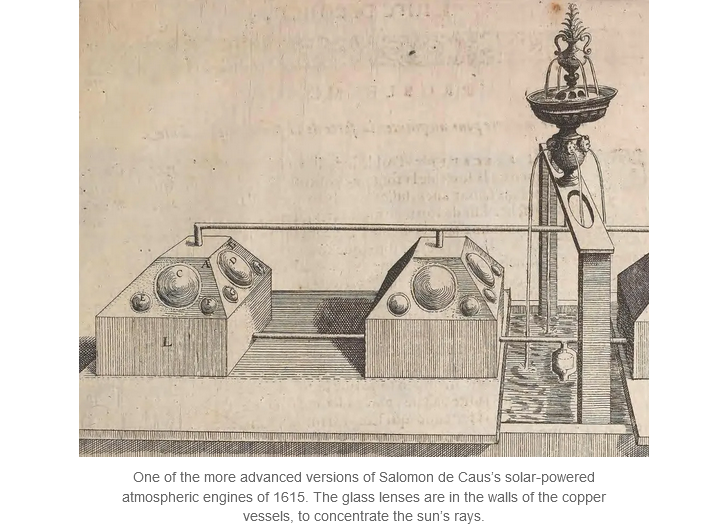
As I explained in Part I, the spark for my investigation was noticing that one Salomon de Caus, as early as 1615, had very probably made what amounts to a solar-powered version of Savery’s engine. By concentrating the sun’s rays on trapped air above the water in copper vessels, the resulting expansion of the trapped air and steam drove the water up a pipe to make a fountain flow. Most crucially of all, however, when the vessels cooled again they sucked water up and into them from a cistern below — a principle that de Caus also applied to having statues make music when the sun shone, and which he hinted may be useful for other things too.
Noticing this machine was a big shock to me, but de Caus’s invention was not even that original. It was actually an improvement of another, almost entirely ignored device described by Hero of Alexandria as early as the 1st Century, and which Hero in turn derived from one Philo of Byzantium who wrote in the 3rd Century BC.
Philo’s original device was very simple: a hollow leaden sphere with a bent tube rising out of it and into some water at the bottom of a jug. As the sun heated the sphere, the expanding air was pushed up the tube and into the jug’s water, escaping by bubbling out of the water. And crucially, when the sphere was removed from the sun and allowed to cool, the water was then drawn up the tube and into the sphere — Philo, about 1,900 years before Savery, had already encapsulated in a simple model the power of condensation to raise water.
Philo’s device was simple, but the principles it illustrated do appear to have been applied. Hero’s work, for example, includes a libas, or “dripper” fountain. In this alternative version of Philo’s apparatus, Hero connected the jug and sphere by two other pipes to a cistern underneath, as well as starting with some water already in the sphere. The jug now acted more like a funnel, into which the original bent tube now dripped its water like a fountain when the sun shone on the sphere. When cooled, however, the sphere replenished itself from the cistern underneath. It was almost exactly like de Caus’s version, which merely improved the strength of the fountain when it was heated, seemingly by replacing the lead with more heat-conductive copper and by using glass convex lenses to concentrate the sun’s rays.
Hero’s solar-powered dripping fountain doesn’t sound all that impressive, but both Philo and Hero appreciated the wider potential of its underlying principles.
Philo, for example, noted that it might make use of alternative heat sources: he described how his apparatus would work whether pouring hot water over the sphere, or by heating it over a fire. Once it cooled, it would always draw the water up.
Hero even suggested a mechanical use for the effect. By setting a fire on a hollow, airtight altar, the heated air within would flow down a tube into a sphere full of water, which in turn would be pushed up another tube into a hanging bucket. The bucket, when sufficiently heavy with water, would then pull on a rope to open some temple doors. Crucially, when the fire was extinguished, Hero noted that the cooling of the air in the altar would draw the water back into the sphere again, lighten the bucket, and so allow the doors to be closed by a counterweight. Although the condensing phase was really just for resetting the device, the fundamental ideas behind a Savery engine were already there: it raised water, used a fuel, and exploited condensation. It even did some light mechanical work.
Comments Off on Earlier almost-steam-engine developments
July 16, 2022
Anti-Tank Chats #4 Bazooka | The Tank Museum
The Tank Museum
Published 18 Mar 2022Join Stuart Wheeler for an Anti-Tank Chat and discover the US military’s development of the Bazooka anti-tank weapon.
(more…)
Comments Off on Anti-Tank Chats #4 Bazooka | The Tank Museum
July 9, 2022
Tank Chat #151 Plastic Tank | The Tank Museum
The Tank Museum
Published 11 Mar 2022► TIMESTAMP:
00:00 – INTRO
00:43 – FEATURES
(more…)
Comments Off on Tank Chat #151 Plastic Tank | The Tank Museum
July 5, 2022
QotD: The Great Enrichment
In particular, it is ideas that people have for commercially tested betterment that matter. Consider alternating-current electricity, cardboard boxes, the little black dress, The Pill, cheap food, literacy, antibiotics, airplanes, steam engines, screw-making machines, railways, universities, cheap steel, sewers, plate glass, forward markets, universal literacy, running water, science, reinforced concrete, secret voting, bicycles, automobiles, limited access highways, free speech, washing machines, detergents, air conditioning, containerization, free trade, computers, the cloud, smart phones, and Bob Gordon’s favorite, window screens. …
And the Great Enrichment depended on the less famous [but] crucial multitudes of free lunches prepared by the alert worker and the liberated shopkeeper rushing about, each with her own little project for profit and pleasure. Sometimes, unexpectedly, the little projects became big projects, such as John Mackey’s one Whole Foods store in Austin, Texas resulting in 479 stores in the U.S. and the U.K., or Jim Walton’s one Walmart in Bentonville, Arkansas resulting in 11,718 stores worldwide.
Letting people “have a go” to implement such ideas for commercially tested betterment is the crux. It comes, in turn, from liberalism, Adam Smith’s “obvious and simple system of natural liberty”, “the liberal plan of [social] equality, [economic] liberty, and [legal] justice”. Liberalism permitted, encouraged, honored an ideology of “innovism” — a word preferable to the highly misleading word “capitalism,” with its erroneous suggestion that the modern world was and is initiated by piling up bricks and bachelors’ degrees.
Dierdre McCloskey, “How Growth Happens: Liberalism, Innovism, and the Great Enrichment (Preliminary version)” [PDF], 2018-11-29.
Comments Off on QotD: The Great Enrichment
July 4, 2022
QotD: The French solution to trench warfare
On the defensive, the French had adopted many of the same principles of the German defense-in-depth we’ve already discussed. On the offense, they came to favor (particularly under the influence of Philippe Pétain and […] Ferdinand Foch) an offensive doctrine designed to maximize France’s position in an attritional contest: that is to limit losses and maximize enemy casualties while still taking and holding ground. The system favored limited “bite-and-hold” attacks, ideally limited such that the attack stopped before triggering the inevitable German counter-attack. Remember that it was when the attacker ran out of steam and the defender’s counter-attack came that the casualty ratios tended to shift to favor the defender. In French thinking, the solution was just to not reach that point.
Instead, the French came to favor – and the British and Americans picked up the same method by the end – elaborately prepared small offensives. The elaborate preparation meant planning out the attack carefully, using shorter but carefully planned hurricane barrages (all of this planning, of course took time) and then seizing the enemy’s forward positions and just their forward positions. Instead of then trying to push through – the old French notion of assault brutal et continu (“brutal and continuous” – a “keep up the pressure till they break” method) which Robert Nivelle had favored – methodical battle focused on “bite-and-hold”.
Once you hit your limited objectives in that first rush where enemy resistence is disoriented (from the short, hurricane barrage) and weaker – and thus where the casualty ratio favors you – you stop and begin fortifying your position. You dig those communications trenches, move up your artillery and brace for the counter-attack. By the time the enemy realizes you aren’t going to attack his second or third line positions (and trigger his devastating counter-attack), you are dug in and prepared for his attack (the hold part of “bite-and-hold”). To reestablish defense in depth, the defender now has to back up to establish new lines to the rear (or launch his own fresh offensive, but by late 1918, the Germans were too weak for this). A long series of such attacks – with significant intervals for fresh careful planning and stockpiling resources – could slowly but surely lever your opponent off of key positions, one by one. It would also preserve a favorable balance of casualties, ensuring that in the end, the enemy runs out of men and shells before you do (that is the “rupture” that Joffre had always hoped for, but which arrived but two years too late for his career).
Such a slow, expensive, bloody and unglamorous strategy was in some ways only politically possible once, by 1918, it had become apparent that all other options were exhausted. That said, to argue that this bite-and-hold operational doctrine broke the trench stalemate is probably not fair either. The progress of allied offensives in 1918 was extremely slow by even the standards of 1914. The German Spring Offensive was well and truly done in July and the Allied offensive picked up in August and ran through November as fast as it could (with Foch doing everything short of getting out and pushing the offensive to try to speed it up) and yet the final allied positions by November were not even in Germany. Even at its greatest distance in 100 days of unbroken victories by a force with materiel and numerical superiority, the front moved less than 100 miles and the overall casualty ratio was roughly even (around a million on both sides).
Bret Devereaux, “Collections: No Man’s Land, Part II: Breaking the Stalemate”, A Collection of Unmitigated Pedantry, 2021-09-24.
Comments Off on QotD: The French solution to trench warfare
July 2, 2022
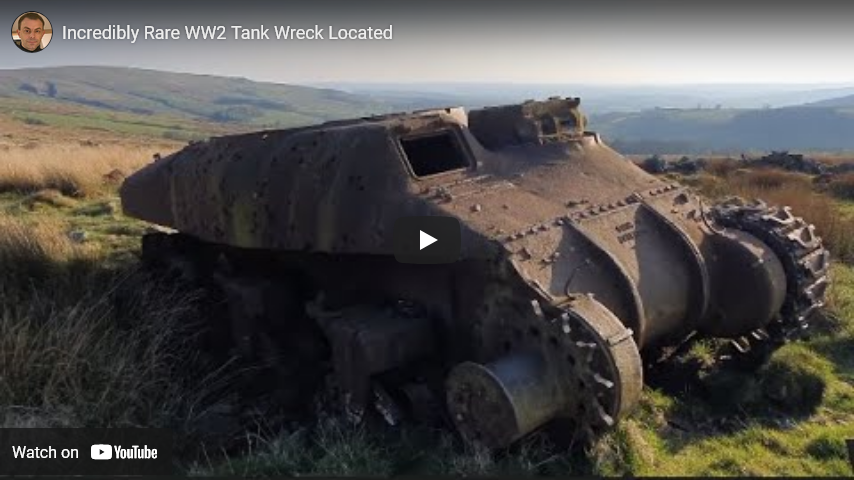
Incredibly Rare WW2 Tank Wreck Located
Mark Felton Productions
Published 5 Mar 2022The story of an incredibly rare WW2 tank that remains forgotten on a UK gunnery range.
Many thanks to Destination Discovery (ADTV) for tank footage. Please visit their wonderful channel for more footage: https://www.youtube.com/channel/UCxyc…
Dr. Mark Felton is a well-known British historian, the author of 22 non-fiction books, including bestsellers Zero Night and Castle of the Eagles, both currently being developed into movies in Hollywood. In addition to writing, Mark also appears regularly in television documentaries around the world, including on The History Channel, Netflix, National Geographic, Quest, American Heroes Channel and RMC Decouverte. His books have formed the background to several TV and radio documentaries. More information about Mark can be found at: https://en.wikipedia.org/wiki/Mark_Fe…
Help support my channels:
https://www.paypal.me/markfeltonprodu…
https://www.patreon.com/markfeltonpro…Disclaimer: All opinions and comments expressed in the ‘Comments’ section do not reflect the opinions of Mark Felton Productions. All opinions and comments should contribute to the dialogue. Mark Felton Productions does not condone written attacks, insults, racism, sexism, extremism, violence or otherwise questionable comments or material in the ‘Comments’ section, and reserves the right to delete any comment violating this rule or to block any poster from the channel.
Credits: US National Archives; Library of Congress; Imperial War Museum; YouTube Creative Commons; LHOON; Martin van Dalen.
Thumbnail: Destination Discovery (ADTV)
Comments Off on Incredibly Rare WW2 Tank Wreck Located
June 27, 2022
Look at Life — The Jumping Jets (1965)
PauliosVids
Published 20 Nov 2018The revolutionary vertical take-off capacity of the RAF Kestrel.
[Wikipedia: “The Hawker P.1127 and the Hawker Siddeley Kestrel FGA.1 are the British experimental and development aircraft that led to the Hawker Siddeley Harrier, the first vertical and/or short take-off and landing (V/STOL) jet fighter-bomber.
“Development began in 1957, taking advantage of the Bristol Engine Company’s choice to invest in the creation of the Pegasus vectored-thrust engine. Testing began in July 1960 and by the end of the year the aircraft had achieved both vertical take-off and horizontal flight. The test program also explored the possibility of use upon aircraft carriers, landing on HMS Ark Royal in 1963. The first three aircraft crashed during testing, one at the 1963 Paris Air Show.
“Improvements to future development aircraft, such as swept wings and more powerful Pegasus engines, led to the development of the Kestrel. The Kestrel was evaluated by the Tri-partite Evaluation Squadron, made up of military pilots from the United Kingdom, the United States, and West Germany. Later flights were conducted by the U.S. military and NASA.
“Related work on a supersonic aircraft, the Hawker Siddeley P.1154, was cancelled in 1965. As a result, the P.1127 (RAF), a variant more closely based on the Kestrel, was ordered into production that year, and named Harrier – the name originally intended for the P.1154 – in 1967. The Harrier served with the UK and several nations, often as a carrier-based aircraft.”]

Comments Off on Look at Life — The Jumping Jets (1965)
June 20, 2022
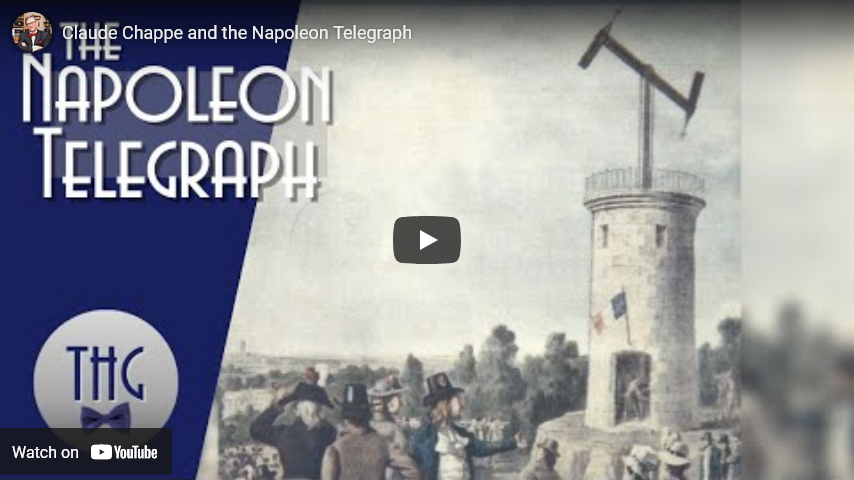
Claude Chappe and the Napoleon Telegraph
The History Guy: History Deserves to Be Remembered
Published 2 Mar 2022The development of technology for speedy long-distance communication dates back to antiquity, and reached its pre-electronic peak in the telegraph before Samuel Morse’s telegraph. Before wires crossed the world, Napoleonic France could send a message from Paris to Lille, a distance of some 250 kilometers, in ten minutes.
Check out our new community for fans and supporters! https://thehistoryguyguild.locals.com/
This is original content based on research by The History Guy. Images in the Public Domain are carefully selected and provide illustration. As very few images of the actual event are available in the Public Domain, images of similar objects and events are used for illustration.
You can purchase the bow tie worn in this episode at The Tie Bar:
https://www.thetiebar.com/?utm_campai…All events are portrayed in historical context and for educational purposes. No images or content are primarily intended to shock and disgust. Those who do not learn from history are doomed to repeat it. Non censuram.
Find The History Guy at:
New community!: https://thehistoryguyguild.locals.com/
Please send suggestions for future episodes: Suggestions@TheHistoryGuy.netThe History Guy: History Deserves to Be Remembered is the place to find short snippets of forgotten history from five to fifteen minutes long. If you like history too, this is the channel for you.
Awesome The History Guy merchandise is available at:
teespring.com/stores/the-history-guyScript by THG
#history #thehistoryguy #France
June 15, 2022
QotD: The gobsmacking magnitude of “The Great Enrichment”
The exactitude, of course, is inessential. In Japan and Finland it was roughly the factor of 30. But it could be the worldwide factor since 1800 of 10 only, about $2 or $3 to $30 a day (to $10,000 a year, the level of Brazil now, to fix ideas), and still be utterly novel. As a Brit might say, the Great Enrichment was gobsmacking.
The enrichment was actually much greater than the factor of 30, because price indices, especially recently, do not adequately reflect improvements in quality, as was determined in the early 1990s by the Boskin Commission … Consider your cell phone, your auto tires, your medical treatment — all greatly better, recently. Even economic facts and analyses are better. (Well, sometimes.) The downward bias from inadequately deflating money prices for improved quality is not far from 2% per year, which would double recent growth rates in the rich countries.
Its magnitude, novelty, recency, and location are all crucial to explaining the Great Enrichment, because together they strongly suggest that there was something deeply peculiar about Britain in the 18th century, and that afterwards the peculiarity spread to the rest of the world. Such facts make “run-up” theories such as in Stephen Broadberry et alii look implausible, because they depend on a metaphor of an airplane taking off, with little else by way of explanation for why the Industrial Revolution (a factor of 2) happened or, especially, its follow-on the Great Enrichment (a factor of 20 or 30). Likewise, it is dubious to attach the Great Enrichment to remote causes within Europe, such as the Black Death — which originated in China, with similar terrors, and yet yielded no Great Enrichment there. Also dubious is the Eurocentric belief, prominent in conservative circles, of some ancient superiority of melanin-challenged Volk back in the Black Forest. (Did you know, for example, that all European countries had common law in the Middle Ages, that is, judge-found-and-made, not legislated or codified?)
The Great Enrichment is the second most important secular event in human history, second only to the domestication of plants and animals making for cities and literacy.
Dierdre McCloskey, “How Growth Happens: Liberalism, Innovism, and the Great Enrichment (Preliminary version)” [PDF], 2018-11-29.
Comments Off on QotD: The gobsmacking magnitude of “The Great Enrichment”
June 11, 2022
The steam engine — one of the keys to the industrial revolution — was actually pretty late to be invented
In the latest Age of Invention newsletter, Anton Howes gives the first part of what promises to be a fascinating deep dive into steam engine development pre-dating the commonly accepted chronology of its invention:
What did I discover that so shocked me? When researching my last post on the inventors surrounding Prince Henry in the 1610s, and because I’ve been looking into the history of energy at the urging of Apoorv Sinha and others at Carbon Upcycling, I had a read through the published work of one of the inventors, Salomon de Caus.
De Caus often features in histories of the steam engine, as someone who in 1615 wrote about and depicted the expansive force of steam — heat up water in a copper vessel with a narrow tube coming out the top, and see how water or steam can be made to rise! He was even briefly known as the “true”, French inventor of the steam engine, because of a nineteenth-century hoax.
To historians of science and technology today, however, de Caus’s illustration is pretty unremarkable. He usually just gets a brief name-check, more or less copy-pasted from older histories. This is because the expansive force of steam would turn out not to be all that important in the development of the steam engine, as we’ll see, and because it was ancient.
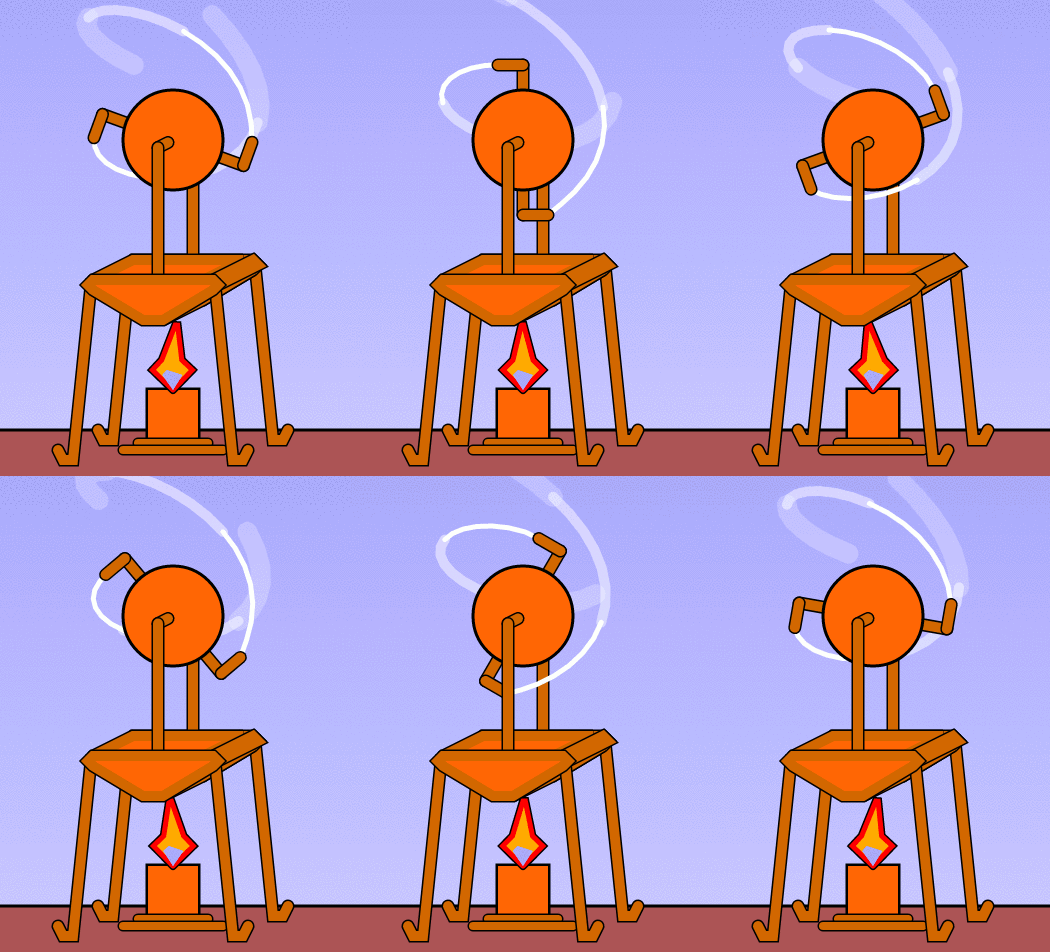
3D animation of an aeolipile or Hero’s engine.
Animation by Michael Frey via Wikimedia Commons.Hero of Alexandria, writing sometime in the first century, had already exploited the fact that when you boil the water in a metal vessel with a long, narrowing spout, the steam will come out with quite some force. This aeolipile, as it was sometimes called, was known and used throughout the middle ages and well into the seventeenth century. Sometimes it was shaped a bit like an alchemist’s retort, and known as the “philosophical bellows”. Other times, it was shaped as a human face, the steam issuing from its mouth — like the Greek god Aeolus, blowing the wind.
This was no mere toy, but found plenty of practical use. The spout of the philosophical bellows was often directed at a lamp’s flame, to have a sort of blow-torch effect. It was used, for example, to do finer tasks like bending glass pipes, or in fine metalwork — there are loads of accounts of this throughout the fifteenth, sixteenth, and seventeenth centuries, with some authors even talking about its merits relative to other instruments, suggesting real-life use. Its heat could, apparently, also be used to get fires going in wet weather, or from damp wood (provided you had some dry wood on hand to get the aeolipile itself going).
It could also be put to more sophisticated uses. Hero explained how the principle of thermal expansion — of either water or air — could be exploited to spout steam or even wine onto an altar’s fire to make it flare, to make water issue from a fountain, to make miniature dancers rotate and jump up and down, and to push air through bird-shaped automata to make them sing. A 1630s English version claimed to make the figure of a dragon hiss.
It could even be used to do some light mechanical work. Hero described a version that might make a hollow ball spin, by having the steam issue from bent nozzles. He even described a version where water could be forced by steam from one container into another, which would pull on a weight to open some doors. Taking his idea and running with it, engineers from at least the fifteenth century onwards wrote about directing the aeolipile’s narrow spout at miniature turbines to turn a roasting spits above a fire — suggested in Italy in Leonardo da Vinci’s notebooks, and in a 1551 Ottoman manuscript by Taqi ad-Din — or to do light industrial work like stamping ores and minerals into powders.
The principle of using heat to expand air or steam was even tried for much heavier-duty tasks. In 1605, the French inventor Marin Bourgeois developed an air-powered gun — known as the “wind-gun” — which used air that was pumped and compressed into the barrel. Within just a couple of years, having heard of the demonstration before the French court, and after paying a visit to Bourgeois, the mathematician David Rivault began experimenting on how the same effect might be achieved by heating water in a cannon. In the same decade, the Spanish military engineer Jerónimo de Ayanz y Beaumont also tried to use the expansionary force of steam to drive water up and out of mines — essentially, an industrial version of what Hero had done with fountains.
Comments Off on The steam engine — one of the keys to the industrial revolution — was actually pretty late to be invented
June 8, 2022
The Story Behind the Dambuster Raid – WW2 Special
World War Two
Published 7 Jun 2022The thousand-bomber offensive was about to begin as Air-Marshall Harris was assembling his forces. Yet one man was to challenge his strategy. The aircraft designer Barnes Wallis thought: “What if there was a way to destroy Germany’s industrial might not by simply dropping thousands of bombs over its cities, but by a precision strike against its dams?” For this, a new kind of bouncing bomb was to be delivered.
(more…)
Comments Off on The Story Behind the Dambuster Raid – WW2 Special
June 5, 2022
Winchester G30M
Forgotten Weapons
Published 27 Jul 2016http://www.patreon.com/ForgottenWeapons
With the death of Jonathan “Ed” Browning in 1939, development of the Winchester G30 rifle was passed into the hands of a new employee at Winchester by the name of David Marshall Williams. Williams would become widely known as “Carbine” Williams in later years thanks to Jimmy Stewart and Hollywood, but we will get to that part of the story later.
What Williams did to the G30 was to replace Browning’s annular gas piston with his own short stroke tappet system (this being the first rifle to use that system of Williams’). This substantially improved the gun’s reliability, and Winchester was able to submit it to Marine Corps trials in 1940 alongside the Garand and Pedersen rifles under the designation G30M. The Marine Corps was legitimately interested in the G30M, as it was expected to be both faster and cheaper to manufacture than the Garand.
Ultimately the trials were won by the Garand, with the G30M placing third in total malfunctions and broken parts. This had involved 37 different tests and more than 12,000 rounds through each rifle. The Garand had 1,480 total malfunctions and 49 parts broken, replaced, or repaired. The Johnson had 1,547 and 72 respectively, and the G30M 2,864 and 97 (roughly double the number of problems as the Garand).
Despite this failure, Winchester was encouraged to continue working on the rifle, if for no other reason than the possibility of foreign purchasers. Williams’ next step would be to replace the Browning tilting bolt with a Garand-type rotating bolt, which would result in a rifle Winchester would call the M2, or “the seven and a half pound rifle”. We will examine that rifle in the next video …

Comments Off on Winchester G30M


