
Military History Visualized
Published on 17 May 2016Patreon: https://www.patreon.com/mhv
Response video, it was necessary, I like Lindybeige, but his latest video “Bren vs Spandau – which was better?” had too many errors. So here is my response to his video.
October 30, 2018
RE: Bren vs Spandau – which was better? @Lindybeige
Comments Off on RE: Bren vs Spandau – which was better? @Lindybeige
September 8, 2018
Battle of Saipan – Steel and Coral – Extra History – #1
Extra Credits
Published on 6 Sep 2018The battle of Saipan would decide the fate of the Pacific War. On a tiny island, just five miles wide, thousands died under advanced artillery and amphibious tanks. This series is brought to you by World of Tanks PC. Check out the game at the link below and use the invite code FORAGER for extra goodies. https://redir.wargaming.net/r06pve1j/…
Support us on Patreon! http://bit.ly/EHPatreon
Comments Off on Battle of Saipan – Steel and Coral – Extra History – #1
August 8, 2018
Doing military intelligence … backwards
Ted Campbell on what he sees as a big problem with western military command structures and particularly the way military intelligence is being over-centralized away from the fighting troops and pushed high up the chain of command:
Intelligence is vital in modern combat operations … just as it was when Alexander set about conquering the known world. But, as Alexander knew, real intelligence is gathered by the troops in direct contact with the enemy and is augmented by e.g. spies who read the enemies mail (our modern, very effective SigInt services, for example, and drones and so on). There is a now well established ~ and I think wrong headed ~ system which aims to collect ALL intelligence at the highest possible level and then disseminate it down … that’s exactly backwards! Combat intelligence is gathered, in the main, by troops in contact with the enemy, by privates and troopers and corporals and then it is passed up the chain to be collated with reports from other troops in contact and then a refined picture is passed back down … where it is promptly corrected by the troops in contact. Intelligence staffs in HQs almost never know much of anything of real utility but they have convinced commanders that if there can only be more and more highly ranked intelligence officers with more clerks and more drones and more computers and so on, that they will, somehow, get ahead of the enemy. It’s a siren song that has, already, run more than one combat commander up on to the rocks of operational failure. The only people who have a good feel for what the enemy is up to are the people who have them in their sights. Don’t get me wrong: I am a HUGE fan of SigInt and drones and UWB radio devices that can see through walls and so on … I want the micro drones and the cyber bugs to be in the hands of the corporals in the rifle sections who are making their way house-to-house and floor-by-floor.
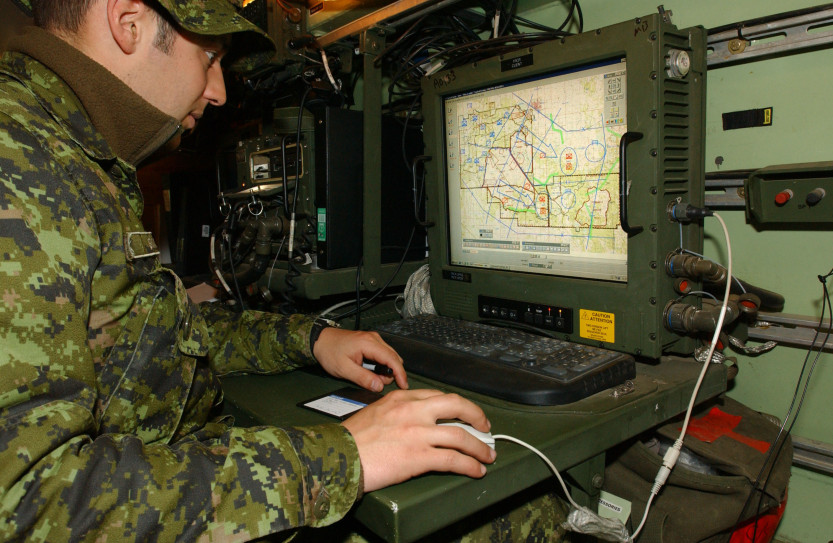
But the bigger threat, by far, is a brigade command post that looks like this …
… than like this:
April 18, 2003, Wainwright, Alberta
Captain Jeremy Small, the Signals Officer with the First Battalion of the Royal Canadian Regiment (1 RCR)(Petawawa, Ontario), works on the Athene Tactical System (ATS) in the Command Post (CP). The ATS is a new battlefield information system being tested by 2 Canadian Mechanized Brigade Group (2CMBG) Headquarters and the 1 RCR. The digital information can be shared in a more timely fashion than the old method, which needed to be drawn by hand. The 1 RCR are part of the is part of the approximately 4,600 Canadian Forces members who are participating in the first major army training exercise of the 21st Century, from April 7 to May 2, 2003 in Wainwright, Alta. After two years of planning, co-operation, strategic resource management, and with assistance from the Air Force, the Army has created Exercise RESOLUTE WARRIOR. Fourteen combat and support units are training together in a multi-element combat environment in preparation for potential and upcoming high readiness tasks at home and abroad. This exercise is the confirmation of the skills and cohesion of the units involved and will be similar to an actual deployment.
Photo: MCpl Paul MacGregor, Canadian Forces Combat CameraThe urban battle of the future, like those of the past will be fought by rifle sections of eight to 12 soldiers, directed by platoon commanders (young, 20-something, lieutenants) overseen and supports by company and battalion commanders. The lessons that my Regiment learned at Ortona, during the Christmas season of 1943, (and which were drummed into my head by ‘old sweats‘ 20 years later) will still apply. Generals and brigadiers and colonels may plan and guide the battle but it will be fought by captains and corporals and privates … hand-to-hand, house-by-house, street-by-street … whether it is a small city or a giant metropolis. Yes, that young soldier would love to have a little drone to see around the corner before he throws the grenade and he might even be interested in knowing that SigInt says that enemy is running low on ammo and food, but at the moment he, like all combat soldiers, must trust, mainly, in his own judgment of the situation as he, and only he, can see it.
But while the privates and corporals are fighting the battle and gathering the real intelligence about the enemy, the legal officer will be wanting to know exactly what (s)he (the rifle section commander) sees and (s)he, the legal officer, will want to advise the brigade commander (who commands 6,500 soldiers) to interfere directly with the the command decisions of the most junior leaders (section (10 soldiers) and platoon (35 soldiers) commanders) and with the control decisions being made by company (125 soldiers) and battalion (900 soldiers) commanders. Good brigade commanders will resist that pressure and they will, equally, close their ears to the urgent warnings of the Public Affairs officer who will say something like “if this goes wrong the Minister will be embarrassed and that will cost you your next star.”

Comments Off on Doing military intelligence … backwards
July 10, 2018
Mountain Combat In The Vosges – The Battle For Alsace-Lorraine I THE GREAT WAR Special
The Great War
Published on 9 Jul 2018The Battle for Alsace-Lorraine in the Vosges was unforgiving and brutal. Both the French and the German troops were fighting in extreme conditions for a extremely symbolic stretch of land.
Comments Off on Mountain Combat In The Vosges – The Battle For Alsace-Lorraine I THE GREAT WAR Special
July 8, 2018
Swedish home defence
Last week, Strategy Page took a look at Sweden’s home defence arrangements, including their first surprise mobilization of the Hemvärnet – Nationella skyddsstyrkorna (Home Guard) in over 40 years:
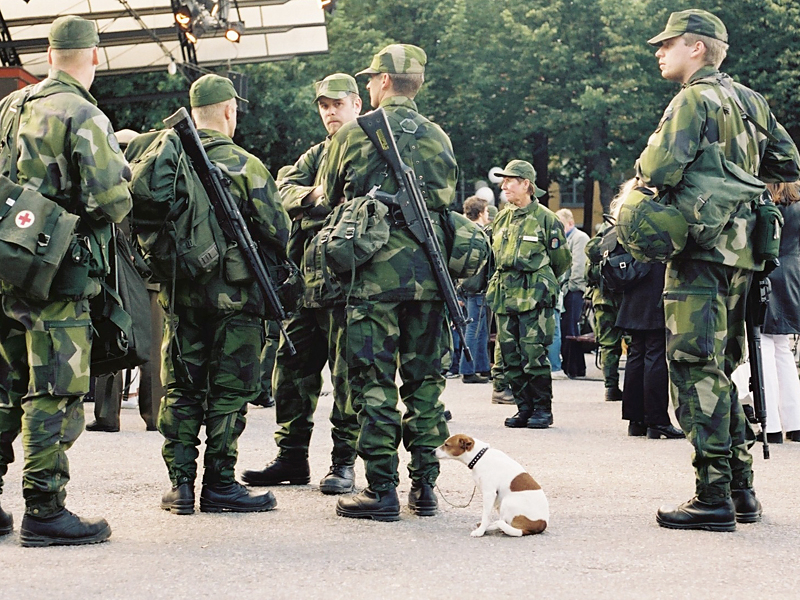
Swedish Home Guard soldiers in Kungsträdgården, Stockholm on 6 August, 2001.
Photo by Peter Fristedt, via Wikimedia Commons.
On June 4th Sweden held its first nationwide, unannounced mobilization of the Home Guard since 1975. This is another effort to prepare Sweden to deal with the renewed Russian threat. The Home Guard consists of reservists and volunteers whose job is local defense and maintenance of order in a national or local emergency. The Home Guard currently has about 22,000 members organized into 70 infantry battalions (each with 2-5 companies) that are assigned to areas where their part-time soldiers work and live. The Home Guard was created in 1940 and now depends on volunteers who are either former full time or reservist personnel who have at least three months of basic training. Twice a year Home Guard personnel two four day long training exercises. These four-day events involve practicing mobilization and doing what they are expected to do in wartime or a major emergency. In addition, most Home Guard companies (about 70 troops each) hold weekend training sessions ten times a year.
The unannounced mobilization of the Home Guard serves to find out how well the Home Guard as a whole would function. The Home Guard is voluntary and members can leave the force any time they choose to. Since 2014 there have been more volunteers and the Home Guard units could be more selective in who they accepted. The Home Guard mobilization is but the latest effort by Sweden to rebuild its traditional defense. The Home Guard take their training and readiness very seriously, especially when there is an obvious threat. In 1940 it was the Germans but after 1945 it was the Russians, at least until 1991. Now the Russians are once more a threat and the government had to agree that the Home Guard required more attention, resources and training.
Yet the Home Guard is more a police and emergency services than a military one. While the guardsmen are armed they are not expected to be a primary defense against invaders. This point was made when the people of Gotland Island recently pointed out that the local Home Guard was not enough to protect areas like Gotland from a surprise attack. The resulted in the government taking action to put a military garrison back on Gotland.
The Home Guard is not the only component of Swedish military readiness being tested. In late 2017 Sweden held its largest military exercises since the 1990s. Some 19,000 full-time soldiers and reservists were involved and the exercise was based on Russia attempting to seize and hold the island of Gotland after a surprise attack. The defense of Gotland has been an issue in Sweden ever since conscription was ended in 2010. Since the 1990s the military budget and number of full-time troops were cut. That led to the elimination of the Gotland garrison, a small force of full-time soldiers to watch for a Russian surprise attack and alert the reserve forces on the island to mobilize. With the end of conscription, it proved impossible to attract enough volunteers from Gotland to sustain the traditional force of military reservists, who would quickly mobilize and confront the invaders.
Comments Off on Swedish home defence
June 20, 2018
Tank Chats #31 Mark IX | The Tank Museum
The Tank Museum
Published on 3 Feb 2017The thirty first in a series of short films about some of the vehicles in our collection, presented by The Tank Museum’s historian David Fletcher MBE. The First World War Mark IX, the first armoured personnel carrier, was designed to solve the problem of moving infantry across the battlefield with the fighting tanks.
Comments Off on Tank Chats #31 Mark IX | The Tank Museum
June 10, 2018
The Landings At Cape Helles 1915 I THE GREAT WAR On The Road
The Great War
Published on 9 Jun 2018Thank you to Mr Ali Serim for making this trip possible.
Indy and our guide Can Balcioglu explore the southern tip of Gallipoli where the British Army landed in April 1915.
Comments Off on The Landings At Cape Helles 1915 I THE GREAT WAR On The Road
May 19, 2018
The Macedonian phalanx – structure and organization
Syntagma
Published on 19 Feb 2018A description of the Macedonian phalanx structure during the Alexander and Diadochi age, based on later written Asclepiodotos and Aelian infantry manuals.
Comments Off on The Macedonian phalanx – structure and organization
May 15, 2018
Evolution of French Infantry During World War 1 I THE GREAT WAR Special
The Great War
Published on 14 May 2018The French soldier in 1914 was already very different from the one in 1918 if you looked at his uniform or equipment. Also the combat tactics evolved considerably in four years of war. The Battle of Verdun, the Nivelle Offensive or the Battle of La Malmaison were important steps during that evolution in which the Poilu became a modern French soldier.
Comments Off on Evolution of French Infantry During World War 1 I THE GREAT WAR Special
April 17, 2018
Storm of Steel – Author And Officer Ernst Jünger I WHO DID WHAT IN WW1?
The Great War
Published on 16 Apr 2018Storm of Steel (In Stahlgewittern) by Ernst Jünger is one of the most harrowing German accounts of World War 1. The author was an officer on the Western Front and fought with the assault troops and stormtroopers until summer 1918.
Comments Off on Storm of Steel – Author And Officer Ernst Jünger I WHO DID WHAT IN WW1?
April 12, 2018
LANDSKNECHTS – most brutal mercenaries of the Renaissance | IT’S HISTORY
IT’S HISTORY
Published on 11 Apr 2018Today we are going to tell you about The Landsknechts – German mercenaries from the 16th century with a very formidable reputation.
Comments Off on LANDSKNECHTS – most brutal mercenaries of the Renaissance | IT’S HISTORY
March 30, 2018
Havildar Bhanbhagta Gurung’s Knife Wielding WWII Assault
Today I Found Out
Published on 19 Feb 2018In this video:
In March of 2008, the world lost one of the most fearless soldiers to have served during WWII; a man who single-handedly cleared five heavily fortified positions with nothing more than a knife, a few grenades, a rock, and a complete disregard for the bullets flying around him the whole time. This is the story of Bhanbhagta Gurung.
Comments Off on Havildar Bhanbhagta Gurung’s Knife Wielding WWII Assault
March 23, 2018
Kaiserschlacht – German Spring Offensive 1918 I THE GREAT WAR Week 191
The Great War
Published on 22 Mar 2018It was all or nothing for the German Army under General Erich Ludendorff now: They unleashed the biggest offensive of the entire war on the Western Front trying to split the British and French Armies, drive the British off the continent and capture Paris.
Comments Off on Kaiserschlacht – German Spring Offensive 1918 I THE GREAT WAR Week 191
March 16, 2018
The Imperial German Army’s final throw of the dice – Operation Michael, March 1918
Victor Davis Hanson summarizes the Central Powers’ brief moment of strength early in 1918:
One hundred years ago this month, all hell broke loose in France. On March 21, 1918, the German army on the Western Front unleashed a series of massive attacks on the exhausted British and French armies.
German General Erich Ludendorff thought he could win World War I with one final blow. He planned to punch holes between the French and British armies. Then he would drive through their trenches to the English Channel, isolating and destroying the British army.
The Germans thought they had no choice but to gamble.
The British naval blockade of Germany after three years had reduced Germany to near famine. More than 200,000 American reinforcement troops were arriving each month in France. (Nearly 2 million would land altogether.) American farms and factories were sending over huge shipments of food and munitions to the Allies.
Yet for a brief moment, the war had suddenly swung in Germany’s favor by March 1918. The German army had just knocked Russia and its new Bolshevik government out of the war. The victory on the Eastern Front freed up nearly 1 million German and Austrian soldiers, who were transferred west.
Germany had refined new rolling artillery barrages. Its dreaded “Stormtroopers” had mastered dispersed advances. The result was a brief window of advantage before the American juggernaut changed the war’s arithmetic.
The Spring Offensive almost worked. Within days, the British army had suffered some 50,000 casualties. Altogether, about a half-million French, British and American troops were killed or wounded during the entire offensive.
But within a month, the Germans were sputtering. They could get neither supplies nor reinforcements to the English Channel. Germany had greedily left 1 million soldiers behind in the east to occupy and annex huge sections of conquered Eastern Europe and western Russia.
The British and French had learned new ways of strategic retreat. By summer of 2018, the Germans were exhausted. In August, the Allies began their own (even bigger) offensive and finally crushed the retreating Germans, ending the war in November 1918.
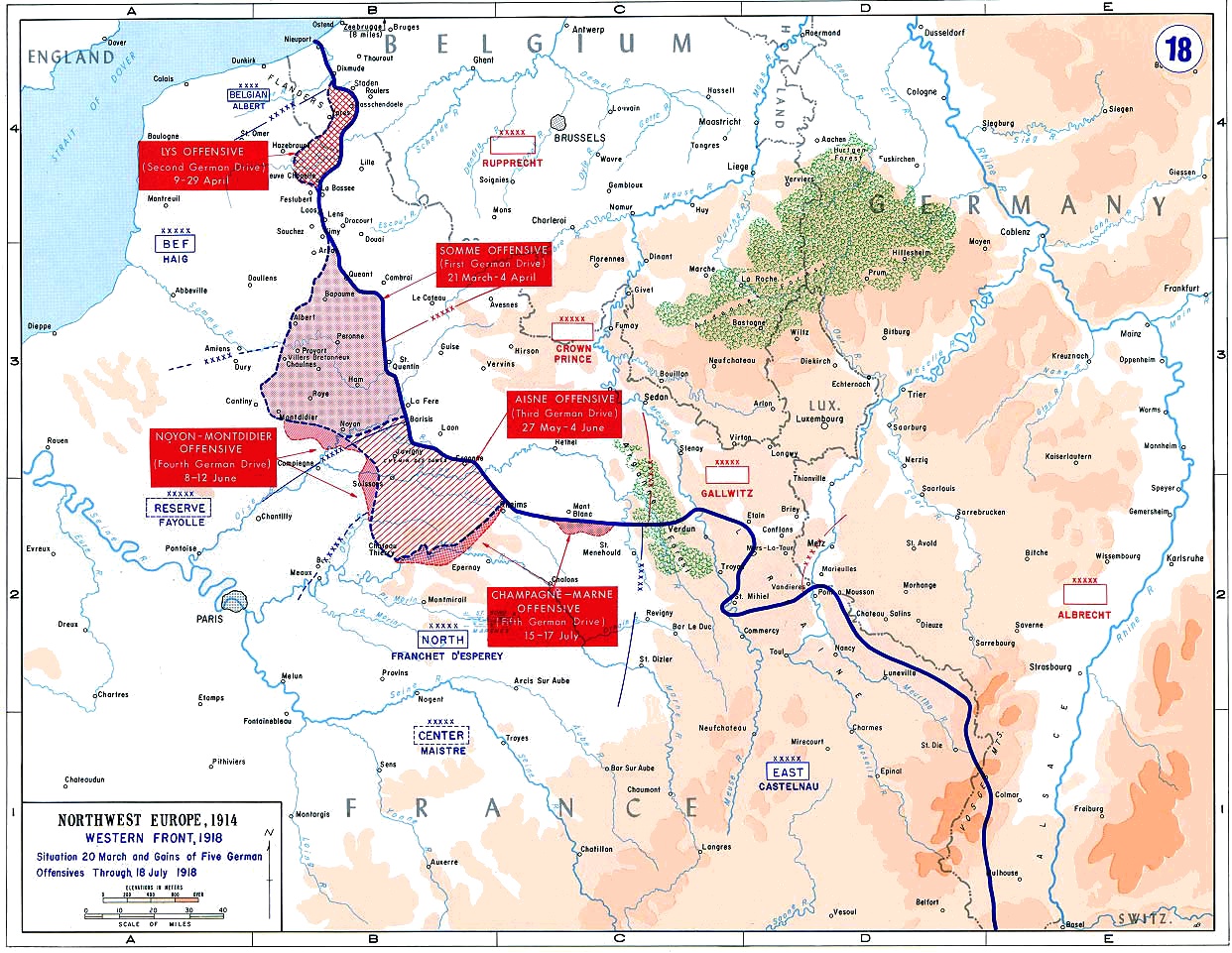
Click to see full-sized image.
For more information on Operation Michael, sometimes known as “The Kaiser’s Battle”, here’s the Wikipedia entry.
Comments Off on The Imperial German Army’s final throw of the dice – Operation Michael, March 1918
March 13, 2018
German Tactics For 1918 Spring Offensive I THE GREAT WAR Special
The Great War
Published on 12 Mar 2018The German Spring Offensive in 1918, the so called Kaiserschlacht or Operation Michael, was the biggest German offensive of World War 1 and Quartermaster-general Erich Ludendorff prepared his troops for this battle by incorporating everything the German Army had learned in this war until now. Hutier Infiltration Tactics, Georg Bruchmüller’s artillery targeting and more lessons from the Eastern Front mean the Entente was facing a different army than before.
Comments Off on German Tactics For 1918 Spring Offensive I THE GREAT WAR Special


