Quotulatiousness

August 26, 2025

“One of the top tips for having a decent country is never, ever, allow the fuckwits to gain power”

If you need to drop someone off at London’s Gatwick Airport, you’ll find yourself facing a £7 charge for the privilege, no matter what day of the week or time of day you choose. Tim Worstall explains why:

“Gatwick Airport, North Terminal” by Martin Roell from Berlin, Germany is licensed under CC BY-SA 2.0 .

It’s sod all to do with congestion and everything to do with the tractor production statistics the fuckwits have imposed upon the airport.

    The conditions attached by the transport secretary included national landscape provisions as per the Levelling Up and Regeneration Act 2023, more consideration for sustainability in buildings design and additional pollution-related mitigation measures.

    The government said in its formal response to the Planning Inspectorate’s recommendations on the Gatwick DCO that it wanted more detail on how it would achieve its commitment of 54% of passengers arriving at the airport via rail within the first year of dual runway operations, which could be by the end of this decade.

The government has a target. That 54% of the arrivals at an airport — yes, an airport, where people get on jet planes — must be by public transport. Therefore the airport is charging for car drop offs in order to decrease the number of car drop offs. There is no more reason than that. Or, as up at the top, the reason there’s a £7 drop off charge at Gatwick Airport is because we are ruled by the fuckwits who have a target for public transport to an airport where people then get on jet planes.

    London Gatwick has also accepted a requirement to have 54% of passengers using public transport prior to bringing the Northern Runway into operation and has reiterated the need for third parties, including the Department for Transport, to support delivery of the necessary conditions and improvements required to meet this target. This would include, for example, reinstating the full Gatwick Express train service.

    Given the reliance on other parties to achieve this 54% target, should it not be achieved then London Gatwick has also proposed an alternative cars-on-the-road limit to be met before first use of the Northern Runway to address concerns about possible road congestion. Furthermore, if neither the 54% transport mode share or the cars-on-the-road limit are met, then use of the Northern Runway would be delayed until £350m of road improvements have been completed. This would make sure any additional road traffic flows can be accommodated and any congestion avoided.

It’s all fuckwit targets set by fuckwits.

Of course, there are those who think that fuckwit targets set by fuckwits are a good idea. For one of the problems of life is that there are always fuckwits:

    When we talk about airport expansion, we often focus on runways, terminals, and the physical infrastructure. But what about how people actually get to the airport?

    The journey begins long before passengers step foot in a terminal, and their choices about transport can have a significant impact on congestion, carbon emissions, and overall passenger experience.

    One of the conditions set for Gatwick’s expansion is a legally binding guarantee that 54% of passengers will travel by public transport, up from today’s 44%. On the surface, it sounds like a simple shift. But transport isn’t just about availability — it’s about behaviour, convenience, and incentives.

One of the top tips for having a decent country is never, ever, allow the fuckwits to gain power. But we have done so therefore there is this £7 charge for a drop off at Gatwick Airport. That’s it, there is no other reason. There are fuckwits buried in the belly of the British state and they’re making the rules now.

August 21, 2025

QotD: Computer models

Filed under: Economics, Government, Media, Politics, Quotations, Technology — Tags: , , , — Nicholas @ 01:00

Should some sort of post-mortem ever be conducted on the catastrophic failure of all computer models, it will be done with the help of a computer model, that will cost billions in whatever currency to assemble. It will show the need for more computer studies. And therefore, it will be catastrophically wrong.

But note: for 100 dollars or negotiable, I will produce a minority report that will explain everything, infallibly. I will not preview the report in this Idlepost, however, because it might be worth money to me.

Aw, heck. Since I am rich beyond the dreams of avarice, let me just go ahead and blow all the beans. Let me recklessly tell gentle reader why computer models are always mistaken.

It is because their makers decide the result, before they design the model.

This does not mean they are self-interested phanatics, consciously preying on the gullibility of a drooling, ignorant public; although usually it does. For even if, by disposition, they are lofty, objective types, they will need, objectively, a lofty budget to perform a “credible” study. This means they must beg huge sums of money, and this will only be available from a source with an unhealthy interest in the result.

You see, the problem has nothing to do with computers. Even among humans, the phenomenon of “garbage in, garbage out” is well attested. The intention of following the evidence where it leads, is transient. I should think only a saint could sustain it, for longer than he could hold his breath under water.

David Warren, “A note on sternutation”, Essays in Idleness, 2020-06-19.

July 18, 2025

The Napoleonic-era Royal Navy

Filed under: Books, Britain, Economics, History, Military — Tags: , , , , — Nicholas @ 04:00

David Friedman on some of the aspects of Britain’s Royal Navy in the late eighteenth and early nineteenth century which may be incomprehensible to modern readers who encounter it in works of historical fiction (like the books of C.S. Forester or Patrick O’Brian):

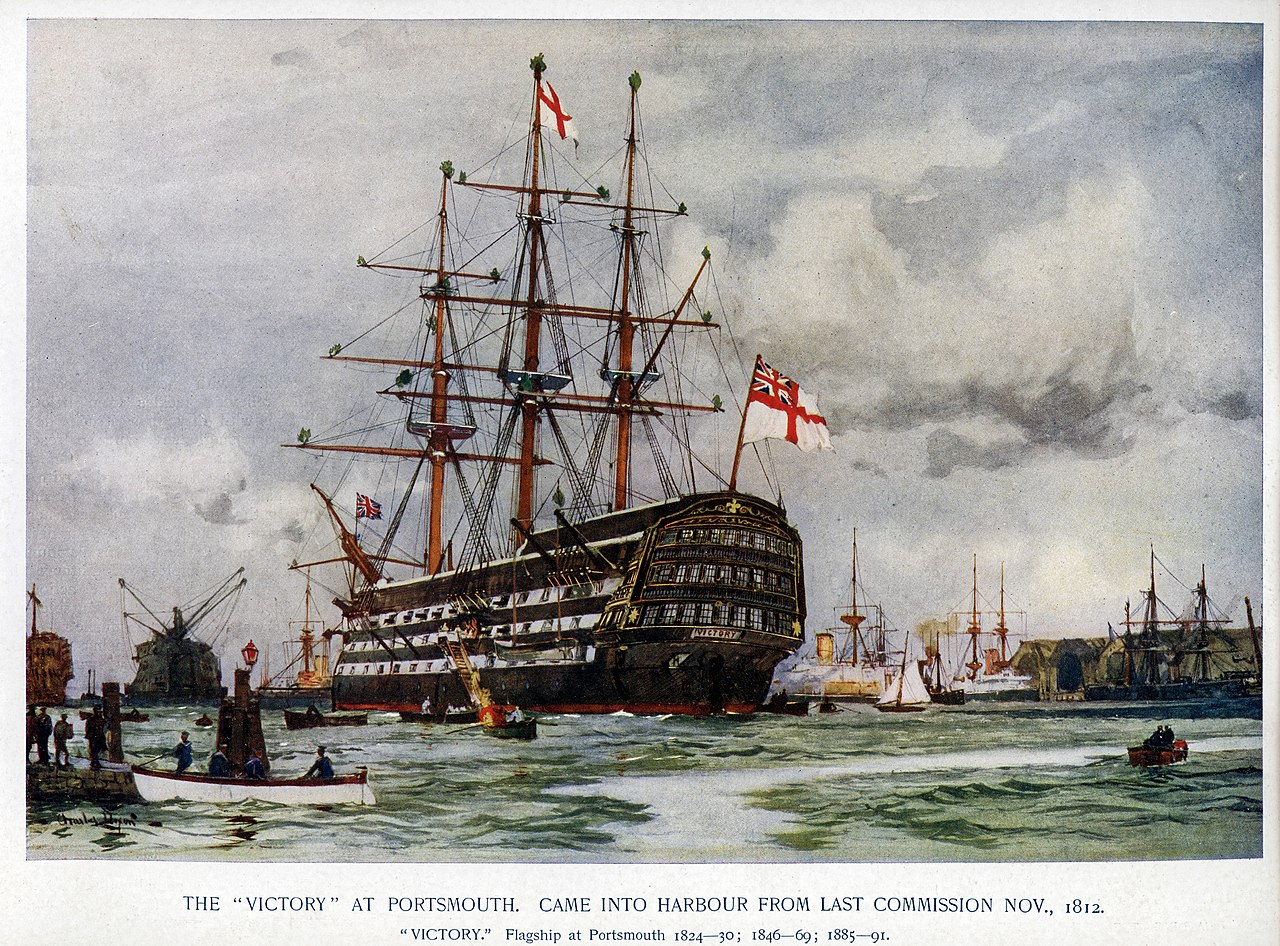
HMS Victory in Portsmouth Harbour”
Painting by Charles Edward Dixon (1872-1934) via Wikimedia Commons.

I have read and enjoyed several series of novels set in the British navy during the Napoleonic wars, most recently one by Naomi Novik that departs a little further from history than its predecessors by providing the British and their enemies with dragons. The internal structure and the associated rules and customs of the navy seem very strange to a modern eye, yet it was a strikingly successful institution.

One feature likely to catch an economist’s eye was prize money. If a naval vessel captured a legitimate prize, an enemy warship or merchantman, and brought it back to port, the vessel and its contents were sold and the money distributed among those responsible. One large chunk went to the captain, another was distributed among his officers, a third among the crew, a fourth to the admiral under whose orders he was operating.

Another feature of the system was the role of patronage, political influence both within the navy and outside it in the career of an officer, especially a young officer. The critical step of promotion from lieutenant to captain depended in part on performance, in particular on the opinion of the captain under whom a lieutenant was serving. But it depended also on things that seem, to us, irrelevant.

One of Patrick O’Brien’s novels contains a conversation between Maturin, one of his protagonists, and a friend, a young officer of aristocratic birth. The officer has been having an affair with the separated wife of a high naval official and wants to know whether he should live openly with her. Maturin’s response is that, moral issues aside, it might be imprudent for him to offend a powerful official and so risk his future career. His friend replies that he has considered that matter but his family controls a significant number of seats in both houses of parliament and he thinks their influence will be sufficient to balance that of the man he will be offending.

Neither party sees anything strange in either the assumption that giving personal offense to someone within the bureaucracy will make it harder for a competent officer to be promoted or that having a politically influential family will make it easier; that is just part of how the system works. It was a system that produced extraordinarily successful results, a navy that, from the late 18th century to the early 20th won almost every ship to ship or fleet to fleet battle it fought at anything close to even odds.1

A third feature was the seniority system. Once a lieutenant was promoted to captain, his future rank depended only on how long he survived. His name was on the list of captains, the list was ordered by strict seniority, and the next captain to be promoted to admiral would be the one at the top of the list. When two or more captains were working together it was the senior who commanded. That provided an unambiguous rule for allocating command, since every captain knew where he was on the list and knew, or could readily find out, where any other captain was. But it was a rule that had nothing to do with the relative competence of two officers of the same nominal rank.

Promotion beyond captain was entirely determined by seniority; what the officer got to do with his rank was not. An insufficiently competent captain who made it to admiral would end up as an admiral of the yellow, an admiral without a fleet, effectively retired on half pay. A sufficiently competent captain could be assigned particularly important duties, including the command of a group of ships with the temporary position of commodore — provided none of the other captains in the squadron was senior to him. A sufficiently incompetent captain could end up without a ship, on half pay with no chance of prize money. In peacetime, when there was no shortage of competent captains, a minor failing might do it.

[…]

Consider the case of the pre-modern British navy. Prize money was a property solution. The admiralty wanted captains to have an incentive to capture enemy merchant ships, defeat and capture enemy warships, even at risk to their lives. Most of the relevant decisions were made by the captain, so he got the largest part of the reward, but other people, including the admiral whose orders determined what opportunities the captain had to earn prize money, got some of it. A pattern that shows up in the novels, and presumably in the real history, is an admiral who puts an unusually competent and aggressive captain in places where he is likely to encounter enemy warships not because he likes the captain but because he hopes to profit from successful encounters.

Allen argues that prize money was an imperfect property solution because capturing a warship was much riskier, more likely to get the captain killed, than capturing a merchant ship, but prize money was awarded for both. One puzzle he does not consider is why the navy did not solve the problem of misaligned incentives by lowering the prize money awarded for merchant ships or raising it for warships, which should have been easy enough to do.

Allen offers the imperfect alignment of incentives, such as the temptation for a captain in a fleet action to hang back and let other ships and their captains take the risk, as a reason why the property solution had to be supplemented with elements of the other two systems. The admiralty had detailed information on what a captain did through a system of three different logs, one by the captain, one by his first lieutenant, one by the sailing master, the ship’s senior warrant officer. A captain whose career showed him to be incompetent or too inclined to go after merchant ships and avoid warships might end up spending the rest of his career on shore with no ship, hence no opportunity for prize money. A captain who declined a clear opportunity for combat with a ship of the same class was subject to trial by court martial; one admiral ended up convicted and executed for failing to pursue the enemy fleet after an engagement.


    1. With the possible exception of the War of 1812.

June 19, 2025

QotD: Peer review and the replication crisis

Filed under: Bureaucracy, Education, Media, Quotations, Science — Tags: , , , , — Nicholas @ 01:00

But what about the error correction function of peer review? Surely it’s important to ensure that the literature doesn’t fill up with bullshit? Shouldn’t we want our journals to publish only the most reliable, correct information – data analysis you can set your clock by, conclusions as solid as the Earth under your feet, uncertainties quantified to within the nearest fraction of a covariant Markov Chain Monte Carlo-delineated sigma contour?

Well, about that.

The replication crisis has been festering throughout the academic community for the better part of a decade, now. It turns out that a huge part of the scientific literature simply can’t be reproduced. In many cases the works in question are high-impact papers, the sort of work that careers are based on, that lead to million-dollar grants being handed out to laboratories across the world. Indeed, it seems that the most-cited works are also the least likely to be reproduced (there’s a running joke that if something was published in Nature or Science, you know it’s probably wrong). Awkward.

The scientific community has completely failed to draw the obvious conclusion from the replication crisis, which is that peer review doesn’t work at all. Indeed, it may well play a causal role in the replication crisis.

The replication crisis, I should emphasize, is probably not mostly due to deliberate fraud, although there’s certainly some of that. There was a recent scandal involving the connection of amyloid plaques to Alzheimer’s disease which seems to have been entirely fraudulent, and which led to many millions – perhaps billions – of dollars in biomedical research programs being pissed away, to say nothing of the uncountable number of wasted man-hours. There have been many other such scandals, in almost every field you can name, and God alone knows how many are still buried like undiscovered time bombs in the foundations of various sub-fields. Most scientists, however, are not deliberately, consciously deceptive. They try to be honest. But the different models, assumptions, and methods they adopt can lead to wildly divergent results, even when analyzing the same data and testing the same hypothesis. Beyond that, they can also be sloppy. And the sloppiness, compounded across interlinked citation chains in the knowledge network, builds up.

Scientists know quite well that just because something has received the imprimatur of publication in a peer-reviewed journal with a high impact factor doesn’t mean that it’s correct. But while they know this intellectually, it’s very difficult to avoid the operating assumption that if something has passed peer review it’s probably mostly okay, and they’re not inclined to spend valuable time checking everything themselves. After all, they need to publish their own papers – in order to finish their PhD, get that faculty position, or get that next grant – and papers that are just trying to reproduce the results of other papers, that aren’t doing something novel, aren’t very interesting on their own, hence unlikely to be published. So instead of checking carefully yourself, you assume a work is probably reliable, and you use it as an element of your own work, maybe in a small way – taking a number from a table to populate an empty field in your dataset – or maybe in an important way, as a key supporting measurement or fundamental theoretical interpretative framework.

But some of those papers, despite having been peer reviewed, will be wrong, in small ways and large, and those erroneous results will propagate through your own results, possibly leading to your own paper being irretrievably flawed. But then your paper passes peer review, and gets used as the basis for subsequent work. Over time the entire scientific literature comes to resemble a house of cards.

Peer review gives scientists – and the lay public – a false sense of security regarding the soundness of scientific results. It also imposes an additional, and quite unnecessary, barrier to publication. It frequently takes months for a paper to work its way through the review process. A year or more is not unheard of, particularly if a paper is rejected, and the authors must start the whole process anew at a different journal, submitting their work as a grindstone for whatever rusty old axe the new referee is looking to sharpen. Far from ensuring errors are corrected, peer review slows down the error correction process. A bad paper can persist in the literature – being cited by other scientists – for some time, for years, before the refutation finally makes it to print … at which point some (not all) will consider the original paper debunked, and stop citing it (others, not being aware of the debunking, will continue to cite it). But what if the refutation is itself tendentious? The original authors may wish to reply, but their refutation of the refutation must now go through the peer review process as well, and on and on it interminably drags …

As to what is happening behind the scenes, no one – not the public, not other scientists – has any idea. The correspondence between referees and authors is rarely published along with the paper. Whether the review was meticulous or sloppy, whether the referee’s critiques warranted or absurd, is entirely opaque.

In essence, the peer review process slows down the publication duty cycle, thereby slowing down scientific debate, while taking much of that debate behind closed doors, where its quality cannot be evaluated by anyone but the participants.

John Carter, “DIEing Academic Research Budgets”, Postcards from Barsoom, 2025-03-17.

May 13, 2025

For boys, sometimes a touch of competition is all that’s required

Filed under: Books, Education — Tags: , , , — Nicholas @ 03:00

Jon Miltimore was concerned when a report from his son’s school indicated that his son was lagging behind in reading compared to his classmates:

“Old Victorian Childrens’ Books” by pettifoggist is licensed under CC BY-SA 2.0 .

So the fact that my own son — who is quite bright and scores extremely high in math — was struggling hit me a little, but it was not a surprise. Like many children, he had fallen behind in reading during the pandemic, and our efforts to get him caught up at home were pretty ineffective. Part of the problem was that as parents we did not do a good enough job of finding the right books to naturally kindle his interest and curiosity, but another issue was that at some point he began to feel self-conscious about this reading, which created an aversion to books.

[…]

A few months later, I had just finished reading a story to my 6-year-old son, who shares a bedroom with his older brother. I went to flick the light off when my older son said something I’d never heard before.

“Can I read for just ten more minutes,” he pleaded, showing me his book on pro football players.

I quickly gave my approval, then went downstairs to tell my wife. She was not as surprised as I was.

“They’re doing a reading competition at school. It’s boys against girls,” she said. “Every minute he reads is now added to their score. So now he wants to read — because it’s a competition.”

My wife did not say this disapprovingly, but she said it in a way that said of course he wants to read now. (My son is competitive.)

Over the next several weeks I watched as my son made a point of reading every night. Oftentimes he’d ask — just like on that first night — if he could read just 10 more minutes. Many nights he’d fall asleep with a book on his chest.

I have to admit that at first I found this strategy a tad cynical, but then I got the results. Over the span of seven weeks, my son leapt nearly two reading levels. He’s reading comfortably at the third-grade level and we’re now focusing more on reading comprehension than reciting sentences. He’s asking for books on World War I, World War II, and Vietnam for Christmas.

“His fluency has improved so much! I am so proud of him,” his teacher later told me.

Competition as a Virtue

I don’t doubt that some will look on this strategy with disdain.

We’re taught today that competition is crass, even harmful. George Soros, in a highly read piece from the 1990s published in The Atlantic, could have been speaking for many when he wrote that competition can “cause intolerable inequities and instability”. For many, competition is a dirty word, a sinister force to be suppressed and controlled.

This is nonsense, of course. Competition isn’t just innate to humans; it brings out the best in us.

It’s the force that drove Roger Bannister to break the four-minute mile. It’s given us the achievements of Michael Phelps and Michael Jordan. Socially, competition is what prompted the Brooklyn Dodgers to do the unthinkable and sign Jackie Robinson, breaking the color barrier and forever changing sports and America.

April 4, 2025

Wine, Urine, Paperclips: America’s Secret Weapons of WWII

World War Two
Published 3 Apr 2025

Today Astrid and Anna explore the Simple Sabotage Field Manual, a top-secret WWII guide that taught ordinary people how to disrupt the Nazi war machine. From factory slowdowns to derailed trains, they show how small acts of sabotage targeted Hitler’s regime, and how resistance often came from unexpected places.
(more…)

March 12, 2025

QotD: A different parable of democracy’s origins

Filed under: Europe, Government, History, Quotations — Tags: , , , , , — Nicholas @ 01:00

Let me tell you a parable about the origins of democracy. It isn’t actually true, but as with Nietzsche’s genealogies it isn’t supposed to be true, it’s supposed to be revealing. Once upon a time a country was ruled by a king, and inevitably whenever the old king died there was a huge and bloody civil war. Eventually, after the dust settled, one of the armies would be victorious and the other defeated, and the general of the victorious army would become the new king.

Then one day, somebody came up with a daring suggestion: what if instead of actually fighting a civil war, they instead had a pretend civil war. The two contenders for the throne would arm-wrestle, and everybody would treat the winner as if he had actually won the civil war, and thus many lives would be saved. Everybody applauded this idea, unfortunately the first time it was tried the loser of the arm-wrestling contest decided to try his luck anyways, broke the deal, started the civil war, and won. The problem with this approach is that it’s “unstable”, because one’s ability to win an arm-wrestle is only loosely correlated with one’s ability to win a hypothetical civil war. The rule-by-arm-wrestle system can work so long as nobody challenges it, but as soon as somebody does, it’s prone to collapse.

Then somebody else observed that in the last few civil wars, the side with the bigger army always won, and proposed that instead of settling the succession on the battlefield, the two sides simply count up the number of soldiers they would be able to muster, and the side with the largest hypothetical army would win without the war being fought. Note how different this situation is from the previous proposal! This time, the defeated party of the fake, simulated war has good reason not to be a sore loser, because he’s just seen that if the matter really came to blows, he’d probably lose. The solution is “stable” in this sense, all sides are incentivized to accept the outcome. And thus democracy was born.

I like this as a pragmatic argument for a loosely democratic system. It has nothing to do with the moral case for popular sovereignty, or whether it is right and just for the governed to have a say in government, it’s simply about avoiding violent instability by giving everybody a sneak peek at how the putative civil war might turn out, then all agreeing to not have it. But this theory has another selling-point, which is that it also tells us why democracy arose when it did, and why it may now be on the way out. If the principle is that governments will tend towards a form and structure and rule of succession that’s closely tied to their ability to fend off challengers, the that suggests that the most common form of government will depend heavily on what the dominant military technology and strategy of its era happens to be.

For example: in the early Middle Ages, wars were fought by a much smaller number of people, and success in warfare was more dependent on the actions of an elite group of professional soldier-aristocrats. And sure enough, political power was also concentrated in the hands of this much smaller group, because in the event that somebody decided to contest the state, it was the opinion of this group that mattered, not the opinions of everybody.

Sometime in the nineteenth century, the “meta” for total warfare changed dramatically. The combination of mass production, replaceable parts in machinery, and new weaponry that was deadly even in the hands of the untrained masses, all meant that suddenly the pure, arithmetic quantity of men under arms on each side became a much more potent factor in the military calculus. Is it any wonder that a little while later, democracy began to spread like wildfire around the globe? Mass suffrage and mass conscription are inextricably bound with one another. The people have generally ruled in our lifetimes, but only because a little while before (these things always operate on a lag) wars were decided by masses of conscripts with rifles.

There’s no rule that says this connection between military success and popular support has to hold true forever, and in fact it probably won’t. You can imagine this going a few different ways. Perhaps the conflicts of the future will be settled by vast swarms of autonomous killer robots, and the winner will be whoever can produce the best robots the fastest. This world might be conducive to rule by industrial conglomerates and robber-barons, a return to the great age of oligarchy, but with a less aristocratic, more plutocratic spin. If we look to the past, there was a class of societies whose militaries had an extreme ratio of capital intensity to labor intensity — the Mediterranean merchant republics with their fleets and their mercenary armies of condottieri. If future wars are settled by robots, we may find ourselves bowing to a new, doubtless very different, doge.

There’s another possible world, where control of information becomes supreme. You can think of this world as being an intensification of our current one, with an arms race of ever more sophisticated techniques for swaying the masses. Surface democracy spins out of control as an ecosystem of competing psychological operations vie to program or reprogram or deprogram swarms of bewildered and unsuspecting voters, alternatingly using them as betting chips and battering rams. This is a world ruled by the meme lords — brutally efficient teams of spin doctors, influencers, AIs, and the occasional legacy media organization. Like I said, pretty much just an intensified version of our current world.

My guess, however, is that neither of these worlds will come to pass, but instead a third one. The history of military technology is a history of the ancient contest between offensive technologies and defensive technologies, with both sides having held the crown at various points. We may be about to see the balance shift decisively in favor of offensive technologies, with extreme political consequences. Arguably we’ve been in that world ever since the invention of the atom bomb, but WMDs haven’t affected this strategic calculus as much as you might guess, due to all the issues surrounding their use (to be clear, this is a good thing).

Technology marches on, however, and I believe there’s a chance that it’s about to deliver us into a new golden age of assassination.1 Between miniaturized drones with onboard target recognition, bioengineered plagues designed to target exactly one person, and a host of more creative ideas that I don’t even want to write about for fear of summoning them into existence, it may soon become very dangerous to be a public figure with any enemies — that is to say, dangerous to be a public figure at all. What kind of men will rule such a world, where your reign could end the moment somebody discovers it?

Two kinds of men: men with nothing to lose, and men that you will never find. This world of ever-present threat to those with power is a world eerily well adapted to governance by grey, faceless men in grey, faceless buildings. A world of conspiracies hatched in unobtrusive exurban office parks, of directives concealed within stacks of paperwork, where the primary goal of power is to hide itself from view. In other words it’s the world that MITI already inhabits. As in so many things, the future is here, it’s just unevenly distributed.

John Psmith, “REVIEW: MITI and the Japanese Miracle by Chalmers Johnson”, Mr. and Mrs. Psmith’s Bookshelf, 2023-04-03.


    1. Japan had a high-profile and socially traumatizing assassination just recently. I find it noteworthy that Abe was killed when he wasn’t Prime Minister anymore, but was perhaps more influential than ever as a deep state power player.

February 24, 2025

Rule by bureaucrat, believe it or not, was once considered a better form of government

Filed under: Bureaucracy, China, Government, History, Politics, USA — Tags: , , — Nicholas @ 05:00

In the 19th century, the Americans switched from a system where one of the major outcomes of a presidential election was the wholesale replacement of government employees to one where the civil service was “professionalized” to the point that only the very top levels were subject to presidential replacement (Trump 2.0 may mark a significant change in this). Fans of the professional bureaucracy would sometimes gesture toward the venerable Chinese model, which had been run in this way for a very long time until the 20th century. Lorenzo Warby considers the actual performance of these kinds of systems:

Excerpt from the handscroll Viewing the Pass List. Imperial examination candidates gather around the wall where results had been posted. Traditionally attributed to Qiu Ying, but now suspected to be the work of a late-Ming painter with Qiu Ling’s name added.
National Palace Museum via Wikimedia Commons.

Over the course of the C19th, Western states adopted the Chinese notion of appointment by examination for their government bureaucracies. Such appointment-by-merit did have the effect — for about a century and a half — of creating effective and responsive bureaucracies. So much so, that Western democracies gave more and more tasks to such bureaucracies.

This replicates the early stage of the Chinese dynastic cycle — the actual one (see below), rather than the traditional version — where, early in a Dynasty, rule through the bureaucracy is quite effective, even efficient. In modern Western democracies, the legitimacy of democratic action — the demon-in-democracy problem, where the all-trumping legitimacy of the democratic principle tends to overwhelm other ways of doing things — aided the massive expansion in government action, and so in the ambit of government bureaucracy.

The trouble with adopting the Chinese model of appointment-by-merit bureaucracy — including selection-by-examinations — is that folk failed to take a good hard look at the patterns of Chinese government. This despite the fact that the keju, the imperial examination, was introduced under Emperor Wen of Sui (r.581-604) and was not abolished until 1905, so there was quite a lot of history to consider.

The patterns of Chinese government are much less encouraging, because the quite effective, quite efficient, stage of bureaucratic administration does not last. The problem with appointment-by-merit is that it selects for capacity, but not character. Confucianism tries to encourage good character, but it repeatedly turned out to be a weak reed compared to incentive structures. (Almost everything is a weak reed, compared to incentive structures.)

The actual dynastic cycle was:

  1. Population expands due to peace and prosperity in a unified China. This pushes against resources — mainly arable land — creating mass immiseration, an expanding underclass with no marriage prospects, peasant revolts and falling state revenues.
  2. The number of elite aspirants expand — a process aggravated by elite polygyny — but elite positions do not, leading to disgruntled would-be elites who provide organising capacity for peasant revolts (including through sects and cults).1
  3. Bureaucratic pathologies multiply, leading to a more corrupt, less responsive, less functional state apparatus, eroding state capacity and increasing pathocracy (rule by the morally disordered). Late-dynasty imperial bureaucracies could be astonishingly corrupt and dysfunctional.

In contemporary Western societies, mass migration interacting with restrictive land use, and other regulation (e.g. “net zero”), so that:

  1. housing supply is blocked from fully responding to demand for housing—thereby driving up rents and house prices; while also
  2. inhibiting infrastructure supply from responding to demand—increasing congestion and other (notably energy) costs

is creating immiseration pressures. Figures about the “macro” health of the US economy, for instance, are misleading as much of the growth is either not reaching people further down the income scale or is failing to compensate for rising rents.

Western commercial societies are sufficiently dynamic that elite over-supply is much less of a problem than in pre-industrial societies. There is, however, very much a problem of toxic parasitism — the entire (Diversity Equity Inclusion) DEI/EDI apparatus to start with. What we might call malign elite employment or bureaucratic parasitism.

    1. NR: I’ve read that the Taiping Rebellion in China was led by a man who’d failed the Imperial Examination and raised the banner against the entire system as a form of revenge. By the time the rebellion was quashed, somewhere up to 30 million people were killed in the fighting or as an indirect result of the conflict. (Traditional note of caution about any statistics from pre-20th century China … well, any Chinese statistics at all, really.)

Update: Fixed broken link.

February 1, 2025

QotD: In a centrally planned economy, all that matters is meeting or exceeding the Gross Output Target

The mobbed-up oligarchs currently running Russia, for instance, were almost all members of an informal class whose name I forget, which translates as “brokers” or “wheeler-dealers” or something. They learned how best to manipulate the Soviet system of “gross output targets”. Back when he was funny, P.J. O’Rourke had a great bit about this in Eat the Rich, a book I still recommend.

When told to produce 10,000 shoes, the shoe factory manager made 10,000 baby shoes, all left feet, because that was easiest to do with the material on hand — he didn’t have to retool, or go through nearly as many procurement processes, and whatever was left over could be forwarded to the “broker”, who’d make deals with other factory managers for useful stuff. When Comrade Commissar came around and saw that the proles still didn’t have any shoes, he ordered the factory manager to make 10,000 pairs of shoes … so the factory manager cranked out 20,000 baby shoes, all left feet, tied them together, and boom. When Comrade Commissar switched it up and ordered him to make 10,000 pounds of shoes, the factory manager cranked out one enormous pair of concrete sneakers …

So long as Comrade Commissar doesn’t rat him out to the NKVD — and why would he? he’s been cut in for 10% — nobody will ever be the wiser, because on the spreadsheet, the factory manager not just hit, but wildly exceeded, the Gross Output Target. That nobody in Krasnoyarsk Prefecture actually has any shoes is irrelevant.

Severian, “The Finger is Not the Moon”, Rotten Chestnuts, 2021-09-14.

January 27, 2025

QotD: The bureaucratization of university administration

Filed under: Britain, Bureaucracy, Education, Quotations — Tags: , , , , — Nicholas @ 01:00

On the consolidation of power within the administrative bureaucracy:

    The character of the college as a micro-community of academics is being doubly subverted: from within, by the rapid growth of bureaucratic roles taken up by professional administrators, and from without, by a university seeking to centralise control and elide differences among the colleges. The more uniform the overall environment becomes, the more rapidly it will suffer from the bad decisions inevitably yet to be made.

On the metastasis of overpaid, officious administrators:

    The content of this letter is extremely important, so please read it carefully.” It isn’t often that the university speaks to its employees in this way. This was a follow-up email from the former pro-vice-chancellor for strategy and planning, David Cardwell. He wanted academics to complete his Time Allocation Survey by tabulating how many hours were spent across a vast suite of possible activities. It is characteristic of contemporary Cambridge that the strongest rhetoric it can muster is directed toward this self-serving bureaucratic exercise. Cardwell rubbed shoulders with four other pro-vice-chancellors, all enjoying a salary that is several multiples of the typical university academic, and surpasses the Prime Minister’s.

This administrative overgrowth is, by the way, a historical novelty:

    All of this is new: until 1992, the role of vice-chancellor was covered in short stints by the Heads of House, who paused their college governance while the rest of Cambridge got on with what they were here to do. Now we have not only career administrators at the helm, but their five deputies, for an annual cost of around £1.5 million. All the while, the university fails to find the money to keep important subjects alive, such as the centuries-old study of millennia-old Sanskrit.

I’ve been pointing this out for years. Until very recently, administrative functions in universities were largely filled by senior academics: you got bullied into shouldering the unwelcome burden because somebody had to do it, and you drew the short straw. There is nothing that a serious person despises more than paperwork, especially a scholar, who would much rather be happily buried in whatever esoterica he has made his field of study. Forcing academics into administrative roles ensured that the people filling those offices were incentivized to keep the paperwork to an absolute minimum; the last thing they wanted was to create more of the hateful stuff.

Enter, some decades ago, the professional administrators. Initially, these usually had some sort of academic qualification, and still largely do – albeit typically in fake non-disciplines, “public administration” or what have you – but they were not in any sense scholars. They were managers. Give us your burden, they said; we’ll do all the annoying paperwork for you, and you can concentrate on your very important research, you very important scholars, you. Thus the professoriate, like gullible fools, handed over the keys to the kingdom.

Unlike professors, managers are incentivized to create as much administrative complexity as they can: the more administration there is to perform, the more administrators the institution needs, and the larger the fiefdoms senior administrators can command. Since admin typically has control of the budget, they were easily able to appropriate the necessary funds. The result has been the explosive proliferation of useless eaters with lavish salaries and ridiculous titles like Senior Vice Assistant Dean for Excellence or Junior Associate Student Life Provost. At many universities, administrators now exist in a 1:1 ratio with the student body.

Admin have sucked shrinking university budgets dry, with real intellectual consequences: they aren’t going to fire themselves, and they sure aren’t taking a salary cut, so to make up budget shortfalls academic programs with low enrolment get the axe. Butterfield’s reference to the closure of the Sanskrit program is an example of this; there are many such examples, and they are increasingly common. To brains built out of buzzwords and spreadsheets, everything is either a marketing technique or a revenue stream, and if a program isn’t popular enough to subsidize their summer vacations in Provence or social-justicey enough for them to brag to their beach friends about how progressive they are, it serves no purpose.

This ability of university administrations to close down programs illustrates something else, which is that they are the real power on campus. The academics are mere employees: they will teach whichever students the admin decides to admit, will teach those students whatever the admin says to teach them, will not teach what the admin tell them not to teach, will teach in whatever manner admin decides is best, and will evaluate the results of that instruction in whatever fashion admin mandates they be evaluated.

As members of the managerial class, university administrators are drones of the global managerial hive mind, and instinctively exert a homogenizing influence. Old, parochial practices must be jettisoned in favour of standardizing the institutions they manage.

    As for our age-old titles – of lecturer, senior lecturer, reader and professor – these were replaced with American titles so as to be “more intelligible” to a global audience. … To conjure up a world of “assistant professors” and “associate professors”, who in fact have no supporting relationship to “the professors”, makes a mockery of that venerable system.

Administrators dislike horizontal social relationships amongst faculty. Peer-to-peer network architectures are hard to control; they prefer a server-terminal model, with management as the server through which all communications pass, and professors as the terminals, who can be regulated through systems of permissions. Thus, they set about dissolving those institutions that facilitate conviviality amongst the faculty:

    It was telling that a few years ago the authorities silently closed down the University Combination Room, the 14th-century hall in which academics could freely convene outside their individual colleges.

Administration is also sneaky, adopting governance practices that minimize whatever legacy powers the professoriate still possesses:

    Although in theory Cambridge academics are self-governing, the move to online voting, with minimal announcement, allows for many university policies to be driven through by those who want them enacted.

Butterfield understands full well that the problems are hardly unique to Cambridge:

    All this I say of Cambridge. But these issues go right across the university sector … The public need to trust and respect the elite academic institutions they fund; but that respect is waning, as stories continue to reveal politicised teaching, grade inflation, authoritarian campus policies and lurid, even laughable, research grants. The ambitions of our whole education system are ultimately pegged to the achievements at the very pinnacle of academia. If Cambridge can’t resist decline, who can?

The obvious answer is: no one can resist this. Not Cambridge, not Oxford, not University College London, not Harvard, not Princeton, not MIT, and not Whittier College. The problem is too systemic; the rot too deep. Decades of administrative consolidation of power has subsumed the ivory tower into an appendage of the global asset management system. Generations of ideological infection by the mind virus of cultural Marxism, wokeism, critical social justice, gay race communism, whatever you want to call it, has poisoned the minds of too many of the faculty. Generations of steadily declining standards, an inevitable consequence of massively increased enrolment which of unavoidable necessity heavily sampled the fat middle of the IQ distribution, has thinned out the influence of the bell curve’s rarefied tail to statistical irrelevance. After all of this, the only way to save the university is to purge it, of the great mass of low-performing affirmative action students, of the diversity hire academics who substitute clumsy sermonizing for the scholarship they can neither understand nor perform, and most especially of the great tumorous mass of useless administrators.

Such a purge, to be effective, would need to be thorough. To be thorough, it would remove almost everyone in the system. This would be the same as destroying the system. To save the patient, one would have to kill the patient.

Therefore no such purge will take place.

Instead, the system will crumble, buckle under its own weight, and eventually collapse.

As, in fact, it is doing.

John Carter, “Crumbling DIEvory Towers”, Postcards From Barsoom, 2024-10-25.

January 22, 2025

“Do not give institutional power to activists” or “moral projects to bureaucrats”, but “Progressivism systematically does both”

Lorenzo Warby on the dangers of enabling totalitarians and suffering the useful idiots in any political system:

The overthrow of Robespierre in the National Convention on 27 July 1794, Max Adamo (1870),
Wikimedia Commons.

Do not give institutional power to activists, as activism — being power without responsibility that readily lauds bad behaviour — attracts manipulative “Cluster B” personalities. Moreover, activism degrades realms of human action by imposing pre-conceived outcomes and constraints on them. We can see this is in all the entertainment franchises whose internal logics of story and canon have been debauched in the service of political messaging.1

Do not give moral projects to bureaucrats, as such projects elevate the authority of the bureaucrats who become moral masters, devaluing the authority of the citizens turned into moral subjects, and so undermines any ethic of service to said citizenry. Such projects also frustrate accountability, as the grand intentions can, and will, be used to shield the bureaucrats from scrutiny. Indeed, moral projects rapidly become moralised projects, whose grand intentions protects, even aggrandise, the self-interest of the bureaucrats.2

Progressivism systematically does both — give institutional power to activists and moral projects to bureaucrats. Hence progressivism has so often proved disastrous for human flourishing. Indeed, it has a powerful tendency to use the grandeur of its moral intentions to free itself from moral constraints: to be moralised, rather than moral.

As various folk “walk away” from what left-progressivism has become, a common sentiment is some version of “this is not the Left I remember” or “this is not what the Left used to stand for”. Yet, one of the striking things about Post-Enlightenment Progressivism (aka “wokery”) within contemporary societies is how thoroughly it is replicating mechanisms of social control familiar to any student of Communism, of Marxist Party-states.

This “not the Left I joined” is typically a notion of “the Left” that does not include Lenin, Stalin, Mao, Pol Pot, Mengistu, Ceausescu … So it is an historically illiterate, “wouldn’t-it-be-nice”, Leftism. Yet it is precisely the Left that does include Lenin, Stalin, Mao, Pol Pot, Mengistu, Ceausescu and so on whose echoes are being played out in our societies.

When we look around our contemporary societies, we have commissars/political officers (aka DEI officers, intimacy consultants, sensitivity readers, bias response teams, etc); Zhdanovism, in the remarkable ideological conformism in the arts, entertainment and gaming (usefully discussed here); Lysenkoism in science journals, especially the genderwoo sex-is-non-binary nonsense, though genetics research and male-female differences also have aspects of it; and censorship that was originally paraded as stopping “hate speech”, now being purveyed as anti-dis/mis/mal-information. Critical Pedagogy — which has become influential in Education Faculties and teacher training — is explicitly about replicating Mao’s Cultural Revolution model of permanent revolution. We have the same, disastrous, patterns of institutional power to activists and moral projects to bureaucrats.


    1. There is a large difference from the “we want to be included, we want a say” activism that abolished first the slave trade and then slavery, that abolished laws against Jews and Catholics, that gave us universal male and then female suffrage — what I have called the Emancipation Sequence. Such political movements included previously excluded folk in freedoms and political processes that already existed. They did not give institutional power to activists nor moral projects to bureaucrats.

    2. The institutional shrinkage of the Church has not abolished the meaning-and-morality role it used to play, it has just shifted it into academe and the welfare state apparat, making both simultaneously more arrogant and less functional.

January 18, 2025

Incentives matter even to “objective” scientists

Filed under: Cancon, Government, Health, Politics, Wine — Tags: , , , , — Nicholas @ 03:00

A 2019 Canadian “study” ideally illustrates that scientists are just as human as anyone else where they are incentivized to provide “desired” outcomes:

“The Beer Store” by Like_the_Grand_Canyon is licensed under CC BY-NC 2.0

Earlier this year, a major Canadian study on alcohol policy provided an excellent illustration of this. As news headlines across the country reported, 16 scientists and researchers at various universities and institutions had, through their Canadian Alcohol Policy Evaluation, shown that provincial governments are “failing to address alcohol problems”.

The scientists evaluated provincial government policies and assigned a grade in the “D” range to seven of Canada’s 13 provinces or territories, while five received an “F”. The policy evaluation, however, was a curious one. Strangely, the policy evaluation did not evaluate whether government policies were beneficial to those who want to buy or sell alcohol.

Instead, provincial governments were evaluated more favorably if they devoted greater efforts toward afflicting buyers and sellers of alcohol through punitive taxes, price controls, heavy restrictions on the sale and marketing of alcoholic beverages, higher minimum legal drinking ages, and so on.

Even in the most restrictive markets, the researchers found that alcohol was too cheap, or that its purchase was too convenient, or that governments did not do enough to discourage or restrict its sale and consumption.

Predictably, and perhaps exemplifying Berlinski’s point on scientists grasping for government funds, the report authored by 16 scientists whose livelihoods involve raising public alarm about alcohol consumption concluded that there ought to be more government funding for public education on the dangers of alcohol consumption.

The report also advocated more government funding for bureaucracies to discourage drinking, more government funding for a lead organization to implement restrictive alcohol policies, more government funding for independent monitoring of such implementation, and more government funding to track and report the harm caused by alcohol consumption.

Like the CEO of a domestic automobile company insisting that tariffs against car imports — which would cause a massive wealth redistribution from consumers’ wallets into his own and those of the company’s shareholders — are in the national interest, the anti-drinking scientists insisted in the name of public health and wellness upon income redistribution from taxpayers and consumers to their own industry.

January 2, 2025

DOGE has a lot of low-hanging fruit to pick

Filed under: Bureaucracy, Economics, Government, Politics, USA — Tags: , , , , — Nicholas @ 03:00

Patrick Carroll selects some of the least-defendable ways the US government has been spending taxpayer money from Senator Rand Paul’s 2024 Festivus Report, including pickleball courts, $10B in unused office space, DEI initiatives for birdwatchers, crop fertilizer in foreign countries, and literal circus performances:

Rand Paul by Gage Skidmore is licensed under CC BY-SA 2.0 .

Why does such government waste persist year after year? A significant part of the explanation traces back to the concept of concentrated benefits and dispersed costs. Essentially, the beneficiaries tend to be a small, concentrated group, so they lobby hard for these outlays because they stand to gain a lot from them. Taxpayers, on the other hand, tend to be dispersed and only minimally affected by any single expense, so it’s not usually worth it for them to lobby against the spending, or even learn about it in the first place.

Economist Gordon Tullock famously illustrated this concept with his fictional Tullock Economic Development Plan. The plan “involves placing a dollar of additional tax on each income tax form in the United States and paying the resulting funds to Tullock, whose economy would develop rapidly”.

Think about the incentive Tullock would have to advocate for this plan, compared to the incentive that an ordinary taxpayer would have to look into it and voice their objections. With campaign contributions and votes to be gained from the special interest beneficiaries, is it any wonder politicians often go for these kinds of wealth transfers?

The ubiquity and stubborn persistence — year after year — of all this waste, combined with the economic theory that explains why it happens, suggests that there is a fundamental problem with the process of government as we know it. This is not, as many are itching to believe, a “Democrat” problem or a “Republican” problem. The degree of government waste changes very little with changing administrations. No, this is a problem with the government as such.

To solve this problem, we need to ask not just who should run the government, but what the government should be allowed to spend money on in the first place, given what we know about its entirely predictable and repeatedly demonstrated propensity for waste and dysfunction.

Milei has already started that conversation in Argentina. Let’s hope that with the new Trump administration and DOGE, that’s a conversation we can have here as well.

December 28, 2024

How the H1B visa argument follows an earlier political struggle

On the social media platform formerly known as Twitter, ESR points out that the arguments over US work permits for foreigners might well have been prefigured by the now-receding tide of attempts to gut the second amendment:

    alexandriabrown @alexthechick
    It is difficult to overstate how caustic this is to public debate and public acceptance of legislation. If you give us X, we will accept restriction Y is the basis of all compromise. When a party gets X on the basis of accepting Y, then immediately undermines Y, the deal is void.

This was part of a thread about H1B abuse, correctly pointing out that the companies who lobbied for H1B didn’t hold up their end of the deal, leaving many Americans feeling betrayed — especially tech workers who were fired in favor of an imported hire, then told their severance pay would be denied if they didn’t train their replacements.

I am, however, irresistibly reminded of another betrayal. One I’ve written about before — but maybe at least part of this story needs to be told again.

Today in the 21st century most of the American gun culture is bitterly, even fanatically opposed to more “gun control” laws, and howling for all of them clear back to the National Firearms Act of 1934 to be repealed. Donald Trump earned huge support with his promise to get national concealed-carry reciprocity pushed through Congress.

We weren’t always like that. Long ago, before 1990, many of us were less resistant to new gun control measures. Sometimes major gun-rights organizations would even help lawmakers draft legislative language.

(Yes, I was a gun owner then. So I’m not going by legends, but by lived experience.)

What changed?

The quid-quo-pros we were offered were many variations of “If you will accept this specific restriction X, we will stop pushing. We will stop trying to undermine your Second Amendment rights in general. Help us save the chilllldren!”

That promise was never kept. Gradually, we noticed this. It always turned out that the minority of angry suspicious people who said “This won’t be enough, they’ll come back for another bite!” were right.

Eventually, some documents leaked out of one of the major graboid organizations that revealed a conscious strategy of salami-slicing — instead of challenging gun rights directly, they intended to gradually make owning personal weapons less useful and more onerous until the culture around them collapsed.

So nowadays we’re pretty much all angry and suspicious. Even restrictions that do little harm and might be objectively reasonable (bump stocks, anyone?) touch off tsunamis of protest.

People offering us more “deals” (just give up this one little thing, mmmkay?) now have negative credibility.

Are you paying attention, Big Tech? (Particularly you, @elonmusk, and you, @VivekGRamaswamy.) Because you’re almost there, now. Too many people see that H1B has become an indentured-servitude fraud that victimizes both the workers it imports and the Americans it displaces.

You credibility isn’t as shot as the gun-banners’ yet. You still have some room for recovery on “high-skilled immigation” in general, but it’s decreasing.

Your smart move would be to sacrifice H1B so you can keep the O-1 “genius” visas. I advise you to take it, because if you dig in your heels I think you are likely to lose both.

And on the reason so many Americans have become angry about blatant and exploitive H1B visa abuse:

Today’s big beef is between tech-success maximizers like @elonmusk and MAGA nationalists who think the US job market is being flooded by low-skill immigrants because employers don’t want to pay competitive wages to Americans.

To be honest, I think both sides are making some sound points. But I’d rather focus on a different aspect of the problem.

When I entered the job market as a fledgling programmer back in the early 1980s, I didn’t have to worry that some purple-haired harpy in HR was going to throw my resume in the circular file because I’m a straight white male.

I also didn’t have to worry that a hiring manager from a subcontinent that shall not be named would laugh at my qualifications because in-group loyalty tells him to hire his fourth cousin from a city where they still shit on the streets.

It’s a bit much to complain that today’s American students won’t grind as hard as East Asians when we abandoned meritocracy more than 30 years ago. Nothing disincentivizes working your ass off to excel more than a justified belief that it’s futile.

Right now we’re in and everybody-loses situation. Employers aren’t getting the talent they desperately need, and talent is being wasted. That mismatch is the first problem that needs solving.

You want excellence? Fire the goddamn HR drones and the nepotists. Scrap DEI. Find all the underemployed white male STEM majors out there who gave up on what they really wanted to do because the hiring system repeatedly punched them in the face, and bring them in.

Don’t forget the part about paying competitive wages. This whole H-1B indentured-servitude thing? It stinks, and the stench pollutes your entire case for “high-skill” immigration. You might actually have a case, but until you clean up that mess Americans will be justified in dismissing it.

These measures should get you through the next five years or so, while the signal that straight white men are allowed to be in the game again propagates.

I’m not going to overclaim here. This will probably solve your need for top 10% coders and engineers, but not your need for the top 0.1%. For those you probably do have to recruit worldwide.

But if you stop overtly discriminating against the Americans who could fill your top 10% jobs, your talent problem will greatly ease. And you’ll no longer get huge political pushback from aggrieved MAGA types against measures that could solve the rest of it.

Doesn’t that seem like it’s worth a try?

November 30, 2024

The mission of DOGE

One of Donald Trump’s more interesting announcements shortly after winning the federal election early in November was that he was going to give Elon Musk and Vivek Ramaswamy a formal position to do to the US government’s vast array of bureaucratic organizations what Javier Milei did to Argentina’s bloated national government. Here, scraped from the social media platform formerly known as Twitter, is Devon Eriksen‘s thoughts on how to go about pruning back the “fourth branch” of government:

Since the framers of the Constitution created a federal government with three branches, not four, there are no Constitutional checks on the emergent fourth branch.

Currently, the fourth branch is in many ways the most powerful, and certainly the most destructive, arm of the government.

– It has the privilege of targeting individual citizens on its own initiative, which is forbidden to the three other branches.

– It can interfere their lives in any way it wishes by making a “ruling”.

– The only recourse against a “ruling” is to take the bureaucracy in question to court.

– But the process is the punishment, because this takes months if not years and costs tens if not hundreds of thousands of dollars.

– Until recently, courts have deferred to bureaucrats as a matter of legal precedent. Now they merely do so as a matter of practice.

– But should the bureaucracy lose anyway, the only punishment the court inflicts is that they are told they have to stop doing that specific thing.

– Any fines or legal costs imposed on them punish the taxpayer, not the agent or even the agency.

– And the next, closely related, thing the bureaucracy thinks of to do is once again fair game, until the courts are once again brought in, at further cost, to tell it to stop.

All of this creates a Red Queen Effect.

Citizens must establish their own organizations, and raise donations to engage in constant lawfare, just to retain the rights they haven’t lost yet. And they must win every time to maintain the status quo.

Bureaucrats, on the other hand, can fight endless legal battles using money taken from their victims by the IRS, at no cost to themselves. Any victory they claim, they may keep permanently, while any loss may be refought endlessly simply by a slight variance of the attack.

Obviously, if this system is not changed, all power will accrue to the bureaucracy over time. They will constitute a totalitarian authority over every aspect of the life of every citizen.

This is why the name “DOGE” (Department of Government Efficiency) is a serious mistake.

Look, Elon, I like a joke as much as the next guy, and I do think irreverence is a load-bearing component of checking the bureaucracy, because a false aura of gravitas is one of their defenses against public outrage.

But words mean things.

When you create a check on the bureaucracy and call it the department of government efficiency, you focus the attention, and the correction, on the fact that the bureaucracy is stomping on people’s lives and businesses inefficiently, not on the fact that they are doing so at all.

But the name isn’t my decision. The power of the vote isn’t that granular. I can only elect an administration, not protect it from tactical errors by weighing in on individual policy decisions.

Unless someone with direct power happens to read this.

So, regardless of the name, here’s how an organization might be set up to effectively check federal bureaucracies.

1. DOGE must be responsive, not merely proactive.

Being proactive sounds better in the abstract, but it is much easier for a federal agency to gin up some numbers to fight a periodic overall audit, than it is to fight an investigation of a specific case.

2. DOGE must have direct oversight.

If it must take agencies to court, it is merely a proxy for the citizens whose money is being wasted, and whose rights are being trampled.

Imagine the level of inefficiency, waste, and delay, if your process for addressing bureaucratic abuse simply results in one part of the federal government pursuing an expensive court case against another.

Instead, DOGE must have the power to simply make a ruling, via its own investigation hearing process, which is binding on federal agencies.

Any appeals to the court system must be allowed to trigger their own DOGE investigation (for wasting taxpayer fighting a ruling).

3. DOGE must have the power to punish the agent, not just the agency.

“You have to stop that now” is not a deterrent. Neither is fining the agency, because such fines are paid by the American taxpayer.

DOGE must follow Saul Alinsky’s 11th rule: target individuals, not institutions.

Why?

Because agencies are agencies. They consist of agents.

An agent is someone who acts on behalf of a principal — someone whose interests the agent is supposed to represent.

When the agent is incentivized so that his interests diverge from those of the principal, he will be increasingly likely to act in his own interest, not the principal’s.

This is the Principal-Agent Problem.

An agency is a construct, a theoretical entity. What Vonnegut would call a “granfalloon”.

Agencies do not act, they do not make decisions, they do not have incentives they respond to. Any appearance to the contrary is an emergent property created by the aggregate action of agents.

Every decision, whether we admit it or not, has a name attached to it, not a department. It is that person who responds to incentives.

Agents will favor their own incentives over those of their principal (the American people) unless a counter incentive is present for that specific person.

For this reason, DOGE should, must, have the power to discipline individual employees of the federal agencies it oversees.

This doesn’t just mean insignificant letters of reprimand in a file. It means fines against personal assets, firing, or even filing criminal charges. No qualified immunity.

Yes, you read that right. DOGE must be able to fire other agencies’ staff. I recommend that anyone fired by DOGE be permanently illegible for any federal government job, excluding only elected positions.

4. DOGE investigations must be triggerable by citizen complaints.

This is self-explanatory. It gives DOGE the practical capability to redress individual injustices, and it crowdsources your discovery problem.

Establish a hotline.

5. DOGE must have sufficient power to protect and reward whistleblowers, and punish those who retaliate against them.

6. Bureaucrats must be held responsible for outcomes, not just for following procedure.

Often, procedure is the problem. The precedent must be established, and clearly enforced, that because agents have agency, agents are responsible for using their discretion to ensure efficient, just, and sane outcomes, not just for doing whatever departmental policy allows.

7. DOGE must have an adversarial relationship with the bureaucracies is oversees.

This eliminates the phenomenon of “we investigated ourselves and found no wrongdoing”.

Following the previous recommendation is almost sure to make this happen.

The point is not for DOGE to address every instance of waste or wrongdoing, it is to make bureaucrats act responsibly because they fear an investigation.

In essence, I am imagining DOGE (or some superior name that better reflects the mission) as an entity with a license to treat bureaucrats the way bureaucrats currently treat citizens.

« Newer PostsOlder Posts »

Powered by WordPress