
Published on 15 Sep 2016
After the United States acquired the Philippines from Spain, the U.S. Board of Fortifications recommended that important harbors be fortified. This led to the development of defenses on several islands at the mouth of Manila and Subic Bays. One of these was El Fraile Island which would later become Fort Drum, America’s concrete battleship.
Read more about America’s concrete battleship, Fort Drum, here: http://www.wearethemighty.com/articles/americas-concrete-battleship-defended-manila-bay-until-the-very-end
June 25, 2017
Fort Drum – America’s concrete battleship
Comments Off on Fort Drum – America’s concrete battleship
June 23, 2017
British and Irish Iron Age hill forts and settlements mapped in new online atlas
In the Guardian, Steven Morris talks about a new online resource for archaeological information on over 4,000 Iron Age sites:
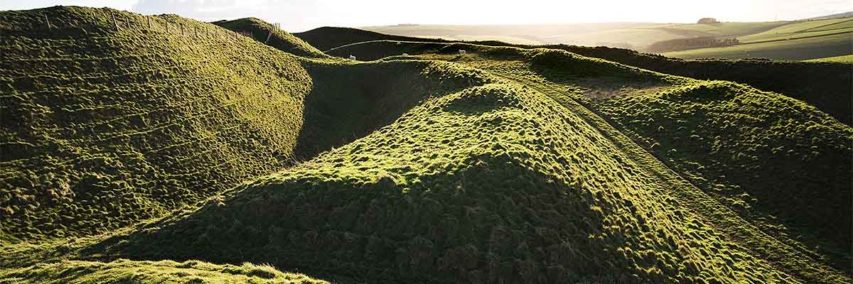
Maiden Castle in Dorset. View of the west gate and ramparts (English Heritage)
Some soar out of the landscape and have impressed tourists and inspired historians and artists for centuries, while others are tiny gems, tucked away on mountain or moor and are rarely visited.
For the first time, a detailed online atlas has drawn together the locations and particulars of the UK and Ireland’s hill forts and come to the conclusion that there are more than 4,000 of them, mostly dating from the iron age.
The project has been long and not without challenges. Scores of researchers – experts and volunteer hill fort hunters – have spent five years pinpointing the sites and collating information on them.
[…]
Sites such as Maiden Castle, which stretches for 900 metres along a saddle-backed hilltop in Dorset, are obvious. But some that have made the cut are little more than a couple of roundhouses with a ditch and bank. Certain hill forts in Northumbria are tiny and probably would not have got into the atlas if they were in Wessex, where the sites tend to be grander.
Many hill forts will be familiar, such as the one on Little Solsbury Hill, which overlooks Bath. But there are others, such as a chain of forts in the Clwydian Range in north-east Wales, that are not so well known. Many are in lovely, remote locations but there are also urban ones surrounded by roads and housing.
The online atlas and database will be accessible on smartphones and tablets and can be used while visiting a hill fort.
H/T to Jessica Brisbane for the link.
Comments Off on British and Irish Iron Age hill forts and settlements mapped in new online atlas
June 9, 2017
The Battle of Messines – Explosion Beneath Hill 60 I THE GREAT WAR Week 150
Published on 8 Jun 2017
In the early morning of June 7 the area around Messines Ridge is shattered by huge explosions beneath the German positions. Miners and sappers had dug tunnels and filled them up with tons of explosives. Up to 10,000 German soldiers are killed in this inferno. At the same time, the Romanian Army seems to be in shape for an attack against the Germans again and the 10th Battle of the Isonzo continues.
Comments Off on The Battle of Messines – Explosion Beneath Hill 60 I THE GREAT WAR Week 150
May 23, 2017
Top 10 Reasons the Byzantine Empire Was Among the Most Successful in History
Published on 2 May 2017
You’d see a lot of changes when looking at a map of present day Europe and comparing it to a 30 year old one. Belarus, Moldova, Ukraine and the Baltic States were all part of the USSR. Yugoslavia and Czechoslovakia were still states. Go back even further and the map looks even stranger. Putting all those different people under the same banner and keeping them that way was and still is next to impossible. Many have tried and most have failed, but the first to even come close were the Romans. Their inheritors, the Byzantines, managed to keep it together for over 1100 years, thus creating the longest-living Empire on the continent. Here’s how they did it.
Comments Off on Top 10 Reasons the Byzantine Empire Was Among the Most Successful in History
May 16, 2017
Exploring Fort Douaumont With The VERDUN Developers I THE GREAT WAR Special
Published on 15 May 2017
Join our Live Stream with the Developers: http://twitch.com/tgw_series
Check out Verdun: http://www.verdungame.com/We went to the Verdun area in France this winter and visited Fort Douaumont together with the developers of the video game VERDUN. They rebuilt the fort in their game and their knowledge of the sight shows when Indy is walking through the fort.
Comments Off on Exploring Fort Douaumont With The VERDUN Developers I THE GREAT WAR Special
April 16, 2017
Smoke Screens – Fortress Location – Recruitment Age I OUT OF THE TRENCHES
Published on 15 Apr 2017
Start your free Great Courses Plus trial today: http://ow.ly/z4VI30acl50
It’s time for Out Of The Trenches again where Indy answers your questions about World War 1, this week we talk about the recruitment age, smoke grenades and fortress locations.
Comments Off on Smoke Screens – Fortress Location – Recruitment Age I OUT OF THE TRENCHES
March 19, 2017
Byzantium, Persia and the rise of Islam
At The Declination, Dystopic explains why he’s fascinated by the untold stories of the sudden influx of Muslim armies from the Arabian peninsula that shattered the Persian Empire and nearly toppled the Byzantines in the 7th century:
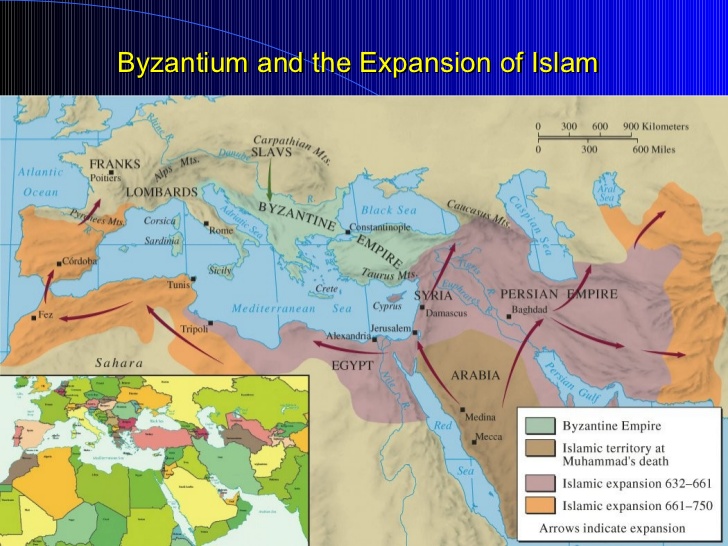
Image from World History Unit 4 Byzantium And Islam
In the course of perusing my backlinks, I discovered a little-known blog call the House of David. This one is fascinating because the author delves deeply into a topic which has bothered me for most my life: just how was it that Islam conquered Sassanian Persia and most of Byzantium more or less simultaneously? Normally this question is answered in the West, at least, by primarily Greek sources. Those are useful, yes, but only paint part of the picture. The proprietor of House of David seeks to answer the question from Persian and Arabic sources, also.
The strangeness of this event cannot be overstated. As successors to the Romans (or as Romans themselves, depending on how you account them), the Byzantines were masters of siege craft. Certainly the Theodosian walls impress well enough. Being consummate engineers of fortifications, Roman forts and walled cities dotted the empire, and for the most part, the Romans were excellent at defending them. The Byzantines continued the tradition of effective defense throughout most of their history, as they were under near-constant assault from all sides.
[…]
In some cases, of course, there was treachery from some of the Byzantines themselves, most notably in Egypt. But in other cases, such as the Exarchate of Africa, local Byzantine resistance was absolutely fierce. The wars in North Africa absolutely devastated the place. It never recovered after this. So complete was this devastation and desolation that Carthage, which bounced back even after the Romans razed it, never recovered from it. Even conquest by the Vandals had not been so terrible.
And still, after the Byzantines themselves lost much of North Africa, the native Christian Berbers continued to resist for some time under a supposed witch-queen named Kahina. And Byzantine resistance remained for a time around Cueta even after Carthage was destroyed, where the possibly-apocryphal Count Julian was said to have finally thrown in with the Muslims in order to avenge himself upon the Visigoths.
Yet the Arab steamroller moved on.
The final triumph of Byzantine siege craft could be seen in the twin Arab sieges of Constantinople, both beaten back effectively by the Byzantines. So why did they lose so completely everywhere else?
Comments Off on Byzantium, Persia and the rise of Islam
February 14, 2017
Fortress Ottawa, a post-War of 1812 alternative use for Parliament Hill
Colby Cosh linked to this Ottawa Citizen article by Andrew King:
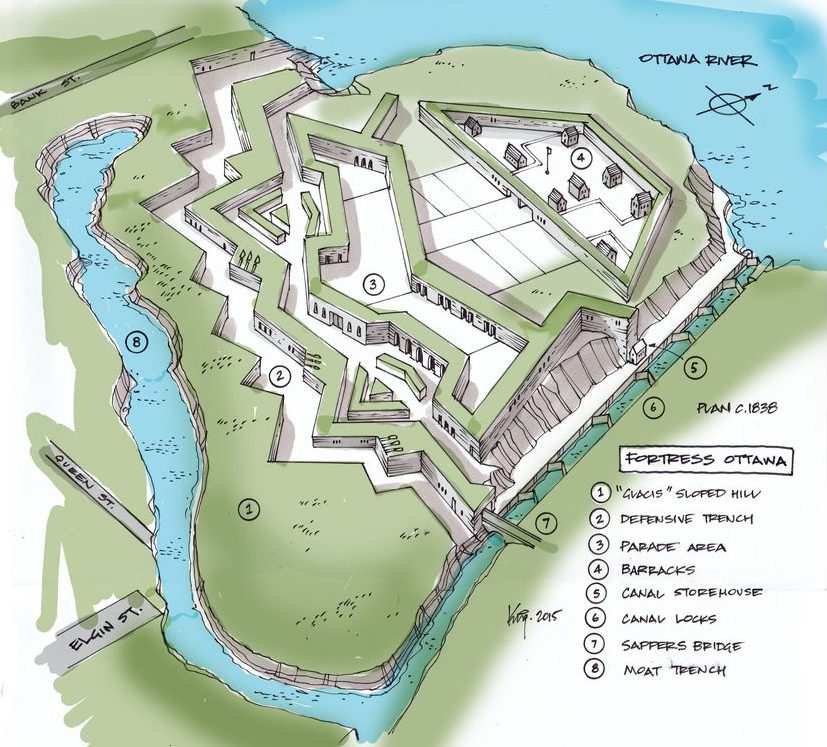
Mapped out with defensive moats, trenches and cannon placements, Bytown’s sprawling stone fortification on the hill was a typical 19th century “star fort,” similar to Fort George in Halifax, also known as Citadel Hill, and the Citadelle de Québec in Quebec City. The “star fort” layout style evolved during the era of gunpowder and cannons and was perfected by Sebastien Le Prestre de Vauban, a French engineer who studied 16th century forts designed by the Knights of Malta. A star fort built by the order with trenches and angled walls withstood a month-long siege by the Ottoman Empire. This layout remained the standard in fort design until the 20th century.
Ottawa’s planned fortress would have also integrated a water-filled moat trench to the south, where Laurier Street is now, to impede an attack. On the northern side, the natural limestone cliffs along the Ottawa River would have served as a defensive measure. Access and resupply points were at the canal near the Sappers Bridge, and a zigzagging trench with six-metre-high stone walls would have run parallel to Queen Street. Parliament Hill, with its gently sloping banks to the south, was called a “glacis” positioned in front of the main trench so that the walls were almost totally hidden from horizontal artillery attack, preventing point-blank enemy fire.
Conceptual image by Andrew King of the “alternate reality” where Fortress Ottawa came to be.
After the rebellions were quashed and the threat of an attack from the United States fizzled out by the mid-1850s, Canada abandoned plans to fortify Bytown.
In 1856, the Rideau Canal system was relinquished to civilian control, and three years later Bytown was selected as the capital of the Province of Canada. The grand plans for Ottawa’s massive stone fortress were shelved and the area that would have been Citadel Hill became the scene of a different kind of battle, that of politics.
Comments Off on Fortress Ottawa, a post-War of 1812 alternative use for Parliament Hill
February 7, 2017
The Hindenburg Line – Ludendorff’s Defence In Depth I THE GREAT WAR Special
Published on 6 Feb 2017
1916, the Year of Battles, had strained Germany’s resources everywhere but especially on the Western Front they needed to defend their captured territory against an ever growing number of Entente Forces. Erich Ludendorff decided to shorten the front line where possible and built a new “Defence In Depth” line: The Siegfried Line. This defensive network was supposed to grind the Entente forces down while freeing up more German resources.
Comments Off on The Hindenburg Line – Ludendorff’s Defence In Depth I THE GREAT WAR Special
January 31, 2017
QotD: Parts of the “Wild West” we won’t see on TV or in the movies
In the Nineties, a change began to take place. Reviewers and interviewers started describing Flashman (and me) as politically incorrect, which we are, though by no means in the same way.
This is fine by me. Flashman is my bread and butter, and if he wasn’t an elitist, racist, sexist swine, I’d be selling bootlaces at street corners instead of being a successful popular writer.
But what I notice with amusement is that many commentators now draw attention to Flashy’s (and my) political incorrectness in order to make a point of distancing themselves from it.
It’s not that they dislike the books. But where once the non-PC thing could pass unremarked, they now feel they must warn readers that some may find Flashman offensive, and that his views are certainly not those of the interviewer or reviewer, God forbid.
I find the disclaimers alarming. They are almost a knee-jerk reaction and often rather a nervous one, as if the writer were saying: “Look, I’m not a racist or sexist. I hold the right views and I’m in line with modern enlightened thought, honestly.”
They won’t risk saying anything to which the PC lobby could take exception. And it is this that alarms me – the fear evident in so many sincere and honest folk of being thought out of step.
I first came across this in the United States, where the cancer has gone much deeper. As a screenwriter [at which Fraser was almost as successful as he was with the 12 Flashman novels; his best-known work was scripting the Three Musketeers films] I once put forward a script for a film called The Lone Ranger, in which I used a piece of Western history which had never been shown on screen and was as spectacular as it was shocking – and true.
The whisky traders of the American plains used to build little stockades, from which they passed out their ghastly rot-gut liquor through a small hatch to the Indians, who paid by shoving furs back though the hatch.
The result was that frenzied, drunken Indians who had run out of furs were besieging the stockade, while the traders sat snug inside and did not emerge until the Indians had either gone away or passed out.
Political correctness stormed onto the scene, red in tooth and claw. The word came down from on high that the scene would offend “Native Americans”.
Their ancestors may have got pie-eyed on moonshine but they didn’t want to know it, and it must not be shown on screen. Damn history. Let’s pretend it didn’t happen because we don’t like the look of it.
I think little of people who will deny their history because it doesn’t present the picture they would like.
My forebears from the Highlands of Scotland were a fairly primitive, treacherous, blood-thirsty bunch and, as Robert Louis Stevenson once wrote, would have been none the worse for washing. Fine, let them be so depicted, if any film maker feels like it; better that than insulting, inaccurate drivel like Braveheart.
The philosophy of political correctness is now firmly entrenched over here, too, and at its core is a refusal to look the truth squarely in the face, unpalatable as it may be.
George MacDonald Fraser, “The last testament of Flashman’s creator: How Britain has destroyed itself”, Daily Mail, 2008-01-05.
Comments Off on QotD: Parts of the “Wild West” we won’t see on TV or in the movies
December 20, 2016
Exploring WW1 Forts in Ukraine I THE GREAT WAR Special
Published on 19 Dec 2016
Check out how Ryan explored the area of Przemysl: https://www.youtube.com/watch?v=9tRuMlWQiw0
We worked together with the Ukrainian authorities and got permission to film in some of the sub-forts of Przemsyl.
Comments Off on Exploring WW1 Forts in Ukraine I THE GREAT WAR Special
December 13, 2016
The Design of Przemyśl Fortress – Walking Through The Old Forts I THE GREAT WAR Special
Published on 12 Dec 2016
Thank you Tomasz Idzikowski for showing us Fort I and XV in great detail. Definitely check out his books if you speak Polish.
We spend several days in Przemyśl in August 2016 and took a walk through the well preserved forts around the city that you know from our show.
Comments Off on The Design of Przemyśl Fortress – Walking Through The Old Forts I THE GREAT WAR Special
December 12, 2016
Siege of Przemyśl – Summary I THE GREAT WAR Special
Published on 11 Dec 2016
This is the prologue of our episodes filmed at Przemyśl. Indy summarises all the events relevant to the two Sieges of Przemyśl and the battles in the region. In the next instalment we will dive into the details of the fort design and explore the live of the soldiers in the forts.
Comments Off on Siege of Przemyśl – Summary I THE GREAT WAR Special
November 8, 2016
Operational analysis: The Battle of the Pelennor Fields
The Angry Staff Officer analyzes the Battle of the Pelennor Fields (called by some the Battle of Minas Tirith) in terms of the six warfighting functions:
… Which leads me to my problem statement for this impromptu mission analysis that I am forcing you into: how did the forces of Gondor wage unified land operations versus the forces of Sauron at the Battle of Minas Tirith? More specifically, how can a primarily infantry force defend against a numerically superior enemy that possesses significant air assets, fires superiority, and freedom of movement and maneuver?
Couched in these terms, the problem statement resembles the complex situation faced by our brigade combat teams in a potential peer-to-peer engagement.
The situation – for those who do not remember it – is as follows: the forces of Gondor have been driven back from their forward defensive strongpoints along the Anduin River in the population center of Osgiliath. The withdrawal had been conducted in an orderly manner until the rear guard covering the retreat came under air attack by the Nazgul, which used their air superiority to drive the defenders into a panic. Most significantly, this air sortie wounded the primary land component commander, Faramir, depriving the forces of Gondor of their most effective warfighter.
More than 30,000 orcs and men of the forces of Sauron then enveloped the battle positions around Minas Tirith and began a siege of the 4,000 or so defenders of the city, which was primarily an infantry force with little in the way of cavalry or artillery. Significantly, the defenders possessed virtually no anti-air defenses, allowing the Nazgul freedom of movement around the battlefield – a dangerous proposition as the Nazgul also wielded considerable psychological damage (not unlike the sound of Stuka dive bombers in World War II). The greatest asset for Gondor was the wizard Gandalf – a force multiplier by any definition of the term – who was serving as the principle mission command adviser to Denethor. The objective for Gondor was to maintain their battle positions and hold out until reinforcements could arrive. However, lines of communication were cut during the siege and Gondor could not be sure that cavalry reinforcements from neighboring Rohan could arrive in time to save the city. This uncertainty weighed heavily on the forces of Gondor.
As a good staff officer, I turn to Army Doctrinal Publication 3-0, Unified Land Operations to understand the problem through the six warfighting functions. And given that J.R.R. Tolkien himself was a British signal officer during World War I, it would be appropriate to start out with mission command.
I imagine the author was grinning when he got to this section:
Luckily for Gondor, Gandalf then assumed command of all land forces, despite his position as a primary staff advisor to Denethor.
Yeah, that’s right, a staff officer took over operations.
Gandalf immediately provided vision and direction to the city’s defenders at a critical moment, as the forces of Sauron were conducting a breaching operation on the gates of Minas Tirith utilizing a battering ram named Grond. Arriving at the enemy point of breach, Gandalf rallied the forces in the engagement area, organized the defense, and directly opposed the primary enemy air and land component commander, the Witch-king of Angmar. The Witch-king was Sauron’s chief captain and commander of the Nazgul. Under his supervision, Sauron’s forces breached the main perimeter to the city and the Witch-king moved through the point of penetration into the far side of the breach, where he was confronted by Gandalf. The two land component commanders were prevented from close combat by the arrival of the primary maneuver element: the forces of Rohan.
H/T to John Donovan for the link.
Comments Off on Operational analysis: The Battle of the Pelennor Fields
July 17, 2016
Mission Tactics – Barbed Wire Placement I OUT OF THE TRENCHES
Published on 16 Jul 2016
Indy answers your questions about World War 1 again. In this week’s episode we talk about mission tactics, how to deal with your own barbed wire and what Indy is excited about in Battlefield 1.
Comments Off on Mission Tactics – Barbed Wire Placement I OUT OF THE TRENCHES


