
The domesticated horse is not native to the Americas. There is perhaps no more important fact when trying to understand how the horse-borne nomadic cultures of the Eurasian Steppe relate to those of the Great Plains. The first domesticated horses arrived in the Americans with European explorer/conquerors and the settler-colonists that followed them. Eventually enough of those horses escaped to create a self-reproducing wild (technically feral, since they were once domesticated) horse population, the mustangs, but they are not indigenous and mustangs were never really the primary source of new horses the way that wild horses on the Steppe were (before someone goes full nerd in the comments, yes I am aware that there were some early equines in the Americas at very early dates, but they were extinct before there was any chance for them to be domesticated).
Horses arrived in the Great Plains from the south via the Spanish and moving through Native American peoples west of the Rocky Mountains by both trade and eventually raiding in the early 1700s. Notably firearms also began moving into the region in the same period, but from the opposite direction, coming from British and French traders to the North and West (the Spanish had regulations against trading firearms to Native Americans, making them unavailable as a source). Both were thus initially expensive trade goods which could only be obtained from outside and then percolated unevenly through the territory; unlike firearms, which remained wholly external in their supply, horses were bred on the plains, but raiding and trade were still essential sources of supply for most peoples on the plains. We’ll get to this more when we talk about warfare (where we’ll get into the four different military systems created by this diffusion), but being in a position where one’s neighbors had either the horse or the gun and your tribe did not was an extreme military disadvantage and it’s clear that the “falling out” period whereby these two military innovations distributed over the area was very disruptive.
But unlike guns, which seem to have had massive military impacts but only minimal subsistence impacts (a bow being just as good for hunting bison as a musket, generally), the arrival of the horse had massive subsistence impacts because it made hunting wildly more effective. But the key thing to remember here is: the horse was introduced to the Great Plains no earlier than 1700, horse availability expanded only slowly over the area, but by 1877 (with the end of the Black Hills War), true Native American independence on the Great Plains was functionally over. Consequently, unlike the Steppe, where we have a fairly “set” system that had already been refined for centuries, all we see of the Plains Native American horse-based subsistence system is rapid change. There was no finally reached stable end state, as far as I can tell.
Though there is considerable variation and also severe limits to the evidence, it seems that prior to the arrival of the horse, most Native peoples around the Great Plains practiced two major subsistence systems: nomadic hunter-gathering on foot (distinct from what will follow in that it places much more emphasis on the gathering part) on the one hand and a mixed subsistence system of small-scale farming mixed seasonally with plains hunting seems to have been the main options pre-horse, based on the degree to which the local area permitted farming in this way (for more on those, note Isenberg, op. cit., 31-40). Secoy (op. cit.) notes that while there is some evidence that the Plains Apache may have shifted through both systems, being hunter-gatherers prior to the arrival of horses, by the time the evidence lets us see clearly (which is shortly post-horse) they are subsisting by shifting annually between sedentary agricultural racheirias (from the Spring to about August) and hunting bison on the plains during the fall. Isenberg notes the Native Americans of the Missouri river combining corn agriculture with cooperative bison hunting in the off-season (in that case, in the summer). Meanwhile, the Comanches and Kiowas seem to have mostly subsisted on pedestrian bison hunting along with gathering fruit and nuts, with relatively little agriculture, prior to going fully nomadic once they acquired horses. Bison hunting on foot required a lot of cooperation (so a group) and it seems clear that it was not enough to support a group on its own and had to be supplemented somehow, at least before the arrival of the horse. Some mix of either bison+gathering or bison+horticulture was required.
Isenberg argues (op. cit.), that at this point the clear advantage was to what he terms the “villagers” – that is the farmer-hunters who lived in villages, rather than the nomadic hunter-gathers. These horticulturists were more numerous and seem quite clearly to have had the better land and living conditions. Essentially the hunter-gatherers stuck on marginal land were mostly hunter-gatherers because they were stuck on marginal land, which created a reinforcing cycle of being stuck on marginal land (the group is weak due to small group size because the land is marginal and because the group is weak, it is only able to hold on to marginal lands). That system was stable without outside disruption. The horse changed everything.
A skilled Native American hunter on a horse, armed with a bow, could hunt bison wildly more effectively than on foot. They could be found more rapidly, followed at speed and shot in relative safety. It is striking that while pedestrian bison hunting was clearly a team effort, a hunter on a horse could potentially hunt effectively alone or in much smaller groups. In turn, that massively increased effectiveness in hunting allowed the Native Americans of the region, once they got enough horses, to go “full nomad” and build a subsistence system focused entirely on hunting bison, supplemented by trading the hides and other products of the bison with the (increasingly sedentary and agrarian) peoples around the edges of the Plains. Many of the common visual markers of Plains Native Americans – the tipi, the travois, the short bow for use from horseback – had existed before among the hunter-gathering peoples, but now spread wore widely as tribes took to horse nomadism and hunting bison full time. At the same time, Isenberg (op. cit. 50-52) has some fascinating paragraphs on all sorts of little material culture changes in terms of clothing, home-wares, tools and so on that changed to accommodate this new lifestyle. The speed of the shift is quite frankly stunning.
We’ll come back to this later, but I also want to note here that this also radically changed the military balance between the nomads and the sedentary peoples. The greater effectiveness of bison hunting meant that the horse nomads could maintain larger group sizes (than as hunter-gatherers, although eventually they also came to outnumber their sedentary neighbors, though smallpox – which struck the latter harder than the former – had something to do with that too), while possession of the horse itself was a huge military advantage. Thus by 1830 or so, the Ute and Comanche pushed the Apache off of much of their northern territory, while the Shoshone, some of the earliest adopters of the horse, expanded rapidly north and east over the Northern Plains, driving all before them (Secoy, op. cit., 30-31, 33). Other tribes were compelled to buy, raise or steal horses and adopt the same lifestyle to compete effectively. It was a big deal, we’ll talk about specifics later.
Bret Devereaux, “That Dothraki Horde, Part II: Subsistence on the Hoof”, A Collection of Unmitigated Pedantry, 2020-12-11.
July 30, 2022
QotD: The advent of horses and firearms on the North American plains
July 23, 2022
Some of the events that lead to the Dutch farmers’ revolt
In UnHerd, Senay Boztas provides a useful chronology of how the Netherlands government managed to piss off so many Dutch farmers, leading to the protests we are still seeing (even if the legacy media is doing their best to ignore it):
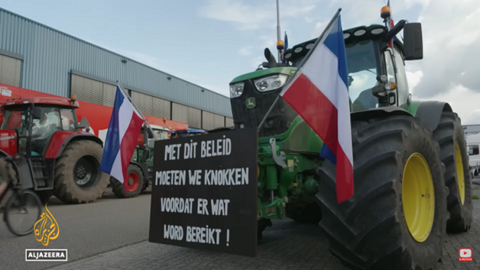
“For many farmers it’s the end of their business and they will fight until the last. Sometimes these farms go back generations, they were built by hand, and people feel farmers heart and soul. This is all being taken away.”
Jan Brok, vice chairman of the BoerBurgerBeweging (BBB) party, understands why Netherlands farmers have spent the past month blockading food distribution centres, roads and ministers’ driveways. They are horrified by a new environmental policy that will mean a likely 30% reduction in livestock.
The Netherlands is a country of four million cattle, 13 million pigs, 104 million chickens, and just over 17 million people. It is Europe’s biggest meat exporter with a total area of just over 41,000 square kilometres, and a fifth of this is water. It is one of the world’s most densely populated countries, with the EU’s highest density of livestock.
But there is a significant cost to this abundance: the local environmental impact. Such intensive agriculture, and livestock farming in particular, creates harmful pollution. Manure and urine mix to produce ammonia, and together with run-off from nitrogen-rich fertiliser on fields ends up in lakes and streams, where it can promote excessive algae that smothers other life. Manure here is not a vital fertiliser but a problem waste product.
For decades, this success in trade and agriculture has been accompanied by high emissions of harmful nitrogen compounds, including nitrogen oxides emitted by industry and transport. Levels were dropping, and in 2015, the Dutch introduced a “trading scheme” known as the Programmatische Aanpak Stikstof (PAS) to try to reduce the pollution.
But a Council of State court ruling in 2019 — on a case brought by two local environmental organisations against various farms — ruled that this offsetting scheme was invalid. Permission could not be granted for polluting projects or farm expansion in exchange for promised nitrogen-related reductions in the future: the reductions needed to come first.
The government panicked: national shutdowns were put in place, building projects were put on hold and traffic speeds reduced to 100 kph in the daytime on major roads; it was also obvious that farming was a problem — something needed to be done about all ammonia, nitrogen oxide and nitrous oxide emissions.
Then, in January, the conservative-liberal-Christian coalition pledged to halve nitrogen production by 2030, with a €25 billion budget to back it up. That money was the loud part. The quiet part included the possibility of expropriation, of the government forcibly purchasing farmland. Plans drawn up by civil servants include slashing livestock numbers by 30%. More than €500 million is being brought forward for regional government to buy out farmers this year and next.
Leading the charge among the coalition partners are the Democrats 66 (D66) party. They insisted on “real action for the climate” in their last manifesto. Tjeerd de Groot, the D66 nature and farming spokesman, pointed out that the Netherlands is Europe’s biggest nitrogen emitter, followed by Belgium and Germany. He told a current affairs programme last week: “It is absolutely essential — but also painful — that the plans go through.”
In June, the government published two documents. One: a map showing the areas that need to reduce emissions by between 12% and 95%. The second was a statement that aimed to help farmers — which De Groot admits failed spectacularly. Farmers saw ruin, not a pair of documents. They looked at the percentage reduction figures next to their farms, and began interpreting how many cattle they would need to cull. It was an enormous blow. Many of them had made huge, expensive investments in new equipment to reduce the environmental impact of their herds.
Hence the massive uprising.
July 22, 2022
Winemaking in the Middle Ages | The Process, Taste, Storage and Use
Kobean History
Published 31 Aug 2020
(more…)
July 21, 2022
Farmers’ protests against insane environment mandates continue in the Netherlands
For some unknown reason, the huge protests by Dutch farmers against ridiculous environment-protection rules seems to be getting almost no media coverage. As Rex Murphy pointed out in the National Post, if this was happening in Canada, the government would already have imposed the Emergencies Act and be actively depriving people of their civil rights across the board. Somehow, this protest is uninteresting to most of the legacy media, but as Brendan O’Neill explains, it is a huge deal:
This strange, sunny week has provided the best proof yet that the West’s elites have taken leave of their senses. That they have fully retreated from reason, and from reality itself. As farmers and workers across the world continue to rise up against the tyrannical consequences of climate-change alarmism, what are the elites doing? Engaging in yet more climate-change alarmism. Wringing their hands over the hot weather and its forewarning, as they see it, of the manmade heat-death of the planet that is apparently just around the corner. They continue to peddle the very politics of eco-dread that is whacking farmers and the working class and storing up problems for us all.
The contrast could not have been more stark. On one side we have farmers everywhere from Ireland to the Netherlands to, of course, Sri Lanka making it as plain as they can that the warped ideology of Net Zero will make it harder for them to produce the food that humanity needs. And on the other side we have the Net Zero fanatics of the upper middle classes continuing to push their dire, destructive green ideology. The heatwave proves we must cut emissions even faster and more severely, they tweet in their breaks from sunning themselves in their spacious gardens, even as farmers tell them that the zealous obsession with cutting emissions will make it harder to grow crops. So this is where we’re at – with a ruling class more invested in fact-lite narratives of apocalypse than in the basic responsibility of a society to make food.
This politics is best understood as luxury apocalypticism. It is clearer than it has been for a very long time that the fantasy of the end of the world, of marauding, industrious mankind polluting itself into oblivion, is something only the well-off and time-rich can afford to indulge. The dream of eco-doom is a simultaneously self-hating and self-serving political narrative. It expresses the elite’s turn against the very modernity they helped to create while also flattering their belief that only they can save us. That only their plans to slash emissions, to cut back on global travel and generally to shrink the “human footprint” can hold Armageddon at bay. The great benefit of the global revolt of farmers and workers is that it is injecting a truth and a realism into public discussion that might just help to push back the luxurious and ruinous ideologies of the new elites.
Everywhere, farmers are saying “Enough”. In the Netherlands farmers have been revolting for weeks against their government’s perverse demands that they slash their use of nitrogen compounds. The Dutch government, under pressure from the EU, has committed itself to cutting its nitrogen emissions in half by 2030. This would entail farmers getting rid of vast numbers of their livestock, crushing their ability to make a living and to produce what needs to be produced. So we have the truly surreal situation where Dutch farmers are protesting in their thousands for the right to feed the people of the Netherlands while the elites of the Netherlands demonise them, harass them and even shoot at them. I can think of no better illustration of the loss of logic and humanity within the modern elites than this strange spectacle.
July 8, 2022
Dutch government clearly has been cribbing notes from Justin Trudeau’s brownshirt tactics for dealing with unarmed protests
For such a big story, the revolt of the Dutch farmers doesn’t seem to be getting as much international coverage as you might expect … almost as though governments and the tame mainstream media are trying to hide it:
Whether it’s the Netherlands or Canada, the story is the same across the globe. Over the past several years, elitists occupying positions of power within governments have grown accustomed to imposing their will on ordinary citizens.
It doesn’t matter that they’re blatantly violating the social contract established by their own people. For the elitist, the only item on the agenda is maintaining power and dominion over the populace, whom they view as nothing more than subjects meant to obey their diktats without question.
Avoiding such power grabs, however, requires a vigilant citizenry, whose dedication to liberty must be stronger and more widespread than elitists’ devotion to tyranny. As witnessed during the Covid regime, compliance with the state gives birth to more draconian edicts, which only continue to erode the line between democracy and oligarchy.
Make no mistake, if the Dutch farmer protesters let their foot off the gas for one second, the state will not hesitate to shove their alarmist, degrowth policies down the people’s throats without remorse. Any form of surrender will likely continue to enable more overreaching policies, which will undoubtedly infringe upon the everyday lives of Dutch people.
The other day it was reported that police had opened fire on a tractor driven by a 16-year-old. Today, the young man was released from custody without charges:
Farmers’ protests in the Netherlands have reached the royal palace at Dam Square in Amsterdam. 16-year old Jouke, who was shot at by a police officer on Tuesday, was released without charges.
Opposition leader Geert Wilders released a bombshell letter showing the globalist Dutch government wants to use expropriated agricultural land for asylum centers.
Around 40,000 Dutch farmers paralyzed traffic in the Netherlands and blocked around 20 food distribution centers over the weekend with trucks and tractors. Yesterday the protests reached Dam Square in Amsterdam and the seat of government in The Hague. The airport in Groningen was blockaded by demonstrators on Wednesday, German farmers joined the protests in Heerenberg near the Dutch-German border.
In an incident near the blockaded food distribution center at Heerenveen in Friesland, police officers shot at 16-year-old Jouke’s tractor, which was already turning away from the roadblock, missing the boy’s head by an inch (Gateway Pundit reported). Jouke and two other protestors were arrested on suspicion of “attempted manslaughter” after which an angry crowd gathered in front of the police station in Leeuwarden. All three have now been released without charges.
A farmer in Leeuwarden told Canadian journalist Keean Bexte that the Rutte government had “created a climate where the police think they can shoot”. Dutch farmers are being dispossessed and committing suicide, the protester said, while China, for example, fails to meet any environmental regulations.
[…]
Sky News Australia host Rowan Dean compared the Dutch police tactics to the violent quashing of Canadian trucker protests by uparmored riot police, calling Premiers Trudeau and Marc Rutte the “golden pin-up boys for Klaus Schwab and the globalist fantasists of the World Economic Forum.”
“The similarities between Canada and Holland are as startling as they are disturbing,” Dean said. “Only a few months ago, it was the Canadian government that attacked its own citizens in the most grotesque and terrifyingly authoritarian manner during the so-called Truckers’ Convoy when the government actually froze the bank accounts and basically starved out any individuals in what was legitimate peaceful democratic opposition to Covid (vaccine) mandates. That ended badly for Trudeau.”
At the World Economic Forum in Davos 2021, Dutch PM Marc Rutte had boasted about “Holland’s involvement with the World Economic Forum’s Global Food Innovation Hubs, which is busily ‘transforming food systems and land use'”, Dean said.
At Ace of Spades H.Q., J.J. Sefton had this to say about the protests and the repressive measures taken by the Dutch and Canadian governments toward peaceful protestors:
Mind you, this is in Holland. I’m no ethnographer, but the Netherlands is a country and people that are about as liberal, peaceful and secular as they come. Like many other European nations, they atoned for the collective guilt over what happened to its Jews during the war (among other things) by opening its borders to a massive influx of Muslim immigrants with predictable results. Strange how what happened to Theo Van Gogh was all but ignored and someone like Geert Wilders is vilified. Yet with this green madness, somehow the people have woken up to the Globalist/EU wolf at their throat. The Dutch government’s response? Crush the farmers. You have to wonder what the reaction would have been had most or even some of them had been Muslim? Meh, Muslims don’t farm. But, think about it. This is Holland. Not North Korea, Cuba, Venezuela or Iran. Holland. A supposedly enlightened European democratic society that imposes its will on people and sets the water cannon and tear gas on them for daring to object.
Well, look at Canada only a few short months ago. In the wake of the truckers’ convoy protest over forced injections, how did Justin Castreau-cescu react? Arrests, confiscation of vehicles and bank accounts, among other things. Cana-fucking-da. Now look at what that maple syrup sucking hoser is up to:
The Canadian government is funding a booklet being sent to schools across the country that teaches children to be wary of people who champion “free speech.”
Yes, really.
It’s a Paul Joseph Watson video, hence the short quote. But it says it all. Holland is no longer Holland. Canada is no longer Canada and America is no longer America. You know it. They know it. The forces that hijacked those governments and societies know it. The question is not do they know that we know? Of course they know we know. Yet they are betting the farm that we are not going to do a damned thing about it. So, okay, J.J. What about this “optimism” thing? In a sense, as Dave in FL and CBD talked about, I am optimistic in that I understand that what cannot go on will not go on. And this crap for sure cannot go on.
In Spiked, Brendan O’Neill comments on the lack of interest among the people you’d expect to be most vocal in support of working people protesting against out-of-touch, arrogant elites:
If police were opening fire on protesters in a European nation, we would have heard about it, right? If there was a mass uprising of working people in a European Union country, taking to the streets in their thousands to cause disruption to roads, airports and parliament itself, it would be getting a lot of media coverage in the UK, wouldn’t it? The radical left would surely say something, too, given its claims to support ordinary people against The System. Cops shooting at working men and women whose only crime is that they pounded the streets to demand fairness and justice? There would be solidarity demos in the UK, for sure.
Well, all of this is happening, right now, in a nation that’s just an hour’s flight from Britain, and the media coverage here is notable by its absence. As for the left in Britain and elsewhere in Europe – there’s just silence. This is the story of the revolting Dutch farmers. These tractor-riding rebels have risen up against their government and its plans to introduce stringent environmental measures that they say will severely undermine their ability to make a living. They have been protesting for a couple of years now, but their fury has intensified in recent weeks. They’ve blocked motorways, blocked roads to airports, set fire to bales of hay, and descended on The Hague. Things are so serious that yesterday, in the province of Friesland, police opened fire. Mercifully, no one was injured.
There has been some reportage outside of the Netherlands, of course. But it has been strikingly muted. And it isn’t hard to see why. This is a people’s revolt against eco-tyranny, against the modern elite’s determination to slash “harmful” emissions with little regard for the consequences such action will have for working people and poor people. To the formers of elite consensus opinion, for whom environmentalism is tantamount to a religion, the sight of pesky little people rebelling against green diktats is too much to bear. So they either demonise these dissenters, as is happening in the Netherlands, or they ignore them in the hope they will go away, as is happening outside the Netherlands.
The farmers have a very good case. Their concern is that the government’s plans for slashing greenhouse gases will hit farming – and other industries – very hard indeed. The targets, introduced last month, commit the Netherlands to halving its use of nitrogen compounds by 2030. The government says emissions of nitrogen oxide and ammonia, both of which emanate from livestock, will need to be drastically cut. This will entail farmers getting rid of vast numbers of their livestock, potentially devastating their livelihoods. Fishermen are concerned, too. As of next year, fishing permits will be given out on the basis of the eco-friendliness of the trawler the fisherman is using, and many are worried that they’ll end up permit-less, unable to earn a living. They have blocked harbours in solidarity with the farmers. The construction industry could also suffer. Courts have blocked numerous infrastructure projects on the basis that the emissions they cause will breach the new eco-rules.
July 6, 2022
The ongoing protests by Dutch farmers demand your attention
Protests in many countries in the western world can get violent and even be claimed (by the targets of the protest) to be “insurrections”, but protests in the Netherlands always have more of an edge to them than elsewhere, because when the Dutch really get angry they have, in the past, gone so far as to kill AND EAT their prime minister. The current protests haven’t gone that far yet, but politicians should keep in mind that Dutch farmers can react primally to being treated in the way the Soviets treated the kulaks:
This is really important – you know, on the level of “pay attention or your food supply is next”.
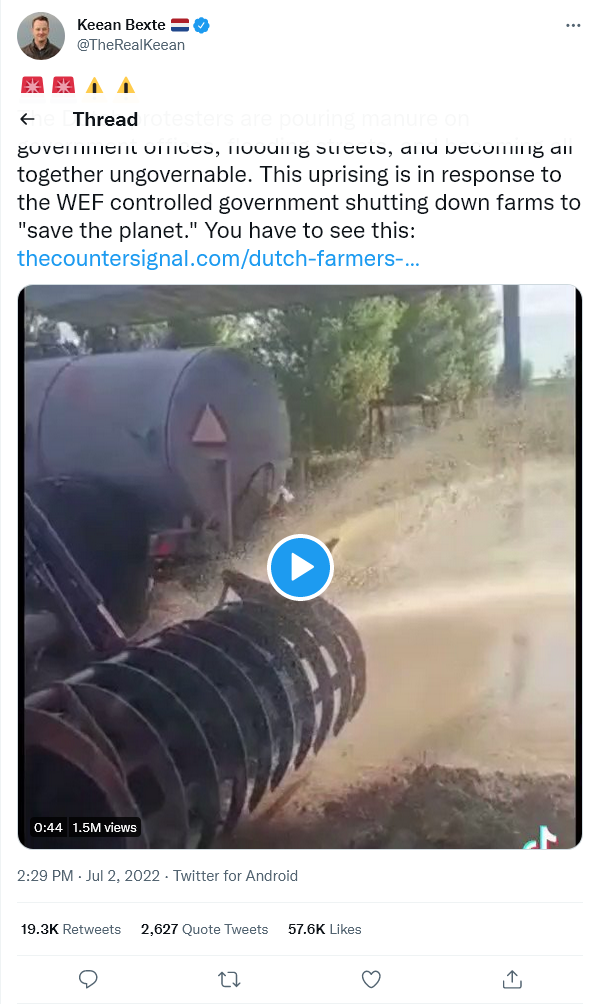
We reported last week that Dutch farmers were attacking government vehicles, blocking roads, and dumping manure on government buildings in response to a new “climate” policy that shut down numerous family farms because their cows were farting too much.
These farmers are now banned from working their own land to feed their families.
Let me explain what’s happening and why it is of the utmost importance as I randomly drop in videos of what the Dutch farmers are doing to keep your attention.
Unelected elites at the World Economic Forum, World Bank, United Nations, and BlackRock think us little people are rodents that are polluting the Earth, and that it’s their job to cull us and tame us so we can follow their smartypants amazingness into what is obviously a glorious future.
These elites get corporations to fall in line by promoting “Environmental-Social-Governance” metrics (a scorecard, if you will) that shows how many woke policies a company is adopting. Do they have a climate pledge? Are they hiring based on skin color, gender, and sexual fetish? Do they fly a rainbow flag over their headquarters? Do they have at least a few dozen “equity” executives to make sure everyone is a good little Marxist?
Companies lose customers by joining this radical, perverse cult, but they get access to the trillions of dollars represented by the elites and the corrupt organizations, from the WEF to the WHO to the mega-investment firms. They don’t care if you boycott them because they are expecting to simply outlast you.
The elites then get governments to fall in line by lobbying, pushing big money into local elections, and taking over school boards and classrooms to ensure good little disciples are being churned out to vote for the right people. They get young people riled up, telling them the planet is burning and that unarmed black men are yelling “Hands up, don’t shoot!” while being gunned down by racist white cops in the streets. Good people watch as their cities burn and politicians bail out the rioters.
June 13, 2022
QotD: Helot women in Sparta
And I want to stress the importance of this question, because there are more helot women in Sparta than there are free humans in Sparta (as from last time, around 15% of Sparta is free – men and women both included – but 42.5% of Sparta consists of enslaved helot women). If we want to say absolutely anything about the condition of life in Sparta, we simply cannot ignore such a large group of human beings living in Sparta.
And our sources here let us down catastrophically. There are, to my knowledge, no passages anywhere in the corpus of ancient literature which are actually about helot women, and every passage that mentions them could be included on a single typed page with space to spare. But that is no excuse to pretend they do not exist, and we are going to talk about them.
As far as we can tell, family structure and labor roles among the helots approximated what we see in the rest of Greece. Once freed, the Messenian helots establish a fairly normal polis in Messenia, so it hardly seems like they had some radically different social makeup. That gives us the beginnings of sketching out what life might have been like for a helot woman: we can then take the handful of things we know that are peculiar about their circumstances and combine them with what we know about the normal structure of life for ancient Greek peasant families.
The primary economic occupation of helot women was probably in food preparation and textile production. And if I know my students, I know that the moment I start talking about the economic role of women in ancient households, a very specific half of the class dozes off. Wake Up. There is an awful tendency to see this “women’s work” as somehow lesser or optional. These tasks I just listed are not economically marginal, they are not unimportant. Yes, our ancient sources devalue them, but we should not.
First: let’s be clear – women in ancient households (or early modern households, or modern households) were not idle. They had important jobs every bit as important as the farming, which had to get done for the family to survive. I’ve estimated elsewhere that it probably takes a minimum of something like 2,220 hours per year to produce the minimum necessary textile goods for a household of five (that’s 42 hours a week spinning and weaving, every week). Most of that time is spent spinning raw fibers (either plant fibers from flax to make linen, or animal fibers from sheep to make wool). The next step after that is weaving those threads into fabric. Both weaving and spinning are slow, careful and painstaking exercises.
Food preparation is similarly essential, as you might imagine. As late as 1900, food preparation and cleanup consumed some 44 hours per week on average in American households, plus another 14 hours dedicated to laundry and cleaning (Lebergott, Pursuing Happiness (1993)). So even without child rearing – and ask any parent, there is a TON of work in that – a small peasant household (again, five members) is going to require something like 100 hours per week of “woman’s work” merely to sustain itself.
Now, in a normal peasant household, that work will get split up between the women of the house at all ages. Girls will typically learn to spin and weave at very young ages, at first helping out with the simpler tasks before becoming fully proficient (but of course, now add “training time” as a job requirement for their mothers). But at the same time (see Erdkamp, The Grain Market in the Roman Empire (2005) on this) women often also had to engage in agricultural labor during peak demand – sowing, harvesting, etc. That’s a lot of work to go around. Remember, we’re positing a roughly five-individual household, so those 100 hours may well be split between only two people (one of whom may be either quite old or quite young and thus not as productive).
In short: these tasks, when combined with all of the other demands, is very much a full time job and then some. It’s also a job that someone very much needs to do if the family is to survive.
We can assume that these demands, along with marriage, the bearing and raising children, and religious rituals and festivals, likely shaped the contours of the lives of helot women, much as they would have for many poor women in the Greek (or Roman) countryside. But the Spartan system also shapes these contours and it does so in almost entirely negative ways.
Let’s start [with] textiles. Spartiate women do not engage in textile manufacture (Xen. Lac. 1.4) as noted previously, nor do they seem (though the evidence here is weaker) to engage in food preparation. In the syssitia, at least, the meals are cooked and catered by helot slaves (Plut. Lyc. 12.5, 12.7). In the former case, we are told explicitly by Xenophon that it is slave labor (he uses the word doule, “female slave”, which clearly here must mean helot women) which does this. So helot women now have an additional demand on their time and energy: not only the 2,200 hours for clothing their own household, but even more clothing the spartiate household they are forced to serve. If we want to throw numbers at this, we might idly suppose something like five helot households serving one spartiate household, suggesting something like a 20% increase in the amount of textile work. We are not told, but it seems a safe bet that they were also forced to serve as “domestics” in spartiate households. That’s actually a fairly heavy and onerous imposition of additional labor on these helot women who already have their hands full.
We also know […] that helot households were forced to turn over a significant portion of their produce, perhaps as high as half. I won’t drag you all through the details now – I love agricultural modeling precisely because it lets us peek into the lives of folks who don’t make it into our sources – but I know of no model of ancient agriculture which can tolerate that kind of extraction without bad consequences. And I hear the retort already coming: well, of course it couldn’t have been that bad, because there were still helots, right? Not quite, because that’s not how poor farming populations work. It can be very bad and still leave you with a stable – but miserable – population.
Bret Devereaux, “Collections: This. Isn’t. Sparta. Part III: Spartan Women”, A Collection of Unmitigated Pedantry, 2019-08-29.
May 30, 2022
Technocratic meddling in developing countries at the local level
One of the readers of Scott Alexander’s Astral Codex Ten has contributed a review of James Ferguson’s The Anti-Politics Machine. The reviewer looked at a few development economics stories that illustrate some of the more common problems western technocrats encounter when they provide their “expert advice” to people in developing countries. This is one of perhaps a dozen or so anonymous reviews that Scott publishes every year with the readers voting for the best review and the names of the contributors withheld until after the voting is finished:
But even if the project was in some sense a “failure” as an agricultural development project, it is indisputable that many of its “side effects” had a powerful and far-reaching impact on the Thaba-Tseka region. […] Indeed, it may be that in a place like Mashai, the most visible of all the project’s effects was the indirect one of increased Government military presence in the region
As the program continued to unfold, the development officials became more and more disillusioned — not with their own choices, but with the people of Thaba-Tseka, who they perceived as petty, apathetic, and outright self-destructive. A project meant to provide firewood failed because locals kept breaking into the woodlots and uprooting the saplings. An experiment in pony-breeding fell apart when “unknown parties” drove the entire herd of ponies off of cliffs to their deaths. Why, Ferguson’s official contacts bemoaned, weren’t the people of Thaba-Tseka committed to their own “development”?
Who could possibly be opposed to trees and horses? Perhaps, the practitioners theorized, the people of Thaba-Tseka were just lazy. Perhaps they “didn’t want to be better”. Perhaps they weren’t in their right mind or had made a mistake. Perhaps poverty makes a person do strange things.
Or, as Ferguson points out, perhaps their anger had something to do with the fact that the best plots of land in the village had been forcibly confiscated to make room for wood and pony lots, without any sort of compensation. The central government was all too happy to help find land for the projects, which they took from political enemies and put in the control of party elites, especially when it could use a legitimate anti-poverty program as cover. In Ferguson’s words, the development project was functioning as an “anti-politics machine” the government could use to pretend political power moves were just “objective” solutions to technical problems.
A local student’s term paper captured the general discontent:
In spite of the superb aim of helping the people to become self-reliant, the first thing the project did was to take their very good arable land. When the people protested about their fields being taken, the project promised them employment. […] It employed them for two months, found them unfit for the work, and dismissed them. Without their fields and without employment they may turn up to be very self-reliant. It is rather hard to know.
Two things stand out to me from this story. First, the “development discourse” lens served to focus the practitioners’ attention on a handful of technical variables (quantity of wood, quality of pony), and kept them from thinking about any repercussions they hadn’t thought to measure.
This is a serious problem, because “negative effects on things that aren’t your primary outcome” are pretty common in the development literature. High-paying medical NGOs can pull talent away from government jobs. Foreign aid can worsen ongoing conflicts. Unconditional cash transfers can hurt neighbors who didn’t receive the cash. And the literature we have is implicitly conditioned on “only examining the variables academics have thought to look at” — surely our tools have rendered other effects completely invisible!
Second, the project organizers somewhat naively ignored the political goals of the government they’d partnered with, and therefore the extent to which these goals were shaping the project.
Lesotho’s recent political history had been tumultuous. The Basotho Nationalist Party (BNP), having gained power upon independence in 1965, refused to give up power after losing the 1970 elections to the Basotho Congress Party (BCP). Blaming the election results on “communists”, BNP Prime Minister Leabua Jonathan declared a state of emergency and began a campaign of terror, raiding the homes of opposition figures and funding paramilitary groups to intimidate, arrest, and potentially kill anyone who spoke up against BNP rule.
This had significant effects in Thaba-Tseka, where “villages […] were sharply divided over politics, but it was not a thing which was discussed openly” due to a fully justified fear of violence. The BNP, correctly sensing the presence of a substantial underground opposition, placed “development committees” in each village, which served primarily as local wings of the national party. These committees spied on potential supporters of the now-outlawed BCP and had deep connections to paramilitary “police” units.
When the Thaba-Tseka Development Project started, its international backers partnered directly with the BNP leadership, reasoning that sustainable development and public goods provision could only happen through a government whose role they primarily viewed as bureaucratic. As a result, nearly every decision had to make its way through the village development committees, who used the project to pursue their own goals: jobs and project funds found their way primarily to BNP supporters, while the “necessary costs of development” always seemed to be paid by opposition figures.
The funding coalition ended up paying for a number of projects that reinforced BNP power, from establishing a new “district capital” (which conveniently also served as a military base) to constructing new and better roads linking Thaba-Tseka to the district and national capitals (primarily helping the central government tax and police an opposition stronghold). Anything that could be remotely linked to “economic development” became part of the project as funders and practitioners failed to ask whether government power might have alternate, more concerning effects.
As we saw earlier, the population being “served” saw this much more clearly than the “servants”, and started to rebel against a project whose “help” seemed to be aimed more at consolidating BNP control than meeting their own needs. When they ultimately resorted to killing ponies and uprooting trees, project officials infatuated with “development” were left with “no idea why people would do such a thing”, completely oblivious to the real and lasting harm their “purely technical decisions” had inflicted.
May 14, 2022
QotD: The farming cycle in pre-modern Mediterranean cultures
The seasonal patterns vary a bit depending on the conditions and the sort of wheat being sown. In much of the Mediterranean, where the main concern was preserving a full year’s moisture for the crop, planting was done in autumn (November or October) and the crop was harvested in early summer (typically July or August). In contrast, the Han agricultural calendar for wheat planted in the spring, weeded over the summer and harvested in fall. The Romans generally kept to the autumn-planting schedule, except our sources note that on land which was rich enough (and wet enough) to be continuously cropped year after year (without a fallow), the crop was sown in spring; this might also be done in desperation if the autumn crop had failed. In Egypt, sowing was done as the Nile’s flood waters subsided at the beginning of Peret (in January), with the harvest taking place in Shemu (summer or early fall).
(As an aside on the seasons: we think in terms of four seasons, but many Mediterranean peoples thought in terms of three, presumably because Mediterranean winters are so mild. Thus the Greeks have three goddesses of the seasons initially, the Horae (spring, summer and fall) and Demeter’s grief divides the year into thirds not fourths in the Homeric Hymn to Demeter. In ancient Egypt, there were three seasons: Akhet (Flood); Peret (Emergence [of fertile lands as the waters recede]) and Shemu (Low Water). The perception of the seasons depended on local climate and local cycles of agriculture.)
Bret Devereaux, “Collections: Bread, How Did They Make It? Part I: Farmers!”, A collection of Unmitigated Pedantry, 2020-07-24.
April 2, 2022
QotD: The pre-modern farming household
At the same time that households were large (by modern standards), the farms they tilled were, by modern standards, very small. The normal size of a Roman household small farm is generally estimated between 5 and 8 iugera (a Roman measurement of land, roughly 3 to 5 acres); in pre-Han Northern China (where wheat and millet, not rice, were the staple crops), the figure was “one hundred mu (4.764 acres)” – essentially the same. In Languedoc, a study of Saint-Thibery in 1460 showed 118 households (out of 189) on farms of less than 20 setérée (12 acres or so; the setérée appears to be an inexact unit of measurement); 96 of them were on less than 10 setérée (about 6 acres). So while there is a lot of variation, by and large it seems like the largest cluster of household farms tend to be around 3 to 8 acres or so; 5 acre farms are a good “average” small farm.
This coincidence of normal farm size and family size is not an accident, but essentially represents multi-generational family units occupying the smallest possible farms which could support them. The pressures that produce this result are not hard to grasp: families with multiple children and a farm large enough to split between them might do so, while families without enough land to split are likely to cluster around the farm they have. Pre-modern societies typically have only limited opportunities for wage labor (which are often lower status and worse in conditions than peasant farming!), so if the extended family unit can cluster on a single farm too small to split up, it will (with exception for the occasional adventurous type who sets off for high-risk occupations like soldier or bandit).
Now to be clear that doesn’t mean the farm sizes are uniform, because they aren’t. There is tremendous variation and obviously the difference between a 10 acre small farm and a 5 acre small farm is half of the farm. Moreover, in most of the communities you will have significant gaps between the poor peasants (whose farms are often very small, even by these measures), the average peasant farmer, and “rich peasants” who might have a somewhat (but often not massively so) larger farm and access to more farming capital (particularly draft animals). […] Nevertheless, what I want to stress is that these fairly small – 3-8 acres of so – farms with an extended family unit on it make up the vast majority of farming households and most of the rural population, even if they do not control most of the land (for instance in that Languedoc village, more than half of the land was held by households with more than 20 setérée a piece, so a handful of those “rich peasants” with larger accumulations effectively dominated the village’s landholding […]).
This is our workforce and we’re going to spend this entire essay talking about them. Why? Because these folks – these farmers – make up the majority of the population of basically all agrarian societies in the pre-modern period. And when I say “the majority” I mean the vast majority, on the order of 80-90% in many cases.
Bret Devereaux, “Collections: Bread, How Did They Make It? Part I: Farmers!”, A collection of Unmitigated Pedantry, 2020-07-24.
March 17, 2022
Irish Stew From 1900 & The Irish Potato Famine
Tasting History with Max Miller
Published 16 Mar 2021Help Support the Channel with Patreon: https://www.patreon.com/tastinghistory
Tasting History Merchandise: crowdmade.com/collections/tastinghistoryFollow Tasting History here:
Instagram: https://www.instagram.com/tastinghist…
Twitter: https://twitter.com/TastingHistory1
Tiktok: TastingHistory
Reddit: r/TastingHistory
Discord: https://discord.gg/d7nbEpyLINKS TO INGREDIENTS & EQUIPMENT**
Sony Alpha 7C Camera: https://amzn.to/2MQbNTK
Sigma 24-70mm f/2.8 Lens: https://amzn.to/35tjyoW
Le Creuset Cast Iron Round Casserole: https://amzn.to/2N5rTJKLINKS TO SOURCES**
Tamales Video: https://www.youtube.com/watch?v=s2JyN…
Quesadilla Video: https://www.youtube.com/watch?v=NPxjQ…
The History of the Great Irish Famine of 1847 by John O’Rourke: https://amzn.to/3qCM8fD
Great Irish Potato Famine: https://amzn.to/3kZg58j**Some of the links and other products that appear on this video are from companies which Tasting History will earn an affiliate commission or referral bonus. Each purchase made from these links will help to support this channel with no additional cost to you. The content in this video is accurate as of the posting date. Some of the offers mentioned may no longer be available.
Subtitles: Jose Mendoza
PHOTO CREDITS
Saint Patrick Catholic Church: By Nheyob – Own work, CC BY-SA 4.0, https://commons.wikimedia.org/w/index…
Kindred Spirits: By Gavin Sheridan – Own work, CC BY-SA 4.0, https://commons.wikimedia.org/w/index…MUSIC CREDITS
“Fiddles McGinty” by Kevin MacLeod is licensed under a Creative Commons Attribution 4.0 license. https://creativecommons.org/licenses/…
Source: http://incompetech.com/music/royalty-…
Artist: http://incompetech.com/“Achaidh Cheide – Celtic” by Kevin MacLeod is licensed under a Creative Commons Attribution 4.0 license. https://creativecommons.org/licenses/…
Source: http://incompetech.com/music/royalty-…
Artist: http://incompetech.com/#tastinghistory #stpatricksday #ireland
March 14, 2022
Roman Republic to Empire 04 Slavery in the Roman Republic and Empire
seangabb
Published 5 Feb 2021[Update 2023-03-02 – Dr. Gabb took down the original posts and re-uploaded them.]
Here is the fourth lecture, which discusses the nature and extent of slavery in the Roman Empire. It begins with legal definitions and the attempted justifications by philosophers, then proceeds, via the use of slaves as workers in all occupations, including as sex objects, to the great slave revolts of the Late Republic. There is also a section on the valuation of slaves.
In this series, Sean Gabb will explain how the Roman Constitution was transformed, in just over a century, from an oligarchical republic with strong elements of democracy to a divine right military dictatorship.
(more…)
March 11, 2022
New Rome by Paul Stephenson
In The Critic, Daisy Dunn reviews a new history of the Eastern Roman Empire (called the Byzantine Empire by later scholars) that sounds quite interesting:

[Paul] Stephenson, a prolific scholar of Byzantium, has a wonderfully sharp eye for data and detail. His book examines the journey by which the Roman Empire progressed from being ruled from several different cities in the fifth century, among them Alexandria, Antioch, Constantinople and Rome itself, to just Constantinople, home to Procopius, and the “New Rome” of the book’s title.
I sat down expecting a narrative history of the fall of Rome, but was pleasantly surprised to find a portrait of the changing empire populated by statistics and technical hypotheses of a kind one would usually encounter in a copy of the Economist. The first ten pages alone contain references to cosmogenic radionuclides, the Maunder Minimum and the Early Anthropocene. I confess I needed a dictionary.
It is hard to think of another historian who applies such a scientific approach to ancient history, except perhaps the Stanford professor Josiah Ober, who has applied political theory and modern economic modelling to information garnered from classical sources to equally eye-opening effect. The terminology is not off-putting because Stephenson proves able to weave it succinctly and fluidly into his account of how the Late Empire functioned.
Constantinople, formerly Byzantium, was the principal base of the emperors from Theodosius I (“The Great”) in the final quarter of the fourth century onwards. The city was beautified with a wide variety of art and architecture, including the famous Egyptian obelisk, the arrival of which in the late fourth century is seemingly as mysterious as the appearance of the monolith in 2001: A Space Odyssey.
[…]
Attempts to answer the time-old question of why Rome fell have been characterised in recent years by a new awareness of the role that factors including pollution and climate change played. Anyone who has shrugged at the suggestion that the weather had anything to do with the demise of such a mighty empire will, I think, come away from this book persuaded that climate change and natural disasters provide an important part of the answer. Far from being moralistic and attempting to apply the examples of the past as a warning, Stephenson lays down the evidence unemotionally, and lets it speak for itself.
The causes of change were not purely driven by human behaviour, though smelting and, even more so, heavy warfare in the era of invading Huns and Vandals, had a significant environmental impact. Pollen records reveal a dramatic decline in the growing of cereals in Greece by about 600AD and, from the seventh century, pollination was happening predominantly through nature rather than agriculture.
The root cause of this was the destruction of arable land following invasions and the decline in human settlements. Add to this diminishing sunlight — measurements of “deposited radionuclides” indicate a significant reduction of light between the midfourth and late seventh centuries — and we are looking at a radically different landscape in this period from that of the High Empire.
Natural disasters (or were they?) also played a part. The later fifth and early sixth centuries witnessed a number of major volcanic eruptions. Vesuvius, which famously buried Pompeii when it awoke from seven centuries of dormancy in 79AD, erupted in 472 and 512, bookending, as Stephenson notes, the overthrow of the last Roman emperor, Romulus Augustulus.
March 7, 2022
QotD: Historical fiction and fantasy works usually leave out the vast majority of the people who did all the work
But the actual human landscape of the pre-modern period was defined – in agrarian societies, at least – by vast numbers of farms and farmers. Their work proceeded on this cyclical basis, from plowing to sowing to weeding to harvesting and threshing to storage and then back again. Religious observances and social festivals were in turn organized around that calendar (it is not an accident how many Holy Days and big festivals seem to cluster around the harvest season in late Autumn/early Winter, or in Spring). The uneven labor demands of this cycle (intense in plowing and reaping, but easier in between) in turn also provided for the background hum of much early urban life, where the “cities” were for the most part just large towns surrounded by farmland (where often the folks living in the cities might work farmland just outside of the gates). People looked forward to festivals and events organized along the agricultural calendar, to the opportunities a good harvest might provide them to do things like get married or expand their farms. The human drama that defines our lives was no less real for the men and women who toiled in the fields or the farmhouses.
And of course all of this activity was necessary to support literally any other kind of activity.
Bret Devereaux, “Collections: Bread, How Did They Make It? Part III: Actually Farming”, A Collection of Unmitigated Pedantry, 2020-08-06.
February 28, 2022
Roman Republic to Empire 03 Inequality and Corruption
seangabb
Published 5 Feb 2021[Update 2023-03-02 – Dr. Gabb took down the original posts and re-uploaded them.]
Here is the third lecture, which describes the decay of the Roman Constitution as a result of changes in patterns of land tenure in Italy after the Second Punic War, and as a result of the flood of foreign money into Rome from military victories and war indemnities and bribes.
(more…)


