
World War Two
Published 26 Aug 2021Brazilian President, Getúlio Vargas, has led his country as dictator since the 1930s. He has embraced European fascist ideas and fostered close ties with Germany and Italy. Yet, he also maintains a close relationship with the United States. After skilfully playing both sides, he must now choose Axis or Allies.
(more…)
August 27, 2021
On Which Side is Brazil? – WW2 Special
Comments Off on On Which Side is Brazil? – WW2 Special
August 10, 2021
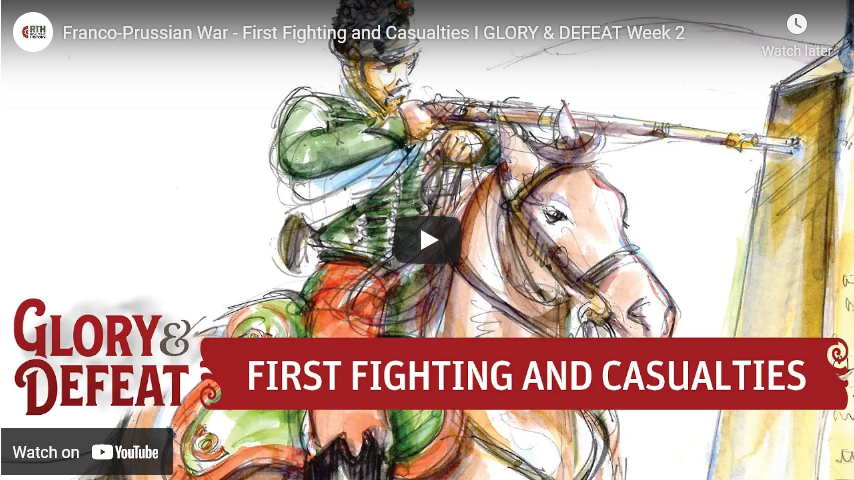
Franco-Prussian War – First Fighting and Casualties I GLORY & DEFEAT Week 2
realtimehistory
Published 22 Jul 2021Support Glory & Defeat: https://realtimehistory.net/gloryandd…
With the official declaration of war from France, Prussia mobilizes and calls in the defensive alliances with the other German states within the North German Confederation but also with Bavaria, Württemberg and Baden. And while the bigger armies still assemble, the first skirmishes happen near the French border.
» OUR PODCAST
https://realtimehistory.net/podcast – interviews with historians and background info for the show.» LITERATURE
Arand, Tobias: 1870/71. Der Deutsch-Französische Krieg erzählt in Einzelschicksalen. Hamburg 2018Arand, Tobias / Bunnenberg, Christian (Hrsg.): Karl Klein. Fröschweiler Chronik. Kriegs- und Friedensbilder aus dem Krieg 1870. Kommentierte Edition. Hamburg 2021
Bourguinat, Nicolas / Vogt, Gilles: La guerre franco-allemande de 1870. Une histoire globale. Paris 2020
Howard, Michael: The Franco-Prussian War. London 1961
Milza, Pierre: L’année terrible. La guerre franco-prussienne septembre 1870 – mars 1871. Paris 2009
» SOURCES
Becker, Josef (Hrsg.): Bismarcks spanische «Diversion« 1870 und der preußisch-deutsche Reichsgründungskrieg. Bd. III. Paderborn, München, Wien, Zürich 2003
Bebel, August / Bernstein, Eduard (Hrsg.): Der Briefwechsel zwischen Friedrich Engels und Karl Marx. Bd. IV. Stuttgart 1921
Fontane, Theodor: Krieg gegen Frankreich, Bd. 1. Berlin 1873
Napoléon III: Proclamation de l’Empereur. Paris, 23. Juillet 1870
» OUR STORE
Website: https://realtimehistory.net»CREDITS
Presented by: Jesse Alexander
Written by: Cathérine Pfauth, Prof. Dr. Tobias Arand, Jesse Alexander
Director: Toni Steller & Florian Wittig
Director of Photography: Toni Steller
Sound: Above Zero
Editing: Toni Steller
Motion Design: Philipp Appelt
Mixing, Mastering & Sound Design: http://above-zero.com
Maps: Battlefield Design
Research by: Cathérine Pfauth, Prof. Dr. Tobias Arand
Fact checking: Cathérine Pfauth, Prof. Dr. Tobias ArandChannel Design: Battlefield Design
Contains licensed material by getty images
All rights reserved – Real Time History GmbH 2021
Comments Off on Franco-Prussian War – First Fighting and Casualties I GLORY & DEFEAT Week 2
August 9, 2021
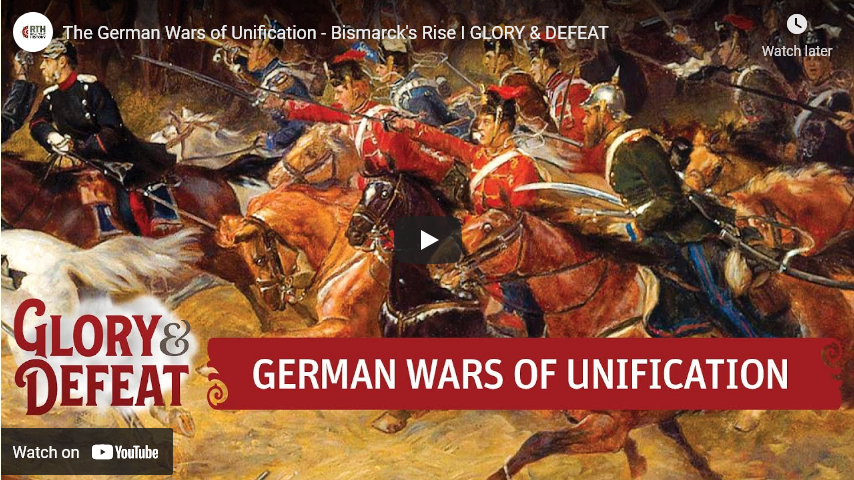
The German Wars of Unification – Bismarck’s Rise I GLORY & DEFEAT
realtimehistory
Published 19 Jul 2021Support Glory & Defeat: https://realtimehistory.net/gloryandd…
After the failed revolution of 1848, the German states within the German confederation were still moving towards unification. This movement would come from the citizens this time though but from the top. Prussia’s chancellor Otto von Bismarck was using clever and aggressive diplomacy to outmaneuver his biggest German rival: Austria.
» OUR PODCAST
https://realtimehistory.net/podcast – interviews with historians and background info for the show.» LITERATURE
Arand, Tobias: 1870/71. Der Deutsch-Französische Krieg erzählt in Einzelschicksalen. Hamburg 2018
Bremm, Klaus-Jürgen: 1866. Bismarcks Krieg gegen die Habsburger. Darmstadt 2016
Buk-Swienty: Schlachtbank Düppel. Geschichte einer Schlacht. Hamburg 2015
Fesser, Gerd: Königgrätz – Sadowa. Bismarck Sieg über Österreich. Berlin 1994» SOURCES
Böhme, Helmuth (Hrsg.): Die Reichsgründung. dtv-Dokumente. München 1967Dollinger, Hans: Das Kaiserreich. Seine Geschichte in Texten, Bildern und Dokumenten. München, 1966
Hardtwig, Wolfgang /Hinze, Helmuth (Hrsg.): Deutsche Geschichte in Quellen und Darstellungen. Bd. 7: Vom Deutschen Bund zum Kaiserreich 1815 – 1871. Stuttgart 1997
Huber, Ernst Rudolf (Hrsg.): Dokumente der Verfassungsgeschichte, Bd. 2. 1851 – 1900. Stuttgart u.a. 1961
N.N.: Helmuth von Moltkes Briefe an seine Braut und Frau. Stuttgart u.a. 1911
Low, Sidney / Sanders Lloyd C.: The History of England During the Reign of Victoria (1837-1901) Volume 12 of 12, [Part of Series: The Political History of England in Twelve Volumes, Edited by William Hunt and Reginald L. Poole], Longmans, Green, and Co., London. 1907
» OUR STORE
Website: https://realtimehistory.net»CREDITS
Presented by: Jesse Alexander
Written by: Cathérine Pfauth, Prof. Dr. Tobias Arand, Jesse Alexander
Director: Toni Steller & Florian Wittig
Director of Photography: Toni Steller
Sound: Above Zero
Editing: Toni Steller
Motion Design: Philipp Appelt
Mixing, Mastering & Sound Design: http://above-zero.com
Maps: Battlefield Design
Research by: Cathérine Pfauth, Prof. Dr. Tobias Arand
Fact checking: Cathérine Pfauth, Prof. Dr. Tobias ArandChannel Design: Battlefield Design
Contains licensed material by getty images
All rights reserved – Real Time History GmbH 2021
Comments Off on The German Wars of Unification – Bismarck’s Rise I GLORY & DEFEAT
August 5, 2021
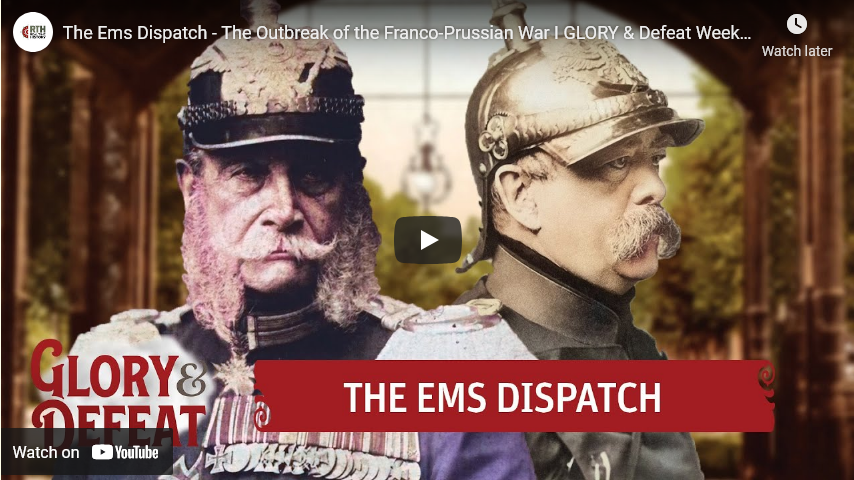
The Ems Dispatch – The Outbreak of the Franco-Prussian War I GLORY & Defeat Week 1
realtimehistory
Published 13 Jul 2021Support Glory & Defeat: https://realtimehistory.net/gloryandd…
French and Prussian animosity have been swelling in the background since the German Wars of Unification started in the 1860s. The French Duc de Gramont hopes that a victory over Prussia could restore French prestige while Prussian Chancellor Bismarck needs a reason to fulfill his dream of German unification from above. When the crisis about the Spanish throne escalates with the Ems Dispatch, the die is cast and the Franco-Prussian War begins.
» OUR PODCAST
https://realtimehistory.net/podcast – interviews with historians and background info for the show.» LITERATURE
Arand, Tobias: 1870/71 – Die Geschichte des Deutsch-Französischen Krieges erzählt in Einzelschicksalen. Hamburg 2018Böhme, Helmut: (Hrsg.): Die Reichs-gründung. dtv-Dokumente. München 1967
Gall, Lothar (Hrsg: Deutschland Archiv). Kaiserreich Bd. I. o.O. 2007
Girard Louis: Napoléon III. Paris 1986
Mährle, Wolfgang (Hrsg.): Nation im Siegesrausch. Württemberg und die Gründung des Deutschen Reiches 1870/71. Stuttgart 2020
Milza, Pierre: L’année terrible. La guerre franco-prussienne septembre 1870 – mars 1871. Paris 2009
» SOURCES
Fontane, Theodor: Der Krieg gegen Frankreich Bd. I. Berlin 1873Louis L. Snyder, ed., Documents of German History. New Brunswick, N.J.: Rutgers University Press, 1958
» OUR STORE
Website: https://realtimehistory.net»CREDITS
Presented by: Jesse Alexander
Written by: Cathérine Pfauth, Dr. Tobias Arand, Jesse Alexander
Director: Toni Steller & Florian Wittig
Director of Photography: Toni Steller
Sound: Above Zero
Editing: Toni Steller
Motion Design: Philipp Appelt
Mixing, Mastering & Sound Design: http://above-zero.com
Maps: Battlefield Design
Research by: Cathérine Pfauth, Prof. Dr. Tobias Arand
Fact checking: Cathérine Pfauth, Prof. Dr. Tobias ArandChannel Design: Battlefield Design
Contains licensed material by getty images
All rights reserved – Real Time History GmbH 2021
Comments Off on The Ems Dispatch – The Outbreak of the Franco-Prussian War I GLORY & Defeat Week 1
July 18, 2021
QotD: Rules of wars in the Eighteenth Century
Although the Succession of Wars went on nearly the whole time in the eighteenth century, the countries kept on making a treaty called the Treaty of Paris (or Utrecht).
This Treaty was a Good Thing and laid down the Rules for fighting the wars; these were:
(1) that there should be a mutual restitution of conquests except that England should keep Gibraltar, Malta, Minorca, Canada, India, etc.;
(2) that France should hand over to England the West Indian islands of San Flamingo, Tapioca, Sago, Dago, Bezique and Contango, while the Dutch were always to have Lumbago and the Laxative Islands;
(3) that everyone, however Infantile or even insane, should renounce all claim to the Spanish throne;
(4) that the King (or Queen) of France should admit that the King (or Queen) of England was King (or Queen) of England and should not harbour the Young Pretender, but that the fortifications of Dunkirk should be disgruntled and raised to the ground.
Thus, as soon as the fortifications of Dunkirk had been gruntled again, or the Young Pretender was found in a harbour in France, or it was discovered that the Dutch had not got Lumbago, etc., the countries knew that it was time for the treaty to be signed again, so that the War could continue in an orderly manner.
W.C. Sellar & R.J. Yeatman, 1066 And All That, 1930.
Comments Off on QotD: Rules of wars in the Eighteenth Century
June 24, 2021
QotD: The fantasy world of Canadian geopolitical posturing
Yet for all the reflexive anti-Americanism that has been the meat and mead of Canadian nationalism, Canada’s leadership class has usually been pretty good about understanding who is in charge. Over the course of the 20th century, from the Ogdensburg agreement of 1940 and the post-war establishment of NORAD to the Free Trade Agreement of 1988, we cemented that reality with a defence and economic alliance.
Paradoxically, what this continental defence and economic security arrangement has given us is the opportunity to let our internationalist pretensions run wild. One of the weirdest things about Canada is the extent to which we like to frame our place in the world in a-geographic terms. We imagine that we are as threatened as anyone by the mix of post-Cold War failed states, opportunistic terrorism, regional authoritarianism, and humanitarian disasters. By the same token, we like to presume that we are as well-positioned as any other country to do something about all of this.
As the dean of Canadian defence policy Kim Nossal points out in a recent paper, this a-geographic security fantasy is reflected in the official defence reviews that Canadian governments have released since the 1990s. Or take, for example, the 2017 Liberal policy statement, entitled Strong, Secure, Engaged, which rejects the idea that Canada’s privileged geographic location mitigates these global threats for us. As Nossal concludes, when you look at how Canadian governments actually talk about our security situation, you get little sense that, thanks to the Americans, Canada occupies “one of the safest spaces in contemporary global politics.”
You can see the logical leaps, then.
Once you’ve convinced yourself that Canada’s security is disconnected from the geographical imperative of the American security guarantee, it’s only a few steps to the conclusion that who we choose as our global strategic partner is actually a meaningful choice. And if it is true, as China’s president Xi Jinping has claimed, that the East is on the rise and the West is in decline, then why not throw your lot in with the new big dog on the block?
Andrew Potter, “Hedging our bets with China was a mistake”, The Line, 2021-03-23.
Comments Off on QotD: The fantasy world of Canadian geopolitical posturing
June 13, 2021
Fundamentally unserious nation – “… for Canada’s leaders, all the world’s a ‘gram”
In the Friday wrap-up edition of The Line, a consideration of how shallow, insincere posturing, and performing became the hallmarks of Canadian government leadership:
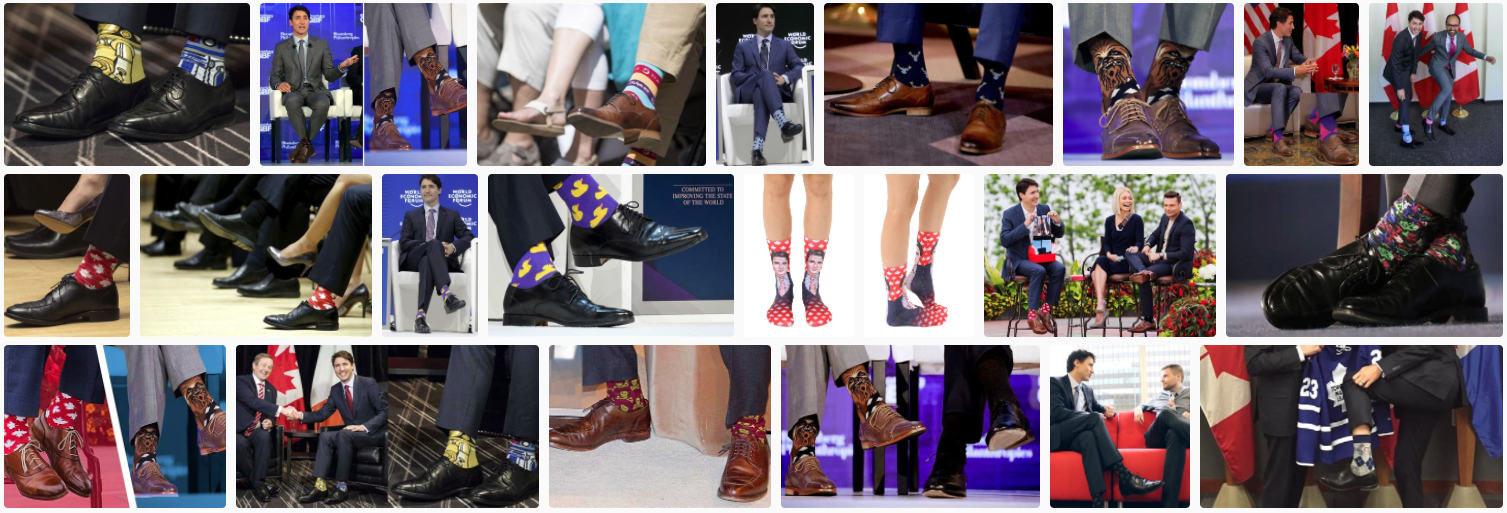
Typical image search results for “Justin Trudeau socks”
Look, we at The Line are as tired as you are about the more, shall we say, theatrical aspects of Justin Trudeau’s approach to being prime minister. Whether it was his Day One “because it’s 2015!” smirk, his obsession with showing off his socks to foreign dignitaries, his fashion sense while vacationing in India, and countless other Trudeauvian trips of the light fantastic, the man has always seemed more interested in performance than in the substance of governing.
But that’s not quite right. Because if there is one thing we’ve come to realize over the past five years and a bit, it is that for the Trudeau Liberals, the performance is the governing. For example, we used to wonder at the amount of time and energy that Cabinet ministers spent working on their Instagram accounts, since it went far beyond what would seem to be necessary for promoting and communicating policy. But once we understood that it was the job of policy to promote the Instagram account, and not the other way around, all of this proudly vacuous behaviour started to make a lot more sense.
But while we’ve gotten more or less used to it here in Canada (or maybe the right word is “numb”), we’ve always wondered how it looks through foreign eyes. Those abstract wonderings became a little more concrete over the past few weeks. Countries are opening up, people are starting to travel, politicians are going back to their old habits of holding regular meetings to make sure the world is still ticking along. And for Canada’s leaders, all the world’s a ‘gram.
So it was that at the G7 summit in Cornwall England this week, Prime-Minister-In-All-But-Name Chrystia Freeland was the only finance minster to wear a mask in a group photo taken outdoors. Ok, we thought, maybe she’s not fully vaxxed, maybe she has reason to be extra cautious. Except in a string of photos taken just before the official photo, Freeland was captured scrambling to put on her mask, not for safety, but for show.
Freeland was just getting the crowd warmed up for her nominal boss, Justin Trudeau. At his official G7 welcome on Friday, Trudeau was the only leader to put a mask on to give Boris Johnson the chummy elbow, only to remove it a few seconds later. We get it. It’s a version of the old “what lie did I tell?” problem, but for acting. Which audience am I playing to at this exact moment? It’s hard for even an old luvvie like Trudeau to keep track.
Once he’s back in Canada, Trudeau is going to hole up in a hotel for a few days, which the Globe‘s Cam Clark aptly referred to as “symbolic penance for a symbolic policy.” We agree with Clark that there’s some good fun in seeing someone get tied up in their own moral posturing. But while Clark is unhappy at the prospect of the prime minister cooling his heels for three days, we’re less fussed about Trudeau’s prospective stay in Hotel Q. Because while Clark thinks “there are real things” for the prime minister to be doing, we doubt that very much.
Comments Off on Fundamentally unserious nation – “… for Canada’s leaders, all the world’s a ‘gram”
June 9, 2021
Do the Nazis Have Atomic Bombs? – WW2 – Spies & Ties 03 – Sam & Erwin part 2
World War Two
Published 8 Jun 2021All belligerents are working hard to develop a powerful nuclear super-weapon. The Americans wonder how far along the Germans are, and send in their spies.
(more…)
Comments Off on Do the Nazis Have Atomic Bombs? – WW2 – Spies & Ties 03 – Sam & Erwin part 2
May 29, 2021
Justin Trudeau is clearly not concerned about China or Chinese involvement in Canadian affairs
In The Line, Jen Gerson outlines the PM’s latest display of insouciance in regard to anything involving China, their ruling Communist party, or the Chinese military:
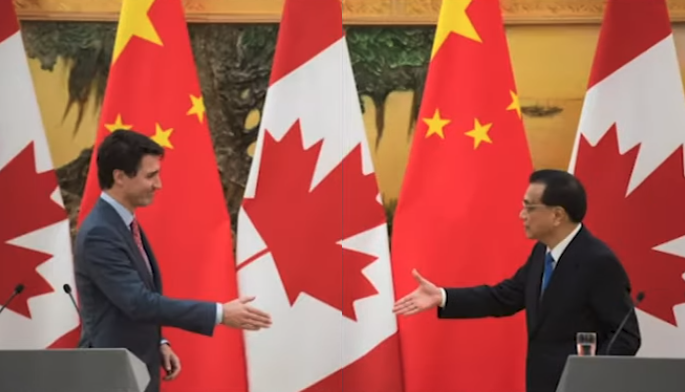
The Globe and Mail reported last week that Canada’s top infectious disease research centre, the National Microbiology Laboratory in Winnipeg, had hosted and otherwise collaborated with guest researchers and scientists from China — including some with links to that country’s military or government. O’Toole asked about this in the House, and Trudeau gave a very routine Trudeauvian non-answer. O’Toole and other Tories kept up the questioning, Trudeau eventually responded with this (as per Hansard): “Mr. Speaker, we have always and will always take this threat seriously. Public safety officials have met with more than 34 universities to help them keep their research safe. In 2020, CSIS engaged more than 225 different organizations, including universities, to ensure that they were aware of foreign threats. I also want to mention that we are seeing a disturbing rise in anti-Asian racism. I hope that my Conservative Party colleagues are not raising fears about Asian Canadians.”
Sigh. Where do we begin?
First of all, though this may shock our readers, the Sun papers, and its columnists, have been known to exaggerate their criticisms of the PM. The PM gave a more substantive answer than Lilley gave him credit for. You can disagree with the PM — see below! — without getting cute with what he actually said. The racism line was dumb, and shitty. It was beneath the PM and unfair to the legitimate questions that were being asked. Trudeau shouldn’t have said it, and he was right to get called out for it.
So yes, a dick move by the PM — in a hundred years, maybe one of his descendants can apologize for it. But let’s not take our eye off the ball.
Trudeau’s answers were more than Lilley suggested, but they’re still not good enough. O’Toole and the Conservatives are onto something. China’s ruling regime is aggressive, brutal, and thuggish. They’re a threat to security abroad, they’re committing outright crimes against humanity against their own religious minorities, they’ve crushed Hong Kong underfoot, and they’re actively hostile to Canada. None of this is racist to note.
And yet our federal Liberals remain alarmingly unable to admit any of this. We don’t buy that it’s just a matter of political expediency, an awkward but necessary consequence of the ongoing detention of the two Michaels. Hell, we wish that the Liberals were just being publicly cautious with their real views on Beijing while remaining clear-eyed about the threat behind closed doors. The evidence continues to suggest that the federal Liberals, from Trudeau on down, remain hopelessly naïve about the nature of Beijing’s rulers, even as more and more of our allies are getting real about what the next generation or two of geopolitics is gonna look like for the Western alliance. (Which Canada remains a part of, whether Trudeau likes it or not.)
The growing tensions with a rising China are a big deal. It is only going to become a bigger deal. The Liberals need to get with the program. We hope to see more on this across the Canadian media — and hopefully it’s a bit more useful and productive than what the Sun ran with this week. The Liberals look terrible on this file already for entirely legitimate, serious reasons. We don’t need to pop our aging joints as we stretch and contort ourselves to make it seem so.
Comments Off on Justin Trudeau is clearly not concerned about China or Chinese involvement in Canadian affairs
May 5, 2021
April 23, 2021
Treaties and War, The Washington Naval Conference
The History Guy: History Deserves to Be Remembered
Published 17 Aug 2017The History Guy remembers the Washington Naval Conference, a watershed in diplomacy.
The episode discusses events and shows some artwork depicting warships, which some viewers may find disturbing. All events are described for educational purposes and are presented in historical context.
The History Guy uses images that are in the Public Domain. As photographs of actual events are often not available, I will sometimes use photographs of similar events or objects for illustration.
Patreon: https://www.patreon.com/TheHistoryGuy
The History Guy: Five Minutes of History is the place to find short snippets of forgotten history from five to fifteen minutes long. If you like history too, this is the channel for you.
Awesome The History Guy merchandise is available at:
teespring.com/stores/the-history-guyThe episode is intended for educational purposes. All events are presented in historical context.
#ushistory #thehistoryguy #militaryhistory

Comments Off on Treaties and War, The Washington Naval Conference
April 21, 2021
“The error in Western thinking was to view CCP officials as civilised counterparts”
In Quillette, Aaron Sarin traces the last twenty years of successful diplomacy, industrial espionage, and ever-increasing CCP media influence in China’s relationships with western nations:
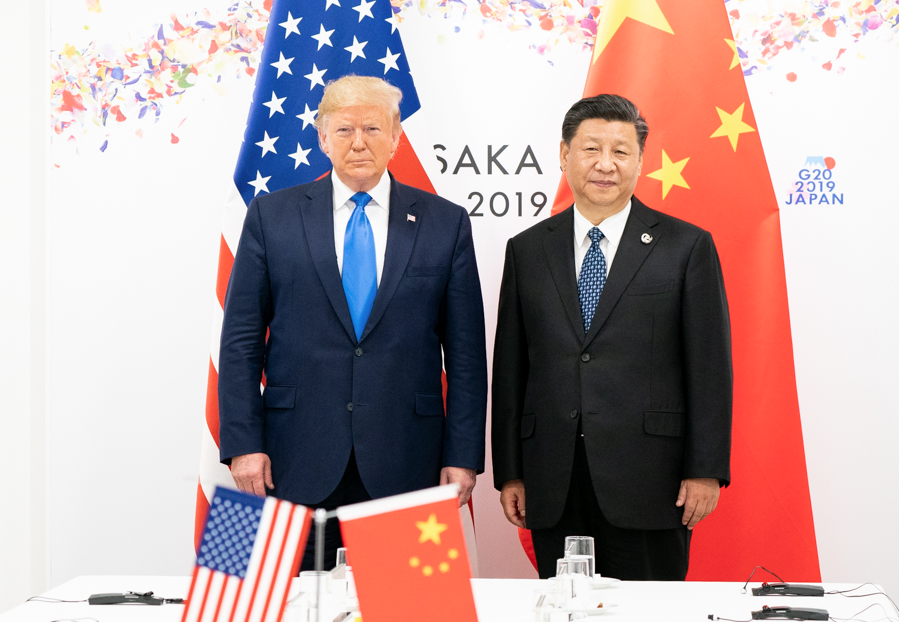
President Donald Trump and PRC President Xi Jinping at the G20 Japan Summit in Osaka, 29 June, 2019.
Cropped from an official White House photo by Shealah Craighead via Wikimedia Commons.
By the end of 2020, China’s relationships with the US and Australia had reached their lowest point in living memory, while Sino-British relations weren’t far behind. Yet the European Commission chose this moment to sign a major new investment treaty with Beijing. The deal appeared to have been rushed to completion just before Joe Biden’s inauguration, as if to avoid the fuss that a new American administration would be sure to make. Indeed, incoming National Security Adviser Jake Sullivan felt sore enough to send a pointed tweet: “The Biden-Harris administration would welcome early consultations with our European partners on our common concerns about China’s economic practices.”
The truth is that Brussels has been drifting further and further from Washington ever since the election of Donald Trump, and there are few signs the winds will change now that Biden has taken office. In 2017, Merkel said that Europe could no longer rely on America. By 2020, it seemed truer to say that Europe would rely on China from now on. Indeed, diplomats like Emmanuel Bonne (Macron’s foreign policy adviser) have been most enthusiastic about “France’s readiness to step up strategic communication with China.” In his gushing deference, Bonne can sometimes sound like a man with a gun to his head: “France respects China’s sovereignty, appreciates the sensitivity of Hong Kong-related issues, and has no intention of interfering in Hong Kong affairs.” There are times when the language of neutrality reveals with painful clarity that a side has been chosen.
Brussels officials talk of “strategic autonomy,” of course. They hope to carve out a path to self-sufficiency while at the same time enjoying mutually beneficial relationships with partners like Beijing. The problem is that mutually beneficial relationships are not possible with predators. As successive American administrations have found, those who maintain close connections with the Communist Party will eventually suffer large-scale intellectual property theft and the loss of millions of manufacturing jobs.
Brussels can hardly expect that Beijing will respect this new agreement. Recall the various promises that were made regarding Hong Kong: all of them were broken. Party officials may have signed a legal document recognising the city’s special administrative status, but this was purely for show. In 2017, having apparently now ascended to a position above the law, they declared that the document had “no practical significance.” Remember how Barack Obama was given firm assurance that Beijing would never militarize the South China Sea? There were handshakes and smiles all round, and then Beijing proceeded to militarize the South China Sea.
Indeed, some of the commitments included as part of the new deal echo those made 20 years ago, when China first joined the World Trade Organisation. It was agreed in 2001 that prices in every sector would be determined by market forces; that state-owned enterprises would begin operating free of state influence; that international norms regarding intellectual property would be respected; and so on. After two decades, we can see that the Communist Party has kept not one of its promises.
The error in Western thinking was to view CCP officials as civilised counterparts. We failed to see that we were dealing with a pack of thugs and grifters — men for whom the rule of law is neither reality nor ideal, but façade. This lesson has now been learned in some quarters, but clearly not in the upper echelons of the European Union. This new investment deal even includes a reference to “commitments on forced labour,” which is little short of an insult when we consider the hundreds of thousands of Uyghurs who have been made to toil all day till dusk in the cotton fields of Xinjiang. The truth is that the EU has been fooled. There will be no “win-win situation.” Not when dealing with the Communist Party, which has always viewed geopolitics as a zero-sum game. In the words of Bilahari Kausikan, once Singapore’s top diplomat, “only the irredeemably corrupt or the terminally naïve take seriously Beijing’s rhetoric about a ‘community of common destiny.'”
Comments Off on “The error in Western thinking was to view CCP officials as civilised counterparts”
April 13, 2021
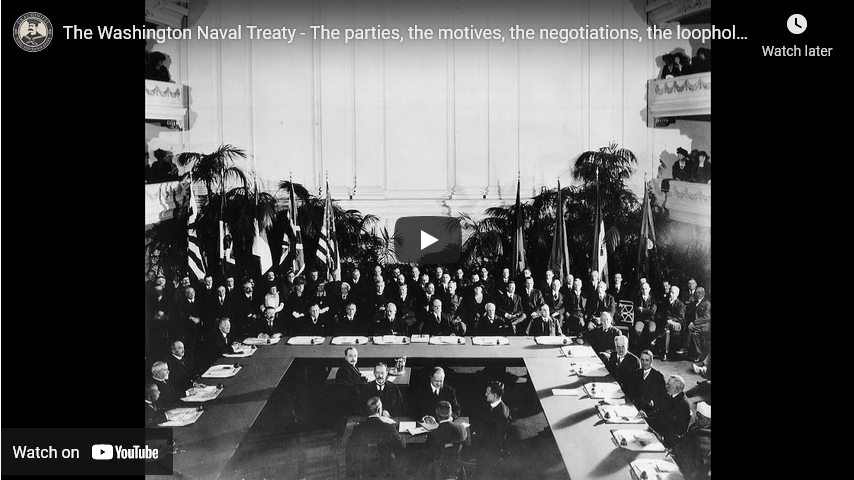
The Washington Naval Treaty – The parties, the motives, the negotiations, the loophole abuse…
Drachinifel
Published 10 Feb 2021Today we look at the Washington Naval Treaty, why it came to be, the broad aspects of negotiation, what it meant and how people turned it into a legal pretzel.
Sources:
http://www.ibiblio.org/pha/pre-war/19…
www.amazon.co.uk/dp/B00KIXWLE2
www.amazon.co.uk/Kaigun-Strategy-Technology-Imperial-1887-1941-ebook/dp/B01DRYEMH2
www.amazon.co.uk/Treaty-Cruisers-RE-ISSUE-International-Competition/dp/1526748509
www.amazon.co.uk/Naval-Policy-Between-Wars-Anglo-American/dp/1473877407Free naval photos and more – www.drachinifel.co.uk
Want to support the channel? – https://www.patreon.com/Drachinifel
Want a shirt/mug/hoodie – https://shop.spreadshirt.com/drachini…
Want a poster? – https://www.etsy.com/uk/shop/Drachinifel
Want to talk about ships? https://discord.gg/TYu88mt
Want to get some books? www.amazon.co.uk/shop/drachinifelDrydock
Episodes in podcast format – https://soundcloud.com/user-21912004
From the comments:
Gamebook
2 months ago (edited)
The Americans didn’t want to build the ships, but could have afforded to do so.
The Japanese did want to build the ships, but couldn’t have afforded to do so.
The French wanted other people to think that they wanted to build the ships and could afford to do so, but in fact they didn’t want to and couldn’t have afforded to do so.
The Italians did not want the French to build the ships, and thought they had prevented them from doing so, but in fact see above. The Italians themselves could not afford to build the ships any more than the French could.
The British sort of wanted to build the ships, and could sort of have afforded to do so, but would rather everyone just restrained themselves as that would leave the Royal Navy in a better position than they could have paid for in the event of another naval arms race.
Comments Off on The Washington Naval Treaty – The parties, the motives, the negotiations, the loophole abuse…
April 7, 2021
QotD: The G-[pick-a-number] meetings
The first three were essential to plan for victory and peace, though many of their key provisions, especially for the liberation of Eastern Europe, were ignored by Stalin. The first Nixon-Brezhnev meeting was substantive and a couple of the later Reagan-Gorbachev meetings were very productive. These were intense business meetings between people who really were at the summit of world power and influence. The only matter agreed to in meetings between Soviet and American leaders between 1945 and 1972 was in the “kitchen debate” between then vice-president Nixon and Khrushchev in Moscow in 1959, when (forgive my coarseness in the interests of historical accuracy), Khrushchev accused Nixon of uttering “Horse shit, no, it is cow shit, and nothing is fouler than that” to which Nixon replied, “You don’t recognize the truth, and incidentally, pig shit is fouler than cow shit.” Khrushchev conceded the second point.
Conrad Black, “Take heed Canada: the U.S. would win a true trade war”, Conrad Black, 2018-06-16.
Comments Off on QotD: The G-[pick-a-number] meetings
March 24, 2021
“By now it has dawned on even the most glossy-eyed internationalists that we are well into another sides-picking era of global geopolitics”
Like it or not, we’re already a few years into a new Cold War, this time with the Chinese Communist Party. The Canadian government seems to be among the last in the world to recognize this change in the geopolitical situation. In The Line, Andrew Potter shows why Justin Trudeau must stop trying to cuddle up to Xi:
The outrageous secret trials in China of Michael Spavor last Friday and Michael Kovrig this Monday are nothing more than punctuation marks on a storyline that has been obvious for some time now.
Which is why it was enormously gratifying to see more than two dozen diplomats show up to seek admittance to Kovrig’s trial. The fact that none was admitted is unfortunate but largely beside the point — what matters is the public display of solidarity. Even more gratifying perhaps is the announcement (by Canadian officials) that the U.S. has promised to treat the two Canadians as if they were American citizens. After all, it was our acquiescence to a U.S. request to arrest Huawei executive Meng Wanzhou at Vancouver International Airport in 2018 that prompted Beijing to nab Spavor and Kovrig in retaliation. While Chinese officials have denied that what this amounts to is hostage diplomacy, they’ve also made it clear that the fate of the Michaels is tied to that of Meng.
What makes the public support from all of these countries so remarkable is that a lot of them — the Czechs, the Finns, the Romanians — have very little to gain from sticking their neck out for Canada. More to the point, every one of these countries has good reason to wonder just how committed Canada itself is to this show of collective strength. After all, it was only five years ago that senior members of the Liberal party were freely — privately, but freely — saying that as far as the Liberal government was concerned, the U.S. was yesterday’s news and China was the horse Canada was going to ride into the future.
And while a lot has changed over the last five years (not least of which is the fact that Donald Trump has come and gone as president of the United States), it remains incomprehensible that it was just last year the Canadian National Research Council placed its disastrous COVID-19 vaccine bet with CanSino Biologics, a Chinese company with close ties to the Chinese military. What are our allies to make of the fact that only last month, the federal granting agency NSERC partnered with Huawei to sponsor computer engineering at Canadian universities. Or that Canada’s visa office in Beijing is owned and staffed by a Chinese police force?
Whether it is a matter of naïveté, bad faith, or outright cravenness, Canada continues to give every indication that it is a country that is still hedging its bets.
Comments Off on “By now it has dawned on even the most glossy-eyed internationalists that we are well into another sides-picking era of global geopolitics”


