Quotulatiousness

June 22, 2012

Microsoft Surface: “Lacking a physical product to test, all we can do is talk bollocks based on conjecture”

Filed under: Humour, Technology — Tags: , , — Nicholas @ 10:09

While I’ve been avoiding tablet computers, having an actual keyboard that can attach to a tablet makes it more like something I might be able to find a use for. In The Register, Alistair Dabbs explains why he’s already very fond of the announced-but-not-available-yet Microsoft Surface:

I don’t wish to suggest that Microsoft Surface is truly vapourware, but surely it’s suspicious that it’s announcing a product that no one’s going to be able to buy for half a year.

One supposes that Microsoft intends to create a buzz and get us talking about their forthcoming (new) foray into tablet computers. Yet the problem with jumping the gun — apart from the ‘false start’ accusations that lead on from this metaphor — is that commentators are left with a void to fill. Lacking a physical product to test, all we can do is talk bollocks based on conjecture.

This, as you know, is my specialty.

First, let me say that I don’t care a hoot about the provenance of the name ‘Surface’ — ho-ho, it used to be a table, so fucking what? Making fun of a name tells us nothing about the product.

Take ‘Metro’.

“We call it Metro because it’s modern and clean.” Oh, and here’s me thinking they called it Metro because it’s populated by young Algerians brandishing flick-knives and smells of wee. It’s just a word to put on the packaging and its actual meaning has no significance. After all, what does the word ‘pod’ have to do with playing MP3 files?
June 5, 2012

Stuxnet, Duqu, and Flame: joint US-Israeli projects

Filed under: Middle East, Military, Technology, USA — Tags: , , , , , — Nicholas @ 09:02

The US and Israeli governments have admitted that the Stuxnet, Duqu, and Flame malware infections were joint efforts:

American and Israeli officials have finally confirmed that the industrial grade Cyber War weapons (Stuxnet, Duqu and Flame) used against Iran in the last few years were indeed joint U.S.-Israel operations. No other details were released, although many more rumors are now circulating. The U.S. and Israel were long suspected of being responsible for these “weapons grade” computer worms. Both nations had the motive to use, means to build and opportunity to unleash these powerful Cyber War weapons against Iran and other that support terrorism.

The U.S. Department of Defense had long asked for permission to go on the offensive using Cyber War weapons. But the U.S. government regularly and publicly declined to retaliate against constant attack from China, mainly because there were fears that there could be legal repercussions and that weapons used might get out of control and cause lots of damage to innocent parties.

Iran turned out to be another matter. Although not a serious Cyber War threat to the United States, Iran was trying to build nuclear weapons and apparently Israel had already been looking into using a Cyber War weapon to interfere with that. Given the nature of these weapons, which work best if the enemy doesn’t even know they exist, don’t expect many details to be released about this Cyber War program. What is known is that the Cyber War weapons unleashed on Iran were designed to concentrate only on very specific targets. So far, only three weapons that we know of have been used. One (Stuxnet) was designed to do damage to one specific facility, the plant where Iran produced nuclear fuel for power plants, and atomic weapons. That one worked. The other two (Duqu and Flame) were intelligence collection programs. They also apparently succeeded, remaining hidden for years and having lots of opportunity to collect enormous quantities of valuable data.

May 6, 2012

Technology is not the panacea

Filed under: Education, Health, India, Technology — Tags: , , , , — Nicholas @ 10:06

I’m generally very pro-technology, but the One Laptop Per Child (OLPC) effort always struck me as putting the technology cart in front of the educational (and cultural) horse. A report at The Economist has examples of technological fixes that haven’t actually “fixed” the problems they were intended to solve:

The American charity has an ambitious mission — transform the quality of education in the developing world by giving every poor student a laptop. Targeting a $100 laptop, OLPC succeeded in creating a usable computer at a very low price point (the actual number was closer to $200). Unfortunately most of the attention in the project was focused on the technology and not enough on its efficacy. In the first rigorous evaluation of the programme, the Inter-American Development Bank (IDB) found little evidence that the laptops influenced educational outcomes. The study, conducted in Peru four years after the programme was launched, found no improvement in math or language. While the computers did lead to some gains in cognitive skills, the authors concluded that access to a laptop didn’t improve attendance. Neither did it motivate students to spend more time on their homework.

There is similarly disappointing news on cooking stoves. The World Health Organization estimates that indoor pollution from primitive cooking fires contributes to 2m deaths annually. One solution is to use clean cooking stoves. At a cost of $12.50, these stoves are an inexpensive way to reduce respiratory ailments and improve air quality. The Global Alliance for Clean Cookstoves (GACC), a public-private initiative, is making a big push for 100m homes in the developing world to switch to clean stoves by 2020. But a new NBER paper by Rema Hanna from Harvard University and Esther Duflo and Michael Greenstone from MIT, questions the long-term health or environmental benefits from this programme. The authors evaluated a clean-stove programme in eastern India, covering 15,000 households over five years. Their study found that after the initial year, enthusiasm for the stoves waned and households didn’t make the necessary investments to maintain them. As a result, the programme had very little effect on respiratory health or air pollution.

Both these projects highlight some common misconceptions in using technology for development. For one, solving intractable social problems requires fundamental changes in the target population. It also needs a supportive institutional framework to reinforce the right behaviour. Technology can complement this process, but it is no substitute for the human element. In Peru, simply adding laptops to the classroom, without investing in teachers who were proficient in computer-aided education, meant that the academic impact was limited. The IDB paper rightly points out that in poor countries where wages are low, development money may be better spent on labor-intensive education interventions than on expensive tools.

April 28, 2012

Charles Stross analyzes the economic and technical arguments for removing DRM on ebooks

Filed under: Books, Business, Economics, Media — Tags: , , , — Nicholas @ 00:08

A post at Charles Stross’s blog from earlier this week, when Macmillan announced that they were removing DRM from their ebook lines:

After I recommended that the major publishers drop mandatory DRM from their ebook products, I realized that my essay had elided a bunch of steps in my thinking, and needed to reconsider some points. Then I realized that it’s not a simple, straightforward argument to make. Consequently, I ended up writing another essay, although I’ve tried to summarize my conclusions below.

First, my conclusions:

1. The rapid current pace of change in the electronic publishing sector is driven by the consumer electronics and internet industry. It’s impossible to make long term publishing plans (3-10 years) without understanding these other industries and the priorities of their players. It is important to note that the CE industry relies on selling consumers new gadgets every 1-3 years. And it is through their gadgets that readers experience the books we sell them. Where is the CE industry taking us?

2. Dropping DRM across all of Macmillans products will not have immediate, global, positive effects on revenue in the same way that introducing the agency model did …

3. However, relaxing the requirement for DRM across some of Macmillans brands will have very positive public relations consequences among certain customer demographics, notably genre readers who buy large numbers of books (and who, while a minority in absolute numbers, are a disproportionate source of support for the midlist).

4. Longer term, removing the requirement for DRM will lower the barrier to entry in ebook retail, allowing smaller retailers (such as Powells) to compete effectively with the current major incumbents. This will encourage diversity in the retail sector, force the current incumbents to interoperate with other supply sources (or face an exodus of consumers), and undermine the tendency towards oligopoly. This will, in the long term, undermine the leverage the large vendors currently have in negotiating discount terms with publishers while improving the state of midlist sales.

Now the details:

February 10, 2012

Help sponsor a new home for the historic Colossus code-cracking computer

Filed under: Britain, History, Technology, WW2 — Tags: , , — Nicholas @ 11:11

John Leyden at The Register on the fundraising efforts to build a new home for the WW2 cryptographic computer:

The National Museum of Computing (TNMOC) has turned to a tried-and-tested fundraising method to establish a home for the rebuilt Colossus computer at Bletchley Park.

Individuals and firms are invited to buy up pixels of an online picture of the wartime code-breaking machine — at 10 pence per dot with a minimum spend of £10 — pretty much like Alex Tew’s million-dollar homepage effort.

The museum’s curators need the cash to open an exhibition featuring the Colossus in the historic Block H, on the spot where Colossus No 9 stood during the Second World War and where the rebuild took place.

Colossus was the world’s first electronic programmable computer, and was used to crack encrypted messages between Hitler and his generals.

January 21, 2012

Robert Johnson: How to save Economics

Filed under: Economics, Education, History, Media — Tags: , , , — Nicholas @ 11:10

Writing in Time, Robert Johnson has a few recommendations to rescue the field of economics from its current state:

First, economists should resist overstating what they actually know. The quest for certainty, as philosopher John Dewey called it in 1929, is a dangerous temptress. In anxious times like the present, experts can gain great favor in society by offering a false resolution of uncertainty. Of course when the falseness is later unmasked as snake oil, the heroic reputation of the expert is shattered. But that tends to happen only after the damage is done.

Second, economists have to recognize the shortcomings of high-powered mathematical models, which are not substitutes for vigilant observation. Nobel laureate Kenneth Arrow saw this danger years ago when he exclaimed, “The math takes on a life of its own because the mathematics pushed toward a tendency to prove theories of mathematical, rather than scientific, interest.”

[. . .]

The third remedy for repairing economics is to reintroduce context. More research on economic history and evidence-based studies are needed to understand the economy and overcome the mechanistic bare-bones models the students at Harvard objected to being taught.

[. . .]

Fourth, we must acknowledge the intimate, inseparable relationship between politics and economics. Modern debates about who caused the financial crisis — ­government or the private financial sector — are almost ­nonsensical. We are living in an era of money politics and large powerful interests that influence the laws and regulations and their enforcement. In order to catalyze the evolution of economics, research teams would benefit from multidisciplinary interaction with politics, psychology, anthropology, sociology and history.

H/T to Tim Harford for the link.

January 11, 2012

Computers as doctors

Filed under: Health, Technology — Tags: , — Nicholas @ 12:02

An interesting post from Alex Tabarrok at Marginal Revolution:

In 2004 I wrote In Praise of Impersonal Medicine arguing:

    I have nothing against my physician but I would prefer to be diagnosed by a computer. A typical physician spends most of the day playing twenty questions. Where does it hurt? Do you have a cough? How high is the patient’s blood pressure? But an expert system can play twenty questions better than most people. An expert system can use the best knowledge in the field, it can stay current with the journals, and it never forgets.

and in 2006 I noted:

    The practice of modern medicine is surprisingly primitive … My credit card company knows far more about my shopping history than my physician knows about my medical history.

I now believe that we are on the cusp of major changes to medicine. The thousand dollar genome sequence is less than a year away, Ford has just developed a car seat that can monitor your health, many people are already using wrist monitors to measure heart and sleep patterns. All of this data will soon be combined with massive databases to offer predictive and prescriptive health diagnosis.

But my favourite part of the posting was this comment from Joseph Huntington:

Stay clear of Doctors. I am a lifelong physician. Cardiologist, Head Surgeon, UCLA for 17 years. Medicine today is riskier than any casino. I left the zoo when it became a Federal Collection Center for data that will likely be used in population selection. If you’re a model or athlete, you have nothing to fear. If you’re sub-average, or over age 35 … just sleep well, drink water, walk, breathe deeply, eat mostly fresh things, laugh, love, work honorably and again, stay away from guys like me.

November 25, 2011

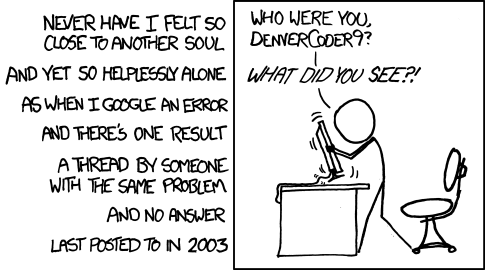
Ever gone looking for the answer to a technical question online?

Filed under: Humour, Technology — Tags: , , — Nicholas @ 09:07

This xkcd installment is amazingly accurate, at least based on my experiences:

Wisdom of the Ancients

Remember to mouse-over the cartoon: you’re missing at least half the humour if you don’t read the mouse-over text of any xkcd cartoon.

November 19, 2011

Internet users’ password security still hasn’t improved

Filed under: Technology — Tags: , , , , , — Nicholas @ 10:03

Do you use any of the following terms as your password? If so, congratulations, you’re helping keep the rest of us from being as easily hacked as you are:

1. password
2. 123456
3. 12345678
4. qwerty
5. abc123
6. monkey
7. 1234567
8. letmein
9. trustno1
10. dragon
11. baseball
12. 111111
13. iloveyou
14. master
15. sunshine
16. ashley
17. bailey
18. passw0rd
19. shadow
20. 123123
21. 654321
22. superman
23. qazwsx
24. michael
25. football

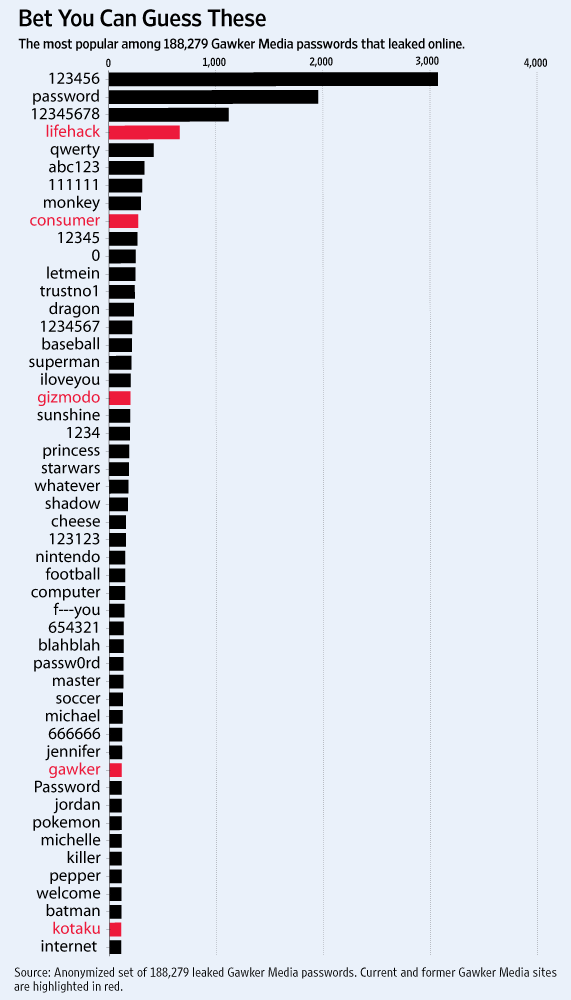
This list is from SplashData, who produce (among other things) a password-keeper utility. Last year, Gawker published the 50 top passwords in a graphic:

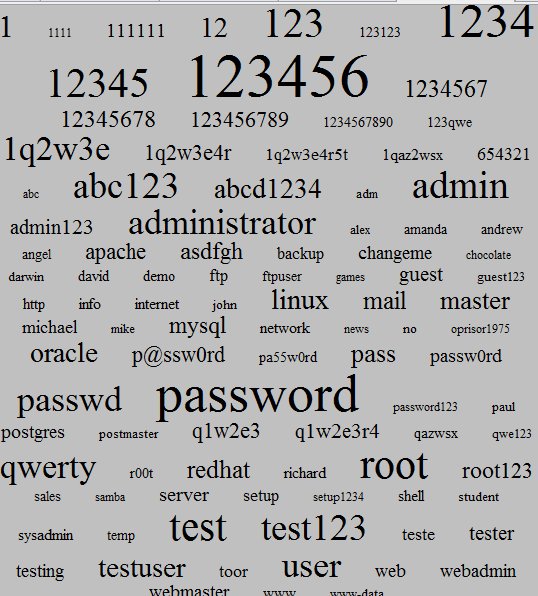
Here’s a word cloud from an earlier post on passwords:

Other posts on this topic: opportunities for humour with your bank’s secret questions, xkcd on the paradox of passwords, Passwords and the average user, More on passwords, And yet more on passwords, and Practically speaking, the end is in sight for passwords.

October 23, 2011

What to do when “Tech Support” calls you

Filed under: Humour, Law, Technology — Tags: , , — Nicholas @ 11:39

crshbndct recounts the heart-warming story of his recent call from “Tech Support”:

“Good Morning Sir, I am calling to inform you that you have serious issues with your pc and that we can help you fix them”

“Really? I just got it working today (had been having a nightmare of a time with video drivers)”

“Yes, Sir, but do not worry, we can help you to fix this problems”

(Realising its a scam, but willing to play along)

“Oh OK well that’s good. How are you going to do that?”

“Well Sir, Your computer runs a thing called Windows XP, which has many viruses and malware and rootkits and things like this which infect your master root on your CPU and slow it down and causes problems with your computer which can cost a lot to fix. We can help you fix this really cheaply”
“Really cheaply?!?! That sounds fantastic!! How do I do it?”

September 30, 2011

Another science fiction device may be on the way to reality

Filed under: Technology — Tags: , , — Nicholas @ 08:59

Ever read some of those late-60s or early-70s SF stories that assumed that computers that ran using non-binary logic would replace the binary logic machines of the day? Welcome to the future:

In 2007, Hewlett-Packard’s labs demonstrated the first memristor recognized as such. A portmanteau of “memory” and “resistor,” “memristance” was the theoretical fourth circuit variable first described in 1971. While HP stock will probably not yield the sort of profits we’re looking for here, it will help generate them indirectly.

Because of its unique properties, memristors will enable far more powerful circuitry. Unlike transistor-based circuits that form the core of modern electronics, memristive circuits retain their state after losing power. Theoretically, you could power on a memristor-based computer and have all the data in memory that it had when you powered off. Memristor memory could replace hard drives and transistor-based RAM.

Memristors, however, can do more than act as memory. They can replace existing processing components. This means that much more functionality can be implemented in a single component. Instead of busing data back and forth between separate memory and processing locations on a circuit board, memristors do it all. Data, then, are available for processing with shorter wait times. Memristors reduce total hardware size, cost and energy consumption. Yet memristors can multitask in other ways, opening up a whole range of exciting possibilities.

September 2, 2011

Time perspectives

Filed under: Economics, Education, Media, Technology — Tags: , , , — Nicholas @ 00:06

H/T to Chris Myrick for the link.

August 20, 2011

For his next trick, he’ll be knapping his own flint for arrowheads

Filed under: History, Technology — Tags: , — Nicholas @ 09:54

Okay, I exaggerate . . . a bit:

When IBM released its first personal computer, the 5150, 30 years ago, it was deliberately drab — black, gray, and low-key. That’s because IBM intended the 5150 to be a serious machine for people doing serious work.

So how better to celebrate this important anniversary than by using the 5150 for what it was meant to do? Working on a 5150 seems to be a tall task in today’s vastly accelerated computing world, however. Could a PC that’s as old as I am manage to email, surf the Web, produce documents, edit photos, and even tweet?

I sequestered myself for four days amid boxes of 5.25-inch floppy drives and serial cables to find out. The answer to my question turned out to be both yes and no — but more interesting was all the retro-computing magic I had to perform. In the end, my experiment proved two things:

  • People now use the PC for many things that weren’t even conceived of in 1981, and the 5150, unsurprisingly, is woefully underpowered for those advanced tasks. But when you use it for the core computing tasks the 5150 was designed for, IBM’s first PC has still got game.
  • Early floppy discs were just too darned small!

August 16, 2011

Charles Stross on the future of network security

Filed under: Science, Technology — Tags: , , , — Nicholas @ 12:40

Charles isn’t a professional in network security, but he has a good track record of exploring the consequences of new technology in his science fiction works. He was invited to give the keynote address at the 2011 USENIX conference.

Unlike you, I am not a security professional. However, we probably share a common human trait, namely that none of us enjoy looking like a fool in front of a large audience. I therefore chose the title of my talk to minimize the risk of ridicule: if we should meet up in 2061, much less in the 26th century, you’re welcome to rib me about this talk. Because I’ll be happy to still be alive to rib.

So what follows should be seen as a farrago of speculation by a guy who earns his living telling entertaining lies for money.

The question I’m going to spin entertaining lies around is this: what is network security going to be about once we get past the current sigmoid curve of accelerating progress and into a steady state, when Moore’s first law is long since burned out, and networked computing appliances have been around for as long as steam engines?

I’d like to start by making a few basic assumptions about the future, some implicit and some explicit: if only to narrow the field.

August 10, 2011

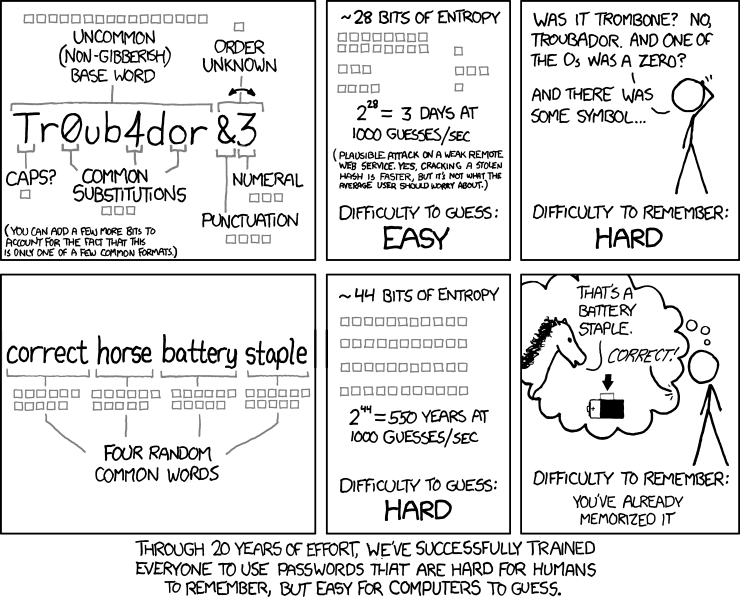
xkcd on the paradox of passwords

Filed under: Humour, Technology — Tags: , , , , — Nicholas @ 10:10

He’s absolutely right, you know . . .

« Newer PostsOlder Posts »

Powered by WordPress