
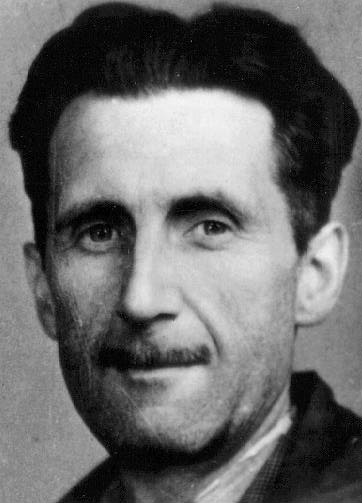
Orwell’s press card portrait, 1943
I know it is the fashion to say that most of recorded history is lies anyway. I am willing to believe that history is for the most part inaccurate and biased, but what is peculiar to our own age is the abandonment of the idea that history could be truthfully written. In the past people deliberately lied, or they unconsciously coloured what they wrote, or they struggled after the truth, well knowing that they must make many mistakes; but in each case they believed that “facts” existed and were more or less discoverable. And in practice there was always a considerable body of fact which would have been agreed to by almost everyone. If you look up the history of the last war in, for instance, the Encyclopaedia Britannica, you will find that a respectable amount of the material is drawn from German sources. A British and a German historian would disagree deeply on many things, even on fundamentals, but there would still be that body of, as it were, neutral fact on which neither would seriously challenge the other. It is just this common basis of agreement, with its implication that human beings are all one species of animal, that totalitarianism destroys. Nazi theory indeed specifically denies that such a thing as “the truth” exists. There is, for instance, no such thing as “Science”. There is only “German Science”, “Jewish Science”, etc. The implied objective of this line of thought is a nightmare world in which the Leader, or some ruling clique, controls not only the future but the past. If the Leader says of such and such an event, “It never happened” — well, it never happened. If he says that two and two are five — well, two and two are five. This prospect frightens me much more than bombs — and after our experiences of the last few years that is not a frivolous statement.
But is it perhaps childish or morbid to terrify oneself with visions of a totalitarian future? Before writing off the totalitarian world as a nightmare that can’t come true, just remember that in 1925 the world of today would have seemed a nightmare that couldn’t come true. Against that shifting phantasmagoric world in which black may be white tomorrow and yesterday’s weather can be changed by decree, there are in reality only two safeguards. One is that however much you deny the truth, the truth goes on existing, as it were, behind your back, and you consequently can’t violate it in ways that impair military efficiency. The other is that so long as some parts of the earth remain unconquered, the liberal tradition can be kept alive. Let Fascism, or possibly even a combination of several Fascisms, conquer the whole world, and those two conditions no longer exist. We in England underrate the danger of this kind of thing, because our traditions and our past security have given us a sentimental belief that it all comes right in the end and the thing you most fear never really happens. Nourished for hundreds of years on a literature in which Right invariably triumphs in the last chapter, we believe half-instinctively that evil always defeats itself in the long run. Pacifism, for instance, is founded largely on this belief. Don’t resist evil, and it will somehow destroy itself. But why should it? What evidence is there that it does? And what instance is there of a modern industrialized state collapsing unless conquered from the outside by military force?
Consider for instance the re-institution of slavery. Who could have imagined twenty years ago that slavery would return to Europe? Well, slavery has been restored under our noses. The forced-labour camps all over Europe and North Africa where Poles, Russians, Jews and political prisoners of every race toil at road-making or swamp-draining for their bare rations, are simple chattle slavery. The most one can say is that the buying and selling of slaves by individuals is not yet permitted. In other ways — the breaking-up of families, for instance — the conditions are probably worse than they were on the American cotton plantations. There is no reason for thinking that this state of affairs will change while any totalitarian domination endures. We don’t grasp its full implications, because in our mystical way we feel that a regime founded on slavery must collapse. But it is worth comparing the duration of the slave empires of antiquity with that of any modern state. Civilizations founded on slavery have lasted for such periods as four thousand years.
When I think of antiquity, the detail that frightens me is that those hundreds of millions of slaves on whose backs civilization rested generation after generation have left behind them no record whatever. We do not even know their names. In the whole of Greek and Roman history, how many slaves’ names are known to you? I can think of two, or possibly three. One is Spartacus and the other is Epictetus. Also, in the Roman room at the British Museum there is a glass jar with the maker’s name inscribed on the bottom, “Felix fecit“. I have a mental picture of poor Felix (a Gaul with red hair and a metal collar round his neck), but in fact he may not have been a slave; so there are only two slaves whose names I definitely know, and probably few people can remember more. The rest have gone down into utter silence.
George Orwell, “Looking back on the Spanish War”, New Road, 1943 (republished in England, Your England and Other Essays, 1953).
July 21, 2019
QotD: History in a totalitarian age
July 16, 2019
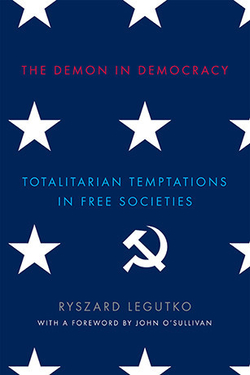
Totalitarian Temptations in Free Societies by Ryszard Legutko
Daniel Pipes reviews a recent translation (from Polish) by Teresa Adelson:
Legutko does not claim liberalism resembles communism in its monstrosity, much less that the two ideologies are identical; he fully acknowledges that the first is democratic and the second brutally tyrannical. After recognizing this contrast, however, he gets down to the more pungent topic of what the two have in common.
He first perceived those commonalities in the 1970s when visiting the West, where he saw how its liberals preferred communists to anti-communists; later, with the overthrow of the Soviet Bloc, he watched liberals warmly welcome communists, but not their anti-communist opponents. Why so?
Because, he argues, liberalism shares with communism a powerful faith in rational minds finding solutions which translates into a drive to improve the citizen, modernize him, and mold him into a superior being. Accordingly, both ideologies politicize, and thereby debase, every aspect of life, including sexuality, the family, religion, sports, entertainment, and the arts. (Here’s a mischievous but deadly serious question: which is the more awful art, the communist or the liberal, Stalin’s or the Venice Biennale’s?) [see below]
Both engage in social engineering to create a society whose members are “indistinguishable, in words, thoughts, and deeds ” from one another, aiming for a largely interchangeable population with no dissidents making trouble. Each sublimely assumes its specific vision constitutes the greatest hope for mankind and represents the end of history, the final stage of mankind’s evolution.
Trouble is, such grand schemes for improving mankind inevitably lead to severe disappointment; human beings, it turns out, are far more stubborn and less malleable then dreamers would like. When things go badly (say, food production for communists, unfettered immigration for liberals), two nasty consequences follow.
Here’s a mischievous but deadly serious question:
Which is the more awful "art", #Stalin’s or the Venice Biennale's (@la_Biennale)?
– Both are political kitsch
– But #SocialRealism is for the simple minded & #AvantGardism for the sophisticated
– The one lies, the other perverts pic.twitter.com/mgd1DX1FPF— Daniel Pipes دانيال بايبس (@DanielPipes) July 8, 2019
July 12, 2019
The European Migration Crisis – WW2 – WaH 004 – June 1940
World War Two
Published on 11 Jul 2019When the Nazi German Reich invades western and northern Europe this creates a massive refugee and forced migration crisis all across Europe. In eastern Europe, The Nazis and the Soviets have already been forcing families out of their homes to be relocated, incarcerated and murdered for nine months by now.
Join us on Patreon: https://www.patreon.com/TimeGhostHistory
Or join The TimeGhost Army directly at: https://timeghost.tvFollow WW2 day by day on Instagram @World_war_two_realtime https://www.instagram.com/world_war_t…
Join our Discord Server: https://discord.gg/D6D2aYN.
Between 2 Wars: https://www.youtube.com/playlist?list…
Source list: http://bit.ly/WW2sourcesWritten and Hosted by: Spartacus Olsson
Produced and Directed by: Spartacus Olsson and Astrid Deinhard
Executive Producers: Bodo Rittenauer, Astrid Deinhard, Indy Neidell, Spartacus Olsson
Creative Producer: Joram Appel
Post Production Director Wieke Kapteijns
Research by: Spartacus Olsson
Edited by:Spartacus Olsson
Map animations: EastoryEastory’s channel: https://www.youtube.com/channel/UCEly…
Archive by Screenocean/Reuters https://www.screenocean.com.A TimeGhost chronological documentary produced by OnLion Entertainment GmbH.

July 6, 2019
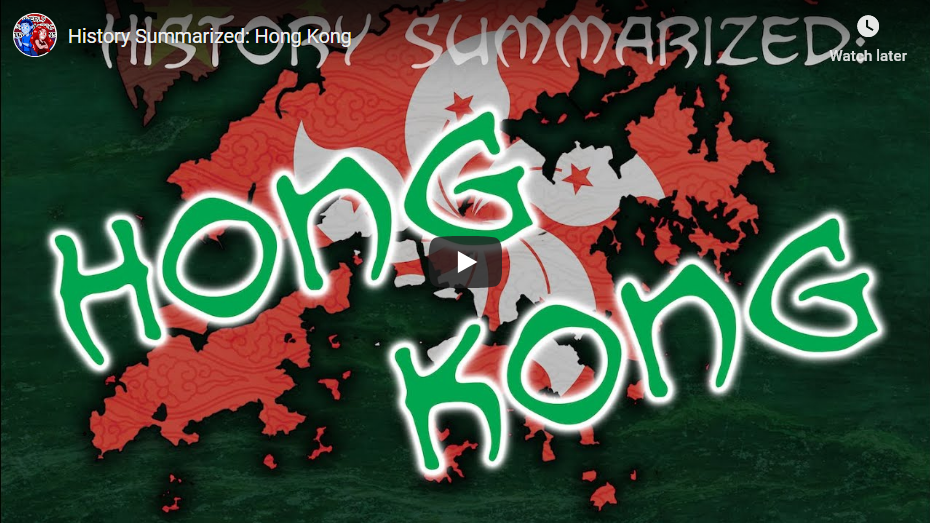
History Summarized: Hong Kong
Overly Sarcastic Productions
Published on 5 Jul 2019Sometimes small corners of the map can have outsized effects on the surrounding world. Hong Kong is undoubtedly one of History’s greatest examples of big things coming from small beginnings. If you’re curious about Hong Kong’s current political situation, there’s no better place to start than at the beginning.
LEARN MORE about Hong Kong’s current events:
China is Erasing its border with HK: https://www.youtube.com/watch?v=MQyxG…
HK’s huge protests, explained: https://www.youtube.com/watch?v=6_Rdn…Further Historical Reading:
A Modern History of China — Steve Tsang https://www.amazon.com/Modern-History…PATREON: https://www.Patreon.com/OSP
June 29, 2019
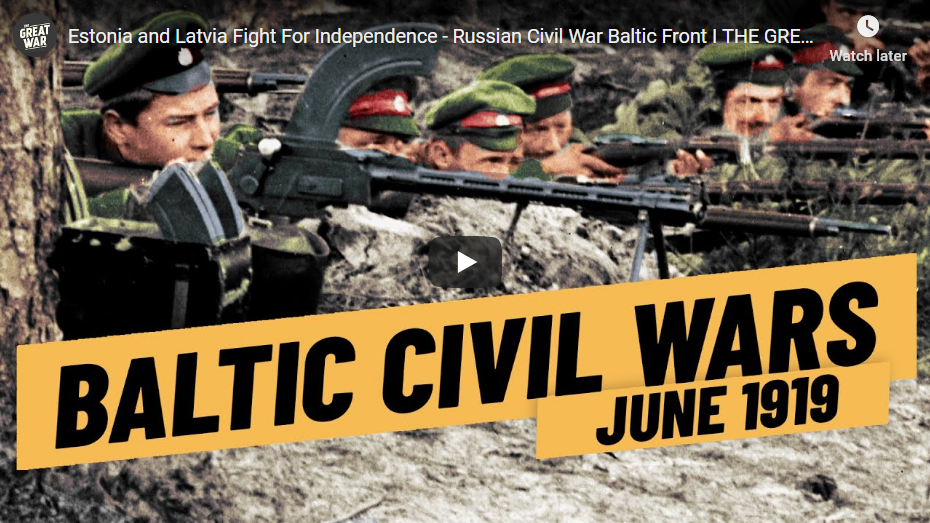
Estonia and Latvia Fight For Independence – Russian Civil War Baltic Front I THE GREAT WAR June 1919
The Great War
Published on 28 Jun 2019GAME OF TRENCHES: The first 20 players to register at: http://bit.ly/GameOfTrenches will receive in-game rewards worth a total of 10 600 Gold
Estonia and Latvia had declared their independence from Russia in the late 1918 chaos. Over the spring of 1919 both countries’ new governments needed to defend that independence not only against the Russian Bolsheviks: there was also a violent internal struggle about the future of these countries. The Baltic Germans didn’t want to give up their social status and the even the anti-Bolshevik Russians considered the Baltics as part of the Russian Empire.
» SUPPORT THE CHANNEL
Patreon: https://www.patreon.com/thegreatwar
Merchandise: https://shop.spreadshirt.de/thegreatwar/» SOURCES
Bennett, Geoffrey Martin. Cowan’s War. The Story of British Naval Operations in the Baltic, 1918-1920 (London: Collins, 1964)Chester, Geoff. “When the Capital of Latvia was a Ship Called Saratov” (Deep Baltic, 2016). https://deepbaltic.com/2016/06/13/whe…
Fletcher, William A. “The British Navy In the Baltic, 1918-1920. Its Contribution to the Independence of the Baltic Nations”. Journal of Baltic Studies, Vol. 7, No. 2, Summer 1976, p. 134-144.
Gerwarth, Robert. The Vanquished. Why the First World War Failed to End, 1917-1923 (Penguin, 2017).
Hatlie, Mark R. Riga at War 1914-1919. War and Wartime Experience in a Multi-ethnic Metropolis (Marburg: Herder-Institut, 2014). https://digital.herder-institut.de/pu…
Jēkabsons, Ēriks: “Cēsis, Battle of”, in: 1914-1918-online. International Encyclopedia of the First World War, ed. by Ute Daniel, Peter Gatrell, Oliver Janz, Heather Jones, Jennifer Keene, Alan Kramer, and Bill Nasson, issued by Freie Universität Berlin, Berlin 2014-10-08. https://encyclopedia.1914-1918-online…
Ibid. “The Latvian War of Independence 1918-1920 and the United States”. In: Fleishman L., Weiner A. (ed). War, Revolution, and Governance: The Baltic Countries in the Twentieth Century (Boston, 2018).
Kirby, David. The Baltic World 1772–1993. Europe’s Northern Periphery in an Age of Change. (London: Longman, 1995).
Raun, Toivo U. Estonia and the Estonians, 2nd ed. (Stanford: Hoover, 2002).
Sammartino, Annemarie H. The Impossible Border: Germany and the East, 1914–1922 (Cornell, 2014).
Sullivan, Charles L. “The 1919 German Campaign in the Baltic. The Final Phase.” In The Baltic States in Peace and War, 1917–1945, ed. V. Stanley Vardys and Romuald J. Misiunas, 31-42. (University Park: Penn State, 1978).
Tammela, Mari-Leen. Saaremaa Uprising. Estonica (Estonian Institute, 2012). http://www.estonica.org/en/Saaremaa_U…
Uustalu, Evald. The History of Estonian People (London: Boreas, 1952).
Von Rauch, Georg. The Baltic States. The Years of Independence 1917-1940 (London: Hurst, 1995).
Smele, Jonathan. The ‘Russian’ Civil Wars, 1916-1926: Ten Years That Shook the World (Oxford University Press: 2016)
Palmer, Alan. Northern Shores: A History of the Baltic Sea and Its Peoples (John Murray, 2005)
»CREDITS
Presented by: Jesse Alexander
Written by: Jesse Alexander
Director: Toni Steller & Florian Wittig
Director of Photography: Toni Steller
Sound: Toni Steller
Editing: Toni Steller
Mixing, Mastering & Sound Design: http://above-zero.com
Motion Design: Christian Graef – GRAEFX
Maps: Daniel Kogosov (https://www.patreon.com/Zalezsky)
Research by: Jesse Alexander
Fact checking: Florian WittigChannel Design: Alexander Clark
Original Logo: David van StepholdA Mediakraft Networks Original Channel
Contains licensed material by getty images
All rights reserved – Real Time History GmbH 2019
June 15, 2019
QotD: The early Bauhaus
The ideas of the modernists were generally expressed in the imperative mood and were frequently of a pseudo-mystical nature. Professor Curl’s description of some of the practices prevalent in the early Bauhaus make for hilarity; cranks are always a source of fun. In the early days, the modernists of the Bauhaus tended to a form of health mysticism involving vegetarianism, garlic paste, and regular enemas. Far more important, however, was their early and inherent attraction to totalitarianism. As the author points out, Gropius and Miës van der Rohe had no objection to Nazism other than that the Nazis failed to commission work from them. Gropius was an opportunistic anti-Semitic snob who espoused communism until it was no longer convenient for his career. Miës sucked up to the Nazis as much as he was able. The fact that both of them emigrated from Germany has done much to obscure their accommodation with the Nazis and even allowed the modernists to pose as anti-Nazi — though the most important proponent of modernism in America, Philip Johnson, had for some years been a rank Nazi in more than merely nominal terms. Moreover, as Professor Curl points out, the Nazi aesthetic, like the communist, had much in common with modernism.
Theodore Dalrymple, “Crimes in Concrete”, First Things, 2019-06.
June 10, 2019
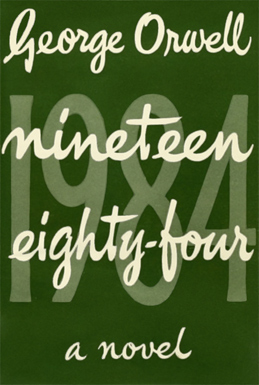
The intended message of George Orwell’s Nineteen Eighty-Four
There are few novels which have been so enthusiastically claimed by partisans of both the right and the left — sometimes simultaneously — for misunderstood reasons. Orwell wasn’t warning us about technology (although he brilliantly illustrated how technology can be harnessed in service of the state), nor was he somehow warning us about the evils of current or recent politicans (Reagan, Bush, Trump). Orwell, a dedicated life-long socialist, was warning us of the dangers of totalitarianism, particularly the communist style of totalitarianism:
June 8, 2019, marks the 70th anniversary of George Orwell’s dystopian novel 1984. There will be no shortage of think pieces that will misinterpret its legacy. They will focus on social media, security cameras, data collection, and “fake news.” The problem? The novel was not a commentary on the downside of technology. It was meant to warn against the growing spread of communism.
In the decades since the time of its publication, the context of Orwell’s magnum opus has been lost. What remains in the cultural memory are simply fragments of the larger picture: government censorship, ubiquitous surveillance cameras, and Orwell’s clever neologisms (Newspeak, doublethink, and thoughtcrime, among others). This selective recall has led to a widespread misreading of the book’s original warning.
[…]
From the left, most present-day articles and blog posts project the character “Big Brother” onto President Donald Trump, like Eliot Namay’s column in the May 6 edition of the Charleston Gazette-Mail. They typically focus on Trump’s fevered populism and his penchant for impulsive speech, which can lead him to play fast and loose with facts.
Sales of 1984 spiked dramatically after his inauguration in 2017 when White House Press Secretary Sean Spicer (incorrectly) touted the “largest audience ever to witness an inauguration.” Trump advisor Kellyanne Conway later defended the claim on Meet the Press, blurting out the now infamous phrase, “alternative facts.” Scores of news stories compared her gaffe to Orwell’s “Newspeak” and “doublethink.” It’s also fairly common to read comparisons of Trump’s rallies to the “Two Minutes Hate” depicted in 1984.
Comparisons from the right, on the other hand, generally focus on the politically correct speech codes of colleges and universities or on the massive data gathering of big tech companies like Facebook and Google, warning readers that “Big Brother is Watching You.” Kalev Leetaru explores both of these issues in his May 6 column in Forbes, where he compares the social media de-platforming trend to Orwell’s “unperson” status. Notably, sales of 1984 also spiked in 2013 after Edward Snowden leaked details of the NSA’s mass collection of internet and phone records. A slew of articles followed, asserting that 1984 had arrived.
A certain amount of hyperbole is a characteristic of today’s reporting and commentary, but current comparisons to 1984 are inappropriate. Again, George Orwell was writing about a specific regime. Big Brother was an obvious reference to “Uncle Joe” Stalin, a uniquely evil dictator. Trump has his shortcomings, but he is no Stalin. A president who is prone to exaggeration does not equal a government-controlled press (which the Soviet Union had). The “Two Minutes Hate” recalled Stalin’s public demonization of Trotzky, who dared to criticize Stalin’s tactics. Data collection is a growing concern, to be sure, but it doesn’t precede a terrifying knock on the door from the KGB.
May 29, 2019
US Soldiers Fighting in Russia – The End of the “Polar Bear Expedition” I THE GREAT WAR May 1919
The Great War
Published on 28 May 2019The so called Allied intervention into the Russian Civil War suffered from no clear operational goals and mandate and when US President Woodrow Wilson pulled out the American soldiers that were fighting in Northern Russia in May 1919, the operation suffered another setback. Public pressure against US foreign intervention was increasing now that Germany had been beaten and many people didn’t understand what American soldiers were doing in Russia anyway. At the same time Winston Churchill and his supporters maintained that it was vital to defeat the Bolsheviks in Russia once and for all.
» SUPPORT THE CHANNEL
Patreon: https://www.patreon.com/thegreatwar
Merchandise: https://shop.spreadshirt.de/thegreatwar/» SOURCES
Crownover, Roger. The United States Intervention in North Russia, 1918-1919: The Polar Bear Odyssey. Edwin Mellen Press, 2001.Wright, Damien. Churchill’s Secret War With Lenin: British and Commonwealth Military Intervention in the Russian Civil War, 1918-20, Helion and Company, 2017
Long, John W. “American Intervention in Russia: the North Russian Expedition, 1918-1919,” in Arthur Dudden, ed. American empire in the Pacific: from trade to strategic balance 1700 – 1922 (Aldershot: Ashgate, 2004): 321-344.
Mawdsley Evan. The Russian Civil War, Pegasus Books, 2019
Moore, Joel. The History of the American Expedition Fighting the Bolsheviki Campaigning in North Russia 1918-1919 (1920)
»CREDITS
Presented by: Jesse Alexander
Written by: Jesse Alexander
Director: Toni Steller & Florian Wittig
Director of Photography: Toni Steller
Sound: Toni Steller
Editing: Toni Steller
Mixing, Mastering & Sound Design: http://above-zero.com
Motion Design: Christian Graef – GRAEFX
Maps: Daniel Kogosov (https://www.patreon.com/Zalezsky)
Research by: Jesse Alexander
Fact checking: Florian WittigChannel Design: Alexander Clark
Original Logo: David van StepholdA Mediakraft Networks Original Channel
Contains licensed material by getty images
All rights reserved – Real Time History GmbH 2019
May 15, 2019
1984 – Dystopias and Apocalypses – Extra Sci Fi
Extra Credits
Published on 14 May 2019What makes 1984 still relevant to modern readers is that it serves as a warning against fascism in all its possible forms. George Orwell’s service fighting in the Spanish Civil War led him to see that the heart of totalitarianism is about xenophobia and nationalism no matter which kind of government it came from.
The idea that Orwell presents us in 1984 is that people subtle enough and brutal enough can take the undirected dissatisfaction and anger of a society and point it at whatever they will, using us to damn ourselves.
May 7, 2019
Arthur Chrenkoff relates his own economic “a-ha!” moment
He says he’s never had a religious or spiritual revelation, but he did have one that was pure economics:
By way of background, you have to remember that I grew up under declining communism. As someone has once wryly remarked, in a planned economy everything is planned except for the economy. In Poland of my childhood and early teenage years virtually everyone was employed by the state and so virtually all the income was derived from the state, except, of course, for the rampant black market. Shops were few and generally poorly stocked. Some goods were unobtainable, others required queuing and a lot of luck (or connections) to get, and either way most were of inferior quality to that in the West. Even if you have managed to save enough money, you had to get onto a waiting list to acquire an apartment, car, or household goods. The wait could take decades. Life’s necessities were more widely available but quite haphazard in their distribution. During the crisis years of the 1980s, most food items required ration cards. People literally had to scheme and plot to get their hands on toilet paper. Sure, the Eastern European socialism for most part managed to provide everyone with a bare minimum of subsistence so that no one starved anymore, but beyond that the economic system was shambles, never managing to produce the sufficient quantity and quality of what people needed and wanted. We all knew that the West, by comparison, was a kingdom of plenty, thanks the workings of that scary capitalism, but as a kid I wouldn’t be able to explain to you how, by contracts to our socialism, it somehow managed to produce in abundance all those cars, toys and oranges and bananas. We were told by the authorities that it was all a sham, built on exploitation of workers and resulting in widespread poverty. But we knew enough to know that everything is relative. When the Jaruzelski regime in the early 80s trumpeted in the government-run media (there were no other legal ones) its charity initiative to send sleeping bags to the homeless of New York, an anonymous wag somehow managed to place and ad in one of the papers “Will swap a two bedroom apartment in Warsaw for a sleeping bag in New York”.
I was 15 when I left, unbeknownst to me two years before the fall of the Wall, and spent 16 months in Italy before finally arriving to start a new life in Australia. For a kid from Eastern Europe, Italy was a revelation; I didn’t know enough about anything then to realise that the country we thought was a paradise has always in reality been somewhat of a hot mess. Australia at the end of the decade of wide-ranging economic reforms, which really opened the country to the world and unleashed its creative potential, was even more of contrast to the drabness, shortages and absurdity of the “real socialism” I grew up under.
The story of my economic experience is very brief: one day, not long after settling in Australia, I was in a car, being driven somewhat off the beaten path, through what can be described as a light industrial area. Then, all of a sudden, among all the rather anonymous sheds and buildings I saw a large, free standing store. I can’t remember its name but I remember it was selling carpets. And that’s all. I grew up with few shops around, which, no doubt in part because European cities tend to be a lot more condensed, occupied the same space as the living. But here, here was a whole store, a very large store that specialised in one product only – floor coverings – and it was, relatively speaking, sitting in the middle of nowhere. That it was in business, that it somehow managed to operate, indicated to me that people, many people, actually drove over here, from some distances away, for no other purpose than just to buy one thing – a carpet. So strange. So peculiar. This was my revelation, my economic epiphany in a back seat: this whole capitalist system must truly be incredibly complex and magnificent – and superior to all the alternatives – if it means a shop like this can thrive selling one particular type of product to people who don’t live anywhere near it.
May 1, 2019
Bavarian Soviet Republic – 1919 Economy and Reconstruction I BEYOND THE GREAT WAR
The Great War
Published on 30 Apr 2019» SUPPORT THE CHANNEL
Patreon: https://www.patreon.com/thegreatwar
Merchandise: https://shop.spreadshirt.de/thegreatwar/Jesse Alexander takes a look at the short lived but historically important Bavarian Soviet Republic that existed for 3 weeks in April 1919. He also takes a look at the post armistice economy and reconstruction in the west.
» SOURCES
Deperchin, Annie. “Des destructions aux reconstructions,” in Stéphane Audoin-Rouzeau and Jean-Jacques Becker, eds. Encyclopédie de la Grande guerre 1914-1918 (Paris : Bayard, 2013): 1063-1074.Gerwarth, Robert. The Vanquished. Why the First World War Failed to End, 1917-1923 (Penguin, 2017).
Jones, Mark. Am Anfang war Gewalt. Die Deutsche Revolution 1918/19 und der Beginn der Weimarer Republik (Berlin: Propyläen, 2017). English edition: Founding Weimar. Violence and the German Revolution of 1918-19 (Cambridge University Press, 2016).
» SOCIAL MEDIA
Twitter: https://twitter.com/WW1_Series
Reddit: https://reddit.com/r/TheGreatWarChannel»CREDITS
Presented by: Jesse Alexander
Written by: Jesse Alexander
Director: Toni Steller & Florian Wittig
Director of Photography: Toni Steller
Sound: Toni Steller
Editing: Toni Steller
Mixing, Mastering & Sound Design: http://above-zero.com
Motion Design: Christian Graef – GRAEFX
Maps: Daniel Kogosov (https://www.patreon.com/Zalezsky)
Research by: Jesse Alexander
Fact checking: Florian Wittig
Channel Design: Alexander Clark
Original Logo: David van StepholdA Mediakraft Networks Original Channel Contains licensed material by getty images
All rights reserved – Real Time History GmbH 2019
From the comments:
The Great War
28 minutes ago
As a small production announcement: This was the last episode in the classical format where we answer questions directly. From May onward, every video we publish every other week will have one main topic: an important event from exactly 100 years ago. This will make it much easier to follow the channel and it will be more in line with our mission statement to cover the war in real time 100 years later. Of course, you can still ask questions. We will answer some of the directly in our Patreon podcast and we will use them as inspiration for our episodes. As an example: A lot of fans asked if we will cover the American “Polar Bear Expedition” and so that will be exactly what we will cover in our episode in late May. On top of that, we will do a small “time jump” and starting with our episode in June we will have a synchronized timeline again meaning: The episodes coming out in June 2019 will cover June 1919 and so forth.
April 18, 2019
Chiang Kai-shek Plays it Like Stalin | Between 2 Wars | 1926 Part 3 of 3
TimeGhost History
Published on 17 Apr 2019In 1926 Chiang Kai-shek manages to turn the Kuomintang into his own private army, and the events are befuddling…
Join us on Patreon: https://www.patreon.com/TimeGhostHistory
Hosted by: Indy Neidell
Directed by: Astrid Deinhard
Written by: Spartacus Olsson
Produced by: Astrid Deinhard
Executive Producers: Bodo Rittenauer, Astrid Deinhard, Indy Neidell, Spartacus Olsson
Creative Producer: Joram Appel
Post Production Director: Wieke Kapteijns
Edited by: Wieke Kapteijns
Research by: Spartacus Olsson supported by Gabriel MatsakisColorized Pictures by Olga Shirnina
https://klimbim2014.wordpress.comVideo Archive by Screenocean/Reuters http://www.screenocean.com
A TimeGhost chronological documentary produced by OnLion Entertainment GmbH.
From the comments:
TimeGhost History
15 hours ago (edited)
First of all, many thanks to Gabriel Matsakis for helping out with the research for this episode! While writing about China and Chiang Kai-shek, Spartacus realised that he needed to make more than one script to explain The Northern Expedition (crucial to the developments that eventually lead to the World War in China), so we threw in another episode in 1926 to explain Chiang Kai-shek’s rise to power. In the next episode (1927 part 1) we will return to the United States and look at the economic boom and the Roaring Twenties. We will also return to China and the actual Northern Expedition in a 1927 episode after that. Enjoy the confusion that is China in the 1920s!?!
April 15, 2019
The Lenin Boys Go To War – Hungarian Soviet Republic I THE GREAT WAR 1919
The Great War
Published on 14 Apr 2019Like many European countries, Hungary experienced rapid political changes in the aftermath of the 1918 armistices. The Kingdom of Hungary used to rule big parts of South Eastern Europe and many peoples within its former boundaries are now gaining independence and expand their territory. The new Hungarian Republic is faced by external and internal pressures and after a coup becomes the Hungarian Soviet Republic, the 2nd Soviet State in Europe.
» SUPPORT THE CHANNEL
Patreon: https://www.patreon.com/thegreatwar
Merchandise: https://shop.spreadshirt.de/thegreatwar/» SOURCES
Böhler, Jochen. “Post War Military Action and Violence (East Central Europe,” in 1914-1918 online. International Encyclopedia of the First World War. https://encyclopedia.1914-1918-online…Borsanyi, György. The Life of a Communist Revolutionary, Bela Kun (New York: Columbia University Press, 1993).
Freud, Sigmund and Sándor Ferenczi. The Correspondence of Sigmund Freud and Sándor Ferenczi, Volume 2: 1914-1919. Eva Brabant, Ernst Falzeder, Patrizia Giampieri-Deutsch, eds. (Boston: Harvard University Press, 1993).
Gerwarth, Robert. The Vanquished. Why the First World War Failed to End, 1917-1923 (Penguin, 2017).
Gilley, Christopher. “Peasant Uprisings/Tambovshchina” in 1914-1918 online. International Encyclopedia of the First World War: https://encyclopedia.1914-1918-online…
Leidinger, Hannes. “Revolutions (Austria Hungary),” in 1914-1918 online. International Encyclopedia of the First World War https://encyclopedia.1914-1918-online…
Leonhard, Jörn. Der überforderte Frieden. Versailles und die Welt 1918-1923 (CH Beck, 2018).
Mawdsley, Evan. The Russian Civil War (New York: Pegasus Books, 2005).
Molnar, Miklos. From Bela Kun to Janos Kadar: 70 years of Hungarian Communism (New York: Berg, 1990).
Pastor, Peter. Hungary Between Wilson and Lenin (New York: Columbia University Press, 1976).
Pastor, Peter, ed. Revolutions and Interventions in Hungary and its Neighbor States, 1918-1919 (New York: Columbia University Press, 1988).
Vörös, Boldiszar. “Bela Kun,” in 1914-1918 online. International Encyclopedia of the First World War https://encyclopedia.1914-1918-online…
» SOCIAL MEDIA
Twitter: https://twitter.com/WW1_Series
Reddit: https://reddit.com/r/TheGreatWarChannel»CREDITS
Presented by: Jesse Alexander
Written by: Jesse Alexander
Director: Toni Steller & Florian Wittig
Director of Photography: Toni Steller
Sound: Toni Steller
Editing: Toni Steller
Mixing, Mastering & Sound Design: http://above-zero.com
Motion Design: Christian Graef – GRAEFX
Maps: Daniel Kogosov (https://www.patreon.com/Zalezsky)
Research by: Jesse Alexander
Fact checking: Florian Wittig
Channel Design: Alexander Clark
Original Logo: David van StepholdA Mediakraft Networks Original Channel
Contains licenced material by getty images
All rights reserved – Real Time History GmbH 2019


