
I hate rumor. Perhaps I hate it more because I grew up in a village.
The people who imagine villages are idyllic and every person in it loves the other like a brother or sister, have no knowledge of people — or reality. Sure, in many villages in isolated places, most of the people there are related to some degree. This was not true where I grew up, because the village was already in the process of exploding into a large-city suburb. It wasn’t visible to me as a child, because it was so slow, and newcomers still took years to integrate, but it it had been going on for so long that the appellation of “aunt” given to any grown woman by any child was just courtesy, not truth. Still, had we been all related, people who imagine that makes for harmonious living must have been only children and the children of only children.
No, never mind, I’m being silly. Those people are actually enormous racists and oikophobes. Hating their own home, they imbue places far away, particularly those inhabited by people who tan more than they do, with the qualities of heaven. They also in the process make those people-who-tan (or as I always think when I’m the object of this type of thought, and yes, I am, it’s what enables them to think themselves my intellectual superiors a-priori “Little brown peoples”) less than human. They (we) are not people with our own agency, and all the virtues and vices of mankind, but sort of little pets, perfect, well behaved and needing both the protection of our masters, the pale enlightened, and their pat on the head for how good we are. (Most of the left’s ideas on “defeating colonialism” envision themselves as benevolent colonial masters. In fact, the colonialism of Marxist ideas in Africa is what has made it hell on Earth, far worse than any colonial overseers could do. By turning their best and brightest into Marxist apostles at our “finest universities” they get to send these ideas back to Africa. There was some idea they would flourish there among people unsullied by greed and the wish to succeed individually (yes, it’s that racism again. It is inherent in the left’s contrived “celebration” of black people, Kwanza, which is really a celebration of socialist principles. And no, is in no way African. It was invented in the US. For one there isn’t such a thing as an “African” holiday. The continent is as or more varied than Europe (because transport was near impossible for most of its existence, tribes and villages were very isolated indeed.)) It didn’t. Instead it has made Africa worse than ever before. And this was done by turning its favorite sons, its brightest sparks into poison pills. Colonialist Marxism is appalling and responsible for the deaths of millions. As is Marxism everywhere.)
Sarah Hoyt, “Painted All In Tongues”, According to Hoyt, 2017-03-20.
March 25, 2019
QotD: Village life
March 19, 2019
The Russian Civil War in Early 1919 I THE GREAT WAR
The Great War
Published on 18 Mar 2019Check out The Great War Miniatures Game: http://bit.ly/BattlefrontMiniatures
Use “greatwarchannel1” for 25% off of the Great War Game Book
Use “greatwarchannel2” for 10% off of any Army Deal plus free shipping worldwide.The biggest conflict, or rather series of conflicts, that had their roots in the First World War are today known as the Russian Civil War. After the October Revolution the Bolsheviks under Vladimir Lenin and Leon Trotsky fought all across the former Russian Empire to consolidate their power.
» SUPPORT THE CHANNEL
Patreon: https://www.patreon.com/thegreatwar
Merchandise: https://shop.spreadshirt.de/thegreatwar/» SOURCES
Figes, Orlando. A People’s Tragedy. The Russian Revolution (London: The Bodley Head, 2017 [1996]).Mawdsley, Evan. The Russian Civil War (New York: Pegasus Books, 2005).
Robert Gerwarth, The Vanquished. Why the First World War Failed to End, 1917-1923 (Penguin, 2017)
Gattrell, Peter. Russia’s First World War (Pearson, 2005).
Leonhard, Jörn. Der überforderte Frieden. Versailles und die Welt 1918-1923 (CH Beck, 2018).
Lloyd George, David. The Truth About the Peace Treaties, vol 1, (London: Victor Glocancz, 1938).
Mawdsley, Evan. “International Responses to the Russian Civil War,” in 1914-1918 online.
International Encyclopedia of the First World War. https://encyclopedia.1914-1918-online…Peeling, Siobhan. “War Communism,” in 1914-1918 online.
International Encyclopedia of the First World War. https://encyclopedia.1914-1918-online…Smele, Jonathan. The ‘Russian’ Civil Wars 1916-1926 (London: Hurst, 2015).
Sumpf, Alexandre. “Russian Civil War,” in 1914-1918 online.
International Encyclopedia of the First World War. https://encyclopedia.1914-1918-online…Volkov, Evgenii. “Czech Legions,” in 1914-1918 online.
International Encyclopedia of the First World War. https://encyclopedia.1914-1918-online…» SOCIAL MEDIA
Twitter: https://twitter.com/WW1_Series
Reddit: https://reddit.com/r/TheGreatWarChannel»CREDITS Presented by: Jesse Alexander
Written by: Jesse Alexander
Director: Toni Steller & Florian Wittig
Director of Photography: Toni Steller
Sound: Toni Steller
Editing: Toni Steller
Mixing, Mastering & Sound Design: http://above-zero.com
Motion Design: Christian Graef – GRAEFX
Maps: Daniel Kogosov (http://patreon.com/Zalesky)
Research by: Jesse Alexander
Fact checking: Florian Wittig
Channel Design: Alexander Clark Original Logo: David van StepholdA Mediakraft Networks Original Channel
Contains licenced material by getty images
All rights reserved – Real Time History GmbH i.Gr. 2019
March 9, 2019
Old posts (from the old blog) about Chinese official economic statistics
This post at Continental Telegraph a few days back reminded me I wanted to get around to gathering some of my older posts about the reasons to take the official GDP numbers from the Chinese government with more than just a pinch of salt. Here’s my very first rant on the topic from 10 August, 2004 (original expired URL – http://bolditalic.com/quotulatiousness_archive/000323.html):
On my way in to work this morning, I heard a stock advisor doing his best to make reasonable assumptions about what the average listener needed to know about the economy. This guy has been pretty level-headed in the past, but this morning’s talk just got my head ready to explode.
The topic of discussion was the Chinese economy and how the Chinese central bank was having to take greater efforts to rein in economic expansion. He talked about how many different sectors of the North American economy were, to greater or lesser degree, depending more and more on Chinese growth to increase their own investments and output. The idea that the Chinese economy was "overheating" was bandied about. He closed by indicating that a slight drop in the official growth rate from 9.8% to 9.6% showed that the Chinese central bank was seeing some results from their intervention in the economy.
There are so many things wrong here that I’m almost at a loss where to start. While there is no doubt that China is a fast-growing economy, the most common mistake among both investors and pundits is to assume that China is really just like South Carolina or Ireland … a formerly depressed area now achieving good results from modernization. The problem is that China is not just the next Atlanta or Slovenia. China is still, more or less, a command economy with a capitalist face. One of the biggest players in the Chinese economy is the army, and not just in the sense of being a big purchaser of capital goods (like the United States Army, for example).
The Chinese army owns or controls huge sectors of the economy, and runs them in the same way it would run a division or an army corps. The very term "command economy" would seem to have been minted to describe this situation. The numbers reported by these "companies" bear about the same resemblance to reality as those posted by Enron or Worldcom. With so much of their economy not subject to profit and loss, every figure from China must be viewed as nothing more than a guess (at best) or active disinformation.
Probably the only figures that can be depended upon for any remote accuracy would be the imports from other countries — as reported by the exporting firms, not by their importing counterparts — and the exports to other countries. All internal numbers are political, not economic. When a factory manager can be fired, he has his own financial future at stake. When he can be sentenced to 20 years of internal exile, he has his life at stake. There are few rewards for honesty in that sort of environment: and many inducements to go along with what you are told to do.
Under those circumstances, any growth figures are going to be aggregated from all sectors, most of which are under strong pressure to report the right numbers, not necessarily corresponding with any real measurement of economic activity. So, if the economic office wants to see a drop in the economy, that’s what they’ll get.
Basing your own personal financial plans on numbers like this would quickly have you living in a cardboard box under a highway overpass. Companies in the soi-disant free world have shareholders or owners to answer to. Companies in China exist in a totally different environment.
I returned to the same topic on October 25, 2004, triggered by yet another talking head on the radio under the heading “More Economic Voodoo — or is that Feng Shui?” (original URL – http://www.bolditalic.com/quotulatiousness_archive/000580.html):
Again this morning, I was listening to my local jazz radio station on the way in to work. As usual, they had a broker from CIBC Wood Gundy giving portfolio advice at about 9:20 a.m. Today’s talk was about investing in China, and how the markets have been reacting to the recent small drop in the official GDP growth figures released by the Chinese central bank.
This time, the emphasis was on the idea that in spite of the breathtaking growth figures, Chinese firms still are not particularly profitable and that therefore there are better ways of investing your money to benefit from all that growth. Unlike the last time I addressed this issue, this time I thought that the advisor was actually making pretty good sense. The incredible transformation of China from a pure command-driven economy to a mixed economy will certainly provide lots of opportunities for people to get rich; it will also provide even more opportunities to lose big money.
Much of the problem is that even now, the Chinese economy is not particularly free: the official and unofficial controls on the economy provide far too many opportunities for rent-seeking officialdom to play favourites and cripple antagonists (and for once, "cripple" is not just a bit of hyperbole). Any numbers provided by the Chinese authorities cannot be depended upon, and should probably only be viewed as an indication of what the Chinese government wants the outside world to believe.
Even in a relatively free economy like Canada, the underground economy can be huge, with plenty of economic activity happening out of reach of the taxman. In China, where everybody was raised in an environment where providing the "wrong" answer to your leader could get you imprisoned (or executed) as an economic criminal, the numbers upon which the bankers and financial officials depend can only be described as extremely unreliable.
Update 26 October: The Last Amazon asks a highly pertinent and pointed question:
In the past week, the Globe and Mail has been featuring the economic engine that China has become. Its economy is thriving so much so that Chinese government owned companies like China Minmetals Corp (which had revenues in 2003 of USD$11.7 billion) is currently negotiating to buy outright 100% of the stock of the Canadian mining corporation, Noranda Inc. The total stock is estimated at approximately CDN$6.7 billion.
If the Chinese government can afford to buy Noranda Inc. why hasn’t anyone asked when China will reimburse the overburdened Canadian taxpayers of this fair land for the Cdn$65.4 million that has been given to China as foreign aid?
I managed to stay away from the topic until April 13, 2007, when I posted “The Chinese Economy”, which largely quoted from my first two posts (old URL – http://bolditalic.netfirms.com/quotulatiousness_archive/003649.html):
Everyone must have heard many different variations on how incredible the Chinese economy is: spectacular growth, innovations galore, etc., etc. And there’s much truth to it — China has been industrializing at a mind-croggling pace. At least, the visual evidence says so. The economic data coming out of China is, to be kind, not as dependable as similar data from most other countries. […]
Three years on, I must retract a tiny bit there … Enron’s and Worldcom’s figures, while deliberately misleading, were refutable (and the culprits taken to court). […]
Samizdata links to a brief Tyler Cowen post which includes this quote:
…of the 3,220 Chinese citizens with a personal wealth of 100 million yuan ($13 million) or more, 2,932 are children of high-level cadres. Of the key positions in the five industrial sectors – finance, foreign trade, land development, large-scale engineering and securities – 85% to 90% are held by children of high-level cadres.
That’s even higher than I expected. But it’s an excellent example of what I originally wrote about back in 2004: the economy isn’t free, and the beneficiaries are disproportionally those who are politically well-connected. Caveat investor.
And that was when I discovered that my “full” backup of files from the old site is actually missing nearly a year of posts from May 2008 to May 2009 (when I moved to the current site). I vaguely recall that Jon (my former virtual landlord) was having problems with limited storage on that site — I was just a freeloading guest — so perhaps one of the things we lost was the auto-archiving after we reached a certain capacity.
Thanks to the Wayback Machine, I found a couple of other entries but they were often just rehashes of the first two posts interspersed with quotations from articles I felt were being too Pollyanna-ish about the Chinese economic numbers, like this one from May 2, 2008:
Those untrustworthy Chinese economic numbers
Regular readers will know that I’ve been a long-term skeptic about the economic figures reported by the Chinese government (for example, here and here back in 2004). As a result, this post at the Economist is not very surprising:
As China’s importance in the global economy increases, investors are paying more attention to its economic numbers. Yet the country’s official statistics are notoriously ropy. Some commentators accuse China’s government of overstating GDP growth for political reasons, others complain that the official inflation rate is fraudulently low. So which data can you trust?
One reason to be suspicious of GDP figures is that China is always one of the first countries to report them, usually only two weeks after the end of each quarter. Most developed economies take between four and six weeks to produce them.
However, The Economist still feels that the Chinese economy is larger than reported. My sense of distrust in the figures argues for it being neither as big nor as robust as the reported figures indicate. They’re professional economic reporters … I’m a guy typing a blog entry. I wonder what the long-term odds are for either of us to be closer to the truth?
It’s tough to disagree with this, though:
The prize for the dodgiest figures goes to the labour market. The quarterly urban unemployment rate is meaningless because it excludes workers laid off by state-owned firms as well as large numbers of migrant workers, who normally live in urban areas but are not registered. Wage figures are also lousy. There has recently been much concern about the faster pace of increase in average urban earnings. But this series does not cover private firms, which are where most jobs have been created in recent years.
Now that China is such an engine of global growth, it urgently needs to improve its economic data. Only a madman would drive a juggernaut at full speed with a faulty speedometer, a cracked rear-view mirror and a misty windscreen.
By this point, Jon was referring to my obsession with bogus Chinese economic statistics as my “hobby horse” … yet it wasn’t unknown for him to send me links to articles on that very topic. Here’s another post, courtesy of the Wayback Machine, from January 23, 2009:
China’s economic situation
There’s an article at The Economist today that shows a touching belief in the magic of the Chinese economy. The reported Gross Domestic Product has fallen to “only” 5.8%. The Economist‘s writer spends much of the article worrying about this gloomy report:
New figures show that China’s GDP growth fell to 6.8% in the year to the fourth quarter, down from 9% in the third quarter and half its 13% pace in 2007. Growth of 6.8% may still sound pretty robust, but it implies that growth was virtually zero on a seasonally adjusted basis in the fourth quarter.
Industrial production has slowed even more sharply, growing by only 5.7% in the 12 months to December, compared with an 18% pace in late 2007. Thousands of factories have closed and millions of migrant workers have already lost their jobs. But there could be worse to come. Chinese exports are likely to drop further in coming months as world demand shrinks. Qu Hongbin, an economist at HSBC, forecasts that exports in the first quarter could be 19% lower than a year ago. 2009 may well see the first full-year decline in exports in more than a quarter of a century.
Economists have become gloomier about China’s prospects, with many now predicting GDP growth of only 5-6% in 2009, the lowest for almost two decades.
I’ve blogged about the Chinese economy on a few occasions (most recently here), generally with the same concern: that the numbers reported cannot be relied upon. The same is true here. Interestingly, the Economist article I linked to back in May makes this point quite well, yet today’s article appears to treat the Chinese government’s numbers as solid.
China has changed substantially from twenty years ago, and in many ways for the better. Most ordinary Chinese today are more free — economically anyway — than they were a generation ago, and there is a lot more opportunity for individuals to set up businesses and to succeed without needing Party connections. All this is indisputable … yet vast swathes of the Chinese economy are a legacy of the worst command-and-control period. It’s not an exaggeration to say that we can expect to discover the “official numbers” have absolutely no relationship to reality, because the numbers are compiled from various sources including both free-r quasi-capitalist companies and tottering government-owned (and often People’s Liberation Army-owned) conglomerates which cannot be depended upon to report anything accurately.
An example from this article: “a fall in electricity output of 6% in the year to the fourth quarter, down from average annual growth of 15% over the previous five years.” That’s not just a reduction in the rate of growth, that’s a reported drop in output of 6%. Imagine what the state of a European or Japanese/Korean economy running at only 94% of electricity … it’d be something you’d only see at times of severe economic contraction, not as a sign of a slow-down in growth.
Finally, on May 22, 2009, a final post on the topic at the old blog:
Official Chinese statistics
If you’ve read the blog for a while, you’ll know that I’m pretty skeptical about how believable the official statistics coming from the Chinese government may be. The Economist is somewhat undecided on the matter … sometimes publishing articles that treat the official numbers as legitimate and other times, showing more doubt:
Part of the recent optimism in world markets rests on the belief that China’s fiscal-stimulus package is boosting its economy and that GDP growth could come close to the government’s target of 8% this year. Some economists, however, suspect that the figures overstate the economy’s true growth rate and that Beijing would report 8% regardless of the truth. Is China cheating?
Economists have long doubted the credibility of Chinese data and it is widely accepted that GDP growth was overstated during the previous two downturns. In 1998-99, during the Asian financial crisis, China’s GDP grew by an average of 7.7%, according to official figures. However, using alternative measures of activity, such as energy production, air travel and imports, Thomas Rawski of the University of Pittsburgh calculated that the growth rate was at best 2%. Other economists reckon that Mr Rawski was too pessimistic. Arthur Kroeber of Dragonomics, a research firm in Beijing, estimates GDP growth was around 5% in 1998-99, for example. The top chart, plotting the official growth rate against estimates by Dragonomics, clearly suggests that some massaging of the government statistics may have gone on. The biggest adjustment seems to have been made in 1989, the year of political protests in Tiananmen Square. Officially, GDP grew by over 4%; Dragonomics reckons it actually declined by 1.5%.
Of course, The Economist doesn’t want to lose sales in China, so the last paragraph of the article blithely re-assures readers that things are improving and that the official numbers are much harder to fudge now than they used to be. That may well be true (I rather hope it is), but in the same way that you can get much more impressive growth from a very small base, you can become much more honest with your numbers when you’re starting from pure fiction.
[…] Let’s just say that I’m still unconvinced.
After that, my hobby-horse rides can be found by searching for “china economy” (or just click this link) on the current blog, or you can just peruse the China category.
March 7, 2019
QotD: Marxist absolutism
Do you know why Marxists like absolutism so much? Why even a 99.9% success rate is not good enough for them? Because it gives them an excuse to continue to exist. No human society will ever reach 100% of anything. There will always be people who are poor, people who don’t get the care they need, people who die senselessly, idiots who get drunk and wreck someone’s life. Always.
Reducing the incidence of those things is a good and noble pursuit. But they can never be stopped completely. By saying that nothing is good enough unless it has a 100% success rate, the Marxist is giving himself power for life, and his organization power forever. Because so long as one person slips through the cracks, he can say “my work is not done yet.”
But the single-minded focus of Marxists on power politics is a good tell. Absolutism can tell you if someone is a Marxist, but so can an over-reliance on the language of political power. Normal people might talk politics for a while, even rant about it as I do here, but there are also times when they just don’t care about politics at all.
Marxists want to bring politics into everything. Are you eating a plate of Chinese takeout? Cultural Appropriation. Do you drive a nice car? Privilege! Do you like your hair a certain way? Racism! Everything must involve politics with them. They cannot stop thinking about their obsession for even the briefest of moments. At some point, a normie is likely to talk about his dog, or his kid, or how much he likes beer, or something totally unrelated to politics. The Marxist, on the other hand, will find a way to steer that back.
Dystopic, “Marxism: The bug wearing an Edgar suit”, The Declination, 2017-03-10.
February 20, 2019
Glueing back together the shards of China | Between 2 Wars | 1925 Part 2 of 2
TimeGhost History
Published on 19 Feb 2019One man tries to reunite China, he is Sun Yat Sen but he shall not see his work come to fruition.
Join us on Patreon: https://www.patreon.com/TimeGhostHistory
The Great War China during WWI Special https://www.youtube.com/watch?v=TofCR…
Hosted by: Indy Neidell
Directed by: Spartacus Olsson
Written by: Spartacus Olsson
Produced by: Astrid Deinhard
Executive Producers: Bodo Rittenauer, Astrid Deinhard, Indy Neidell, Spartacus Olsson
Creative Producer: Joram Appel
Edited by: Wieke Kapteijns
Research by: Spartacus OlssonColorized Pictures by Olga Shirnina and Norman Stewart
Olga’s pictures: https://klimbim2014.wordpress.com
Norman’s pictures https://oldtimesincolor.blogspot.com/Video Archive by Screenocean/Reuters http://www.screenocean.com
A TimeGhost chronological documentary produced by OnLion Entertainment GmbH
February 19, 2019
QotD: Internal contradictions of political correctness
… there was an article in the magazine arguing, on what might loosely be called philosophical grounds, for an end to the separation of men and women in sports. Women tennis players, for example, should compete against men, even if this means (as it does) that no woman could ever again make a living as a tennis player. In the name of equality of the sexes, one sex should be eliminated from a whole field of endeavor. Presumably, also, there should be no concessions for the handicapped, who would be forced to compete not against those similarly handicapped but against the fully fit.
Though this be madness, yet there is method in it: For the greater political correctness’ violation of common sense, the better — at least if its goal is power over men’s minds and conduct. In this sense it is like Communist propaganda of old: The greater the disparity between the claims of that propaganda and the everyday experience of those at whom it was directed, the greater the humiliation suffered by the latter, especially when they were obliged to repeat it, thus destroying their ability to resist, even in the secret corners of their heart. That is why the politically correct insist that everyone uses their language: Unlike what the press is supposed to do, the politically correct speak power to truth.
One of the strange things about the politically correct is that they never seem to become bored with their own thoughts. And this leads to a dilemma for those who oppose political correctness, for to be constantly arguing against bores is to become a bore oneself. On the other hand, not to argue against them is to let them win by default. To argue against rubbish is to immerse oneself in rubbish; not to argue against rubbish is to allow it to triumph. All that is necessary for humbug to triumph is for honest men to say nothing.
Theodore Dalrymple, “Two Forms of Mass Hysteria”, Taki’s Magazine, 2017-03-11.
February 17, 2019
Lyndon LaRouche, RIP
When I was first active in the Ontario and federal Libertarian parties in the mid-1970s, I’d sometimes get accused of being a follower of Lyndon LaRouche. Not by fellow Libertarians, I hasten to add, but by random members of the public. At that time I’d never heard of LaRouche, and I have no idea why some Canadians thought he had anything at all to do with libertarian philosophy or politics. He was, as Jesse Walker points out, pretty much the definition of an ANTI-libertarian in US politics:
Ordinarily I’m fond of cranks, maybe excessively so. You say extremist; I say charmingly kooky freethinker. You say cult; I say fascinating young religion. You say lunatic conspiracy theory; I say spooky new addition to America’s homegrown mythology. But even my tolerance has its limits, and one of those limits is Lyndon LaRouche.
LaRouche, who died Tuesday at age 96, was a despicable old fraud, and the warmest feeling I’ve ever been able to conjure for his devotees is pity. Fiercely authoritarian in both his political ideals and his personal life, LaRouche fed his followers a stream of lies, psychological abuse, and paranoid fantasies. Those fantasies featured a big cast of villains, from the queen of England to Aristotle to “Dope, Inc.” to gay people, not to mention whichever follower or ex-follower was the designated scapegoat of the moment. One such scapegoat, Ken Kronberg, committed suicide after the denunciations turned his way.LaRouche didn’t limit his abuse to the people who chose to cast their lot with him. He aimed it outwards too — most infamously during “Operation Mop-Up,” when his followers in several cities used fists, bats, chains, and nunchuks to attack members of the Communist Party and other leftist groups. When those assaults began in 1973, LaRouche considered himself a part of the radical left; Operation Mop-Up, he hoped, would establish his “hegemony” over the competition. But a few years later he was aligning himself with Klansmen and the far-right Liberty Lobby. He had a habit of flipping positions like that.
He also had a habit of running for president — first as the 1976 nominee of the U.S. Labor Party, then as a recurring contender for the Democratic nomination. His biggest successes came in the North Dakota primary of 1992 and the Michigan primary of 2000, when he managed to outpoll everyone else on the ballot. This sounds less impressive when you learn that (a) in both cases, for quirky reasons, none of the major candidates were actually on the ballot, and (b) LaRouche still managed to lose both primaries. In North Dakota he was beaten handily by some write-in votes for Ross Perot, and in Michigan he was outvoted by “uncommitted.”
Most people’s direct encounters with LaRouchism came in one of two ways. The first was to stumble on one of the candidate’s prime-time infomercials, in which he’d inform viewers that Walter Mondale is a Soviet agent, that the government should “quarantine” people with AIDS, or whatever other idea had caught his fancy at the moment. (LaRouche pushed his AIDS idea with a front group called — I swear I am not making this up — PANIC, for the Prevent AIDS Now Initiative Committee.) The second was to run into his followers as they handed out literature in public places. My most memorable encounter with LaRouchie leafletters was in Ann Arbor in the early ’90s, where they had made a big sign that said “EATING ARAB BABIES ISN’T KOSHER.” (I’ve heard people call LaRouche a “coded” anti-Semite. In that case you didn’t have to work hard to crack the code.)
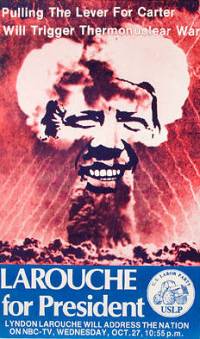
So, LaRouche’s ideas were all over the authoritarian map, but he must have been a really dynamic, engaging speaker to fascinate so many different people for so many years, right? One of those orators that just grabs the attention and plays on it like a fine musical instrument?
There are LaRouche TV specials that consist of nothing but LaRouche himself talking, but I didn’t want to inflict one of those on you. You know why? Because when he’s not saying something utterly crazy, the man is boring. Lyndon LaRouche was a child of the American Weird, but he was too dull to excel even at raving like a lunatic.
February 14, 2019
January 28, 2019
The Cold War – OverSimplified (Part 2)
OverSimplified
Published on 24 Jan 2019
January 26, 2019
The Cold War – OverSimplified (Part 1)
OverSimplified
Published on 24 Jan 2019
January 8, 2019
QotD: RINOs and other soft conservatives
The RINOs you complain about are RINOs now but they weren’t always. I don’t know how many of you remember the seventies. The right here was kind of like the right in Europe. It assumed that in the end communism would not only win, but DESERVED to win, and what the right disagreed with was the way to get there. It is useful to remember this was a time when William Buckley’s dictum that conservatism was “Standing astride History yelling stop” found deep resonance. Unpack that phrase. It assumes history comes with an arrow, that it’s not going our way, and that at best we can get it to pause.
Those RINOs who, by the way, took immense flack back then were as conservative as anyone dared to be. Because everyone knew in the end the reds won.
Then the wall fell down and we knew what true horrors lurked on the other side.
Individuals process these things fast enough. Well, my generation, at any rate, awakened by Reagan and shown that the win of the dark side was not inevitable, was more pro-freedom than people ten years older than us.
But when we saw the wall fall down, it pushed many of us further into the liberty side of the isle. Not only wasn’t a communist win inevitable, but their vaunted “strengths” like superior planning and better minority integration didn’t exist unless you really wanted to plan for three million size thirty boots for the left foot only, and integration meant grinding the minorities very fine and spreading them in the soil.
However cultures aren’t individuals. Cultures re-orient and process startling events very slowly.
Yeah, those older Republicans are still with us, and they were over 45 when the wall fell, which means they couldn’t reorient anymore. (Studies have been done.)
Sarah Hoyt, “The Long March”, According to Hoyt, 2015-12-20.
January 3, 2019
QotD: Distorting history for political ends
Every nationalist is haunted by the belief that the past can be altered. He spends part of his time in a fantasy world in which things happen as they should — in which, for example, the Spanish Armada was a success or the Russian Revolution was crushed in 1918 — and he will transfer fragments of this world to the history books whenever possible. Much of the propagandist writing of our time amounts to plain forgery. Material facts are suppressed, dates altered, quotations removed from their context and doctored so as to change their meaning. Events which it is felt ought not to have happened are left unmentioned and ultimately denied. In 1927 Chiang Kai Shek boiled hundreds of Communists alive, and yet within ten years he had become one of the heroes of the Left. The re-alignment of world politics had brought him into the anti-Fascist camp, and so it was felt that the boiling of the Communists ‘didn’t count’, or perhaps had not happened. The primary aim of propaganda is, of course, to influence contemporary opinion, but those who rewrite history do probably believe with part of their minds that they are actually thrusting facts into the past. When one considers the elaborate forgeries that have been committed in order to show that Trotsky did not play a valuable part in the Russian civil war, it is difficult to feel that the people responsible are merely lying. More probably they feel that their own version was what happened in the sight of God, and that one is justified in rearranging the records accordingly.
Indifference to objective truth is encouraged by the sealing-off of one part of the world from another, which makes it harder and harder to discover what is actually happening. There can often be a genuine doubt about the most enormous events. For example, it is impossible to calculate within millions, perhaps even tens of millions, the number of deaths caused by the present war. The calamities that are constantly being reported — battles, massacres, famines, revolutions — tend to inspire in the average person a feeling of unreality. One has no way of verifying the facts, one is not even fully certain that they have happened, and one is always presented with totally different interpretations from different sources. What were the rights and wrongs of the Warsaw rising of August 1944? Is it true about the German gas ovens in Poland? Who was really to blame for the Bengal famine? Probably the truth is discoverable, but the facts will be so dishonestly set forth in almost any newspaper that the ordinary reader can be forgiven either for swallowing lies or failing to form an opinion. The general uncertainty as to what is really happening makes it easier to cling to lunatic beliefs. Since nothing is ever quite proved or disproved, the most unmistakable fact can be impudently denied. Moreover, although endlessly brooding on power, victory, defeat, revenge, the nationalist is often somewhat uninterested in what happens in the real world. What he wants is to feel that his own unit is getting the better of some other unit, and he can more easily do this by scoring off an adversary than by examining the facts to see whether they support him. All nationalist controversy is at the debating-society level. It is always entirely inconclusive, since each contestant invariably believes himself to have won the victory. Some nationalists are not far from schizophrenia, living quite happily amid dreams of power and conquest which have no connection with the physical world.
George Orwell, “Notes on Nationalism”, Polemic, 1945-05.
December 20, 2018
China’s Cultural Revolution
In Quillette, James David Banker describes the beginnings of Mao Zedong’s Cultural Revolution:
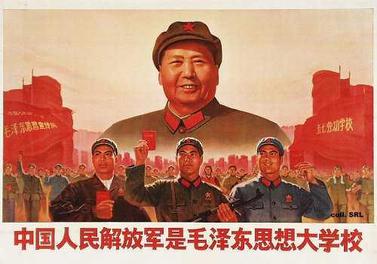
“The Chinese People’s Liberation Army is the great school of Mao Zedong Thought”, 1969.
A poster from the Cultural Revolution, featuring an image of Chairman Mao, published by the government of the People’s Republic of China.
Image via Wikimedia Commons.
“Nobody is more dangerous than he who imagines himself pure in heart,” wrote James Baldwin, “for his purity, by definition, is unassailable.” This observation has been confirmed many times throughout history. However, China’s Cultural Revolution offers perhaps the starkest illustration of just how dangerous the “pure in heart” can be. The ideological justification for the revolution was to purge the Chinese Communist Party (CCP), and the nation more broadly, of impure elements hidden in its midst: capitalists, counter-revolutionaries, and “representatives of the bourgeoisie.” To that end, Mao Zedong activated China’s youth — unblemished and uncorrupted in heart and mind — to lead the struggle for purity. Christened the “Red Guards,” they were placed at the vanguard of a revolution that was, in truth, a cynical effort by Mao to reassert his waning power in the Party. Nevertheless, it set in motion a self-destructive force of almost unimaginable depravity.
The Cultural Revolution commenced in spirit when Mao published a letter indicting a number of Party leaders on May 16, 1966. But it was a seemingly minor event nine days later that ignited the revolution in effect: a young philosophy professor at Peking University named Nie Yuanzi placed a “big-character poster” (a handwritten propaganda sheet featuring large Chinese characters) on a public bulletin board denouncing the university president and others in the administration as bourgeois revisionists. Mao immediately endorsed her protest, which set off a chain reaction of student revolt that swept through China.
That chain reaction was accelerated by “working groups” of ideologues sent to administer schools. Under their tenure, schools became centers of activism rather than learning. Students were encouraged to create big-character posters exposing their own teachers, officials, and even parents. The accused were humiliated in daily “struggle sessions” in which their students and colleagues interrogated them and demanded confessions. The viciousness of these sessions rapidly intensified. Students beat, spat upon, and tortured — in horrifically creative ways — their often elderly teachers and professors. In one case, students demanded their biology professor stare at the sun with wide open eyes. If he blinked or looked away, they beat him. Even middle and elementary school students participated in the struggle sessions, sometimes beating their teachers to death with sticks and belt buckles.
Students were also encouraged to turn on their classmates. As the sins of one generation passed to the next, a new hierarchy was born: the children of revolutionaries on top and the children of “landlords,” “capitalists,” and “rightists” at the bottom. These students were labeled “rotten eggs” and were fair game for the same treatment meted out to their parents. The current president of the People’s Republic of China, Xi Jinping, endured this fate. He was only 15 years old when his father, a loyal Maoist and one-time propaganda chief, was purged, his sister executed, and his own mother forced to denounced Xi as a reactionary. Amid the hysteria, teachers, professors, and intellectuals did not dare to stand up to the students or defend their colleagues lest they suffer similar fates. But they could not escape by being bystanders. With every word and action becoming potential evidence of capitalist sympathy, teachers and intellectuals enthusiastically joined their students in the struggle sessions and screaming rallies.
December 16, 2018
QotD: Transferring nationalist passions
The intensity with which they are held does not prevent nationalist loyalties from being transferable. To begin with, […] they can be and often are fastened up on some foreign country. One quite commonly finds that great national leaders, or the founders of nationalist movements, do not even belong to the country they have glorified. Sometimes they are outright foreigners, or more often they come from peripheral areas where nationality is doubtful. Examples are Stalin, Hitler, Napoleon, de Valera, Disraeli, Poincare, Beaverbrook. The Pan-German movement was in part the creation of an Englishman, Houston Chamberlain. For the past fifty or a hundred years, transferred nationalism has been a common phenomenon among literary intellectuals. With Lafcadio Hearne the transference was to Japan, with Carlyle and many others of his time to Germany, and in our own age it is usually to Russia. But the peculiarly interesting fact is that re-transference is also possible. A country or other unit which has been worshipped for years may suddenly become detestable, and some other object of affection may take its place with almost no interval. In the first version of H. G. Wells’s Outline of History, and others of his writings about that time, one finds the United States praised almost as extravagantly as Russia is praised by Communists today: yet within a few years this uncritical admiration had turned into hostility. The bigoted Communist who changes in a space of weeks, or even days, into an equally bigoted Trotskyist is a common spectacle. In continental Europe Fascist movements were largely recruited from among Communists, and the opposite process may well happen within the next few years. What remains constant in the nationalist is his state of mind: the object of his feelings is changeable, and may be imaginary.
But for an intellectual, transference has an important function […]. It makes it possible for him to be much more nationalistic — more vulgar, more silly, more malignant, more dishonest — that he could ever be on behalf of his native country, or any unit of which he had real knowledge. When one sees the slavish or boastful rubbish that is written about Stalin, the Red Army, etc. by fairly intelligent and sensitive people, one realises that this is only possible because some kind of dislocation has taken place. In societies such as ours, it is unusual for anyone describable as an intellectual to feel a very deep attachment to his own country. Public opinion — that is, the section of public opinion of which he as an intellectual is aware — will not allow him to do so. Most of the people surrounding him are sceptical and disaffected, and he may adopt the same attitude from imitativeness or sheer cowardice: in that case he will have abandoned the form of nationalism that lies nearest to hand without getting any closer to a genuinely internationalist outlook. He still feels the need for a Fatherland, and it is natural to look for one somewhere abroad. Having found it, he can wallow unrestrainedly in exactly those emotions from which he believes that he has emancipated himself. God, the King, the Empire, the Union Jack — all the overthrown idols can reappear under different names, and because they are not recognised for what they are they can be worshipped with a good conscience. Transferred nationalism, like the use of scapegoats, is a way of attaining salvation without altering one’s conduct.
George Orwell, “Notes on Nationalism”, Polemic, 1945-05.
December 12, 2018
QotD: G.K. Chesterton’s political Catholicism
Ten or twenty years ago, the form of nationalism most closely corresponding to Communism today was political Catholicism. Its most outstanding exponent — though he was perhaps an extreme case rather than a typical one — was G. K. Chesterton. Chesterton was a writer of considerable talent who whose to suppress both his sensibilities and his intellectual honesty in the cause of Roman Catholic propaganda. During the last twenty years or so of his life, his entire output was in reality an endless repetition of the same thing, under its laboured cleverness as simple and boring as ‘Great is Diana of the Ephesians.’ Every book that he wrote, every scrap of dialogue, had to demonstrate beyond the possibility of mistake the superiority of the Catholic over the Protestant or the pagan. But Chesterton was not content to think of this superiority as merely intellectual or spiritual: it had to be translated into terms of national prestige and military power, which entailed an ignorant idealisation of the Latin countries, especially France. Chesterton had not lived long in France, and his picture of it — as a land of Catholic peasants incessantly singing the Marseillaise over glasses of red wine — had about as much relation to reality as Chu Chin Chow has to everyday life in Baghdad. And with this went not only an enormous overestimation of French military power (both before and after 1914-18 he maintained that France, by itself, was stronger than Germany), but a silly and vulgar glorification of the actual process of war. Chesterton’s battle poems, such as Lepanto or The Ballad of Saint Barbara, make The Charge of the Light Brigade read like a pacifist tract: they are perhaps the most tawdry bits of bombast to be found in our language. The interesting thing is that had the romantic rubbish which he habitually wrote about France and the French army been written by somebody else about Britain and the British army, he would have been the first to jeer. In home politics he was a Little Englander, a true hater of jingoism and imperialism, and according to his lights a true friend of democracy. Yet when he looked outwards into the international field, he could forsake his principles without even noticing he was doing so. Thus, his almost mystical belief in the virtues of democracy did not prevent him from admiring Mussolini. Mussolini had destroyed the representative government and the freedom of the press for which Chesterton had struggled so hard at home, but Mussolini was an Italian and had made Italy strong, and that settled the matter. Nor did Chesterton ever find a word to say about imperialism and the conquest of coloured races when they were practised by Italians or Frenchmen. His hold on reality, his literary taste, and even to some extent his moral sense, were dislocated as soon as his nationalistic loyalties were involved.
Obviously there are considerable resemblances between political Catholicism, as exemplified by Chesterton, and Communism. So there are between either of these and for instance Scottish nationalism, Zionism, Antisemitism or Trotskyism. It would be an oversimplification to say that all forms of nationalism are the same, even in their mental atmosphere, but there are certain rules that hold good in all cases.
George Orwell, “Notes on Nationalism”, Polemic, 1945-05.


