Quotulatiousness

July 17, 2021

Look at Life – The Last Battleship – HMS Vanguard (1962)

Filed under: Britain, History, Military — Tags: , , , — Nicholas @ 02:00

capspread
Published 29 Nov 2020

#LookatLife​ #HMSVanguard​ #RoyalNavy​ #Shipping​ #Battleship​

The life and death of HMS Vanguard, and the uses to which her steel will be put.

Another Look at Life Documentary from Volume 2 – Military – The Last Battleship – HMS Vanguard made in 1962.

HMS Vanguard was a British fast battleship built during the Second World War & commissioned afterwards. She was the biggest and fastest of the Royal Navy’s battleships, the only ship of her class, and the last battleship to be built. Work on Vanguard was started and stopped several times during the war and her design was revised several times during her construction to reflect war experience. These stoppages and changes prevented her from being completed before the end of the war.

Vanguard‘s first task after completing her sea trial at the end of 1946 was, early the next year, to convey King George VI & his family on the first Royal Tour of South Africa by a reigning monarch. While refitting after her return, she was selected for another Royal Tour of Australia and New Zealand in 1948. This was cancelled due to King George’s declining health & Vanguard briefly became flagship of the Mediterranean Fleet in early 1949. After her return home in mid-1949, she became flagship of the Home Fleet Training Squadron. Throughout her career, the battleship usually served as the flagship of any unit to which she was assigned. During the early 1950s, Vanguard was involved in a number of training exercises with NATO forces. In 1953 she participated in Queen Elizabeth II’s Coronation Review. While she was refitting in 1955, the Admiralty announced that the ship was going to be put into reserve upon completion of the work. Vanguard was sold for scrap and was broken up beginning in 1960.

Vanguard had an overall length of 814 feet 4 inches (248.2 m), a beam of 107 feet 6 inches (32.8 m) & a draught of 36 feet (11 m) at deep load. She displaced 44,500 long tons (45,200 t) at standard load and 51,420 long tons (52,250 t) at deep load. The ship was significantly larger than her predecessors of the class, almost 50 feet (15.2 m) longer & displaced about 6,000 long tons (6,100 t) more than the older ships at deep load. Vanguard was overweight by some 2,200 long tons (2,200 t), which magnified the difference. The ship had a complete double bottom 5 feet (1.5 m) deep & she was divided into 27 main compartments by watertight bulkheads.

The King George V-class ships had been built with almost no sheer to the main deck forwards to allow ‘A’ turret to fire straight forward at zero elevation, resulting in those ships being wet forward. Vanguard was redesigned as a result of this experience, significant sheer & flare being added to the bow. The ship was well regarded as seaworthy, able to keep an even keel in rough seas. At full load, Vanguard had a metacentric height of 8.2 feet (2.5 m).

As a fleet flagship, her complement was 115 officers and 1,860 men in 1947. Air conditioning was provided for many of the ship’s control spaces, & asbestos insulation was provided on exposed areas of the ship’s sides, decks and bulkheads. Steam heating was provided for her armament, instruments, look-out positions & other equipment to make Vanguard suitable for operations in the Arctic. An Action Information Centre was fitted below the main armour deck with facilities to track aircraft & ships around Vanguard.

Vanguard was laid down on 2 October 1941 by John Brown and Company of Clydebank, Scotland. After the Japanese invasion of Malaya in December, the ship was given an A1 priority in the hope of finishing her by the end of 1944, and construction of the light cruiser HMS Bellerophon, as well as some merchant shipping, was halted to expedite the ship’s completion. This was unsuccessful, however, due to a shortage of skilled labour. As a result, it was not until 30 November 1944 that the ship was launched. Princess Elizabeth presided over this ceremony, the first ship she ever launched, and was presented with a diamond rose brooch to commemorate the event.

The end of hostilities following Japan’s surrender reduced the need for new warships, and consequently the ship was not commissioned until 12 May 1946. By this time, a total of £11,530,503, including £3,186,868 for the modernisation of the main armament, had been spent on producing Vanguard.

On 9 October 1959 the Admiralty announced that Vanguard would be scrapped, as she was considered obsolete and too expensive to maintain. She was decommissioned on 7 June 1960 & sold to BISCO for £560,000. On 4 August 1960, the ship was towed from Portsmouth to the breaker’s yard at Faslane, Scotland. As Vanguard was being towed towards the harbour entrance, she slewed across the harbour and ran aground near the Still & West pub. She was pulled off by five tugboats an hour later, and made her final exit from Portsmouth. Five days later she arrived at Faslane, and by mid-1962 the demolition process was complete.

July 13, 2021

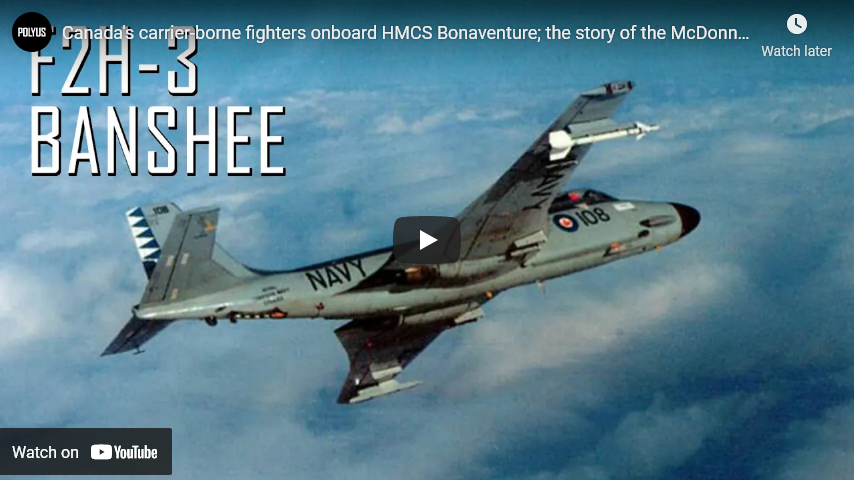
HMCS Bonaventure – Guide 143

Filed under: Britain, Cancon, History, Military — Tags: , , , , , — Nicholas @ 02:00

Drachinifel
Published 21 Sep 2019

Canada’s last carrier is today’s subject for discussion.

Want to support the channel? – https://www.patreon.com/Drachinifel​

Want a shirt/mug/hoodie – https://shop.spreadshirt.com/drachini…​

Want a medal? – https://www.etsy.com/uk/shop/Drachinifel​

Want to talk about ships? https://discord.gg/TYu88mt

Want to get some books? www.amazon.co.uk/shop/drachinifel

Drydock Episodes in podcast format – https://soundcloud.com/user-21912004

June 30, 2021

Tank Chats #113 | Ferret Scout Car | The Tank Museum

Filed under: Britain, History, Military, Weapons — Tags: , , — Nicholas @ 02:00

The Tank Museum
Published 11 Dec 2020

Tank museum Historian David Fletcher discusses the Ferret Armoured Car, also commonly known as the Ferret Scout Car. Built between 1952 and 1972 by Daimler, the Ferret was pressed into service in a reconnaissance role and saw service with the British Army, RAF and multiple commonwealth countries throughout its service life.
(more…)

June 25, 2021

L4: The Bren in 7.62mm NATO

Filed under: Britain, History, Military, Weapons — Tags: , , , , , — Nicholas @ 02:00

Forgotten Weapons
Published 10 Mar 2021

http://www.patreon.com/ForgottenWeapons​

https://www.floatplane.com/channel/Fo…​

Cool Forgotten Weapons merch! http://shop.bbtv.com/collections/forg…​

When the British military transitioned from the .303 British cartridge to 7.62mm NATO in the 1950s, it replaced the Enfield rifles with the new L1A1 SLR (the FAL) but retained the Bren gun as a support weapon. The Bren was updated to use 7.62mm, in a process more complicated than most people would think. Ultimately, only a few thousand L4 series Brens were made, as they were rather quickly supplanted by the FN MAG as a belt-fed support weapon.

The four different patterns of L4 are:
L4A1 – the initial pattern, without magazine supports
L4A2 – the Bren MkIII in 7.62mm with magazine supports
L4A3 – the Bren MkII in 7.62mm with magazine supports
L4A4 – the A2 and A3 patterns with chrome-lined barrels

Contact:
Forgotten Weapons
6281 N. Oracle 36270
Tucson, AZ 85740

June 11, 2021

Tanks Chats #110 | T-72 | The Tank Museum

Filed under: History, Military, Russia, Weapons — Tags: , , , , , — Nicholas @ 02:00

The Tank Museum
Published 13 Nov 2020

Join David Willey as he discusses the T-72, a Soviet era main battle tank which first entered production in 1971. The T-72’s service life has proven to be extremely successful. With about 20,000 produced, it has seen service with over 40 countries, and thanks to refurbishment, is still in service to this very day.

With thanks to RecoMonkey for additional images https://www.recomonkey.com/
(more…)

June 6, 2021

QotD: The Soviet Union in the Cold War, China today

Filed under: China, History, Media, Quotations, Russia, USA — Tags: , , , , , — Nicholas @ 01:00

Back in the days of the Cold War, much was said about the titanic power of the Soviet Union. The USSR, we were told, was a superpower the equal of the United States, possibly even superior. This meme was spread by lefties who wanted the USSR to win, by sincere pacifists hoping to stop war before it could begin, and by an enormous cohort of liberals who repeated it because they heard it from the first two. (Much liberalism can be explained this way. It’s the ultimate “I heard it from somebody” ideology.)

Needless to say, it was gibbering nonsense. The late ’80s Soviet collapse revealed that the USSR was never any kind of power at all – an economy that didn’t produce, weapons that didn’t work, a populace addicted to drink and overwhelmed with despair. “Bulgaria with nukes” is how someone characterized it, and truer words were never spoken. That remains the case today, despite Vlad Putin’s chest-beating, and it’s likely to remain the case as far ahead as anyone can see.

The same trope is being repeated regarding China. China, we are told, is the coming nation. The second largest economy on Earth, soon to be the first. A billion and a half people, each more educated than any American; a military power second to none, with advanced weapons of a nature that we can only gape at. A country exercising its power over vast reaches of the Pacific and moving into the Indian Ocean, Africa, and the Mideast with no one to oppose it.

We hear this from the likes of Thomas Friedman, who has spent much of his career looking for his personal Mussolini. It’s repeated by deeper figures across the political spectrum. In fact, it can be said without exaggeration to have become received wisdom.

There’s no point in asking how true this is. The proper question to ask is whether it embodies any truth at all.

J.R. Dunn, “The Myth of China as Superpower”, American Thinker, 2019-01-09.

June 4, 2021

Tank Chats #109 | Scorpion & TV15000 | The Tank Museum

Filed under: Britain, History, Military, Weapons — Tags: , , , — Nicholas @ 02:00

The Tank Museum
Published 30 Oct 2020

Join The Tank Museum’s Historian David Fletcher as he discusses the TV15000, the unique prototype of the FV101 Scorpion armoured reconnaissance vehicle. David examines its development and how it came to be the production Scorpion we know today.
(more…)

May 28, 2021

Tank Chats #108 | M48 | The Tank Museum

Filed under: History, Military, USA, Weapons — Tags: , , , , , — Nicholas @ 02:00

The Tank Museum
Published 23 Oct 2020

Tank Museum Historian David Fletcher discusses the M48 “Patton”, an American first generation Main Battle Tank introduced in 1952. Throughout its service life, the M48 has been very successful and has seen service with many countries including the Americans in Vietnam and the Israel Defense Forces.

Support the work of The Tank Museum on Patreon: ► https://www.patreon.com/tankmuseum
Visit The Tank Museum SHOP & become a Friend: ► tankmuseumshop.org

Twitter: ► https://twitter.com/TankMuseum
Instagram: ► https://www.instagram.com/tankmuseum/
#tankmuseum #tanks

May 21, 2021

Tank Chats #107 | T-62 | The Tank Museum

Filed under: History, Military, Russia, Weapons — Tags: , , , , — Nicholas @ 02:00

The Tank Museum
Published 9 Oct 2020

Here The Tank Museum’s Curator David Willey discusses the Soviet T-62, including its development and service life. Introduced in 1962, it was a further evolution of the T-55 series, which David discussed in Tank Chat #104.

Support the work of The Tank Museum on Patreon: ► https://www.patreon.com/tankmuseum
Visit The Tank Museum SHOP & become a Friend: ► tankmuseumshop.org

Twitter: ► https://twitter.com/TankMuseum
Instagram: ► https://www.instagram.com/tankmuseum/
#tankmuseum #tanks

April 29, 2021

Tank Chats #105 | Saladin | The Tank Museum

Filed under: Britain, History, Military, Weapons — Tags: , , , — Nicholas @ 02:00

The Tank Museum
Published 4 Sep 2020

David Fletcher is back! Join him as he discusses the FV601 Saladin — a six wheeled armoured car developed by Crossley Motors and later produced by Alvis. The Saladin has had a long service life and despite its dated design, is still in service with some countries.

Support the work of The Tank Museum on Patreon: ► https://www.patreon.com/tankmuseum
Visit The Tank Museum SHOP & become a Friend: ► tankmuseumshop.org

Twitter: ► https://twitter.com/TankMuseum
Instagram: ► https://www.instagram.com/tankmuseum/
#tankmuseum #tanks

April 24, 2021

This Insane Helicopter Was The Largest Ever Built: The Mil V-12 Story

Filed under: History, Military, Russia, Technology, Weapons — Tags: , , , , — Nicholas @ 02:00

Mustard
Published 10 Sep 2020

Sign up for an annual CuriosityStream subscription and you’ll also get a free Nebula subscription (the new streaming platform built by creators) here: http://CuriosityStream.com/mustard

Research and writing in collaboration with Tomás Campos.

The Soviets built some of the largest and most technically advanced helicopters in the world. By 1957, the Mil Mi-6 had already emerged as the largest helicopter ever built, far out-sizing helicopters built in the west. But for the Soviet Union, the need to build a helicopter far larger than even the Mi-6, soon became a matter of national security.

By 1960, American U-2 spy planes conducting high altitude reconnaissance flights over the Soviet Union were beginning to uncover the location of the country’s Intercontinental Ballistic Missile (ICBM) sites. These first generation R-7 Semyorka ICBMs were being deployed throughout the Soviet Union as fast as possible, but their enormous size and weight meant they could only be delivered to launch sites using trains. The need to build rail lines to launch sites made the ICBM sites easy to spot in U.S. reconnaissance photos.

Keeping the missile sites hidden was a matter of national security. The Soviets devised a bold plan to airlift ICBMs into the vast and remote Soviet wilderness, thereby eliminating the need for rail lines or even roads. This would make it virtually impossible for spy planes to track down missile sites hidden in over twelve million square kilometres of forests. But to make the plan work, the Soviets would need to build a helicopter with at least twice the lifting power of the Mi-6.

Design studies for the new enormous helicopter began in 1959, with the Soviet Council of Ministers formally approving development in 1962. But development of such an ambitious helicopter would progress slowly, as various configurations (single rotor, tandem and transverse) were studied. Construction of testing-rigs, transmission systems and mock-ups began in 1963, and construction of the first prototype started in 1965. The new prototype would be designated as the Mil V-12 (with plans to designate the production version as Mil Mi-12). The first test flight in 1967 ended in failure as the V-12 crashed back to earth sustaining minor damage due to oscillations caused by control problems. A second test flight a year later proved the helicopter’s airworthiness.

The V-12 would go on to break numerous world records for lifting capacity, but its fate had already been sealed by a rapidly changing strategic situation. The introduction of spy satellites, and the development of new lighter and mobile ICBMs made hiding nuclear missiles strategically irrelevant.

In 1970, the Soviet Air Force refused to accept the V-12 into state acceptance trials, due to a lack of need. Although a second V-12 prototype would be constructed in 1972, there were simply too few scenarios that would require such a large and complex helicopter. In 1974 development of the V-12 was cancelled and the Mil Design Bureau shifted efforts to designing the Mil Mi-26, the largest helicopter to enter service.

Select footage courtesy the AP Archive:
AP Archive website: http://www.aparchive.com YouTube: https://www.youtube.com/c/aparchive and https://www.youtube.com/c/britishmovi…

Special thanks to Nick Arehart for helping clean up our audio:
https://twitter.com/airhrt_

Link to the Mustard Store:
teespring.com/stores/mustard-store

Music used in this production (reproduced under license):

Intro Song: “Space Cinematic”- https://www.pond5.com/royalty-free-mu…

Song 2: “Yet Another Chase” – https://www.epidemicsound.com/track/X…

Song 3: “The Board Is Set” – https://www.epidemicsound.com/track/g…

Song 4: “Grim March” – https://www.pond5.com/royalty-free-mu…

Song 5: “Like the Wind” – https://www.pond5.com/royalty-free-mu…

Song 6: “Synthwave Industrial Technology” – https://audiojungle.net/item/synthwav…

Thanks for watching!

April 21, 2021

Tank Chats #104 | T-54 & T-55 | The Tank Museum

Filed under: History, Military, Russia, Weapons — Tags: , , , , — Nicholas @ 02:00

The Tank Museum
Published 14 Aug 2020

Here Curator David Willey discusses the T-54, and its successor the T-55, tanks which can source their roots back to the Second World War and are probably the most produced tanks of all time.

Support the work of The Tank Museum on Patreon: ► https://www.patreon.com/tankmuseum
Visit The Tank Museum SHOP & become a Friend: ► tankmuseumshop.org

Twitter: ► https://twitter.com/TankMuseum
Instagram: ► https://www.instagram.com/tankmuseum/
#tankmuseum #tanks

April 15, 2021

Britain Goes From Trainer to Competition: the No 8 Mk I

Filed under: Britain, History, Military, Weapons — Tags: , , , — Nicholas @ 02:00

Forgotten Weapons
Published 18 Jun 2018

http://www.forgottenweapons.com/brita…

http://www.patreon.com/ForgottenWeapons

Cool Forgotten Weapons merch! http://shop.bbtv.com/collections/forg…

Initially intended to be used only by the British Army (the Land Service), in 1950 the No8 rifle’s role was expanded to cover all three services. Unlike the other trainers made up to this point, the No8 MkI was designed as a target and competition rifle, instead of a service rifle reduced in caliber. It has a heavy barrel, a nice trigger converter to cock on open, and a heavy competition type stock. Adopted in 1948 or 1949 (sources differ), a whopping 76,000 were ordered and manufactured by BSA and Fazackerly — they remained in service until finally declared obsolescent by the British in 2014.

If you enjoy Forgotten Weapons, check out its sister channel, InRangeTV! http://www.youtube.com/InRangeTVShow
Contact:
Forgotten Weapons
6281 N Oracle #36270
Tucson, AZ 85704

April 11, 2021

HMCS Warrior (R31) – Colossus-class Light Aircraft Carrier

Filed under: Cancon, History, Military — Tags: , , , , , — Nicholas @ 02:00

canmildoc
Published 30 Mar 2013

HMS Warrior (R31) was a Colossus-class light aircraft carrier which served in the Royal Canadian Navy from 1946 to 1948 (as HMCS Warrior). She was transferred to the Royal Canadian Navy, commissioned as HMCS Warrior and placed under the command of Captain Frank Houghton. She entered Halifax harbour on 31 March 1946, a week after leaving Portsmouth. She was escorted by the destroyer HMCS Micmac and the minesweeper HMCS Middlesex. The RCN experienced problems with the unheated equipment during operations in cold North Atlantic waters off eastern Canada during 1947. The RCN deemed her unfit for service and, rather than retrofit her with equipment heaters, made arrangements with the Royal Navy to trade her for a more suitable aircraft carrier of the Majestic class which became HMCS Magnificent (CVL 21) on commissioning. [Original text from Wikipedia]

Tags: Colossus Class Light Aircraft Carrier, HMCS Warrior, HMCS, RCN, Royal Canadian Navy, aircraft carrier, CV, Halifax

From the Wikipedia description of HMCS Warrior:

Warrior was a Colossus-class light aircraft carrier that was 630 feet 0 inches (192.0 m) long between perpendiculars and 695 feet 0 inches (211.8 m) overall with a beam at the waterline of 80 feet 0 inches (24.4 m) and an overall width of 112 feet 6 inches (34.3 m). The ship had a mean draught of 23 feet 3 inches (7.1 m). Warrior had a standard displacement of 13,350 long tons (13,560 t) when built and a full load displacement of 18,300 long tons (18,600 t). The aircraft carrier had a flight deck 690 feet 0 inches (210.3 m) long that was 80 feet 0 inches (24.4 m) wide and was 39 feet 0 inches (11.9 m) above the water. The flight deck tapered to 45 feet (14 m) at the bow. For takeoffs, the flight deck was equipped with one BH 3 aircraft catapult capable of launching 16,000-pound (7,257 kg) aircraft at 66 knots (122 km/h). For landings, the ship was fitted with 10 arrestor wires capable of stopping a 15,000-pound (6,804 kg) aircraft, with two safety barriers rated at stopping a 15,000-pound aircraft at 40 knots (74 km/h). Warrior had two aircraft elevators located along the centreline of the ship that were 45 by 34 feet (13.7 by 10.4 m) and could handle aircraft up to 15,000 pounds on a 36-second cycle. The aircraft hangar was 275 by 52 feet (83.8 by 15.8 m) with a further 57 by 52 feet (17.4 by 15.8 m) section beyond the aft elevator, all with a clearance of 17 feet 6 inches (5.3 m). The hangar was divided into four sections by asbestos fire curtains. The hangar was fully enclosed and could only be entered by air locks and the lifts, due to the hazardous nature of aviation fuel and oil vapours. The vessel had stowage for 98,600 Imperial gallons (448,244 l; 118,414 US gal) of aviation fuel.

The ship was powered by steam created by four Admiralty 3-drum type boilers driving two Parsons geared turbines, each turning one shaft. The machinery was split into two spaces, each containing two boilers and one turbine, separated by 24-foot (7.3 m) spaces containing aviation fuel. The spaces were situated en echelon within the ship to prevent a single disabling torpedo strike. The engines were rated at 42,000 shaft horsepower (31,319 kW) and the vessel had a capacity for 3,196 long tons (3,247 t) of fuel oil, with an range of 8,300 nautical miles (15,372 km) at 20 knots (37 km/h). The ship’s maximum speed was 25 knots (46 km/h). There was no armour aboard the vessel save for mantlets around the torpedo storage area. There were no longitudinal bulkheads, but the transverse bulkheads were designed to allow the ship to survive two complete sections of the ship being flooded.

Warrior was designed to handle up to 42 aircraft. The aircraft carrier carried a wide range of ordnance for their aircraft from torpedoes, depth charges, bombs, 20 mm cannon ammunition and flares. For anti-aircraft defence, the aircraft carrier was initially armed with four twin-mounted and twenty single-mounted 40 mm Bofors guns. The original radar installation included the Type 79 and Type 281 long-range air search radars, the Type 293 and Type 277 fighter direction radar and the “YE” aircraft homing beacon. The ship had a maximum ship’s company of 1,300, which was reduced in peacetime.

After service with the RCN, Warrior was returned to the Royal Navy, and subsequently sold to Argentina, entering service as ARA Independencia until 1971 when she was struck from the Argentinian navy list and scrapped.

April 10, 2021

Britain’s Only Repeating Enfield Trainer: the No7 Mk I

Filed under: Britain, History, Military, Weapons — Tags: , , , , — Nicholas @ 02:00

Forgotten Weapons
Published 12 Jun 2018

http://www.forgottenweapons.com/brita…

http://www.patreon.com/ForgottenWeapons

Cool Forgotten Weapons merch! http://shop.bbtv.com/collections/forg…
Developed by BSA immediately after World War Two, the No7 MkI training rifle was the only one of the British Enfield trainers to use a magazine. Only 2500 of these rifles were produced, contracted by the Royal Air Force and delivered in 1948. Their magazine is a commercial BSA 5-round magazine modified slightly to latch into a housing inside a regular No4 Enfield magazine body. This makes them a particularly enjoyable rifle for range shooting, as well as one of the scarcest of the standard British trainers.

Note that Canada also developed and adopted a No7 MkI .22 rimfire trainer, but that type is a single shot design, and does not share any parts with the British No7 MkI.

If you enjoy Forgotten Weapons, check out its sister channel, InRangeTV! http://www.youtube.com/InRangeTVShow
Contact:
Forgotten Weapons
6281 N Oracle #36270
Tucson, AZ 85704

« Newer PostsOlder Posts »

Powered by WordPress