
The Tank Museum
Published 3 Sep 2021David Willey is back with another Tank Chat! This week’s episode is all about the Schützenpanzer. A West German infantry fighting vehicle developed from 1956 to 1958.
(more…)
December 21, 2021
Tank Chat #136 | Schützenpanzer | The Tank Museum
December 19, 2021
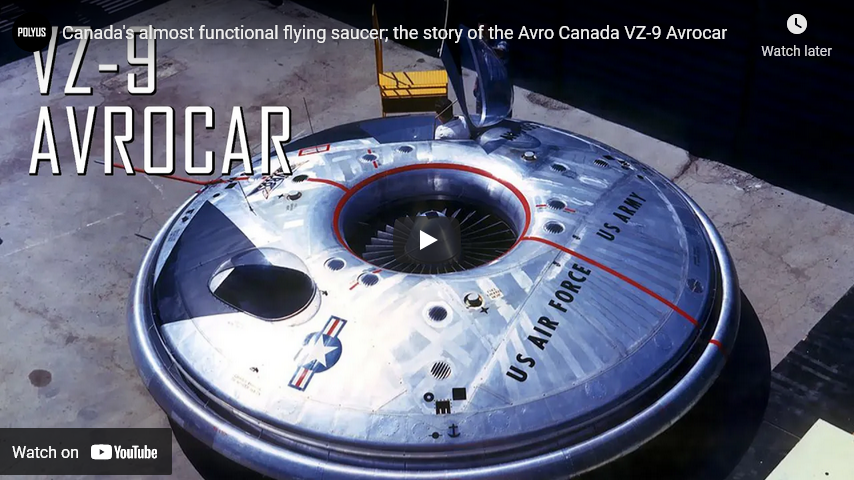
Canada’s almost functional flying saucer; the story of the Avro Canada VZ-9 Avrocar
Polyus Studios
Published 14 Jul 2018Support me on Patreon – https://www.patreon.com/polyusstudios
The Avro Canada VZ-9AV Avrocar: Canada’s first attempt at vertical take off and landing aircraft. Although the concept ultimately turned out to be a dead-end, the engineers and designers at Avro experimented with bold new ideas. Their concepts would push the limits of the imagination and reflected the extreme technological optimism of its time.
Music:
Denmark – Portland Cello ProjectResearch Sources:
“Declassified: America’s Secret Flying Saucer” – https://www.popularmechanics.com/mili…
Avro Canada VZ-9 Avrocar – https://www.aviationsmilitaires.net/v…
Avrocar: Canada’s Flying Saucer: The Story of Avro Canada’s Secret Projects by Bill Zuk (2001)
How to Build a FLYING SAUCER – https://declassification.blogs.archiv…
LaesieWorks – AVROCAR VZ-9AV – http://www.laesieworks.com/ifo/lib/AV…
The Living Moon – Project Silverbug – The Avrocar – http://www.thelivingmoon.com/49ufo_fi…Footage Sources:
Avrocar I Progress Report 01/02/1958 – 05/1959 – US National Archives (~1959)
Disc Flight Development, Avrocar I Progress Report, 05/02/1959 – 04/12/1960 – US National Archives (~1960)
Avrocar Continuation Test Program and Terrain Test Program, 06/01/1960 – 06/14/1961 – US National Archives (~1959)
Tiltwing Versatility – San Diego Air and Space Museum (~1971)Aircraft mentioned:
Project Y
Project Y-2
Project PV 704
Project 1794
Project Silverbug
Weapon System 606A
VZ-9AV Avrocar
CL-84 Dynavert#Avrocar #CanadianAerospace #Polyus
Comments Off on Canada’s almost functional flying saucer; the story of the Avro Canada VZ-9 Avrocar
December 16, 2021
Supersonic Firsts
The History Guy: History Deserves to Be Remembered
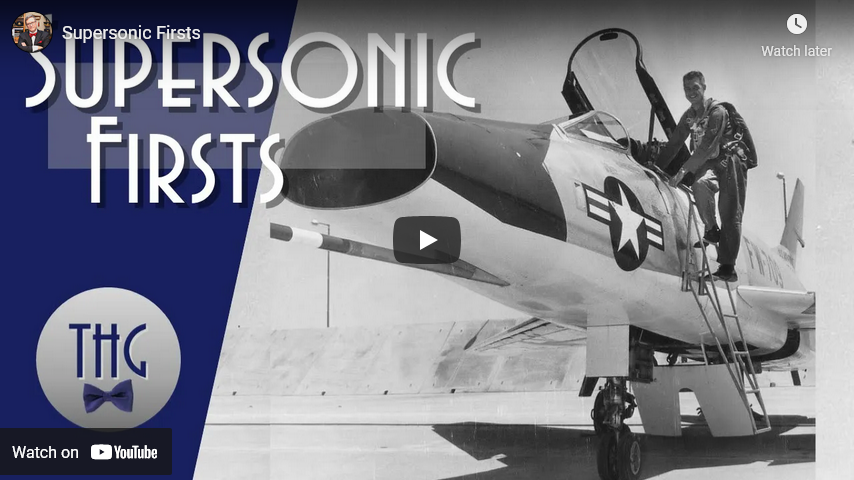
Published 20 Aug 2021On August 20, 1955, United States Air Force Colonel Horace A Hanes set the world’s first supersonic world speed record in a North American Aviation F-100C Super Sabre. Although we are well into the supersonic age, aircraft that can exceed the speed of sound are still rare machines, and marvels of engineering and pilot prowess. The early aviation pioneers who tested the terrifying sound barrier have helped scientists better understand the dynamics of superfast speeds.
This is original content based on research by The History Guy. Images in the Public Domain are carefully selected and provide illustration. As very few images of the actual event are available in the Public Domain, images of similar objects and events are used for illustration.
You can purchase the bow tie worn in this episode at The Tie Bar:
https://www.thetiebar.com/?utm_campai…All events are portrayed in historical context and for educational purposes. No images or content are primarily intended to shock and disgust. Those who do not learn from history are doomed to repeat it. Non censuram.
Find The History Guy at:
Patreon: https://www.patreon.com/TheHistoryGuy
Please send suggestions for future episodes: Suggestions@TheHistoryGuy.netThe History Guy: History Deserves to Be Remembered is the place to find short snippets of forgotten history from five to fifteen minutes long. If you like history too, this is the channel for you.
Awesome The History Guy merchandise is available at:
teespring.com/stores/the-history-guyScript by THG
#history #thehistoryguy #airforce
Comments Off on Supersonic Firsts
December 9, 2021
Tank Chat #135 | Marder | The Tank Museum
The Tank Museum
Published 27 Aug 2021In this latest episode of Tank Chats, Curator David Willey details the German Marder. A post-war Infantry Fighting vehicle.
(more…)
Comments Off on Tank Chat #135 | Marder | The Tank Museum
December 1, 2021
Tank Chats #134 | Centurion | The Tank Museum
The Tank Museum
Published 20 Aug 2021David Fletcher is back with another Tank Chat on one of the most successful post-war tank designs, Centurion. It was the primary British Army main battle tank of the post-World War II period.
(more…)
Comments Off on Tank Chats #134 | Centurion | The Tank Museum
November 28, 2021
SA80 History: XL70 Series Final Prototypes (Individual Weapon and LSW)
Forgotten Weapons
Published 13 May 2017Armament Research Services (ARES) is a specialist technical intelligence consultancy, offering expertise and analysis to a range of government and non-government entities in the arms and munitions field. For detailed photos of the guns in this video, don’t miss the ARES companion blog post:
http://armamentresearch.com/british-e…
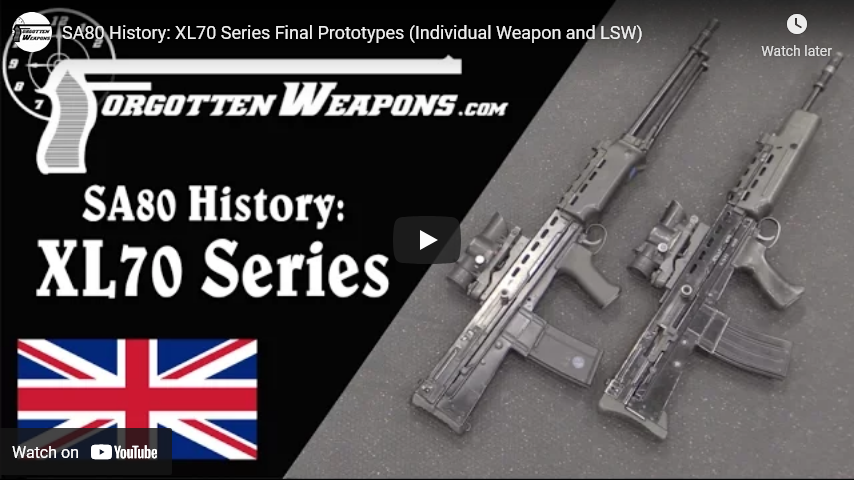
By 1980, the scheduled deadline for adopting the L85 and L86 was rapidly approaching, and the weapons should have been in the last stages of fine-tuning before production began. This was not the case, however — testing was still uncovering critical problems in the guns.
The goal for these weapons was 8000 MRBF (Mean Rounds Between Failure) for the LSW and 2500 MRBF for the IW. As real testing began, the numbers were actually 100-300 MRBF. In many cases, the guns could not run three magazines in a row without a malfunction, and this was literally an order of magnitude below the requirements. But what truly led to the massive problems with the L85/86 was that RSAF Enfield did not fix these problems. Instead, they moved the goalposts. With so many problems, it was decided to only count malfunctions that occurred in the endurance testing (ie, when the guns were not put under any environmental stress at all) and to only count “critical” malfunctions in the tally. A “critical” failure was one which could not be resolved by the shooter, such as a split barrel. Simple feed or ejection failures were not counted, nor were malfunctions that required gun disassembly to correct. Even under this new paradigm, MRBF over 3000 could not be achieved.
In addition, the LSW was showing a problem that would become endemic; split groups. The weapon shot very good groups in semiautomatic, but in full auto fire it would produce two discreet groups. The first shot in each burst would land about 6 minutes of angle low and right compared to the remaining rounds in the group. This would be the subject of significant work, and was never fully rectified.
http://www.patreon.com/ForgottenWeapons
Cool Forgotten Weapons merch! http://shop.bbtv.com/collections/forg…
If you enjoy Forgotten Weapons, check out its sister channel, InRangeTV! http://www.youtube.com/InRangeTVShow
Comments Off on SA80 History: XL70 Series Final Prototypes (Individual Weapon and LSW)
November 26, 2021
Look at Life — Air Umbrella (1961)
PauliosVids
Published 20 Nov 2018A look at NATO’s international squadrons, with footage of the F104 Starfighter.

Comments Off on Look at Life — Air Umbrella (1961)
November 24, 2021
The Marshall Plan
The Cold War
Published 6 Jul 2019Our series on the history of the Cold War period continues with a documentary on the Marshall Plan and how the USA was able to help in the rebuild of the post-War World and gained valuable allies while doing it
Consider supporting us on Patreon: https://www.patreon.com/thecoldwar

Comments Off on The Marshall Plan
November 21, 2021
SA80 History: XL60 Series in 4.85mm
Forgotten Weapons
Published 10 May 2017Armament Research Services (ARES) is a specialist technical intelligence consultancy, offering expertise and analysis to a range of government and non-government entities in the arms and munitions field. For detailed photos of the guns in this video, don’t miss the ARES companion blog post:
http://armamentresearch.com/british-e…
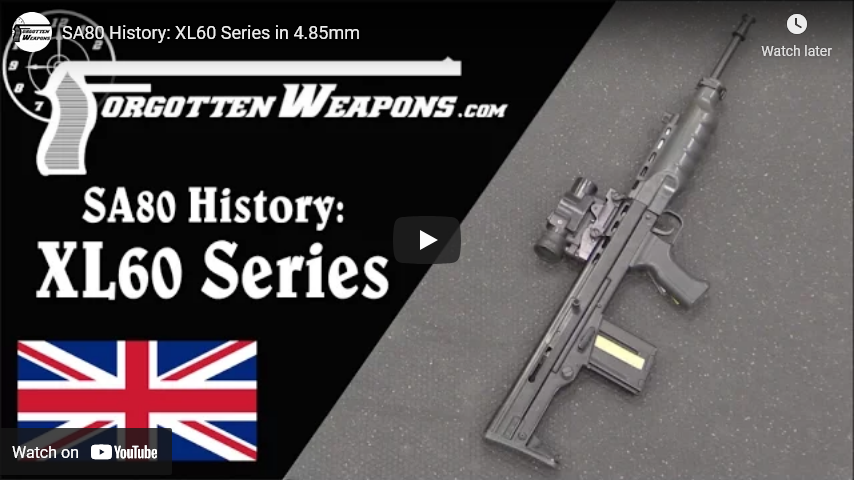
Once the basic configuration of the new British rifle was determined, the next step was to build a series of prototypes. The design that took form was basically a bullpup copy of the Armalite AR-18. The design team at Enfield were mostly senior draftsmen, with virtually no firearms experience among them. To make things worse, most of the design team was regularly rotated onto other projects, preventing them from developing any project experience on the rifle.
Several prototype batches were made (typically of a dozen guns each, both IWs and LSWs), all in the unique British 4.85x49mm cartridge, with a variety of different feature sets. Through the different patterns, configurations would change on the safety (push button vs lever) fire selector (push button vs lever), and magazine catch (straight-in side lever vs rock-in side lever vs rock-in rear paddle). At this time, plans still existed to make both left- and right-handed versions of the final gun, so prototypes of both were manufactured.
Because cost-cutting measures had not yet been forced on the project, these XL-60 series guns were generally reliable, at least in normal conditions. They are quite comfortable to fire, with a cartridge very similar to the 5.56mm NATO in practical terms. There is nothing particularly wrong with that cartridge, but it would be dropped when it lost NATO trials to the Belgian SS109 … but we will address that in the next episode of the SA80 history.
http://www.patreon.com/ForgottenWeapons
Cool Forgotten Weapons merch! http://shop.bbtv.com/collections/forg…
If you enjoy Forgotten Weapons, check out its sister channel, InRangeTV! http://www.youtube.com/InRangeTVShow
Comments Off on SA80 History: XL60 Series in 4.85mm
November 18, 2021
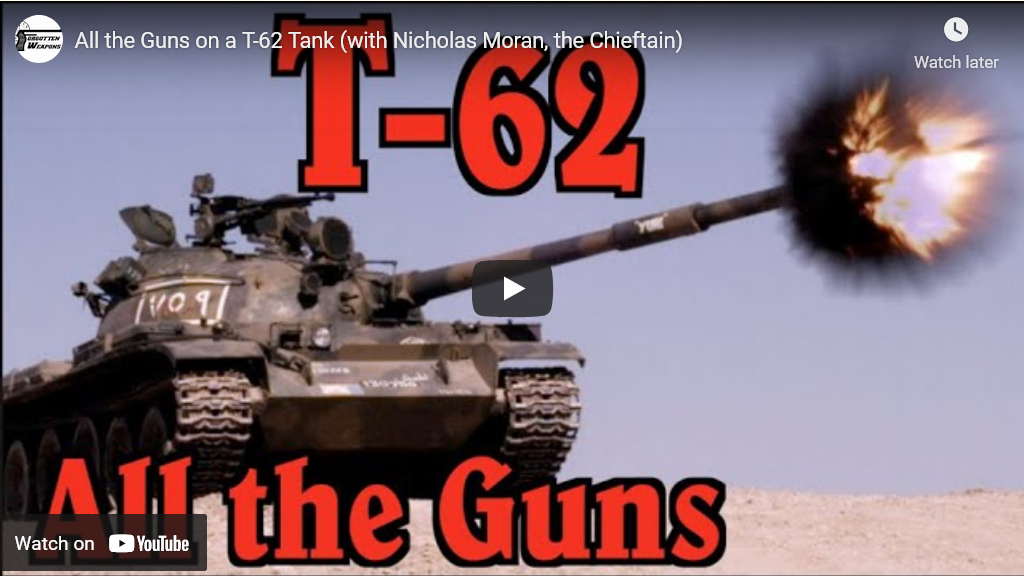
All the Guns on a T-62 Tank (with Nicholas Moran, the Chieftain)
Forgotten Weapons
Published 5 Aug 2021Try out World of Tanks with a special bonus tank using this link!
Today Nicholas Moran (the Chieftain) and I are at Battlefield Vegas courtesy of Wargaming.net, to show you around a Soviet T-62 and all its various armaments. This particular T-62 was built in 1971 or 1972 and initially sold to Syria. It saw combat in the Valley of Tears in 1973, but survived as was eventually transferred to Lebanese ownership. From there is was captured by Israel and eventually imported into the United States via the UK. The T-62 was the last of the “simple” WW2-style Soviet tanks, and equipped with an extremely effective 115mm smoothbore main gun. In addition to that cannon, we will discuss and shoot the coaxial PKT machine gun and the loader’s antiaircraft DShKM heavy machine gun.
If you enjoy this video, check out World of Tanks – and maybe they will send Nicholas and I back again to do the same thing yet again on a third tank!
For videos on the detail of tanks like this one, check out The Chieftain:
https://www.youtube.com/user/WorldOfT…
https://www.youtube.com/channel/UCp4j…0:00:00 – Introduction
0:06:02 – Coaxial PKT
0:13:12 – Antiaircraft DShKM
0:20:25 – 115mm Main Gun
0:28:43 – Firing the main gunContact:
Forgotten Weapons
6281 N. Oracle 36270
Tucson, AZ 85740
Comments Off on All the Guns on a T-62 Tank (with Nicholas Moran, the Chieftain)
November 13, 2021
Creation of Israel
The Cold War
Published 1 Jun 2019Our series on the history of the Cold War period continues with a documentary on the creation of Israel, Zionist movement, reactions and diplomatic maneuvers of other states and the build-up to first Arab-Israeli war
Consider supporting us on Patreon: https://www.patreon.com/thecoldwar

Comments Off on Creation of Israel
November 12, 2021
Britain’s Highly Unusual Crescent-Wing Victor Bomber
Dark Skies
Published 2 Nov 2021The V force was a legendary team of bombers built to serve during the post-war crisis. However, they would not carry ordinary bombs, but nuclear weapons.
As World War II ended, the division between the West and the East became a significant threat to world peace, and shortly before the Cold War began, Britain started working on a modern jet bomber force that could rival any other on the planet.
The Handley Page Victor featured a one-of-kind wing, making it the largest aircraft to break the sound barrier up to that point.
As the British mastered the atomic bomb by the mid-1950s with the exceptional V force and the Victor to deliver it, Britain’s stature among the world’s superpowers significantly solidified.
—
Join Dark Skies as we explore the world of aviation with cinematic short documentaries featuring the biggest and fastest airplanes ever built, top-secret military projects, and classified missions with hidden untold true stories. Including US, German, and Soviet warplanes, along with aircraft developments that took place during World War I, World War 2, the Korean War, the Vietnam War, the Cold War, the Gulf War, and special operations missions in between.
As images and footage of actual events are not always available, Dark Skies sometimes utilizes similar historical images and footage for dramatic effect and soundtracks for emotional impact. We do our best to keep it as visually accurate as possible.
All content on Dark Skies is researched, produced, and presented in historical context for educational purposes. We are history enthusiasts and are not always experts in some areas, so please don’t hesitate to reach out to us with corrections, additional information, or new ideas.

Comments Off on Britain’s Highly Unusual Crescent-Wing Victor Bomber
November 10, 2021
Tank Chats #131 | Kanonenjagdpanzer | The Tank Museum
The Tank Museum
Published 9 Jul 2021Curator David Willey discusses the German Cold War tank destroyer the Kanonenjagdpanzer or Jpz 4-5 for short.
(more…)
Comments Off on Tank Chats #131 | Kanonenjagdpanzer | The Tank Museum
November 9, 2021
QotD: Hollywood in the late Golden Age
In certain ways, Hollywood today is just like it was a half-century ago. It’s a company town, a plantation devoted to the manufacture of cultural commodities designed to please the largest possible number of people. Then as now, nearly all of the films produced there fit neatly into the pigeonholes of a limited number of highly stylized genres: gangster movies, costume dramas, romantic comedies, Westerns.
The main difference between then and now is that in the old days, such films were mass-produced on the assembly lines of the major studios. Americans of all ages went to the movies at least once a week, and they expected to see something different every time they went. Hence the studio system, which ground out product fast enough to meet the omnivorous demand. Except for the occasional Gone With the Wind, the modern Spielberg-style “event” movies that now dominate Hollywood filmmaking didn’t exist. You went to the movies not to see Spider-Man or Lord of the Rings, but simply to see a show. If the show in question was a Western or a mystery, that was good; if it starred John Wayne or Robert Mitchum, that was better. But nobody went out of his way to see a Wayne Western directed by Howard Hawks, much less a Mitchum mystery directed by Jacques Tourneur. You took what you got, and if what you got happened to be a Red River or Out of the Past, then you got lucky.
That’s why so many of the best films made in Hollywood in the Forties and Fifties were Westerns and mysteries. Precisely because they were commodities, their makers tended to be ignored by the front office. So long as your last picture turned a profit, however small, you got to make another one. If the movies in which you specialized were low-budget genre pictures for which demand was more or less constant, all that mattered was that you stay more or less within the accepted conventions of the genre, and the conventions of the Western and the mystery happened to be wonderfully well-suited to the artful telling of serious stories that were both entertaining and cheap to produce. The art, of course, was optional, and most such movies were as forgettable as a Law and Order rerun, but some of them were as good — and as serious — as a movie can be.
Terry Teachout, “What Randolph Scott Knew”, American Cowboy, 2005-12-23.
Comments Off on QotD: Hollywood in the late Golden Age
November 8, 2021
Look at Life — Rendered Safe (1962)
PauliosVids
Published 20 Nov 2018A look at the work of a bomb disposal squad.

Comments Off on Look at Life — Rendered Safe (1962)


