
In an attempt to put down “racism”, the concept of “hate terms” was introduced into English law for the first time. This makes many words and expressions unlawful, and punishable by fines and imprisonment. It is the most comprehensive system of censorship since the days of Hitler’s Germany and Stalin’s Russia, and means there are more restrictions on freedom of expression in England than at any other time since Hogarth’s days.
It is, of course, fatal to humour, if enforced and persisted in. For one vital quality of humour is inequality, and striking visual, aural, and physical differences. Differences in sex, age, colour, race, religion, physical ability, and strength lie at the source of the majority of jokes since the beginning of human self-consciousness. And all jokes are likely to provoke discomfort if not positive misery among those laughed at. Hence any joke is liable to fall foul of those laws. The future for humourists thus looks bleak, at the time I write this. The ordinary people like jokes, often crude ones, as George Orwell pointed out in his perceptive essay on rude seaside picture postcards. But are ordinary people, as opposed to minor officials, in charge any more? Democracy doesn’t really seem to work, and people are insufficiently dismayed at its impotence.
Paul Johnson, Humourists: From Hogarth to Noël Coward, 2010.
November 7, 2020
QotD: “Hate speech”
November 2, 2020
Federal government to web giants: “BOHICA!”
Michael Geist provides an unauthorized backgrounder on the Canadian government’s quixotic attempt to shakedown the likes of Netflix for money to give to “struggling” Canadian media companies:
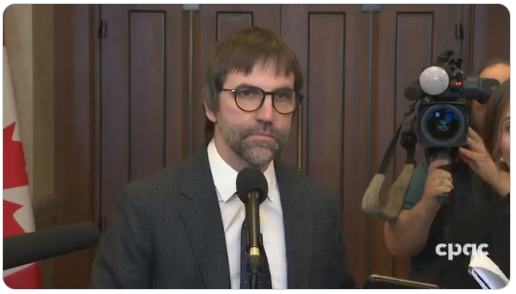
Canadian Heritage Minister Steven Guilbeault, 3 February 2020.
Screencapure from CPAC video.
Canadian Heritage Minister Steven Guilbeault is set to introduce his “Get Money from Web Giants” Internet regulation bill on Monday. Based on his previous public comments, the bill is expected to grant the CRTC extensive new powers to regulate Internet-based video streaming services. In particular, expect the government to mandate payments to support Canadian content production for the streaming services and establish new “discoverability” requirements that will require online services to override user preferences by promoting Canadian content. The government is likely to issue a policy direction to the CRTC that identifies its specific priorities, but the much-discussed link licensing requirement for social media companies that Guilbeault has supported will not be part of this legislative package.
These reforms mark the culmination of a dramatic reversal in government digital policy. After then-Heritage Minister Melanie Joly unveiled her 2017 digital cancon strategy that focused on market-based solutions and emphasized exports of Canadian culture, extensive lobbying gradually let to a major policy flip flop. The CRTC reversed its prior position on Internet streaming regulation in 2018 with a regulate-everything approach, the deeply flawed Yale report released earlier this year provided the blueprint for CRTC-led regulation, and Guilbeault jumped on board with a declaration that his top legislative priority was to “get money from web giants.”
On Monday, the government will undoubtedly line up the lobby groups that supported the reform to provide positive quotes, suggest reforms will lead to billions in new revenues, and claim the bill ensures regulatory fairness by requiring that everyone contribute. Yet much of the policy is based on fictions: that this levels the playing field, that there is a Cancon crisis, that discoverability requirements respond to a serious concern, that this will result in quick payments to the industry, that this is consistent with net neutrality, or that consumers will not bear the costs of reform.
None of this is true. But beyond those issues – each discussed in further detail below – this most notably represents a significant new source of speech regulation. We do not require government authorization to publish newspapers, blog posts, or to simply voice our views in a public forum. That we require governmental authorization in the form of licensing for broadcasters was largely justified in furtherance of cultural policies on the grounds of limited access to scarce spectrum. That justification simply does not apply to the Internet, no matter how many times Guilbeault refers to the inclusion of Internet companies within the “broadcast system.” This is not a matter of Internet exceptionalism. Laws and regulations such as taxation, competition, privacy, and consumer protection are all among the rules that apply regardless of whether the service is offline or online. But speech regulation by the CRTC should require a far better justification than the lure of “free money” from Internet companies.
November 1, 2020
QotD: Trumbo
And it was. Needless to say, the movie made villains of the conservatives who opposed the Marxist infiltration: people like John Wayne and Hedda Hopper in particular, Wayne because Wayne, and Hopper because she had a son serving in the U.S. Navy during the Korean War. Of course Wayne was made out to be a bully and Hopper a vindictive bitch — and the Senators and Congressmen who haled the Commies in front of the Senate and House Un-American Committee (HUAC) were depicted as ideological purists who saw Communists behind every bush — even though, in the case of Hollywood, there were Commies behind every bush at the time.
Of course, much was made of the fact that being a Communist wasn’t actually illegal (then, and now), and Trumbo made a great show of this being a First Amendment issue — which it was — and how these Commies all wanted to improve America, but of course there were evil right-wingers like Wayne, Joe McCarthy and HUAC harassing them at every turn.
The execution of the traitors Julius and Ethel Rosenberg got a little puff piece in the movie, which didn’t — couldn’t — actually say they weren’t guilty of
treasonespionage, so it was brushed over with the throwaway that it was the first execution for espionage in peacetime, as though peacetime should give espionage a pass. And if that wasn’t enough, the Rosenberg children were paraded around as sympathy magnets — as they still are — because Communists have no problem using children to serve their own purposes.Kim du Toit, “Blacklists Matter”, Splendid Isolation, 2020-07-28.
October 25, 2020
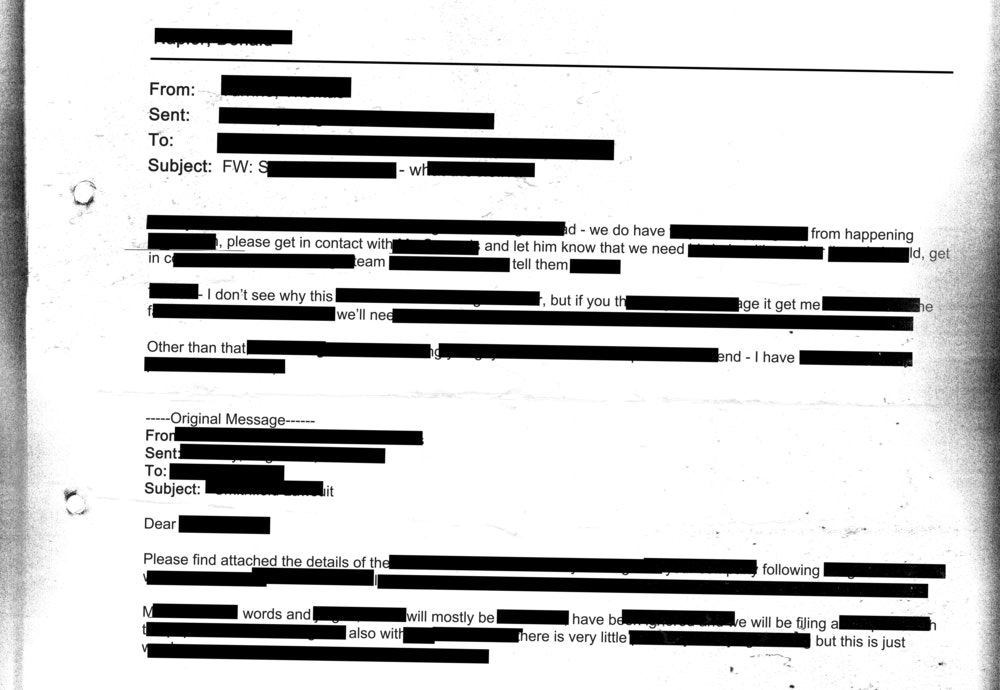
Canada’s broken [REDACTED] to [REDACTED] [REDACTED]
In The Line, a look at the failings of the federal government’s promises to fix the badly broken Access to Information system:
Sometimes, Line readers, though we always strive to be fair, we cannot deny that certain politicians are just fun to skewer. Because some of them are just terrible, terrible people, and while we polite Canadians don’t normally report too much on the personal lives of our elected leaders, well, what can we say? When you can, within responsible journalistic bounds, give a dirtbag a hard time for falling down on the job, hey. Life is good!
Patty Hajdu, the federal minister of health, is actually … perfectly pleasant. This isn’t unheard of in our politicians, but it’s rare enough to mention here, all to make very clear that we take no particular pleasure in reporting on her pathetic performance this week. But report it we must. And pathetic it surely was.
Under sharp questioning by Tory MP Michelle Rempel Garner, Hajdu very carefully and deliberately aimed a soon-to-be-banned .44 Magnum revolver at her foot, waited a dramatic second for effect, and then figuratively blew her poor extremity to smithereens. Rempel Garner had been asking about the abysmally broken state of the federal access-to-information systems, and Hajdu, with all-too-Liberal scorn, stood up and declared:
Mr. Speaker, I have spoken to hundreds, if not thousands, of Canadians since the pandemic was first announced, when COVID-19 arrived on our shores. In fact, not once has a Canadian asked me to put more resources into freedom of information officers. What they have asked me for is to ensure that all the resources of Canada are devoted to one thing, and that is the health, safety and economic prosperity of our country. We are going to continue to make sure that Canada has the most robust response possible.
There are two gigantic problems with Hajdu’s answer there.
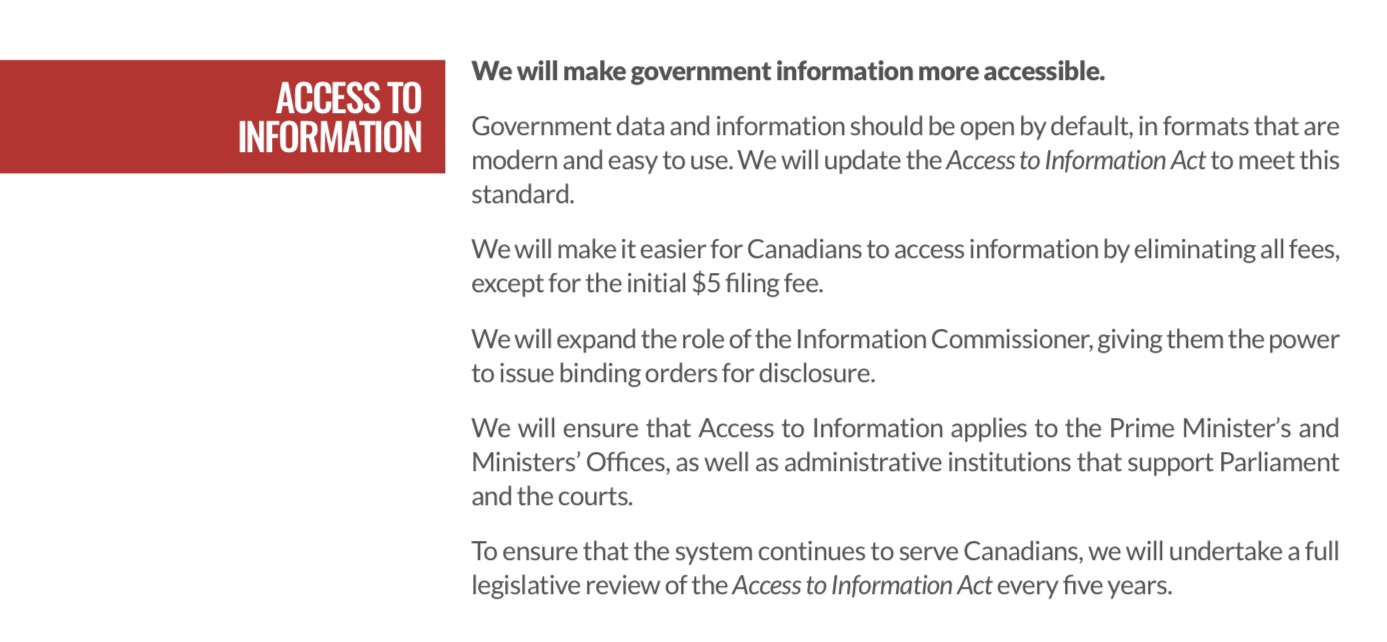
The first is that Canada’s access-to-information regime is notoriously dysfunctional, and her government has long admitted that. Indeed, fixing this disgrace was a major plank in the party’s 2015 platform.
In the years since, the government has effectively accomplished the square root of zero.
October 19, 2020
Sarah Hoyt – “… I’ve been feeling like I’m at the end of a Bond movie, and the villain is telling me his big master plan and how Western Civilization is tied to the train tracks and can’t escape”
In the latest Libertarian Enterprise, Sarah Hoyt explains why she’s not expecting the US federal election next month to resolve anything, at least not in a positive way:

At this point I hold about a 10% chance the Democrats/Socialists/Communists (interchangeable now that the masks are off) don’t fraud their way into full power, pack the court and rip our system apart, to install (yet again) a form of communism. This is complicated by the fact that a lot of them are in China’s pockets. Or rather, China has been filling their pockets for a long while. We might find ourselves working for racist, hegemonic overlords, besides suffering all the ills of a descent into communism. (By the way, they’ve already been doing this to some extent to the less fortunate countries, including most African countries. The left in the US and Europe believes this is benevolence. And that Chinese aren’t racist. I wouldn’t believe it, if it hadn’t been said to me over and over.)
There is maybe another 25% of chance we’ll find ourselves in CW II, now with even more foreign interference. What comes out of that, G-d only knows, and I’m not Him. Which is good, because I have trouble enough being me.
And there is a very strong chance that even if Trump wins the White House, besides continuing to have to drive a car where the wheel is disconnected (the extent of which I wasn’t even fully sure of until this month) he won’t do more than delay the crash.
Sometimes here, and particularly at insty, because I tend to do that really late at night when I’m exhausted and less able to control my moods, you’ll catch a hint of how hopeless I feel our situation to be.
In fact since the lockdown, I’ve been feeling we were screwed. That the lockdown was imposed all over the world on such flimsy evidence, that countries and churches, and every cultural institution not only submitted to it but kept telling the people how much it was needed sent me into a deep depression from which I haven’t fully recovered. (Again, the evidence that this virus was MAYBE as bad as the flu has been before our eyes since the beginning. You don’t need special equipment to see it. The homeless were congregating and not dying in droves. The people in slums in the third world weren’t dying at a higher rate than usual. And there were the numbers from the Diamond Princess. Which some idiot here tried to justify with “but they got the best treatment.” In a floating petri dish. With no special equipment. May G-d have mercy on the soul of every idiot who bought that bullshit.).
This last week, on the other hand, I’ve been feeling like I’m at the end of a Bond movie, and the villain is telling me his big master plan and how Western Civilization is tied to the train tracks and can’t escape.
Oh, not the massive corruption of the Biden crime family. I mean seriously. Any of you who didn’t know already that Crackhead McStripperbang wasn’t being paid for foreign countries for his services must have been living under a rock.
Not even the ridiculous, immediate coordination with which our tech overlords moved to clamp down on that information and preventing it from reaching the virgin ears of most of our willfully and willingly ignorant countrymen.
No, what discouraged me most was the “sexual preference” suddenly becoming a slur and Webster dictionary falling in line. (Seriously, guys, sexual preference goes way beyond orientation. For instance, my sexual preference is monogamous and with someone I love. If you think that there’s no preference involved, you must think people have absolutely no control over their impulses.) Because that bullshit couldn’t happen, even in the most totalitarian of conspiracies.
And that’s the terrifying thought. These people are no more conspiring than your breaklines being cut are a conspiracy not to stop the car.
They are a result of deep inlaid propaganda and misseducation which cause a lot of people to try to fall into line with the “word from above” and be “right” with those they view as the smart people and the masters of society.
October 18, 2020
Larry Correia on the danger in allowing Big Tech to decide what speech is and is not allowed to be heard
The recent now-you-see-it, now-you-don’t over allegations that former Vice President Biden’s son used his father’s influence to gain vast sums of money are — ahem — unproven but persuasive. The frantic efforts of companies like Google, Facebook, and Twitter to keep those allegations out of the public eye get Larry Correia very angry:

If social media had banned Obama’s press secretary, and then stopped Diane Feinstein and Chuck Schumer from sharing articles from the New York Times, and then shut down the Obama campaign page nineteen days before his election against Mitt Romney, everyone would have lost their fucking minds. And rightfully so! Because that kind of blatant manipulation of information is evil.
If I put that into a thriller my editor would tell me it was too far fetched. Nobody would buy into such mustache twirling villainy, even if I was writing cyberpunk dystopia.
But Correia, they are private companies and you are usually against meddling in the affairs of private companies, you big hypocrite! Yeah, usually I am, but this is also something new, the likes of which mankind has never seen before, with these entities being the primary exchange of information for BILLIONS of people, so it’s kind of hard to put this thing which didn’t exist before into historical context. Facebook has no real competitors, and it has something like 2.7 billion regular users. With the flick of a switch it can stop a third of the Earth’s population from seeing whatever it doesn’t want them to see. Humanity has never had that before.
That’s real fucking power right there.
Now, unlike most people on the internet, I am not compelled to pretend to be a lawyer who just got my law degree from the University of Internet. Communications law is not my area, and I’m not going to be a Dunning-Krugerand talking about section 230 or whatever.
However, what I do know is that this is some seriously dangerous bullshit, and if we keep going down this road it is going to lead to some very bad ends. Freedom of speech functionally ceases to exist when both sides speak, but only one side is heard. If social media is a forum, then it needs to be an actual forum. If it is functionally a propaganda arm of the DNC, then so be it, but it can’t keep pretending to be something it’s not, while mindfucking the populace.
They are subpoenaing the Twitter CEO to come testify before congress but I expect that to be another utterly useless clown show where dummies ask dumb questions about something they don’t understand to some clever asshole who is just going to lie.
Like most liberty minded people, I have a reflexive dislike for government regulation of the free market. If the government can screw something up, it will. However I doubt I’ll feel that strongly about the sanctity of the free market as I’m being starved to death in a re-education gulag, after conservatives were stupid enough to let a tiny group of control freak statists have absolute power over the whole country’s speech and information.
What we’ve got right now with a handful of organizations having a monopoly over news and knowledge is stupid, getting stupider, and going to end extremely badly.
I don’t give a shit if you are liberal or conservative, the idea of some entity like Google determining what mankind is allowed to know or not know should terrify the shit out of you. Free speech becomes a meaningless concept if only approved speech is ever seen. And if you are cheering this shit on because right now it is helping your team score points against the other team, you are fool. Because once they have that power it is only a matter of time until one of your beliefs ends up on the naughty list too.
(note, that’s not an issue for Kool Aid drinking progs, because they don’t actually have any beliefs beyond GET POWER. It took them less than 24 hours to change “sexual preference” to a bad thing in the dictionary)
The only good thing about this situation is that even though Facebook and Twitter are trying to monopolize the flow of information, they are still bad at it. This week’s attempt at shutting down the New York Post‘s expose will probably go down as the biggest Streisand Effect in history. Their painfully obvious censorship will make far more people pay attention and lend credence to the report. Because after all, they wouldn’t try this hard to squish it, if there wasn’t some meat to it.
October 17, 2020
Actually, his photo has that effect on me too …
… except that I still keep the beard. David Warren, on the other hand, is clean shaven:

“Jack Dorsey, Twitter and Square founder, in a London cafe in November 2014.” by cellanr is licensed under CC BY-SA 2.0


Every time I see a photograph of Jack Dorsey, I want to wash and shave. It is seldom that another human being has such an hygienic effect on me; especially one I have never personally met. Thanks to him, I may report to gentle reader that, up here in the privacy of the High Doganate (surrounded by jackhammers), I am quite clean-shaven this morning. I was able to resist the temptation to bathe in Dettol, but my shower was the next best thing.
I’m going out on a limb here. I am assuming my reader knows who Jack Dorsey is. (It’s not hard to find his picture.)
The boss of Twitter is among the “deep tech” executives who have, in a less ambiguous way than ever before, shut the accounts of the Trump campaign, within three weeks of a national election, and are blocking those (rather numerous) subscribers who are trying to forward the meaty revelations appearing in the New York Post. Those, incidentally, unambiguously show that one of the presidential candidates (Biden, of all people) is seriously fraudulent and corrupt. Who’d have guessed it? (Well, I did.)Now, when I write “deep tech,” some reader will accuse me of touting a conspiracy theory. I use this expression on the analogy of “deep state.” Curiously, I don’t think this is a conspiracy at all. In the District of Columbia, where the bureaucratic institutions of the Merican Nanny State are chiefly located, Democrats routinely take well over 90 percent of the vote. Republicans do not necessarily finish second, however. That the labour pool for these institutions is overwhelmingly “progressive,” is something I infer.
Ditto for Silicon Valley. The residents do not need to conspire, although the speed at which identical editorial decisions are reached, is amazing. This I attribute to their electronic hardware.
Some seven years ago, under the influence of well-intended friends, I did a three-month experiment of “being on Twitter.” They said it would immensely increase my “hits,” and it did — while dramatically decreasing attention to them. I was flattered by all the fan-mail I received, because I am a shallow person, but when the three months were up I got off. For I do not covet a mass audience, or that kind of fame. Engaging in live-time battles of wits with other Twitterers is fun for a while, but sooner or later one recovers one’s self-respect. Or at least some people do.
October 15, 2020
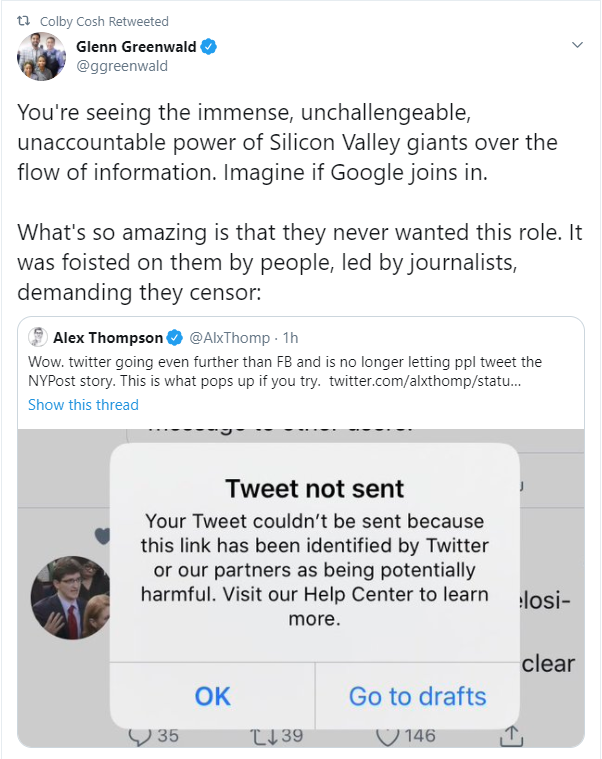
Twitter will now helpfully prevent you from committing thoughtcrime, citizen!
When you appoint yourself the guardian of speech, you quickly become the gatekeeper of all speech:
September 29, 2020
Modern Classics Summarized: 1984
Overly Sarcastic Productions
Published 24 Feb 2017It’s the mother of all dystopias! Long before YA dystopia rose to power, before the age of Young Attractive Heroes who Rebel Against The State and Also Find Love, there was just Winston Smith — a middle-aged man in poor health who Rebelled Against The State and Also Found Love. It just ended much less prettily for him.
1984 codified most of the modern dystopia tropes — absolute control of the media, black-bagging people who spoke out, and a lot of popular terms like “doublethink”, “big brother”, and “thought police”. Unfortunately, a lot of those terms got stripped of context and thrown around for the sake of Extra Edge, and as a result they get used a little haphazardly. And there’s nothing Red hates more than misused terminology, so here’s the video outlining the ORIGINAL meaning of 1984!
PATREON: www.patreon.com/user?u=4664797
MERCH LINKS:
Shirts – https://overlysarcasticproducts.threa…
All the other stuff – http://www.cafepress.com/OverlySarcas…Find us on Twitter @OSPYouTube!
September 27, 2020
“It is a Chestertonian paradox which Chesterton himself never wrote: a government changing the nature of the state successfully and without opposition because nobody can believe what they are seeing, and so everybody politely ignores it.”
In The Critic, Peter Hitchens on the many civil institutions that have been seriously wounded — not so much by the Wuhan Coronavirus, but by government responses to it:

David Icke about to speak at Piers Corbyn’s 20 August anti-masking demonstration in Trafalgar Square.
Screencap from YouTube video – https://www.youtube.com/watch?v=DOZQ58uTWdw
The long retreat of law, reason and freedom has now turned into a rout. It was caused by many things: the mob hysteria which flowered after the death of Princess Diana; the evisceration of education; the spread of intolerant speech codes designed to impose a single opinion on the academy and journalism; the incessant state-sponsored panics over terror; the collapse and decay of institutions and traditions.
These have all at last flowed together into a single force, and we seem powerless against it. Absurdly, the moment at which they have achieved maximum power is accidental, a wild, out of-proportion panic response to a real but limited epidemic.
Outside total war and its obscenities, we have not seen what we are living through now. To list the constitutional events of the last few months is to ask the complacent chattering classes of Britain what it reminds them of: the neutering of parliament into a rubber stamp controlled by the executive; the death of political pluralism; the introduction of government by decree; the disappearance of the last traces of an independent civil service; the silence in the face of these events of media and courts; the subjection of the police to state edicts rather than to law.
[…]
Documents of this kind are not supposed to get out. In better times than these, with active and critical media, this particular passage — with its clear implication that it was the task of the state to scare us into compliance — might have led to the fall of the government. As it is, you will struggle to find mentions of it in the British national press. They are there, but they are hard to find and not on any daily front pages. This is not because of censorship or because of any kind of collective action.
It is because most people, having lived all their lives in relaxed freedom, are quite unable to believe what is in front of their eyes. It is a Chestertonian paradox which Chesterton himself never wrote: a government changing the nature of the state successfully and without opposition because nobody can believe what they are seeing, and so everybody politely ignores it.
This could not have happened, in my view, 60 years ago. Rigorous education, especially of the elite, had at that time created a significant class of people who knew how to think, and how to assess evidence. There would always have been someone, whether it was a Tam Dalyell or a Churchill, to point out the true direction of events and warn against them, prominently. Much of the press would have given this dissent house room, rather than obediently conforming (in order to #ProtectOurNHS). But in the intervening years such rigorous schooling has been replaced by an egalitarian education system which teaches its students what to think, not how to think. Criticism of the past is obligatory, but any cold-eyed assessment of the present — in which new ideas benevolently rule — is disliked and ignored.
As well as this, there have been the various spasms of panic and emotion which convulsed the country after the Cold War ended. These were profound attacks on reason. They were also attacks on limited government and the rule of law, which rest largely on the power of reason. Most people quite like being afraid of something, and many dislike freedom and the responsibility that comes with it. The honest among us all admit it.
Once, before Charles Darwin, Ypres and the Somme, the Christian religion answered those needs. The Fear of the Lord was the Beginning of Wisdom, and the devoted service of Christ was perfect freedom. Faith offered eternal life and helped people to accept temporal death as normal. This belief helped to sustain earthly liberty because, as Edmund Burke pointed out, the man who truly fears God will fear nothing else. No despot can get very far if there are such men around in any number.
September 19, 2020
QotD: Dictatorship of the Cancel Culture proletariat
While not the most important, the first of these points is the most relevant on a day-to-day basis. Without endorsing these behaviours, the plain fact is that the huge majority of people have probably at some point told an ethnic or regional joke, sent a pornographic or un-PC snap, had sex while intoxicated, used a slur tied to sexual orientation / race / gender online or in the lockerroom, worn a St Paddy’s Day or Cinco de Mayo outfit they would really prefer a mulligan on, or committed other Cardinal Sins against Wokeness. As a result of this, many young people are intently aware that Twitter and Facebook wars involving the unearthing of old content generally end with egg on the face of everyone involved. Caucasian NBA point guard Donte DeVincenzo was humiliated in late 2018 by the revelation that – at age 14 – he had described his hoops handle as “ballin’ on these nig*as like I’m Derrick Rose”. He ended up deleting his entire social-media presence. The point of monitoring this sort of thing, for the many people and organisations that do so, is not punishing the tiny minority of real racists and abusers out there so much as keeping normal citizens too terrified by the potential unearthing of past indiscretions to comment lustily on the issues of the day.
The fact that virtually anyone could in fact “legitimately” be cancelled leads into extreme partisan hypocrisy. While anyone who attended church as a lad might correctly suspect that the hard right is capable of similar behaviour, cancellers today are overwhelmingly concentrated on the “social justice” left – and they are, at least occasionally, reluctant to eat their own. This often results in remarkable and hilarious double standards. In February 2018, for example, liberal Virginia governor Ralph Northam – nicknamed “Coonman” – escaped any serious censure after he was revealed to have apparently appeared in a mid-1980s high-school yearbook photo wearing shoe-polish blackface.
To be fully fair to Northam, the same photo included a student dressed in full white robes as a Ku Klux Klansman, and CNN has noted that Northam has never actually said “whether he was wearing the Ku Klux Klan outfit or [the] blackface”. Oh, fair enough. At any rate, he serves as governor of Virginia today. Not to be outdone by any of his neighbors to the south, Canadian prime minister Justin Trudeau was revealed that same year to have worn black- and brown-face several times, and as late as 2001, once apparently painting his entire body to appear in costume as Aladdin at an Arabian Nights revue! He, too, remains solidly entrenched in office today.
Wilfred Reilly, “They can’t cancel all of us”, Spiked, 2020-06-17.
August 1, 2020
QotD: Voluntary self-censorship
Any fair‐minded person with journalistic experience will admit that during this war official censorship has not been particularly irksome. We have not been subjected to the kind of totalitarian “co-ordination” that it might have been reasonable to expect. The press has some justified grievances, but on the whole the Government has behaved well and and has been surprisingly tolerant of minority opinions. The sinister fact about literary censorship in England is that it is largely voluntary. Unpopular ideas can be silenced, and inconvenient facts kept dark, without the need for any official ban. Anyone who has lived long in a foreign country will know of instances of sensational items of news — things which on their own merits would get the big headlines — being kept right out of the British press, not because the Government intervened but because of a general tacit agreement that “it wouldn’t do” to mention that particular fact. So far as the daily newspapers go, this is easy to understand. The British press is extremely centralized, and most of it is owned by wealthy men who have every motive to be dishonest on certain important topics. But the same kind of veiled censorship also operates in books and periodicals, as well as in plays, films and radio. At any given moment there is an orthodoxy, a body of ideas which it is assumed that all right thinking people will accept without question. It not exactly forbidden to say this, that or the other but it is “not done” to say it, just as in mid‐Victorian times it was “not done” to mention trousers in the presence of a lady. Anyone who challenges the prevailing orthodoxy finds himself silenced with surprising effectiveness. A genuinely unfashionable opinion is almost never given a fair hearing, either in the popular press or in the highbrow periodicals.
At this moment what is demanded by the prevailing orthodoxy is an uncritical admiration of Soviet Russia. Everyone knows this, nearly everyone acts on it. Any serious criticism of the Soviet regime, any disclosure of facts which the Soviet Government would prefer to keep hidden, is next door to unprintable. And this nation-wide conspiracy to flatter our ally takes place, curiously enough, against a background of genuine intellectual tolerance. For though you are not allowed to criticize the Soviet Government, at least you are reasonably free to criticize our own. Hardly anyone will print an attack on Stalin, but it is quite safe to attack Churchill, at any rate in books and periodicals. And throughout five years of war, during two or three of which we were fighting for national survival, countless books, pamphlets and articles advocating a compromise peace have been published without interference. More, they have been published without exciting much disapproval. So long as the prestige of the U.S.S.R. is not involved, the principle of free speech has been reasonably well upheld. There are other forbidden topics […] but the prevailing attitude toward the U.S.S.R is much the most serious symptom. It is, as it were, spontaneous, and is not due to the action of any pressure group.
The servility with which the greater part of the English intelligentsia have swallowed and repeated Russian propaganda from 1941 onward would be quite astounding if it were not that they have behaved similarly on several earlier occasions. On one controversial issue after another the Russian viewpoint has been accepted without examination and then publicized with complete disregard to historical truth or intellectual decency. To name only one instance, the B.B.C. celebrated the twenty-fifth anniversary of the Red Army without mentioning Trotsky. This was about as accurate as commemorating the battle of Trafalgar with out mentioning Nelson, but evoked no protest from the English intelligentsia. In the internal struggles in the various occupied countries, the British press has in almost all cases sided with the faction favored by the Russians and libeled the opposing faction, sometimes suppressing material evidence in order to do so. A particularly glaring case was that of Colonel Mihailovich, the Jugoslav Chetnik leader. The Russians, who had their own Jugoslav protégé in Marshal Tito, accused Mihailovich of collaborating with the Germans. This accusation was promptly taken up by the British press: Mihailovich’s supporters were given no chance of answering it, and facts contradicting it were kept out of print. In July, 1943, the Germans offered a reward of 100,000 gold crowns for the capture of Tito, and a similar reward for the capture of Mihailovich. The British press “splashed” the reward for Tito, but only one paper mentioned (in small print) the reward for Mihailovich; and the charges of collaborating with the Germans continued. Very similar things happened during the Spanish civil war. Then, too, the factions on the Republican side which the Russians were determined to crush were recklessly libeled in the English leftwing press, and any statement in their defense, even in letter form, was refused publication. At present, not only is serious criticism of the U.S.S.R. considered reprehensible, but even the fact of the existence of such criticism is kept secret in some cases. For example, shortly before his death Trotsky had written a biography of Stalin. One may assume that it was not an altogether unbiased book, but obviously it was saleable. An American publisher had arranged to issue it and the book was in print — I believe the review copies had been sent out — when the U.S.S.R. entered the war. The book was immediately withdrawn. Not word about this has ever appeared in the British press, though clearly the existence of such a book, and its suppression, was a news item worth a few paragraphs.
George Orwell “The Freedom of the Press”, 1945 (written as the introduction to Animal Farm, but not published in Orwell’s lifetime).
July 22, 2020
How the left lost its sense of humour
Matt Taibbi outlines the way “the right” used to be the humourless scolds and omnipresent busybodies demanding the government trample the rights of people they didn’t like, then points out that the progressives have become exactly the people they used to poke fun at:
The old Republican right’s idea of “humor” was its usual diatribes against Bad People, only with puns thrown in (are you ready for “OxyClinton”?). As a result the Fox effort at countering the Daily Show, the 1/2 Hour News Hour — a string of agonizing “burns” on Bush-haters and Hillary — remains the worst-rated show in the history of television, according to Metacritic. The irony gap eventually spelled doom for that group of Republicans, as Trump drove a truck through it in 2016. However, it’s possible they just weren’t as committed to the concept as current counterparts.
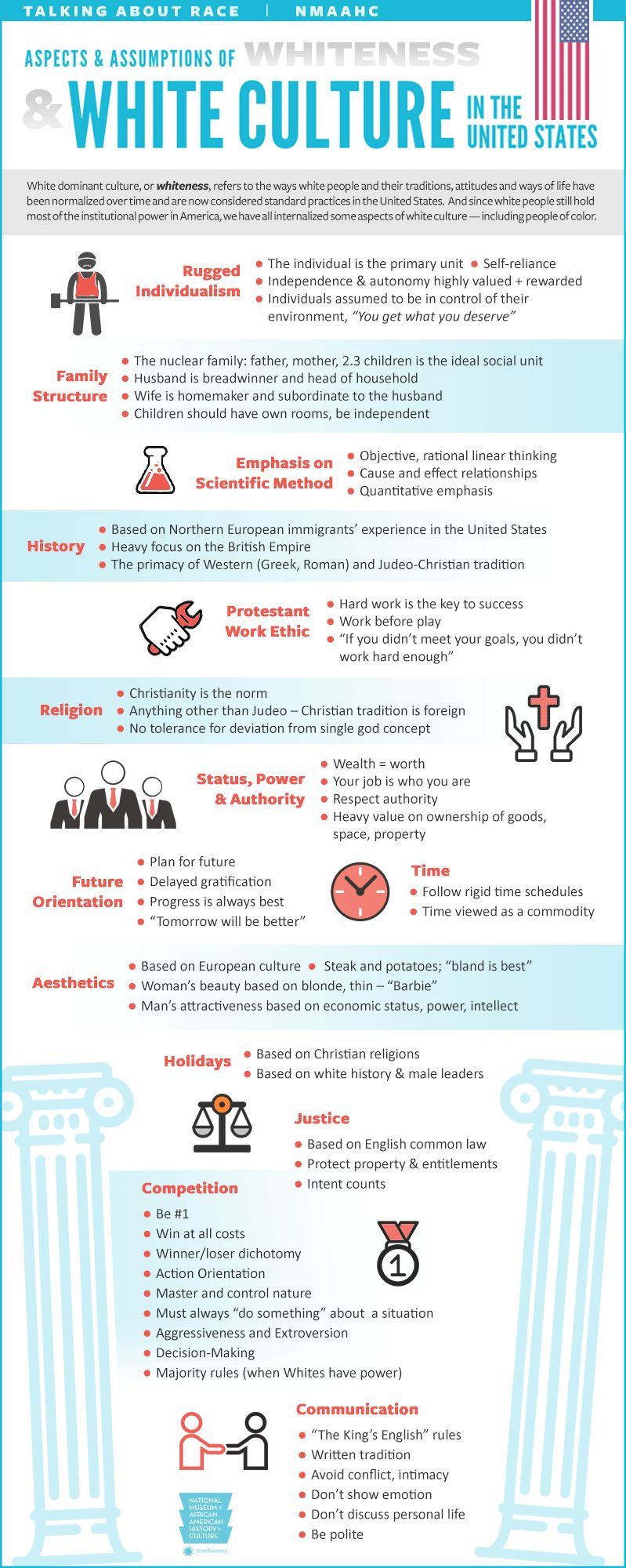
Take the Smithsonian story. The museum became the latest institution to attempt to combat racism by pledging itself to “antiracism,” a quack sub-theology that in a self-clowning trick straight out of Catch-22 seeks to raise awareness about ignorant race stereotypes by reviving and amplifying them.
The National Museum of African American History and Culture created a graphic on “Aspects and Assumptions of White Culture” that declared the following white values: “the scientific method,” “rational, linear thinking,” “the nuclear family,” “children should have their own rooms,” “hard work is the key to success,” “be polite,” “written tradition,” and “self-reliance.” White food is “steak and potatoes; bland is best,” and in white justice, “intent counts.”
The astute observer will notice this graphic could equally have been written by white supremacist Richard Spencer or History of White People parodist Martin Mull. It seems impossible that no one at one of the country’s leading educational institutions noticed this messaging is ludicrously racist, not just to white people but to everyone (what is any person of color supposed to think when he or she reads that self-reliance, politeness, and “linear thinking” are white values?).
The exhibit was inspired by white corporate consultants with Education degrees like Judith Katz and White Fragility author Robin DiAngelo, who themselves echo the work of more consultants with Ed degrees like Glenn Singleton of Courageous Conversations. Per the New York Times, Courageous Conversations even teaches that “written communication over other forms” and “mechanical time” (i.e. clock time) are tools by which “whiteness undercuts Black kids.”
The notion that such bugbears as as time, data, and the written word are racist has caught fire across the United States in the last few weeks, igniting calls for an end to virtually every form of quantitative evaluation in hiring and admissions, including many that were designed specifically to combat racism. Few tears will be shed for the SAT and ACT exams, even though they were once infamous for causing Harvard to be overpopulated with high-scoring “undesirables” like Jews and Catholics, forcing the school to add letters of reference and personal essays to help restore the WASP balance.
The outcry against the tests as “longstanding forces of institutional racism” by the National Association of Basketball Coaches is particularly hilarious, given that the real problem most of those coaches are combating is the minimal fake academic entry requirement imposed by the NCAA to help maintain a crooked billion-dollar business scheme based on free (and largely Black) labor. The tests have been tweaked repeatedly over the years to be more minority-friendly and are one of the few tools that gave brilliant but underprivileged kids a way to blow past the sea of rich suburbanites who feel oppressed by them … But, fine, let’s stipulate, as Neon Bodeaux put it, that “them tests are culturally biased.” What to make of the campaign to end blind auditions for musical positions, which the New York Philharmonic began holding in the early seventies in response to complaints of discrimination?
Before blind auditions, women made up less than 6 percent of orchestras; today they’re half of the New York Philharmonic. But because the change did not achieve similar results with Black and Hispanic musicians, the blind audition must now be “altered to take into fuller account artists’ backgrounds and experiences.” This completes a decades-long circle where the left/liberal project went from working feverishly to expunge racial stereotypes in an effort to level the playing field, to denouncing itself for ever having done so.
This would be less absurd if the effort were not being led in an extraordinary number of cases by extravagantly-paid white consultants like DiAngelo and Howard Ross, a “social justice advocate” whose company billed the federal government $5 million since 2006 to teach basically the same course on “whiteness” to agencies like NASA, the Treasury, the FDIC, and others.
It’s unsurprising that in the mouths of such people, the definitions of “whiteness” sound suspiciously like lazy suburban white stereotypes about Black America, only in reverse. They read like a peer-reviewed version of Bill de Blasio’s infamous joke about “CP Time.”
July 10, 2020
Freedom of speech – a tool to be discarded when your opponents try to use it
Arthur Chrenkoff discusses the recent uproar among progressives over an open letter calling for respect for free speech … when the “wrong kind of people” started signing on:
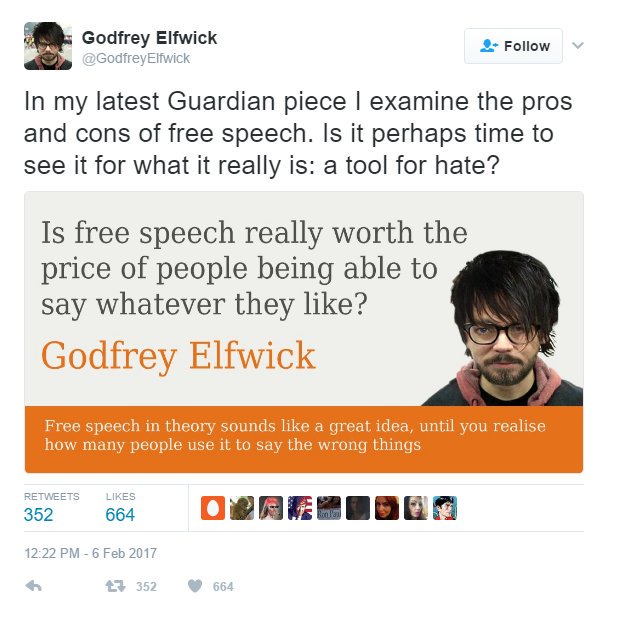
Godfrey Elfwick’s disturbingly accurate summary of free speech support among the woke.
So how did it come to this on a meta-level – how did the left, which for a long time championed ideas like freedom of speech, come to be the new censors and book burners?
The answer is short and simple: power.
Thanks to its Marxist heritage, the left is all about power. Who has it, who doesn’t (Lenin’s famous ur-question “who whom?”), how to get it. Power and power relationship is the ultimate touchstone and lodestar, the prism through everything else is seen and judged. Everything, including morality – what’s right, what’s wrong – flows from the position in this binary system (and with power it is a zero-sum game: you either have it all or you have none).
Turkish Islamist president Recep Erdogan has once famously said “Democracy is like a streetcar. When you come to your stop, you get off.” The stop – the end – is power; democracy is the mean to the end.
So it is with the left and freedom. The left was pro-freedom when it was on the way up. Being pro-freedom helped them achieve their objectives. Freedom of speech, for example, was important because it guaranteed them the ability to spread their ideas.
Now the left has the power, if not in all respects and in equal measure, certainly as far as culture is concerned, where it enjoys near hegemony. Being on top it doesn’t need freedom of speech anymore. Quite the contrary: freedom of speech now enables its critics to challenge their ideas and their position. Debate is a waste of time and effort, much better and more efficient is to silence any dissenting voices.
It’s never about principle – it’s about the side (yours) and power (yours to gain and keep).
July 5, 2020
Andrew Sullivan – “There is no doubt at this point that communist China is a genocidal state”
In his latest column, Andrew Sullivan discusses China’s latest outrages against groups within China:
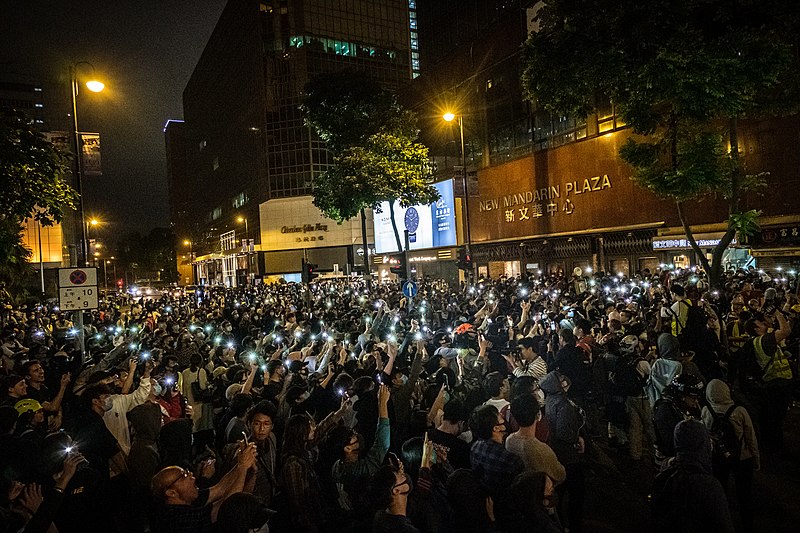
Protest against the Chinese government in Hong Kong, 25 November 2019.
Photo by Studio Incendo via Wikimedia Commons
Genocide is not measured simply by the number of human beings in a demographic group who have been killed. Such numbers vary. The pogroms in Europe of the 14th century killed far, far fewer Jews than died in the 20th-century Holocaust, but it would be crazy not to see a very similar eliminationist impulse. It’s the genocidal intent that defines a genocide. The United States Holocaust Memorial Museum defines it as “the intent to destroy, in whole or in part, a national, ethnic, racial, or religious group.” Their definition includes the following five categories:
- Killing members of the group.
- Causing serious bodily or mental harm to members of the group.
- Deliberately inflicting on the group conditions of life calculated to bring about its physical destruction in whole or in part.
- Imposing measures intended to prevent births within the group.
- Forcibly transferring children of the group to another group.
There is no doubt at this point that communist China is a genocidal state. The regime is determined to coerce, kill, reeducate, and segregate its Uighur Muslim population, and to pursue eugenicist policies to winnow their ability to sustain themselves. The Associated Press just published an exhaustive and chilling account of the extent of the campaign, which was reportedly supported and seconded by the president of the United States when speaking with President-for-life Xi.
We already know about the reeducation camps. We found out this week the grisly detail that China may even have been exporting human-hair products taken from Uighur political prisoners in those camps. What the AP helps us better understand is how the regime is forcibly sterilizing Uighur women inside and outside the camps, attempting to control the Uighur population by assaulting basic reproductive freedom. Uighur families with multiple children are now in danger of being sent to camps for the crime of bringing Uighur kids into the world: “Time in a camp — what the government calls ‘education and training’ — for parents with too many children is written policy in at least three counties, notices found by [scholar Adrian] Zenz confirmed. In 2017, the Xinjiang government also tripled the already hefty fines for violating family planning laws for even the poorest residents — to at least three times the annual disposable income of the county.”
And the campaign of terror is working: “Birth rates in the mostly Uighur regions of Hotan and Kashgar plunged by more than 60% from 2015 to 2018, the latest year available in government statistics. Across the Xinjiang region, birth rates continue to plummet, falling nearly 24% last year alone — compared to just 4.2% nationwide, statistics show.” In the Uighur city of Hotan, over a third of all married women of childbearing age were sterilized in 2019 alone. And this is taking place in the context of a new campaign to increase the fertility and offspring of the majority Han Chinese. This is pure racial social engineering.
This genocidal dictatorship also took this past week to stomp all over what’s left of freedom in Hong Kong. Just before the anniversary of the end of British rule in Hong Kong, Beijing has introduced a new security law that all but eviscerates any freedom for dissent in the former British colony. It renders a variety of offenses that involve pro-democracy activism and criticism of the regime punishable by up to a lifetime in jail. The law is deliberately vague, was passed with no input from Hong Kong’s own government before its details were revealed, and criminalizes offenses such as “secession, subversion against the central Chinese government, terrorism, and colluding with foreign forces.”
The effect has been immediate: Key members of a leading dissident group, Demosisto, resigned, and the party has been disbanded. Throughout Hong Kong, businesses that had posted messages of support for the pro-democracy forces are swiftly removing them. People are deleting their social-media accounts for fear of imprisonment. A BBC reporter notes the immediate impact: “One contact of mine, a lawyer and human-rights activist, sent me a message shortly after the law was passed. ‘Please delete everything on this chat,’ he wrote.”


