The Cynical Historian
Published 10 Oct 2020Thanks to Private Internet Access for sponsoring this video. Click here to get 77% off and 3-months free: http://www.privateinternetaccess.com/…
We’ve been seeing a lot of coverage about the post office here in the United States. A lot of folks talk about the history of it, but generally in a piecemeal fashion. The fact most of this commentary lacks is that the post office has always been a political tool, from its beginnings even before the US Constitution. Interestingly enough, what it has been used for over the years has changed substantially, but it is always a harbinger of the up and coming dominant ideology. The post office is a cornerstone of our democracy. The postal system in the United States is uniquely important.
Check out Mr. Beat’s video: https://www.youtube.com/watch?v=favVdKa6cRQ
————————————————————
Connected videos:
3:30 – 1776 | Based on a True Story: https://youtu.be/xY4Te8Qm07A
9:15 – What caused the Mexican-American thing? https://youtu.be/HTmSN4Exci0
9:15 – What Caused the Texas Revolution? https://youtu.be/lDWH-DC74Pk
9:25 – California Gold Rush: https://youtu.be/W1dmyx6LBKA
9:30 – History of California: https://www.youtube.com/playlist?list…
11:30 – The Sectional Crisis: https://youtu.be/Ff2AKILyi0o
14:05 – History of Voting by Mail: https://www.youtube.com/watch?v=favVd…
18:25 – Trains and Oil in California: https://youtu.be/0Ef0Ir-hbFc
18:30 – The History of Early Flight: https://youtu.be/sPgxuD0uYYE
20:35 – US Veterans History: https://youtu.be/ANUqaNykuRs
————————————————————
references:
The United States Postal Service: An American History (Washington, DC: United States Postal Service, 2020). https://about.usps.com/publications/p… [PDF]USPS’s website has a trove of information on their history: https://about.usps.com/who-we-are/pos…
The national postal museum is run by the Smithsonian and includes numerous research articles available to anyone on their website: https://postalmuseum.si.edu/research-…https://www.nationalgeographic.com/hi…
————————————————————
Support the channel through PATREON:
https://www.patreon.com/CynicalHistorian
or by purchasing MERCH: teespring.com/stores/the-cynical-hist…
LET’S CONNECT:
Discord: https://discord.gg/Ukthk4U
Twitter: https://twitter.com/Cynical_History
Subreddit: https://www.reddit.com/r/CynicalHistory/————————————————————
Wiki: The United States Postal Service (USPS; also known as the Post Office, U.S. Mail, or Postal Service) is an independent agency of the executive branch of the United States federal government responsible for providing postal service in the United States, including its insular areas and associated states. It is one of the few government agencies explicitly authorized by the United States Constitution.
The USPS traces its roots to 1775 during the Second Continental Congress, when Benjamin Franklin was appointed the first postmaster general. The Post Office Department was created in 1792 with the passage of the Postal Service Act. It was elevated to a cabinet-level department in 1872, and was transformed by the Postal Reorganization Act of 1970 into the United States Postal Service as an independent agency. Since the early 1980s, many direct tax subsidies to the USPS (with the exception of subsidies for costs associated with disabled and overseas voters) have been reduced or eliminated.
————————————————————
Hashtags: #history #USPS #USMail
January 6, 2021
The Use and Abuse of the US Postal System (feat. Mr. Beat)
January 4, 2021
QotD: Repressing the facts in genetic research
Now, in 2010, cleared-eyed observers are imagining a near-term future scenario that looks like this: (1) we will shortly have genomic-sequence information on hundreds of thousands of human beings from all over the planet, enough to build a detailed map of human genetic variation and a science of behavioral genetics. (2) We will confirm that variant alleles correlate strongly with significant measures of human ability and character, beginning with IQ and quite possibly continuing to distribution of time preference, sociability, docility, and other important traits. (3) We will discover that these same alleles correlate significantly with traditional indicia of race.
In fact, given the state of our present knowledge, I judge all three of these outcomes are near certain. I have previously written about some of the evidence in Racism and Group Differences. The truth is out there; well known to psychometricians, population geneticists and anyone who cares to look, but surrounded by layers of denial. The cant has become thick enough to, for example, create an entire secondary mythology about IQ (e.g., that it’s a meaningless number or the tests for it are racially/culturally biased). It also damages our politics; many people, for example, avert their eyes from the danger posed by Islamism because they fear being tagged as racists. All this repression has been firmly held in place by the justified fear of truly hideous evils – from the color bar through compulsory sterilization of the “inferior” clear up to the smoking chimneys at Treblinka and Dachau. But … if the repressed is about to inevitably return on us, how do we cope?
It’s not going to be easy. I saw this coming in the mid-1990s, and I’m expecting the readjustment to be among the most traumatic issues in 21st-century politics. The problem with repression, on both individual and cultural levels, is that when it breaks down it tends to produce explosions of poorly-controlled emotional energy; the release products are frequently ugly. It takes little imagination to visualize a future 15 or 20 years hence in which the results of behavioral genetics are seized on as effective propaganda by neo-Nazis and other racist demagogues, with the authority of science being bent towards truly appalling consequences.
Eric S. Raymond, “A Specter is Haunting Genetics”, Armed and Dangerous, 2010-06-19.
December 11, 2020
“Politically correct language … seemed like a nice, polite, and Canadian sort of thing to do”
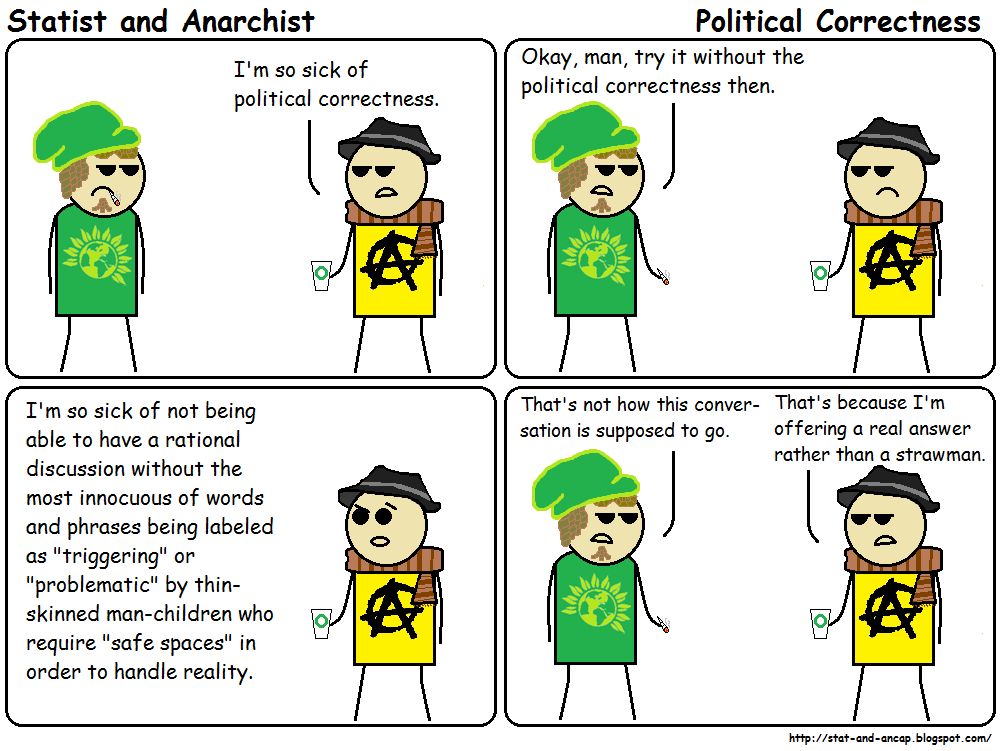
Meaghie Champion discusses politically correct language in The Line:

Source: https://www.deviantart.com/blamethe1st/art/Statist-And-Anarchist-063-Political-Correctness-589944623
I grew up in the 1970s and ’80s. I have never lived in a world without what we now call “political correctness” — typically understood to mean using a kind of stilted and artificial language in order to atone for the disadvantages and slights suffered by marginalized groups and avoid inflicting new ones. Politically correct language required more effort to communicate, but it seemed like that effort was worth it to not offend people. It seemed like a nice, polite, and Canadian sort of thing to do.
I went along with political correctness out of a sincere desire to be accommodating to disadvantaged and dis-enfranchised groups. This became especially true after I learned about the “Sapir Whorf theory of psycho neurolinguistics.” The theory suggests that language shapes our perception of reality; that by altering the way we talk, we can shift the way we think — and, thus, collectively, we can shape reality itself. From this, it seemed logical to “de-gender” language or stop using stereotypes. It seemed like a small ask. Maybe I personally couldn’t solve big problems that concerned me as a good liberal … i.e. things like poverty or world hunger, but I could be nice in how I expressed myself and try to use language that everybody was using to be equitable and more fair.
What I didn’t understand, then, was that this precedent set a trap in which many good, well-intentioned liberals are finding themselves stuck. It’s no longer about ameliorating past sins: there is a project afoot to re-make the English language. The purpose of this project is to re-engineer how people think about certain subjects like gender, sex, and race, while skipping the necessary prerequisites of persuasion and logic. Conservative positions are declared off limits, even bigoted, simply by shaping the way we are allowed to talk about them.
Right now, even as I type this, there is a veritable army of academics hard at work on what they call “de-colonizing” and “de-gendering” language at many universities and colleges. There are tens of thousands of activists and academics in universities and online organizing and pushing for ever-changing rules to be enforced as it relates to the English language. It’s a multi-million-dollar industry in academia and woke corporatism. And it’s already starting to spill over into government regulations and enforcement.
I love the English language. I have been a voracious reader since childhood. I thrill at well-spoken and written prose and poetry. A finely turned witticism or fantastic mot juste can break my heart with its perfection. Further, I’m First Nations, and that love of the English language has also carried me into a love of the study of my tribal cradle tongue “Hul’qumi’num.” Shouldn’t I, as a First Nations person, be in favour of de-colonizing the English language? No. No, I do not think so. I have little patience or regard for any effort that makes language a less workable and functional tool of human endeavour. I identify strongly as a writer, and I take this assault upon the tool with which I conduct my craft very personally.
November 21, 2020
“Ah, and so it begins. The problematization of Substack”
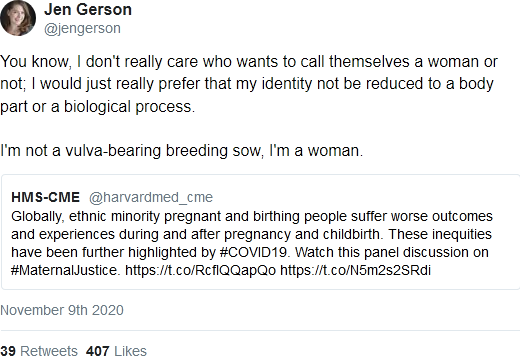
Writing — appropriately — on Substack, Jen Gerson outlines her transition from full-time journalist to journalist-subsisting-on-the-crumbs-of-direct-reader-support at The Line:
True story: an ambitious young man with an idea for a startup gave me a ring on the phone. He wanted to start a new platform for writers and journalists; what would it take to encourage a writer like me to abandon the mainstream media and go fully independent? I explained the sort of site that might entice me — a clean and painless user interface, basic word processor, and something to take care of IT and payment back end. I then hung up the phone and thought to myself: “Nice guy. Too bad that idea isn’t going anywhere.”
After all, why would I abandon paying gigs in mainstream journalism for the uncertainty of direct reader support? It was a crazy idea.
Years passed.
Well, this gentleman went off to form a company called, uh, Substack, and after Andrew Sullivan left New York Magazine to reconstitute the Daily Dish under the aegis on this very platform, I was forced to dredge up this gentleman’s email and offer to eat my hat.
Because by then, mainstream media was in a state of financial and moral disarray and it was time for me to do what I would have done three years earlier if I had possessed the foresight — start The Line. In any case, the founder of Substack was very kind and even managed to schedule a call with me, at which point I said: “OK, you were right.”
This was one of the conversations that eventually led to my co-founding this fine newsletter that you are reading now, but in the course of this chat I had to ask another question: “You know they’re going to come after you, right? Are you ready for that?”
He said Substack is, indeed, committed to serving its community of writers — provided they aren’t spreading hate or disinformation, of course — but I suspect the company is only beginning to gain a glimpse of the test ahead.
When I read the Columbia Journalism Review‘s piece “The Substackerati“, released this week, my first response was: “Ah, and so it begins. The problematization of Substack.”
November 17, 2020
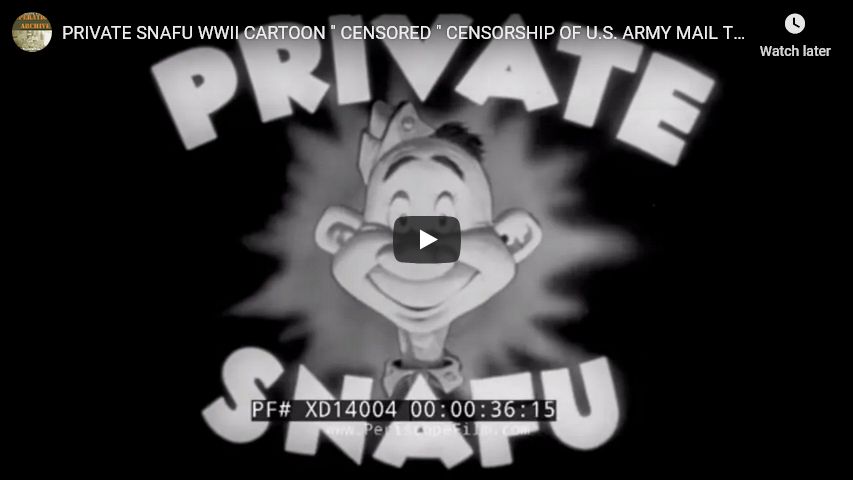
Private SNAFU “Censored” WW2 US Army cartoon
PeriscopeFilm
Published 11 Aug 2020Want to support this channel and help us preserve old films? Visit https://www.patreon.com/PeriscopeFilm
Visit our website www.PeriscopeFilm.com
Censored is one of 26 Private SNAFU (Situation Normal, All F*cked Up) cartoons made by the U.S. Army Signal Corps to educate and boost the morale of the troops. The SNAFU character was created by Theodore Geisel (Dr. Seuss) and Phil Eastman, and most were animated by Warner Brothers Animation Studios. They were voiced by actors including Mel Blanc and scored by Carl Stalling. This cartoon Censored, depicts the lengths to which Private SNAFU will go to sneak an uncensored letter in the mail — with terrifying results. Fortunately it all turns out to be a dream, but SNAFU is so shaken that he censors his own mail. The film was obviously inspired by the mass censorship of personal letters by the Army during the war, to reduce the chance that enemy spies would be able to gain intelligence by intercepting them.
Much of the military correspondence during the war took place via V-mail, short for Victory Mail. This was a hybrid mail process used as the primary and secure method to correspond with soldiers stationed abroad. To reduce the cost of transferring an original letter through the military postal system, a V-mail letter would be censored, copied to film, and printed back to paper upon arrival at its destination. The V-mail process is based on the earlier British Airgraph process
During World War II, both the Allies and Axis instituted postal censorship of civil and military mail. The largest organizations were those of the United States, though the United Kingdom employed about 10,000 censor staff while Ireland, a small neutral country, only employed about 160 censors. Both blacklists and whitelists were employed to observe suspicious mail or listed those whose mail was exempt from censorship. In the United States censorship was under the control of the Office of Censorship whose staff count rose to 14,462 by February 1943.
We encourage viewers to add comments and, especially, to provide additional information about our videos by adding a comment! See something interesting? Tell people what it is and what they can see by writing something for example: “01:00:12:00 — President Roosevelt is seen meeting with Winston Churchill at the Quebec Conference.”
This film is part of the Periscope Film LLC archive, one of the largest historic military, transportation, and aviation stock footage collections in the USA. Entirely film backed, this material is available for licensing in 24p HD, 2k and 4k. For more information visit http://www.PeriscopeFilm.com
November 14, 2020
November 13, 2020
Oddly, the Canadian media evince no interest whatsoever in the Trudeau government’s malign plans for the Internet
In The Line, Peter Menzies shows how little the mainstream media outlets in Canada care about the power grab the feds are attempting with their proposed “get money from web giants” shakedown:
In order to understand where media and public attention has been the past couple of weeks, all you had to do was listen in on Monday morning’s Ottawa news conference.
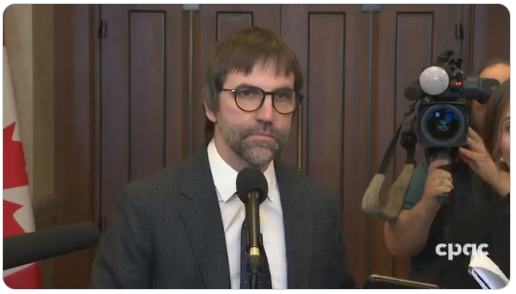
Six days after Heritage Minister Steven Guilbeault had introduced ground-breaking legislation to regulate content online, Prime Minister Justin Trudeau announced more cash to bring better Internet to rural and remote communities. There were also some COVID-19 updates and something about help for agriculture.
And, of course, the questions asked by the media were about the U.S. election. What else could possibly be of interest?
Eventually there were a few inquiries about Telesat and low-Earth-orbit satellites, but you get the point: things that matter to people’s daily lives such as cable bills, data plans, Netflix, cellular service, crappy WiFi and slow Internet connections haven’t been of much interest to Canadian media lately.
So there has been a dearth of chatter about Guilbeault’s controversial plan to (my words, not his): restrict consumer choice, tax Netflix to finance certified Canadian content (Cancon) and bring to an end the greatest period of prosperity in the history of the Canadian film and television industry. Did I mention stifling innovation, increasing streaming subscription costs and scaring away investment? No? My bad. Those too.
Guilbeault has decided that the agency dedicated to defining the nation’s TV and radio diet — the Canadian Radio-television and Telecommunications Commission (CRTC) — is now going to be in charge of what you are allowed to dine on online as well. No longer will you be able to manage your preferences. No more popcorn and candy for you. Going forward, Cancon spinach and broccoli will be on your plate every evening. Breathtakingly, Guilbeault has “modernized” communications legislation by giving authority over the Internet to something called a “radio-television” commission by using something still called the “broadcasting” act.
November 7, 2020
QotD: “Hate speech”
In an attempt to put down “racism”, the concept of “hate terms” was introduced into English law for the first time. This makes many words and expressions unlawful, and punishable by fines and imprisonment. It is the most comprehensive system of censorship since the days of Hitler’s Germany and Stalin’s Russia, and means there are more restrictions on freedom of expression in England than at any other time since Hogarth’s days.
It is, of course, fatal to humour, if enforced and persisted in. For one vital quality of humour is inequality, and striking visual, aural, and physical differences. Differences in sex, age, colour, race, religion, physical ability, and strength lie at the source of the majority of jokes since the beginning of human self-consciousness. And all jokes are likely to provoke discomfort if not positive misery among those laughed at. Hence any joke is liable to fall foul of those laws. The future for humourists thus looks bleak, at the time I write this. The ordinary people like jokes, often crude ones, as George Orwell pointed out in his perceptive essay on rude seaside picture postcards. But are ordinary people, as opposed to minor officials, in charge any more? Democracy doesn’t really seem to work, and people are insufficiently dismayed at its impotence.
Paul Johnson, Humourists: From Hogarth to Noël Coward, 2010.
November 2, 2020
Federal government to web giants: “BOHICA!”
Michael Geist provides an unauthorized backgrounder on the Canadian government’s quixotic attempt to shakedown the likes of Netflix for money to give to “struggling” Canadian media companies:
Canadian Heritage Minister Steven Guilbeault is set to introduce his “Get Money from Web Giants” Internet regulation bill on Monday. Based on his previous public comments, the bill is expected to grant the CRTC extensive new powers to regulate Internet-based video streaming services. In particular, expect the government to mandate payments to support Canadian content production for the streaming services and establish new “discoverability” requirements that will require online services to override user preferences by promoting Canadian content. The government is likely to issue a policy direction to the CRTC that identifies its specific priorities, but the much-discussed link licensing requirement for social media companies that Guilbeault has supported will not be part of this legislative package.
These reforms mark the culmination of a dramatic reversal in government digital policy. After then-Heritage Minister Melanie Joly unveiled her 2017 digital cancon strategy that focused on market-based solutions and emphasized exports of Canadian culture, extensive lobbying gradually let to a major policy flip flop. The CRTC reversed its prior position on Internet streaming regulation in 2018 with a regulate-everything approach, the deeply flawed Yale report released earlier this year provided the blueprint for CRTC-led regulation, and Guilbeault jumped on board with a declaration that his top legislative priority was to “get money from web giants.”
On Monday, the government will undoubtedly line up the lobby groups that supported the reform to provide positive quotes, suggest reforms will lead to billions in new revenues, and claim the bill ensures regulatory fairness by requiring that everyone contribute. Yet much of the policy is based on fictions: that this levels the playing field, that there is a Cancon crisis, that discoverability requirements respond to a serious concern, that this will result in quick payments to the industry, that this is consistent with net neutrality, or that consumers will not bear the costs of reform.
None of this is true. But beyond those issues – each discussed in further detail below – this most notably represents a significant new source of speech regulation. We do not require government authorization to publish newspapers, blog posts, or to simply voice our views in a public forum. That we require governmental authorization in the form of licensing for broadcasters was largely justified in furtherance of cultural policies on the grounds of limited access to scarce spectrum. That justification simply does not apply to the Internet, no matter how many times Guilbeault refers to the inclusion of Internet companies within the “broadcast system.” This is not a matter of Internet exceptionalism. Laws and regulations such as taxation, competition, privacy, and consumer protection are all among the rules that apply regardless of whether the service is offline or online. But speech regulation by the CRTC should require a far better justification than the lure of “free money” from Internet companies.
November 1, 2020
QotD: Trumbo
Over the past weekend I watched Trumbo, the story of the Marxist screenwriter blacklisted by Hollywood during the Red Scare back in the 1950s. To say that I watched it with a jaundiced eye would be a very big understatement, because I suspected (just from the trailer) that the movie would just be one big blowjob for both Dalton Trumbo and his merry little band of Commiesymps who infested Hollywood back then.
And it was. Needless to say, the movie made villains of the conservatives who opposed the Marxist infiltration: people like John Wayne and Hedda Hopper in particular, Wayne because Wayne, and Hopper because she had a son serving in the U.S. Navy during the Korean War. Of course Wayne was made out to be a bully and Hopper a vindictive bitch — and the Senators and Congressmen who haled the Commies in front of the Senate and House Un-American Committee (HUAC) were depicted as ideological purists who saw Communists behind every bush — even though, in the case of Hollywood, there were Commies behind every bush at the time.
Of course, much was made of the fact that being a Communist wasn’t actually illegal (then, and now), and Trumbo made a great show of this being a First Amendment issue — which it was — and how these Commies all wanted to improve America, but of course there were evil right-wingers like Wayne, Joe McCarthy and HUAC harassing them at every turn.
The execution of the traitors Julius and Ethel Rosenberg got a little puff piece in the movie, which didn’t — couldn’t — actually say they weren’t guilty of
treasonespionage, so it was brushed over with the throwaway that it was the first execution for espionage in peacetime, as though peacetime should give espionage a pass. And if that wasn’t enough, the Rosenberg children were paraded around as sympathy magnets — as they still are — because Communists have no problem using children to serve their own purposes.Kim du Toit, “Blacklists Matter”, Splendid Isolation, 2020-07-28.
October 25, 2020
Canada’s broken [REDACTED] to [REDACTED] [REDACTED]
In The Line, a look at the failings of the federal government’s promises to fix the badly broken Access to Information system:
Sometimes, Line readers, though we always strive to be fair, we cannot deny that certain politicians are just fun to skewer. Because some of them are just terrible, terrible people, and while we polite Canadians don’t normally report too much on the personal lives of our elected leaders, well, what can we say? When you can, within responsible journalistic bounds, give a dirtbag a hard time for falling down on the job, hey. Life is good!
Patty Hajdu, the federal minister of health, is actually … perfectly pleasant. This isn’t unheard of in our politicians, but it’s rare enough to mention here, all to make very clear that we take no particular pleasure in reporting on her pathetic performance this week. But report it we must. And pathetic it surely was.
Under sharp questioning by Tory MP Michelle Rempel Garner, Hajdu very carefully and deliberately aimed a soon-to-be-banned .44 Magnum revolver at her foot, waited a dramatic second for effect, and then figuratively blew her poor extremity to smithereens. Rempel Garner had been asking about the abysmally broken state of the federal access-to-information systems, and Hajdu, with all-too-Liberal scorn, stood up and declared:
Mr. Speaker, I have spoken to hundreds, if not thousands, of Canadians since the pandemic was first announced, when COVID-19 arrived on our shores. In fact, not once has a Canadian asked me to put more resources into freedom of information officers. What they have asked me for is to ensure that all the resources of Canada are devoted to one thing, and that is the health, safety and economic prosperity of our country. We are going to continue to make sure that Canada has the most robust response possible.
There are two gigantic problems with Hajdu’s answer there.
The first is that Canada’s access-to-information regime is notoriously dysfunctional, and her government has long admitted that. Indeed, fixing this disgrace was a major plank in the party’s 2015 platform.
In the years since, the government has effectively accomplished the square root of zero.
October 19, 2020
Sarah Hoyt – “… I’ve been feeling like I’m at the end of a Bond movie, and the villain is telling me his big master plan and how Western Civilization is tied to the train tracks and can’t escape”
In the latest Libertarian Enterprise, Sarah Hoyt explains why she’s not expecting the US federal election next month to resolve anything, at least not in a positive way:
At this point I hold about a 10% chance the Democrats/Socialists/Communists (interchangeable now that the masks are off) don’t fraud their way into full power, pack the court and rip our system apart, to install (yet again) a form of communism. This is complicated by the fact that a lot of them are in China’s pockets. Or rather, China has been filling their pockets for a long while. We might find ourselves working for racist, hegemonic overlords, besides suffering all the ills of a descent into communism. (By the way, they’ve already been doing this to some extent to the less fortunate countries, including most African countries. The left in the US and Europe believes this is benevolence. And that Chinese aren’t racist. I wouldn’t believe it, if it hadn’t been said to me over and over.)
There is maybe another 25% of chance we’ll find ourselves in CW II, now with even more foreign interference. What comes out of that, G-d only knows, and I’m not Him. Which is good, because I have trouble enough being me.
And there is a very strong chance that even if Trump wins the White House, besides continuing to have to drive a car where the wheel is disconnected (the extent of which I wasn’t even fully sure of until this month) he won’t do more than delay the crash.
Sometimes here, and particularly at insty, because I tend to do that really late at night when I’m exhausted and less able to control my moods, you’ll catch a hint of how hopeless I feel our situation to be.
In fact since the lockdown, I’ve been feeling we were screwed. That the lockdown was imposed all over the world on such flimsy evidence, that countries and churches, and every cultural institution not only submitted to it but kept telling the people how much it was needed sent me into a deep depression from which I haven’t fully recovered. (Again, the evidence that this virus was MAYBE as bad as the flu has been before our eyes since the beginning. You don’t need special equipment to see it. The homeless were congregating and not dying in droves. The people in slums in the third world weren’t dying at a higher rate than usual. And there were the numbers from the Diamond Princess. Which some idiot here tried to justify with “but they got the best treatment.” In a floating petri dish. With no special equipment. May G-d have mercy on the soul of every idiot who bought that bullshit.).
This last week, on the other hand, I’ve been feeling like I’m at the end of a Bond movie, and the villain is telling me his big master plan and how Western Civilization is tied to the train tracks and can’t escape.
Oh, not the massive corruption of the Biden crime family. I mean seriously. Any of you who didn’t know already that Crackhead McStripperbang wasn’t being paid for foreign countries for his services must have been living under a rock.
Not even the ridiculous, immediate coordination with which our tech overlords moved to clamp down on that information and preventing it from reaching the virgin ears of most of our willfully and willingly ignorant countrymen.
No, what discouraged me most was the “sexual preference” suddenly becoming a slur and Webster dictionary falling in line. (Seriously, guys, sexual preference goes way beyond orientation. For instance, my sexual preference is monogamous and with someone I love. If you think that there’s no preference involved, you must think people have absolutely no control over their impulses.) Because that bullshit couldn’t happen, even in the most totalitarian of conspiracies.
And that’s the terrifying thought. These people are no more conspiring than your breaklines being cut are a conspiracy not to stop the car.
They are a result of deep inlaid propaganda and misseducation which cause a lot of people to try to fall into line with the “word from above” and be “right” with those they view as the smart people and the masters of society.