Quotulatiousness

May 2, 2021

“The PMO was told that Canada’s top soldier was accused of sexual misconduct, and they ignored it. It just didn’t move their give-a-shit needle.”

Filed under: Cancon, Government, Military — Tags: , , , — Nicholas @ 03:00

The weekend edition of The Line looks at the outrageous failure of Canada’s military high command and the government officials charged with oversight of the Canadian Armed Forces:

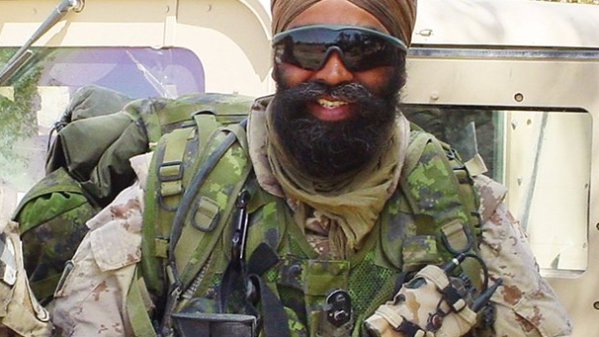
Canadian Defence Minister (at least for the moment) Harjit Sajjan.

This week saw a mealy mouthed political non-apology for the record books from Minister of National Defence Harjit Sajjan, who wants any women in the military who feel like they were let down to know that the government is very, very sorry. Gee, thanks, Minister. What a profile in courage that is. How reassuring to the women — and some men! — in the military either living with the reality or memory of sexual misconduct in the ranks.

And then there was the double-double approach to Supreme Court justices. Marie Deschamps wrote a detailed report on sexual misconduct in the military in 2015 (this report was discussed in depth here at The Line previously). Some of the action items in that report have been enacted, and things are therefore slightly better. But there is a lot more that could be done, that was already spelled out by Deschamps, and the report is just sitting there, neglected by all comers like those weird bagels with raisins in them. Now that the Minister has gotten the non-apology monkey off his back, maybe he’d like to grab the goddamn report he already has and, like, you know, do something with it?!

No. No, dear readers, he does not. What he’d like to do is appoint another former Supreme Court justice to write another report.

LOL! Just kidding. What he wants to do is buy time. The minister is hoping — and he will probably be proven right! — that Canadians won’t care about some lady soldiers getting harassed or outright raped in the military, not if his government can stick the vaccine landing, as seems increasingly likely. Sajjan has had literally years to take on the well-known issues inside the Canadian Forces, and he’s nibbled around the edges a bit, and no more. Only now that his ass is hanging out in the wind, along with a bunch of PMO staffer asses, and perhaps the prime minister’s, has the party rediscovered the urgency of the issue.

Pointing out the many ways that Trudeau and his government fail to live up to their own branding is almost a joke these days. Like, gosh, what more can we say? But if you have any capacity for shock and outrage left, and yeah, we know that’s a big if, this should set you off. The facts are plain. There’s no longer any dispute. The PMO was told that Canada’s top soldier was accused of sexual misconduct, and they ignored it. It just didn’t move their give-a-shit needle. That needle didn’t quiver for three years, until some great reporters at Global News dug this up and put the PM in danger of yet again being revealed to be a hypocritical fraud on women’s issues.

And we can’t have that! So let’s call in a retired Supreme to get to the bottom of all this. A few years from now.

Sorry, ladies of the armed forces. Better is always possible for you. But under Trudeau and Sajjan, it’s possible only in theory, and only when they get nervous about their own fates.

Thanks for your service, though.

March 21, 2021

“Speaking of military affairs […] the sexual misconduct scandals continue to rock the senior leadership of the Canadian Armed Forces”

Filed under: Cancon, Government, Media, Military — Tags: , , , , — Nicholas @ 03:00

The weekend round-up at The Line includes a bit more on the ongoing scandal where over a third of the senior military leadership of the Canadian Forces are currently under investigation for sexual impropriety:

Canadian Defence Minister (at least for the moment) Harjit Sajjan in better times.

We noted with interest Steve Saideman, who holds the Paterson Chair in International Affairs at Carleton, has called for National Defence Minister Harjit Sajjan’s resignation — and Saideman is no partisan alarmist.

We agree with Saideman. Sajjan should quit or be sacked, frankly, pour encourager les autres. He should be epically sacked for birthing one of the stupidest possible excuses for inaction that we’ve ever heard from a minister of the Crown. Sajjan, under sharp questioning at committee, said — he really said this, we shit you not — that it wasn’t his place to get involved when allegations of sexual misconduct by retired army general Jonathan Vance were brought to his attention because, since Sajjan is an elected official, his involvement would politicize the matter.

Think about that for a minute. The entire goddamned basis of our system of government is ministerial accountability. Once upon a time, before it became awkward and inconvenient for him personally, Prime Minister Trudeau used to even boast about how he was bringing back government by cabinet, in contrast to that nasty, evil, centralizing Harper fellow. But according to Minister Sajjan, ministers are actually the wrong people to get involved in these serious issues … because they’re politicians. This completely inverts the way our government is supposed to work, though it might actually be a depressingly accurate summary of how Trudeau’s cabinet ministers interpret their roles.

But think about the message it sends to to our women (and men!) in uniform who’ve been the victim of abuse and harassment, sexual or otherwise: sorry, guys, I’d love to help and all, but I’m too busy being a fucking Liberal politician to step in as minister of National Defence.

Sajjan’s gotta go. Now. If he doesn’t quit he should be fired. And as we’ve been saying for weeks now, this is only getting worse — the sexual misconduct scandal that was frantically ignored by Canada’s self-styled feminist government has now made The New York Times, which means, if you’re an Ottawa Liberal, this is about as real as it gets. All that media attention was nice when it was fawning, with nice photo spreads, but … this? This isn’t fun for the Liberals at all.

March 14, 2021

“You mean Justin Trudeau might have not lived up to his own self-branding and may have even — this is hard to even type — fallen short of the standard he sets for others?!”

Filed under: Cancon, Government, Military — Tags: , , , — Nicholas @ 03:00

Over at The Line, they’ve had to double the number of fainting couches available for overwhelmed and emotionally depleted staff members after discovering that the ongoing military leadership scandal goes up to the man at the top, Justin Trudeau himself:

We told you a week ago about the sexual misconduct scandal(s) at the very top of the Canadian Armed Forces. Army General Jonathan Vance recently retired after serving as the chief of the defence staff, the highest post in the military. Shortly after, Global News reported that he had faced two allegations of inappropriate sexual conduct during his career. Then, Vance’s successor was also required to step aside while being investigated for allegations of a sexual nature.

This is embarrassing for the military, but as we noted last week, there’s danger here to the government — Defence Minister Harjit Sajjan was told about the allegations against Vance, and passed that up the chain of command … meaning the PM knew, and did nothing.

Whoa, whoa, whoa. You mean Justin Trudeau might have not lived up to his own self-branding and may have even — this is hard to even type — fallen short of the standard he sets for others?!

OK, OK. We had to sit down a minute there and catch our breath. It’s all just so much to take in. The government clearly knows it’s in trouble. Sajjan gave some testy testimony in which he said that it would have been inappropriate for him take an active role in any investigation. This is an awfully god-damned novel interpretation on ministerial responsibility that we’re excited to see become even dumber as this unfolds. The PM, for his part, has adjusted his ass covering; where once he said that he was not aware of the allegations against Gen. Vance, he now admits he was told in 2018, but says he did not know the details.

Think about that for a minute. The prime minister of Canada, the self-styled feminist prime minister of Canada, was told that the country’s top soldier, a man in a position of incredible power and authority, was accused of sexual misconduct, and … that’s it? Like he didn’t ask any questions? Give the old general a buzz and ask what’s up? A government that tried to sink an admiral in a case so flimsy it collapsed once readily available facts came to light couldn’t be bothered to find out if all that smoke around the general may have been from a fire?

This is, remarkably, not even the funny part. Everything above is embarrassing and awful and pathetic, but it actually gets worse.

March 13, 2021

As of today, one third “of the most senior admirals and generals (four and three star officers) in the Canadian Armed Forces have been accused of some sort of impropriety”

Filed under: Cancon, Military — Tags: , , , — Nicholas @ 03:00

Ted Campbell regards this new fig leaf of appointing some sort of “watchdog” for the Canadian Armed Forces — in light of the ongoing investigations into impropriety on the part of too damned many senior officers — as worse than a waste of time:

Another “watchdog” is going to do exactly nothing. The former Ombudsman did his job, he did the right thing. The problem was that the political leadership ~ specifically Defence Minister Harjit Sajjan ~ decided to ignore him and then to shut him out of the process. I have no idea why Minister Sajjan decided to put the interests of the most senior military officers ahead of those subordinate to them, but he did. The Ombudsman was the watchdog we needed. He did all the right things. Defence Minister Sajjan failed the men and women in the Canadian Armed Forces, he failed the institution and he failed Canada. Another watchdog will not fix that.

Some years ago I said that our military needed to be seen in human terms. Our men and women in uniform, I said, needed to be tough, superbly disciplined, well trained, adequately equipped and also properly organized and well led, too. I believe that the Canadian Armed Forces are not well enough led and that has led to a breakdown in discipline which I said, back in 2016, “is the sine qua non of soldiering.” I stand by that. Nothing, not firepower, not leadership, not fighting spirit, not huge budgets and the finest hardware, nothing else matters as much as discipline. I will not be moved off that position because I know that I have 3,000 years of history to back me up.

I remember, in 1961, reading an article, I’m pretty sure it was in Time magazine, but Google doesn’t help me out there, which noted that Lieutenant General Geoffrey Walsh had taken over (as Chief of the General Staff) (and I’m about 99% sure I have the words correct) “the small but superbly disciplined Canadian Army.” I showed the little article to an older soldier who said something like “this is some [expletive] Yank magazine, eh? Well, it figgers; they look at us and they think we’re the [expletive] Grenadier [expletive] Guards. All they see is the marchin’ and the drill and we look great ’cause they’re a sloppy bunch of [expletive]. But you remember, kid, what I tell ya. The real discipline ain’t on the parade square, it’s in the field and you listen to what I [expletive] tell ya’ and then you do like I [expletive] tell ya’.” (It was that kind of [expletive]😉 army 60 years ago.) And he was right of course. Yes, our Regiment was a thing of beauty when we trooped the colour ~ as good as any other regiment in the world ~ but what made us better than any of the rest was self-discipline, learned the proper way by the examples set by good, tough leaders. Somehow the Canadian Armed Forces seems to have lost too much toughness, too much discipline and far too much leadership.

November 27, 2020

Is clean water too much to ask for in a first world nation?

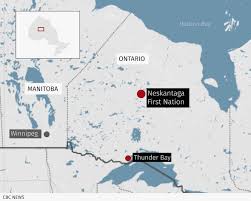
Ted Campbell explains how he would resolve the TWENTY-FIVE YEAR OLD PROBLEM in the Neskantaga First Nation in northern Ontario, which is one of the many First Nation public health issues the federal government has been promising to address for years:

A few weeks ago I was horrified to read about the 25 year long water problems that continue to plague the Neskantaga First Nation in North-Western Ontario ~ yes you read that right: it’s been 25 years since these Canadians have had clean, potable water! I begged the government to Do Something! and I offered one concrete idea based upon by near certain knowledge of what the Canadian Armed Forces can and have done for people overseas. One of my readers, a retired colonel in our Military Engineering branch confirmed that what I suggested was doable.

Now I read, in a report by Campbell Clark in the Globe and Mail, that the main problems are a combination of political over-promising and bureaucratic ineptitude. I am going to blame Justin Trudeau for pretty much all of the political over-promising: he made it a centrepiece of his 2015 election campaign and then totally failed to follow through. He has to wear at least a large part of the bureaucratic ineptitude, too, because he’s been prime minister of Canada for over five years. He’s failed, again.
OK, I can hear you saying: if you’re so smart how would you fix things?

For a start I would stick with the outlines of my earlier proposal: I would ask the Army to help, right now, using existing technology. We would declare this a disaster ~ and if Canadians going without clean water for 25 years doesn’t qualify as a disaster then I don’t know what does ~ and send the Canadian Armed Forces’ Disaster Assistance Response Team (the DART) to the Neskantaga First Nation and tell them to fix whatever needs fixing ~ using the Indigenous Services department’s budget. When they finished there we would buy them a new water purification system and send them the next First Nation that has a water disaster on its hands. People overseas will have to wait or we’ll have to build a second DART.

Next I would ask the Army and the Canadian manufacturers of water purification systems to work together with First Nations corporations, like Matawa First Nations Management, to develop (at the Indigenous Services department’s expense) concrete, workable plans to install, operate and maintain, over their complete life-cycle, water purification and waste disposal systems and the electrical power and the power and water distribution systems necessary to support them.

After this long, it may not be that the government can’t deliver these services, it might be that the government has deliberately chosen not to deliver.

July 12, 2020

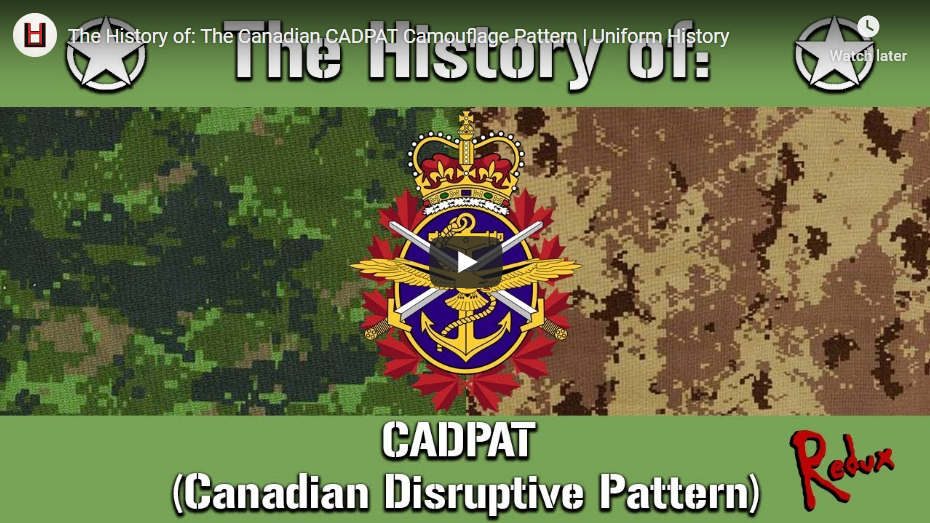
The History of: The Canadian CADPAT Camouflage Pattern | Uniform History

Filed under: Cancon, History, Military — Tags: , , , — Nicholas @ 02:00

Uniform History
Published 21 Jan 2019

Welcome to our first episode of 2019. Today we’ll be covering the, first of its kind, digital camouflage patterns more commonly known as CADPAT.

Again we’d like to thank everyone who pointed out some of the missing bits. So hopefully take two on CADPAT paints the larger more complete picture.

You can check out the YouTube Channel War Aesthetic here: https://www.youtube.com/user/spartan1…

As always music by: https://www.juliancrowhurst.com/

June 29, 2020

The Canadian Armed Forces Primary Reserve

Filed under: Cancon, Military — Tags: , , — Nicholas @ 03:00

Ted Campbell looks at the state of the reserves, specifically the Army Reserve:

For those interested, and every thinking Canadian should have some, albeit limited interest in the subject, there is an interesting thread over on Army.ca which deals with the problems (there are a lot of them) in making Canada’s reserve Army (the militia if you’re old enough) into an effective force.

I’m going to go with what I think is the majority opinion and say that our Army reserve, in particular, is ineffective. That does not mean that it does not do yeoman service: Canada’s tiny regular Army could not have conducted sustained combat operations in Afghanistan from 2002 to 2014 unless thousands and thousands of reserve force soldiers had stepped up. They were mostly young men, many looking for some combination of a full-time job, some adventure, a faster route into the regular Army, or even a sort of “gap year” experience, but some, like Canada’s current Defence Minister Harjit Sajjan, were middle-aged senior officers when they took a year off from their civilian careers to serve. Today, as I write many reserve force soldiers are serving in a new sort of front-line: long term care facilities that have been ravaged by the COVID-19 virus. The one problem that Canada does NOT have in its Army (regular or reserve) is the quality of the people who serve ~ they are, by and large, amongst the best soldiers in the world and, equally, especially the reservists, Canada’s finest citizens.

But too many people seem to be content with the notion that reserve Army is doing enough by providing a pool of individuals to fill up or augment regular Army units in an emergency. If that’s all the country wants, if that’s the level of capability for which we are willing to settle, then I think we, as a nation, do not deserve the service of the men and women in our reserve Army units.

June 20, 2020

“What did you do in the Wuhan Coronavirus war, Daddy?”

Filed under: Bureaucracy, Cancon, Government, Health — Tags: , , , , — Nicholas @ 05:00

Chris Selley metaphorically dons the garb of a war correspondent to report on how the Canadian government systematically mishandled the epidemic “war”:

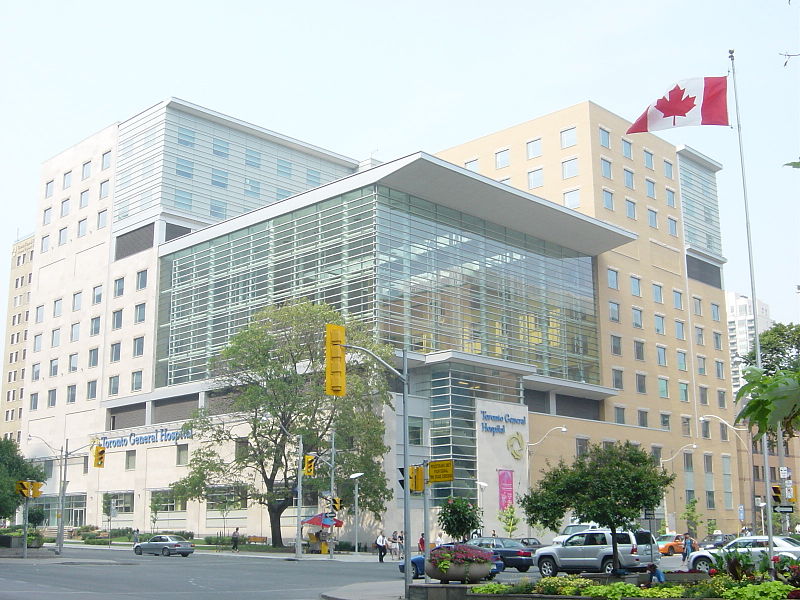
Toronto General Hospital.
Photo via Wikimedia Commons.

At first, comparisons to wartime seemed a bit silly. All we were being asked to do, after all, was stay indoors. As the World Health Organization was declaring a pandemic 100 days ago, the commanders had everything under control: the borders, the epidemiology, the strategy, support for shuttered businesses and their employees. Traditionally, wartime puts those of us left on the home front to work whether we like it or not. This was entirely the opposite: the worst we would have to put up with — in theory, assuming government aid was as advertised — was the indignity of idleness. Collective inaction would flatten the curve, the forces of COVID-19 would be beaten back, and summer would be saved. Peace in our time.

And then it instantly turned to quagmire. Canadians watched slack-jawed as COVID-19 breached our most fundamental defences. You don’t need Sun Tzu’s perspicacity to inform people arriving in Canada of their responsibility to self-isolate, and exactly what self-isolation means — go directly home, do not stop for groceries, do not receive visitors. I just did it, right there, in half a sentence. But we couldn’t manage it: Where information was distributed at all, it was excessively complex even as it failed to deliver the central message. Provincial forces threatened mutiny. Alberta Commander-in-Chief Jason Kenney stormed into the Edmonton airport demanding answers. It took weeks to sort out.

[…]

If it didn’t seem like a war before, it sure did once the real live army was drafted in to bail out long-term care homes in Ontario and Quebec that had descended into horrifying squalor. We learned the appalling details from leaked military reports. And now, in an almost poetic act of military pigheadedness, the Ottawa Citizen reports the Armed Forces are trying to hunt down and punish the leakers.

The war must go on. But sitting here in still-locked-down Toronto, stewing in my own bile, I cannot say this is filling me with patriotic fervour. I find myself simultaneously envious of other provinces that are in the process of reopening, and sympathetic to their residents: If it weren’t for the two sick men of the federation [Ontario and Quebec] dominating the narrative, they would likely have reopened much earlier.

Indeed, jealousies have bloomed as weeks turned to months. Apartment dwellers envy other apartment dwellers who have balconies. All apartment dwellers envy homeowners. Everyone envies cottage-owners. Some cottage-country mayors have told cottage-owners to stay put and keep their infestations to themselves. People cooped up with their kids sometimes envy those with time to themselves; singletons who have had enough alone time to last a decade occasionally envy those trying to juggle kids with working from home. The pleasant novelty of Zoom-based socializing faded ages ago, as everyone realized that Zoom-based socializing sucks.

More than 8,200 Canadians are dead, most having lived long lives but many having died in grim and lonely circumstances. In future, considerably more deaths and distress will be associated with the lockdown itself. The psychological effects of this will be studied for decades. If war isn’t quite the right analogy, it’s certainly closer to a war than anything that has been contested on Canadian soil in my or my parents’ lifetime, and it will come at a greater cost to the whole of society than any actual war that Canadian forces have fought over that time. It’s a terrible shame that as a nation, we didn’t win.

June 19, 2020

National Defence Headquarters needs to go on a crash diet

Filed under: Bureaucracy, Cancon, Government, Military — Tags: , — Nicholas @ 05:00

Ted Campbell knows how Canada’s NDHQ got into the state it is in, and has some suggestions for getting it out of its critical state of administrative morbid obesity:

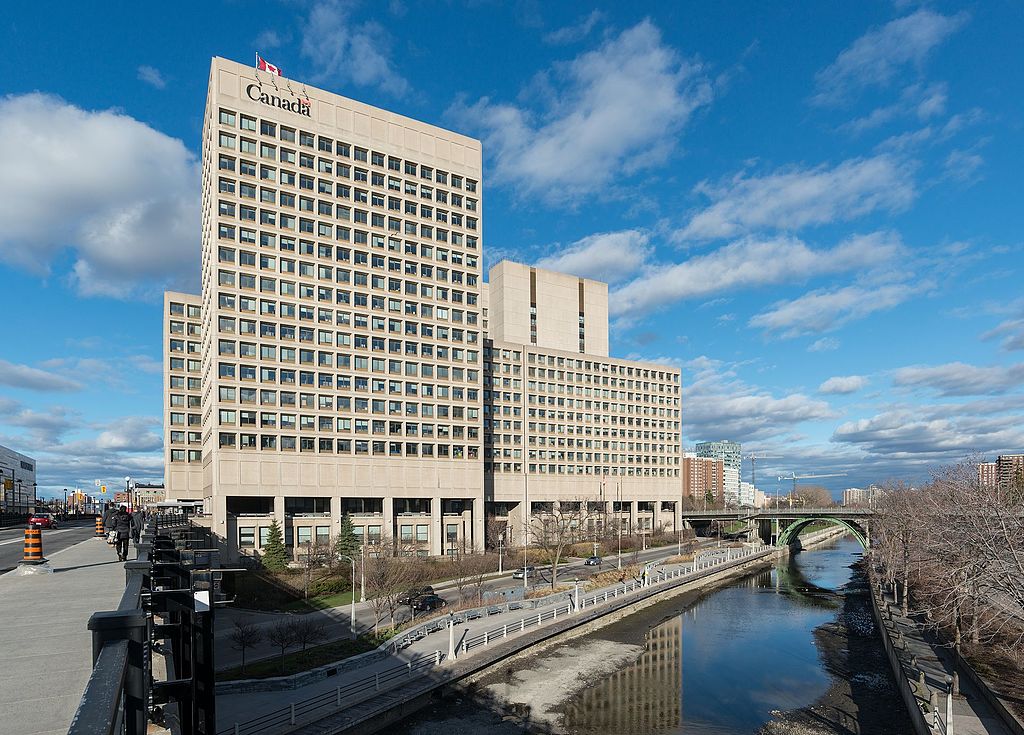
Major General George R. Pearkes Building in Ottawa, home of National Defence Headquarters on Colonel By Drive.
Photo by DXR via Wikimedia Commons.

National Defence Headquarters is a HUGE place with diverse functions. First: it is, simultaneously, the management centre of the Department of National Defence, which is a very large (and complex) department of government that includes the Canadian Armed Forces (but the CAF is just one of DND’s “arms”), and it is the national command centre for the Canadian Armed Forces. Second: it is one of the biggest budget departments in Canada. Defence spending supports many hundreds of thousands of jobs in the military, in the civil service and all across the spectrum of Canadian industry from the highest of high-tech enterprises through to janitorial services. It is never surprising when things fall through the cracks in any large, complex organization, is it?

But there are two other problems:

As defence spending has declined, year-after-year, always in terms of GDP and often in terms of its share of the public accounts and sometimes in real, dollar terms, too, the headquarters, especially the military’s command and control (C²) superstructure, has grown. A bit of growth is not surprising when one must “do more with less” as I well remember being told during the rounds of budget and staff cuts in the 1990s. Although to their credit, defence ministers in the Chrétien-Martin era imposed a series of staff cuts on the HQs in Ottawa, there was a bit of growth in the (largely civil service) policy and financial management areas. But in the Harper era that all changed. Budget pursestrings were loosened by governments after 2001 and, under e.g. Conservative Defence Minister Gordon O’Connor the Canadian Forces began to receive some much needed new equipment including the big CC-177 Globemaster III transport planes, new CH-147F Chinook transport helicopters and Leopard tanks ~ all procured on sole-source contracts, over the objections of many. But then O’Connor was replaced by Peter MacKay and, it appeared to me, the generals and admirals took over and the HQ went from lean to overweight and then to downright fat. Then, in the Trudeau era, the HQ went from simply being fat to being morbidly obese. There are, now, hundreds of admirals and generals, managing a military force that numbers in the (too few) thousands. Even serving flag and general officers have told me that cutting the highest ranks by ⅓ would do no harm and some retired officers and civil servants (with intimate knowledge of the inner workings of the HQ at the highest levels) say that a 50% cut would be healthy. The simple fact is that the Canadian Forces have too many very smart, very able senior officers with too little real work to do. They, not surprisingly, fill the time available with “work” of their own devising which, often, involves creating new and more complex command structures which require more and more general officers. The process seems unconstrained from the top.

Why? What happened?

Well, it started with the very best of intentions. I recall being told by one very, very fine general that we, the Canadian Forces, must, above all else, be “interoperable” with our American allies and that, he explained, meant adapting to their command and control system, poor as he thought it was. He said, and he meant, adapting, not adopting. But he retired and a new generation of officers entered the most senior ranks and some of them seemed, to me, to be more interested in adopting than in just adapting to. We seemed, in the 2000s, to be seized by a giant case of military penis envy and we seemed to want to have a local version of whatever the Americans had. The result was a proliferation of new command and control organizations, all put in place as the combat elements were actually shrinking. The end result was an unconscionable GOFO [General Officer/Flag Officer] to combat sailor and solder ratio and a bloated and, in my opinion, weak and inefficient command and control superstructure.

May 28, 2020

Wuhan Coronavirus versus Canadian government planning and implementation

As Chris Selley illustrates, this was a clear failure for the various levels of government:

When Ontarians look back on the COVID-19 pandemic as the moment when their government finally ponied up the big bucks and fixed the province’s long-term care system, they will likely also wonder what the hell took so long. As appalled as everyone quite rightly is by the Canadian Forces’ report into the state of five long-term care homes that were in dire enough shape to require military intervention, we really shouldn’t be shocked. As the Ottawa Citizen in particular has reported in recent years, the system’s staffing levels were designed for a much less old, much less sick and much less Alzheimer’s-afflicted population than lives in them today — and it led to some terrible outcomes in normal times.

Perhaps it was easy to blame such incidents on individual villains: Ottawa support worker Jie Xiao, who was caught on video punching 89-year-old Georges Karam 11 times in the face; or Elizabeth Wettlaufer, one of Canada’s most prolific and yet somehow least-famous serial killers, who murdered at least eight senior citizens in long-term care homes during her red flag-festooned nursing career. Perhaps tales of society’s most vulnerable being forced to wallow in their own filth, or even just left alone in confusion and misery, are too much for the human mind to contemplate at length.

In any event, it only stood to reason that a virus as potent as the one that causes COVID-19 would exploit weak points in a long-term care system. Between wandering patients, fans circulating air throughout facilities and a lack of basic sterilization control, you would almost think these five facilities wanted the virus to spread. It’s a wretched understatement to say we can do better.

We shouldn’t fool ourselves, though: Long-term care homes will always be uniquely vulnerable. And as the economy reopens, it’s essential we keep focusing on them. It’s essential that we focus, period.

There is a tendency among media in Central Canada to treat “Canada’s COVID-19” outbreak as a single thing affecting all of society. It clearly isn’t. The numbers are all over the map. Quebec has reported by far the most cases and deaths: 5,655 and 480 per million population, respectively. Ontario is at roughly one-third of that: 1,778 cases per million and 144 deaths per million. At 1,569 cases per million, Alberta has a comparable number of cases to Ontario — but far fewer deaths, at just 31 per million. British Columbia has the same death rate as Alberta, but with only one-third as many cases. Saskatchewan, Manitoba, Newfoundland and New Brunswick have reported just 18 deaths between them. Quebec has nearly 30,000 active cases; Ontario has just over 6,000; Manitoba has 16.

December 6, 2019

“‘The world needs more Canada’, some of us love to boast. Just not if it costs money”

Filed under: Cancon, Military, Politics, USA — Tags: , , , — Nicholas @ 03:00

In hindsight, President Trump let Justin Trudeau off rather lightly for his blatant disrespect on the world stage. Trump has all the cards in our bilateral trade relationship, and the Canadian economy isn’t in a healthy state at the moment. It’s not a risk any Canadian PM should be running when we are so “delinquent” on our NATO commitments, as Chris Selley points out:

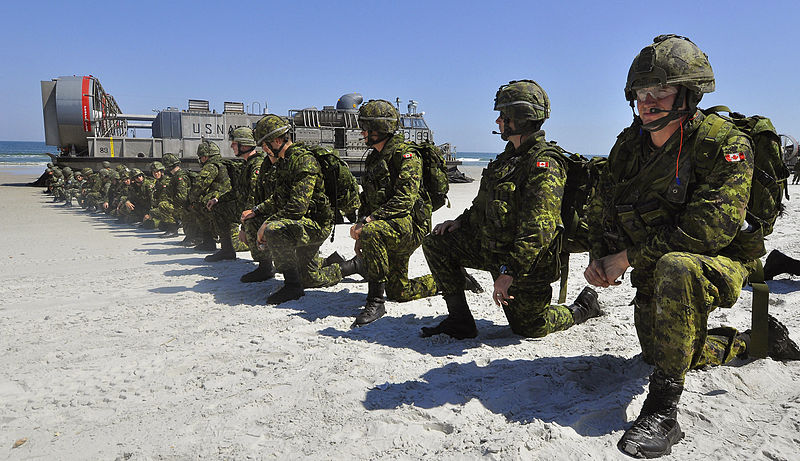
Canadian soldiers set a perimeter position after disembarking a U.S. Navy landing craft during a simulated amphibious landing, 24 April 2009. The training exercise was part of the 50th iteration of UNITAS, a multi-national exercise intended to increase interoperability among participating navies. Other participating nations include Brazil, Peru, Mexico, Germany, Ecuador, Argentina and Chile.
U.S. Coast Guard photo by Petty Officer Seth Johnson via Wikimedia Commons.

The unfortunate thing is that the precipitating event for this little spat could have been useful: An American president publicly calling out Canada, in effect, as a deadbeat brother. At their media availability-cum-fireside chat, Trump accused Canada — again in remarkably diplomatic language, by his standards — of being “slightly delinquent” when it comes to military spending, particularly as it relates to our NATO obligations. The unofficial target for NATO countries is two per cent of GDP. In 2018, the World Bank pegged Canada at 1.25.

This is far from a unique state of affairs. “The world needs more Canada,” some of us love to boast. Just not if it costs money. As a percentage of gross national income, Canada’s foreign aid spending is 0.26 per cent — below the OECD average of 0.31 and a pale shadow of countries like Sweden and Norway, which spend quadruple that. During the last election campaign, no doubt having extensively focus grouped the idea, the Conservatives promised to cut aid spending by 25 per cent.

Canada routinely lobbies for a seat on the UN Security Council for reasons no one can quite articulate — I suspect because it’s a relatively inexpensive thing that we can then boast about. Trudeau’s Liberals orated furiously about Canada’s alleged peacekeeping imperative during the 2015 election, dithered for an eon about how to fulfil it, sent 200 soldiers and eight helicopters to Mali for a year, and then brought them home. Peace kept! Conservatives spent the previous decade talking up Canada’s hard-power credentials even as military spending fell, as a percentage of GDP, for five out of the nine years Stephen Harper was prime minister.

No Canadian government of any stripe can procure a new fighter jet, icebreaker or frigate to save its life — because at the end of the day, we can’t use them to save our lives. If things really go pear-shaped we’re basically begging at Uncle Sam’s feet anyway, so military procurement has become about buying votes and very little else. Military spending has risen under Trudeau’s Liberals, but it’s still less than the 2009 high point under Harper — 1.4 per cent of GDP, in 2009. It was above two per cent as recently as 1987.

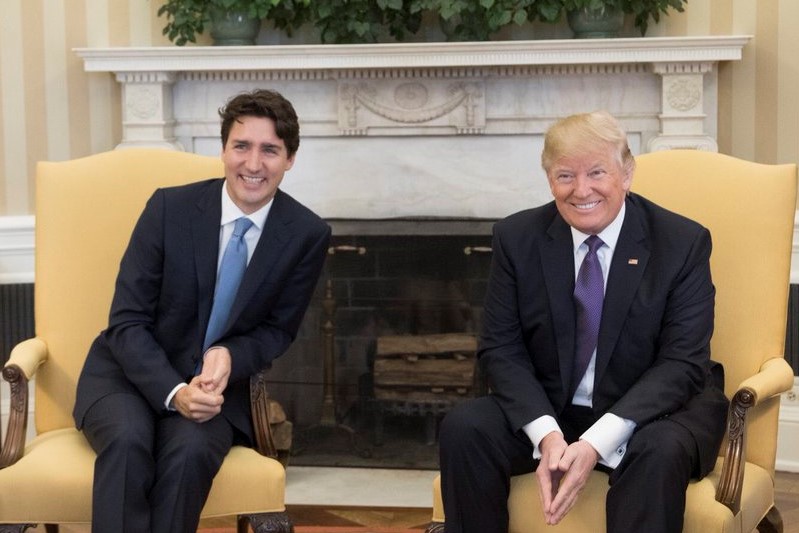
Justin Trudeau meets with President Donald Trump at the White House, 13 February, 2017.
Photo from the Office of the President of the United States via Wikimedia Commons.

November 28, 2019

“The chickens are coming home to roost … but they are, actually, Pierre Trudeau’s chickens”

Filed under: Cancon, Government, Military, Politics, USA — Tags: , , , , — Nicholas @ 03:00

Ted Campbell looks at Justin Trudeau’s plight — needing to focus on policies that will increase his party’s chances of winning more seats in Quebec — with increasing demands from south of the border to get the Canadian commitment to higher military spending moved from “aspirational goal” to actual policy:

Justin Trudeau meets with President Donald Trump at the White House, 13 February, 2017.
Photo from the Office of the President of the United States via Wikimedia Commons.

Many in the media are saying, and I agree, that Justin Trudeau’s agenda for the next couple of years is about 99.9% domestic and focused, mainly, gaining seats in on Québec and holding on, at least, in Atlantic Canada and in urban and suburban Ontario and British Columbia. The overarching aim ~ the ONLY aim ~ of this government is to be re-elected with a majority.

As I mentioned a week or so ago, Donald J Trump is about to rain all over Justin Trudeau’s parade.

As Murray Brewster reports, for CBC News,

    The Liberal government is facing renewed political pressure from the administration of U.S. President Donald Trump to increase defence spending to meet the benchmark established by NATO [… and …] Robert O’Brien, the new U.S. national security adviser, said it is an “urgent priority” to get allies across the board to set aside military budgets that are equal to two per cent of the individual country’s gross domestic product [… while …] Speaking with journalists at the Halifax International Security Forum on Saturday, O’Brien rattled off a list of the world’s flashpoints, including Iran and Venezuela, as well as traditional adversaries such as Russia and China [… saying …] “There are very serious threats to our freedom and our security [… and adding that …] Canada made a pledge at [the 2014 NATO Summit in] Wales to spend two per cent. We expect our friends and our colleagues to live up to their commitments, and Canada is an honourable country; it’s a great country.”

Note the choice of words by Mr O’Brien, who is “a lawyer and former U.S. State Department hostage negotiator.” He doesn’t say that President Trump and the USA “asks” Canada to keep its word (although the Harper government said that spending 2% of GDP on defence was an “aspirational goal,” rather than a firm commitment) nor did he say something like “the US hopes Canada will change its ways and spend more on defence.” He said that Donald Trump’s America “expects” Canada to live up to its “pledge.” As I mentioned before, when President Trump negotiates with friends and allies he usually has both fists in the air and his knuckles are often reinforced with unfair trade tariffs and the like. Right now he is, for example, asking Japan and South Korea to pay much, much more to support American forces in their countries because, in his mind, he (America) is providing a “service” which is all for the Asians and is not, in any way, in America’s self-interest and, therefore, he wants to be reimbursed. It’s a very Trumpian notion. I am sure he sees NATO and NORAD in very much the same light.

[…]

The issue that worries some analysts is that while Canada is, in the final analysis, protected by the US because it is in America’s best interests to protect us, NATO provides a useful counter-balance and, in effect, helps us to at least pretend to be a little less than just another American colony. And that, having the status of being little better than a US colony, is what Pierre Trudeau willed upon Canada in the late 1960s and early 1970s when he wanted to leave NATO, entirely and saddled Canada with his, juvenile, nonsensical, neo-isolationist “Foreign Policy For Canadians” white paper in 1970. Although Brian Mulroney wanted Canada to be independent – think standing up to President Reagan and Prime Minister Thatcher on South Africa – and Stephen Harper did, too, the cumulative impact of Trudeau-Chrétien-Trudeau for 30 of the last 50 years has been too much to change. When our political leaders don’t care about Canada being a leader amongst the nations and don’t, in fact, even care about Canada being a truly sovereign state then we will sink, inevitably, into the status of an American colony.

November 4, 2019

Canadian Army TAPV – Tactical Armoured Patrol Vehicle

Filed under: Cancon, Military, Weapons — Tags: , , — Nicholas @ 06:00

Matsimus
Published 1 Jun 2018

The Textron TAPV (Tactical Armoured Patrol Vehicle) is an armoured car currently in use by the Canadian Army. It is based on the M1117 Armoured Security Vehicle, developed for use by the military police of the US Armed Forces.

The Tactical Armoured Patrol Vehicle (TAPV) program began in 2009, and in 2012 the contract was awarded to Textron Systems, Inc. On August 16, 2016, Textron systems delivered the first Tactical Armoured Patrol Vehicle (TAPV) to the Canadian Army. An eventual 500 vehicles will be purchased, with the option to order an additional 100.

Sorry for the re-upload, thanks to those who want to make my life more difficult.

Hope you enjoy!!

Want to support my channel? Check out my Patreon Donation page! https://www.patreon.com/user?u=3081754

DISCORD IS BACK! Come hang out!
https://discord.gg/Hsg9gtS

I have Twitter…..sadly:
https://twitter.com/MatsimusGaming

October 18, 2019

Colonel Daniel Stepaniuk’s one-man campaign to wipe out (some) religious observance in the Militia

Filed under: Cancon, Military, Religion — Tags: , , , , — Nicholas @ 03:00

Christie Blatchford on the oddly partial actions of the officer in charge of more than a dozen Ontario militia regiments as far as religion is concerned:

The Lorne Scots (Peel, Dufferin and Halton Regiment) on parade in Brampton, Ontario on 24 September, 2016.
Photo by Nicholas Russon.

An army brigade commander has told the 14 Ontario reserve regiments under his charge that they must cancel any “church parade” they have planned.

Despite a lack of complaints about the parades, which see soldiers march to their regimental church, Col. Daniel Stepaniuk urged his commanding officers to stop participating in “any event where the primary purpose is liturgical, spiritual or religious … even if the service is non-denominational.”

A custom in the Canadian Army since the time of Confederation, the parades aren’t as common as they once were, though many units still have at least one a year, often tied to Remembrance Day ceremonies.

[…]

First of all, there is the glaring contradiction with Stepaniuk’s harsh stand on church parades and a parade that happened in Toronto last April.

A group of soldiers — I counted between 15 and 20 — were issued weapons, allowed to march in their military uniforms and were escorted by an armoured vehicle in the annual Khalsa parade for Canada’s Sikh community. It is considered a holy day.

The soldiers were from the Lorne Scots, one of Stepaniuk’s reserve units based in Brampton. The CO of the unit said at the time that he signed off on the weapons only after his commander (that would presumably be Stepaniuk, or perhaps the brigadier-general above him) approved the soldiers’ participation.

So weapons worn at a Khalsa Day parade good, though against the rules (The Canadian Armed Forces Manual of Drill and Ceremonial), according to army spokeswoman Karla Gimby.

But soldiers going anywhere near a church, bad, and against rules five years old that no one cared to enforce until now.

But most of all, in such small incremental strikes, does Canadian history and tradition lose strength.

September 7, 2019

C2A1: Canada’s Squad Automatic FAL

Filed under: Cancon, History, Military, Weapons — Tags: , , , , , — Nicholas @ 04:00

Forgotten Weapons
Published on 6 Sep 2019

http://www.patreon.com/ForgottenWeapons

Cool Forgotten Weapons merch! http://shop.bbtv.com/collections/forg…

Canada was the first country to formally adopt the FN FAL as its standard service rifle, and in 1958 it added the C2 light machine gun version of the FAL to its arsenal. The C2, later updated to C2A1, was a heavy-barreled version of the regular FAL rifle. It shared all the same basic action components, but with a dual-use bipod/handguard, a rear sight calibrated out to 1000 meters, and 30-round magazines as standard. The gun was mechanically fine, but not a great light support weapon, as its rifle lineage sacrificed handling and sustained fire capability. Only about 2700 were produced, and it was ultimately replaced by the C9 (FN Minimi) in the 1980s.

Many thanks to Movie Armaments Group in Toronto for the opportunity to showcase their AR-10 rifles for you! Check them out on Instagram to see many of the guns in their extensive collection:

https://instagram.com/moviearmamentsg…
http://www.moviearms.com

Contact:
Forgotten Weapons
PO Box 87647
Tucson, AZ 85754

« Newer PostsOlder Posts »

Powered by WordPress