Forgotten Weapons
Published on 19 Jul 2019http://www.patreon.com/ForgottenWeapons
Cool Forgotten Weapons merch! http://shop.bbtv.com/collections/forg…
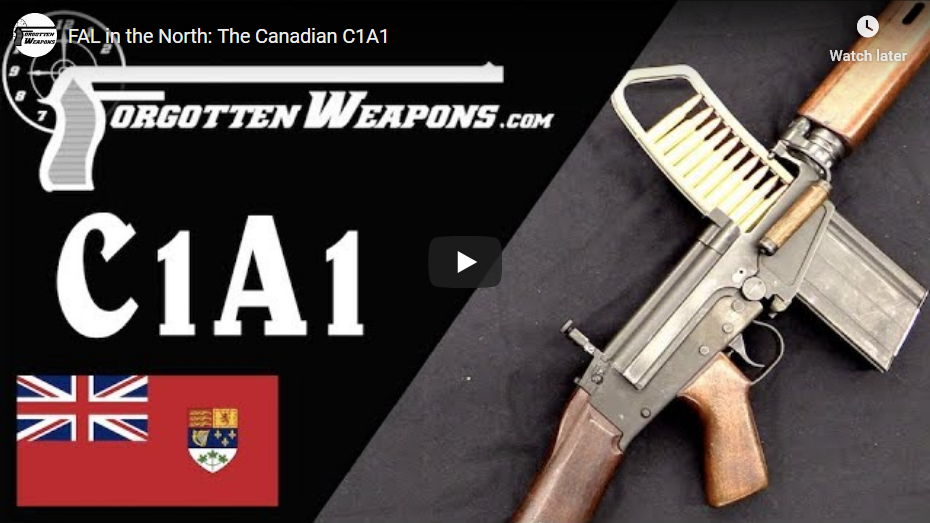
Canada was the first country to adopt the FAL rifle, purchasing trials rifles from FN within weeks of the formal standardization of the 7.62mm NATO cartridge. Canada acquired production rights to the rifle along with the technical package from FN, and spent 18 months converting the drawings into 1st-angle inch pattern (which would be used by the rest of the Commonwealth nations subsequently). Both a C1 rifle pattern and a C2 LMG pattern were made, although today we are looking at just the C1.
The first production was a run of 20 toolroom prototypes, one of which we have in today’s video. After a few changes were made – most distinctively to the rear sight – full-scale production commenced. Over the following years, a few minor changes were made, and a slightly improved C1A1 pattern adopted. These would service the Canadian military until eventually replaced with the C7 rifles.
Contact:
Forgotten Weapons
PO Box 87647
Tucson, AZ 85754
July 22, 2019
FAL in the North: The Canadian C1A1
July 18, 2019
Andrew Coyne interviews NATO Secretary General Jens Stoltenberg
In the National Post, Andrew Coyne discusses NATO, Donald Trump, and Russia with the current Secretary General of NATO, Jens Stoltenberg:

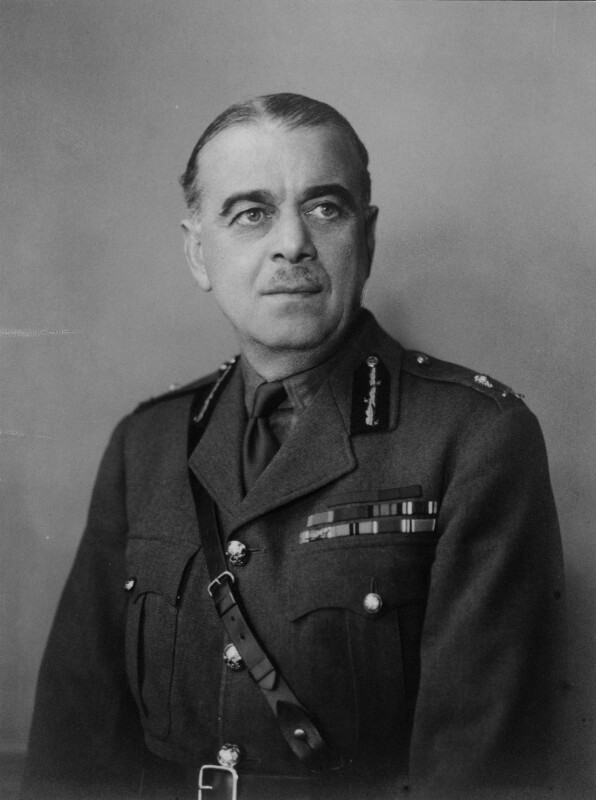
General Hastings “Pug” Ismay, later the first Secretary General of NATO during his military service as Winston Churchill’s chief military assistant in 1941.
Official British government photograph via Wikimedia Commons.
Throughout their term in government — and especially since Donald Trump’s victory in America’s 2016 election — Prime Minister Justin Trudeau’s Liberals have taken every opportunity to pay tribute to the “rules-based international order,” the consensus among countries that everyone’s interests are best served by following a set of rules and guiding principles that have evolved through the decades, expressed through things such as trade agreements and international alliances like the United Nations. If this consensus has a face it may be that of Jens Stoltenberg. The urbane former prime minister of Norway has been Secretary General of the North Atlantic Treaty Organization (NATO) since 2014, and through tough times for the international consensus he’s been one of the loudest voices defending it. This week he was in Canada to meet with Trudeau, to tour the Canadian Forces’ Garrison Petawawa and to discuss Canada’s NATO deployments in Latvia and Iraq. He sat down for an interview with the National Post‘s Andrew Coyne.
Q. Lord Ismay, NATO’s first secretary-general, famously defined the alliance’s mission as “keeping the Soviet Union out, the Americans in, and the Germans down.” When you hear some of the things Donald Trump says about NATO, about Article 5 (the collective defence provision) — are the Americans still in?
A. Yes. And they are more in now than they have been for a long time — meaning that they are actually increasing their NATO presence in Europe. After the end of the Cold War, Canada and the United States, for natural reasons, reduced their military presence in Europe. Because tensions went down, there was less need… Now tensions are increasing again, and both Canada and the United States are now increasing their military presence in Europe: Canada with a Canadian-led battle group in Latvia, and the United States with a battle group in Poland and also with a new armoured brigade. So what we see is that the United States is actually investing more in NATO, more military presence in Europe, more U.S. investments in infrastructure, in pre-positioned equipment, more exercises. So the message from the United States is that they are committed to NATO and we see that not only in words but also in deeds.
Q. But when you see Trump questioning the value of multilateral institutions, asserting “America First,” his chumminess with Putin, does it risk sending a signal that, if push came to shove — if Russia got up to no good in the Baltics or what have you — that America’s resolution to resist that would be less than certain?
A. For me the strongest possible signal to send is the presence of U.S. forces in Europe. The fact that we now, for the first time in the history of NATO, have U.S. troops in the eastern part of the alliance, in Poland and the Baltic countries. There is no way to send a clearer signal than that. And the Canadian troops because they are part of the picture. To have American troops in the Baltic countries sends a very clear signal that if a Baltic country is attacked it will trigger a response from the whole alliance… It’s not possible to imagine a stronger and clearer signal than that.
July 11, 2019
To lose one VCDS may be regarded as misfortune; to lose five looks like horrific leadership failure
(Apologies to Oscar for my misappropriation of his phrasing for the title of this post.) The current Vice-Chief of the Defence Staff has announced his resignation. Lieutenant General Paul Wynnyk will resign from his current role after rumours circulated that he was to be replaced with former VCDS Vice-Admiral Mark Norman. Ted Campbell has more:
I see, from a story on Global News, broken by Mercedes Stephenson, of Global and David Pugliese (Post Media), two journalists with very good sources inside DND and the Canadian Armed Forces, that “The second in command of Canada’s military Lt.-Gen. Paul Wynnyk is resigning after he said Chief of the Defence Staff General Jonathan Vance planned to replace him as the vice chief of the defence staff with Vice-Admiral Mark Norman … [but] … Vance then reversed that plan weeks later, according to Wynnyk, when Norman settled with the government and retired from the military.”
Lieutenant General “Wynnyk was the fifth vice chief to serve under Vance, and questions are now being raised about his leadership, senior military sources told Global News … [and, the report says] … There are now questions about who will fill the job next. No one appears to be ready, the sources said.” With the utmost respect to Mercedes Stephenson’s sources, who are, I suspect three and two-star admirals and generals, almost any general officer is “ready” to be Vice Chief of the Defence Staff or to fill almost any other “flag” appointment (jobs like surgeon general and the judge advocate general being obvious exceptions). I lived through times when the head of the Army’s equipment engineering branch was not an engineer ~ but was picked specifically because he could lead and manage people and could leave the “engineering” to subordinates, and when a logistics officer ran the Army, to the horror or a few combat branch dinosaurs, and when a Signals officer was Chief of the Defence Staff, too, because, at the time, the top leaders still understood that generals are generalists. I will assert, some will disagree but they are wrong, that almost every rear admiral and major general, from almost every corner of the military, is “ready” right now, to be Chief of the Defence Staff and almost every commodore and brigadier general is equally “ready” to be the Vice Chief. If that is not the case then the Canadian Forces’ leadership system is in a crisis right now, which only a wholesale slaughter of admirals and generals will rectify … or else there will be a slaughter of young Canadian men and women when our armed forces muct face a near-peer enemy.
At the risk of repeating myself:
- The current military command and control (C²) superstructure is beyond bloated, it is morbidly obese;
- The military C² system has things back-asswards ~ staff officers outrank combat commanders. We have commodores and brigadier generals sitting behind big desks in Ottawa when they ought to be commanding flotillas, brigades and air groups. The desks in HQs should be occupied by Navy captains and commanders and Army and RCAF colonels and lieutenant colonels, all of whom are, already, proven executives;
- The CDS should be a three-star officer, a vice admiral or a lieutenant general ~ Canada, with only about 110,000 men and women, regular and reserve, in uniform, doesn’t need a four-star CDS. Reducing her or his rank would be an act “pour encourager les autres;”
- The military’s command culture must start with getting the foundation right. The recruiting, selection, training and development of junior leaders, corporals and 2nd lieutenants (using the Army as my example), must be the highest priority for every single senior officer. If the foundation is solid then developing admirals and generals will not be a problem. If, as I suspect, the foundation is weak, if there is rank inflation, as I assert there is, at the tank/rifle section and troop/platoon command levels, then problems are going to persist and be magnified at the unit (ship, regiment or squadron), formation (group, brigade, wing and higher) and command levels and in National Defence HQ, too. Eventually, if the foundation is weak then we, Canadians will pay the price in blood … the blood of our sons and daughters and grandsons and granddaughters.
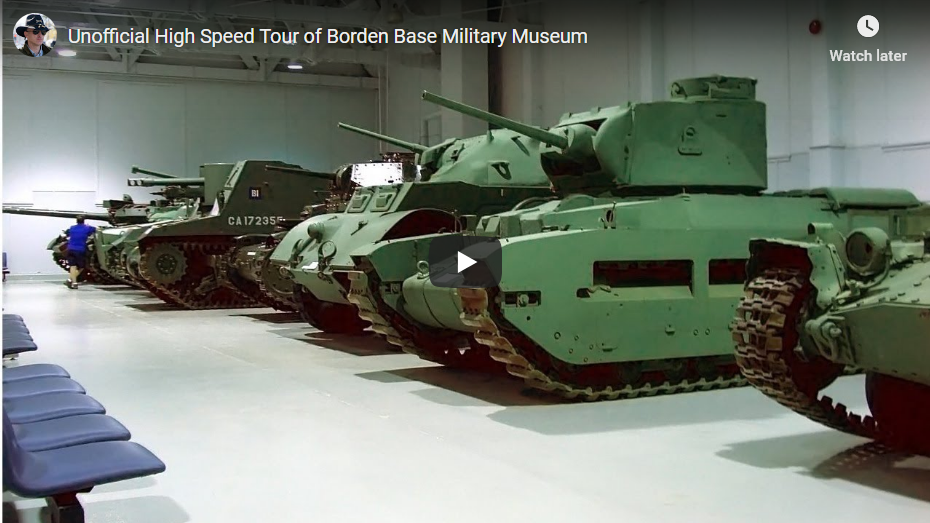
Unofficial High Speed Tour of Borden Base Military Museum
The_Chieftain
Published on 8 Jun 2019Canadian Forces Base Borden is located about an hour’s drive North of Toronto. The base is open access, so anyone can go to the museum.
In addition to the vehicles at the museum, there are others scattered as monuments around the base. I encountered a T-72 and T-55 on my way out the gate.
July 4, 2019
Is there a country with which Justin Trudeau hasn’t messed up Canada’s relationship?
Ted Campbell responds at some length to a Globe and Mail article by Doug Saunders, outlining the degradation of diplomatic relations with almost all our allies and trading partners since Justin Trudeau became PM.
The Globe and Mail‘s award-winning international affairs correspondent Doug Saunders, someone with whom I (almost equally) often disagree and agree, has penned an insightful piece in the Good Grey Globe in which he says that “Suddenly, Canada finds itself almost alone in the world, with a Liberal government realizing that its optimistic foreign policy no longer entirely makes sense … [but, he concludes] … Even if the current crisis in liberal democracy proves temporary and short-lived, we know that it can recur – and likely will. If the institutions of 1945 no longer work and the doctrines of 2015 have failed to have an effect, we should develop new ones that will keep Canada connected to the better parts of the world for the rest of the century.”
[…]“After the Second World War,” Mr Saunders writes, “Canada gained a few more foreign-policy outlets. Canada played a large role in creating the institutions that governed the postwar peace: the United Nations and its various organizations; NATO; the global trade body that became the World Trade Organization; the Bretton Woods institutions, including the International Monetary Fund and the World Bank. Canada was decisive in the international agreement that authorized the future creation of the twin states of Israel and Palestine, giving it a role in the Middle East that expanded with its creation of the institution of peacekeeping after the Suez Crisis in 1956 … [but this really is a silly statement, albeit one that too many Canadians believe to be true. Canada didn’t create the “institution of peacekeeping” in 1956. It was already there, in the United Nation’s case since Ralph Bunch (USA) and Sir Brian Urquhart (UK) created it in 1948 and it had been around since, at least, Woodrow Wilson’s 14 Points speech in 1918, but it is now part of the Laurentian Elite‘s quite dishonest revisions of Mike Pearson’s sterling legacy as a diplomat and politician] … And, starting in the 1950s, Canada became a player and a spender in the new field of foreign aid and development. Under both Liberal and Progressive Conservative governments, Canada used those tools to play a small but well-regarded place in the liberal-democratic order – and to slowly but profitably build its trade and economic relations.”
[…]
I agree with Doug Saunders about the sources of Canada’s current weakness. He neglected to mention the root cause: Pierre Trudeau explicitly rejected, in the late 1960s, the “St Laurent Doctrine” and replaced it with a social “culture of entitlement” which meant that our place in the world had to be sacrificed on the altar of a reinforced social safety net. I agree that Donald J Trump is the key to our and the West’s current angst and confusion, not Vladimir Putin, Xi Jinping or Arab terrorists, all of whom are easier to understand, but I would argue that we would be much better placed to cope with president trump and the 21st century had we not abandoned our role as a leading middle power circa 1970. I have reservations about all three of Mr Saunder’s prescriptions:
- I’m not sure another G-N, not even a “committee to save the world” is a really good idea;
- I am nervous about interfering in the internal affairs of other countries ~ think about “do unto others” and all that; and
- I really doubt that Canadians are ready to spend what’s needed on our defence and, I suspect, they will not be until it is (almost) too late.
Like Mr Saunders, Mr Lang and Professor Paris, I, too, want to save the liberal world order and Canada’s place in it; I’m just not sure that any of the proposed solutions offered by Doug Saunders, by Eugene Lang or even by Professor Roland Paris are going to be enough. I think we need less formality and fewer organizations in international actions and a lot more ad hocery. I hope that we will have new, adult leadership here in Canada in the fall of 2019 and I hope that a new, grownup prime minister will begin, quickly, to mend relations with Australia, India, Japan and the Philippines and other Asian nations, to shore up our relations with Europe and, especially, with Iceland, the Netherlands, Norway, Switzerland and UK. I also hope Canada will open new, more productive dialogues with Africa, the Caribbean and Latin America and with Iran, Russia and China, also. I am convinced that Professor Stein is correct and we must have an “interests-based,” even a selfish suite of foreign, defence, immigration and trade policies. We should not go about looking for enemies, but we must understand that we have precious few friends and, for now, we cannot count on America to be one of them. America, Australia and Britain, China, Denmark and India, Japan, Mexico and the Philippines, and Singapore and Senegal, too, will all act in pursuit of their own interests; Canada needs to be willing and able to do the same and to work with them, even with Donald Trump’s America and Xi Jinping’s China and Vladimir Putin’s Russia when our interests converge and, politely, stand aside when they diverge. The G7 and G20 and a proposed new G9 are all harmless, but also, largely useless, talking shops. Both diplomacy and foreign affairs must be conducted on a case-by-case, country-by-country, issue-by-issue and interest-by-interest basis and diplomacy and foreign affairs can only be conducted with positive effect when Canada is respected for both its examples and values (soft power) and for its hard, economic and military power, too.
Thus, the first step in doing our part to “save the world” is probably the one that most Canadians will have near the bottom of their priority list: rebuilding Canada’s military ~ which must start, after a lot of the fat has been trimmed from a morbidly obese military command and control (C²) superstructure, with steadily growing the defence budget … and that cannot happen until the economy is firing on all cylinders, including energy exports to the world.

July 2, 2019
Rebecca Jensen on strategy, tactics and the need for a Canadian approach to “operational art”
Rebecca Jensen’s submission was selected as one of five winners of the 2018 Defence and Security Essay Competition:
Over 12 years, the Canadian military involvement in Afghanistan cost 162 lives, more than 10 times as many wounded, and $18 billion in direct costs. While the tactical capabilities of the Canadian Armed Forces were widely praised, it is unclear what benefit Canada or Afghanistan realized for this steep investment of blood and treasure.
“Operational art” is the term used in defence circles to describe the alignment of tactical accomplishments with strategic ends, since tactical victories alone, as coalition forces have learned in Afghanistan, do not ensure success. The development of a more rigorous approach to operational art in the CAF would help to shrink the gap between tactical accomplishments and strategic stagnation in future conflicts, particularly in coalition missions involving stabilization and development elements.
Operational art connects tactical activities to strategic objectives. Principle elements include the coordination of tactical efforts in space and time to achieve national goals, as well as the balancing of resources and risk. Fighting as part of a coalition, and in complex contingency operations that include elements of stability operations and conventional warfighting, makes the practice of operational art more difficult, as it increases the factors shaping inputs, the environment, and desired outcomes. In particular, it requires coalition members to account for, if not balance, coalition and national objectives, which may differ or even be at odds with each other.
The Canadian army adopted much US thinking about operational art in the 1980s. Confronted by a conflict in Afghanistan very different from that for which it had trained, the CAF reacted similarly, grafting American doctrine and perspectives onto the army’s existing thought and practices. Given the need for rapid adaptation in Afghanistan within an US-dominated coalition effort, this graft made had a pragmatic logic to it, but in the longer term, it is no substitute for the development of organic Canadian thought on the planning and conduct of war.
The publication of Land Operations [PDF] by Canada’s director of army doctrine in 2008 represented an important step in that direction. Crucially, it recognized the complexity of wars like Afghanistan, and the centrality of relationships with other services, nations, and agencies. However, the emphasis on particular end states, and the dualism implicit in the siloing of fires and influence operations, which take place on the physical and psychological planes respectively per the manual, is reductive and linear. When termination criteria include objectives as subjective and complex as a “stable and legitimate host government,” the military can more helpfully plan [PDF] for progress toward that state than be charged with achieving a particular result. While some military activities will be more concerned with influence than maneuver and vice versa, it is similarly unproductive to prompt the military to be aware of the physical and psychological planes. Not only are the moral and the material affected by any action, they are frequently irreducibly interconnected.
May 31, 2019
Addressing the Canadian Forces’ shortfall in recruiting
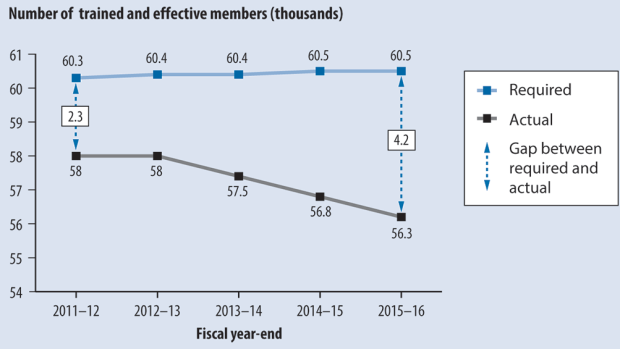
The Canadian Armed Forces have an authorized strength of more than 60,000, but have not been close to that level for several years: as of 2016 there were barely more than 56,000. Recruiting has not kept pace with the demand:
Canada’s armed forces have struggled for years to attract and retain talent. The latest reports only highlight the growing gulf between the number of members required for a fully staffed service, and the lack of actual personnel.
On May 7, Procurement Canada published an expression of interest notice asking the film and television industry to help boost the military’s brand among millennials and young Canadians.
The document ascribes young people’s apparent lack of interest in joining the military to a shift in generational attitudes.
“Millennials rank inward-focused values – happiness, discovery, etc. – higher than collective-focused values – justice, duty, etc.,” the report says.
“Characteristically, they want to contribute to society in a way that is meaningful as viewed in their own standards.”
Membership in the Canadian Armed Forces (CAF) fell from 58,000 to 56,300 between 2011 and 2016, while the forces’ staffing requirements actually grew.
The shortfall in personnel by the end of 2016 measured 4,200 jobs – nearly twice the vacancy gap of four years prior – with no evidence of a reversal of fortunes since.
A fascinating statistic popped up in the coverage that I hadn’t seen before:
The callout also targets celebrity personalities, influencers, podcasts and video games as potential vehicles for pro-military narratives, and stresses the importance of attracting visible minorities “as they account for 51 per cent of all science, technology, engineering and math (STEM) degrees and account for 50 per cent of the doctorate holders in Canada.”
According to the 2016 Census (summarized by Wikipedia), the national average of visible minorities is 22%, so that 22% is disproportionally represented in the graduating classes in STEM programs.
H/T to my friend William for the link.
March 11, 2019
Recruiting and retention in the Canadian Forces
Ted Campbell briefly discusses a “new” plan to recruit (some) soldiers for special forces units directly from civilian life:
Lee Berthiaume, writing in the Globe and Mail, says that “The Canadian Forces are considering whether to recruit elite special-forces soldiers straight off the street rather than forcing them to follow the traditional route of first spending several years in the military … [and] … The idea, which is still being debated, comes as Canada’s special forces – and the military as a whole – look at radical new ways to attract and retain people with the skills and experience needed to fight tomorrow’s wars … [some insiders suggest] … That includes not just computer experts, for example, but also those with different ethnic and cultural backgrounds and language skills, as the special forces aim to operate more effectively in different parts of the world.“
First, I agree that “tomorrow’s wars”
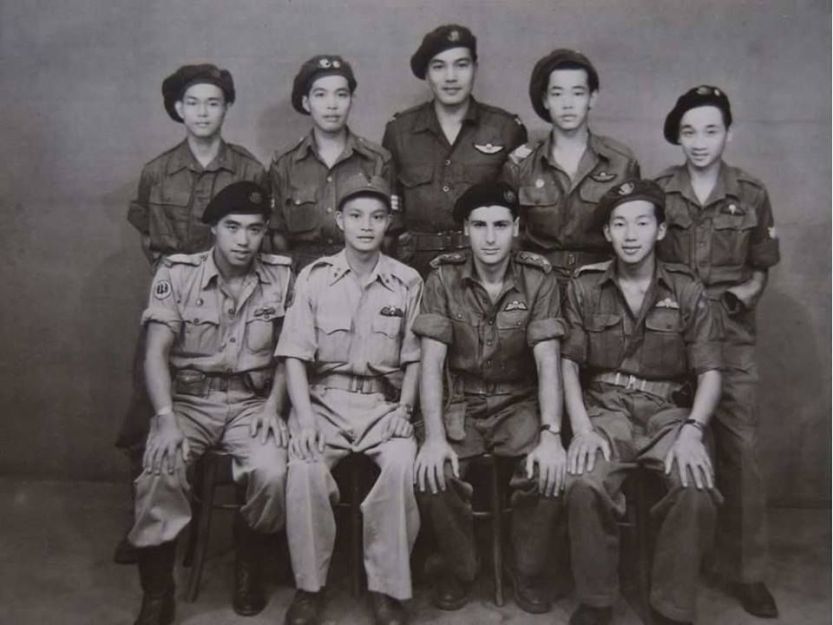
willmay require some more people with scarce or special skills than we are likely to need in conventional or traditional military operations, but, despite the fact that a) I have been retired for almost a generation’s worth of years, and b) I was never in special forces, I am confident in saying that a special forces soldier is, first an foremost, a soldier and then, after much training, a special soldier.Second, there is nothing new about recruiting special forces soldiers, right off the street, because they possess some special skills …
… but the men in the picture underwent horrendously difficult military training before they were ‘streamed’ into the special forces (Force 136) and sent to South East Asia to fight.
I take MGen Peter Dawe, Commander of the Canadian Special Operations Forces Command [at] his word when he says that “This is not about achieving set quotas or anything else … [and] … From a hard-operational perspective, do we have the right mix of people with the right sort of background, education, language, ethnicity, gender … that will allow us to do what our government expects us to do and will expect us to do in the future?” I believe that any focus on gender is politically inspired rubbish; I know that many women can do everything that many men can do, sometimes better ~ their gender is totally and completely irrelevant.
I also know, from discussion with serving members, that the Canadian Forces have an across the board recruiting and retention problem. The solutions to the recruiting and retention (both matter, equally) problems include
- Better pay and allowance ~ that’s always a pretty obvious solution to part of the problem;
- Separate pay for leadership (rank) and for skill (trade) ~ it has been over 50 years since Paul Hellyer screwed up the rank/trade system (especially the junior leadership ranks) in a (very welcome by all who, like me, were serving then) attempt to solve a remuneration problem. It’s well past time to revisit the whole pay and allowances system;
- Newer and better equipment ~ who can blame young, hotshot fighter pilots for not wanting to fly 30+ years old, hand-me-down from Australia, jets? Who can blame sailors for being tired of constant sea duty in old warships? Who can blame soldiers for showing disdain for an Army that cannot even issue them proper boots or replace a World War II vintage pistol? and
- Fight! This may seem counter-intuitive, but history and experience and academic studies all say that the best recruiting sergeant, better even than a pay raise and shiny new equipment, is the voice of guns. Now, I know this is exactly 180º out of phase with the current government’s policies and also goes against what many (most, I suspect) Canadians think their military ought to be all about, but neither the government nor many people really know or care much about he health of the military.
February 17, 2019
When Trump gets serious with Canada about defence spending
Ted Campbell notes that, despite all the nay-saying, President Trump appears to be getting results with US allies on defence issues. That being the case, he’s wondering when Prime Minister Trudeau will get the message:

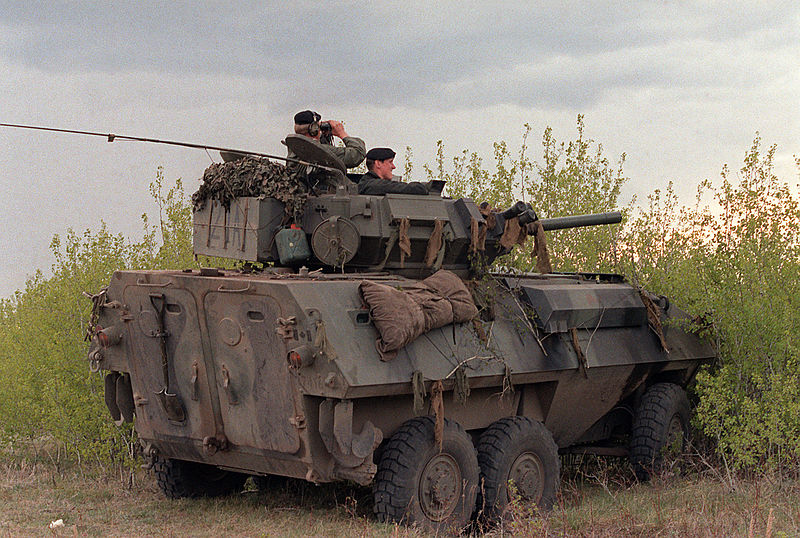
A right rear view of a Canadian army Cougar wheeled fire support vehicle being used as an observation post by soldiers standing watch during the combined U.S./Canadian NATO Exercise Rendezvous ’83. Location: Camp Wainright, AB
I was commenting on this before president Trump was elected; and shortly after his 2016 election victory I said that
“Prime Minister Trudeau and most European presidents and prime ministers will have to face a newly elected US president who wants them to pay for a bigger and bigger slice of their own defence. Real leaders would do well to recognize that the Americans have a valid point … some, probably many of them, including Prime Minister Justin Trudeau, may try to pretend that it doesn’t matter; they will be wrong.”
I was impressed, then, with how deeply many, many Americans felt about Donald Trump’s campaign message which said that allies were “freeloading,” and taking unfair advantage of America’s innate generosity … I was very, very conscious of the fact that, when I was a young man, a junior officer in Canada’s tough, superbly disciplined, well trained, trained, nuclear armed “vest pocket army” (as more than one allied general called us) brigade group in Germany, Canada used to pay its full and fair share … but we stopped, in the late summer of 1969, when Pierre Trudeau tried to totally withdraw from NATO and, indeed, from the world.
I wonder when President Trump will send someone like Timothy Betts, the Deputy Assistant Secretary and Senior Advisor for Security negotiations and Armaments in the US State Department, to Ottawa to demand that Canada should pay up after a half century of “freeloading” on the US taxpayers’ goodwill. That will come as a nasty shock to Team Trudeau and, indeed, to a majority of Canadians who have gotten used to the notion that the Americans will defend us out of the kindness of their hearts. I’m not sure that Canada is next in line, but I suspect we’re on his short list.
January 9, 2019
QotD: When the solution to one problem becomes a bigger problem
A couple of weeks ago I posted an article about the important of “junior leadership” in the military, especially, but, by extension, in all enterprises. My point was that if one lays a good, firm, foundation of “junior leadership” (tank and rifle section and troop and platoon commanders in the Army) then everything else ~ senior leadership, management, operations and even strategy ~ will probably thrive, but, if the foundation is weak, poorly laid, then success is unlikely in anything, and, if it does occur, it will be by accident.
I am reminded that back in the 1960s one of the (many) problems than then Minister of National Defence Paul Hellyer wanted to solve was pay. The Navy, Army and Air Force were having some trouble recruiting in the late 1950s and early 1960s: the post war recessions were over, the economy was growing, the threat of war seemed to be receding and military pay was quite low … all those things made recruiting and retaining the right people more difficult ~ especially for a military that was changing, rapidly, into a technologically sophisticated organization. There had been several boards and panels, reporting to both Prime Ministers Diefenbaker and Pearson, recommending new, better, higher pay scales for the military but little action had been taken because there was no public appetite for military pay raises. Paul Hellyer decided to ‘work around’ the problem by changing the definitions of “junior leadership.” Whereas, prior to the mid 1960s, the tank or infantry section commander had been a corporal (a rank that one could, theoretically, achieve after only 18 months of training ~ and 20 or 21 year old corporals were not rare, I was one) and the platoon or troop commanders were lieutenants, Mr Hellyer changed the rank of tank and section commander to sergeant (a rank that, typically, takes 10 years to achieve) and made promotion to corporal automatic, subject only to passing a trade/speciality skill course, and he made troop and platoon commanders captains and lowered the time that had to be spent as a lieutenant.
The effect was to debase the rank of corporal ~ which still retained its status as a “non commissioned officer” rank in the National Defence Act and Queen’s Regulations ~ by making privates and corporals interchangeable as “workers,” and, equally, to debase the captain rank by making captains and lieutenants interchangeable as first level combat commanders. In effect, while trying to solve one problem, Mr Hellyer created another ~ which I believe might be more serious.
Ted Campbell, “The foundation (2)”, Ted Campbell’s Point of View, 2017-02-21.
November 11, 2018
QotD: “Chateau” generals and the modern Canadian Army
… the great British strategist, one of the “fathers” of modern armoured-mechanized-mobile warfare, Major General JFC “Boney” Fuller, wrote in the mid 1930s called Generalship: Its Diseases and Their Cure: A Study of the Personal Factor in Command. In it Fuller was harshly critical of what he saw as an old, fat (quite literally) and out of touch military command structure that was intent on fighting the last war, or even the one before that, and was unable to innovate or accept change. Too many generals, he suggested, were physically and mentally unfit for the stresses of modern war, they could not “rough it” with soldiers and actually needed to be in nice warm chateaux behind the lines while soldiers and colonels fought in the mud. This is related to something that the brilliant British soldier-scholar Field Marshal Lord Wavell said in his comments on “generalship:” commanders need to be “robust … able to withstand the shocks of war.” Fuller, especially, went to great lengths, and back two thousand plus years in history, to say that wars and military leadership require physical and mental vigour and that young people, often very young people can master both war and leadership. I suspect that both Fuller and Wavell would look at our modern Canadian Army, especially at our seasoned, experienced and relatively old sergeant section and tank commanders and so, “No, no, no! You’re wasting all that good training and experience at too low a level. Section commanders need only half that much training; those sergeants should be doing more and more important things.”
I believe that we, the Canadian public, need and deserve a more efficient and cost effective Army, and one way to make it so is to lower the ranks of junior leaders: tank and rifle section and tank troop and rifle platoon commanders. It should be harder but quicker for young soldiers to achieve the ranks of lance corporal, corporal and master corporal and command a tank or a rifle section ~ but the corporals and master corporals should be paid more. Junior officers should spend longer in the ranks of second lieutenant and lieutenant, and be paid more, while they are given the opportunities to master the basics of their profession. If you have first rate platoon commanders you’ll get good generals without too much trouble … if you don’t have a plentiful supply of really good tank troop and rifle platoon commanders then good generals will only appear now and again, by happy accident.
Ted Campbell, “The foundation (2)”, Ted Campbell’s Point of View, 2017-02-21.
September 16, 2018
A suggested re-organization for the Canadian Forces
Ted Campbell continues his series on how to reform the Canadian Forces, this time looking at the overall command and control structure:
How the nation’s armed forces should be organized is a topic of nearly endless debate amongst military people. It is no secret, I think, that I favoured the joint force structure that former Defence Minister Paul Hellyer introduced in the 1960s. I was less enamoured with his idea of functional commands, but it was hard to strike a balance. I like the American model of joint, regional commands.
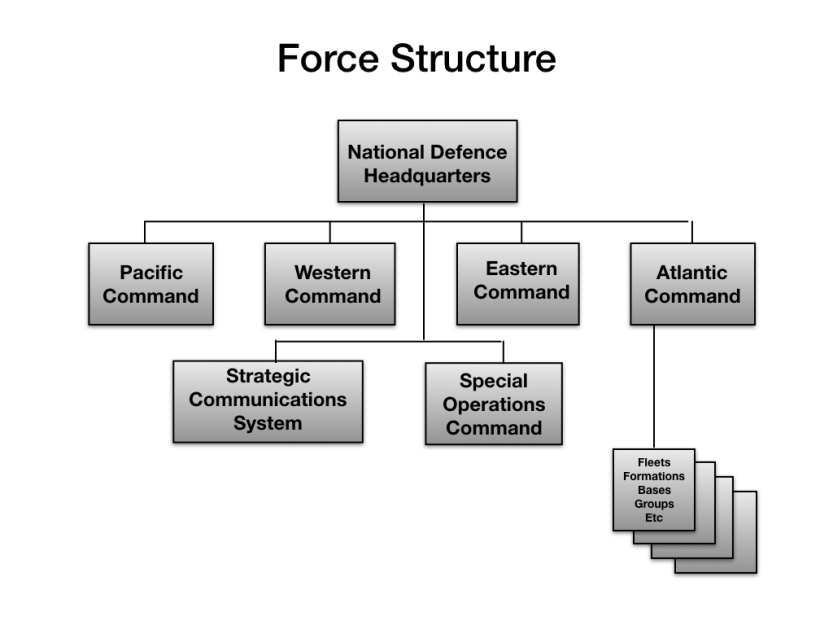
There is, almost always, a need for a few, national, functional organizations ~ for special forces and, perhaps global, strategic command, control and communications (C³) ~ but, in general, I believe that one large, national, strategic/operational HQ can control a half dozen commands, say four or five regional and two or three functional, something like this:
In my model (which reflects my deeply personal and often idiosyncratic views) the three star* Chief of the Defence Staff, in Ottawa, would command, just for example, four two star regional joint commanders (rear admirals or major generals) who would, in their turn, command almost every formation, base, depot, dockyard, base, combat ship and combat brigade, unit or wing in their geographic area. There would be a few exceptions ~ the one star officer (commodore or brigadier general, perhaps only a Navy captain or Army/RCAF colonel is needed) commanding the Strategic Communications System would command the specialized units scattered across the country and, indeed, around the world, but those units would get their day-to-day administrative and logistical support from their regional commander. Ditto for the one star officer commanding the Special Operations Command … except that he might need to have a bit more administrative and logistical power because of the nature of his business. There might be a perceived need for a separate Joint Operations (Overseas) Command but I doubt it is really necessary. The national Joint Staff (headed by a two star officer) in Ottawa can plan and direct the mounting of operations and each regional command should have a one star deputy commander who has a deployable HQ than can go, by sea and or air, to any trouble-spot in the world on fairly short notice.
In my model it seems obvious that Pacific and Atlantic Commands are going to be, primarily joint Navy/Air commands, likely, usually, commanded by a Navy rear admiral or an RCAF major general while Western and Eastern Commands will be, mainly, joint Army/Air commands, usually commanded by Army or RCAF major generals, but, if (s)he is the best person available there is no reason why an Army major general could not command Pacific Command and no reason why a Navy rear admiral could not command Western Command, for example. The commanders will have real commands, full of fighting and support forces … things like the current Canadian Forces Intelligence Command, will revert to being staff branches in the national HQ and the units will be part of the joint commands. Similarly, the Chiefs of the Naval, General and Air Staffs will be the professional heads of their services, responsible for things like doctrine, individual training standards and equipment requirements, but they will not be commanders.
[…]
* One of my critics has chided me for using the term “stars” when we, Canadians, don’t put stars on admirals’ and generals’ shoulders, rather they have maple leaves to indicate the level of their rank … fair enough, except that he is, as we used to say, “picking the fly sh!t out of the pepper” because I’m not using “slang”, as he suggests, but rather, I am using that was, when I served, and I understand is, still, common parlance in Canada and amongst our allies, including in the UK and Australia, too.
September 13, 2018
The Canadian Forces are suffering from obesity … in leadership and staff
Ted Campbell responds to requests to explain what he feels the Canadian Forces should do about our far-too-large military headquarters buttprint:
… let’s consider the command and control (C²) superstructure. I’m going to continue to argue that it is beyond “fat,” it is, now, morbidly obese and that condition actually poses a danger to our national defence. Too many cooks do spoil the broth and Canada has too many admirals and generals […] without enough real ‘work’ to keep them all productively busy; so they send each other e-mails and fabricate crises for their own HQ to solve and, generally, just make a nuisance of themselves. Fewer admiral and generals (and Navy captains and Army and RCAF colonels) will be busier and more productive and less dangerous.
I have a couple of concrete suggestions:
Start by reducing the rank of the Chief of the Defence Staff from four stars (admiral or general) to three stars, vice admiral or lieutenant general. We only have something like 65,000 regular force military members and 25,000 reserve force members. In about 1960 the Canadian Army, alone, had nearly 50,000 regular force members and something like 30,000 in the militia (reserve army) and it was commanded by one lieutenant general. Now, some will argue that times have changed and increased complexity means that higher ranks are needed. I call bullsh!t! The Israeli Defence Forces, today, has over 175,000 full time members and over 400,000 in reserve. Gadi Eizenkot, the Chief of Staff of the IDF holds the rank of Rav Aluf ~ lieutenant general, and he is the only Israeli officer to hold that high a rank. Now, let’s play a little mind game … suppose you are (four star) General Joseph Dunford of the United States Marine Corps, the Chairman of the Joint Chiefs of Staff, the most senior officer in the world’s most powerful military; now suppose, also, that your phone is ringing off the hook for some reason and your aide calls in on the intercom and says, “I have (four star) General Vance of Canada on line 1 and (three star) Rav Aluf Eizenkotof Israel on line 2, sir.” Which line does General Dunford pick up? Of course he isn’t impressed by Canadian General Jonathan Vance’s four stars; but he is mightily impressed by the size and power of the force that answers to three star Lieutenant General Eizenkot.
The argument that we need a four star CDS just because everyone else has one is specious … it’s rubbish. The Americans have several four star admirals and generals, they also have over 1¼ million active duty military personnel and 10 aircraft carriers and over 4,000 nuclear weapons. India has has a few four star officers, the Indian Army, with over 1 million regular, professional troops and with almost 1 million reserve soldiers, has one, only one, four star general. Canada does not need any four star officers on a regular basis … our lieutenant generals, vice admirals, rear admirals and so on, including Navy captains and Army colonels may all need generous pay raises but they do not need more gold on their shoulders and sleeves. Canada got its first four star officer back during World War II, when we had over 1 million men and women under arms. The rank returned in 1951, after our main allies, America (in 1947) and Britain (in 1939) established unified Chiefs of Staff committees to coordinate joint operations, when General Charles Foulkes was appointed to the post, which he would hold for almost a decade. Lowering the rank to three stars (vice admiral or lieutenant general) and raising the pay, would set a good example for the rest of the military and, indeed for all of government, in setting senior executive compensation, including perquisites, and status at reasonable levels.
Another thing, which I have mentioned before, is that back in the 1960s, when Defence Minister Paul Hellyer was upsetting every apple cart he and his team decided that the best way to set ranks and pay was to “benchmark” some military jobs with civil service equivalents. Now, in the civil service the appointment of “director” is, usually, the lowest level of executive ~ it is the point where technical expertise meets up with broader government wide responsibility and accountability, ‘ranks’ below that are specialists, ranks above it are, increasingly generalists. Now, anyone who knows much of anything about the military will agree that the first executive level in the Canadian Armed Forces is the captain of a major warship (a frigate, say) or the commanding officer of an Army regiment or battalion or of an Air Force squadron. Those ships and units are commanded by officers in the rank of commander or lieutenant colonel but for some reason, in the mid 1960s, the Hellyer team decided, probably just an error made in haste, that Navy captain and Army colonel and RCAF group captain were the appropriate ranks for directors and some very serious rank inflation was embedded inside the Canadian Armed Forces’ command and control (C²) superstructure … it’s an easy enough problem to fix although it will cause some short term disruption, and it means that the officers’ pay scales probably need to be reformed all the way down to the very bottom.
It has always seemed to me that the hallmark of a great army, of a great defence staff, especially, is a culture of excellence. The ranks of the staff don’t matter much, the staff act of behalf and in the name of the commander they serve. In fact, in a really good staff system the chain of command is always crystal clear because the senior staff are always, without fail, lower in rank (occasionally equal to) than the subordinate commanders. Thus, in an army corps (three or four divisions, perhaps 100,000 soldiers) the corps commander is a lieutenant general (three stars) and the subordinate commanders of divisions and of the corps artillery, are major generals (two star officers); in a proper corps the chiefs of staff of the operations and logistics branches, who control operations on behalf of the corps commander, are one star officers ~ brigadier generals. Ditto in the division (20,000+ soldiers) where the major general is the division commander and brigadier generals are the brigade commanders, the two chiefs of staff (operations, which includes intelligence, and logistics, which includes administration and personnel) are colonels … in each case the subordinate commanders outrank the senior staff officers. But the senior staff are listened to with great regard because they are excellent at their job and because they speak for the superior commander.
August 27, 2018
Upgrading Canada’s LAV III armoured fighting vehicles
From the LAV III Wikipedia page:

Canadian Army LAV III convoy near Khadan, Afghanistan – 2010-01-25
Photo by Staff Sgt. Christine Jones via Wikimedia Commons
The LAV III, originally named the Kodiak by the Canadian Army, is the third generation of the Light Armoured Vehicle (LAV) family of Infantry fighting vehicle built by General Dynamics Land Systems first entering service in 1999. It was developed in Canada and is the primary mechanized infantry vehicle of the Canadian Army and the New Zealand Army. It also forms the basis of the Stryker vehicle used by the US Army and other operators.
[…]
In July 2009, the Canadian Department of National Defence announced that $5 billion would be spent to enhance, replace and repair the army’s armoured vehicles. Part of the spending would be used to replace and repair damaged LAV III’s due to wear and tear from operations in Afghanistan. As much as 33 percent of the army’s light armoured vehicles were out of service. Furthermore, the LAV III’s will be upgraded with improved protection and automotive components. The Canadian Armed Forces has lost over 34 vehicles and 359 were damaged during the mission in Afghanistan. The Canadian army has lost 13 LAV’s and more than 159 were damaged by roadside bombs or enemy fire. Of the $5 billion announced, approximately 20% of it will be used to upgrade LAV III models. The upgrade will extend the LAV III life span to 2035. The remaining $4 billion is to be spent on a “new family of land combat vehicles”. The Department of National Defence considered the purchase of vehicles meant to accompany the Leopard 2 and to sustain the LAV III into combat. […]
On October 21, 2011 the Canadian government announced a $1.1 billion contract to General Dynamics Land Systems to upgrade 550 LAV III combat vehicles. The government said the upgrade is needed to improve protection against mines and improvised explosive devices (IEDs), which have been the cause of a number of Canadian deaths in Afghanistan. The improvements will also extend the service of the vehicles up to 2035 and will boost troop mobility. The upgrades include a new and more powerful engine, increased armour protection, steering and brake systems. The turret hatches on the LAV III would be made larger and improved fire control, thermal, day and low-light sights, and data displays. The weight of the vehicle would increase from 38,000 pounds (17,000 kg) to 55,000 pounds (25,000 kg). The first of 66 upgraded LAV IIIs was delivered on February 1, 2013. The success of the upgrade program and budget pressures led to the cancellation of the Close Combat Vehicle replacement program later that year.
In September 2012 the original contract valued to at $1.064 billion to upgrade the 550 LAV III’s variants, an infantry section carrier, a command post, an observation post and an engineer vehicle to the LAV 6.0 configuration, was modified. This included an additional $151 million to upgrade 66 LAV III’s to the LAV 6.0 reconnaissance variant or ‘recce’.
On February 10, 2017 General Dynamics Land Systems – Canada of London, Ont. was awarded a $404 million order to work on 141 LAV Operational Requirement Integration Task (LORIT) vehicles. This contract will upgrade the remaining LAV III fleet in the Canadian Army to the LAV 6.0 configuration. This brings the Canadian Army’s Light Armoured Vehicle III Upgrade (LAVUP) program to a total cost of $1.8 billion.
Final completion and delivery of the Canadian Army’s Light Armoured Vehicle III Upgrade (LAVUP) to upgrade the LAV III to the LAV 6.0 is expected to be completed by December 2019.

Canadian combat engineers in light armoured vehicules cross the river on a German floating bridge in Tancos, Portugal, during JOINTEX 15 as part of NATO’s exercise TRIDENT JUNCTURE 15 on November 2, 2015.
Photo by Sgt Sebastien Frechette via Wikimedia Commons
Ken Pole has more on the program at Canadian Army Today:
The LAV UP, also known as LAV 6.0, project is expected to push their operational life to 2035.
That effectively was set in motion in November 2008 when the Department of National Defence (DND) confirmed that it wanted to combine three programs into one general set of upgrades to all armoured vehicles. That led to a $1.064-billion contract award to GDLSC in October 2011 to modernize 550 LAV IIIs to enhance not only their survivability, but also their mobility and lethality.
Under the contract, 409 vehicles were to receive turret and chassis upgrades while 141 LAV Operational Requirement Integration Task (LORIT) variants were scheduled to receive only the turret upgrade. A contract amendment in February 2017 added $404 million to upgrade the LORIT chassis as well.
Now the focus within the Directorate of Land Requirements (DLR) is on the Light Armoured Vehicle Specialist Variant Enhancements (LAV SVE). Major Philippe Masse, the project director, brings operational chops from Afghanistan, although he’s quick to say that he’s had a lot to learn about the vehicles since he was assigned. He’s taken a clean-sheet approach, conducting extensive discussions with combat engineers, artillery officers, and gunners.
Masse’s career includes nine months as commander of a light infantry platoon tasked with force protection of the Kandahar Provincial Reconstruction Team and later as second-in-command of the Royal 22nd Regiment battlegroup’s parachute company for its final combat rotation on Operation Athena.
The LAV III infantry carrier and command post variants are the two largest elements of the fleet and are often tasked additional roles. However, the two specialist variants, the Engineer and the Observation Post Vehicle, used by Artillery’s forward detachments, will be “enhanced” under this project.
[…]
There is extra pressure on the LAV SVE package because it was specifically identified in the Strong, Secure, Engaged policy document. “We’re on track; the options are getting a lot of priority,” Masse said. “We’re already engaged with General Dynamics Land Systems because they basically own the intellectual property of the fleet…. When you want to integrate new stuff, they’re among the first phone calls you have to make.”
While integration of a complex system is always a challenge, one of the team’s considerations will also be ease of maintenance, especially for soldiers in the field. “We’re looking to align that, if possible, with existing in-service support contracts that we already [have],” he said. “The bottom line for us is reliability.”
May 28, 2018
Leopard tanks in Afghanistan – “When the legend becomes fact, print the legend”
There’s a story that’s been told for more than a decade and — given the Canadian government’s legendary unwillingness to spend money on the military — widely believed. David Pugliese does his best to debunk it here:

Canadian Leopard 1A3 (Leopard C1) at the Bovington Tank Museum.
Photo by Chris Parfeniuk, via Flickr.
As stories go it’s a pretty good one.
The Canadian Army was up against a tough enemy – the Taliban – in Afghanistan. Commanders called for Leopard tanks to join the battle but those armored vehicles had been mothballed and made into monuments.
So the ever resourceful Canadian Army crews jumped in the Leopard tanks mounted on concrete pads outside bases as monuments and drove them off those platforms, making sure they were shipped to their comrades in Afghanistan.
This myth has been around since 2007 and has once again resurfaced in a new book by retired Maj.-Gen. David Fraser about Operation Medusa.
Fraser also repeated the story in a recent CBC interview with Anna-Maria Tremonti, noting that he knew of at least one Leopard tank pulled off its concrete pad and brought back to serviceability and then shipped to Afghanistan.
In the 2008 book Kandahar Tour by Lee Windsor, David Charters and Brent Wilson the story gets even better. The tanks were driven off the concrete pads and then sent to Afghanistan, according to those authors.
A similar claim is made at the museum devoted to telling the story of the “Essex Regiment (Tank).” On its website the museum claims multiple numbers of Canadian Leopard tanks were taken from monuments (“A mad scramble to retrieve tanks from monuments and prepare them for war,” it claims).
Again, a great story.
But the Canadian Army says it never happened.
The Army points out that Leopard tanks, positioned on the concrete pads as monuments, had already been demilitarized so no one was driving them anywhere.
So what did happen?