Long live Slop!
Slop is a creative style that emerged around 2023 with the rise of generative AI. Slop art is flat, awkward, stale, listless, and often ridiculous. Slop works are celebrated for their stupidity and clumsiness — which are often amplified by strange juxtapositions of culture memes.
These Slop works are widely mocked by the audience — and even by the people who create and curate them. Yet they are the results of hundreds of billions of dollars in tech investment.
Slop is all about wastefulness!
Let’s put this in context: In the current moment, there’s no money for serious artists — in filmmaking, fiction, painting, music, whatever. But there’s an endless supply of dollars to create Slop technology.
In fact, no artistic movement in human history has soaked up more cash than Slop.
This seems like a paradox. Why is so much money devoted to churning out crap?
Ah, that’s part of the appeal of Slop. The audience’s gleeful mockery is actually enhanced by the fact that a huge fortune has been wasted in creating pointless and bizarre works.
In other words, this mismatch between means and ends is a key part of our aesthetic movement. Hence a certain degree of cynicism is embedded in both the production and consumption of Slop.
So it’s stupid. It’s wasteful. It’s tasteless. It’s cynical.
And that’s all part of the plan.
Long live Slop!
Ted Gioia, “The New Aesthetics of Slop”, The Honest Broker, 2025-02-25.
May 26, 2025
QotD: A Slop manifesto
May 21, 2025
AI hallucinations capture the Chicago Sun-Times summer reading list
Good luck finding some of the highly recommended books on the Chicago Sun-Times list of summer reading … they don’t actually exist (yet):
Critics aren’t perfect.
Sometimes they get facts wrong. Sometimes their judgment is faulty. Sometimes they dangle their modifiers or split their infinitives with everybody watching.
I’ve been there. And it’s awkward.
But I’ve never seen anything as embarrassing as the “Summer Reading List for 2025” in the Chicago Sun-Times.
It gave glowing reviews to books that don’t exist. And I bet you can guess why.
Yes, the newspaper relied on AI to write the article.
The article starts with a recommendation for Tidewater Dreams by Isabel Allende. This is Allende’s “first climate fiction novel” where “magical realism meets environmental activism”.
It’s a shame that Allende never wrote this book. Nor did anyone else — the book simply doesn’t exist.
(I’ll predict, however, that an AI-generated book with this title will show up on Amazon within a few days. When you live in a world of AI hallucinations, this is how the business model plays out.)
The next book on the Sun-Times list is The Last Algorithm by Andy Weir. This novel is also non-existent. But the storyline — about rogue AI that gains consciousness — makes me think that the bots are now mocking us.
It doesn’t get better. The first 10 books on the summer reading list are entirely hallucinated.
As the story of the fake reviews spread on social media, the Sun-Times got into damage control mode. It issued a public statement denying responsibility.
But that just makes matters worse.
Why are they publishing garbage without vetting it? And the denial is also implausible.
Somebody at the newspaper must have given the okay to this. The printing presses don’t run themselves (although maybe that will be the next stage of the AI business model).
How is this happening?
We are now several years into the AI revolution. I’m constantly hearing about new, improved bots that are smarter than super-geniuses, and can replace lowly humans.
But the bizarre lapses are getting worse — and more dangerous.
AI is routinely making stupid, nonsensical mistakes that even the most incompetent employee would never make. I’ve met some incompetent journalists over the years, but none would make a boneheaded move of this magnitude.
And this is after a trillion dollars has been sunk into AI by the most powerful corporations in the world. This is after they have soaked up much of the energy grid. This is after all the training and vetting and upgrading.
We’re not talking about beta testing or first generation AI. Silicon Valley is actually bragging about this tech — but it’s stupider than the worst journalist in the country.

April 28, 2025
A potential positive to the explosion of AI-generated fake porn
The one thing we have always been able to predict with 100% confidence is that every new media will be used for pornography and crime, often in the same product. However, No Pasaran makes a case for there being a socially useful side to the ever-increasing realism of fake porn from popular LLM generators:
Seriously?! Am I the only person that sees the benefits of this “troubling trend” of online bullying?!
Think about it.
Blackmail is now a thing of the past.
That’s it.
It’s over.
Whether you are a teen or an adult, whether the photos are real or not, you can simply pass all of them off — indeed, you can do so nonchalantly — as fakes or deepfakes. To your classmates, to your spouse, to your constituents. Who will know whether you are fibbing or telling the truth? (Maybe you hardly know yourself …)
(In a totally different context, of course, that is exactly what Joe Biden’s White House did …)
As it happens, a considerable size of the audience for these sex photos/videos — maybe far more than half — will already be assuming that they’re fakes … (Thanks for the Instalink, Sarah.)
Depression at 16? Suicide at 17? Why fear sextortion at this point? Compliment instead the (anonymous) photo/video creators for doing a good job — for doing an outstanding job.
On my phone I keep receiving photos of Donald Trump tenderly cuddling with Joe Biden or Vladimir Putin or Stormy Daniels. Lots of apps now make you “repair” snapshots that are decades or (over) a century old, colorize them, and make them into mini-movies (the latest one I saw delighted me as it involved Civil War daguerreotypes from the 1860s).
I also keep receiving AI ads where, by combining a couple of photos of myself and of any girl (someone I know and am perhaps infatuated with or some rock or movie star or someone — Marilyn Monroe? Rudolph Valentino? Che Guevara? Queen Victoria? — who has been dead for decades) I can make myself hug or kiss that person — hungrily — on the mouth.
Years ago (long before AI), I was writing a TV script imagining a politician who was on national television and who was all of a sudden ambushed with private photos of him in a compromising position (with a woman other than his wife, with a man, with many women, with many men, at an orgy, in a BDSM cave, with a money shot, whatever …). Talk of falling victim; talk of bullying; talk of harassment (justified or otherwise)!
How should he react?
Ignore the content. And, with an admiring voice, let out a whistle and praise the work: “Wow, that’s well done!”
“What do you mean?!” interrupts the TV presenter, visibly frustrated. “No no no! Don’t tell me you are claiming they’re fake?! We have proof that you were seen at—”
Again, this was before AI, needless to say, which only made the politician’s next words even more startling: “It is so how admirable the degree to which studios have made progress with special effects!”
February 21, 2025
Tech enshittification continues
Ted Gioia notes that even the world’s biggest search engine provider is doing almost everything it can to make your search experiences worse and worse:

Almost everything in the digital world is turning into its opposite.
- Social media platforms now prevent people from having a social life.
- ChatGPT makes you less likely to chat with anybody.
- Relationship apps make it harder for couples to form lasting relationships.
- Health and wellness websites make it almost impossible to find reliable health advice — instead peddling products of dubious efficacy.
- Product review sites now prevent people from reading impartial reviews by actual users of the product, instead operating as pay-for-play vehicles.
- Etc. etc. etc.
You can often tell by the name. PayPal will never pay you a penny, and it’s certainly not your pal. Microsoft Teams only works if you stay away from your team. If you keep using Safari, you will never go on an actual Safari.
But the worst reversal is happening with search engines. They now prevent you from searching.
I’ve known Google up close and personal from the start. I initially found the company quirky and endearing — but those days ended long ago. The company is now clueless and creepy.
Almost every day I read some ugly news story about Google. Here are a few headlines from a typical week:
- “Google ditches promise not to develop AI weapons” (February 12)
- “Millions of Google users alarmed after discovering new AI tool they can’t turn off” (February 14)
- “Google facilitated Russia and China’s censorship requests” (February 15)
- “Google’s new fingerprinting policy sparks privacy backlash as ads become harder to avoid” (February 17)
- “Google data centers used nearly 6 billion gallons of water in 2024” (February 11)
This company goes out of its ways to do mischief. Messing with people is in its DNA.
Meanwhile, its base business is degrading at an alarming rate. The company doesn’t seem to care.
In a strange turnaround, search engines don’t want you to search for anything. That’s because searching leads you on a journey — and Google doesn’t want you to leave their platform.
The search engine was invented as your gateway to the web. The inventors of this technology tried to index every page on the Internet — so that you could find anything and everything.
That was an exciting era. Search engines were like train stations or airports. They took you all over the world.
At Google today, the goal is the exact opposite. You never leave the station.
Techies once described the Internet as a digital highway. But we need a different metaphor nowadays. Web platforms want to trap you on their app, and keep you there forever.
So, instead of a digital highway, we have a digital roach motel. They let the roaches check in — but not check out.
February 14, 2025
Trump may start paying attention to Canadian cultural protectionist polices next
Michael Geist points out just how many Canadian federal policies and programs will likely come under scrutiny by the Trump administration for their blatant protectionism against US cultural products:

My Globe and Mail op-ed argues the need for change is particularly true for Canadian digital and cultural policy. Parliamentary prorogation ended efforts at privacy, cybersecurity and AI reforms and U.S. pressure has thrown the future of a series of mandated payments – digital service taxes, streaming payments and news media contributions – into doubt. But the Trump tariff escalation, which now extends to steel and aluminum as well as the prospect of reviving the original tariff plan in a matter of weeks, signals something far bigger that may ultimately render current Canadian digital and cultural policy unrecognizable.
Our cultural frameworks are largely based on decades-old policies premised on marketplace protections and mandated support payments. This included foreign ownership restrictions in the cultural sector and requirements that broadcasters contribute a portion of their revenues to support Canadian content production.
As we moved from an analog to digital world, the government simply extended those policies to the digital realm. But with Mr. Trump appearing to call out what he views to be Canadian protectionist policies in sensitive sectors such as banking ownership, the cultural and digital sectors may be next.
If so, there are no shortage of long-standing policies that tilt the playing field in favour of Canadians that could spark some uncomfortable conversations.
Why do U.S. companies face ownership restrictions in the telecom and broadcast sectors? Why are Canadian broadcasters permitted to block U.S. television signals in order to capture increased advertising revenue? Why do Canadian content rules exclude U.S. companies from owning productions featuring predominantly Canadian talent?
The Canadian response that this is how it has always been is unlikely to persuade Mr. Trump.
Canadian policies premised on “making web giants pay” may also be non-starters under Mr. Trump. For the past five years, the Canadian government seemingly welcomed the opportunity to sabre rattle with U.S. internet companies. This led to mandated payments for streaming services to support Canadian film, television and music production; link taxes that targeted Meta and Google to help Canadian news outlets; and the multibillion-dollar retroactive digital services tax that is primarily aimed at U.S. tech giants.
Not only have those policies raised consumer affordability and marketplace competition concerns, they have also emerged as increasingly contentious trade issues. If the trade battles with the U.S. continue, the pressure to scale back the policies will mount.
Beyond rethinking established cultural and digital policies both new and old, the bigger changes may come from re-evaluating the competitive impact of policies that rely heavily on regulation just as the U.S. prioritizes economic growth through deregulation. Proposed Canadian privacy, online harms and AI rules have all relied heavily on increased regulation, looking to Europe as the model.
For example, consider the Canadian approach to AI regulation in the now-defunct Artificial Intelligence and Data Act. It specifically referenced the European Union’s regulatory system, which establishes extensive regulatory requirements for high-risk AI systems and bans some AI systems altogether.
However, the European approach is not the only game in town. Mr. Trump moved swiftly to cancel the former Biden administration’s executive order on AI regulation, signalling that the U.S. will prioritize deregulation in pursuit of global AI leadership. Further, the arrival of DeepSeek, the Chinese answer to ChatGPT, took the world by storm and served notice that U.S. AI dominance is by no means guaranteed.
The competing approaches – U.S.-style lightweight regulation that favours economic growth against a more robust European regulatory model that emphasizes AI guardrails and public protections – will force difficult policy choices that Canada has thus far avoided.
February 1, 2025
China produced DeepSeek, Britain is mired in deep suck
In the Sean Gabb Newsletter, Sebastian Wang discusses the contrast between China’s recent release of the DeepSeek AI platform that appears to be eating the collective lunches of the existing LLM products by US firms and the devotion of the British Labour government to plunge ever deeper into their Net Zero dystopian vision:

Net Zero image from Jo Nova
For those few readers who may be unaware, DeepSeek is an advanced open-source artificial intelligence platform developed in China. Released in late 2024, it has set a new standard in AI, outperforming American counterparts in adaptability and capability. It excels in natural language processing, machine learning, and data analysis, and — critically — it is open source. Unlike the proprietary models that dominate the American tech landscape, DeepSeek allows anyone to adapt, improve, and use it as he sees fit. It’s not just a technological triumph for China; it’s a serious challenge to American domination of information technology and an opportunity for those who want to break free from the stranglehold of Silicon Valley.
As a Chinese person, I take pride in this achievement. It’s a testament to what my people can achieve with focus and ambition. But my concern is less about taking pride in what China has done and more about lamenting how little Britain has contributed to this revolution. Britain, the birthplace of the Industrial Revolution, seems to have no place in this new world of AI-driven progress. The question is why?
The answer is simple: The people who rule Britain have chosen decline. Crushing taxes on income and capital gains, and inheritance taxes, punish those who want to create wealth. Endless regulations stifle ambition, making it easier to conform than to innovate. Worst of all, there are the net zero policies, which have made energy costs the highest in the world, making electricity unaffordable and unreliable. Industries that depend on energy have been priced out of existence, and the dreamers and doers who might have built the next DeepSeek are being ground down by a system designed to reward mediocrity.
Net zero is not a noble goal born of misconception; it’s a disaster by design. It’s a wealth transfer scheme that takes from ordinary working people and hands billions to a small clique of green profiteers. The winners are the wind farm builders, the financiers running opaque carbon trading schemes, and the activists cashing in on government handouts. The losers are everyone else — families struggling to pay energy bills, businesses forced to close, and an entire country left unable to compete.
Compare this to China. DeepSeek wasn’t luck — it was the product of a system that rewards innovation. Electricity in China is cheap and reliable. Regulations focus on enabling progress, not blocking it. Ambition is celebrated, not treated as a threat. The ruling class there, for all its many and terrible faults, understands the value of creating wealth and technological self-reliance. Britain’s ruling class, by contrast, has abandoned the idea of building anything. They’d rather sit in the City of London, counting money made elsewhere, than see industry and innovation flourish in the country at large. They have chosen decline — not for them, but for us.
January 28, 2025
AI, the iPhone, and other tech whizzery are not the most important inventions ever
Freddie deBoer reacts to so, so many technically illiterate hot takes about this or that latest bit of techno-woo bling being given accolades as “the most important invention”:

Years ago, I think in 2010, Business Insider invested a great deal of hype and hoopla into a list they developed of the one hundred most important inventions of all time. I have tried and tried to find a link, including via the Internet Archive, but no dice; I’ll chalk it up to linkrot, the endless deterioration of the web over time, Business Insider‘s paywall, and their convoluted publishing history. You’ll have to take my word for it that, in a list that was released with great fanfare, they rated the iPhone as the most important invention of all time. Not antibiotics, the plow, or alternating current, not anesthesia or the lightbulb, but the iPhone, which took a bunch of things that already existed (cellular telephone service, email on the go, a touchscreen) and put them in one remarkably profitable package. The Business Insider list isn’t alone in putting the iPhone so high on ranked lists of human achievement. There’s plenty you can find, including a British survey that put the iPhone at number eight, ahead of the internal combustion engine, or this New York Times podcast which puts the iPhone at number three, although the list seems to be partially tongue in cheek. There’s a lot you could ask about such a choice, including epistemological questions inherent to putting a cellphone above the electricity-generating technologies that power it. But my visceral response to this kind of thinking — and even aside from ordinal lists of importance, the smartphone-supremacy attitude is very common — is to say, wow, these people must really enjoy shitting in the yard.
Plumbing — bringing fresh water from one place to another and disposing of human waste via engineering — goes back to antiquity, and you occasionally find claims of affordances like flush toilets in ancient times. Today, modern people in most developed parts of the world have constant access to free-running clean water and toilets that can remove physical waste to a secure processing facility or holding unit, with heated water on demand a very nice extra. That’s largely a 20th-century and forward phenomenon. There were pretty sophisticated sewer systems in Victorian London, the White House got running water in the Jackson administration, and as usual major metropolitan areas in rich countries were ahead of the game generally. But it wasn’t until the 1920s or so that indoor plumbing became a true mass phenomenon, again only in wealthy countries, and it was perfectly common for a soldier coming home from World War II in 1945 to be coming home to a house with a well and an outhouse. It wasn’t until the 1960s that a majority of American homes had indoor plumbing, which means that the beginning of the Space Age overlapped with a period where most Americans couldn’t wash their hands whenever they wanted to. And, as cool as NASA and launching satellites and orbiting the Earth and traveling to the Moon are, their practical impacts on human life pale in comparison to modern plumbing.
So when I read people putting the iPhone as the pinnacle of human ingenuity, I have to imagine that they’re big fans of shitting in their yard. Because if faced with a choice, they’ve indicated that they’d choose their smartphone over their toilet! And that’s quite a choice. It might be worth doing a little reality check in that regard by spending a month without one and then a month without the other. So you see how life feels without your smart phone for 30 days, and then you see what it’s like to not be able to access indoor plumbing for 30 days. You have to piss and shit outside. You have to walk to a well, if you can find one, to get (hopefully clean) water, and then you have to heat it up on your stove if you want it hot. You can’t shower, and taking a bath would be a remarkably laborious process that still left you with tepid water. And this isn’t just a question of comfort but a question of essential hygiene, by which I mean medically-relevant hygine — cholera, typhoid, gastrointestinal worms, scarlet fever, hepatitis, and many more diseases were massively harder to avoid before mass indoor plumbing. I don’t know you, personally, but I feel considerable confidence in suggesting that your desire to avoid those diseases is greater than your attachment to Instagram.
That’s the shitting in the yard test, or the indoor plumbing test, for those who prefer to avoid vulgarity. The test requires you to compare the hype about a particular tech product up against the actual brick-and-mortar changes wrought in the great period of human advancement that began sometime in the late 19th century and ended sometime in the late 20th; the modern flush toilet is just a particularly relevant example. Is Zoom really a bigger part of your life than food refrigeration, a technology that has saved untold millions of lives over the decades by dramatically reducing deaths from foodborne illness? Is cloud storage really a bigger deal than infant vaccines, which save six lives a minute? Does Android Auto really rate when compared to the airbag? You can call these questions obtuse, and some do, but they are natural and necessary things to think about in an era of obsession with artificial intelligence. (By which people mean LLM/neural net-based artificial intelligence, which is a whole other thing.) When you say that AI is the most important invention in human history, you’re making some really, really powerful claims. And yes, you have to then justify saying that AI is more important than, for example, the transistor, self-negating claims that deny the importance of technologies that make large language models possible. But you also have to justify saying that AI is more important than, like, the bowl. By which I mean, bowls. To put food in. To eat out of. Try and spend the rest of your life without ever using another food container and get back to me about whether ChatGPT is more important. Food containers are inventions!
December 10, 2024
Microsoft has launched a publishing arm called “8080 Books” – AI-generated books anyone?
Ted Gioia notices that Microsoft and other tech companies are moving into book publishing, likely as a way to generate some additional revenue from their vast investments in artificial intelligence ventures over the last several years:

I never expected Microsoft to enter the book business.
But on November 18, this huge tech company quietly announced that it is now a publisher. But there was an interesting twist.
Microsoft is “not currently accepting unsolicited manuscripts”.
Let’s be totally fair. Nobody at Microsoft claims that it plans to replace human writers with AI slop. But this company has invested a staggering $13 billion in AI — it’s their top priority as a corporation.
So what you do think their goals are in the book business?
If you’re looking for a clue, I note that Microsoft’s publishing arm is called 8080 Books. Yes, they named it after the 8080 microprocessor.
How charming!
And just a few hours after Microsoft announced this move, TikTok did the exact same thing.
According to The Bookseller:
ByteDance, the company behind the video-sharing platform TikTok, has announced that it will start selling print books in bookshops from early next year, published under its imprint, 8th Note Press. 8th Note Press will work in partnership with Zando to publish print editions and sell copies in physical bookstores starting early 2025.
Here, too, nobody is claiming that they will replace humans with bots. But why would a company that has built its empire with online social media have any interest in the slow and stodgy business of selling printed books on paper?
Oh, by the way, TikTok’s parent is investing huge sums in AI. The company has even found a way around export controls on Nvidia chips. Just a few weeks before entering the book business, ByteDance’s sourcing of AI tech from Huawei was leaked to the press.
And as if these coincidences weren’t enough to alarm you, another AI publishing development happened at this same time — but (here too) with very little coverage in the media.
Tech startup Spines raised $16 million in seed financing for an AI publishing business that aims to release 8,000 books per year.
Here, too, the company says that it wants to support human writers. Maybe it will run a new kind of vanity publishing business. But is that a sufficient lure to attract $16 million in seed financing?
It’d be a rearguard action, but it’d be nice to have a requirement that publishers disclose when published works are partly or wholly AI-extruded, wouldn’t it? It would certainly help me to avoid buying books or magazines where AI hallucinations may occur in key sections …
October 26, 2024
Secrets of the Herculaneum Papyri
toldinstone
Published Jul 5, 2024The Herculaneum papyri, scrolls buried and charred by Vesuvius, are the most tantalizing puzzle in Roman archaeology. I recently visited the Biblioteca Nazionale in Naples, where most of the papyri are kept, and discussed the latest efforts to decipher the scrolls with Dr. Federica Nicolardi.
My interview with Dr. Nicolardi: https://youtu.be/gs1Z-YN1aQMChapters:
0:00 Introduction
0:40 Opening the scrolls
1:47 A visit to the library
2:38 A papyrologist at work
4:00 The Vesuvius Challenge
4:46 What the scrolls say
5:40 Contents of the unopened scrolls
6:28 The other library
7:12 An interview with Dr. Nicolardi
(more…)
October 4, 2024
You know the jig is up for “renewables” when even Silicon Valley techbros turn against it
JoNova on the remarkably quick change of opinion among the big tech companies on the whole renewable energy question:

Google, Oracle, Microsoft were all raving fans of renewable energy, but all of them have given up trying to reach “net zero” with wind and solar power. In the rush to feed the baby AI gargoyle, instead of lining the streets with wind turbines and battery packs, they’re all suddenly buying, building and talking about nuclear power. For some reason, when running $100 billion dollar data centres, no one seems to want to use random electricity and turn them on and off when the wind stops. Probably because without electricity AI is a dumb rock.
In a sense, AI is a form of energy. The guy with the biggest gigawatts has a head start, and the guy with unreliable generators isn’t in the race.
It’s all turned on a dime. It was only in May that Microsoft was making the “biggest ever renewable energy agreement” in order to power AI and be carbon neutral. Ten minutes later and it’s resurrecting the old Three Mile Island nuclear plant. Lucky Americans don’t blow up their old power plants.
Oracle is building the world’s largest datacentre and wants to power it with three small modular reactors. Amazon Web Services has bought a data centre next to a nuclear plant, and is running job ads for a nuclear engineer. Recently, Alphabet CEO Sundar Pichai, spoke about small modular reactors. The chief of Open AI also happens to chair the boards of two nuclear start-ups.
September 16, 2024
Stephen Fry on artificial intelligence
On his Substack, Stephen Fry has posted the text of remarks he made last week in a speech for King’s College London’s Digital Futures Institute:
Yes, I’m still 12
So many questions. The first and perhaps the most urgent is … by what right do I stand before you and presume to lecture an already distinguished and knowledgeable crowd on the subject of Ai and its meaning, its bright promise and/or/exclusiveOR its dark threat? Well, perhaps by no greater right than anyone else, but no lesser. We’ll come to whose voices are the most worthy of attention later.
I have been interested in the subject of Artificial Intelligence since around the mid-80s when I was fortunate enough to encounter the so-called father of Ai, Marvin Minsky and to read his book The Society of Mind. Intrigued, I devoured as much as I could on the subject, learning about the expert systems and “bundles of agency” that were the vogue then, and I have followed the subject with enthusiasm and gaping wonder ever since. But, I promise you, that makes me neither expert, sage nor oracle. For if you are preparing yourselves to hear wisdom, to witness and receive insight this evening, to bask and bathe in the light of prophecy, clarity and truth, then it grieves me to tell you that you have come to the wrong shop. You will find little of that here, for you must know that you are being addressed this evening by nothing more than an ingenuous simpleton, a naive fool, a ninny-hammer, an addle-pated oaf, a dunce, a dullard and a double-dyed dolt. But before you streak for the exit, bear in mind that so are we all, all of us bird-brained half-wits when it comes to this subject, no matter what our degrees, doctorates and decades of experience. I can perhaps congratulate myself, or at least console myself, with the fact that I am at least aware of my idiocy. This is not fake modesty designed to make me come across as a Socrates. But that great Athenian did teach us that our first step to wisdom is to realise and confront our folly.
I’ll come to the proof of how and why I am so boneheaded in a moment, but before I go any further I’d like to paint some pictures. Think of them as tableaux vivants played onto a screen at the back of your mind. We’ll return to them from time to time. Of course I could have generated these images from Midjourney or Dall-E or similar and projected them behind me, but the small window of time in which it was amusing and instructive for speakers to use Ai as an entertaining trick for talks concerning Ai has thankfully closed. You’re actually going to have to use your brain’s own generative latent diffusion skills to summon these images.
[…]
An important and relevant point is this: it wasn’t so much the genius of Benz that created the internal combustion engine, as that of Vladimir Shukhov. In 1892, the Russian chemical engineer found a way of cracking and refining the spectrum of crude oil from methane to tar yielding amongst other useful products, gasoline. It was just three years after that that Benz’s contraption spluttered into life. Germans, in a bow to this, still call petrol Benzin. John D. Rockefeller built his refineries and surprisingly quickly there was plentiful fuel and an infrastructure to rival the stables and coaching inns; the grateful horse meanwhile could be happily retired to gymkhanas, polo and royal processions.
Benz’s contemporary Alexander Graham Bell once said of his invention, the telephone, “I don’t think I am being overconfident when I say that I truly believe that one day there will be a telephone in every town in America”. And I expect you all heard that Thomas Watson, the founding father of IBM, predicted that there might in the future be a world market for perhaps five digital computers.
Well, that story of Thomas Watson ever saying such a thing is almost certainly apocryphal. There’s no reliable record of it. Ditto the Alexander Graham Bell remark. But they circulate for a reason. The Italians have a phrase for that: se non e vero, e ben trovato. “If it’s not true, it’s well founded.” Those stories, like my scenario of that group of early investors and journalists clustering about the first motorcar, illustrate an important truth: that we are decidedly hopeless at guessing where technology is going to take us and what it’ll do to us.
You might adduce as a counterargument Gordon Moore of Intel expounding in 1965 his prediction that semiconductor design and manufacture would develop in such a way that every eighteen months or so they would be able to double the number of transistors that could fit in the same space on a microchip. “He got that right,” you might say, “Moore’s Law came true. He saw the future.” Yes … but. Where and when did Gordon Moore foresee Facebook, TikTok, YouTube, Bit Coin, OnlyFans and the Dark Web? It’s one thing to predict how technology changes, but quite another to predict how it changes us.
Technology is a verb, not a noun. It is a constant process, not a settled entity. It is what the philosopher-poet T. E. Hulme called a concrete flux of interpenetrating intensities; like a river it is ever cutting new banks, isolating new oxbow lakes, flooding new fields. And as far as the Thames of Artificial Intelligence is concerned, we are still in Gloucestershire, still a rivulet not yet a river. Very soon we will be asking round the dinner table, “Who remembers ChatGPT?” and everyone will laugh. Older people will add memories of dot matrix printers and SMS texting on the Nokia 3310. We’ll shake our heads in patronising wonder at the past and its primitive clunkiness. “How advanced it all seemed at the time …”
Those of us who can kindly be designated early adopters and less kindly called suckers remember those pioneering days with affection. The young internet was the All-Gifted, which in Greek is Pandora. Pandora in myth was sent down to earth having been given by the gods all the talents. Likewise the Pandora internet: a glorious compendium of public museum, library, gallery, theatre, concert hall, park, playground, sports field, post office and meeting hall.
September 10, 2024
“The world has gone mad. But nothing is as crazy as the AI news”
Ted Gioia is covering the AI beat like nobody else. In this post he shares several near-term predictions involving AI development and deployment:
The world has gone mad. But nothing is as crazy as the AI news.
Every day those AI bots and their human posse of true believers get wilder and bolder — and recently they’ve been flexing like body builders on Muscle Beach.
The results are sometimes hard to believe. But all this is true:
- The movie trailer for Francis Ford Coppola’s new film got pulled from theaters because “the studio had been duped by an AI bot“.
- Just one person in North Carolina was able to steal $10 million in royalties from human musicians with AI-generated songs. They got billions of streams.
- The promoters of National Novel Writing Month angrily declared that opposition to AI books is classist and ableist.
- Children are now routinely using AI to make nude photos of other youngsters.
- Nearly half of the safety team at OpenAI left their jobs — and almost nobody seems to care or notice.
- AI tech titan Nvidia lost a half trillion in market capitalization over the course of just a few days — including the largest daily decline in the history of capitalism.
- By pure coincidence, Nvidia’s CEO sold $633 million worth of stock in the weeks leading up to the current decline.
We truly live in interesting times — which is one of the three apocryphal Chinese curses.
(The other two, according to Terry Pratchett, are: “May you come to the attention of those in authority” and “May the gods give you everything you ask for”. By tradition, the last is the most dangerous of all.)
I get some credit for anticipating this. On August 4, I made the following prediction:
But it’s going to get even more interesting, and very soon. That’s because the next step in AI has arrived — the unleashing of AI agents.
And like the gods, these AI agents will give us everything we ask for.
Up until now, AI was all talk and no action. These charming bots answered your questions, and spewed out text, but were easy to ignore.
That’s now changing. AI agents will go out in the world and do things. That’s their new mission.
It’s like giving unreliable teens the keys to the family car. Up until now we’ve just had to deal with these resident deadbeats talking back, but now they are going to smash up everything in their path.
But AI agents will be even worse than the most foolhardy teen. That’s because there will be millions of these unruly bots on our digital highways.

August 21, 2024
The Great Enshittification – technological progress is now actually regressing
Ted Gioia provides ten reasons why all our lovely shiny technological improvements have turned into a steady stream of enshittified “updates” that reduce functionality, add unwanted “improvements” and make things significantly less reliable:
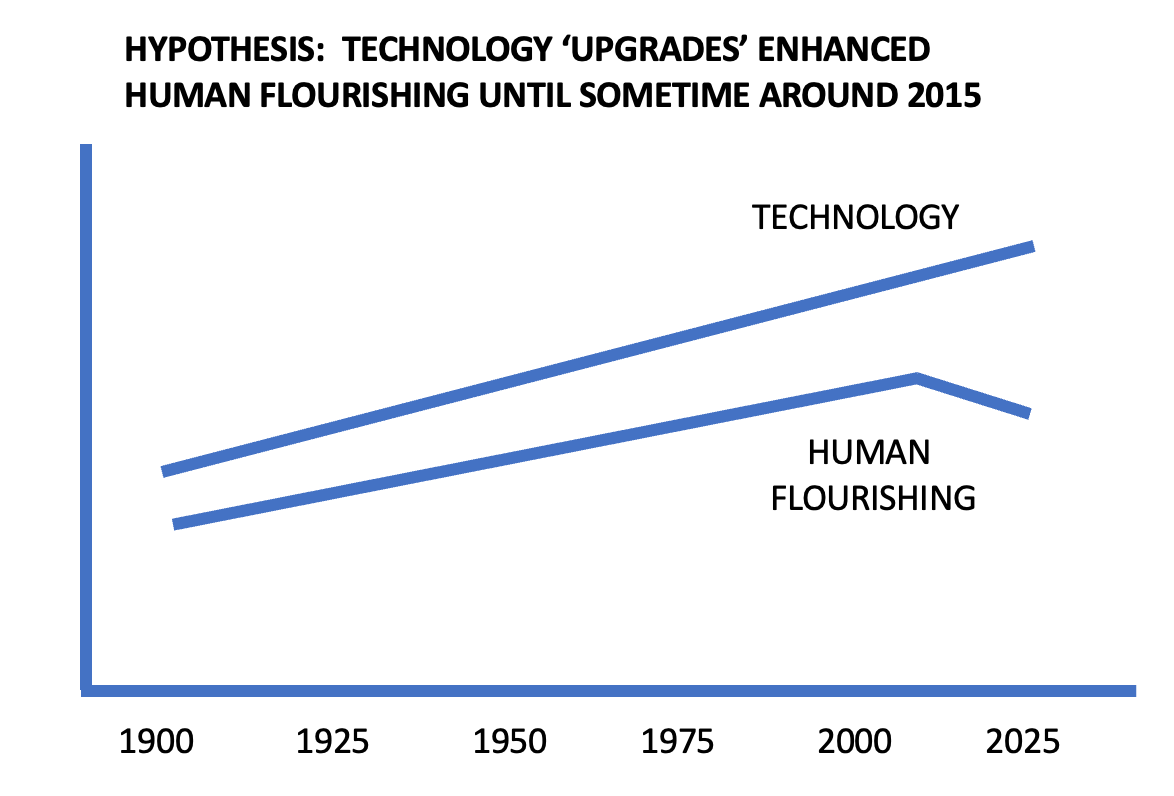
By my measure, this reversal started happening around a decade ago. If I had to sum things up in a conceptual chart, it would look like this:
The divergence was easy to ignore at first. We’re so familiar with useful tech that many of us were slow to notice when upgrades turned into downgrades.
But the evidence from the last couple years is impossible to dismiss. And we can’t blame COVID (or other extraneous factors) any longer. Technology is increasingly making matters worse, not better — and at an alarming pace.
[…]
But I have avoided answering, up until now, the biggest question — which is why is this happening?
Or, to be more specific, why is this happening now?
Until recently, most of us welcomed innovation, but something changed. And now a huge number of people are anxious and fearful about the same tech companies they once trusted.
What caused this shift?
That’s a big issue. Unless we understand how things went wrong, we can’t begin to fix them. Otherwise we’re just griping — about bad software or greedy CEOs or whatever.
It’s now time to address the causes, not just complain about symptoms.
Once we do that, we can move to the next steps, namely outlining a regimen for recovery and an eventual cure.
So let me try to lay out my diagnosis as clearly as I can. Below are the ten reasons why tech is now breaking bad.
I apologize in advance for speaking so bluntly. Many will be upset by my frankness. But the circumstances — and the risks involved — demand it.
August 5, 2024
Short-term technological forecast – “If I were a commercial pilot, I’d tell you to return to your seats and buckle up”
Most of this Ted Gioia post is behind the paywall (and if you can afford it, I’m sure you’d get your money’s worth for a subscription):
I anticipate extreme turbulence on every front for the remaining five months in 2024. You will see it in politics, business, economics, culture, world affairs, the stock market, and maybe even your own neighborhood.
That’s one of the themes of my latest arts and culture update below.
What happened to the AI business model last week?
After almost two years of hype, the media changed its opinion on AI last week.
The hype disappeared almost overnight
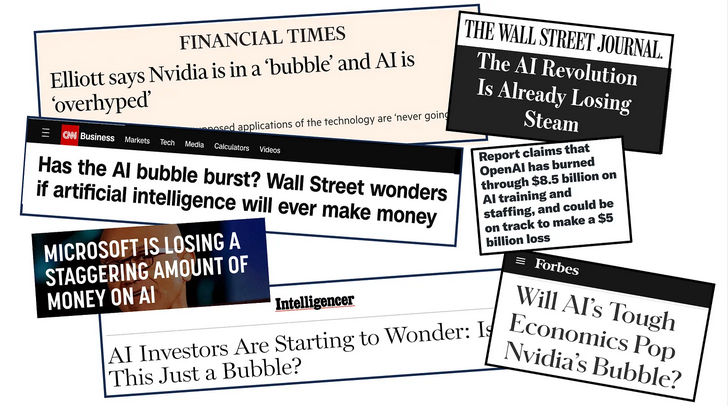
All of a sudden, news articles about AI went sour like reheated 7-Eleven coffee. The next generation AI chips are delayed, and 70% of companies are behind in their AI plans. There are good reasons for this — most workers now say AI makes them less productive.
People are also noticing that AI businesses want to use the entire electricity grid to run their money-losing bots. Meanwhile AI companies are burning through cash at historic levels. Even under the best case scenario, this all feels unsustainable.
But the worst disclosure, in my opinion, came on July 24 — just eleven days ago.
A study published in Nature showed that when AI inputs are used to train AI, the results collapse into gibberish.
This is a huge issue. AI garbage is now everywhere in the culture, and most of it undisclosed. So there’s no way that AI companies can remove it from future training inputs.
They are caught in the doom loop I described last week.
That same day, the Chief Investment Officer at Morgan Stanley warned investors that AI “hasn’t really driven revenues and earnings anywhere”. One day later, Goldman Sachs quietly released a report admitting that the AI business model was in serious trouble.
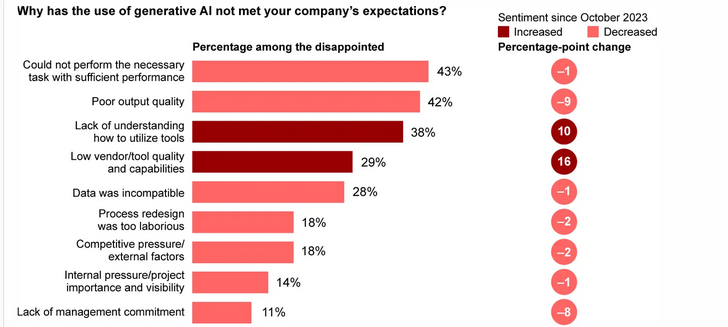
Even consulting firms, who make a bundle hyping this tech, are backtracking. Bain recently shared the following chart (hidden away at the end of a report) which explains why AI projects have failed.
These findings are revealing. They show that management is absolutely committed to AI, but the tools just don’t deliver.
And, finally, last week the media noticed all this.
They published dozens of panic-stricken articles. Investors got spooked too — shifting from greed to fear in a New York minute. Over the course of just two days, Nvidia’s stock lost around $400 billion in market capitalization.
In this environment, true believers quickly turn into skeptics. The whole AI business model gets scrutinized — and if it doesn’t hold up, investment cash flow dries up very quickly.
This is exactly what I predicted 6 months ago. Or even a year ago.
I expect that the next few weeks — or maybe even the next few days — will be extremely turbulent in the AI world.
Buckle up!
The dominant AI music company just admitted that it trained its bot on “essentially all music files on the Internet”.
Suno is a huge player in AI music — it tells investors it will generate $120 billion per year. Microsoft is already using its technology.
But there’s a tiny catch.
The company now admits in a court filing:
Suno’s training data includes essentially all music files of reasonable quality that are accessible on the open internet, abiding by paywalls, password protections, and the like, combined with similarly available text descriptions
Hey, this is totally illegal — it’s like Napster all over again.
Suno will need to prove that all these copyrighted songs are “fair use” in AI training. I doubt that any court will take that claim seriously.
If the music industry is smart, they will use this violation to shut down AI regurgitation of copyrighted songs.
If the music industry is stupid — run according to my “idiot nephew theory” — they will drop charges in exchange for some quick cash.
June 20, 2024
“Surely the only way to defeat racism and homophobia is to treat ethnic and sexual minorities as incapable of high achievement and in need of a leg up from their betters?”
Andrew Doyle on a radical new approach to hiring that might just catch on:

With the inexorable spread of DEI – Diversity, Equity and Inclusion – across the western world, it’s refreshing to see at least one major company resist the decrees of this new religion. This is precisely what happened this week when Scale, an Artificial Intelligence company based in San Francisco, launched a new policy to ensure that its employees were hired on the basis of – wait for it – being the most talented and best qualified for the job.
This innovation, which sees race, gender and sexuality as irrelevant when it comes to hiring practices, should hardly be considered revolutionary. And yet in a world in which the content of one’s character is less important than the colour of one’s skin, to treat everyone equally irrespective of these immutable characteristics is suddenly deemed radical.
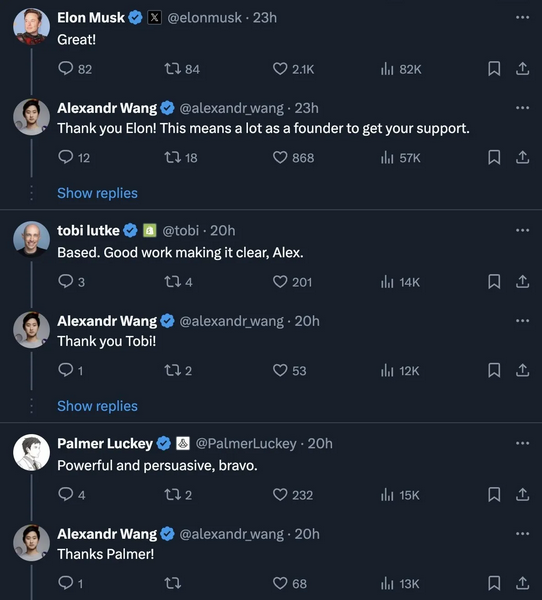
Scale’s CEO, Alexandr Wang, explained that rather than adopt DEI policies, the company would henceforth favour MEI, which stands for Merit, Excellence, and Intelligence. He explained the thinking behind the new scheme in a post on X.
There is a mistaken belief that meritocracy somehow conflicts with diversity. I strongly disagree. No group has a monopoly on excellence. A hiring process based on merit will naturally yield a variety of backgrounds, perspectives, and ideas. Achieving this requires casting a wide net for talent and then objectively selecting the best, without bias in any direction. We will not pick winners and losers based on someone being the “right” or “wrong” race, gender, and so on. It should be needless to say, and yet it needs saying: doing so would be racist and sexist, not to mention illegal. Upholding meritocracy is good for business and is the right thing to do.
One can already hear the likes of Robin DiAngelo and Alexandria Ocasio-Cortez screaming in fury at this blatant implementation of good old-fashioned liberal values. Surely the only way to defeat racism and homophobia is to treat ethnic and sexual minorities as incapable of high achievement and in need of a leg up from their betters?
It is instructive to compare reactions from the Twittersphere (now X) and Instagram, as one X user has done. If nothing else, the comparison reveals how the divide in the culture war is playing out on social media since Elon Musk’s takeover. On X, major figures in the corporate world such as Tobias Lütke (CEO of Shopify), Palmer Luckey (founder of Oculus VR) and Musk himself have congratulated Wang on his new initiative.
By contrast, here are some of the responses on Instagram:
You’re ‘disrupting’ current hard-fought standards you don’t like, by reverting to a system rooted in bias and inequality that asks less of you as a hiring manager and as a leader
– Dan Couch (He/Him)Curious to see how hiring processes can effectively (and objectively) measure one’s ‘merit’, ‘excellence’, and ‘intelligence’, all of which are very subjective terms
– Cole Gawin (He/Him)What is merit and how do we measure it?
– Rio Cruz Morales (They/Them)This sounds a lot like excuse making for casting off DEI principles
– R.C. Rondero De Mosier (He/Him)The pronouns, of course, signify membership of the cult, and so we should not be surprised to see the sentiments of its minions mirroring each other so closely. What Wang is proposing of course builds equality into the hiring system and, contrary to these complaints, it is entirely possible to measure merit objectively. This, after all, is the entire point of academic assessment. The arguments against merit can only be sustained if one presupposes that systemic inequalities are ingrained within society, that all of these relate to the concept of group identity, and that adjustments have to be made accordingly to guarantee equality of outcome.