seangabb
Published 2 May 2022In this, the seventh video in the series, Sean Gabb explains how, following the disaster of the seventh century, the Byzantine Empire not only survived, but even recovered its old position as hegemonic power in the Eastern Mediterranean. It also supervised a missionary outreach that spread Orthodox Christianity and civilisation to within reach of the Arctic Circle.
Subjects covered:
The legitimacy of the words “Byzantine” and “Byzantium”
The reign of the Empress Irene and its central importance to recovery
The recovery of the West and the Rise of the Franks
Charlemagne and the Holy Roman Empire
The Conversion of the Russians – St Vladimir or Vladimir the Damned?
The reign of Basil IIBetween 330 AD and 1453, Constantinople (modern Istanbul) was the capital of the Roman Empire, otherwise known as the Later Roman Empire, the Eastern Roman Empire, the Mediaeval Roman Empire, or The Byzantine Empire. For most of this time, it was the largest and richest city in Christendom. The territories of which it was the central capital enjoyed better protections of life, liberty and property, and a higher standard of living, than any other Christian territory, and usually compared favourably with the neighbouring and rival Islamic empires.
(more…)
October 28, 2022
The Byzantine Empire: Part 7 – Recovery and Return to Hegemony, 717-1025 AD
History Summarized: Mycenaean Greece & the Bronze Age Collapse
Overly Sarcastic Productions
Published 24 Jun 2022I’m pronouncing Mycenaean & Mycenae with a hard “K” sound because that’s how it sounds in Greek, and I would not be so impolite as to mispronounce the name of the first Greek-speaking civilization in history. (The name of “Mycenae” can be spelled Μυκῆναι or Μυκήνη, and I’m using the first one: mee-KEE-neh)
(more…)
October 23, 2022
T. E. Lawrence: The True Lawrence of Arabia
Biographics
Published 13 Jun 2022
(more…)
September 12, 2022
QotD: On the nature of our evidence of the ancient world
As folks are generally aware, the amount of historical evidence available to historians decreases the further back you go in history. This has a real impact on how historians are trained; my go-to metaphor in explaining this to students is that a historian of the modern world has to learn how to sip from a firehose of evidence, while the historian of the ancient world must learn how to find water in the desert. That decline in the amount of evidence as one goes backwards in history is not even or uniform; it is distorted by accidents of preservation, particularly of written records. In a real sense, we often mark the beginning of “history” (as compared to pre-history) with the invention or arrival of writing in an area, and this is no accident.
So let’s take a look at the sort of sources an ancient historian has to work with and what their limits are and what that means for what it is possible to know and what must be merely guessed.
The most important body of sources are what we term literary sources, which is to say long-form written texts. While rarely these sorts of texts survive on tablets or preserved papyrus, for most of the ancient world these texts survive because they were laboriously copied over the centuries. As an aside, it is common for students to fault this or that later society (mostly medieval Europe) for failing to copy this or that work, but given the vast labor and expense of copying and preserving ancient literature, it is better to be glad that we have any of it at all (as we’ll see, the evidence situation for societies that did not benefit from such copying and preservation is much worse!).
The big problem with literary evidence is that for the most part, for most ancient societies, it represents a closed corpus: we have about as much of it as we ever will. And what we have isn’t much. The entire corpus of Greek and Latin literature fits in just 523 small volumes. You may find various pictures of libraries and even individuals showing off, for instance, their complete set of Loebs on just a few bookshelves, which represents nearly the entire corpus of ancient Greek and Latin literature (including facing English translation!). While every so often a new papyrus find might add a couple of fragments or very rarely a significant chunk to this corpus, such additions are very rare. The last really full work (although it has gaps) to be added to the canon was Aristotle’s Athenaion Politeia (“Constitution of the Athenians”) discovered on papyrus in 1879 (other smaller but still important finds, like fragments of Sappho, have turned up as recently as the last decade, but these are often very short fragments).
In practice that means that, if you have a research question, the literary corpus is what it is. You are not likely to benefit from a new fragment or other text “turning up” to help you. The tricky thing is, for a lot of research questions, it is in essence literary evidence or bust. […] for a lot of the things people want to know, our other forms of evidence just aren’t very good at filling in the gaps. Most information about discrete events – battles, wars, individual biographies – are (with some exceptions) literary-or-bust. Likewise, charting complex political systems generally requires literary evidence, as does understanding the philosophy or social values of past societies.
Now in a lot of cases, these are topics where, if you have literary evidence, then you can supplement that evidence with other forms […], but if you do not have the literary evidence, the other kinds of evidence often become difficult or impossible to interpret. And since we’re not getting new texts generally, if it isn’t there, it isn’t there. This is why I keep stressing in posts how difficult it can be to talk about topics that our (mostly elite male) authors didn’t care about; if they didn’t write it down, for the most part, we don’t have it.
Bret Devereaux, “Fireside Friday: March 26, 2021 (On the Nature of Ancient Evidence”, A Collection of Unmitigated Pedantry, 2021-03-26.
August 8, 2022
Barbarian Europe: Part 6 – The Birth of England
seangabb
Published 4 Aug 2021In 400 AD, the Roman Empire covered roughly the same area as it had in 100 AD. By 500 AD, all the Western Provinces of the Empire had been overrun by barbarians. Between April and July 2021, Sean Gabb explored this transformation with his students. Here is one of his lectures. All student contributions have been removed.
(more…)
June 23, 2022
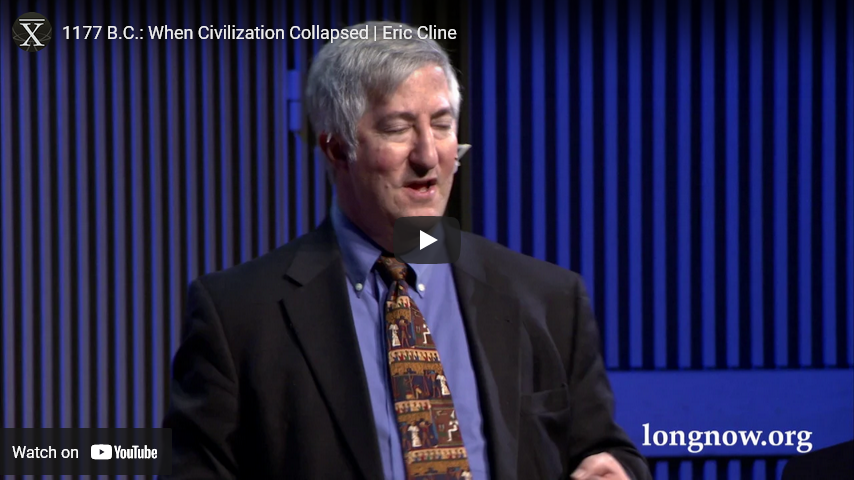
1177 B.C.: When Civilization Collapsed | Eric Cline
Long Now Foundation
Published 19 Apr 2020Consider this, optimists. All the societies in the world can collapse simultaneously. It has happened before.
In the 12th century BCE the great Bronze Age civilizations of the Mediterranean — all of them — suddenly fell apart. Their empires evaporated, their cities emptied out, their technologies disappeared, and famine ruled. Mycenae, Minos, Assyria, Hittites, Canaan, Cyprus — all gone. Even Egypt fell into a steep decline. The Bronze Age was over.
The event should live in history as one of the great cautionary tales, but it hasn’t because its causes were considered a mystery. How can we know what to be cautious of? Eric Cline has taken on on the mystery. An archaeologist-historian at George Washington University, he is the author of 1177 B.C.: The Year Civilization Collapsed. The failure, he suggests, was systemic. The highly complex, richly interconnected system of the world tipped all at once into chaos.
“1177 B.C.: When Civilization Collapsed” was given on January 11, 2016 as part of Long Now’s Seminar series. The series was started in 2003 to build a compelling body of ideas about long-term thinking from some of the world’s leading thinkers. The Seminars take place in San Francisco and are curated and hosted by Stewart Brand. To follow the talks, you can:
Subscribe to our podcasts: http://longnow.org/seminars/podcast
Explore the full series: http://longnow.org/seminars
More ideas on long-term thinking: http://blog.longnow.orgThe Long Now Foundation is a non-profit dedicated to fostering long-term thinking and responsibility. Our projects include a 10,000 Year Clock, endangered language preservation, thousand year+ data storage, and Long Bets, an arena for accountable predictions.
Become a Long Now member to support this series, join our community, and connect with our ongoing work to explore and deepen long-term thinking: http://longnow.org/membership
Follow us on Twitter: https://www.twitter.com/longnow
Subscribe to our channel: https://www.youtube.com/longnow
June 12, 2022
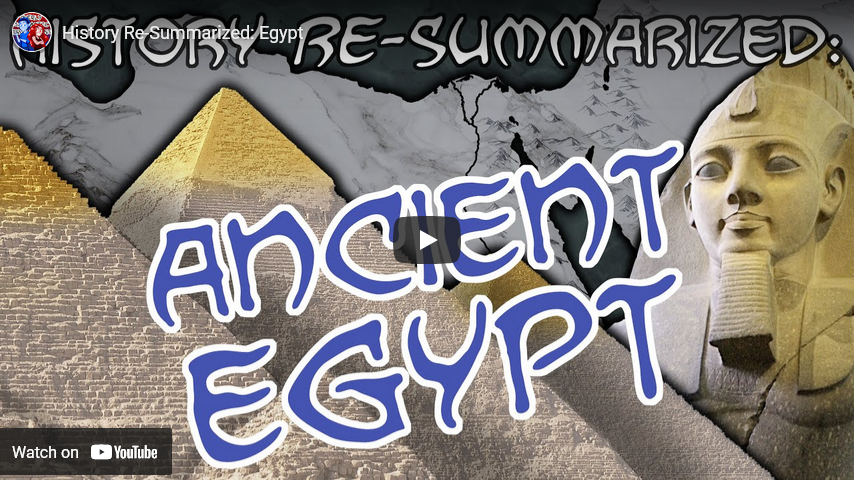
History Re-Summarized: Egypt
Overly Sarcastic Productions
Published 18 Feb 2022I for one was shocked to learn the Egyptians actually buried their kings in a giant Millennium Puzzle.
We’ve covered Egypt on this channel in previous videos, but this History Re-Summarized is the Definitive Edition, redone from the ground up to present the best possible account — starting at the beginning for a full chronology of Ancient Egypt, from the very first Pharaohs to the Muslim Conquest.
(Observant Egyptologists and D&D players might note the Pyramids are actually D-*Fives*, but technically they’re D-*Nines* since each face is actually two right triangles at a slight angle to each other and not a single flat isosceles triangle, so shhh, we can pretend it’s a D4.)
Sources & Further Reading: The Oxford History of Ancient Egypt & Ancient Egypt: A Very Short Introduction by Ian Shaw, World History Encyclopedia entries on “Ancient Egypt”, “Old Kingdom of Egypt”, “First Intermediate Period of Egypt”, “Middle Kingdom of Egypt”, “Second Intermediate Period of Egypt”, “New Kingdom of Egypt” https://www.worldhistory.org/egypt/, The Great Courses’ lecture series “History of Ancient Egypt” by Bob Brier. Additionally, I have an undergraduate degree in classical studies (re: Persia, Ptolemies and Rome). Extra special thanks to our OSP Discord server moderator & Egyptology connoisseur Billy, for his assistance and guidance for this video!
Our content is intended for teenage audiences and up.
PATREON: https://www.Patreon.com/OSP
PODCAST: https://overlysarcasticpodcast.transi…
DISCORD: https://discord.gg/osp
MERCH LINKS: http://rdbl.co/osp
OUR WEBSITE: https://www.OverlySarcasticProductions.com
Find us on Twitter https://www.Twitter.com/OSPYouTube
Find us on Reddit https://www.Reddit.com/r/OSP/
March 16, 2022
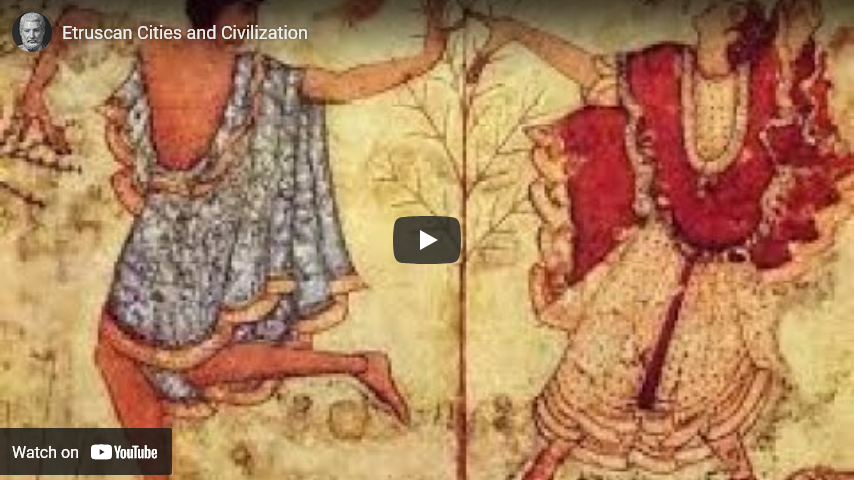
Etruscan Cities and Civilization
Thersites the Historian
Published 9 Apr 2020The Etruscans were one of the most interesting civilizations of antiquity. In this video, I explore some of the distinctive features of Etruscan civilization and also look at some of the key urban sites in Etruria.
Patreon link: https://www.patreon.com/thersites
PayPal link: paypal.me/thersites
Twitter link: https://twitter.com/ThersitesAthens
Minds.com link: https://www.minds.com/ThersitestheHis…
Steemit/dtube link: https://steemit.com/@thersites/feed
BitChute: https://www.bitchute.com/channel/jbyg…
March 1, 2022
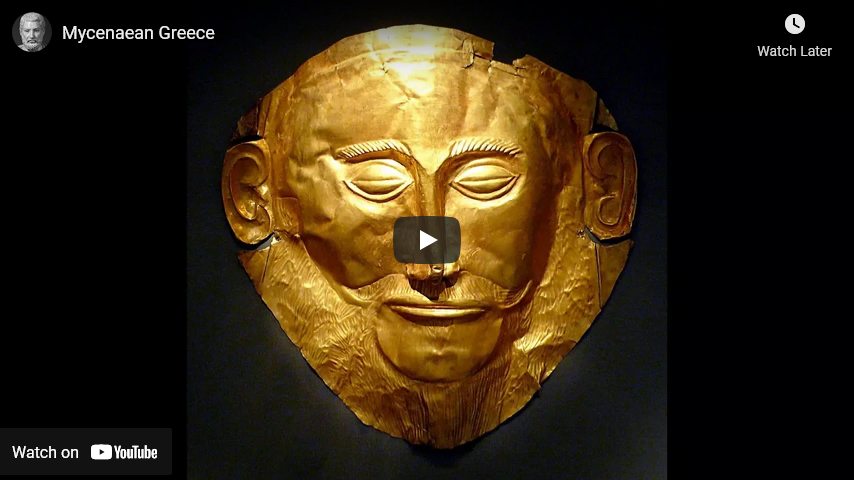
Mycenaean Greece
Thersites the Historian
Published 25 Jan 2018In this video, I look at the Mycenaean civilization in Greece, which lasted from 1600-1100 BCE.
February 8, 2022
Roman Republic to Empire: 01 Mistress of the Mediterranean
seangabb
Published 21 Jan 2021[Update 2023-03-02 – Dr. Gabb took down the original posts and re-uploaded them.]
In 120 BC, Rome was a republic with touches of democracy. A century later, it was a divine right military dictatorship. Between January and March 2021, Sean Gabb explored this transformation with his students. Here is one of his lectures. All student contributions have been removed.
(more…)
February 5, 2022
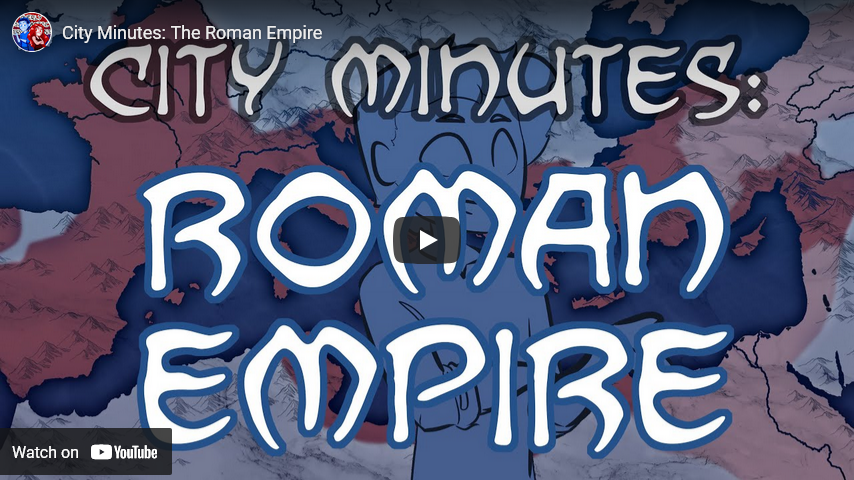
City Minutes: The Roman Empire
Overly Sarcastic Productions
Published 4 Feb 2022The funny thing about Empire is that ~*Rome*~ includes far more than just the City of Rome. Spread out across every corner of the Mediterranean — and then some — Roman Civilization was always adapting to local circumstances and changing over time. Today we’ll look at 5 cities that show the diversity of just how much “Rome” could really mean in the days of the empire.
The Great Cities In History by John Julius Norwich, “A Wonder of the World – Ephesus” from The Great Tours: Greece and Turkey, from Athens to Istanbul by John R. Hale, “Ephesus”, “Leptis Magna”, “Roman Britain”, “Pompeii” from World History Encyclopedia https://www.worldhistory.org/ephesos/, https://www.worldhistory.org/Lepcis_Magna, https://www.worldhistory.org/Roman_Britain, https://www.worldhistory.org/pompeii/. “Ephesus”, “Leptis Magna” “London”, “Pompeii” from Britannica https://www.britannica.com/place/Ephesus, https://www.britannica.com/place/Leptis-Magna, https://www.britannica.com/place/Lond…, https://www.britannica.com/place/Pompeii. I also have a degree in Classical Studies.
Chapters:
0:00 — Rome
0:58 — Ephesus
2:00 — Leptis Magna
3:03 — Londinium
4:12 — Pompeii
5:17 — ConclusionOur content is intended for teenage audiences and up.
PATREON: https://www.Patreon.com/OSP
PODCAST: https://overlysarcasticpodcast.transi…
DISCORD: https://discord.gg/osp
MERCH LINKS: http://rdbl.co/osp
OUR WEBSITE: https://www.OverlySarcasticProductions.com
Find us on Twitter https://www.Twitter.com/OSPYouTube
Find us on Reddit https://www.Reddit.com/r/OSP/
January 23, 2022
The Abandoned Hill With Two Members Of Parliament
Tom Scott
Published 6 Jul 2020Old Sarum, in Wiltshire, is a now-desolate hillfort run by English Heritage. But it was once one of the most important sites in southern England: so important that it had two members of Parliament. Then, it became a “rotten borough”: and a warning about power.
Thanks to English Heritage: more information and how to visit: https://www.english-heritage.org.uk/v…
Research and script assistance from Jess Jewell
Drone camera by Jamie Bellinger
Edited by Michelle Martin: https://twitter.com/mrsmmartin
Audio mix by Graham Haerther: https://haerther.netFilmed safely, following all local and national guidance: https://www.tomscott.com/safe/
SOURCES:
Corfield, P. (2000). Power and the professions in Britain 1700-1850. London: Routledge.Dodsworth, W. (1814). An historical description of the cathedral church of Salisbury: including an account of the monuments, chiefly extracted from Gough’s “Sepulchral Monuments,” and other authentic documents: also, biographical memoirs of the Bishops of Salisbury, from the earliest period by W. Dodsworth, verger of the Cathedral
English Heritage’s own research page: https://www.english-heritage.org.uk/v…
http://www.historyhome.co.uk/c-eight/…
I’m at https://tomscott.com
on Twitter at https://twitter.com/tomscott
and on Instagram as tomscottgo

January 7, 2022
“This is not satire. This is academic archaeology gone woke”
In the New English Review, Timothy H. Ives asks whether the many stone heaps across New England are actually the ruins of First Nations sacred sites:
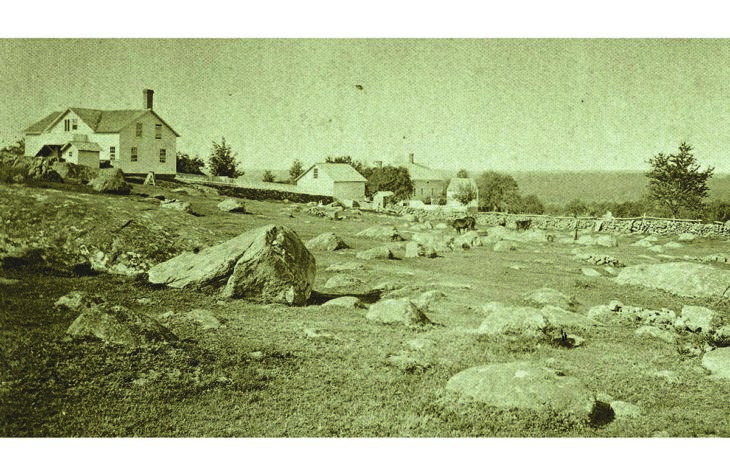
Historic photograph of Woodvale Farm, Rhode Island. The pasture shown here, enclosed by stone walls, features several stone heaps
Photo via New English Review.
Brightman Hill lies deep in the forests of Hopkinton, Rhode Island. It is named for the Brightmans, one of the families who farmed it, and evidence of its agricultural past is, to most observers, unambiguous: old building foundations, a nineteenth-century burial ground, an extensive network of stone walls and hundreds of stone heaps, the results of field clearing. But in 2019, a federally-funded survey of Brightman Hill shattered these traditional interpretations.
The surveyors, Ceremonial Landscapes Research, LLC, are a small group of antiquarians led by Alexandra Martin, a registered professional archaeologist who recently earned her doctorate in anthropology. Instead of stone heaps and walls, the surveyors reported “linear stone groupings” on Brightman Hill. One, they said, “brings to mind a turtle.” Another “appears to have the head of a snake”; another contains “a ‘nest’, large enough for an individual to sit in.” Boulders, naturally milled and deposited by glacial ice, came alive. One was categorized as “an apparent effigy of a human head,” significantly facing southwest, while the flat section of another became a “stone seat” from which celestial alignments could be observed.
This is not satire. This is academic archaeology gone woke. New Englanders may not realize it, but the ground is moving beneath their feet.
Stone heaps, walls and other ruined stone structures are scattered across the secondary forests of New England. Traditionally, archaeologists agreed that they were vestiges of abandoned farmsteads, reclaimed by the forests when many farmers left for the cities or pastures new. But now the culture wars have come to this previously polite field.
Today, radical left-wing academics support claims that the stones are the ruins of ancient Native American ceremonial constructions, and that they need protection from ongoing “settler-colonial” development. Tribal officials champion this claim, presumably to further their own campaigns for “decolonization”. Their “resistance” is applauded by attention-seeking antiquarians and a public entranced by guilt and ideas of social justice. I call this confluence the Ceremonial Stone Landscape Movement (or CSLM).
CSLM claims are fashionable, and almost uniquely powerful. None of these stone structures were signed and dated by their creators, but ceremonial claims carry particular weight — especially when anyone who dismisses them risks being accused of continuing the destruction of Native American culture. Yet the movement’s roots are neither ancient nor grounded in Native American tradition. They’re not even that deep.
The movement and its bizarre theory originated in the late twentieth century among a group of white, middle-class antiquarians. Many are members of the New England Antiquities Research Association (NEARA), founded in 1964; at the time NEARA’s founders resented academic archaeologists for refusing to take seriously their theory that New England’s farmstead ruins are in fact the remains of a megalithic culture transplanted by settlers from Europe in prehistoric times. By 1984, one NEARA member detected a “persecuted-crusader” complex among its members, who seemed determined to “wave the banner of truth with regards to the ‘real’ prehistory of New England” until the “mainstreamers … fall in line and admit the visions of a minority were accurate after all.”
December 18, 2021
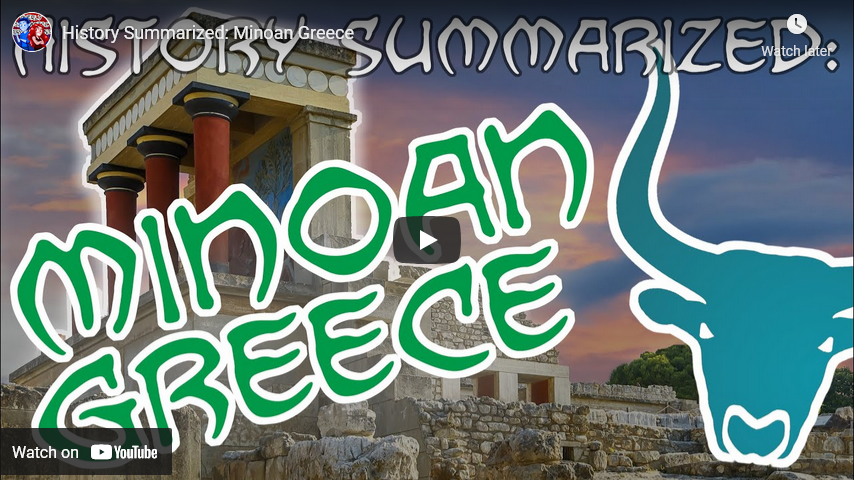
History Summarized: Minoan Greece
Overly Sarcastic Productions
Published 17 Dec 2021The classical Greeks weren’t the first kids on the Aegean block. Long before Athens’ golden age, before Homer, and even before the Trojan War, there was a civilization on the island of Krete. The land of King Minos was home to beautiful palaces, a fascinatingly-complex economy, and something approximating Bull-Cthulu. It’s a fun time, let’s jump in.
SOURCES & Further Reading: The Greeks: An Illustrated History by Diane Cline for National Geographic, The Greeks: A Global History by Roderick Beaton, Lectures from The Great Courses Plus — “Being Minoan and Mycenaean” from The Other Side of History: Daily Life in the Ancient World by Robert Garland, and “Minoan Crete” & “Schliemann & Mycenae” from Ancient Greek Civilization by Jeremy McInerney. And I have a university degree in Classical Studies.
Our content is intended for teenage audiences and up.
PATREON: https://www.Patreon.com/OSP
PODCAST: https://overlysarcasticpodcast.transi…
DISCORD: https://discord.gg/osp
MERCH LINKS: http://rdbl.co/osp
OUR WEBSITE: https://www.OverlySarcasticProductions.com
Find us on Twitter https://www.Twitter.com/OSPYouTube
Find us on Reddit https://www.Reddit.com/r/OSP/
December 14, 2021
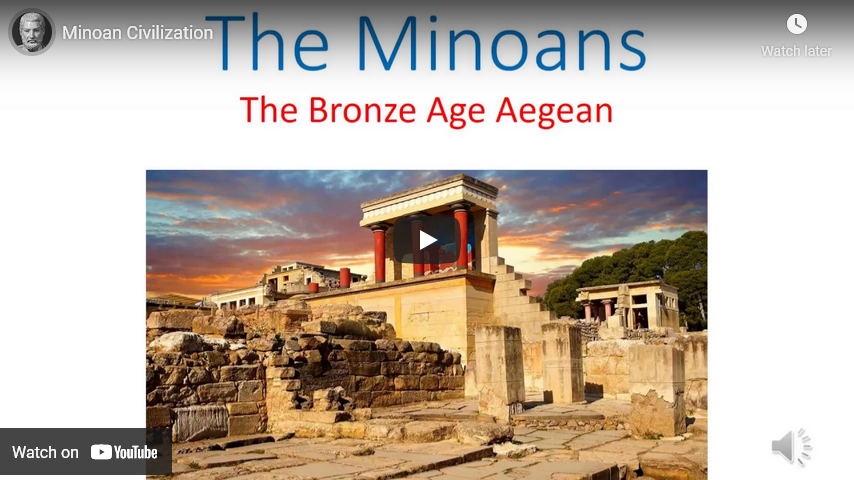
Minoan Civilization
Thersites the Historian
Published 25 Jan 2018In this video, I look at the Bronze Age civilization on Crete known as the Minoans.