
Once our ore reaches the surface (or is removed from its open pit) it is not immediately ready for smelting, but has to go through a series of preparatory steps collectively referred to as “dressing” to get the ore ready for its date with the smelter […]
Ore removed from the mine would need to be crushed, with the larger stones pulled out of the mines smashed with heavy hammers (against a rock surface) in order to break them down to a manageable size. The exact size of the ore chunks desired varies based on the metal one is seeking and the quality of the local ore. Ores of precious metals, it seems, were often ground down to powder, but for iron ore it seems like somewhat larger chunks were acceptable. I’ve seen modern experiments with bloomeries […] getting pretty good results from ore chunks about half the size of a fist. Interestingly, Craddock notes that ore-crushing activity at mines was sufficiently intense that archaeologists can spot the tell-tale depressions where the rock surface that provided the “floor” against which the ore was crushed have been worn by repeated use.
Ore might also be washed, that is passed through water to liberate and wash away any lighter waste material. Washing is attested in the ancient world for gold and silver ores (and by Georgius Agricola for the medieval period for the same), but might be used for other ores depending on the country rock to wash away impurities. The simple method of this, sometimes called jigging, consisted of putting the ore in a sieve and shaking it while water passed through, although more complex sluicing systems are known, for instance at the Athenian silver mines at Laurium (note esp. Healy, 144-8 for diagrams); the sluices for washing are sometimes called buddles. Throughout these processes, the ore would also probably be hand-sorted in an effort to separate high-grade ore from low-grade ore.
It’s clear that this mechanical ore preparation was much more intensive for higher-value metals where making sure to be as efficient as possible was a significant concern; gold and silver ores might be crushed, sorted, washed and rewashed before being ground into a powder for the final smelting process. Craddock presents a postulated processing set for copper ore for the Bronze Age Timna mines that goes through a primary crushing, hand-sorted division into three grades, secondary crushing, grinding, a winnowing step for the low-grade ore (either air winnowing or washing) before being blended into the final smelter “charge”.
As far as I can tell, such extensive processing for iron was much less common; in many cases it seems it is hard to be certain because the sources remain so focused on precious metal mining and the later stages of iron-working. Diodorus describes the iron ore on Elba as merely being crushed, roasted and then bloomed (5.13.1) but the description is so brief it is possible that he is leaving out steps (but also, Elba’s iron ore was sufficiently rich that further processing may not have been necessary). In many cases, iron was probably just crushed, sorted and then moved straight to roasting […]
Bret Devereaux, “Iron, How Did They Make It? Part I, Mining”, A Collection of Unmitigated Pedantry, 2020-09-18.
August 15, 2023
QotD: Iron ore processing in pre-industrial societies
August 11, 2023
Queer Eye for the Tudor ?guy?
At First Things, Carl R. Trueman looks into a recent post from the Mary Rose Museum (where the remains of King Henry VIII’s favourite warship now resides), considering Tudor artifacts recovered from the wreck from a Queer perspective:
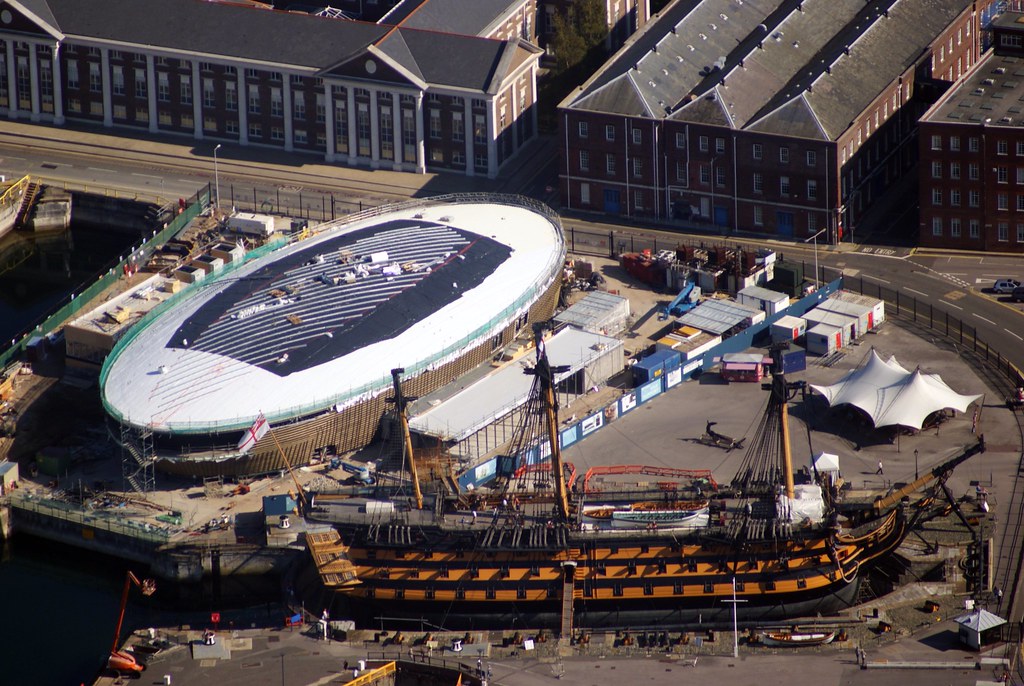
“Mary Rose Museum & HMS Victory” by Silly Little Man is licensed under CC BY-SA 2.0 

 .
.
The anti-Western left has been exposed for its sexual imperialism over the last few months. Evidence is all around. American Muslims have led protests against the imposition of LGBTQ policies and curricula in schools, leaving American progressives uncomfortably caught between two pillars of their favored rhetoric of political thought-crime: transphobia and Islamophobia. The Washington Post opined that anti-LGBTQ moves in the Middle East were “echoing” those of the American culture wars—as if Turkey, Saudi Arabia, and Pakistan had been listed by the Human Rights Campaign as favored vacation destinations until their ruling elites started reading the website of Moms for Liberty.
It is, of course, the nature of imperialism that everything, everywhere, is always to be measured by the imperialists’ standards. And that is also what makes them so impervious to spotting their own imperialism. “Queering the Mary Rose‘s Collection”, an article on the website of the Mary Rose Museum in Portsmouth, England, is a recent example of this. The Mary Rose was a Tudor warship that sank in 1545 and was raised from the seabed in 1982 in a groundbreaking act of marine archaeology. The museum is dedicated to displaying artifacts retrieved from the wreck, some of which are now been analyzed “through a Queer lens”.
The specific examples are an octagonal mirror, nit combs, a gold ring, and Paternosters. Apparently, looking into a mirror can stir strong emotions for both straight and queer people, and for the latter it can generate, for example, feelings of gender dysphoria or euphoria, depending on whether the reflection matches their gender identity. Combs would have been used by the sailors to remove the eggs of hair lice. Today they are reminders of how hairstyles can be the result of imposed gender stereotypes, but also make possible the subverting of these through hairdos that break with social expectations. Rings are a reminder of marriage and, of course, that the Church of England founded by Henry VIII, king during the Mary Rose‘s working life, still does not allow gay marriage. Finally, the Paternosters remind us that the crew were “practicing” Christians and that, once again, Henry VIII, via his initiation of the English Reformation, facilitated the civil criminalization of homosexual acts.
Two things are striking about the article, in addition to its lack of any intellectual merit. First, the absence of any historical awareness is striking. For example, the category of “practicing Christian” is essentially meaningless when applied to the early sixteenth century. Everybody, bar a few underground Jews, Anabaptists, and radicals, was part of the Catholic Church by baptism. The question of how the crew might have understood themselves, whether in terms of mirrors, rings, combs, or Paternosters, is never asked. To be fair, a short blog post cannot ask all the relevant questions, but this does not even nod in the direction of suggesting that the differences between yesterday and today might be remotely interesting or instructive.
David Thompson also has some thoughts on the Mary Rose artifact interpretations:
It’s quality stuff. Just like being there, in the mists of history. And not at all inept, or jarring, or comically incongruous.
As we have seen, many objects can be viewed through a Queer lens and can indirectly tell LGBTQ+ stories.
And thanks to peering through this “Queer lens”, readers will doubtless find that their understanding of Tudor history has been enriched no end.
We’re told – indeed, assured – by Hannah McCann, of the museum’s collections and curatorial staff,
From the Tate Britain and the Wellcome Collection, to the Rijks Museum in Amsterdam and the Whitney Museum of American Art in New York City, museums are reinterpreting and Queering their objects.
A comfort, I know.
Exactly why such “queering” is underway – what its relevance might be – is not, however, made clear. An explanation for this bolting-on of irrelevant, flimsy tat – in the name of “queer theory” – was not, it seems, deemed necessary. Nor is it entirely obvious how such “queering” of museum contents benefits those who wish to know more about Henry VIII’s favourite warship.
July 13, 2023
QotD: The Annales school of history
The big shift in focus for the Annales school was an interest in charting the experience of society below the level of elites (though the elites are not abandoned either), what is sometimes termed “history from below”, as distinct from traditional elite-centered “great man” history or the more deterministic Marxist models of history at the time. You can see the political implications, of course, in the very early 1900s, of declaring the common man worthy of study; this is generally a history from the left but not the extreme left. That focus in turn demanded new approaches because it turned the focus of social history towards people who by and large do not write to us.
In reaching for that experience, Annales scholars tended to frame their thinking in terms of la longue durée (“the long run”); history was composed of three parts: événements (“events”), conjonctures (“circumstances”) and finally la longue durée itself. Often in English this gets rendered as a distinction between “events” (kings, wars, politics, crises) and “structures” (economics, social thought and at a deeper level climate, ecology, and geography). What Annales scholars tended to argue was that those structures were often more important than the events that traditional historians studied: the farmer’s life was far more shaped by very long-term factors like the local ecology, the organization of his farming village, the economic structure of the region and so on. And then the idea goes, that by charting those structures, you can figure things out about the lives of those farmers even if you don’t have many – or any – of those farmers writing to you.
Important to this was the idea of enduring patterns of thought within a society, what Bloch termed mentalités (“mentalities”, like longue durée, this is a technical term usually used in French to make that fact clear). Mentalités – Bloch’s original example was the idea that kings had a holy healing touch, but this could be almost any kind of social construct or pattern of ideas (indeed, one critique of it is that the notion of mentalités is broad and ill-defined) – can last a long time and can inform or constrain the actions of many actors within a society; think of how successive generations of kings can have their decisions shaped or constrained by their societies view – their own view – of kingship. That view of kingship might be more impactful than any one king and so pervasive that even a king would struggle to change it.
So how does this influence my work? I tend to be very much a “history from below” kind of historian, interested in charting the experience of regular farmers, soldiers, weavers and so on. The distinction between the long-term structures that shape life and the short-term events that populate our history is very valuable to think with, especially for identifying when an event alters a structure, because those tend to be very important events indeed. And I think a keen attention to the way people thought about things in the past and how those mentalités can be different than ours is very important.
That said, the Annales stress on mentalités has in some ways been overtaken by more data-driven historical methods on the one hand or a strong emphasis on local or individual experience (“microhistory”) on the other. Mentalités tend to be very big picture, asking how, say, “the French” thought about something over a period of decades or centuries and seeking to know how that shaped their experience. But archaeology, demographics or economic data can reveal patterns of behavior which might not correspond to the mentalités that show up in written texts; this is fundamentally the interaction that informs the “revenge of the archaeologists” in the study of the ancient economy, for instance. On the other hand, not everyone in that big group thinks the same and a microhistory of an individual or a single village might reveal telling local variations not captured in massive-scale structures.
Fortunately, historians do not need to be doctrinaire in our use of theory, we don’t have to pick one and stick to it. Different projects also lend themselves to different approaches. I think the Annales school offers a lot of really useful tools to have my historian’s toolbox, but they sit alongside military theory, archaeological material culture studies methods, philological approaches, a smattering of economic and demographic tools, etc.
Bret Devereaux, “Referenda ad Senatum: January 13, 2023: Roman Traditionalism, Ancient Dates and Imperial Spies”, A Collection of Unmitigated Pedantry, 2023-01-13.
June 1, 2023
Recent discoveries in ancient DNA
The Psmiths, John and Jane, decided to jointly review a book by David Reich called Who We Are and How We Got Here: Ancient DNA and the New Science of the Human Past. This is Jane’s first contribution to an extended email thread between the Psmiths:
The problem with history is that there just isn’t enough of it. We’ve been around for, what, fifty thousand years? Conservatively.1 And we’ve barely written things down for a tenth of that. Archaeological excavation can take you a little farther back, but as the archaeologists always like to remind us, pots are not people. If you get lucky with a society that made things out of durable materials in a cold and/or dry environment (or you get very lucky with anaerobic preservation of organic materials, like in ice or bogs), maybe you can trace a material culture’s expansion and contraction across time and space. But that won’t tell you whether it’s a function of people moving and taking their stuff with them, or people’s neighbors going “ooh, using string to make patterns on your pots, that’s cool” and copying it. It certainly doesn’t tell you what their descendants were doing several thousand years later, potentially in an entirely different place and probably using an entirely different suite of technologies. Trying to understand what happened in the human past based on the historical and archaeological records is like walking into a room where a bomb has gone off and trying to reconstruct the locations of all the objects before the explosion. You can get some idea, but it’s all very broad strokes. And actually it’s worse than that, because it wasn’t just one explosion, it was lots, and we wouldn’t even know how many if we didn’t have a way of winding the clock back. But these days we do, and it’s ancient DNA.
Sometime between when my grandfather gave me a copy of Luca Cavalli-Sforza’s Genes, Peoples, and Languages for my birthday and when you and I decided to read Reich’s book together, two big things happened: humans got really, really good at sequencing and reading genomes, and Svante Pääbo’s lab in Leipzig got really, really good at extracting DNA from ancient bones. (How they developed their procedures is actually a really interesting story, which Pääbo retells in his book, but Reich — whose lab uses the same techniques on an industrial scale — gives a good, brief summary of how it works.) Together, these two advances unlocked … well, not quite everything about the deep past, but an absolutely enormous amount. Suddenly we can track the people, not just the pots, and the story is more complicated and fascinating than anything we might have expected. I’ve written elsewhere about some of the aDNA discoveries about human evolution (Neanderthal admixture, the Denisovans, etc.), but I’m even more excited about what ancient DNA reveals about our more recent past. Luckily, that’s what Reich spends most of the book on, with discussion of ancient ghost populations who now exist only in admixture and then chapters on the specific population genetic histories of Europe, India, North America, East Asia, and Africa, each of which contains some discoveries that would make (at least the more sensible) archaeologists and historical linguists go “well, duh” and others that are real surprises.
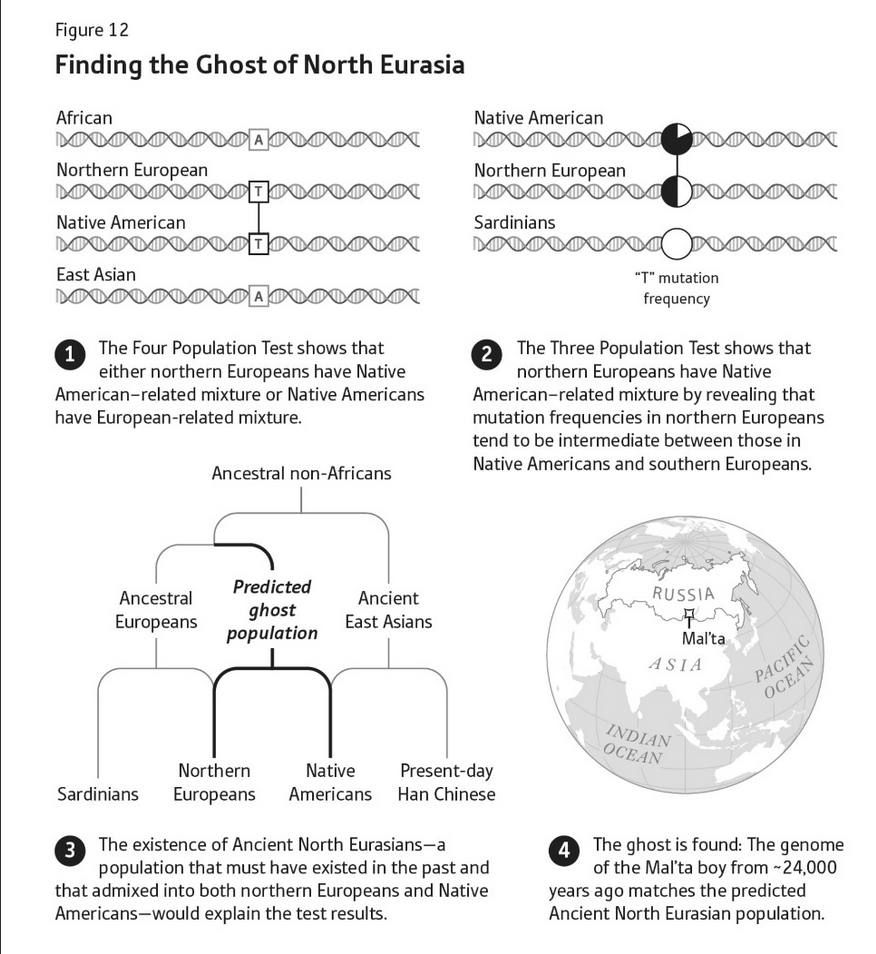
One of the “duh” stories is the final, conclusive identification of the people who brought horses, wagons, and Indo-European languages to Europe with the Yamnaya culture of the Pontic Steppe and their descendants. (David Anthony gives a very good overview of the archaeological case for this in The Wheel, the Horse, and Language, including some very cool experimental archaeology about horse teeth; you have my permission to skim the sections on pots.) My favorite surprising result, though, comes from a little farther north. People usually assume that Native Americans and East Asians share a common ancestor who split from the ancestors of Europeans and Africans before dividing into those two populations, but when Reich’s lab was trying to test the idea they found, to their surprise, that in places where Northern European genomes differ from Africans’, they are closer to Native Americans than to East Asians. Then, using a different set of statistical techniques, they found that Northern European populations were the product of mixture between two groups, one very similar to Sardinians (who are themselves almost-unmixed descendants of the first European farmers) and one that is most similar to Native Americans. They theorized a “ghost” population, which they called the “Ancient North Eurasians”, who had contributed DNA both to the population that would eventually cross the Bering land bridge and to the non-Early European Farmer ancestors of modern Northern Europeans. Several years later, another team sequenced the genome of a boy who died in Siberia 24kya and who was a perfect match for that theorized ghost ANE population.
But we’ve already established that I’m the prehistory nerd in this family; were you as jazzed as I was to read about the discovery of the Ancient North Eurasians?
1. That’s the latest plausible date for the arrival of full “behavioral modernity” in Africa, though our genus goes back about two million years, tool use probably three million, and I think there’s a good case that Homo was meaningfully “us” by 500kya. (That’s “thousand years ago” in “I talk about deep history so much I need an acronym”, fyi.)
May 19, 2023
They made a MOVIE about the discovery of Richard III’s remains!!!
Vlogging Through History
Published 16 Sept 2022Here’s a fantastic hour-long breakdown of the entire search and discovery process – https://www.youtube.com/watch?v=dsTyG…
(more…)
April 23, 2023
My Review of Graham Hancock’s Ancient Apocalypse
Thersites the Historian
Published 17 Jan 2023In this video, I review Graham Hancock’s new series on Netflix, where he presents his case for a globe-spanning prehistoric civilization to a general audience.
(more…)
April 4, 2023
History Summarized: the Ancient Greek Post-Apocalypse
Overly Sarcastic Productions
Published 31 Mar 2023Turns out the “Studio Ghibli Post-Apocalypse” aesthetic has a historical basis in ancient Greek history’s Bronze Age Collapse, long Dark Age, and slow re-emergence into the Polis Age. I don’t know if I’d call the process pleasant, but it sure as hell is a vibe.
GO READ THE ILIAD: https://bookshop.org/p/books/the-ilia… — We enjoy the Fagles translation, as it’s the typical classroom and library standard, but if you want a real treat, try the Alexander Pope edition from the 1700s that’s written entirely in RHYME. THE DAMN THING RHYMES!!!
SOURCES & Further Reading:
“The Age of Heroes” and “Delphi and Olympia” from Ancient Greek Civilization by Jeremy McInerney – “Dark Age and Archaic Greece” from The Foundations of Western Civilization by Thomas F. X. Noble – “Dark Age and Archaic Greece” from The Greek World: A Study of History and Culture by Robert Garland “The Greeks: A Global History” by Roderick Beaton, “The Greeks: An Illustrated History” by Diane Cline, Metropolitan Museum “Geometric Art in Ancient Greece” https://www.metmuseum.org/toah/hd/grg… also have a degree in Classical Studies
(more…)
March 17, 2023
QotD: The unique nature of Roman Egypt
[…]
… what makes Roman Egypt’s uniqueness so important is one of the unique things about it: Roman Egypt preserves a much larger slice of our evidence than any other place in the ancient world. This comes down to climate (as do most things); Egypt is a climatically extreme place. On the one hand, most of the country is desert and here I mean hard desert, with absolutely minuscule amounts of precipitation. On the other hand, the Nile River creates a fertile, at points almost lush, band cutting through the country running to the coast. The change between these two environments is extremely stark; it is, I have been told (I haven’t yet been to Egypt), entirely possible in many places to stand with one foot in the “green” and another foot in the hard desert.
That in turn matters because while Egypt was hardly the only arid region Rome controlled, it was the only place you were likely to find very many large settlements and lots of people living in such close proximity to such extremely arid environments (other large North African settlements tend to be coastal). And that in turn matters for preservation. When objects are deposited – lost, thrown away, carefully placed in a sanctuary, whatever – they begin to degrade. Organic objects (textile, leather, paper, wood) rot as microorganisms use them as food, while metal objects oxidize (that is, rust). Aridity arrests (at least somewhat) both processes. Consequently things survive from the Roman period (or indeed, from even more ancient periods) in Egypt that simply wouldn’t survive almost anywhere else.
By far the most important of those things is paper, particularly papyrus paper. The Romans actually had a number of writing solutions. For short-term documents, they used wax writing tablets, an ancient sort of “dry erase board” which could be scraped smooth to write a new text when needed; these only survive under very unusual circumstances. For more permanent documents, wood and papyrus were used. Wood tablets, such as those famously recovered from the Roman fort at Vindolanda, are fairly simple: thin wooden slats are smoothed so they can be written on with ink and a pen, creating a rigid but workable and cheap writing surface; when we find these tablets they have tended to be short documents like letters or temporary lists, presumably in part because storing lots of wood tablets would be hard so more serious records would go on the easier to store papyrus paper.
Papyrus paper was lighter, more portable, more storeable option. Papyrus paper is produced by taking the pith of the papyrus plant, which is sticky, and placing it in two layers at right angles to each other, before compressing (or crushing) those layers together to produce a single sheet, which is then dried, creating a sheet of paper (albeit a very fibery sort of paper). Papyrus paper originated in Egypt and the papyrus plant is native to Egypt, but by the Roman period we generally suppose papyrus paper to have been used widely over much of the Roman Empire; it is sometimes supposed that papyrus was cheaper and more commonly used in Egypt than elsewhere, but it is hard to be sure.
Now within the typical European and Mediterranean humidity, papyrus doesn’t last forever (unlike the parchment paper produced in the Middle Ages which was far more expensive but also lasts much longer); papyrus paper will degrade over anything from a few decades to a couple hundred years – the more humidity, the faster decay. Of course wood tablets and wax tablets fare no better. What that means is that in most parts of the Roman Empire, very little casual writing survives; what does survive were the sorts of important official documents which might be inscribed on stone (along with the literary works that were worth painstakingly copying over and over again by hand through the Middle Ages). But letters, receipts, tax returns, census records, shopping lists, school assignments – these sorts of documents were all written on less durable materials which don’t survive except in a few exceptional sites like Vindolanda.
Or Egypt. Not individual places in Egypt; pretty much the whole province.
In the extremely dry conditions of the Egyptian desert, papyrus can survive (albeit typically in damaged scraps rather than complete scrolls) from antiquity to the present. Now the coverage of these surviving papyri is not even. The Roman period is far better represented in the surviving papyri than the Ptolemaic period (much less the proceeding “late” period or the New Kingdom before that). It’s also not evenly distributed geographically; the Arsinoite nome (what is today el-Fayyum, an oasis basin to the West of the Nile) and the Oxyrhynchus nome (roughly in the middle of Egypt, on the Nile) are both substantially overrepresented, while the Nile Delta itself has fewer (but by no means zero) finds. Consequently, we need to be worried not only about the degree to which Egypt might be representative of the larger Roman world, but also the degree to which these two nomes (a nome is an administrative district within Egypt, we’ll talk about them more in a bit) are representative of Egypt. That’s complicated in turn by the fact that the Arsinoite nome is not a normal nome; extensive cultivation there only really begins under Ptolemaic rule, which raises questions about how typical it was. It also means we lack a really good trove of papyri from a nome in Lower Egypt proper (the northern part of the country, covering the delta of the Nile) which, because of its different terrain, we might imagine was in some ways different.
Nevertheless, it is difficult to overstate the value of the papyri we do recover from Egypt. Documents containing census and tax information can give us important clues about the structure of ancient households (revealing, for instance, a lot of complex composite households). Tax receipts (particularly for customs taxes) can illuminate a lot about how Roman customs taxes (portoria) were assessed and conducted. Military pay stubs from Roman Egypt also provide the foundation for our understanding of how Roman soldiers were paid, recording for instance, pay deductions for rations, clothes and gear. We also occasionally recover fragments of literary works that we know existed but which otherwise did not survive to the present. And there is so much of this material. Whereas new additions to the corpus of ancient literary texts are extremely infrequent (the last very long such text was the recovery of the Athenaion Polteia or Constitution of the Athenians, from a papyrus discovered in the Fayyum (of course), published in 1891), the quantity of unpublished papyri from Egypt remains vast and there is frankly a real shortage of trained Egyptologists who can work through and publish this material (to the point that the vast troves of unpublished material has created deeply unfortunate opportunities for theft and fraud).
And so that is the first way in which Egypt is unusual: we know a lot more about daily life in Roman Egypt, especially when it comes to affairs below the upper-tier of society. Recovered papyrological evidence makes petty government officials, regular soldiers, small farming households, affluent “middle class” families and so on much more visible to us. But of course that immediately raises debates over how typical those people we can see are, because we’d like to be able to generalize information we learn about small farmers or petty government officials more broadly around the empire, to use that information to “fill in” regions where the evidence just does not survive. But of course the rejoinder is natural to point out the ways in which Egypt may be unusual beyond merely the survival of evidence (to include the possibility that cheaper papyrus in Egypt may have meant that more things were committed to paper here than elsewhere).
Consequently the debate about how strange a place Roman Egypt was is also a fairly important and active area of scholarship. We can divide those arguments into two large categories: the way in which Roman rule itself in Egypt was unusual and the ways in which Egypt was a potentially unusual place in comparison to the rest of Roman world already.
Bret Devereaux, “Collections: Why Roman Egypt Was Such a Strange Province”, A Collection of Unmitigated Pedantry, 2022-12-02.
March 4, 2023
Persistent fantasies about lost Ice Age civilizations
When I was a teen, there seemed to be a lot of pop-sci books on the racks at our local variety store pushing various notions about “highly advanced” but lost civilizations, often attributing things like UFO sightings to these imagined prehistoric groups and tying various conspiracy theories back to them. At Astral Codex Ten, Scott Alexander argues against today’s fans of such unlikely scenarios:
You can separate these kinds of claims into three categories:
- Civilizations about as advanced as the people who built Stonehenge
- Civilizations about as advanced as Pharaonic Egypt
- Civilizations about as advanced as 1700s Great Britain
The debate is confused by people doing a bad job clarifying which of these categories they’re proposing, or not being aware that the other categories exist.
2 and 3 aren’t straw men. Robert Schoch says the Sphinx was built in 9700 BC, which I think qualifies as 2. Graham Hancock suggests “ancient sea kings” drew the Piri Reis map which seems to depict Antarctica; anyone who can explore Antarctica must be at least close to 1700s-British level.
I think there’s weak evidence against level 1 civilizations, and strong evidence against level 2 or 3 civilizations.
Argument 1: Where Are The Sites?
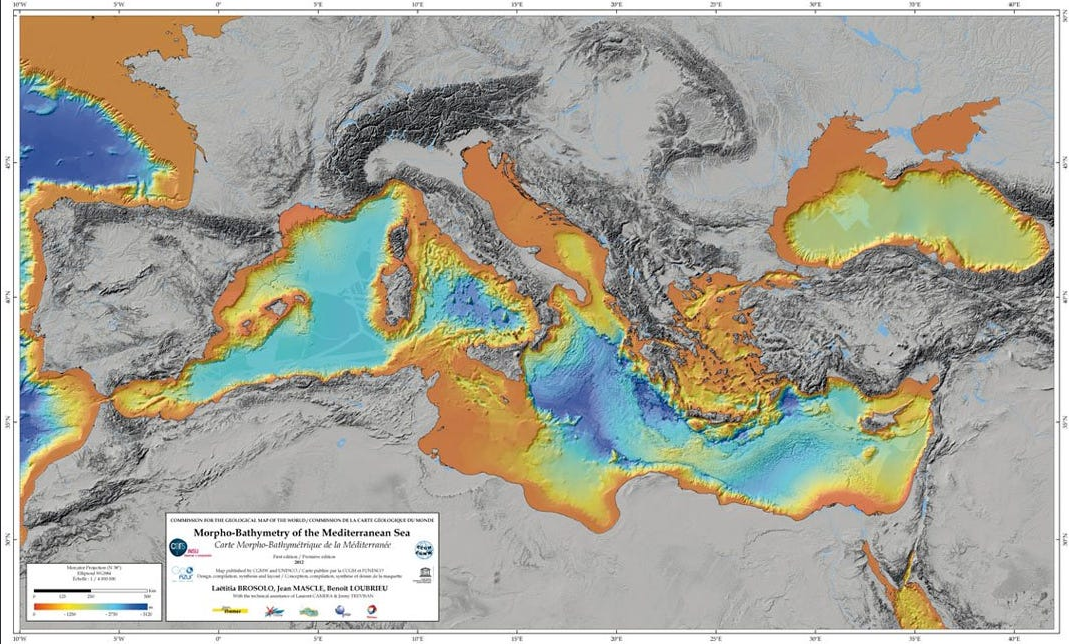
Supporters of ice age civilizations argue that sea level rose 120 meters as the Ice Age glaciers melted, flooding low-lying coasts and destroying any evidence of coastal civilizations.
Areas likely above water during the Ice Age are in orange-brown (source)
What would happen to the ancient civilizations we know about if sea level rose an additional 120m? We would lose Babylon, Rome, and most of Egypt. But:
- The Acropolis of Athens is 150m above sea level, and would be preserved for future archaeologists. Sparta (200m) and Thebes (250m) would also be fine.
- The Hittite capital of Hattusa is almost 1,000m above sea level and would be totally unaffected.
- The two biggest cities in Assyria, Ashur and Nineveh, would both make it.
- Zhengzhou, the capital of the Shang in ancient Chinese, would survive.
- Mohenjo-Daro would sink, but Harappa would be fine.
- Basically nobody in Elam/Medea/Persia would even notice.
- The top 80m of the Great Pyramid would rise above the waterline, forming a little island. The part of the Pyramid above the water would still be taller than the entire Leaning Tower of Pisa. It would be pretty hard to miss!
So a 120m sea level rise wouldn’t be enough to wipe out evidence of our crop of ancient civilizations, and shouldn’t be enough to wipe out evidence of a previous crop, unless they had a very different geographic distribution than ours.
January 14, 2023
Of course the Egyptologists would deny it – Great Pyramid conspiracy theories
At Astral Codex Ten, Scott Alexander looks at one of the persistent Great Pyramid conspiracy theories:
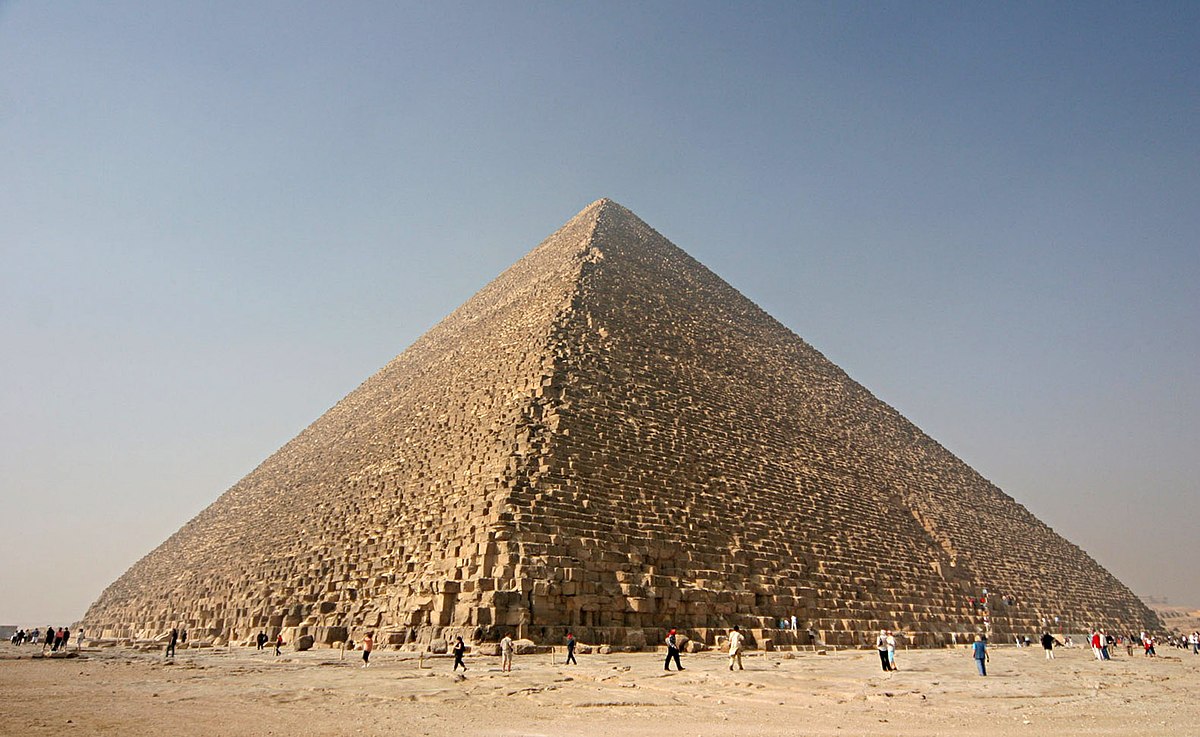
The Great Pyramid of Khufu (Cheops) in Giza, Egypt, the oldest of the Seven Wonders of the Ancient World.
Photo by Nian Aldin Thune via Wikimedia Commons.
Some conspiracy theories center on finding anomalies in a narrative. For example, Oswald couldn’t have shot Kennedy, because the bullet came from the wrong direction. Or: the Egyptians couldn’t have built the Pyramids, because they required XYZ advanced technology. I like these because they feel straightforwardly about styles of processing evidence
(Remember, I use the word “evidence” in a broad sense that includes bad evidence. By saying that some conspiracy theory has “evidence”, I’m not suggesting it’s justifiable, just that someone somewhere has asserted that they believe it for some particular reason. For example, someone might say they believe in alien abductions because of eyewitnesses who claim to have been abducted; I’ll be calling the eyewitnesses “evidence” without meaning to assert it is any good.)
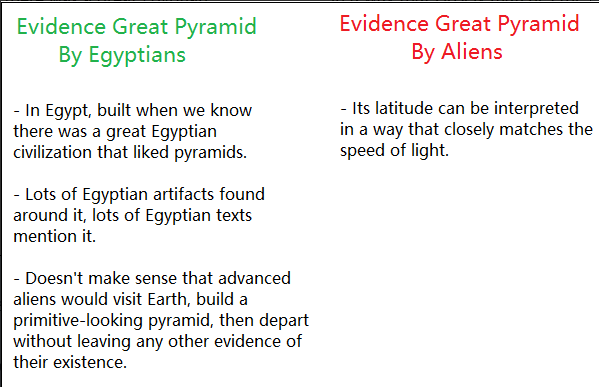
Consider the pseudohistory claims I discuss in The Pyramid And The Garden. The Great Pyramid’s latitude in standard notation equals, to within seven decimal places, the speed of light in tens of millions of meters per second. In a strict sense, this is a one-in-a-million chance, although the post tries to explain why this might be less impressive than it sounds.
So the evidence in favor of “aliens who knew the speed of light built the Great Pyramid” is that it would explain this otherwise baffling coincidence. The evidence against is everything else we know about history, archaeology, architecture, and common sense. Why would superadvanced aliens have visited Earth, created one primitive stone structure, and left without doing anything else? Why does the Great Pyramid look so much like other Egyptian pyramids, and fit into our narrative of Egyptian history so well? What about marks on the Great Pyramid suggesting it was made with primitive tools? Et cetera.
You can sort of see how someone with weird evidence-processing styles might get this wrong. The fact on the right is compact, simple, and quantifiable (the two numbers match to about six digits, so it’s a one-in-a-million coincidence). The facts on the left are vague and holistic.
The mainstream archaeologist has to explain away the evidence on the right. Maybe “has to” is a strong phrase — they can just say “that’s weird, but the common sense evidence is so great that I choose to dismiss it as coincidence”. But it’s an awkward hole in their theory. I talk about how you might go about explaining it away here.
But the conspiracy theorist has to explain away the evidence on the left. This is a harder task. Sometimes you can just stretch a lot of things to make it work — I’ve seen people argue that the supposed mentions in Egyptian texts are less definitive than imagined. But one very strong explanation would be “archaeologists are so invested in protecting the mainstream narrative that they cover up all the evidence that would prove me right”, ie a conspiracy. This neatly sweeps aside a lot of the problem.
December 31, 2022
Coming of the Sea Peoples: Part 6 – Crete and the Minoans
seangabb
Published 6 Jul 2021The Late Bronze Age is a story of collapse. From New Kingdom Egypt to Hittite Anatolia, from the Assyrian Empire to Babylonia and Mycenaean Greece, the coming of the Sea Peoples is a terror that threatens the end of all things. Between April and July 2021, Sean Gabb explored this collapse with his students. Here is one of his lectures. All student contributions have been removed.
(more…)
December 27, 2022
Coming of the Sea Peoples: Part 5 – The Hittites
seangabb
Published 6 Jul 2021[Unfortunately, parts 3 and 4 of this lecture series were not uploaded due to sound issues with the recording].
The Late Bronze Age is a story of collapse. From New Kingdom Egypt to Hittite Anatolia, from the Assyrian Empire to Babylonia and Mycenaean Greece, the coming of the Sea Peoples is a terror that threatens the end of all things. Between April and July 2021, Sean Gabb explored this collapse with his students. Here is one of his lectures. All student contributions have been removed.
(more…)
December 20, 2022
Coming of the Sea Peoples: Part 2 – The Old and New Chronology of the Bronze Age
seangabb
Published 2 May 2021The Late Bronze Age is a story of collapse. From New Kingdom Egypt to Hittite Anatolia, from the Assyrian Empire to Babylonia and Mycenaean Greece, the coming of the Sea Peoples is a terror that threatens the end of all things. Between April and July 2021, Sean Gabb explored this collapse with his students. Here is one of his lectures. All student contributions have been removed.
(more…)
December 16, 2022
Coming of the Sea Peoples: Part 1 – Prelude
seangabb
Published 1 May 2021The Late Bronze Age is a story of collapse. From New Kingdom Egypt to Hittite Anatolia, from the Assyrian Empire to Babylonia and Mycenaean Greece, the coming of the Sea Peoples is a terror that threatens the end of all things. Between April and July 2021, Sean Gabb explored this collapse with his students. Here is one of his lectures. All student contributions have been removed.
More by Sean Gabb on the Ancient World: https://www.classicstuition.co.uk/
Learn Latin or Greek or both with him: https://www.udemy.com/user/sean-gabb/
His historical novels (under the pen name “Richard Blake”): https://www.amazon.co.uk/Richard-Blak…
November 2, 2022
Feeding King Tut
Tasting History with Max Miller
Published 1 Nov 2022
(more…)


