Quotulatiousness

February 26, 2023

The role of Vice President of the United States is, constitutionally, pretty lightweight

Filed under: Government, History, USA — Tags: , , — Nicholas @ 05:00

For most Americans, the Vice President is seen not only as potentially the next President but also as a fairly significant official in the administration, yet this isn’t the way the job was envisioned by the Founding Fathers, as Glenn Reynolds explains:

Vice President Mike Pence (2017-2020) and Vice President Kamala Harris (2021-)

Mike Pence is arguing that the Vice President is a legislative, not an executive, officer. Mike Luttig has a piece in the NYT calling that crazy. (Link is to Josh Blackman’s blog post on same. Luttig’s piece is here, but it’s paywalled.)

Well, as it happens, I had a piece on the topic in the NYT over a decade ago, and I’ve also authored a piece in the Northwestern University Law Review on the topic, and I say he’s not crazy.

Nowadays, we tend to think of Vice Presidents – wrongly – as a sort of junior or co-President, but that’s not actually how it works at all. As I wrote in the Northwestern Law Review piece:

    The Constitution gives the Vice President no executive powers; the Vice President’s only duties are to preside over the Senate and to become President if the serving President dies or leaves office. Traditionally, what staff, office, and perquisites the Vice President enjoyed came via the Senate; it was not until Spiro Agnew mounted a legislative push that the Vice President got his own budget line. The Vice President really is not an executive official. He or she executes no laws — and is not part of the President’s administration the way that other officials are. The Vice President cannot be fired by the President; as an independently elected officeholder, he can be removed only by Congress via impeachment.

In various cases involving the Executive power, the Supreme Court has placed a lot of weight on the question of whether an official can be fired by the President or not.

Continuing:

    Traditionally, Vice Presidents have not done much, which is why the position was famously characterized by Vice President John Nance Garner as “[not] worth a pitcher of warm spit”. That changed when Jimmy Carter gave Fritz Mondale an unusual degree of responsibility, a move replicated in subsequent administrations, particularly under Clinton/Gore and Bush/Cheney.

    The expansion of vice presidential power, however, obscures a key point. Whatever executive power a Vice President exercises is exercised because it is delegated by the President, not because the Vice President posesses any executive power already. The Vesting Clause of Article II vests all the executive power in the President, with no residuum left over for anyone else. Constitutionally speaking, the Vice President is not a junior or co-President, but merely a President-in-waiting, notwithstanding recent political trends otherwise. To the extent the President delegates actual power and does not simply accept recommendations for action, the Vice President is exercising executive authority delegated by the President while being immune to removal from office by the President, unlike everyone else who exercises delegated power. The only recourse for the President is withdrawal of the delegation, with instruction to subordinate officials within the Executive Branch not to listen to the Vice President. However, it seems pretty clear that the President is not allowed to delegate executive power to a legislative official, as that would be a separation of powers violation.

The point of my argument there was to note that, by arguing that Vice President Cheney was not subject to the Freedom of Information Act because he was a legislative official, the White House had raised the question of whether President George W. Bush’s extensive delegation of executive powers to Cheney was unconstitutional. (Hence the title, “Is Dick Cheney Unconstitutional?”)

Tojo Takes Control – Week 235 – February 25, 1944

Filed under: Asia, Britain, Germany, History, India, Italy, Japan, Military, Pacific, Russia, USA, WW2 — Tags: , , , , , , — Nicholas @ 04:00

World War Two
Published 25 Feb 2023

Now that the Americans have seized the Marshall Islands, they can bypass the Japanese base at Truk. This impels Prime Minister Hideki Tojo to shake up both army and navy command, and he even takes personal control over the Japanese Army. On the Anzio Front, Lucian Truscott replaces John Lucas as Allied Commander. In the field, the Allies win a big victory in Burma, and in Ukraine, the Soviets are still on the move.
(more…)

Politicians who ignored warnings now demanding to know why nobody warned them

Filed under: Business, Cancon, Government — Tags: , , — Nicholas @ 03:00

The Canadian government is moving to pass a new law to force “Big Tech” companies like Google and Facebook to pay Canadian broadcasters and newspapers whenever they post a link to one of those sites. The government was told many times that this law wouldn’t produce a cornucopia of new funding for Canadian companies, but would instead get them nothing — in fact, worse than nothing — as Big Tech firms would just ignore Canadian news altogether (possibly even blocking their own users from posting those links). Despite that, now that Google announced they were testing their ability to shut off linking to Canadian sites, the PM and the minister responsible for the new bill are acting as though it’s Google and the other tech firms making threats:

The report that Google is conducting a national test that removes links to Canadian news sites for a small percentage of users sparked a predictable reaction as politicians who were warned that Bill C-18 could lead to this, now want to know how it could happen. None of this week’s developments should come as a surprise. Bill C-18 presents Google and Facebook with a choice: pay hundreds of millions of dollars primarily to Canadian broadcasters for links to news articles or stop linking. Both companies are doing precisely what they said they would do, namely considering stopping linking (Google conducted the same tests in Australia several years ago). Indeed, strip away the hyperbole and the bottom line is this: the costs of Bill C-18 are enormous (the government’s Senate representative suggesting the bill could result in revenues to cover 35% of news expenditures of every news outlet in Canada) and the revenues from news for the platforms are not (Facebook says news only constitutes 3 percent of posts and Google does not even run ads on its Google News product). As some have noted, the government says the companies are stealing content if they link and blocking content if they don’t.

Canadian Heritage Minister Pablo Rodriguez has blithely ignored the risks associated with Bill C-18 for months. By mandating payments for links, the bill creates a real threat to the free flow of information online. It also raises press independence concerns, may violate Canada’s international copyright obligations, harm the competitiveness of independent media, and open the door to trade retaliation by the United States. But as the Google test demonstrates, everyone loses with the current bill. Trust in Google is undermined when it secretly degrades its own service, news organizations won’t see new revenues if the companies stop linking and they will also lose the benefits of the links, and Canadians will find that the bill is an own-goal by the government that undermines the foundation of the Internet.

No one likes to get called on their assertions that Google and Facebook were bluffing when they warned that the prospect of removing news sharing or search results was real, but it is telling that Rodriguez and the bill’s supporters continue to rely on misleading claims about the bill instead of making the case for its actual impact. For example, consider yesterday’s Rodriguez’s tweet:

Leaving aside the fact that Google is blocking links to news sites, not the news sites themselves, Rodriguez continues to falsely claim that the premise of the bill is for the tech companies to “compensate journalists when they use their work.” This just isn’t what the bill does. First, it now includes hundreds of broadcasters that do not even produce news, yet still qualify for compensation. That isn’t compensating for use, it is payment based on holding a CRTC licence. Second, the bill does not require compensation based on use. The standard in Bill C-18 is making news content available, which is defined as:

    For the purposes of this Act, news content is made available if

    (a) the news content, or any portion of it, is reproduced; or
    (b) access to the news content, or any portion of it, is facilitated by any means, including an index, aggregation or ranking of news content.

Google and Facebook don’t typically reproduce the news. Rather, they link to it and thereby send the user to the publisher’s own platform where the publisher benefits from increased traffic and potential ad revenue. Therefore, the key provision is (b), which covers facilitating access to the news, better known as linking to it. That is not how most Canadians would conceive of use and why officials typically avoid acknowledging that the bill is about payment for links.

I tapered off linking to Canadian newspapers the last time this idea was being tossed around, and clearly I’ll need to omit ever linking to Canadian broadcasters and newspapers in future … but given that easily 90% of my readers aren’t Canadian, it’s not going to be too much of a sacrifice.

Ortgies Automatic Pistols: Not as Boring as You Think!

Filed under: Business, Germany, History, Weapons — Tags: , , , , — Nicholas @ 02:00

Forgotten Weapons
Published 16 Jun 2016

The Ortgies is a pistol whose interesting aspects are often overlooked on the assumption that it is just another identical .32 ACP blowback pistol. Well, it is that — but it is also more.

Mechanically, the Ortgies has a rather unusual grip safety mechanism that is quite different from what we expect to see today. It is also interesting in that the .32 and .380 versions differ only in the easily-interchanged barrel — even the magazines are marked for both calibers.

However, the most interesting part of the Ortgies story (in my opinion) is its production. In less than 5 full years (1919-1923), close to a half million of these guns were made, primarily by an industrial subsidiary of the German government. The guns were in large part a work program, creating export goods which could bring desperately needed hard currency into Germany to counteract the economic devastation of the Versailles treaty.

Have a look at the video and you may come away with a newfound appreciation for the humble Ortgies, like I did!
(more…)

QotD: Scientology versus psychiatry

Filed under: Health, Quotations, Religion — Tags: , , — Nicholas @ 01:00

Scientology has a long-standing feud with psychiatry, with the psychiatrists alleging that Scientology is a malicious cult, and the Scientologists alleging that psychiatry is an evil pseudoscience that denies the truth of dianetics. And that psychiatrists helped inspire Hitler. And that the 9/11 was masterminded by Osama bin Laden’s psychiatrist. And that psychiatrists are plotting to institute a one-world government. And that psychiatrists are malevolent aliens from a planet called Farsec. Really they have a lot of allegations.

Scott Alexander, “The APA Meeting: A Photo-Essay”, Slate Star Codex, 2019-05-22.

February 25, 2023

One year into Vladimir Putin’s “Three-Day War”

Filed under: Europe, Military, Russia, Weapons — Tags: , , , , — Nicholas @ 05:00

Tsar Vlad launched his short, victorious war a full year ago, expecting to have the troops home by spring if not sooner. It hasn’t worked out to his timetable at all. Ukraine still stands, although it’s taken one hell of a battering in the process and drawn in more and more vocal support in the west, which has belatedly been followed by actual military supplies and equipment to replace those expended holding back the Russian forces. CDR Salamander follows up his predictions from last year on how things looked to him at that moment in time:
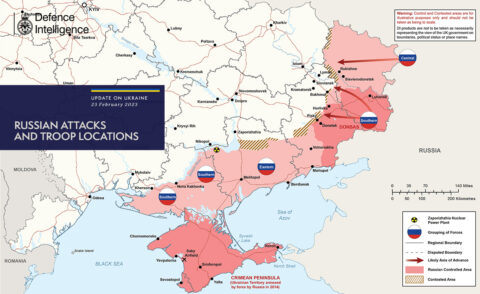
On the day the war started I made 7-points. Let’s review them and see how I did back on 24 FEB 22.

    1. The remaining delusions about the post-Cold War security arrangements in Europe should be firmly buried. History is back and she has her Festivus pole front and center. She has some issues with us, and we’re going to hear about it.

This continues to get firmer and displayed in stark relief. All the “offsets” and “transformations” and “war is new” snake oil sold the last few decades really should not be allowed to have any public space besides to say, “I was wrong.” Rest assured, that won’t stop them — but the issues we raised over the almost 18-yrs of this blog and 14-yrs of the Midrats Podcast remain true. From the shallow magazines to the fact you never have enough large caliber guns to no war is short … we — and a lot of other people tut-tut’d for years — were correct.

    2. NATO has a German problem. While all the “right people” will not shut up about how wonderful former Chancellor Angela Merkle was, people need to be very clear eyed about what a complete disaster she and the German political class have been over the last two decades. They have starved what should be continental European NATO’s most potent military into irrelevance. Her disastrous feel-good, ethno-masochistic immigration policy weakened European cohesion and fed the worst parts of European political subcultures. Yes, she made a lot of well meaning Germans feel good about themselves, but it was a sugar-high that rotted the teeth and poisoned the national metabolism. While willing to defend Europe to the last Pole and Germany to the last American, she decided to preen in her neo-pagan EuroGreen superiority onomastic politics by ditching clean nuclear power and through the complete corruption of her elite, shacked herself to Russian energy oligarchs and thus the Kremlin. Germany needs to fix herself, and NATO needs to work around her and punish her until she starts to behave like a constructive 21st Century security partner.

Germany has made great progress, but is being dragged kicking and screaming in to the 21st Century.

    3. As our friend Jerry Hendrix pointed out yesterday, the moral leaders in NATO right now are the Baltic Republics and I would add Visegrad nations. You can throw Romania in there too. France will go hot and cold as she fights her desire to do the right thing for European security while at the same time nurse her 1,000 year old drive to be the premier leader of Western Europe. Serious but weaker nations will lean on a reluctant USA and limited United Kingdom … simply because — to be frank — much of the rest of the alliance is not that capable.

I think this graph tells that story well;
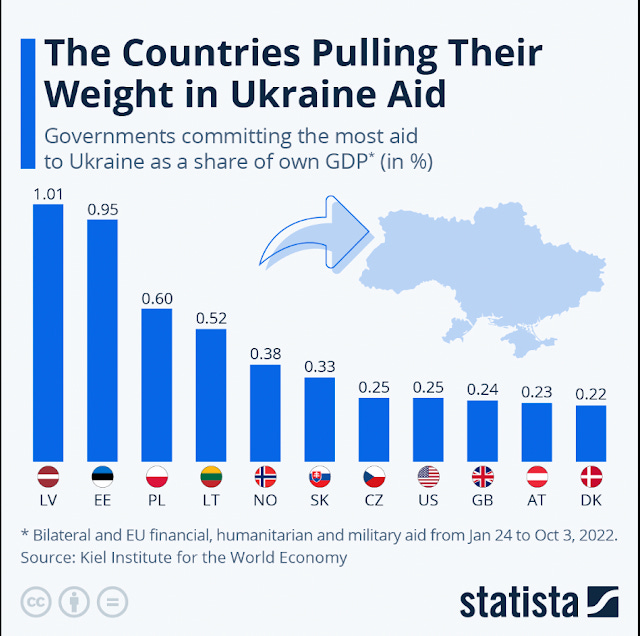
The front-line nations are putting their money where their existential threat is.

    4. In line with #1 above, it is time for Finland at least, and probably Sweden, to join NATO. They both have a long and bloody history with the Russians and should see clearly what time it is.

Another check.

    5. Ukraine waited too long to rearm. Weakened and distracted by a corrupt elite, the good parts of her nation could not get ready fast enough. After the first Russo-Ukraine war of 2014 she should have modeled the armed neutrality of Switzerland with a civilian populace trained and armed to the teeth. As we’ve discussed here before with the former Soviet republics and Warsaw Pact nations, every village needs a few ATGM militia teams trained to slow any advance through their patch of land. If Ukraine can, in whole or part, survive without vassalhood, perhaps they could get there. They can only get there if they build a nation people are willing to fight and die for.

Everyone is rediscovering the utility of a good military-industrial complex that can quickly grow to scale. Amazing what the green-eye-shade accounts forced those who actually are supposed to study war to believe.

A few days ago, Dominic Sandbrook explained that the Ukraine-Russia conflict “is not complicated”:

A year ago, as Vladimir Putin launched his so-called “special military operation” to seize the Ukrainian capital, kill Volodymyr Zelenskyy and wipe much of the latter’s country from the map of Europe, who’d have imagined that the third week of February 2023 would begin with Joe Biden strolling around the streets of Kyiv in sunglasses? For that matter, who would have predicted that Mr Zelenskyy, only recently returned from his own trip to London, would be at his side — still the president of a free country, and still very much alive?

Sometimes it’s nice to be wrong. Like many, probably most Western observers, I held out little hope for Ukraine once the drums of war began to beat in earnest. A couple of days after Mr Putin’s brutal invasion began, I wrote a bullish essay looking back at Ukraine’s history of suffering and resilience. But even as I was agonising over my prose, the bleak news continued to pour in. “Now, while I have been writing, Russian tanks are rolling into the suburbs,” I wrote at one stage. Did I think they would be driven back? I didn’t. “Kyiv will rise again,” I wrote at the end. Stirring words, or so I hoped. But the person I was really trying to persuade was myself, and I didn’t succeed.

In truth, I underestimated the Ukrainian people’s resilience, their courage, their love of country. And I was wrong, too, about the Western alliance. After more than a decade of drift and inaction, from the shameful failure to respond to the seizure of Crimea to the near-criminal indifference to the suffering in Syria, I doubted whether any major Western leader would make more than a token protest about the first full-scale European invasion since the Forties. I never expected to see Finland and Sweden jump off the fence and apply for Nato membership. Nor did I imagine that Joe Biden would be so unswerving in his commitment, or so generous with US military aid. Above all, I never anticipated that Kyiv would hold out, that Kharkiv would stand or that Kherson would be retaken. As I say, it’s nice to be wrong.

It’s often said that the war in Ukraine feels like a throwback, returning us to an age when nationalistic strongmen nursed atavistic dreams of conquest, sending thousands of men to die so that they might scratch new frontiers into the soil of Europe. For all the drones and social media gimmicks, the fighting certainly feels old-fashioned: reading David Patrikarakos’s harrowing dispatch from the front line in Bakhmut, it’s impossible not to think of Passchendaele or Verdun. But for a child of the Seventies, perhaps the most old-fashioned thing of all is the spectacle of a genuinely clear-cut conflict, an unambiguous clash of right and wrong, that feels closer in spirit to the struggle against Hitler’s Germany than to most of the wars in my lifetime.

Andrew Sullivan is convinced that the war is just, but worries whether it is prudent — and he calls it not Ukraine’s but “the West’s defensive war against Russia”:

It is right and just to defend a sovereign country from attack by a much larger neighbor; to fight back against an occupying force committing war crimes on a massive scale; to oppose the logic of dictatorships and defend the foundations of democracy; to uphold a post-Cold War international order which forbids the redrawing of borders by force; to unite democratic countries in Europe against a resurgence of imperial Russia; to defang and defeat a poisonous chauvinism that despises modern freedoms for women and gay people.

It is indeed right and just. But is it prudent?

That’s the question I’m still grappling with, in a week which saw the conflict deepen and the two sides entrench their positions further. President Biden’s trip to Kyiv and his speech in Poland have heightened the stakes, turning this into a more obvious proxy war between the United States and Russia … edging gingerly but relentlessly toward something more direct.

He’s all in now: declaring that Ukraine “must triumph” and that Russia cannot win a war that the Russian leader deems existential. NATO armaments are pouring into Ukraine at an accelerating rate. The training of Ukrainian troops is happening across the Continent. Germany is sending tanks. Pressure is building on Britain to send fighter jets.

The US is ratcheting up arms production as fast as it can, while seriously depleting our own Stinger surface-to-air missiles, 155mm howitzers and ammunition, and Javelin anti-tank missile systems. These are good times for arms producers:

    The Army is planning a 500% increase in artillery shell production, from 15,000 a month to 70,000, according to Army acquisition chief Doug Bush … and intends to double the production of Javelin anti-tank missiles, make roughly 33% more Guided Multiple Launch Rocket Systems surface-to-surface medium-range missiles a year, and produce each month a minimum of 60 Stinger anti-aircraft missiles — which were “almost not in production at all”, according to Bush.

When Ukraine’s effective military is made up almost entirely of NATO equipment, and trained by NATO forces, there surely comes a point at which claiming NATO is not actually at war with Russia gets fuzzy.


Rise of Franco – The Spanish Rif War 1921-1926

Filed under: Africa, Europe, France, History, Military — Tags: , , , , , — Nicholas @ 04:00

The Great War
Published 24 Feb 2023

The Rif War between Spain and the Rif Republic gave rise to a young Spanish officer named Francisco Franco — who later would become Spanish dictator. After Spain had almost lost the war against the Rifi people, they got help from France and WW1 hero Philippe Pétain.
(more…)

Buttigieg isn’t covering himself in glory over his belated East Palestine train derailment response

Filed under: Bureaucracy, Government, Media, Politics, Railways, USA — Tags: , , , , , — Nicholas @ 03:00

Jim Treacher is clearly trying to at least pretend some sympathy for Transportation Secretary Pete Buttigieg, but it’s a tough assignment:

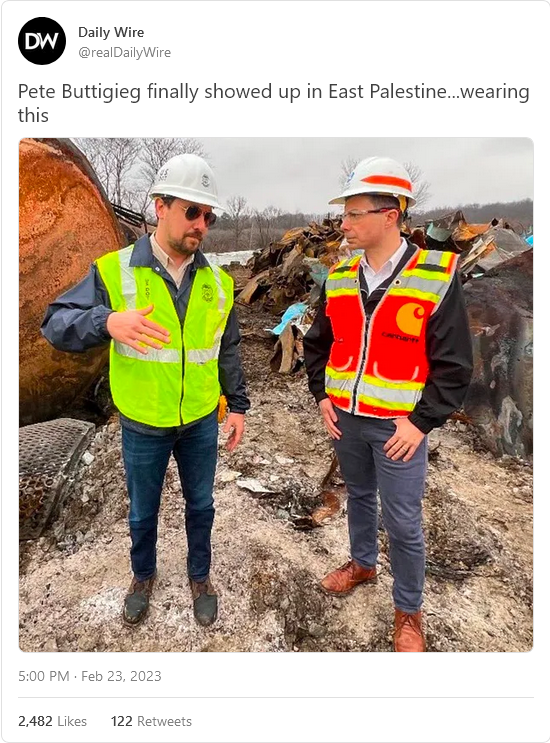
Pete Buttigieg is the type of guy who walks into a job interview and says his biggest weakness is his perfectionism. As a kid he always had an apple for the teacher, and if she forgot to assign homework that day, he was the first with his hand up. He’s a repulsive little hall monitor, so all the other repulsive little hall monitors think he’s simply divine.

Mayor Pete and his fan club are having a really bad time right now, because for once he’s expected to actually do something. Producing results simply isn’t his specialty. After spending three weeks hoping the East Palestine, Ohio rail disaster would stop bothering him if he just ignored it, he finally showed up there yesterday.

And I’m starting to understand his reluctance:

What a visual, huh? He looks like a little kid playing Bob the Builder. It’s not quite Dukakis in the tank, but it’s close.

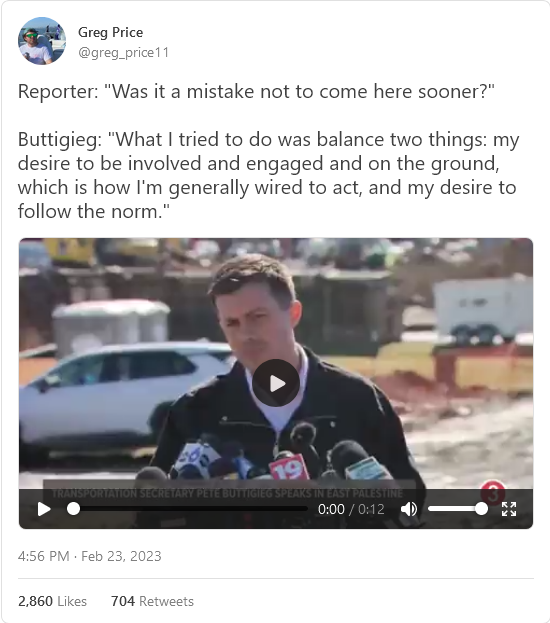
And then it got worse: He started talking.

He’s just so gosh-darn dedicated to his job, you see. His only mistake was listening to you people. He followed the norm. This is your fault!

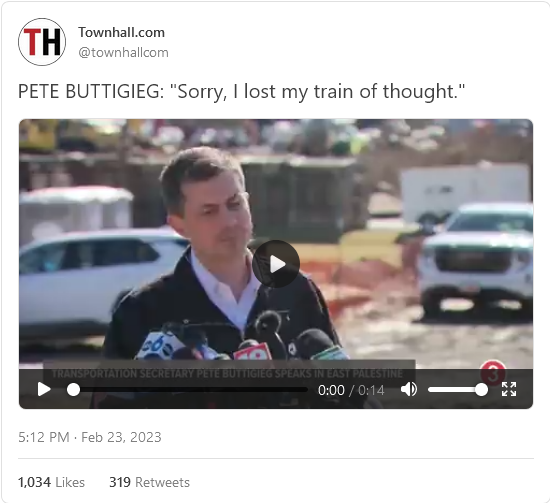
And then he blurted out this instant classic:

Now, which of those words should you try to avoid when you’re talking about a disastrous train derailment? I’m starting to suspect this guy isn’t the unparalleled megagenius the libs keep telling us he is.

[…]

Team Pete is more concerned about reporters asking about East Palestine than about the disaster itself. The rest of us are just an abstraction to them. If they accidentally manage to help some of us, that’s fine. If not, that’s also fine. Either way, we cannot be allowed to stand in the way of their political aspirations.

Mayor Pete really did think this gig would be a cinch, didn’t he? Like, he could just do all the reading the night before the final and ace it. He’s positively resentful at being expected to do what we’re paying him to do. He thinks he’s too good for this job, which is why he’s very bad at this job.

Will Buttigieg’s tenure as transportation secretary ruin his presidential prospects? After all, that’s what this is all about for him. Maybe, maybe not. It’s not as if politics is about solving problems. All you have to do is claim you solved the problems, and your team will cheer for you no matter what.

Making a Simple Stool | Paul Sellers

Filed under: Tools, Woodworking — Tags: , , — Nicholas @ 02:00

Paul Sellers
Published 26 Aug 2022

I am always surprised how few woodworkers have made a simple three-legged stool, and every woodworker should make at least one. I developed this for benchwork instruction, which makes the whole methodology different and unique.

Whether you are a seasoned woodworker or a raw beginner, there is so much to learn about hand tools, wood, technique, and grain structure in this simple stool. It’s just a few hours of very pleasant woodworking and it can be completed with just a handful of common woodworking tools.

I hope you enjoy making yours.
——————
(more…)

QotD: Feudalism versus “Manorialism”

Filed under: Economics, Europe, History, Quotations — Tags: , , , — Nicholas @ 01:00

… the economic system in much of medieval Europe is better understood under this term, manorialism, rather than “feudalism”. Feudalism, as a term, has been generally going out of style among medievalists for a long time, but it is especially inapt here. In a lot of popular discourse (and high school classrooms), feudalism gets used as a catch-all to mean both the political relationships between aristocrats and other aristocrats, and the economic relationships between peasants and aristocrats, but these were very different relationships. Peasants did not have fiefs, they did not enter into vassalage agreements (the feodum of feudalism). Thus in practice my impression is that the experts in medieval European economics and politics tend to eschew “feudalism” as an unhelpful term, preferring “manoralism” to describe the economic system (including the political subordination of the peasantry) and “vassalage” to describe the system of aristocratic political relationships.

Bret Devereaux, “Collections: Bread, How Did They Make It? Part IV: Markets, Merchants and the Tax Man”, A Collection of Unmitigated Pedantry, 2020-08-21.

February 24, 2023

“… they are all weedy, weird sylphs who are essentially un-people, without any wisdom or sense”

Elizabeth Nickson on the current cohort of raised-in-a-vat, cloned “leaders” of most of the western world:

Easily the most destructive cohort in the culture is the financially secure, semi-educated female on the cultural left. She reads nothing but literary fiction, is a book and knitting club member and knows absolutely nothing about the real world. But she is “bold” and “powerful” and never shuts up. Her views are confirmed, amplified and imposed by corporate media, for whom she is the aspirational shopper from whom all wealth flows.

It is the opposite of a virtuous circle. Ignorant protected women of all colors are courted by corporations because she makes 90% of buying decisions (and less fortunate women emulate her). Corporations force the press to slavishly pander to her every stupid whim and deep feel of the month so their adverts work like charms.

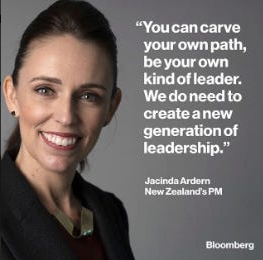
All the above leaders [Jacinda, Trudeau, Nicola, Rishi, and Macron] are manufactured in some MKULTRA facility to appeal to her ignorance, her prejudices, her over-weening self-regard. With the exception of the vegetable in the White House, they are all weedy, weird sylphs who are essentially un-people, without any wisdom or sense. They’ve lived their lives in classrooms and meeting rooms. They serve as pretty, platitudinous ciphers on which to project a profound political ignorance and emotional immaturity.

Our girl, for she has never grown up, has abandoned adult responsibility to luxuriate in narcissism.

She is ruthlessly used by the vicious communist left (as described below) and she has no idea who or what they are. She is the stupidest person on the planet.

And Michelle Obama? If you are thinking of running, think again. Because the hell we will unleash on your ignorant self will make Jacinda tremble with PTSD.

Let someone far less impassioned and far more knowledgeable than me describe Ardern’s humiliating failures below. The damage she caused to her people, to her party, to her country’s economy was as titanic as her ego. Every single other leader listed in the head of this piece is following the same dictated-from-above public policy initiatives. Their fate and that of their citizenry will be the same.

By their fruits ye shall know them.

If you want to know more about the rise and fall of Justin Trudeau’s New Zealand counterpart, Elizabeth’s post includes an extensive discussion of Jacinda Ardern’s career from Dr Muriel Newman of the New Zealand Centre for Political Research.

Up Close and Personal – Mountain Warfare in Italy – WW2 Special

Filed under: Britain, France, Germany, History, Italy, Military, USA, WW2 — Tags: , , , — Nicholas @ 04:00

World War Two
Published 23 Feb 2023

Thanks to Curiosity Stream for sponsoring today’s video

Even as the Allied and Axis commanders focus on the sweeping warfare of the Eastern Front and the planning for the invasion of Europe, their men continue to fight a grinding war of attrition high in the Italian mountains. It’s a war of merciless terrain, brutal close-quarters combat, and vast quantities of artillery and bombs. They may be playing second fiddle, but the soldiers on the Italian front will never forget these battles.
(more…)

You may call it “interest cycling”, but I call it “normality”

Filed under: Books, Personal, Randomness — Tags: , , — Nicholas @ 03:00

Tom Knighton on what is apparently called “interest cycling” in hobbies and other leisure-time activities:

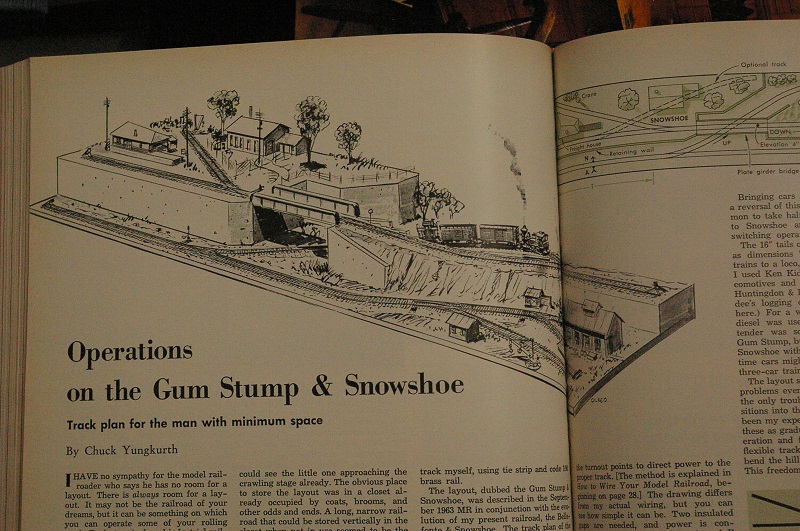
An article from a late 1950s issue of Model Railroader magazine showing a very small HO scale layout plan. The author later admitted that it’s really too small to do much with after it’s built — without some expansion — but the building can take more time than you might expect and you’d need to develop some new skills to do it properly.

Something many ADHD people do — and maybe others, I don’t know — is what I call “interest cycling”.

Basically, I get insanely hyperfocused on one thing, devoting almost all of my time to this One Thing for weeks at a time, then suddenly stop for whatever reason and then jump onto something else.

As a result, I never become truly great at anything. What’s more, since many of these areas of hyperfocus — one article called them obsessions, and with plenty of cause — require money, I end up needing to spend large quantities of money that I really can’t afford to spend.

But, it’s a need.

And it’s a problem. For a lot of us.

See, I have obligations that surround some of my interests. I’m a group leader for the local chapter of an organization I’m part of, for example, that requires not just me to teach a class once per week, but also to advance my own knowledge.

I still teach the class because others are counting on me to do so, but I haven’t been devoting much time to the rest of it, and I should since there are some tangential benefits to what I’m trying to accomplish here at The Knighton Experiment. Sure, some of it isn’t, but that’s just part of the game, so to speak.

What’s worse is that, so far as I’ve been able to find, there aren’t a lot of ways to combat this.

Which suggests that I’m kind of doomed to go through this cycle for the rest of my life.

Now, there are upsides. I mean, there aren’t many people who could detail both how to build a chest of drawers and a 14th-century transitional plate harness, for example. While I can’t necessarily build either with a high degree of proficiency, I at least know what’s involved.

In my own case, those sound like perfectly normal interests — I share both of them — although since my income dropped precipitously several years ago, I don’t spend money as Tom still does. What I have done, however, is to accumulate future stocks of books on those topics I typically cycle through over time so that when the urge strikes I can at least ameliorate some of the need by reading about rather than actively engaging in the hobby/interest/activity. That might be the difference between Tom’s concern and my experience … I cycle among a number of interests, but not brand new ones all the time.

War of 1812 – Freshwater Edition

Filed under: Britain, Cancon, History, Military, USA — Tags: , , , , — Nicholas @ 02:00

Drachinifel
Published 4 Sept 2019

Today we take a look at the War of 1812 as it progressed on the Great Lakes.
(more…)

QotD: Relearning lessons as old as warfare

Filed under: Asia, China, History, Military, Quotations, USA — Tags: , , , — Nicholas @ 01:00

DURING THE FIRST MONTHS of American intervention in Korea, reports from the front burst upon an America and world stunned beyond belief. Day after day, the forces of the admitted first power of the earth reeled backward under the blows of the army of a nation of nine million largely illiterate peasants, the product of the kind of culture advanced nations once overawed with gunboats. Then, after fleeting victory, Americans fell back once more before an army of equally illiterate, lightly armed Chinese.

The people of Asia had changed, true. The day of the gunboat and a few Marines would never return. But that was not the whole story. The people of the West had changed, too. They forgot that the West had dominated not only by arms, but by superior force of will.

During the summer of 1950, and later, Asians would watch. Some, friends of the West, would even smile. And none of them would ever forget.

News reports in 1950 talked of vast numbers, overwhelming hordes of fanatic North Koreans, hundreds of monstrous tanks, against which the thin United States forces could not stand. In these reports there was truth, but not the whole truth.

The American units were outnumbered. They were outgunned. They were given an impossible task at the outset.

But they were also outfought.

In July, 1950, one news commentator rather plaintively remarked that warfare had not changed so much, after all. For some reason, ground troops still seemed to be necessary, in spite of the atom bomb. And oddly and unfortunately, to this gentleman, man still seemed to be an important ingredient in battle. Troops were getting killed, in pain and fury and dust and filth. What had happened to the widely heralded pushbutton warfare where skilled, immaculate technicians who had never suffered the misery and ignominy of basic training blew each other to kingdom come like gentlemen?

In this unconsciously plaintive cry lies buried a great deal of the truth why the United States was almost defeated.

Nothing had happened to pushbutton warfare; its emergence was at hand. Horrible weapons that could destroy every city on earth were at hand — at too many hands. But pushbutton warfare meant Armageddon, and Armageddon, hopefully, will never be an end of national policy.

Americans in 1950 rediscovered something that since Hiroshima they had forgotten: you may fly over a land forever; you may bomb it, atomize it, pulverize it and wipe it clean of life — but if you desire to defend it, protect it, and keep it for civilization, you must do this on the ground, the way the Roman legions did, by putting your young men into the mud.

T.R. Fehrenbach, This Kind of War: A Study in Unpreparedness, 1963

« Newer PostsOlder Posts »

Powered by WordPress