
That was one of the things that made faculty meetings such joys, back in my professin’ days — no matter how trivial the issue at hand, the meeting couldn’t move forward until everyone had gotten up on xzyher soapbox and delivered xzheyr standard diatribe. “As a post-structuralist lesbian Maoist furry, I feel that …” The outside observer would see a room full of identical freaks, but the people inside saw a glorious rainbow of diversity. Real diversity. God help us, they really did. They really do. It’s one of the keys to understanding them.
Severian, “Advice to Young Dissidents”, Rotten Chestnuts, 2020-04-01.
March 3, 2023
QotD: What’s the opposite of university? “Diversity”
Comments Off on QotD: What’s the opposite of university? “Diversity”
March 2, 2023
Anti-Tank Chats #6 | The Panzerfaust | The Tank Museum
The Tank Museum
Published 4 Nov 2022Historian Stuart Wheeler is back with another anti-tank chat. In this episode, he is looking at the development and use of the legendary panzerfaust.
(more…)
Comments Off on Anti-Tank Chats #6 | The Panzerfaust | The Tank Museum
QotD: The rise of the overeducated mediocrity
The son of a friend of mine applied for a place at medical school and was turned down on the grounds that his personal statement was inadequate. I don’t know what was wrong with it; perhaps he employed incorrect old clichés rather than the correct new ones. Having the means to do so, my friend sent his son to a tutor who specialized in personal statements (every bureaucratic requirement is an economic opportunity for an ex-bureaucrat wanting to strike out for himself). No doubt the tutor in personal statements advised him to put in more about his passion for social justice and equality. At any rate, it worked and he was accepted.
In these statements — apparently as much a requirement in the private sector as in the public — you have to not only explain why you have dreamt all your life of this position in the marketing department (selling the unnecessary to the insolvent) and why you, of all the 7,000,000,000 people in the world, are the most suited to it, but also proclaim your deep sense of social responsibility, which you will bring to whatever task you are told to perform. People have never been entirely straightforward, thank goodness (what need of art and literature if they had been?), but we do seem to be breeding up a generation of Pecksniffs and Uriah Heeps.
I don’t want to indulge in what has been called the hermeneutics of suspicion, the habit of finding the supposedly real, occult, and sinister explanation behind perfectly straightforward social phenomena, but nevertheless I cannot help but wonder what the true purpose is of mission statements and their cognates, such as annual declarations of probity and the like. I think (though of course I cannot indubitably prove) that it is to make the world safe for overeducated mediocrities.
Theodore Dalrymple, “In Defense of Mediocrity”, Taki’s Magazine, 2018-02-17.
Comments Off on QotD: The rise of the overeducated mediocrity
March 1, 2023
Our modern age of “squishy totalitarianism”
Chris Bray on the odd controlling habits of our “great and good”, our “moral and intellectual superiors” to urge us to follow their directives “for our own good” (or else):
The anarchist philosopher Crispin Sartwell describes our political culture as one of “squishy totalitarianism”, a term I like quite a bit. (See the third page of this document.) You can disagree and refuse to comply, and the secret police won’t show up at your door (with maybe a growing list of exceptions). We don’t have a gulag. We don’t have the “culture of the disappeared“. You just … maybe find yourself with fewer friends, and some family that stops talking to you, and maybe your employer lets you know that hey, you know what, this doesn’t seem to be working out.
It’s not the Great Terror, it’s just a kind of low-grade grind of social decredentialing that lets you know you’re not making the right choices. We need to rethink Thanksgiving this year, because we’re very disappointed in you. (Don’t you want to be safe?) The way Google searches are working these days is a pretty good example of squishy totalitarianism: Oh, I’m sorry, we have no results for that widely known piece of wrongthink, but here are some results that debunk the conspiracy theory you’re searching for. Wouldn’t you prefer to read a correct search result?
[…]
We can debate the origins and the motive force behind the constant parade of error that has plagued us over the last three years: useless mask mandates, aggressively harmful school closures, insanely damaging vaccine mandates, ludicrous closures of beaches and parks, the pearl clutching over all those conspiracy theories about a lab leak.
You know the terms of the debate: Is the world led by idiots who are screwing it all up, or is this a plan that they’re executing on purpose?
But whichever answer turns out to be correct, one thing that seems extremely clear to me is that this perpetual reign of error couldn’t possibly go on without the unthinking enforcement activity of a distributed commissariat, the slogan-repeating upper-middle-class-aligned cultural apparatus that endlessly lawn signs their compliance. No one has to tell journalists to scold Woody Harrelson: they already know. The moment the Woodster engaged in crimethink, the Rolling Stone writer Marlow Stern started salivating like a trained dog hearing a bell. Vast armies of professors and HR specialists and marketing executives and bureaucrats and Hollywood functionaries and school board wokescolds and on and on and on already know their roles without being assigned to them. It is not correct for you to fail to comply with Current Thing; you are spewing conspiracy theories.
Doctor, the symptoms began shortly after I received the second dose of the Covid vaccine.
No, that is not possible, vaccines do not cause injuries. Let us not discuss this conspiracy theory any further. Here are some pills.
We have an enforcement apparatus made up of people who volunteered for the job. In terms of social class, we have the lower class, the lower-middle-class, the middle class, the Stasi, and the upper class.

Comments Off on Our modern age of “squishy totalitarianism”
School Lunch from the Great Depression
Tasting History with Max Miller
Published 28 Feb 2023
(more…)
Comments Off on School Lunch from the Great Depression
If the Freedom Convoy “actually was what it has often been portrayed as on social media — a horde of thousands of literal Nazis and Confederates set on violently overthrowing our democratically elected government — then [we’d] be living in the Confederate Republic of Nazi Canada by now”
In The Line, Matt Gurney explains how going through Justice Paul Rouleau’s Public Order Emergency Commission report in detail leads to some uncomfortable realizations about Canadian goverment and policing — at all three levels — failed to meet minimal expectations of competency and capacity:

A screenshot from a YouTube video showing the protest in front of Parliament in Ottawa on 30 January, 2022.
Photo via Wikimedia Commons.
The convoy crisis — and I’m mostly speaking here about the events in Ottawa, though the situation at the border crossings fit the same general pattern — forced Canadian police and political leaders to respond quickly to evolving circumstances. And Rouleau’s report is just a relentlessly brutal catalogue of the ways they failed.
Is it really necessary at this point to recap the failure of the Ottawa police? We at The Line have long maintained that the complete failure of the Ottawa police to plan for and control the protest not only allowed the convoy to entrench itself, but also established the psychological paradigm that would define the crisis for weeks: the convoyers held the initiative (not to mention the capital) and the Canadian state was befuddled and adrift. From that, a national crisis was born. Rouleau is just devastating. “The OPS [Ottawa Police Service]’s planning challenges,” he notes on page 56 of the first volume, “were compounded by a general breakdown of command and control.” Super.
He’s even more brutal on page 185 of the second volume: “The influx of Freedom Convoy vehicles and the disruptive behaviour by some protesters threw the OPS operational command at the NCRCC [a command centre] into a state of dysfunction. OPS Inspector Lucas described the atmosphere at the NCRCC as chaotic and explained that he and his team had neither the capacity to process the incoming information nor the resources to respond to the needs it was facing. In the late afternoon of January 29, the OPP’s [Ontario Provincial Police] representative at the NCRCC, Inspector Dawn Ferguson, reported to OPP Superintendent Abrams that OPS members in the NCRCC were panicked and were swearing and yelling orders at each other and at partner agencies.”
Huh.
Moving up a level of government, much has already been written about the cowardice of the Ford government. If any agency performed semi-well, it was the Ontario Provincial Police. The OPP was the force that was generating most of the critical intelligence used (or ignored) during the crisis. It was quick to realize that command-and-control had collapsed in Ottawa (see above), and to begin working with the RCMP on a plan — eventually a series of plans — to restore order. You can’t read POEC and conclude the OPP performed perfectly. Far from it. It was probably the best we had, though, but because Ford took a gander at the mess in Ottawa and decided to mosey on off to the cottage, it couldn’t do much.
Huh.
And that leaves us with the feds. I have maintained since last year that the federal government hasn’t received nearly enough attention in our understanding of what the hell went wrong last year. This has caused a fair degree of pushback, especially from Liberal supporters who read any reference to the “federal government” as “our beloved prime minister”. But no — while I don’t think the prime minister or the federal cabinet did particularly well during the crisis, the real federal failures were in the officials that supported the PM and his ministers.
Among the many other failures, the inability of the various government and police organizations to organize and properly share the information they were handling is perhaps the most disturbing:
If you want to see it yourself, check out pages 38 and 39 of the third volume. For those in a hurry, though, it turns out that even within the government, the flow of information was so bad that the clerk of the privy council, and the prime minister, noted that staff were learning about the convoy not via internal reports, but social media. The federal government had, as Juneau and Rigby have noted, “intelligence gaps” that “hampered the government’s ability to understand, anticipate, and respond to the situation, and to reconcile conflicting information such as contradictory reports about the size of the convoy”. The federal government didn’t have the software to process and analyze online posts, even public ones.
And then there was this (my emphasis added):
[National Security and Intelligence Advisor] Thomas also described an information-sharing gap between law enforcement and government. Assistant Secretary to the Cabinet, Security and Intelligence, Michael MacDonald recalled a significant delay in receiving updates from the RCMP, due to the RCMP’s obligation to consult with each intelligence agency that has provided the RCMP with information prior to sharing that information further (known as the “third party rule”). The NSIA’s office did not receive situation reports, project reports, or other forms of information, such as Project Hendon reports, that the RCMP obtained from other law enforcement agencies. Prior to the events of the convoy, the NSIA was not aware of Project Hendon. …
NSIA Thomas further stated that it was sometimes difficult to know how to interact with law enforcement agencies. She recognized that government must not interfere in operational matters, but thought that there was nonetheless useful information that could have been provided to decision makers without encroaching upon police independence. However, senior officials were uncertain how to obtain that information, and were concerned about “crossing the line” both in requesting information and in discussing solutions.
… huh.
And that doesn’t even cover our now-outgoing national commissioner of the RCMP being so clueless she decided to just not mention germane information during a critical meeting because … well, we never really got a good explanation for that one. Oh well. Enjoy your retirement, Commissioner Lucki!
Comments Off on If the Freedom Convoy “actually was what it has often been portrayed as on social media — a horde of thousands of literal Nazis and Confederates set on violently overthrowing our democratically elected government — then [we’d] be living in the Confederate Republic of Nazi Canada by now”
Mauser WW1 Flyer’s Rifle: the Flieger Selbstlader Karabiner 1916
Forgotten Weapons
Published 1 Nov 2022Paul Mauser dedicated much of his life to the development of a practical semiauto military rifle, and did manage to have a design that was used in combat by Germany in World War One. It began with the model 06/08, a short-recoil, flap-locked design made in both rifle and pistol form. The short recoil idea was disliked by the military for a shoulder rifle, and so Mauser redesigned it to be inertially locked with a fixed barrel. This was sold in small numbers as a sporting rifle, and tested by the military a few years before the war. Once war began, Mauser once again submitted the design for use in an infantry configuration, but the system was too delicate for infantry combat. A second pattern was made for use by fliers, and this was accepted and used in service for that brief period between the introduction of military aviation and the adoption of aerial machine guns.
Designated the FSK-16 (FliegerSelbstladeKarabiner 1916), it was used primarily by balloon and Zeppelin crews. With a large magazine and self-loading action, it was much better for use in aircraft than the typical bolt action infantry rifles — and there was no mud to get into the action while airborne.
(more…)
Comments Off on Mauser WW1 Flyer’s Rifle: the Flieger Selbstlader Karabiner 1916
QotD: What do we mean by “the humanities”?
By way of example, that methodological difference is why there’s a division between political science and history, despite the two disciplines historically being concerned with many of the same subjects and the same questions (to the point that Thucydides is sometimes produced as the founder of both): they use different methods. History is a humanities discipline through and through, whereas political science attempts to hybridize humanities and STEM (Science, Technology, Engineering and Mathematics) approaches; that’s not to say historians never use statistical approaches (I do, actually, quite a lot) but that there are very real differences in methodology. As you might imagine, that difference leads to some competition and conflict between the disciplines as to whose methodology best answers those key questions or equips students to think about them. Given that I have a doctorate in history and self-identify as a historian, you will have no trouble guessing which side of this I come down on, although that might be a bit self-interested on my part.
So if the STEM fields are, at some level, fundamentally about numbers, the humanities are fundamentally about language. The universe may be made of numbers, but the human mind and human societies are constructed out of language. Unlike computers, we do not think in numbers, but in words and consequently, the study of humans as thinking creatures is mostly about those words (yes, yes, I see you there, economics and psychology; there are edge cases, of course). Our laws are written in words because our thoughts form in our heads as words; we naturally reason with words and we even feel with words. Humans are linguistic creations in a mathematical universe; consequently, while the study of the universe is mediated through math, the study of humans and human minds is fundamentally linguistic in nature.
Thus, the humanities.
Bret Devereaux, “Collections: The Practical Case on Why We Need the Humanities”, A Collection of Unmitigated Pedantry, 2020-07-03.
Comments Off on QotD: What do we mean by “the humanities”?
February 28, 2023
The strange Steam Locomotive that was built like a Diesel – SR Leader Class
Train of Thought
Published 4 Nov 2022In today’s video, we take a look at the Southern Railway “Leader” locomotive that was built like a diesel, powered by steam and had a lot pros and cons.
(more…)
Comments Off on The strange Steam Locomotive that was built like a Diesel – SR Leader Class
QotD: Politicians respond to different economic incentives than the rest of us
The temptation is to delay the tough times until your successor can carry the can.
Poor old Keynes inadvertently gave politicians the answer they were looking for – the idea that during the downturn, the government should spend money into the economy to keep it going along nicely. Making sure that those lifeguards sacked from the Skegness lido can swiftly get jobs working at a government Skegness lido prevents them claiming the dole, and keeps them in the economy earning and spending until the economy washes out all the malinvestment and starts growing again. At which point the government Skegness lido closes and the lifeguards go to work at a lido somewhere where the biting Easterly wind doesn’t sandblast your skin off. The government has bridged the gap.
There’s one problem.
The government has no money of its own, so where will it get the money for their lido?
Well, Keynes said it should run a surplus during the good times and stash that surplus money away so it can be used during the downturn – a national rainy-day fund, if you will.
But guess what? Politicians don’t run surpluses.
Why would they? Every penny spent making lives better for voters today makes it more likely they will vote for you. And every penny saved against a rainy day makes it possible for your rivals to win votes tomorrow, by doing the same once they are in power.
So politicians don’t ever HAVE a rainy day fund. But that doesn’t stop them wanting to bridge the gap.
So they borrow the money.
And now what they are doing is not Keynesian, or even neo-Keynesian, but pseudo-Keynesian
By bridging the current gap with borrowed money, they simply make sure that the next gap will be costlier to bridge. Because the interest on the borrowing means that the gap will be wider.
But that’s not even the biggest problem – the biggest problem is that the gap is intrinsically important. We NEED it, to give us pause.
Whereas bridging it enables us to carry on being silly and prevents the misallocations from being flushed out – a lido remains operating in Skegness despite having no customers, and the lifeguards continue to work. Their lifesaving skills (which should be fruitfully employed elsewhere) stagnate at a lido with no punters. Their customer service skills deteriorate as the customers disappear, and what they learn instead is how to sit in a chair and stare into space. Their skills are degrading. Hysteresis, technically.
And so by delaying the collapse of the Skegness lido in pursuit of benign conditions for the voters, the government destroys the skills of our workforce.
Sowell was right – the problems we battle today were caused by the government’s interventions yesterday.
Surely using government to solve our problems is like a man quenching his thirst with seawater?
Alex Noble, “Drinking Brine”, Continental Telegraph, 2019-06-14.
Comments Off on QotD: Politicians respond to different economic incentives than the rest of us
February 27, 2023
The instinct to protect
Rob Henderson on the way that women react to men who demonstrate protective instincts toward them:
Human psychology evolved in environments far more violent than even the most dangerous modern U.S. cities. Overall, in the U.S., the average death rates from interpersonal violence are less than 1 in 10,000.
In contrast, in hunter-gatherer societies, 15 percent of deaths were the result of physical violence.
Our violent evolutionary past has shaped our minds. Even peaceable people in developed countries who have never even been in a fight can still readily estimate men’s physical strength from their face, body, and voice. These estimations tightly correlate with men’s actual physical strength.
A 2022 paper (preprint link here) investigated whether people prefer romantic partners who are willing and able to protect them from violence.
Considering the frequency and intensity of violence in the human ancestral environment, affiliating with people who were able to protect you would have been advantageous. The authors of the paper suggest such preferences have shaped human mating psychology.
The authors (Barlev, Arai, Tooby, and Cosmides) explore the question of whether a potential partner’s ability to protect you from violence is valued. It seems obvious that the answer (especially for women) is almost certainly yes.
However, they also explore whether a potential partner’s willingness (independent of ability) is also considered attractive.
When a woman judges a man, does learning that he is willing to protect her from violence make him more attractive, even if he isn’t particularly effective at doing so?
What about when a woman learns that a man is able but unwilling to protect her? Imagine a muscular guy who, upon seeing his date get mugged, just stands there and does nothing, or runs away.
Is he still more attractive than a guy who is unable but willing to protect her? Picture a scrawny guy who, upon seeing his date get mugged, physically tries but is unsuccessful in his attempt to stop the mugger.
The paper explores these questions.
[…]
Here you see that women rate male dates (described in this particular version of the study as average in physical strength and average in physical attractiveness) who make no attempt to protect them as a 2 out of 10 in attractiveness. Women rate a man who attempts to protect them but fails as a 7.5 out of 10. And a man who attempts to protect them and succeeds is an 8 out of 10.
So the major bump in attractiveness comes from willingness, rather than ability.
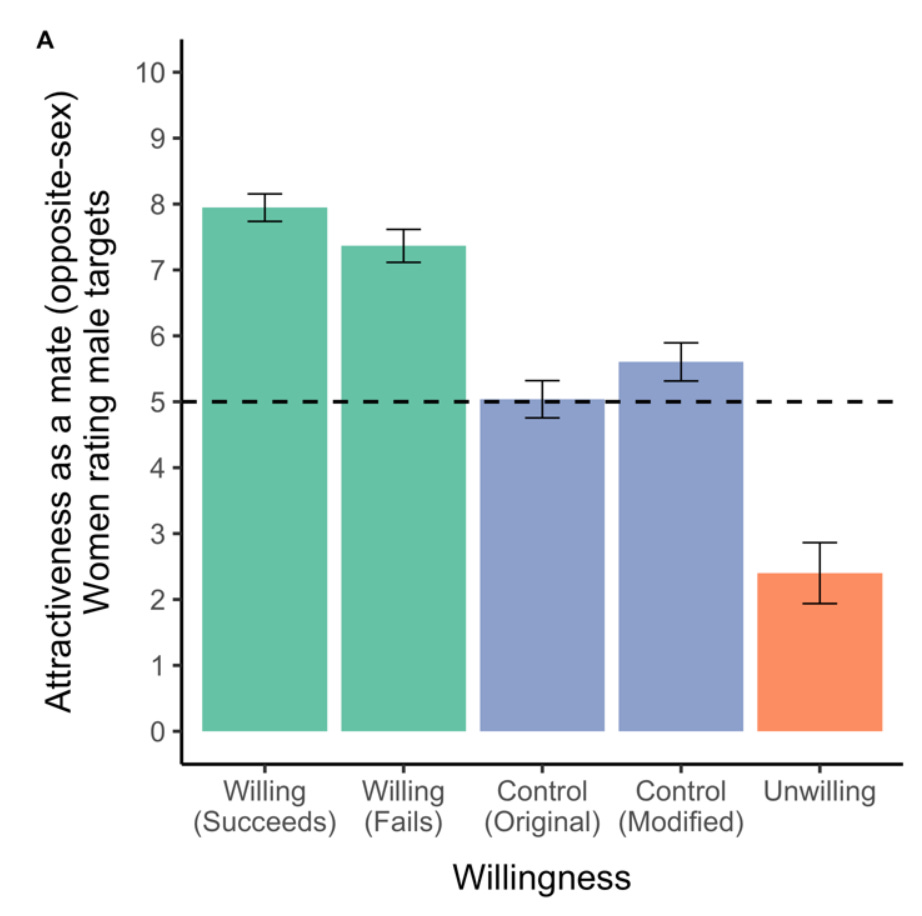
Comments Off on The instinct to protect
Luftwaffe Defeated in One Week?! – War Against Humanity 099
World War Two
Published 26 Feb 2023Allied and German Air Forces fight fierce battles over Europe with civilians caught in the crossfire, while Joseph Stalin and Lavrenti Beria deport two entire ethnicities of half a million in just one week.
(more…)
Comments Off on Luftwaffe Defeated in One Week?! – War Against Humanity 099
“From nine or so I could memorise all the dates of the kings and queens of England … all of which proved hugely useful when it came to impressing the opposite sex in my teens”
The preview portion of an Ed West article on how history should be taught as black comedy rather than a morality tale:
I love history; it is my greatest passion. If I didn’t have to worry about money I’d go and live in a former Templar castle in the Languedoc and spend my afternoons reading 19th-century French historians (pretending to read in the original for my Instagram account, obviously, but actually using a translation).
From a very young age I was obsessed with the subject. The first history tale I remember being engrossed by was the story of Ethelred the Unready and Edward the Martyr. I suppose I felt some sort of nominative solidarity with Edward, the rightful king murdered by a wicked stepmother who then put her own son Ethelred on the throne — and who turned out to be the worst combination of both useless and backstabbing.
Of course, I later learned that the story was more complicated; Edward may not have been murdered, and Ethelred was dealt a very difficult hand. But as a child it sent my mind away to a far off place in a similar way that King Arthur first captured the imagination of many others. Like them, I was first attracted to history via the medieval world, with its kings, castles and sword fights, and its colourful jousts where fair maidens watched heroic knights beat the crap out of each other (although the early medieval had almost none of those things, but again, don’t let that ruin the fun).
There was obviously a very nerdy aspect to this. From nine or so I could memorise all the dates of the kings and queens of England (although I got a bit vague when it got as far as the Edwys and Edwigs), all of which proved hugely useful when it came to impressing the opposite sex in my teens.
Dates are not the most important thing, but for a certain type of mind they make it easier to connect everything. If I learned of an insane pope who liked to torture his cardinals or “Wenzel the Drunkard“, the German king fond of throwing enemies off bridges, I could put it in context that this was the time of Richard II, and it is easier to place. If I’m now reading about Chinese emperors or what was happening in the Umayyad caliphate, where the connection with England would be slim or non-existent, my understanding of English dates still makes it easier to understand.
I loved the fantasy and the expanded sense of imagination, but as I got older, I came to better appreciate the most beautiful thing about history, that it’s all one great black comedy, filled with petty emotions and motivations, and the psychodrama and human absurdity is not some side issue, but the whole point.
Yet the subject is never really taught like that, and perhaps can’t be; and the national history curriculum when I was at school seemed structured in such a way as to suck all the life out of it. It’s not just the incoherence or emphasis; everyone complains about what is taught at school, and no one will ever be satisfied. But worse was the way the subject was almost designed to make it as boring as possible. An area of study was introduced, and then almost immediately we were asked to evaluate the primary and secondary sources; the aim was to invite scepticism, but most teens and pre-teens simply drift off at this point.
Just tell us the story — we can deconstruct it later. Personally, I feel that history shouldn’t be primarily an analysis of how hegemonic power structures orchestrate public relations; it shouldn’t be a morality tale about good and evil; it shouldn’t be a means to make society more inclusive; it should be fun, and when done correctly, it’s the most fun subject in the world.
I’ve heard a lot of other folks’ complaints about how history was taught when they were in school, and it generally aligns with my own experience. The overall plan seemed to be to actively avoid anything that might interest the students (battles, treachery, romance, excitement in general) and instead concentrate on treaty negotiations, lists of dates, and any other dry-as-dust ways to fill the lecture time. As anyone can tell by the subjects I tend to include here on the blog, I’m a big history nerd, but I actively hated the topic in school even as I was reading history for myself outside of school hours.
Ed also recommends the brilliant podcast series The Rest is History with Dominic Sandbrook and Tom Holland (now also available on YouTube, which is where I started listening to it a few weeks back). I’d read several books by each of them, so it was quite a treat to discover they were co-operating on a history podcast that more than met my expectations.
Comments Off on “From nine or so I could memorise all the dates of the kings and queens of England … all of which proved hugely useful when it came to impressing the opposite sex in my teens”
QotD: Sigmund Freud’s insights
That’s what happened with Anna O., history’s most famous psychiatric patient. She had a very turbulent love/hate relationship with her father, as tightly wound girls do. When he became deathly ill on a family vacation, the unresolvable tension caused a whole host of physical symptoms, including hysterical paralysis. Pioneering psychologist Josef Breuer “talked her through” it, finally resolving the emotional conflict and “curing” the patient.
All this would’ve been interesting, but largely irrelevant, were it not for World War I. The world at large didn’t care about the problems of overprivileged Jewish girls, but they did care about their soldiers suddenly going crazy in the trenches. Once military doctors finally ruled out a physical cause, they were left with Freudian explanations: A soldier can’t stop fighting, because he’s an honorable, dutiful soldier. Yet that soldier must stop fighting. The only honorable way out is a wound. If the enemy doesn’t wound him, then, his subconscious will. Hence the bizarre “conversion disorders” — hysterical blindness, paralysis, mutism, etc. — characteristic of “shell shock.”
But a funny thing happened. While everyone now acknowledged the real power of the subconscious mind, we sort of … forgot … about it. Psychology, particularly psychotherapy, went back to being a ghetto Jewish preoccupation. Bored, over-privileged housewives might go to a shrink to talk through their “issues”, but as for the rest of us, well, if we weren’t going into combat anytime soon, why bother? Outside of a few crusty old reactionaries (like yours truly) making fun of SJWs, when was the last time you heard the word “neurotic”?
But that’s the thing: either the subconscious is real, or it isn’t. When we say “neurotic” (the few of us who still do), we usually mean people like Anna O. — rich, cosseted, politically active human toothaches who try to force the entire world into the all-encompassing drama of their Daddy Issues (see also: Virginia Woolf). But that’s not how Freud meant it. According to him, we’re all neurotic to some degree or another, because that’s just how anxiety works.
We all have strong emotional impulses that run counter our self-image. Hence the entire panoply of pop-Freudianism: The preacher who constantly rails against homosexuality from the pulpit is secretly gay (“projection”). The strict, controlling, everything-in-its-place type is a sadist (“anal-retentive”). The player who can’t settle down with any woman is actually trying to find a Mommy figure (“Oedipus complex”). And, of course, the — ahem — daddy of them all, the crippling Daddy Issues that make feminists such fun.
But that’s just the thing: Either anxiety works that way or it doesn’t. Just because we don’t see a specific syndrome in ourselves doesn’t mean we don’t have a whole bunch of anxiety we need to discharge. Just because it’s subclinical, in other words, doesn’t mean it’s not real, or unimportant. See for example the legions of keyboard commandos who show up in the comments of any blog with more than fourteen readers. Yeah, sure, it’s possible that those guys all got kicked out of SEAL Team 6 for being too badass … but it’s probably classic identification. They’re deeply uneasy about the world and their place in it, so they construct themselves an identity as the Rambo of Evergreen Terrace.
Severian, “High Anxiety”, Rotten Chestnuts, 2020-03-16.
Comments Off on QotD: Sigmund Freud’s insights


