
World War Two
Published 9 Dec 2023This is a very busy week of the war. In the west, the Americans manage to reach the Roer River in force, but haven’t taken any of its dams; in Italy, the Allies liberate Ravenna; the Soviet advance in Hungary continues, and the Soviets even set up a new Hungarian government; martial law is declared in Greece; the Japanese make a corridor to Indochina; the fighting on Leyte continues, and the kamikaze menace becomes ever more worrisome.
00:00 INTRO
01:10 British intelligence failure
01:55 Allies reach the Roer River
05:35 Problems with Devers’ 6th Army Group
07:41 Allies liberate Ravenna
08:50 Soviet advances in Hungary
12:10 Soviets set up a new Hungarian government
13:47 A deadly demonstration and martial law in Greece
18:33 Japanese establish a corridor to Indochina
19:59 Leyte and kamikaze attacks
23:45 CONCLUSION
(more…)
December 10, 2023
Can the Americans Stop the Kamikazes? – WW2 – Week 276 – December 9, 1944
Engines of War: How Wars Were Won and Lost on the Railways
WW2TV
Published 15 Jun 2023Engines of War: How Wars Were Won and Lost on the Railways With Christian Wolmar
Before the nineteenth century, armies had to rely on slow and unreliable methods of transportation to move soldiers and equipment during times of conflict. But with the birth of the railroad in the early 1830s, the way wars were fought would change forever. In this show renowned expert Christian Wolmar tells the story of that transformation with a focus on railways in WWII and especially the Normandy campaign.
Christian Wolmar is a British journalist, author, railway historian and Labour Party politician. He is known for his commentary on transport, especially as a pundit on Britain’s railway industry, and was named Transport Journalist of the Year in the National Transport Awards in 2007.
(more…)
December 5, 2023
See Inside Sherman Firefly | Tank Chats Reloaded
The Tank Museum
Published 1 Sept 2023Inspired innovation or a bit of a lash-up? In this video we look inside the legendary Sherman Firefly, the British Army’s Tiger killer. We also hear from a Firefly veteran, Ken Dowding, ex-14th/20th Hussars.
(more…)
QotD: British meals – the midday meal
Before one can discuss the midday meal […] it is necessary to explain away the mysteries of “lunch”, “dinner” and “high tea”. The actual diet of the richer and poorer classes in Britain does not vary very greatly, but they use a different nomenclature and time their meals differently, because certain habits adopted from France during the past hundred years have not yet reached the great masses.
The richer classes have their midday meal at one-thirty in the afternoon and call it “luncheon”. At about half-past four in the afternoon they have a cup of tea and perhaps a piece of bread-and-butter or a slice of cake, which they call “afternoon tea” and they have their evening meal at half-past seven or eight, and call it “dinner”. The others, perhaps ninety percent of the population, have their midday meal somewhat earlier – usually about half-past twelve – and call it “dinner”. They have their main evening meal at about half-past six and call it “tea” and before going to bed they have a light snack – for instance cocoa and bread-and-jam – which they call “supper”. The distinction is regional as well as social. In the North of England, Scotland and Ireland many well-to-do people prefer to follow the working-class time scheme, partly because it fits in better with the working day, and partly, perhaps, from motives of conservation: for our ancestors of a century ago also had their meals at approximately these hours.
But though the name and the hour may differ, every British person’s idea of midday meal is approximately the same. We are not here concerned with the quasi-French meals that are served in hotels, but solely with British cookery, and therefore we can leave both soups and hors d’oeuvres out of account. Most British people are inclined to despise both, and do not care for them in the middle of the day. British soups are seldom good, and there is hardly a single one that is peculiar to the British Isles, while even the word “hors d’oeuvre” has no equivalent in the British language. The British midday meal consists essentially of meat, preferably roast meat, a heavy pudding, and cheese. And here one comes upon the central institution of British life, the “joint”: that is, a large piece of meat – round of beef or leg of pork or mutton – roasted whole with its potatoes round it, and preserving a flavour and a juiciness which meat cooked in smaller quantities never seems to attain.
Most characteristic of all is roast beef, and of all the cuts of beef, the sirloin is the best. It is always roasted lightly enough to be red in the middle: pork and mutton are roasted more thoroughly. Beef is carved in wafer-thin slices, mutton in thick slices. With beef there nearly always goes Yorkshire pudding, which is a sort of crisp pancake made of milk, flour and eggs and which is delicious when sodden with gravy. In some parts of the country suet pudding is eaten with roast beef instead of Yorkshire pudding. Sometimes instead of roasted fresh beef there is boiled salt beef, which is always eaten with suet dumplings and carrots or turnips.
[…]
In the second half of the midday meal we come upon one of the greatest glories of British cookery – its puddings. The number of these is so enormous that it would be impossible to give an exhaustive list, but, putting aside stewed fruits, British puddings can be classified under three main heads: suet puddings, pies and tarts, and milk puddings.
[…]
If the midday meal ends with cheese, that cheese will probably be foreign. Some of the cheeses native to Britain are very good, but they are not produced in large quantities and are mostly consumed locally. The best of them is Stilton, a cheese rather the same kind as Roquefort or Gorgonzola, but stronger-tasting and closer in the grain. Wensleydale, a similar but milder cheese, is also very good.
George Orwell, “British Cookery”, 1946. (Originally commissioned by the British Council, but refused by them and later published in abbreviated form.)
December 3, 2023
Was Hürtgen Forest Worth it? WW2 – Week 275 – December 2, 1944
World War Two
Published 2 Dec 2023The bulk of the fight for Hürtgen Forest is now over, and today we look at the results. We also look at Soviet plans for their January offensive. In the field this week, the Red Army is still fighting in Hungary, the Allies are still trying to reach the Roer River in the west, and in the Pacific Theater the kamikaze menace is wreaking havoc with Allied scheduling.
00:00 INTRO
01:06 Soviet Offensive Plans for 1945
03:12 Red Army attacks in Hungary
06:19 The Port of Antwerp is clear for use
07:23 The Battle of Hurtgen Forest is Over
12:20 Allied advances to the Roer
14:19 Tension builds in Greece
15:32 The aerial situation in the Philippines
21:36 CONCLUSION
(more…)
December 2, 2023
Original FG42: A Detailed Comparison of the 1st and 2nd Patterns
Forgotten Weapons
Published 16 Aug 2023Today we are looking at examples of the first (Type E) and second pattern (Type G) FG42, comparing their construction and disassembling both to get a close look at the internal differences. Despite sharing the basic mechanism, these two models share zero parts in common, not even the bayonets or magazines. We will also discuss the developmental path of the FG-42, and why the majority of production was the 2nd pattern but the vast majority of combat use was the 1st pattern …
(more…)
QotD: Western media and Putin’s war
Regarding [Vladimir Putin’s] Magical Mystery War, I’m going with the stoyak that the casualty counts peddled by the [western media] is part of a very very old playbook which various Western observers have peddled since 1905-that of Russian stupidity and indifference to casualties. Russia loses a war? They’re stupid gopniks who flung their soldiers into meat grinders until they rebelled (1905 or 1917). Russia wins a war? They’re stupid gopniks who flung their soldiers into meat grinders until they won (1945, 2023). Note that you can effortlessly pivot your propaganda when it becomes obvious in hindsight the outcome of the war. This becomes very important when [Putin] negotiates his 18th century kabiniettskreig ending to the war, since nobody in the West, especially AINO, understands how a cabinet war is fought, much less ends. They will claim that they foiled Putin’s plan for conquering all Ukraine (which he never has wanted) by killing hundreds of thousands of poor, oppressed, stupid, vodka-fueled gopniks used as cannon fodder who simply overwhelmed the valiant forces of good by sheer numbers. Not by superior strategy or tactics, or weapons, but the good ol’ Russian sledgehammer. Just like Hitler’s excuse in 1945, when Ivan was knock knock knockin’ on his bunker door. His generals who survived carried that piece of gospel West when the US Army started studying how to fight the Reds and asked the Germans how they did it. Their answer was happily embraced by the next generation of Very Clever Boys in the 1960s and carried forward to today’s Fistagon — Wunderwaffen.
Pickle Rick, commenting on “Friday Mailbag”, Founding Questions, 2023-12-01.
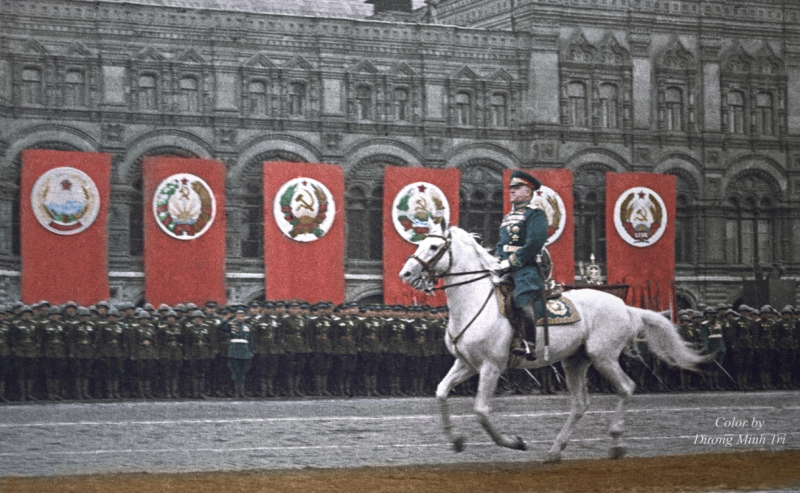
Rick agreed to me posting this quote as long as I included this colourized photo of Marshal of the Soviet Union Georgy Zhukov (“because it’s gangsta as FUCK”)
November 30, 2023
Men and Morale: Canadian Army Training in the Second World War
WW2TV
Published 1 Feb 2023Men and Morale: Canadian Army Training in the Second World War
Part of Canadian Week on WW2TV With Megan HamiltonThe Canadian Army of the Second World War spent more time preparing and training their citizen soldiers then they did in sustained action. This chiefly took place across Canada and in the United Kingdom. Adequate training functioned as a cradle for collective action, morale, empowerment, self-confidence, and, ultimately, success in battle. Yet, due to a number of factors, a sufficient standard of training was not always achieved by all.
There were limits to the Canadian Army’s ability to control the morale of its men as it created a vast organization from scratch. Training camp experiences varied, influenced by factors such as food, weather, comfort, group cohesion, leadership, skill level, discipline, social activities, and interactions with local civilians. In fact, it required a constant negotiation between camp leadership and the rank and file. Drawing from her research on both the Canadian and wider Commonwealth armies, Megan’s presentation will explain why soldiers’ morale in training was a difficult, yet vital, balancing act.
Originally from Vernon, British Columbia, Megan Hamilton is a social and military historian of the 20th century. She has an Honours Bachelor of Arts degree from Wilfrid Laurier University and a Master of Arts degree from the University of Waterloo. Her federally-funded master’s research focused on the Canadian experience of the Second World War, specifically the Vernon Military Camp. Megan’s work has been published by a number of platforms and in 2022 she won the Tri-University History Program’s top essay prize for master’s students.
She is currently located in London, England, where she has begun a fully-funded PhD at King’s College London and the Imperial War Museum, supervised by Dr. Jonathan Fennell. Her dissertation is a study of Second World War army training across the Commonwealth.
(more…)
November 26, 2023
General Patton’s Metz Obsession – WW2 – Week 274 – November 25, 1944
World War Two
Published 25 Nov 2023Metz finally falls to Patton’s 3rd Army, but boy, it’s taken some time. To the south, the Allies also take Belfort and Strasbourg, and to the north Operation Queen continues trying to reach the Roer River. The Soviets complete their conquest of the islands in the Gulf of Riga and continue advancing in Hungary to the south, but it’s the Axis Powers — the Japanese — who are advancing in China, taking Dushan and Nanning.
01:15 Operation Queen Continues
04:49 9th Army attacks toward the Roer
05:54 Pattons 3rd Army takes Metz
09:22 Allies take Belfort, Mulhouse, and Strasbourg
13:56 8th Army Attacks in Italy
15:42 Soviet advances and German indecision
18:05 Japanese take Dushan and Nanning
19:21 The fight for Peleliu ends
21:43 Notes from all over
22:23 Conclusion
(more…)
November 24, 2023
The Man Who Started the Cold War
World War Two
Published 23 Nov 2023What if I told you that a new conflict will sweep the globe in less than a year? It will open not with gunshots but with silent, shadowy espionage. The man who will kick off the Cold War is a quiet Canadian pilot, millionaire, and spymaster. A trusted aide to Churchill and FDR. I bet you haven’t heard this name before: William Stephenson.
(more…)
Freshwater Flattops; The Corn Belt Carriers Wolverine and Sable
[NR: These fascinating lake vessels first came to my attention back in 2013 – Lake Michigan’s carrier fleet.]
Ed Nash’s Military Matters
Published 8 Aug 2023Sources for this video can be found at the relevant article on:
https://militarymatters.online/
(more…)
November 21, 2023
Centaur | Tank Chats #172 | The Tank Museum
The Tank Museum
Published 28 Jul 2023Join David Willey as he tells the complex story of how the Centaur and its sister vehicles were developed when the need for a new cruiser tank emerged.
(more…)
November 19, 2023
How Himmler Learned to Love the Russians – WW2 – Week 273 – November 18, 1944
World War Two
Published 18 Nov 2023Heinrich Himmler wants to build an Army of Soviet POWs, but that has some problems; Patrick Hurley becomes US Ambassador to China, but even before that he’s in hot water with Chiang Kai-Shek; and in the field in the west, the Allies launch Operation Queen to try to cross the Roer River and reach the Rhine.
(more…)
Last Ditch Innovation: The Development of the Gerat 06 and Gerat 06H Rifles
Forgotten Weapons
Published 19 Nov 2012I’m very happy today to present a video we did in cooperation with Oleg Volk, which I’ve titled “Last Ditch Innovation”. It is a look at two late-WW2 German prototype rifles which are the evolutionary grandparents of the CETME and the H&K series of roller-delayed firearms (91, 93, MP5, etc). Thanks to some very generous friends, we have examples of both guns to disassemble and shoot … so sit back, relax, and enjoy the show.
November 18, 2023
World War Two’s most common tank
Lindybeige
Published 2 Aug 2023What click-bait title should I have used for this? “The tank that gave the Germans nightmares”? “The Commonest Communist tank?” “The tank of the teeming red hordes”? As I describe here, they made ever-so many of this type of tank, and that fact alone makes it an important tank.
(more…)


