
World War Two
Published 6 Jan 2024The Germans launch a new offensive, Operation Nordwind, in Alsace, even as their offensive in the Ardennes is stalled. The Allies in the west don’t just have to fight these, they are also having serious issues amongst themselves in High Command that threaten their unity. The siege of Budapest is in full swing and is a hard, fought, bloody battle, and the Soviets and the Americans have big plans for new offensives soon to kick off in Eastern Europe and the Philippines (respectively).
00:00 INTRO
01:20 The Siege of Budapest
04:51 German defense plans in the East
06:38 Montgomery versus Eisenhower
08:32 Eisenhower versus the French
10:35 New German Offensive in Alsace
13:49 Monty’s plans for the press
15:04 The Battle of the Bulge
17:45 Preparations for the Luzon Landings
20:56 Notes to end the week
21:51 Summary and conclusion
(more…)
January 7, 2024
1945 Begins! – WW2 – Week 280 – January 6, 1945
“Of course, you know that you Eeenglish invented modern people smuggling?”
In The Critic, Peter Caddick-Adams talks about the huge problems faced by European nations in combatting people smuggling:
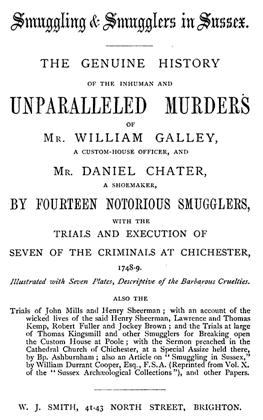
Title page of a book covering the trial of seven smugglers for the murder of two revenue officers. In the preface the author says “I do assure the Public that I took down the facts in writing from the mouths of the witnesses, that I frequently conversed with the prisoners, both before and after condemnation; by which I had an opportunity of procuring those letters which are herein after inserted, and other intelligence of some secret transactions among them, which were never communicated to any other person.”
W.J. Smith, Smuggling and Smugglers in Sussex, 1749, via Wikimedia Commons.
The Prime Minister has nailed his colours to his mast and decided we should “stop the boats”. The slogan is everywhere. What Mr Sunak means is the vessels crossing the Channel laden with bedraggled folk seeking succour on the shores of Albion. I attended a conference recently to see how this was to be done. As the perpetrators are highly organised transnational criminals, the response must be a multi-national one. Delegates were given some historical context. Ours is not a unique era. Since pre-recorded history, mankind has been inclined to see the grass as always greener on the other side of the fence. Hollow out a log to cross a river, invade an island, a coastline, Troy, the Euphrates, the Tigris, the Nile. Anywhere, for trade, for adventure, for sanctuary. Leap the Channel by longship to escape overcrowding, poor crops, for plunder, to claim a crown.
However, we were reminded — for the conference was hosted by several coastal nations studying security and crime — that most of Europe’s maritime problems with criminality and smuggling, be it booze, tobacco, narcotics, fake branded goods, or people, involve rivers, not the open sea. An old friend from the Gendarmerie Maritime observed that the great rivers of the world are not only frontiers, but also highways; earlier versions of today’s motorways, as logistically familiar to the Romans as to our own times. Those long gaggles of barges which still shuffle along the Rhine or Danube are a happenstance of trade we Brits tend to overlook, as our canals and rivers have long been consigned to pleasure-boating.
Based in Messina, the gendarme’s opposite number from the Servizio navale of the Italian Carabinieri, wearing the most resplendent braid-laden uniform of anyone at our gathering, then fixed me with his gimlet eye. “Of course, you know that you Eeenglish invented modern people smuggling?” By this he went on to explain that many of the tricks of shifting people covertly through the Mediterranean, along the Dalmatian coast, by patrol boat about the Baltic, trawler braving the North Sea, MTB across the Channel, caïque over the Aegean, among the Ionian islands, and along the Adriatic, were devised by Britain’s Special Operation’s Executive (SOE) during the Second World War.
My Belgian and French friends observed that such smuggling had honourable roots. From 1789 and post-1917, many nations had aided middle class and aristocratic refugees to flee Revolutionary France and Russia. Subsequently, their descendants helped Jewish families quit the Third Reich. Others aided the British to move vast numbers of manpower by small boat in 1940 from Dunkirk, which emboldened fishermen to repeat the manoeuvre on a smaller scale to confound their German foes. Female Greek, Turkish and Croatian officers chipped in with their knowledge of various rat-lines established during World War Two to support partisans with personnel and weapons, and extract downed airmen, spies and important scientists. Post-war, as a Spanish policeman I knew from my days in Gibraltar observed, the same systems exported Nazi war criminals, and imported drugs and guns.
The modus operandi created in those heady days of derring-do were continued for spies during the Cold War, often by the same families, using the same craft. This applied as much to jaunts and japes up and down the Danube, Rhine, Meuse and Elbe waterways as it did to the open seas. Our Danish representative observed that “boat people” were a distraction. Their numbers were vastly overshadowed by far greater numbers of religious refugees and assorted shady characters, then and now, who used stolen genuine, or expertly forged papers; another legacy from the even more distant times that preceded World War Two. The man from Interpol revealed that today’s Italian and Albanian crime families have such advanced facilities for reproducing many of the world’s passports, ID cards, work permits and driving licences, that they will pass muster even at most European electronic frontier posts and airport controls. Our Albanian colonel shifted uncomfortably.
With the fall of the Iron Curtain, espionage went out of business and, casting about for new business, these latter-day privateers and licenced black marketeers started smuggling industrial quantities of things and people, to replace the nocturnal movement of atomic secrets by night over water. A dinghy full of people in mid-Ocean is merely the tip of a giant iceberg of organisation and logistics that started on 22 July 1940 by direct order of Winston Churchill, but has continued in various legal, semi-legal and illegal forms ever since.
QotD: The US Army between 1945 and 1950
One aftermath of the Korean War has been the passionate attempt in some military quarters to prove the softness and decadence of American society as a whole, because in the first six months of that war there were wholesale failures. It has been a pervasive and persuasive argument, and it has raised its own counterargument, equally passionate.
The trouble is, different men live by different myths.
There are men who would have a society pointed wholly to fighting and resistance to Communism, and this would be a very different society from the one Americans now enjoy. It might succeed on the battlefield, but its other failures can be predicted.
But the infantry battlefield also cannot be remade to the order of the prevailing midcentury opinion of American sociologists.
The recommendations of the so-called Doolittle Board of 1945-1946, which destroyed so much of the will — if not the actual power — of the military traditionalists, and left them bitter, and confused as to how to act, was based on experience in World War II. In that war, as in all others, millions of civilians were fitted arbitrarily into a military pattern already centuries old. It had once fitted Western society; it now coincided with American customs and thinking no longer.
What the Doolittle Board tried to do, in small measure, was to bring the professional Army back into the new society. What it could not do, in 1946, was to gauge the future.
By 1947 the United States Army had returned, in large measure, to the pattern it had known prior to 1939. The new teen-agers who now joined it were much the same stripe of men who had joined in the old days. They were not intellectuals, they were not completely fired with patriotism, or motivated by the draft; nor was an aroused public, eager to win a war, breathing down their necks.
A great many of them signed up for three squares and a sack.
Over several thousand years of history, man has found a way to make soldiers out of this kind of man, as he comes, basically unformed, to the colors. It is a way with great stresses and great strains. It cannot be said it is wholly good. Regimentation is not good, completely, for any man.
But no successful army has been able to avoid it. It is an unpleasant necessity, seemingly likely to go on forever, as long as men fight in fields and mud.
One thing should be made clear.
The Army could have fought World War III, just as it could have fought World War II, under the new rules. During 1941-1945 the average age of the United States soldier was in the late twenties, and the ranks were seasoned with maturity from every rank of life, as well as intelligence.
In World War III, or any war with national emotional support, this would have again been true. Soldiers would have brought their motivation with them, firmed by understanding and maturity.
The Army could have fought World War III in 1950, but it could not fight Korea.
T.R. Fehrenbach, This Kind of War: A Study in Unpreparedness, 1963.
January 5, 2024
Pacific Theater USMC-Modified Johnson M1941 Rifle
Forgotten Weapons
Published 25 Aug 2023Johnson M1941 rifles were used in limited numbers by the US Marine Corps in the Pacific theater of World War Two, but they were used — and generally well liked. Interestingly, there was a fairly common field modification done by the Marines, and that was to cut off the front sight wings, and sometimes cut the rear aperture into a deep V-notch or a flat U-notch style. This particular ex-Marine rifle shows both of these modifications.
(more…)
December 31, 2023
Budapest Under Siege – WW2 – Week 279 – December 30, 1944
World War Two
Published 30 Dec 2023In the west, the Allies break the siege of Bastogne, but the fight for the Ardennes continues. and British commander Bernard Montgomery is maneuvering to take command of the Western Front ground forces. In Hungary Budapest is cut off by the Soviets and under siege, with hundreds of thousands of civilians still in the city. The fight in Italy is winding down for the winter, but the fight in the Philippines continues. In fact, American landings on Luzon are planned to go off soon.
00:00 INTRO
01:22 The Siege of Bastogne
03:10 The failure of 5th and 6th Panzer Armies
06:11 Montgomery wants command
09:27 Guderian appeals to Hitler, “stop the Ardennes Offensive!”
12:11 Budapest surrounded and under siege
17:04 Wrapping up the Gothic Line Campaign
19:29 Churchill in Athens
20:30 The fight in the Philippines
23:07 SUMMARY
(more…)
December 29, 2023
The Soviet follow-on operation after Bagration
Big Serge discusses the state of the Germans on the Eastern Front at the end of the massive Soviet attacks that collapsed Army Group Centre in 1944:
But now, as Bagration began to run out of momentum, the Soviets really did put Model’s army group in the crosshairs with an enormous follow up offensive — the second phase of their summer blockbuster. Model’s army group consisted of two Panzer Armies (the 4th and 1st), and an allied Hungarian force guarding the southern flank. On paper, a pair of Panzer Armies was a formidable force, but like all German units at this stage in the war they were understrength, and by this point they were already bleeding strength as panzer divisions were scrambled north to try and slow down Operation Bagration.
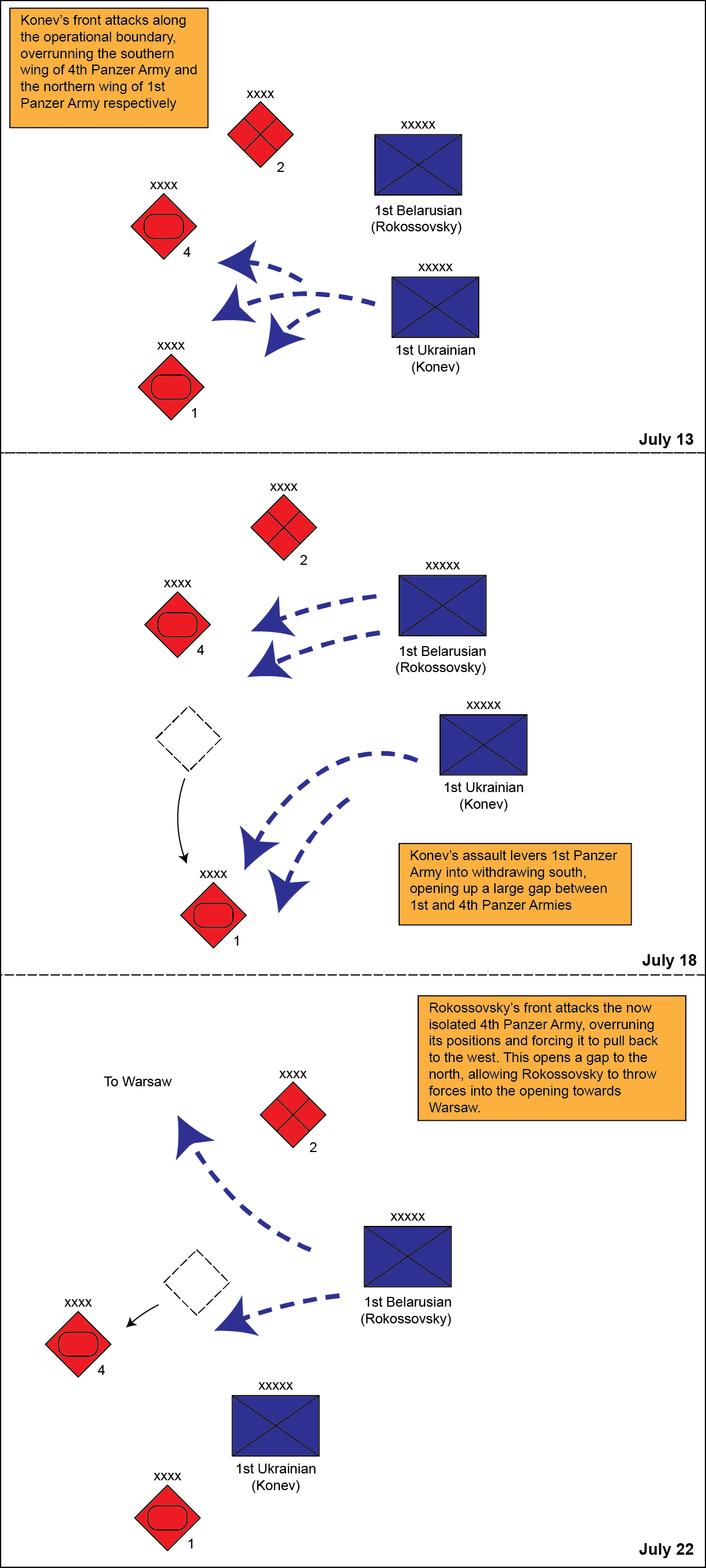
Arrayed against Model’s force were two Soviet Fronts (the equivalent of an Army Group) under a pair of the Red Army’s best operators. The lead off assault came on July 13, with Marshal Ivan Konev’s 1st Ukrainian Front forcing positions in the interstitial zone between Model’s two Panzer Armies. Konev’s intention was to split the two armies apart, force a penetration between them, and then curl into the rear to encircle one, or if possible both of them. Therefore, Konev’s initial assault was highly concentrated, with as much as 70 percent of his artillery and 90 percent of his armor assembled in a few narrow sectors selected for breaching.
With this level of force concentration by the attackers, there was really little that the Germans could do. Nevertheless, a somewhat lethargic and stiff German response helped make the disaster even worse. 4th Panzer Army headquarters initially believed Konev’s opening assault to be only a local attack – later defensively arguing that “there were as yet no signs of the attack being extended to other sections of the front” — and so attempted to respond with local counterattacks by its own reserves. As a result, by the second day of the Soviet offensive the Panzer Army had already committed all of its organic reserves while failing to withdraw from defensive positions that were already compromised. By the time they realized that Konev was launching a serious offensive operation, it was too late. Konev had already bashed into critical seams in the German front, turning his forces into a giant splitting wedge, in place to pry the whole front open.
[…]
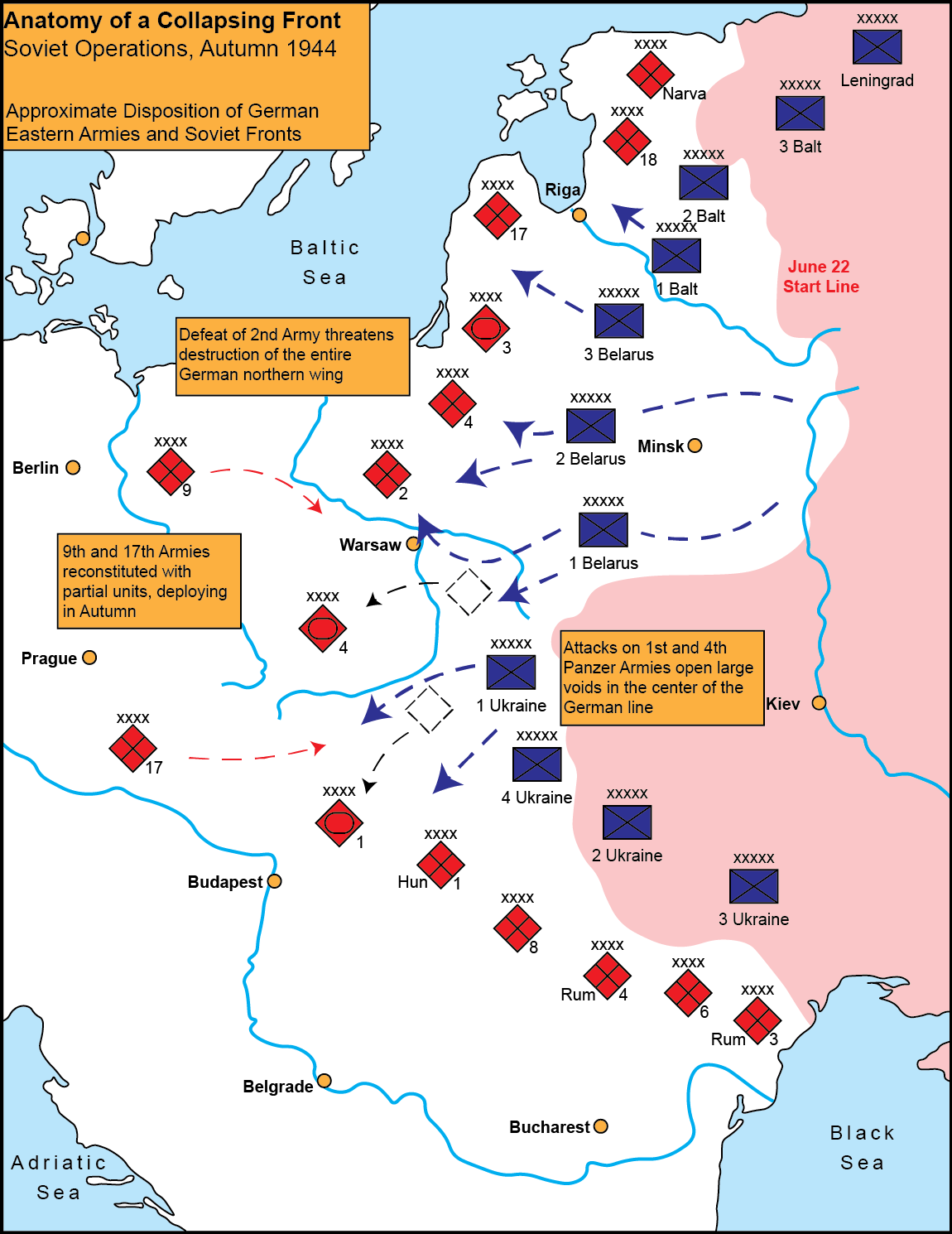
What the Soviets had achieved with their enormous assaults on Army Group North Ukraine was remarkable. By precisely targeting the seams in the German formations, the initial attacks had pried open the German position like a clam, forcing the two panzer armies to retreat in opposite directions — the 1st pulling back to the south towards Hungary, and the 4th withdrawing westward towards Krakow. These diverging withdrawals opened enormous voids in the German line — the official German history of the war simply refers to this sequence of events as “the loss of a continuous front”. In a war where the enemy wielded vast mechanized forces, such gaps were fatal.
Rokossovsky and Konev had essentially overrun an entire German army group — and the best equipped group in the east, at that — in the space of about ten days, wedging the German line open and creating vast voids to drive into. Most importantly, Rokossovsky now faced one of the more tantalizing opportunities of the entire war. A great space now beckoned him to drive north towards Warsaw, and in his path was only the tired remnant of German second army — a force with no armor whatsoever, caught completely out of position.
Any wargamer could look at the map as Rokossovsky saw it and see that the opportunity to win a seminal, world-historical victory was now within reach. A sharp drive on Warsaw would put him in position to not only capture the city (a major transportation, administrative, and supply base), but also smash through the threadbare German 2nd Army and drive to the Baltic Coast. If he could achieve this, fully half of the German eastern forces would be encircled — the entirety of Army Group North (still fighting on the Baltic Coast) and everything that remained of Army Group Center. Rokossovksy now saw little standing between his powerful Front and one of the greatest encirclements — perhaps the greatest — of all time. No less than six German armies were sitting, naked and vulnerable, on the proverbial silver platter.
The Eastern Front was on the verge of total collapse. If Rokossovsky could bash through Warsaw (a seemingly simple proposition, given the enormous overmatch that he enjoyed over German 2nd Army), he would wipe out half the German eastern army and face no meaningful German forces between him and Berlin.
December 28, 2023
War-winning expertise of 1918, completely forgotten by 1939
Dr. Robert Lyman writes about the shocking contrasts between the British Army (including the Canadian and Australian Corps) during the Hundred Days campaign of 1918 and the British Expeditionary Force that was driven from the continent at Dunkirk:
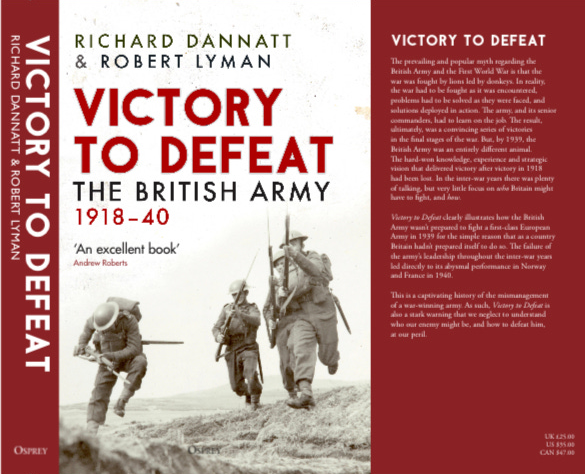
There was a fleeting moment during the One Hundred Days battles that ended the First World War in France in which successful all-arms manoeuvre by the British and Commonwealth armies, able to overturn the deadlock of previous years of trench stalemate, was glimpsed. But the moment, for the British Army at least, was not understood for what it was. With hindsight we can see that it was the birth of modern warfare, in which armour, infantry, artillery and air power are welded together able successfully to fight and win a campaign against a similarly-equipped enemy. Unfortunately in the intervening two decades the British Army simply forgot how to fight a peer adversary in intensive combat. It did not recognise 1918 for what it was; a defining moment in the development of warfare that needed capturing and translating into a doctrine on which the future of the British Army could be built. The tragedy of the inter-war years therefore was that much of what had been learned at such high cost in blood and treasure between 1914 and 1918 was simply forgotten. It provides a warning for our modern Army that once it goes, the ability to fight intensively at campaign level is incredibly hard to recover. The book that General Lord Dannatt and I have written traces the catastrophic loss of fighting knowledge after the end of the war, and explains the reasons for it. Knowledge so expensively learned vanished very quickly as the Army quickly adjusted back to its pre-war raison d’etre: imperial policing. Unsurprisingly, it was what many military men wanted: a return to the certainties of 1914. It was certainly what the government wanted: no more wartime extravagance of taxpayer’s scarce resources. The Great War was seen by nearly everyone to be a never-to-be-repeated aberration.
The British and Commonwealth armies were dramatically successful in 1918 and defeated the German Armies on the battlefield. Far from the “stab in the back” myth assiduously by the Nazis and others, the Allies fatally stabbed the German Army in the chest in 1918. The memoirs of those who experienced action are helpful in demonstrating just how far the British and Commonwealth armies had moved since the black days of 1 July 1916. The 27-year old Second Lieutenant Duff Cooper, of the 3rd Battalion The Grenadier Guards, waited with the men of 10 platoon at Saulty on the Somme for the opening phase of the advance to the much-vaunted Hindenburg Line. His diaries show that his experience was as far distant from those of the Somme in 1916 as night is from day. There is no sense in Cooper’s diaries that either he or his men felt anything but equal to the task. They were expecting a hard fight, but not a slaughter. Why? Because they had confidence in the training, their tactics of forward infiltration, their platoon weapons and a palpable sense that the army was operating as one. They were confident that their enemy could be beaten.
[…]
It would take the next war for dynamic warfare to be fully developed. It would be mastered in the first place by the losers in 1918 – the German Army. The moment the war ended the ideas and approaches that had been developed at great expense were discarded as irrelevant to the peace. They weren’t written down to be used as the basis for training the post-war army. Flanders was seen as a horrific aberration in the history of warfare, which no-right thinking individual would ever attempt to repeat. Combined with a sudden raft of new operational commitments – in the remnants of the Ottoman Empire, Russia and Ireland – the British Army quickly reverted to its pre-1914 role as imperial policemen. No attempt was made to capture the lessons of the First World War until 1932 and where warfighting was considered it tended to be about the role of the tank on the future battlefield. This debate took place in the public arena by advocates writing newspaper articles to advance their arguments. These ideas were half-heartedly taken up by the Army in the later half of the 1920s but quietly dropped in the early 1930s. The debates about the tank and the nature of future war were bizarrely not regarded as existential to the Army and they were left to die away on the periphery of military life.
The 1920s and 1903s were a low point in national considerations about the purpose of the British Army. The British Army quickly forgot what it had so painfully learnt and it was this, more than anything else, that led to a failure to appreciate what the Wehrmacht was doing in France in 1940 and North Africa in 1941-42.
December 27, 2023
The never-settled “Pétain question”
Theodore Dalrymple reviews a new book on the trial of Marshal Pétain after the liberation of France in WW2:
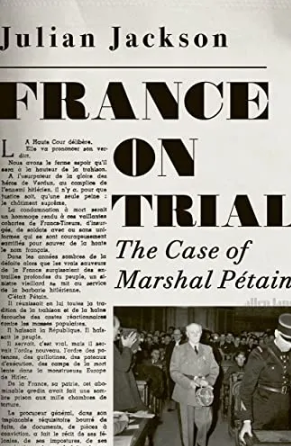
François Mauriac, the left-leaning, Nobel Prize–winning, Catholic novelist, said of the trial of Marshal Pétain that it would never be over: a sentiment more or less echoed by General de Gaulle. And certainly, the figure of Pétain continues to divide opinion in France, at least among those with opinions on such matters. Was he a traitor to France, or its savior, or perhaps something in between the two?
Professor Julian Jackson has written a superb book about Pétain’s trial, its circumstances, and its aftermath. I would like to say that I read it in one sitting, but it was too long for that; but I looked forward impatiently to picking it up again, all else being but a regrettable interruption.
The continued salience of what might be called the “Pétain question” is illustrated by the fact that one of the candidates in the last French presidential election, Éric Zemmour, claimed that Pétain was the savior of the French Jews. This was all the more startling because Zemmour himself is Jewish (his parents emigrated from Algeria to France not long before independence), and because, if Pétain is exonerated in the matter of the deportation of seventy-five thousand Jews during the war to Germany, there to be murdered, his reputation is all but saved: for it is in this matter that his record is most excoriated.
As Jackson reminds us, this was not always so. In the immediate post-war period, and during his trial for treason, the fate of the Jews of France was not much emphasized. According to Éric Conan and Henry Rousso, in their book Vichy, un passé qui ne passe pas (Vichy, a past that does not pass), the Jews of France themselves were not anxious that their treatment by Vichy should be emphasized, for they had had more than enough of being treated as a population apart. They wanted their suffering to be subsumed under that of the nation as a whole, and it was only later, by the subsequent generation, that the deportation assumed its great historiographical importance. It is not that nothing about the deportation was known before, it was merely that less emphasis was placed on it. There is an analogy with the historiography of the Soviet Union. Solzhenitsyn revealed nothing that was not, or could not have been, known before, with all its human and moral significance; the difference was that the world was now ready or willing to believe it.
But what of Zemmour’s claim, which is precisely that which Pétain’s defenders, when they are not outright anti-Semites, make on the Marshal’s behalf? It is certainly true that a far higher percentage of French Jews survived than, say, of Belgian or Dutch Jews (the figures are seventy-five, fifty, and twenty-five percent, respectively). But how much of the difference was attributable to the alleged relative decency, and cunning, of Vichy and its marshal?
Allow me a personal anecdote. Above my mother-in-law’s flat in Paris lived an old Jewish lady whose brother had been deported on the last convoy of Jews from Paris before the end of the occupation. She, however, had been saved by having been sent out of Paris to the care of nuns, who disguised her identity. Hence, she survived.
One day my mother-in-law was traveling on a bus and started to talk to an old lady next to her, who asked her where she lived. She gave the street, then the number, then the number of the flat, whereupon the lady next to her, who was Jewish, burst into tears. This was the very flat in which she had been hidden by family friends during the four years of the occupation, being careful never to appear at the window because opposite was the German Kommandantur, formerly and afterwards a police station. Four years of claustrophobic terror during adolescence: it was like something from a novel by Patrick Modiano.
The survival of these two old ladies owed nothing to Vichy or Marshal Pétain, but this does not settle the historical question. What percentage of the survivors owed their survival to the bravery of individuals, and what to policy decisions? We shall probably never know with any certainty. If one compares the survival rates of France and the Netherlands, what part did the relative geographies of the two countries play? France is much larger and less densely populated, and has many landscapes more conducive to concealment than the Netherlands.
Again, what of the pétainiste claim, repeated by Zemmour, that Vichy sacrificed Jews of non-French origin in order to save those of French origin? The former, however, were more conspicuous, with much smaller networks of potential defenders, than the latter. This might explain the large difference in the survival rates between the French-born and foreign-born Jews, an explanation which would hardly redound to the regime’s credit.
December 24, 2023
The Siege of Bastogne Begins – WW2 – Week 278 – December 23, 1944
World War Two
Published 23 Dec 2023The German Ardennes Offensive, called by the Allies the Battle of the Bulge, is in full swing in Luxembourg and Belgium this week, and the Germans have the key junction town of Bastogne under siege. On the Allied side there comes a large American surrender, plans for counterattacks, and tension growing between British and American Commands. The fight in both Italy and the Philippines continues, and in Hungary the Soviets have nearly surrounded Budapest.
00:26 Intro
01:06 The Battle of the Bulge
03:54 The Malmedy Massacre
06:25 Bastogne
10:00 American Surrender on Schnee Eifel
12:06 Patton plans a counterattack
15:44 Bernard Montgomery and Omar Bradley
18:12 The Red Army advances around Budapest
21:39 Fighting in Italy and Greece
22:45 Leyte and Mindoro
25:07 Conclusion
(more…)
QotD: Dreaming of George Bailey’s world while living in Pottersville
This, the most enduring of the many works of Frank Capra, became the Atlantis myth of post-war America. That is, those who, over the course of the last half-century, saw It’s a Wonderful Life on television, knew well that the age of community and connection depicted on their screens had already passed into the realm of legend. Moreover, to add injury to insult, they also knew that, if they wished to enjoy the fruits of a middle-class existence, they would have to live in the manner of vagabonds.
In the movie, slum-lord Henry Potter tries, but fails, to turn the provincial paradise of Bedford Falls into a run-down haunt of spinsters, drunks, and floozies. In the real world, it was Franklin D. Roosevelt who put the kibosh on the original Main Street, USA. To be more precise, the principal achievements of America’s greatest tyrant, the Great Depression and the Second World War, undermined the financial, legal, and cultural foundations of the “wonderful life”. Thus, by the time this process had run its course, inflation had made a fool’s game of simple thrift, the replacement of law with regulation had hobbled private enterprise, and people who had left home for the sake of college, work, or military service found themselves lost in a sea of strangers.
In response to these changes, colleges and universities stepped up to the proverbial plate, happy to offer substitutes for the things that had been lost. They gave young people a chance to obtain certificates that would attest to both their suitability for service in the ranks of corporate minions and their social respectability. At the same time, these institutions gave older people a way to convert their value-losing cash into an asset that promised to pay dividends that would benefit their children (and, indeed, their grandchildren) for decades to come.
Thus arose the people I have come to call the MICE (Mobile, Individualistic, College Educated) people. Bereft of regional accents, productive property, and deep connections to friends and relations, they wandered the world, building networks, acquiring degrees, and padding resumés. However, after two generations of such peripatetic solipsism, the age of the MICE people is coming to an end.
Young men of parts, who realize that college has nothing to do with either liberal learning or vocational training, are simultaneously taking up skilled trades and stocking their MP3 players with learned podcasts. At the same time, young women of quality are beginning to think that the traditional troika of Kirche, Küche, und Kinder offers better odds of deep satisfaction than life as a hormone-hobbled, Starbucks swilling, girl boss.
So, if you know young people like the ones I’ve just described, do posterity a favor, and put them in contact with each other. After all, they deserve a life as wonderful as that of George and Mary Bailey.
Bruce Ivar Gudmundsson, “College, Class, and Christmas”, Extra Muros, 2023-08-06.
December 22, 2023
Camouflage
World War Two
Published Dec 19, 2023Camouflage comes in many forms, shapes, disguises, and even processes, for there are indeed many ways to hide your soldiers, guns, tanks, and even ships at sea. Today we take a wee look at camouflage during the war.
(more…)
December 21, 2023
The Battle of Ortona
Army University Press
Published 20 Dec 2023Between 20 and 28 December 1943, the idyllic Adriatic resort town of Ortona, Italy was the scene of some of the most intense urban combat in the Mediterranean Theater. Soldiers of the First Canadian Infantry Division fought German Falschirmjager for control of the city, the eastern anchor of the Gustav Line. The Army University Films Team is proud to present, The Battle of Ortona, as told by Major Jayson Geroux of the Canadian Armed Forces.
December 17, 2023
The Battle of the Bulge Begins – WW2 – Week 277 – December 16, 1944
World War Two
Published 16 Dec 2023Adolf Hitler’s Ardennes counteroffensive finally goes off this week, and it does indeed catch the Allies by surprise, and they suspend other offensive operations in the west. They are still attacking in Italy, and the Soviets are still advancing in Hungary, trying to cut off Budapest. In the Far East, there are Allied landings on Mindoro, and they are also on the march in Burma, hoping to pin down the enemy.
0:00 Intro
0:55 Recap
1:22 Street fighting in Athens
04:07 Operation Queen ends
06:33 Autumn Mist Offensive plans
09:51 Allied intelligence failures
12:26 The Ardennes Offensive Begins
16:57 Allied attacks in Italy and Soviet plans to surround Budapest
20:07 The Allied offensive in Burma
22:10 Mindoro Landings
24:33 Summary
25:14 Conclusion
(more…)
December 16, 2023
QotD: British meals – potatoes
George Orwell, “British Cookery”, 1946. (Originally commissioned by the British Council, but refused by them and later published in abbreviated form.)
December 13, 2023
How Churchill Started the Cold War in Greece in 1944 – War Against Humanity 121
World War Two
Published 12 Dec 2023You might think that the Cold War starts after this war ends. But already, as the Germans withdraw from Greece, the ideologically opposed Greek resistance groups ELAS and EDES are at each others’ throats. It all culminates in Athens in December 1944; British troops fire some of the first shots of the Cold War as Greece descends into Civil War.
(more…)


