
World War Two
Published 3 Feb 2024Soviet forces have reached the old German border in force, however, logistical issues and a strong enemy presence possibly threatening their flanks means that a drive on Berlin may not be doable just now. Heinrich Himmler is in charge of the new Army Group to defend the Reich, and he has a host of problems. On the Western Front, the Allies finally eliminated the Colmar Pocket, and in the Philippines, the American advance reaches Manila, and the battle for the city is about to begin.
(more…)
February 4, 2024
Is the Red Army too fast for its own good? – WW2 – Week 284 – February 3, 1945
Comments Off on Is the Red Army too fast for its own good? – WW2 – Week 284 – February 3, 1945
Johnson LMG: History & Disassembly
Forgotten Weapons
Published Feb 29, 2016The Johnson light machine gun is one of the lesser-known US military machine guns of WWII, although it seems to have been very popular with all those who used it in combat. Melvin Johnson made a commendable attempt to get his rifles adopted by the US military, but was unable to unseat the M1 Garand as American service rifle. However, he did make a significant sale of both rifles and light machine guns to the Dutch colonial army.
By the time those Dutch guns were ready to ship, however, the Japanese had overrun most of the Dutch islands. The guns were thus basically sitting on the docks with nowhere to go, and at that point the US Marine Corps took possession of them. Because of their short recoil action and quickly removable barrels, the Johnson guns were ideal for airborne Paramarines, and saw use in the Pacific with these forces. They were also used by the joint US/Canadian First Special Service Force in Italy.
In many ways, the Johnson LMG is similar to the German FG-42, although with more emphasis on full-auto use instead of shoulder rifle use. It fired from a closed bolt in semiauto and from an open bolt in full auto, and had a bipod both effective, light, and easily detachable. Overall the Johnson is a light, handy, and very easily dismantled weapon, and its popularity with combat troops seems well deserved.
Comments Off on Johnson LMG: History & Disassembly
February 2, 2024
The Sad Story of Churchill’s Iceman, Geoffrey Pyke
World War Two
Published Jan 31, 2024Geoffrey Pyke is remembered as an eccentric scientist who spewed out ideas like giant aircraft carriers made of icy Pykerete. But there was much more to him than that. He was a spy, a special operations mastermind, and his novel ideas contributed to the success of D-Day.
(more…)
Comments Off on The Sad Story of Churchill’s Iceman, Geoffrey Pyke
February 1, 2024
The Kohima Epitaph: Britain’s Forgotten Battle That Changed WW2
The History Chap
Published 9 Nov 2023What is the Kohima Epitaph and what has it got to do with Britain’s forgotten battle that changed the Second World War? Well, those of you living in the UK and who attend Remembrance Sunday services will probably know the words even if you don’t know the story behind them:
“When you go home, tell them of us and say,
For your tomorrow, We gave our today.”The memorial which bears those powerful words, stands in a cemetery containing the graves over over 1,400 British servicemen and memorials to over 900 Indian troops who died alongside them. They died in one of the bloodiest, toughest, grimmest battles of the Second World War. A battle sometimes called the “Stalingrad of the East.”
Outnumbered 6:1 and half of whom were from non-combat units, the multi-national British garrison stood their ground in bloody hand-to-hand fighting, refusing to retreat or surrender for two weeks until relieved. And even then the battle continued for another vicious month. That stand stopped the Japanese invasion of India in its tracks and turned the tide of the war in South East Asia. Both for its ferocity and its turning point in the war, it has been called: “Britain’s greatest battle”.
The Japanese lost 53,000 men from their army of 85,000.
The British (14th Army) lost 4,000 men killed and wounded.This forgotten victory was made possible by General William (Bill) Slim commanding the 14th Army. Rather like the battle and the 14th Army, General Slim has not received the recognition that he is due. And yet, it is almost completely forgotten. Rather like the army that fought against the Japanese in Burma.
So, as we near Remembrance Sunday, I think it is time to reveal the story of the Battle of Kohima in 1944.
(more…)
Comments Off on The Kohima Epitaph: Britain’s Forgotten Battle That Changed WW2
January 28, 2024
Himmler Takes Command – WW2 – Week 283 – January 27, 1945
World War Two
Published 27 Jan 2024A new German Army Group has been formed, tasked with protecting the Reich from the east and commanded by none other than Heinrich Himmler, who has never held such a command. The Soviets are really on the move in the east and have even begun reaching the prewar German border. In the west the Allies have cleared the Roer Triangle and are also working hard to eliminate the Colmar Pocket. In the Far East the Americans are advancing on Luzon, and in Burma the Allies have success on the Arakan and the Shwebo Plain, and finally manage to re open the Burma Road with China.
01:27 Soviet advances in East Prussia
09:23 Hungary and the fight for Buda
11:19 Operations Nordwind, Cheerful, and Blackcock
14:23 Block 5
16:14 American advances on Luzon
18:55 Allied successes in Burma
22:06 Summary
22:26 Conclusion
(more…)
Comments Off on Himmler Takes Command – WW2 – Week 283 – January 27, 1945
January 25, 2024
Finnish Jews, Polish Special Forces, and MREs – WW2 – OOTF 32
World War Two
Published 24 Jan 2024How did Finland treat its Jews, and what did Finnish people know about the Holocaust? Who were the mysterious Polish Silent Unseen? And, what sort of rations did soldiers carry? Find out in this episode of Out of the Foxholes.
(more…)
Comments Off on Finnish Jews, Polish Special Forces, and MREs – WW2 – OOTF 32
USS West Virginia
The History Guy: History Deserves to be Remembered
Published 26 October 2023On December 7, 1941, the battleship USS West Virginia was at Pearl Harbor, moored on Battleship Row, next to USS Tennessee. During the Japanese attack, she was struck by seven torpedoes, sinking in shallow water. But the “We Vee” would rise again, and she would lead the American line of battle at the last battleship on battleship action in history. USS West Virginia deserves to be remembered.
(more…)
Comments Off on USS West Virginia
January 23, 2024
The battle of Sangshak, 1944
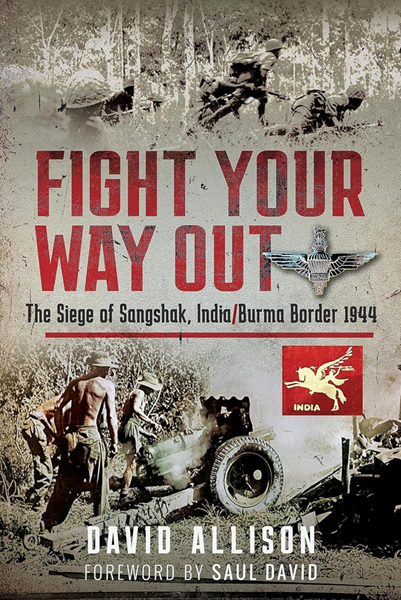
Dr. Robert Lyman discusses a new book by David Allison that covers one of the many small battles that made up the large Imphal-Kohima campaign:
When Wavell, by then Viceroy of India, visited Imphal after the battle in October, to bestow knighthoods on the four victors — Lieutenant Generals Bill Slim (14 Army), Montagu Stopford (33 Corps), Geoffrey Scoones (4 Corps) and Philip Christison (15 Corps) — he admitted to Slim that he found the battle hard to follow, as it seemed to have been fought in “penny-packets”. In professing his ignorance of Slim’s great triumph, Wavell nevertheless hit the nail on the head. Sangshak was one of those penny-packet fights which cumulatively determined the outcome of Japan’s audacious invasion of India.
Like many battles in insufficiently examined wars, Sangshak has suffered over the years from a paucity of rigorous examination. Louis Allen’s magisterial The Longest War gave it short treatment in 1984, and very little else. Until now. I’m delighted to say that a Hong Kong-based Australian lawyer with a military background — David Allison — has produced a new account of this crucial battle, and it is absolutely outstanding. It can be purchased here. I recommend it very strongly. It’s not long: at 159-pages of text you can make your way through this in a couple of days, but it is diligently researched, well written and judiciously argued. For those who know something of the battle, the big arguments in the past about the state training of the 50 Indian Parachute Brigade, the temporary breakdown of its commander, Hope-Thomson and the supposed loss of the captured Japanese map and orders by HQ 23 Indian Division, are calmly and satisfyingly explained.
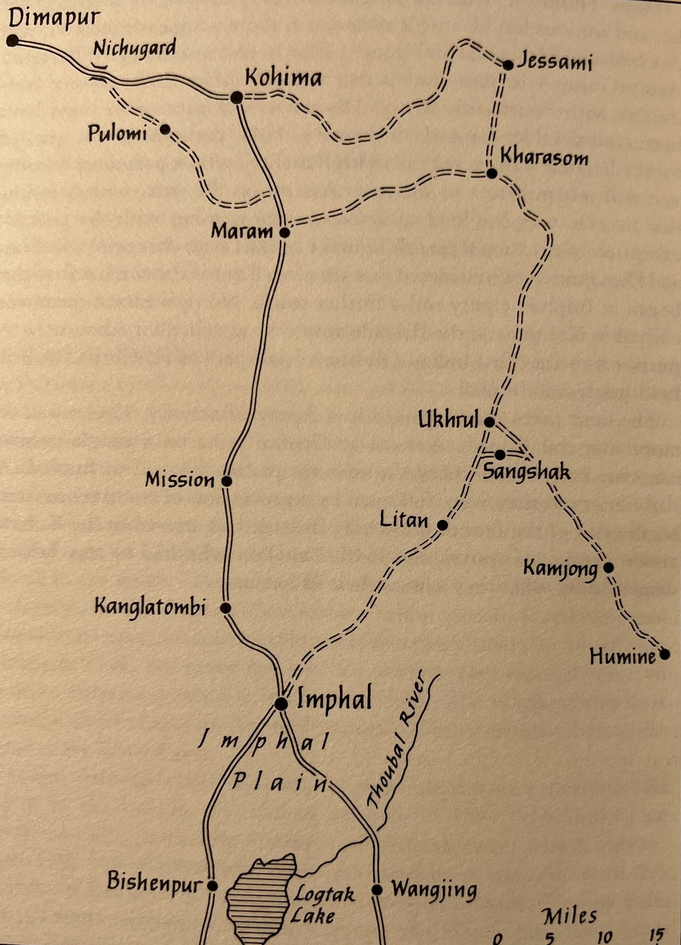
The story can be briefly told. The territory to the north-east of Imphal (centring on the Naga village of Ukhrul) had only the lightest of garrisons and no real defences. Until 16 March it was home to 49 Brigade, which was then despatched to the Tiddim Road to deal with the advance in the south of Lieutenant General Yanagida’s 33 Division. The brigade had considered itself to be in a rear area, and, extraordinarily, no dug-in and wired defensive positions had been prepared. It was one of the most serious British planning failures of the campaign. The entire north-eastern portion of Imphal lay effectively undefended. The gap left by the brigade’s departure had been filled in part by the arrival of the first of the two battalions of the newly raised 50 Indian Parachute Brigade (comprising the Gurkha 152 Battalion and the Indian 153 Battalion), whose young and professional commander, 31-year-old Brigadier M.R.J. (“Tim”) Hope-Thomson, had persuaded New Delhi to allow him to complete the training of his brigade in territory close to the enemy. The area north-east of Imphal was regarded as suitable merely for support troops and training. At the start of March, the brigade HQ and one battalion had arrived in Imphal and began the leisurely process of shaking itself out in the safety of the hills north-east of the town. To the brigade was added 4/5 Mahrattas under Lieutenant Colonel Trim, left behind when 49 Brigade was sent down to the Tiddim Road. To Scoones and his HQ, the area to which Hope-Thomson and his men were sent represented the lowest of all combat priorities. Sent into the jungle almost to fend for themselves, it was not expected that they would have to fight, let alone be on the receiving end of an entire Japanese divisional attack. They had little equipment, no barbed wire, and little or no experience or knowledge of the territory. No one considered it worthwhile to keep them briefed on the developing situation. To all intents and purposes, 50 Indian Parachute Brigade was an irrelevant appendage, attached to Major General Ouvry Roberts’ 23 Indian Division for administrative purposes but otherwise left to its own devices.
Before long, information began to reach Imphal that Japanese troops were advancing in force on Ukhrul and Sangshak. Inexplicably, however, this information appeared not to ring any warning bells in HQ IV Corps in Imphal, which was preoccupied with the developing threat in the Tamu area where the main Japanese thrust was confidently predicted. On the night of 16 March, the single battalion of 50 Parachute Brigade took over responsibility for the Ukhrul area from 49 Brigade, which was hastily departing for the Tiddim Road. They had no idea that an entire Japanese division of 20,000 men was crossing the Chindwin in strength opposite Homalin. On 19 March, large columns of Japanese infantry were reported advancing through the hills.
No one had expected them to be where they were. But the first shock came to the Japanese 3/58 battalion (Major Shimanoe), part of Lieutenant General Sato’s 31 Division – troops whose objective was Kohima, and not Imphal – who were bloodily rebuffed by the determined opposition of the young Gurkha soldiers at an unprepared position forward of Sheldon’s Corner. The 170 Gurkha recruits refused to allow the 900 men of 3/58 to roll over them and inflicted 160 casualties on the advancing Japanese. In the swirling confusion of the next 36 hours, Hope Thomson and his staff kept their heads, attempting to concentrate what remained of the dispersed companies of 152 Battalion and 4/5 Mahrattas back to a common position at the village of Sangshak, which dominated the tracks southwest to Imphal.
It was at this now-deserted Naga village that Hope-Thomson, on 21 March, decided to group his brigade for its last stand, his staff desperately attempting to alert HQ 4 Corps in Imphal to the enormity of what was happening to the north-east. The Japanese columns infiltrated quickly around and through the British positions, heading in the direction of Litan. The Japanese now began days of repeated assaults on the position in a battle of intense bravery and sacrifice for both sides. Hope Thomson’s men could only dig shallow trenches, which provided no protection from Japanese artillery.
Comments Off on The battle of Sangshak, 1944
T-34: The tank that won WWII
The Tank Museum
Published 27 Oct 2023The Soviet T-34 was the most prolifically produced tank of WWII. Basic and austere in design, it was highly effective and capable of being mass-produced. In this video we take a close look inside and out at the tank that made victory over Nazi Germany possible.
(more…)
Comments Off on T-34: The tank that won WWII
January 21, 2024
The Red Army Overruns Poland! – WW2 – Week 282 – January 20, 1945
World War Two
Published 20 Jan 2024The huge new Soviet offensives charge ahead this week, taking Warsaw and Krakow; in the west the Battle of the Bulge is officially called over … though there is still fighting there. On Luzon, the Americans push out of their beachhead, though there is heavy fighting to secure their flank.
(more…)
Comments Off on The Red Army Overruns Poland! – WW2 – Week 282 – January 20, 1945
A Book and a Rifle: The Vercors Resistance in WWII
Forgotten Weapons
Published 20 May 2018One of the single largest actions of the French Resistance during World War Two was Operation Montagnards — the plan to drop about 4,000 Allied paratroops onto the Vercors Massif when the resistance was activated in support of the Allied landings in Normandy and Provence. If you are scratching your head trying to figure out why you don’t remember that operation, it is because it never actually happened. The two Allied landings were originally intended to take place simultaneously, but logistical limitations forced the southern landings to be delayed about two months. In an deliberate decision to prevent the Germans from immediately understanding the nature of the Allied attack, the whole of the French Resistance was activated to support the Normandy landings in June 1944. The internal attacks in the south would force the Germans to keep significant forces in that area in expectation of a second landing, which would increase the chances of the Normandy landings succeeding. Unfortunately, the other result of this decision was that Resistance cells would come into the open in anticipation of imminent military support, which would not be coming. The southern elements of the Resistance were basically sacrificed in this gambit.
The Vercors Massif is a large geographical feature near Lyon and Grenoble which comprises basically a triangular sheer-walled plateau rising well above the surrounding plains. It offers a fantastically defensible redoubt, and that is what it was planned to be. Paratroops dropped onto the top of the massif would reinforce a substantial force of Maquis fighters, and create a serious strong point behind the German lines to aid in the fight inland from the landing beaches. The plan was organized in Algiers by Resistance representatives from the Vercors and Free French officers earlier in the war. Some have argued that the lack of support was simply due to the compromises of the single-landing plan, while others fault de Gaulle for deliberately abandoning the men and women on Vercors as part of a strategy to consolidate post-war political support — but that debate is beyond the scope of today’s discussion.
The fighters and civilians on the massif ultimately held out for about 6 weeks — only just too little to still be there when the Allied armored columns reached Grenoble. The German commander in the area spent several weeks making small probing attacks before the final assault with about 10,000 veteran Wehrmacht soldiers, glider-borne infantry, and tanks. Once that attack came, the fate of the Vercors was sealed. With proper military backing they could have defended their redoubt, but instead they had only a smattering of small arms and no heavy weaponry at all. It was a fight that was gloriously courageous but hopelessly doomed to failure.
I am privileged to have in my own collection a Berthier carbine tied to the Vercors Resistance, as evidenced by the brass embellishments on its stock. While I cannot conclusively prove it came from the Resistance, it was sold to me without any premium attached to them, and I have no reason to believe it is fake. And, of course, since I have no plans to sell it, I am not really concerned about conclusively proving its veracity to others. For me, it is a poignant icon of a tremendously heroic group. I hope I would live up to the bar they set should I ever be in a comparable situation!
(more…)
Comments Off on A Book and a Rifle: The Vercors Resistance in WWII
January 18, 2024
Kalashnikov vs Sturmgewehr!
Forgotten Weapons
Published 17 Sept 2016The German Sturmgewehr and the Soviet Kalashnikov are widely and rightly considered the two most influential and iconic of the modern military rifles. While the German rifle certainly influenced the Soviet design, the two were designed with different intentions and goals. The Sturmgewehr was an attempt to blend the roles of rifle and light machine gun, while the Kalashnikov was intended to blend the roles of rifle and submachine gun — and yet they both reached largely the same practical reality.
Which do you think was the better system?
Comments Off on Kalashnikov vs Sturmgewehr!
January 14, 2024
Soviet and American Massive Attacks – Week 281 – January 13, 1945
World War Two
Published 13 Jan 2024In the East, the Soviets launch a massive series of new offensives. In the West, Monty holds an ill-judged press conference about the Battle of the Bulge. Operation Nordwind, the German offensive in Alsace, continues. In Hungary, there’s house to house fighting as the Red Army besieges Budapest. In Asia, the Allies wrestle with the Kamikazes, begin their landings on Luzon, and advance in Burma.
00:54 Intro
01:12 Recap
01:22 Montgomery’s Press Conference
05:53 Operation Nordwind
07:07 The battle for Hungary
09:38 The huge Soviet offensive begins!
12:22 American landings on Luzon
15:29 Anti-Kamikaze tactics
18:11 Slim’s advance in Burma
21:11 Conclusion
(more…)
Comments Off on Soviet and American Massive Attacks – Week 281 – January 13, 1945
Inside Pz II Luchs | A WW2 Time Capsule
The Tank Museum
Published 13 Oct 2023A remarkably rare vehicle, with just 100 built and just two still in existence, the Panzer II Ausf.L “Luchs” is a reconnaissance variant of the Panzer II and this is one of the most intact and original vehicles we have in our collection. Join Chris Copson as he looks inside this Second World War rarity.
(more…)
Comments Off on Inside Pz II Luchs | A WW2 Time Capsule
January 12, 2024
Eastern Front Deployments, January 11, 1945 – a WW2 Special
World War Two
Published 11 Jan 2024The Soviets are just about to kick off a series of enormous offensives all along the Eastern Front. Here’s a look at the forces who are to attack, and those who will be defending.
(more…)
Comments Off on Eastern Front Deployments, January 11, 1945 – a WW2 Special


