
The Tank Museum
Published Jan 5, 2024If you enjoyed the 2014 movie FURY, watch this and get the inside scoop behind The Tank Museum’s role in David Ayer’s Hollywood production. Ten years on from its release, David Willey describes how one of The Tank Museum’s Shermans and Tiger 131 took starring roles alongside Brad Pitt, Shia LaBeouf, Logan Lerman, Michael Peña, and Jon Bernthal. From initial discussions to the red carpet, David reveals every inch of the process, the lessons learned and the impact it has had on The Tank Museum.
Let us know what you thought of FURY and our tank’s performance in it in the comments below… What else would you like to know?
00:00 | Intro
00:50 | Fury – The Beginning
02:48 | Tiger Inquiries
05:00 | Insurance & Contracts
08:06 | Hollywood in Dorset
09:51 | On Set & Filming
14:55 | Was it worth it?
16:34 | Fury’s Longevity
(more…)
April 12, 2024
FURY – How a Museum with a Sherman Made a Movie
April 11, 2024
SVT-40: The Soviet Standard Semiauto from WW2
Forgotten Weapons
Published Jan 10, 2024The Red Army was interested in developing a semiautomatic rifle clear back to the mid 1920s, and they spent about 15 years running trials and development programs to find one. First in 1930 a Degtyarev design was adopted, followed by the Simonov AVS-36, and then Tokarev won out in 1938 with the SVT-38. Combat experience in the Winter War led to an upgrade program to reduce the weight of the rifle, and that created the SVT-40. Between April 1940 and mid 1942, about 1.4 million SVT-40s were produced in three different factories. They were supposed to be the new standard infantry rifle and also the sniper’s rifle — although they ultimately failed to really be either.
In 1942, production shifted to the AVT-40, identical to the SVT-40 but with a trigger group capable of fully automatic fire. Another roughly 500,000 of these were produced by the end of the war, but the focus of small arms issue had changed to Mosins and submachine guns — options that were a lot cheaper to produce.
(more…)
April 9, 2024
US PT Boats of WW2 – Guide 369
Drachinifel
Published Jan 6, 2024The PT Boats, fast attack craft of the United States Navy, is today’s subject.
(more…)
April 8, 2024
The Battle of Okinawa Begins – WW2 – Week 293 – April 6, 1945
World War Two
Published Apr 6, 2024It’s the next step toward invading Japan’s Home Islands — invading Okinawa, and it begins April 1st. Advances are easy by land, but at sea the kamikaze menace is in full swing. In Burma, plans are made to liberate Rangoon; in the west hundreds of thousands of Germans are surrounded in the Ruhr; and in the east, the Soviets begin assaults on Königsberg and Vienna.
(more…)
April 7, 2024
Instructions for American Servicemen in Britain (1942)
Henry Getley on the US War Department publication Instructions for American Servicemen in Britain produced for incoming GIs on arrival in Britain from early in 1942:
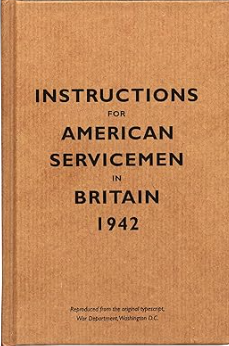
[W]ith their troops pouring into this country from 1942 onwards to prepare for D-Day, officials at the US War Department did their best to make the culture clash as trouble-free as possible. One of their main efforts was issuing GIs with a seven-page foolscap leaflet called Instructions for American Servicemen in Britain.
It’s available in reprint as a booklet and makes fascinating reading, not least for its straightforward, jargon-free writing style and its overriding message – telling the Yanks to use “plain common horse sense” in their dealings with the British.
In parts, it now seems clumsy and condescending. But its purpose was praiseworthy – to try to get American troops to damp down the impression that they were overpaid, oversexed and over here. Many GIs qualified in all three aspects, of course, but you couldn’t blame the top brass for trying.
The leaflet paints a sympathetic (some would say patronising) picture for the incoming Americans of a Britain – “a small crowded island of forty-five million people” – that had been at war for three years, having initially stood alone against Hitler and braved the Blitz. Hence this “cradle of democracy” was now a “shop-worn and grimy” land of rationing, the blackout, shortages and austerity. But beneath the shabbiness, there was steel.
The British are tough. Don’t be misled by the British tendency to be soft-spoken and polite. If need be, they can be plenty tough. The English language didn’t spread across the oceans and over the mountains and jungles and swamps of the world because these people were panty-waists.
There were helpful hints about cricket, football, darts, pounds, shillings and pence, warm beer and badly-made coffee. And because we are two nations divided by a common language, the Yanks were urged to listen to the BBC.
In England the “upper crust” speak pretty much alike. You will hear the newscaster for the BBC (British Broadcasting Corporation). He is a good example, because he has been trained to talk with the “cultured” accent. He will drop the letter “r” (as people do in some sections of our own country) and will say “hyah” instead of “here”. He will use the broad “a”, pronouncing all the a’s in “banana” like the “a” in father.
However funny you may think this is, you will be able to understand people who talk this way and they will be able to understand you. And you will soon get over thinking it’s funny. You will have more difficulty with some of the local accents. It may comfort you to know that a farmer or villager from Cornwall very often can’t understand a farmer or villager in Yorkshire or Lancashire.
The GIs were warned against bravado and bragging, being told that the British were reserved but not unfriendly. “They will welcome you as friends and allies, but remember that crossing the ocean doesn’t automatically make you a hero. There are housewives in aprons and youngsters in knee pants in Britain who have lived through more high explosives in air raids than many soldiers saw in first-class barrages during the last war.”
April 6, 2024
Italian Communists, the French in Indochina, and the fate of Italy’s army – WW2 – OOTF 34
World War Two
Published 5 Apr 2024What happened to Italian soldiers overseas after the fall of Mussolini? What about the French soldiers left over in Indochina after the Japanese “occupation by invitation”? And, what did the Allies think of the Italian Communist movement and its partisan forces?
(more…)
April 4, 2024
See Inside Panther | Tank Chats Reloaded
The Tank Museum
Published Dec 29, 2023Chris Copson takes a detailed look inside and out, of arguably the most advanced German tank of WW2 … the Panther.
Is the Panther the formidable opponent that is was made out to be? Would the allies use such a vehicle and was it over engineered? Find out in today’s video.
00:00 Intro
00:54 Overview – Our Panther
02:41 War time variants & armour
06:06 Design
08:30 Weaponry
10:18 Crew, equipment and flaws – a look inside
17:53 Performance & conclusion
(more…)
March 31, 2024
Allies Charge Forward from the Rhine! – WW2 – Week 292 – March 30, 1945
World War Two
Published 30 Mar 2024All along the Western Front the Allies break out in force, invading German territory and receiving German surrenders by the thousands. In the east, the Soviets take Danzig and Gdynia, and rout the Germans in Hungary. There’s a new Japanese offensive in China, though the fight on Iwo Jima ends with a Japanese defeat.
Chapters
00:45 Recap
01:08 Big Advances all over the West
05:48 Soviets take Gdynia and Danzig
07:09 Zhukov’s forces take Kustrin
10:39 The War in China
12:21 Iwo Jima Ends
14:30 Preliminaries for Okinawa
18:46 More Landings in the Philippines
19:23 Slim focuses on Rangoon
20:12 Notes to end the week
20:48 Summary
21:28 Conclusion
24:47 Call To Action
(more…)
August, 1945 – The Soviets enter the war in China
Big Serge outlines the Soviet invasion of Manchuria in August 1945 and its devastating impact on the Japanese Kwantung Army, finally shattering any remaining illusions that the Soviets would broker a peace between Japan and the western allies:
August Storm: The Soviet Invasion of Manchuria (August 9-20, 1945)
The Second World War had a strange sort of symmetry to it, in that it ended much the way it began: namely, with a well-drilled, technically advanced and operationally ambitious army slicing apart an overmatched foe. The beginning of the war, of course, was Germany’s rapid annihilation of Poland, which rewrote the book on mechanized operations. The end of the war — or at least, the last major land campaign of the war — was the Soviet Union’s equally totalizing and rapid conquest of Manchuria in August 1945.
Manchuria was one of the many forgotten fronts of the war, despite being among the oldest. The Japanese had been kicking around in Manchuria since 1931, consolidating a pseudo-colony and puppet state ostensibly called Manchukuo, which served as a launching pad for more than a decade of Japanese incursions and operations in China. For a brief period, the Asian land front had been a major pivot of world affairs, with the Japanese and the Red Army fighting a series of skirmishes along the Siberian-Manchurian border, and Japan’s enormously violent 1937 invasion of China serving as the harbinger of global war. But events had pulled attention and resources in other directions, and in particular the events of 1941, with the outbreak of the cataclysmic Nazi-Soviet War and the Great Pacific War. After a few years as a major geopolitical pivot, Manchuria was relegated to the background and became a lonely, forgotten front of the Japanese Empire.
Until 1945, that is. Among the many topics discussed at the Yalta Conference in the February of that year was the Soviet Union’s long-delayed entry into the war against Japan, opening an overland front against Japan’s mainland colonies. Although it seems relatively obvious that Japanese defeat was inevitable, given the relentless American advance through the Pacific and the onset of regular strategic bombing of the Japanese home islands, there were concrete reasons why Soviet entry into the war was necessary to hasten Japanese surrender.
More specifically, the Japanese continued to harbor hopes late into the war that the Soviet Union would choose to act as a mediator between Japan and the United States, negotiating a conditional end to war that fell short of total Japanese surrender. Soviet entry into the war against Japan would dash these hopes, and overrunning Japanese colonies in Asia would emphasize to Tokyo that they had nothing left to fight for. Against this backdrop, the Soviet Union spent the summer of 1945 preparing for one final operation, to smash the Japanese in Manchuria.
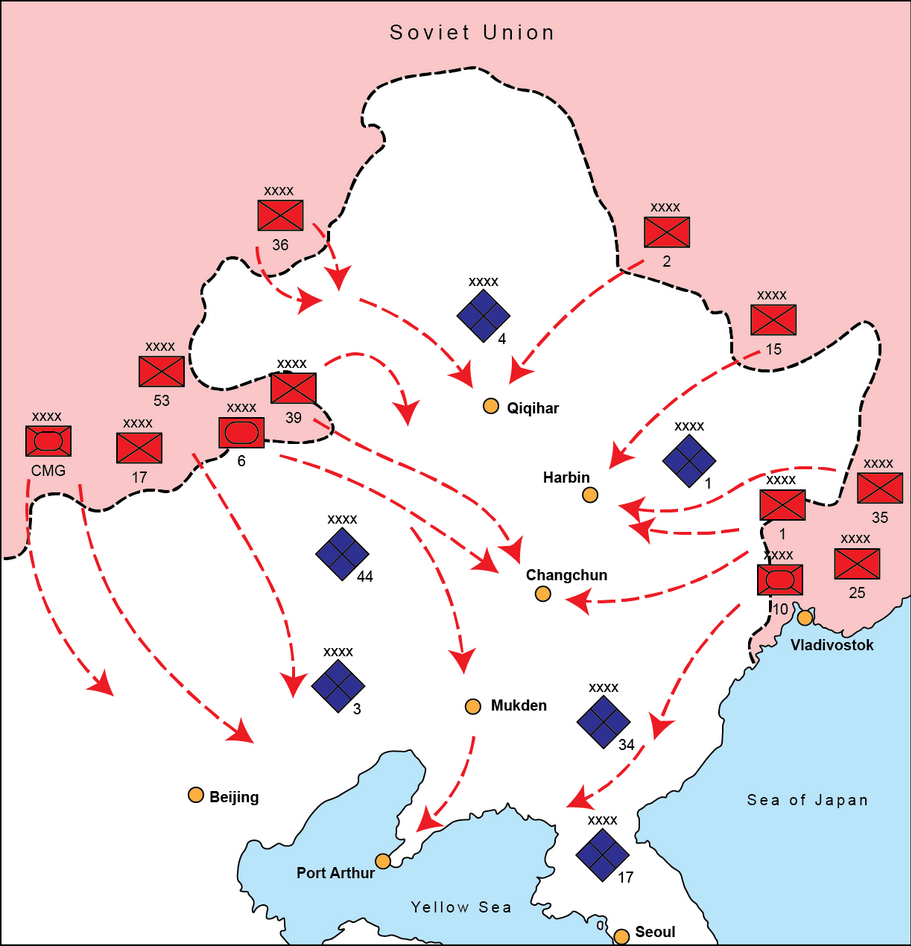
The Soviet maneuver scheme was tightly choreographed and well conceived — representing in many ways a sort of encore, perfected demonstration of the operational art that had been developed and practiced at such a high cost in Europe. Taking advantage of the fact that Manchuria already represented a sort of salient — bulging as it did into the Soviet Union’s borders — the plan of attack called for a series of rapid, motorized thrusts towards a series of rail and transportation hubs in the Japanese rear (from north to south, these were Qiqihar, Harbin, Changchun, and Mukden).
By rapidly bypassing the main Japanese field armies and converging on transit hubs in the rear, the Red Army would effectively isolate all the Japanese armies both from each other and from their lines of communication to the rear, effectively slicing Manchuria into a host of separated pockets.
There were, of course, a host of reasons why the Japanese had no hope of resisting this onslaught. In material terms, the overmatch was laughable. The Soviet force was lavishly equipped and bursting with manpower and equipment — three fronts totaling more than 1.5 million men, 5,000 armored vehicles, and tens of thousands of artillery pieces and rocket launchers.
The Japanese (including Manchurian proxy forces) had a paper strength of perhaps 900,000 men, but the vast majority of this force was unfit for combat. Virtually all of the Japanese army’s veteran units and equipment had been steadily transferred to the Pacific in a cannibalizing trickle — a vain attempt to slow the American onslaught. Accordingly, by 1945 the Japanese Kwantung Army had been reduced to a lightly armed and poorly trained conscript force that was suitable only for police actions and counterinsurgency against Chinese partisans.
Really, there was nothing for the Japanese to do. The Kwantung Army had far less of a fighting chance in 1945 than the Wehrmacht had in the spring of that year, and everyone knows how that turned out. Unsurprisingly, then, the Soviets broke through everywhere at will when they began the assault on August 9. Soviet armored forces found it trivially easy to overrun Japanese positions (armed primarily with archaic, low caliber antitank weaponry that could not penetrate Soviet armor even at point blank range), and by the end of the first day the Soviet pincers were driving far into the rear.
It is easy, in hindsight, to write off the Manchuria campaign as something of a farce: a highly experienced, richly equipped Red Army overrunning and abusing an overmatched and threadbare Japanese force. In many ways, this is an accurate assessment. However, what the offensive demonstrated was the Red Army’s extreme proficiency at organizing enormous operations and moving at high speeds. By August 20 (after only 11 days), the Red Army had reached the Korean border and captured all their objectives in the Japanese rear, in effect completely overrunning a theater that was even larger than France. Many of the Soviet spearheads had driven more than three hundred miles in a little over a week.
To be sure, the combat aspects of the operation were farcical, given the totalizing level of Soviet overmatch. Red Army losses were something like 10,000 men — a trivial number for an operation of this scale. What was genuinely impressive — and terrifying to alert observers — was the Red Army’s clear demonstration of its capacity to organize operations that were colossal in scale, both in the size of the forces and the distances covered.
More to the point, the Japanese had no prospect of stopping this colossal steel tidal wave, but who did? All the great armies of the world had been bankrupted and shattered by the great filter of the World Wars — the French, the Germans, the British, the Japanese, all gone, all dying. Only the US Army had any prospect of resisting this great red tidal wave, and that force was on the verge of a rapid demobilization following the surrender of Japan. The enormous scale and operational proclivities of the Red Army thus presented the world with an entirely new sort of geostrategic threat.
HMS Unicorn (I72) – Guide 367
Drachinifel
Published Dec 23, 2023The Unicorn, a fleet maintenance carrier of the British Royal Navy, is today’s subject.
(more…)
March 27, 2024
Civil Defence is a real thing in Finland
Paul Wells reports back on his recent trip to Finland, where he got to tour one of the big civil-defence shelters in Helsinki:
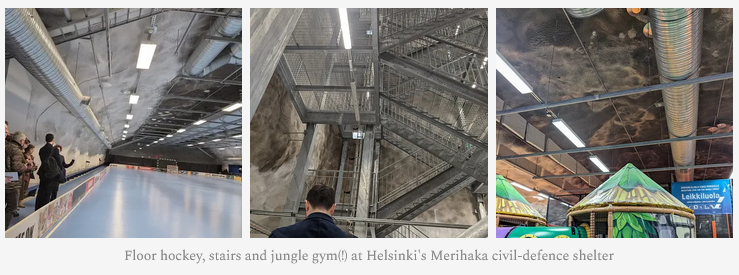
One of the best playgrounds for children in Helsinki is the size of three NFL football fields, dug into bedrock 25 metres below a street-level car park, and built to survive a nuclear bomb.
The air down here is surprisingly fresh. The floor-hockey rinks — there are two, laid end to end — are well maintained. The refreshment stands are stocked with snacks. The steel blast doors are so massive it takes two people to slam one shut.
Finland has been building civil-defence shelters, methodically and without fuss, since the late 1950s. This one under the Merihaka residential district has room for 6,000 people. It’s so impressive that it’s the Finnish capital’s unofficial media shelter, the one visiting reporters are likeliest to be shown. The snack bar and the jungle gym are not for show, however: as a matter of government policy, every shelter must have a second, ordinary-world vocation, to ensure it gets used and, therefore, maintained between crises.
The Merihaka shelter was one of the stops on my visit to Helsinki last week. The first anniversary of Finland’s membership in NATO, the transatlantic defence alliance, is next week, on April 4. Finland’s foreign office invited journalists from several NATO countries to visit Helsinki to update us on Finland’s defence situation. I covered my air travel and hotel. Or rather, paid subscribers to this newsletter did. Your support makes this sort of work possible. I’m always grateful.
The Finnish government used to build most of the shelters. But since 2011, the law has required that new shelters be built at the owners’ expense, by owners of buildings larger than 1,200 square metres and industrial buildings larger than 1,500 square metres.
The city of Helsinki has more shelter space than it has people, including visitors from out of town. Across the country the supply is a little tighter. Altogether today Finland has a total of 50,500 shelters with room for 4.8 million people.
That’s not enough for the 5.5 million people in Finland. But then, if war ever comes, much of the population won’t need shelter, because they’ll be staying groundside to fight.
Conscription is universal for Finnish men between 18 and 60. (Women have been enlisting on a voluntary basis since the 1990s.) The standing armed forces, 24,000, aren’t all that big. But everyone who finishes their compulsory service is in the reserves for decades after, with frequent training to keep up their readiness. In a war the army can surge to 280,000. In a big war, bigger still.
The Soviet Union invaded Finland in 1939, during what was, in most other respects, the “phony war” phase of the Second World War. The Finnish army inflicted perhaps five times as many casualties on the Soviets as they suffered, but the country lost 9% of its territory and has no interest in losing more. Finland’s foreign policy since then has been based on the overriding importance of avoiding a Russian invasion.
The Volkssturm – a Million men to save the Reich?
World War Two
Published 26 Mar 2024The Volkssturm is the last-ditch people’s army of the Third Reich. Sure, on paper, there are millions of old men and boys ready to defend Germany. But how will they be armed? Are they truly willing to die for Hitler? Will they make any difference at all?
(more…)
March 25, 2024
WWII Allied Vehicles – Universal Carrier
Ontario Regiment Museum
Published Jan 26, 2022This multi-part series was originally created in support of our friends at D-Day Conneaut for presentation during their live stream in 2020.
In part 5 the Museum’s Operation Manager Dan Acre details the history of a Canadian-made WWII vehicle, the Universal Carrier. (Please forgive the sound quality, it was one of the first videos we produced in the early stages of the pandemic.)
(more…)
March 24, 2024
Chiang versus Mountbatten – WW2 – Week 291 – March 23, 1945
World War Two
Published 23 Mar 2024Chiang Kai-Shek is demanding his Chinese troops back from Burma, but this doesn’t fit well with Mountbatten’s plans for the region. In Burma, Bill Slim’s forces liberate Mandalay this week and make plans to head south for Rangoon. There’s also friction elsewhere in Allied command — between the Soviets and the Western Allies — over Italy. In the field in Europe, the Soviets advance all along the eastern front, and in the west, the Allies secure another Rhine crossing, and they also launch a double operation to send even more men across the river in force.
0:00 Intro
0:53 Recap
1:20 Iwo Jima
2:15 Plans for Okinawa
3:53 Mandalay liberated and plans for Burma
08:19 Allied Machinations about Italy
10:25 Soviet advances all along the Eastern Front
16:55 Plans for Operation Grapeshot
17:45 Four Allied Operations in the west
23:25 Summary + Conclusion
(more…)
March 22, 2024
Char B1 V Panzer III | Size doesn’t matter – it’s how you use it!
The Tank Museum
Published Dec 15, 2023Two tanks that fought against each other in the early part of World War Two. On one side, the heavily armoured French Char B1 … on the other, the mobile German Panzer III. On paper it’s no contest – but what actually happened when these two tanks fought it out in 1940?
00:00 | Intro
00:49 | Char B1 History
02:16 | Radio Communications
02:45 | Panzer III Crew
03:43 | Char B1 Crew
05:16 | Char B1 V Panzer III
(more…)


