
World War Two
Published 16 Mar 2024After the Allies took a Rhine Bridge last week, Adolf Hitler has again shuffled his commanders, moving Kesselring to the west. Meanwhile, the German offensive in Hungary comes to its end — and it does not end well for the Germans. The Japanese are nearly defeated on Iwo Jima, are feeling a bit of desperation in Burma, but are far, far from defeated on Luzon.
01:02 Recap
01:33 Remagen Bridge and the Western Front
06:44 Army Group Courland and 3rd Belorussian Front
10:23 Konev’s new attacks
11:29 Operation Spring Awakening ends
15:00 A German surrender in Italy?
17:01 Japanese being ground down on Iwo Jima
18:12 The war in the Philippines
20:48 The war in Burma
23:07 Summary
23:36 Conclusion
(more…)
March 17, 2024
Smiling Albert Takes Command – WW2 – Week 290 – March 16, 1945
Comments Off on Smiling Albert Takes Command – WW2 – Week 290 – March 16, 1945
QotD: Imperial Japan and Nazi Germany never had a “long game” … but Stalin did
Though both the Germans and the Japanese had every intention of starting major wars, as everyone knows they seemingly put zero thought into what they’d do once they won. I know, I know, [Himmler] had his sweaty wet dreams about Wehrbauern on the vast Russian steppes, but all but the most rudimentary post-victory planning seems to have been beyond the Third Reich’s capacity — the Reich Resettlement Office, for instance, was tiny even when the war looked like it would be over by Christmas. The Japanese were, if anything, even dumber — they honestly seemed to believe they could run China, all of it, and even India Manchukuo-style.
The Russians, meanwhile, never stopped playing the long game. While Goebbels made a few token gestures at rapprochement with “the West” (yeah, they called it that), and to sell Nazism to ditto, his heart wasn’t in it, any more than the Japanese’s heart was in their “Greater East Asia Co-Prosperity Sphere” hooey. Stalin, by contrast, was always pimping Communism to the West — even in the deepest, darkest days of the war, when it looked like the Wehrmacht was about to march into Moscow, the propaganda directed at the West continued full blast.
Like the German and Japanese aircraft industries, the German propaganda industry was ideologically locked into its core mission: To sell Nazism to Germans. And they were aces at it, no doubt … but then the mission changed. The smart thing for the Germans (and Japanese) to have done with their conquered territories was, in the context of the war, to ease up on the Nazi shit for the duration. The Nazis could’ve had zillions of Ukrainians fighting for them in 1941 just as the Japanese probably could’ve waltzed into India in 1941 had they not been so … well, so Japanese, in the rest of the Pacific rim. Stalin would’ve done it in a heartbeat, had the situation been reversed, and to hell with “authentic” Marxism-Leninism. Win the war first; square the ideology later.
As this is running way long, one example should suffice. Goebbels approached the task of selling Nazism to Germans in the most German way possible: He created the Reich Culture Chamber, which controlled all newspapers, radio broadcasts, film distribution, etc. And it worked, as far as it went — Goebbels deserves his “evil genius” rep — but as we’ve seen, that locked the leadership into an ideological straightjacket. Telling the Wehrmacht to ignore the Commissar Order and buddy up with the Ukrainians would’ve been the smart thing to do, militarily, but it was culturally impossible. Goebbels did his job too well … and then the mission changed.
The Soviets had a similar problem inside the USSR, but — here’s Stalin’s evil genius — they had free reign in propagandizing the West. Goebbels hardly bothered, but the Soviets poured massive resources into it. Forget, as far as you can, everything you think you know about “Nazism” […]. Even if you look at it as objectively as possible, it still seems ridiculous, and there’s a simple explanation for that — it’s not for you. Unless you were a pure blooded Aryan, actually living in Germany (or within Germany’s potential military reach), [they] couldn’t care less about you. Which made being a “Nazi” in, say, America uniquely pointless — you just look like a bigot at best, a traitorous bigot at worst.
Being a “Communist”, though? That was universal. Indeed, that made you a Smart person, a very very smart person, and morally superior to boot. Why? Because you care so much that you’ve mastered this large body of deliberately esoteric doctrine, comrade … all straight out of the NKVD playbook. And if actual life as it was lived in the Soviet Union didn’t quite measure up to the promises, well, that’s because they didn’t have the right people — people like YOU — running things. It’s fucking brilliant — a totally ideologically closed, indeed brutal, system at home, presented as the most open-minded, enlightened, tolerant one possible abroad.
Which is why Joey G. needed a huge Reich Culture Chamber that never came close to justifying its budget, and Stalin needed, effectively, nothing. Being so very, very Smart, wannabe “elites” in the West were happy to spread Commie propaganda for free. The NKVD, let alone the Gestapo, ain’t got shit on the Junior Volunteer Thought Police of Twitter and Facebook …
… which forces us to confront the question: Which model of propaganda are our rulers using? Has the one morphed into the other? Is it real, or is it just “German efficiency”?
Severian, “The Myth of German Efficiency”, Rotten Chestnuts, 2021-05-26.
Comments Off on QotD: Imperial Japan and Nazi Germany never had a “long game” … but Stalin did
March 14, 2024
Book Reviews – Juno Beach and the Canadians
WW2TV
Published Dec 5, 2023A short live show where I talk about my favourite Juno Beach and Canadian focussed Normandy books
WW2TV Bookshop – where you can purchase copies of books featured in my YouTube shows. Any book listed here comes with the personal recommendation of Paul Woodadge, the host of WW2TV. For full disclosure, if you do buy a book through a link from this page WW2TV will earn a commission.
UK – https://uk.bookshop.org/shop/WW2TV
USA – https://bookshop.org/shop/WW2TV
Comments Off on Book Reviews – Juno Beach and the Canadians
March 13, 2024
The History of the Chocolate Chip Cookie – Depression vs WW2
Tasting History with Max Miller
Published Dec 5, 2023WWII ration-friendly chocolate chip cookies made with shortening, honey, and maple syrup
City/Region: United States of America
Time Period: 1940sDuring WWII, everyone in the US wanted to send chocolate chip cookies to the boys at the front. With wartime rationing in effect, we get a recipe that doesn’t use butter or sugar, but shortening, honey, and maple syrup instead.
The dough is much softer than the original version, and the cookies spread out a lot more as they bake. They bake up softer than the crunchy originals, with a light pillowy texture. They aren’t as sweet, but still have a really lovely flavor. It kind of reminds me of Raisin Bran, but with chocolate. All in all, I was pleasantly surprised.
Check out the episode to see a side-by-side comparison with the original recipe.
(more…)
Comments Off on The History of the Chocolate Chip Cookie – Depression vs WW2
March 10, 2024
German Blunder Hands Allies a Rhine Crossing – WW2 – Week 289 – March 9, 1945
World War Two
Published 9 Mar 2024The Allies manage to take an intact bridge over the mighty Rhine at Remagen, a major piece of luck; the Germans launch a new offensive in Hungary, and the Allies end one in Italy. Over in Burma, Meiktila falls, sabotaging the entire Japanese supply system for the country, and on Iwo Jima the fight continues, bloodier than ever for both sides.
00:59 Recap
01:35 The Fall of Meiktila
03:46 The fight on Iwo Jima
05:27 Advances on the Western Front
07:44 The Rhine River
10:05 Remagen Bridge
16:20 Operation Encore
17:10 Rokossovsky and Zhukov attack
18:09 Operation Spring Awakening
21:57 Notes to end the week
23:42 Conclusion
(more…)
Comments Off on German Blunder Hands Allies a Rhine Crossing – WW2 – Week 289 – March 9, 1945
Why Germany Lost the Battle of Kursk, 1943
Real Time History
Published Nov 3, 2023In summer 1943, Germany and the Soviet Union fought the arguably biggest single battle in history with millions of men, thousands of tanks and artillery guns – the battle of Kursk. The German Army wanted to hit the Red Army so hard that they couldn’t go on the offensive again. And indeed, new research shows that the Soviets suffered shockingly high casualties, up to six times more men and equipment. But why then did the Germans lose this historic battle?
(more…)
Comments Off on Why Germany Lost the Battle of Kursk, 1943
March 9, 2024
The Jewish Avengers Who Hunted Nazi Murderers
World War Two
Published Mar 8, 2024In March 1945, the first Jewish unit in the Allied forces reaches the frontline. Before fighting the Nazis, the men spent years battling against the policies of the British government. After the war, they will take vengeance on the perpetrators of the Holocaust and join the Zionist movement in building and fighting for Israel.
(more…)
Comments Off on The Jewish Avengers Who Hunted Nazi Murderers
March 8, 2024
Know Your Ship #20 – Flower Class Corvettes
iChaseGaming
Published Oct 27, 2014Episode 20 of Know Your Ship! In this educational video I cover the Flower class corvettes. These corvettes used by the Royal Canadian Navy and the Royal Navy to great effect during the Battle of the Atlantic. The Flower class were built quickly and cheaply in order to provide as many ships for convoy duty and anti-submarine operations as possible. The Royal Canadian Navy in particular achieved significant success and became experts in anti-submarine operations. Sadly, these ships and their crews are mostly forgotten with the passage of time as attention is mostly given to the surviving capital ships. It is my hope that this educational video will help people to understand and know these important ships that helped safeguard the convoys during World War 2. The only remaining ship of this class is HMCS Sackville which you will see later in this episode.
(more…)
Comments Off on Know Your Ship #20 – Flower Class Corvettes
March 3, 2024
Allied Deception Surrounds Japanese in Burma – WW2 – Week 288 – March 2, 1945
World War Two
Published 2 Mar 2024Bill Slim’s master plan is near fruition and the Japanese are surrounded at Meiktila in Burma. The Allies have also nearly cleared Manila on Luzon, but the fighting on Iwo Jima is just growing in intensity. In Europe, the Soviets are still on the move in Poland, though attacking now to the north, but in Hungary it’s the Germans who are making plans for a new offensive. The big news on the Western Front is the Allies reaching the Rhine, though how they’ll cross that mighty river is anyone’s guess.
(more…)
Comments Off on Allied Deception Surrounds Japanese in Burma – WW2 – Week 288 – March 2, 1945
March 2, 2024
Crossing the Irrawaddy
Dr. Robert Lyman is on a visit to the site of a very significant event in the battle for Burma in 1945:
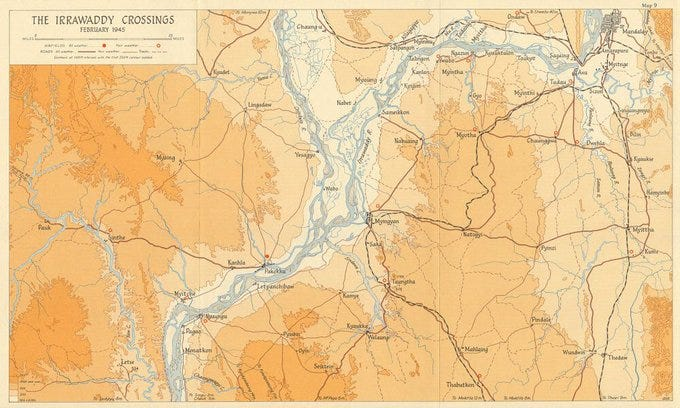
On 13-14 February 1945, 79-years ago this month the 7th Indian Division commanded by Major General Geoffrey Evans secured crossings over the Irrawaddy at Pakkoku and Nyaung-U/Bagan. The northern crossing (Pakkoku) was designed to allow Punch Cowan’s 17th Indian Division, and the Sherman tanks of 255 Indian Tank Brigade, to race across country to seize Meiktila. The southern ones, at Nyaung-U and Bagan (a few miles to the south still), were designed to prevent the enemy from interfering with the operations against Meiktila, and to make him believe that securing the Irrawaddy as a route to Rangoon — and not Meiktila — was Slim’s primary objective. In 2005, for the 60th anniversary of the Irrawaddy crossings, I was privileged to walk the battlefield with three veterans of these crossings, John Chiles (Probyn’s Horse), Manny Curtis (South Lancashire Regiment) and Bert Wilkins (RA, in support of the South Lancs). During that trip we travelled along the Irrawaddy from Bagan, anxiously scouring the maps in the South Lancs’ War Diary searching for B4 beach, where on the early morning of 14 February 1945 two hundred men of 2nd Battalion South Lancashire Regiment had rowed silently across the river to form the vanguard of the 7th Indian Division beachhead. I remember vividly the excitement as we found B4 — it was much easier than I had thought — disembarked from the boat and climbed to the top of the cliffs to find old trenches from the battle. It was an emotional event for the veterans as they recalled the battle and found trenches left by the defenders decades before.
At Nyaung-U the first wave of a company of the 2nd Bn South Lancs (including Manny Curtis) managed to seize the high ground above B4 in the early morning of 14 February. It was the longest opposed river crossing in any theatre of the Second World War. The beaches had been recced by a Sea Reconnaissance Unit and a Special Boat Section. However, subsequent waves of troops from the remainder of the South Lancs, the 4th Battalion 14th Punjab Regiment and the 4th Battalion 1st Gurkha Rifles were mauled by enemy machine gun fire as the leaky canvas boats and temperamental outboard motors failed to cope with the distance they had to cover and the strength of the river’s flow. The enemy? Pagan and Nyaungu were defended not by the Japanese but by three battalions of the Indian National Army’s 4th Guerrilla Regiment, some 2,000 men in well-sited positions overlooking the Irrawaddy. This was the only major engagement of the war when troops of the Indian Army fought in direct combat against the INA. To subdue the enemy positions causing casualties on the water, Sherman tanks of the Gordon Highlanders sniped the enemy positions, and an artillery bombardment by 25-pdrs and a Hurribomber strike pummelled the east bank of the river. Together these actions succeeded in forcing the INA to surrender. Further to the west, at Pagan, the INA’s 9th Battalion took a heavy toll of the assaulting 1/11th Sikh Regiment, before they withdrew to Mount Popa to the rear. River crossing are dangerous, especially for troops with little training in boatmanship, across one of the world’s greatest rivers. But this time the 7th Indian Division succeeded with little training or preparation. By the end of the day the east bank was in its hands. Amazingly, a cinematographic unit were available to film some of the crossings at Nyaung-U. An 8-minute reel of the landings can be seen in the IWM on JFU35.
Today I was able to revisit B4. Not much had changed in nearly 20-years. The size of the Irrawaddy even in the dry season is astonishing, the task given to the men of 33 Brigade enormous. In 2005 we climbed the cliffs that Manny and his friends had raced up in 1945. Looking at them again today, I realised just how Gallipoli-like was the terrain. In the hands of of better trained enemy, 33 Brigade should never have managed to get off the beachhead. Rippling rows of gullies flow behind the initial landing site: if these had all been defended, a position of great depth and near impregnability could have been achieved. These photos look down on B4 and across to the position up which the men of 2nd South Lancs scrambled.
Comments Off on Crossing the Irrawaddy
March 1, 2024
Was JUNO BEACH The Deadliest On D Day? | Canadian Army | Normandy WW2
The History Explorer
Published Oct 27, 2023During the invasion of Fortress Europe the casualty figures sustained on Omaha beach were terrifying; approximately 2,500 US casualties were sustained of which around 800 were killed, depending on which source you use. The ratio was said to be 1 in 19 soldiers would become a casualty.
But it was at Juno beach where the fighting Canadians landed that the casualties were 1 in 18. The fighting on Juno beach resembled modern urban warfare – silencing fortified residential houses, clearing rooms and bunker busting. So was this the more deadly beach? This is the story, of Juno beach and the brave sons of Canada.
On June 6th, 1944, the 3rd Canadian Infantry Division and the 2nd Armoured Brigade were tasked with establishing a bridgehead on the beach codenamed “Juno”. This was an eight-kilometre long stretch of beach between Sword beach to the East and Gold beach to the West.
Come with me as we walk the beaches and take a look at what made this beach so well defended.
(more…)
Comments Off on Was JUNO BEACH The Deadliest On D Day? | Canadian Army | Normandy WW2
February 28, 2024
V-2: Hitler’s Wunderwaffe
World War Two
Published 27 Feb 2024Hitler hopes that the V-2 rocket will turn the tide of the war. It’s cutting edge technology and impossible to intercept. Right now, the first long-range ballistic missile is raining death on London and Antwerp. But is it too little, too late? Find out the backstory to this powerful weapon.
(more…)
Comments Off on V-2: Hitler’s Wunderwaffe
February 26, 2024
FN Model 30: The First Belgian BAR
Forgotten Weapons
Published Nov 22, 2023FN played a role in the production of Polish wz.28 BARs, and in the process obtained a copy of the technical package for the weapon, and converted it to metric measurements. Under the supervision of Dieudonne Saive, this was used as the basis for FN’s own BAR production, called the Modelé 30. Production was done with a license from Colt, who owned the rights to Browning’s patents on the BAR.
The Model 30 was basically a Colt R75 (Model 1925), but incorporated a few improvements. Most significantly, the male and female parts of the gas system were swapped, which prevented carbon from building up and eventually jamming the gas piston. In addition, the bolt removal latch was improved from the US pattern, and the Polish wz.28-style rear sight was used. Lastly, a rate-reduction mechanism on the fire control group gave the gun “slow” and “fast” settings, of roughly 350rpm and 600rpm instead of the traditional semi and full auto settings.
Production began in 7.65mm, and the Belgian Army adopted the weapon, taking deliveries from 1930 until occupation in 1940. The Model 30 was also made in 8mm Mauser, and exported to China and Ethiopia. The design was fairly quickly supplanted in 1932 by the FN Modelé D, which added a quick-change barrel mechanism to the design, and this pattern sold more widely.
(more…)
Comments Off on FN Model 30: The First Belgian BAR
February 25, 2024
Iwo Jima! – WW2 – Week 287 – February 24, 1945
World War Two
Published 24 Feb 2024This week the Battle of Iwo Jima begins and American forces raise the Stars and Stripes on Mount Suribachi. Elsewhere, the Allies fight the stiff Japanese defences in Manila. The Red Army continues fighting through East Prussia and Pomerania as Stalin plans the next stage of the advance on the Reich. There are Allied advances in Western Europe and Italy too.
00:01 Intro
00:54 Recap
01:16 Iwo Jima Begins
06:32 The war in the Philippines
07:56 The Battle of Manila
11:12 Fighting in Burma
12:14 Operation Grenade
13:46 Operation Encore
14:38 Soviet plans for new offensives
21:28 Moscow Commission Meets
(more…)
Comments Off on Iwo Jima! – WW2 – Week 287 – February 24, 1945
QotD: From the M1903 Springfield to the M1 Garand
Lt. General George Patton famously called the M1 Garand “the greatest battle implement ever devised“, a quote often repeated reverently in the context of World War II nostalgia. The US Government after the war gave away millions of M1 Garands, making it a popular civilian rifle for hunting and competitive shooting.
But nostalgia aside, it is also possible to view, from the high perch of hindsight, the M1 Garand as a missed opportunity. The most advanced battle rifle of World War II ultimately looked back too much to the past rather than pointing the way to the future. During its development, senior military officials applied the perceived lessons of the Spanish American War to a rifle designed to solve the problems of the Great War. This intervention prevented the M1 Garand from becoming something closer to a modern assault rifle, with an intermediate power cartridge and higher magazine capacity. The army was in no hurry to ditch the rifle that had won World War II, meaning that the United States did not field its first true assault rifle until two decades after the concept had been invented by the Germans in 1943 and soon successfully adapted by the Soviets in 1947. The first American assault rifle, the M16, would not debut until 1965.
First a necessary caveat: rifles were not the decisive weapon in World War II. For the most part the small arms deployed by the United States had been designed to fight World War I: the Browning Automatic Rifle (1918), the M1919 Browning Medium Machine Gun (as the date implies, first fielded in 1919) and the M2 Browning heavy machine gun, designed in 1918 and so good it is still used over a century later. In contrast, German machine guns were somewhat more recent in design: the MG 34 (as the name implies, first fielded 1934) and the MG 42. During the war, the Germans invented the first true assault rifle, the StG 44.
The secret sauce of the US Army by 1944-45 had little to do with firearms at all: it was a combination of ready mobility through motorization combined with deadly artillery and close air support, enabled by an unmatched communication system that allowed forward observers to direct and adjust fires to lethal effect. The American way of war was rooted in fleets of trucks and jeeps, networks of radios and heaps of shells. Having a nice semi-automatic rifle was ancillary to a conflict like World War II. But the M1 Garand is a useful window into the vagaries of military procurement and technological innovation, which require developers to at once predict the operational environment of the future and analyze the lessons of the past.
Throughout the 1920s, officers at the Infantry School in Fort Benning experimented with new tactics that they hoped would again allow for mobile infantry combat and avoid the trench stalemate of World War I. The basic solution was some form of “fire and maneuver”, in which one section of a unit (say a squad or platoon) would lay down a sufficient base of small arms fire to suppress the enemy so as to facilitate the other section’s advance. By alternating suppression and assault the element might leapfrog its way forward, even against entrenched enemy machine guns.
For such a tactic to work, infantry platoons needed a lot of firepower. Some might come from light machine guns, like the Browning Automatic Rifle, which was issued to individual infantry squads. But it was generally realized that individual infantrymen needed to be capable of a far higher rate of fire than could be provided by the standard issue rifle, the bolt-action M1903 Springfield, fed from a five round magazine. To this end, the US government set about developing a semi-automatic rifle.
The charge was taken up by John C. Garand, a Canadian-born, self taught firearms designer who worked for the Springfield Armory in Massachusetts. Garand’s solution to make the rifle self-loading was to insert a piston beneath the barrel. When the gunpowder exploded in the cartridge, the gas produced in the explosion propelled the bullet out the barrel. But some gas was bled off into a cylinder below the barrel (which gives the M1 its peculiar appearance of seeming to have two barrels); the pressure of the gas in the cylinder drove a piston.3 This piston attached to an operating rod which pushed the bolt of the rifle back, ejecting the spent casing, and allowing a spring in the internal magazine to insert another cartridge into the chamber before a separate spring pushed the operating rod forward and closed the bolt for the next shot, all in a fraction of a second.
Garand had initially worked on a rifle chambering the standard .30-06 cartridge used by the M1903 Springfield rifle (the .30 indicates that the bullet had a diameter of .30 inches, while the 06 indicates that the cartridge had been adopted in 1906; the round is often pronounced “thirty-ought-six”. But when a rival designer named John Pedersen, also affiliated with Springfield Armory, developed a semi-automatic design that chambered a lighter .276 (7mm) round, Garand retooled his project for the lighter round as well, producing a prototype known as the T3, with subsequent refinements labeled the T3E1 and T3E2. The smaller round meant that the internal magazine of the T3E1/2 could accept clips of 10 bullets, doubling the magazine capacity of the M1903 Springfield.
Army officials were very interested in the new round, but wanted proof that a lighter bullet would be sufficiently lethal in combat. A series of grisly ballistic tests were therefore ordered, pitting the .276 round against the traditional .30-06. In 1928, anesthetized pigs were shot through with both rounds. To the surprise and consternation of traditionalists, the .276 did far more damage in the so-called “Pig Board”. This is not paradoxical: the lighter round was more likely to “tumble”, precisely because it was lighter and so more likely to have its trajectory disrupted by bone and tissue; the tumble meant that more of the kinetic energy was expended inside the target, causing far more damage. The .30-06, meanwhile, as a more powerful round, was more likely to punch clean through, retaining its kinetic energy to keep moving forward after passing through the target. Eventually, tests of this sort would be used to sell the army on the lethality of the 5.56mm round used by the M16/M4, which has an even greater tumble, and causes even more grievous injuries. Out of concern that the fat bodies of pigs did not accurately replicate the human teenagers that the new round was designed to kill, a new test was inflicted upon goats, seen as more appropriately lean and therefore better analogs. The result was the same in favor of the .276 (a lighter .256 performed even better). With two rounds of tests vindicating the .276, the Army demanded that its new rifle chamber the .30-06. The final decision was made by Douglas MacArthur himself.
The .30-06 round itself had been the product of a painful lesson learned during the Spanish American War. Here, American troops, armed with Krag M1892 rifles, had found themselves badly out-ranged by Spanish troops armed with Mausers; the famous charge up San Juan Hill occurred after US troops had advanced for some distance under a hail of unanswered rifle fire. Given the importance of sharp shooting to the American military mythos, getting handily outranged and outshot by Spanish forces was a painful embarrassment. The first order of business had been to adopt the Mauser design: the M1903 Springfield was essentially a modified Mauser, as the US government had licensed a number of Mauser’s patents. By upgrading the M1903 to take the heavy .30-06 round, the Army ensured that soldiers could engage targets over a kilometer away. Beyond the deeply ingrained “lessons learned” from the Spanish American War, the mythos of the deadly American sharpshooter was strongly entrenched. Even as disruptors at Benning developed new infantry tactics that stressed volume of fire over accuracy, the phantoms of buck skinned frontiersmen sniping at British redcoats from a thousand paces still occupied the headspace of military leaders; they wanted a rifle with long distance accuracy. The sights on the M1 Garand adjust out to 1200 yards.
But MacArthur’s reasoning seems to have been primarily motivated by administrative and logistical concerns, as he cited the generic difficulties of fielding a lighter round. Some of these challenges may have been related to production and distribution of a sufficient stockpile of new caliber ammunition. There may have also been a concern with the new round complicating the logistics of line companies. The army also used .30-06 for the BAR and Browning medium machine gun, and having all of these shoot the same round in theory simplified the supply of line companies, and allowed for cross-leveling between weapons systems. Similar concerns have the US Army maintaining a policy of only having 5.56mm weapons at the squad level (thus the M4 and M249 Squad Automatic Weapon both shoot 5.56, and the SAW can shoot from M4 magazines).4 Still, MacArthur’s concerns seem unfounded in hindsight. The United States was about to produce billions of bullets during World War II. American troops were about to be so lavishly supplied that distributing two types of bullets would have been readily feasible given the soon to be proven quality of American logistics.5
With MacArthur’s edict, Garand retooled his rifle back to the .30-06 caliber, and his design was finally accepted in 1936. But the larger and more powerful round required a design change: the internal magazine now took clips of eight bullets instead of ten. Two rounds may not sound like much, but every bullet can be precious in a firefight, and this represented a 20% reduction in magazine capacity. Spread over a company sized element, the reduced clip capacity represented over two-thousand fewer rounds that a company commander could expect to fire and maneuver with. Indeed, the M1’s volume of fire proved generally insufficient to suppress the enemy on its own during the war, evidenced by the habit of equipping rifle squads with two Browning Automatic Rifles, instead of one. Marine divisions by the end of the war often deployed three BARs per squad.6
Michael Taylor, “Michael Taylor on The Development of the M1 Garand and its Implications”, A Collection of Unmitigated Pedantry, 2023-09-08.
1. TM 9-1005-222-12.
2. Thus George Wilson, a platoon leader and later company commander in the Fourth Infantry Division, describing a platoon scout stumbling upon the enemy: “The second scout emptied the eight round clip in his M-1 so fast it seemed like a machine gun … the rest of us moved very cautiously and found three dead enemy soldiers in the road.” (G. Wilson. If You Survive. Ivy, 1987).
3. John Garand’s initial design, and early production M1s, had a gas trap inserted over the muzzle to catch the gas after the bullet had exited; when this proved prone to fouling, a design modification drilled a small hole in the barrel just before the muzzle to allow the gas to bleed into the cylinder, most M1 Garands had this “gas port” system.
4. In 2023, US Army infantry will begin transition to the M7 carbine and M250 Squad Automatic weapon, which will both use a 6.8mm bullet, out of concerns that the 5.56 NATO is insufficient to penetrate body armor.
5. Editor’s Note: I agree with Michael here in principle: US logistics could have managed this. But I would also note that part of the reason American logistics were so good is that they applied MacArthur’s reasoning to everything, reusing vehicle chassis, limiting the number of different ammunition calibers and demanding interchangeable parts across the whole range of military equipment. Take one of those decisions away and the whole still functions. Take all of them away and one ends up with the mess that was German production and logistics.
6. Editor’s Note: BAR goes BARRRRRRRRRRR.
Comments Off on QotD: From the M1903 Springfield to the M1 Garand


