Quotulatiousness

November 10, 2012

What Ataturk accomplished to create modern Turkey

Filed under: Europe, Greece, History, Middle East, WW1 — Tags: , , — Nicholas @ 11:35

History Today posted that today is the anniversary of the death of Mustafa Kemal Ataturk, the man who carved modern Turkey out of the ruins of the Ottoman empire:

Mustapha Kemal Pasha was given the honorific title ‘father of the Turks’ at the height of a revolution which he was pushing forward intuitively and idiosyncratically, there being no precedent for such a fundamental sea change in a Muslim state.

Inevitably, it took someone standing outside the Islamic tradition of Ottoman Turkey to create a new state out of Anatolia — rising from the wreck of the empire. But as The Times was to say in its obituary, this was a man of extraordinary qualities; a Cromwell of the Middle East and also a maverick with an almost feminine subtlety in handling crises on the path to supreme power. He had an iron will and displayed single-mindedness when it came to ensuring the security of the state, even to hanging former confederates who plotted against his revolution.

Ataturk was born of an Albanian mother in Salonika and, without connections followed a military career in which, after being involved with the Young Turks reformist movement, he made his name in 1915 by rushing reinforcements to the Gallipoli beach-head and holding the ANZAC assault.

[. . .]

The Kemalists formed a provisional government in the small town of Ankara, in the middle of the desolate Anatolian plateau. On the Aegean and Mediterranean coasts the Greeks and Italians laid claim to what they regarded as their Asia Minor birthright, hoping to recreate some sort of classical empire. Kemal disabused the Greeks, who soon, of all the Allies hoping for a piece of Anatolia, were alone in arms against the nationalist forces. Halted in a blistering hot wilderness just short of Ankara, the Greeks, who had out-marched their supply lines, were outflanked and thrown back by Kemal’s outnumbered and ragged levies at the Sakaria river. A retreat became a headlong flight and the Greek forces joined their fellow nationals and the Armenians and foreigners who had formed the mercantile community of Smyrna, in a panic-stricken evacuation of the sacked and blazing port. Kemal is supposed to have indulged in a drinking orgy as Smyrna went up in flames — a Tartar conqueror’s celebration of total victory.

The Greeks quit the struggle and their sponsor, the British Prime Minister, Lloyd George, who had threatened armed British intervention backed by the fleet to keep Constantinople an open port under British protection, followed suit. The French and Russians signed separate treaties, giving the Kemalists recognition and aid.

November 5, 2012

The three VC winners from one block in Winnipeg

Filed under: Cancon, History, Military, WW1 — Tags: , — Nicholas @ 14:18

The Canadian War Museum now boasts all three Victoria Crosses won by Winnipeg soldiers during World War 1 … who all lived on the same block of Pine Street (now Valour Road):

Victoria Cross Medal Ribbon & BarWhen Acting Cpl. Lionel B. (“Leo”) Clarke was faced with the choice to surrender to the enemy, or to fight his way out of the trenches against all odds, he chose the latter. And, for that act of valour on Sept. 9, 1916, in which he killed or captured 18 German soldiers and two officers, Clarke — then 24 years old — received the highest honour awarded to Canadian soldiers: The Victoria Cross.

Less than two months later he was dead, dying in the arms of his brother Charles at the Battle of the Somme.

On Monday, Clarke, a native of Waterdown, Ont., who volunteered to go to war in 1915 as a bomber, was again honoured in a ceremony at the Canadian War Museum in Ottawa.

It marks an extraordinary occurrence in Canadian military history: in different years and different battles during the First World War, three men from the same block of Winnipeg’s west-end Pine Street earned the Commonwealth’s highest military honour. And with the acquisition of Clarke’s medal, the War Museum now owns all three Victoria Crosses awarded to the men of Pine Street, which in 1925 was renamed Valour Road.

Each of the three men — and the 96 other Canadians who bear the honour — won it for “the most conspicuous bravery, a daring or pre-eminent act of valour or self-sacrifice or extreme devotion to duty, in the presence of the enemy.”

Update: And, if I watched a bit more TV, I’d have known what David Stamper just pointed out to me on Facebook … that they were featured in a Heritage Moment TV spot:

Commemorating the “Great War”

Filed under: Britain, Education, Europe, France, Germany, History, Military, WW1 — Tags: , — Nicholas @ 09:16

“Sir Humphrey” is on what he terms as his “very late Summer Holidays”, but left a thoughtful-as-always post on the British government’s recently announced World War 1 commemoration program:

It was announced that over £50 million of public funding will be provided to commemorate the 100th anniversary of the start of the First World War in 2014. This high profile event will include commemoration, remembrance, and a chance for every school in the country to send students to the battlefields of the Western Front in order to see first-hand ‘Flanders Fields’.

Rarely do wars have such a dramatic impact on a national psyche, but the First world War continues to occupy a place in the heart of the British consciousness which will take generations to reduce. It is sobering to contemplate that across the whole of the UK, there were fewer than 50 ‘Thankful villages’ (locations where everyone who served came back alive). Even today, as a nation we have only just seen the last veterans of the conflict pass on, and there are still plenty of people alive who were born in this time. In Government, it is often forgotten that Lord Astor, who acts as the spokesman for Defence in the House of Lords, is the grandchild of Field Marshal Haig. Even now, almost a century on, our current links to the war remain tangible.

Humphrey has long been a ‘revisionist’ when it comes to WW1, and believes that what should be remembered as not only a violent and bloody war, also represented many of the finest feats of arms in British history. While the conventional view of the 1960s and beyond was of a war that comprised senseless slaughter, where legions of troops were thrown into battle by an uncaring General Staff, the reality is far different. Arguably WW1 represented a supreme accomplishment by the General Staff, who had to take a tiny professional army, expend it and buy time using the TA to mould a new citizen based force, which within five years became the world’s most accomplished fighting force. They did this in a backdrop of expanding the military far beyond what any would have thought possible, while adapting to technological changes at a vast rate. By the start of the One Hundred Days campaign in 1918, there is no doubt that the British Army was probably the best trained equipped and operationally effective army in the world.

This is not to diminish the slaughter or the losses felt, but it often feels that the emphasis is too greatly placed on the hellish experiences of the trenches, and not that of understanding the war, nor decision making as a whole. It is perhaps telling that the most popular public memory of WW1 comes not from primary sources, but from the comedy ‘Blackadder Goes Fourth’, clips of which to this day brighten up innumerable MOD presentations.

The Canadian memories of WW1 are a bit different from those of Britain, although shaped by the same forces: before the war started, Canada was still psychologically a colony of the Mother Country. At the end of the war, Canada stood as a recognized independent entity from Britain (though still recognizing the importance of Britain and the Empire and a proud member of the Empire), with a very hard-earned military reputation. The legalities of full independence still lay in the future (the Statute of Westminster, 1931), but the Canada of 1918 was not the same place it had been in 1914. It saw itself as a nation, not a colony.

November 1, 2012

Recreational trench-building

Filed under: Britain, History, Military, WW1 — Tags: , , — Nicholas @ 14:06

I’ve dug trenches, in my long-past militia days, but I’ve never really thought about doing it as a hobby:

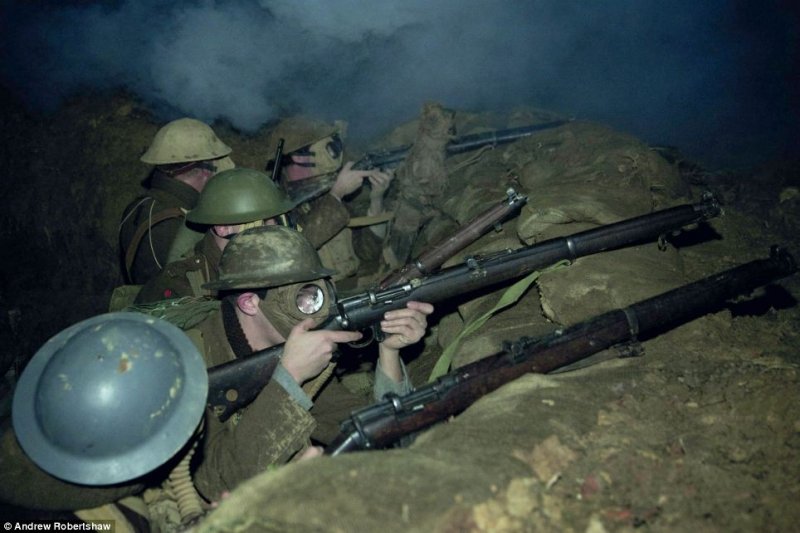
Surrounded by barbed wire, sandbags and mud, this 60ft trench is barely distinguishable from those occupied by British soldiers fighting in the First World War almost a century ago.

The enormous dugout has been painstakingly recreated by an ex-history teacher in his back garden in Surrey, and the dedicated 55-year-old even spent 24 hours living in its confines with a team of volunteers as part of his efforts to experience life as a WWI soldier.

Andrew Robertshaw and 30 helpers spent a month shifting around 200 tonnes of earth to build the enormous three-room trench, which he hopes will teach people more about the horrific living conditions endured by British troops during the Great War.

The only thing that struck me about this and other photos in the article is that the re-enactors look too clean. Digging a trench, then spending more than a short stretch of time therein leaves dirt everywhere:

October 19, 2012

Vegemite: it’s not just Australian for Marmite

Filed under: Australia, Cancon, Food, History, WW1, WW2 — Tags: , — Nicholas @ 00:01

BBC News celebrates the 90th birthday of that uniquely Australian spread, Vegemite:

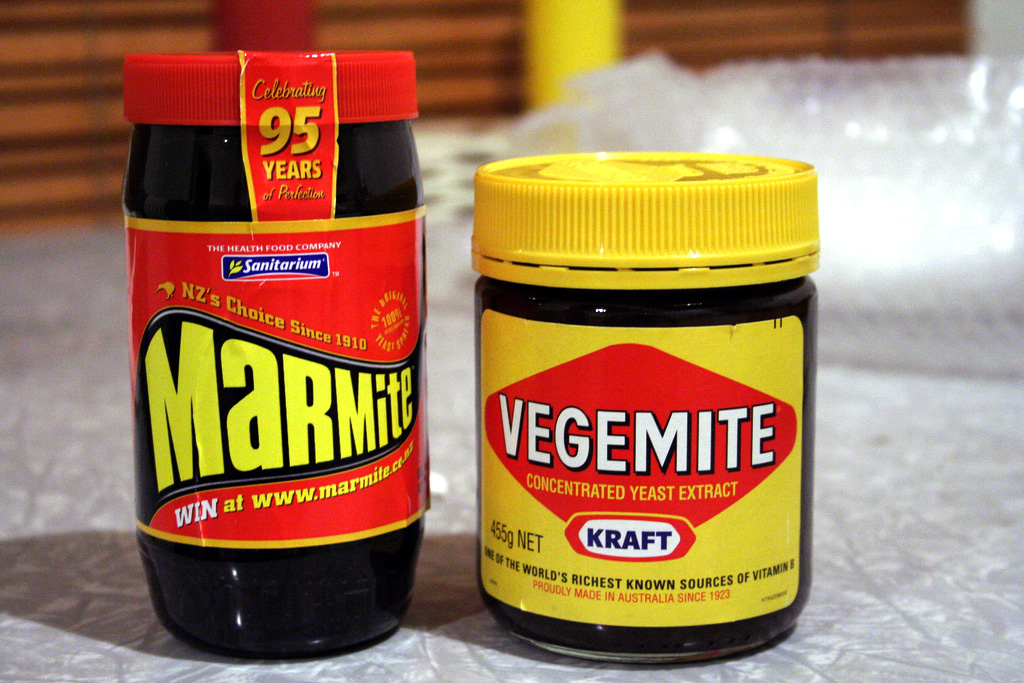
Vegemite and Marmite
Photo via Wikimedia

Vegemite started as a wartime substitute for Marmite, but it’s now as symbolic of Australia as Sydney Harbour Bridge and the koala. How did this salty spread become so popular?

What’s the link between German U-boats, the beer industry, processed cheese and the Men At Work’s 1983 hit, Down Under?

The answer is, they all played a part in turning Vegemite from a humble yeast spread into an Australian icon. Stop any Aussie on any street, anywhere in the world, and they will have a view on Vegemite – for, or against.

Now, on the eve of its 90th birthday, the first official history has just been published. The Man Who Invented Vegemite is written by Jamie Callister, grandson of the man who created it.

[…]

Walker put Callister on the case in 1923, and by the end of the year, the pair were confident they had a finished product. Walker decided to launch a competition so the public could name it and claim a £50 prize. Hundreds entered and it was Walker’s daughter Sheila who pulled the word Vegemite out of a hat.

Like the product itself, the name stuck. But sales were sluggish.

Walker had heard about an ingenious Canadian called James Kraft, who had perfected what came to be known as processed cheese. It was a sensation, as it allowed people who couldn’t afford fridges to store cheese for much longer periods.

In 1924, Walker met Kraft in Chicago. The two men got on well and Walker persuaded Kraft to grant him rights to sell his cheeses in Australia.

[…]

As World War II unfolded, Vegemite became associated with the national interest. Posters put up in Australia had pictures of it with the slogan, “Vegemite: Keeping fighting men fighting fit.”

For Vegemite, the war was a turning point, marking its entry deep into the hearts and consciousness of the Australian public.

September 20, 2012

Potentially deadly legacies of war

Filed under: Environment, History, Military, Weapons, WW1, WW2 — Tags: — Nicholas @ 15:41

A long, fascinating, disturbing blog post at SciencePunk on unexploded munitions from both World War 1 and World War 2, still showing up unexpectedly:

The WMD was discovered, quite by chance, lying by the side of a Bridgeville road in late July by a Delaware state trooper on an unrelated callout. Jutting out of the ground, the 75mm shell was encrusted in barnacles and pitted with rust; barely recognisable as a munition at all. The trooper called in his find and a military team took the bomb to Dover Air Force Base for disposal. As with most conventional rounds, a small charge was placed on the side of the shell and detonated to trigger the vintage munition’s own explosive. But something went wrong, and the bomb failed to explode.

When the two staff sergeants and technician walked over to inspect the failed detonation, they found a strange black liquid seeping out of the cracked mortar. Given that the shell had been under the sea for the better part of fifty years, the men thought little of the foul-smelling substance until hours later, when their skin began to erupt in agonising blisters. All three were rushed to Kent General hospital, where two were released later after minor treatment. A third, more seriously injured serviceman was transported to Temple University Hospital in Philadelphia, where he remained in serious but stable condition with what were only described as “burns or blisters” in a statement issued by the Army later that week. A scientific team were sent to Dover to collect soil samples from the area. The results were clear: the shell had been filled with mustard gas. The United States’ forgotten weapons of mass destruction had returned to haunt it.

[. . .]

With three servicemen now lying in hospital, injured by a weapon of mass destruction, officials could no longer ignore the problem of the rogue munitions. On August 4, the U.S. Army announced a $6 million plan to locate and stem the source of the clamshell ordnance. The investigation was led by Robert Williams Jnr of the Army’s Corps of Engineers. It seemed like an impossible task – Williams couldn’t search every clamshell-topped road in the state, and even if he did, there’d be no guarantee he could complete the survey before one of the hidden weapons detonated. Worse still, nobody knew how the munitions were getting from the ocean into driveways, and how to stop more arriving. Then Williams was handed a gigantic stroke of luck: interviews with everyone who discovered ordnance in their driveways revealed that they had all purchased their clamshell mix from one hauler, Perry Butler. And Perry Butler had an exclusive contract to collect waste clamshells from one Milford clam processing plant: SeaWatch International.

As Delaware’s only clam processor, suspicion had already been placed on the Milford plant. In spite of initial claims that no ordnance had been found on site, when the U.S. Army turned their attention to the factory, it was already the subject of an ongoing investigation by the Occupational Safety & Health Administration. On inspecting the facility, their suspicions were confirmed: twelve munitions were recovered onsite. Workers had picked the highly unstable ordnance off the conveyor lines and stored them in a bucket of water in the basement. The munitions that they did not spot had been first plunged into conditioning tanks with the live clams, passed through steam cookers, and then raked across an industrial shucker that violently shakes the cooked meat from the shells. From there, the ordnance was picked up by Perry Butler, hidden in containers of empty clamshells, who passed them through a grinder that pulverised the shells into gravel before selling the fill on to various downstate residents. That none of the munitions exploded at any point was nothing short of miraculous. That no chemical rounds had broken open or leaked, even more so. SeaWatch International was fined $9,000 by OSHA for endangering staff and only permitted to continue business with the installation of $15,000 metal detector. Just three days later, the buzzer sounded. Workers reported the discovery of a 75mm shell, identical to the one that had injured three servicemen at Dover.

The problem is much bigger than the incidents in Delaware, however, as all the combatant nations of WW1 dumped their unused chemical weapons into the sea … and not always safely (and that really deserves scare quotes: “safely”).

With the close of the First World War, both defeated and victorious nations of the world were left holding thousands of tonnes of lethal chemical weaponry and no one to launch them at. The weapons were dangerous to transport and difficult to store. And nobody really knew how to neutralize their contents. So it’s easy to see how dumping the weapons in the deep ocean, out of harm’s way, was seen as a sensible solution. Entire ships were loaded with munitions, chemical and conventional alike, and sailed out to sea where the cargo was thrown overboard. As part of the CHASE program (“Cut Holes And Sink ‘Em), entire ships filled with weapons and unwanted hardware were scuttled, some detonating on their way to the seabed. For many decades, countries cast their surplus chemical weapons into ocean water and forgot about them. Over a quarter million tonnes of British bombs filled with mustard and phosgene gas and the nerve agent Tabun lie in the waters around the UK, concentrated off the west coast of Scotland. Somewhere between 50,000 and 300,000 tonnes of German, Soviet, US and British chemical agent lies in the shallow Baltic Sea. The USA has also admitted to dumping toxic materiel off the coastlines of other nations rather than risk carrying the volatile cargo home. The James Martin Centre for Non-Proliferation Studies lists 127 known dumpsites across the world, it’s likely even more exist.

August 8, 2012

Sometimes simulation isn’t close enough to reality

Filed under: History, Military, Technology, Weapons, WW1 — Tags: , — Nicholas @ 08:06

The military depends on accurate simulations to train troops, to develop new weapons, and to find ways to counteract military developments in potential enemy forces. It’s obvious that the quality of your simulation is very important, but sometimes the assumptions made in those simulations are quite at odds with the reality they’re supposed to be mimicking:

Increasingly, over the last half century, there has been a culture clash among weapons developers over how to test the new stuff. The problem revolves around the question of what is the most realistic reality. Put another way, how do you go about providing really accurate testing of what the new weapon will do when encountering a real opponent.

The problem is an ancient one, but let us keep the examples less than a century old. At the start of World War I in 1914 there were two types of artillery shells. One was high explosive. The other, more expensive to build and theoretically more effective, was shrapnel. This type was like a shotgun shell. It exploded in the air and sprayed the ground below with metal balls. Tests had shown that these balls would penetrate wood boards set up to represent troops. Because of the expense, less than half the shells used were shrapnel. The need for more artillery shells and the high cost of shrapnel shell led to it being largely replaced by the less effective high-explosive.

Later came a startling revelation. In the 1930s a group of American technicians were setting up some shrapnel shells for a test and one shell exploded prematurely, peppering some of the people with the “lethal” metal balls. They all survived. Further investigation revealed that human skin, muscle and bone were far more resistant to the metal balls than wood boards. World War I combat surgeons, when questioned, remembered that they had never seen a penetration wound caused by shrapnel balls. There has never been much official note made of this very humane weapon during, or after war.

August 6, 2012

Admiral Fisher: an excitable sort of man

Filed under: Britain, Germany, History, Humour, WW1 — Tags: , , , — Nicholas @ 10:41

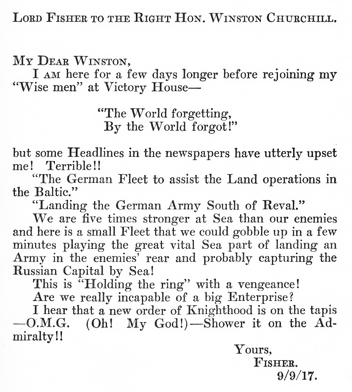
Admiral “Jackie” Fisher was a major historical figure in the Royal Navy, advocate of the modern dreadnought battleship and a tad high-strung (“…and on one occasion, the king asked him to stop shaking his fist in his face”). His relationship with Winston Churchill at the Admiralty must have been something to observe, as two of the most influential men in London worked together (for a while). After leaving the Admiralty for the last time, he still kept in touch with Churchill. Here is an example of his communication style:

This is believed to be the first documented use of the now familiar “OMG”.

H/T to Shaun Usher.

June 30, 2012

The cruellest month in Newfoundland is July

Filed under: Cancon, Economics, History, Military, WW1 — Tags: , — Nicholas @ 10:43

Rex Murphy in the National Post on the worst month in Newfoundland’s calendar:

T.S. Eliot did not write for Newfoundlanders. April is not the cruelest month. For us, it’s July. Both the first and second day of July are marked indelibly in the province’s common memory, the first perhaps the saddest day in the historic calendar, the second as the day of the most fundamental change in the essential makeup of the province.

The greatest tragedy in Newfoundland’s history occurred on July 1, 1916 the opening day of the Battle of the Somne, when nearly 800 men from the 1st Newfoundland Regiment went “over the top” at Beaumont Hammel, only to suffer close to 700 casualties within less than half an hour. It was a virtual annihilation of the entire Regiment. The shockwaves from Beaumont Hammel went through every town and village, city and outport of the time. There was not a place unmarked with grief. To this day, the memory of Beaumont Hammel commands deep respect and notice.

A different kind of event, one not drawn from conflict or war, marks the second day of the month. Just 20 years ago, for the very first time since the late 15th century and the arrival of the Europeans and John Cabot to the fish-crowded waters off Newfoundland, catching cod-fish was declared illegal. The fishery, that great and traditional fishery of Newfoundland, was shut down for the first time in nearly 500 years.

It’s been 20 years since the fishery was closed, and there’s still no sign that it will be re-opening any time soon.

June 17, 2012

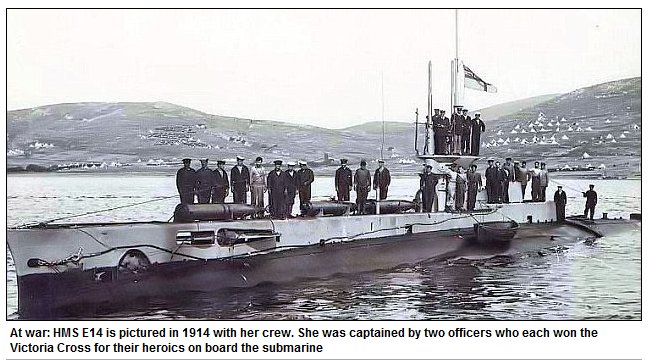
Royal Navy submarine wreck discovered in the Dardanelles

Filed under: Britain, History, Middle East, Military, WW1 — Tags: , , , — Nicholas @ 09:26

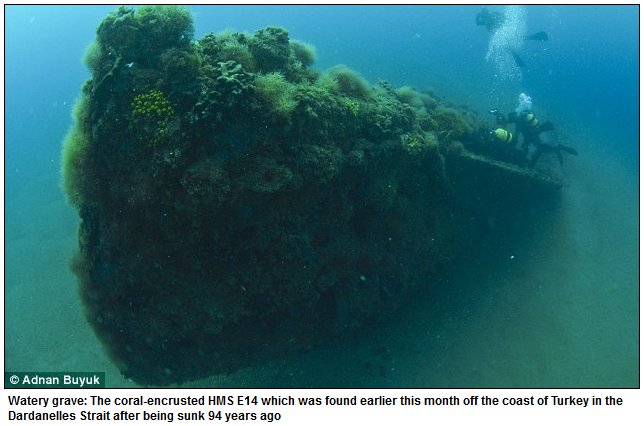
What appears to be the wreck of the E14 has been located just 800 feet offshore in the Straits of the Dardanelles:

Its precise location in the eastern Mediterranean remained a mystery until this month when a Turkish marine engineer and a diver detected it on the seabed off the town of Kumkale – just 800ft from the beach.

The wreck was discovered by marine expert Selçuk Kolay and film-making diver Savas Karakas, who had spent three years trying to find it.

After studying documents at the national Archives in Kew, west London, and surveying Turkish defences, they scanned an unusual object from a boat on the surface.

But they could not establish what it was because it was near the mouth of the straits — a sensitive military area where diving was forbidden.

It took two years to get permission from the military before their team were able to dive to the wreck and confirm it was the E14 earlier this month.

June 16, 2012

Sometimes the navy gets far more use out of a ship than they expect

Filed under: Britain, Europe, History, Military, Russia, USA, WW1, WW2 — Tags: , , , — Nicholas @ 10:12

Strategy Page on some extremely old ships still in service in various navies:

Last year, the British Royal Navy retired its oldest warship still in service, the 4,700 ton HMS Caroline. This light cruiser entered service in 1914 and fought in the epic Battle of Jutland in 1916. After World War II, Caroline served as a training ship, mostly tied up at dockside. When decommissioned last year, the ship could no longer move under her own power.

The Caroline was not the only World War I warship still in service. Currently, the oldest ship still in service is the Russian salvage ship VMF Kommuna. This 2,500 ton catamaran was built in the Netherlands and entered service in 1915. Kommuna began service in the Czar’s navy, spent most of its career in the Soviet (communist) Navy, and now serves in the fleet of a democratic Russia. Originally designed to recover submarines that had sunk in shallow coastal waters, Kommuna remains in service to handle smaller submersibles, does it well and has been maintained over the decades to the point where it cheaper to keep the old girl operational, than to try and design and build a replacement.

Most navies would not want to bring attention to their oldest ship, especially if it was nearly a century old. It’s different in the American Navy. For example, three years ago the carrier, USS Kitty Hawk (CV 63) was finally decommissioned, and ceased to be the oldest ship in the fleet. The Kitty Hawk served for 48 years and 13 days. In that time, about 100,000 sailors served on the ship. The ship was the navy’s last non-nuclear carrier and, since 1998, the oldest ship in commission. “The Hawk” did not age well, and had lots of breakdowns in its final years. This led members of the crew to nickname the ship; “Shitty Hawk”.

June 13, 2012

John Kay on the Finnish frontier

Filed under: Europe, History, Military, Russia, WW1, WW2 — Tags: , , , , — Nicholas @ 08:58

Finland had a very chancy time over the last hundred years. John Kay is visiting now, and reflects on how Finland survived to today:

The Finnish border is an anomaly. In 1918 the Finns won independence for a state that extended to the gates of St Petersburg. Russia captured territory in the 1939-40 Winter War. Finland then fought on the losing side in the second world war and did not remain neutral in the cold war. So the once thriving Finnish industrial city of Viipuri is today the depressed Russian outpost of Vyborg.

A cynical commentator on 20th-century history might observe that the political ineptitude of Kaiser Wilhelm and subsequently of Adolf Hitler brought America in on the opposite side of Germany’s quarrel with Russia in 1917 and 1941. Only when the democratic politicians of modern Germany made the rational alliance did Finland achieve the favourable political and economic outcomes it now enjoys. To pass the watchtowers and barbed-wire fences on the Finnish-Russian border is to be reminded of how fragile, and how recent, are the stability and security we take for granted today.

[. . .]

That observation is evident on the Finnish-Russian border. The razor wire kept Russian citizens in when the living standards of planned societies and market economies diverged. But now the border is easy to cross and the gap in per capita income has narrowed, though not by much. The very different income distributions of egalitarian Finland and inegalitarian Russia can be seen in the car parks and designer shops of Lappeenranta.

In the Soviet era, Finland produced Marimekko; Russia made no clothes any fashion-conscious woman would want to buy. Post-Communist but still autocratic Russia made surveillance equipment; democratic Finland led the world in mobile phones. Today Russia’s geeks hack into your bank account, while those of Finland develop Angry Birds.

The pristine countryside of Finland contrasts with the degraded physical state of much of Russia: a demonstration of the unexpected finding that regulated democratic capitalism preserves the environment more successfully than any other system of government.

May 7, 2012

Royal Flying Corps, 100 years on

Filed under: Britain, History, Military, Technology, WW1 — Tags: , , — Nicholas @ 10:25

April 13th was the 100th anniversary of the founding of the Royal Flying Corps (RFC), which was merged with the Royal Naval Air Service (RNAS) to become the Royal Air Force in 1918. BBC Magazine has an interesting article about the early days:

In most accounts of WWI, mention of the Royal Flying Corps goes hand-in-hand with stories of the fighter aces, men like Albert Ball and James McCudden, who downed dozens of enemy planes.

The romance of gladiatorial combat in the air — initially firing revolvers at one another from the cockpit, and then shooting machine guns through the propellers of the aircraft — makes their adventures against such legendary foes as the Red Baron some of the most stirring tales of the Great War.

But as a division of the British Army, the main role of the Royal Flying Corps, with its hundreds of pilots and thousands of ground crew, was very different.

It was the eyes of the army.

For the first time in history, it was possible not only to get a detailed view of the enemy lines from above, but to see what was going on behind those lines — the trench systems, the support routes, the railways and road vehicles that manoeuvred troops and weaponry into position.

The real heroes of the war in the air were the pilots and observers who flew in all conditions to maintain British air superiority, and to keep the ground troops aware of everything that the enemy was doing.

During the First World War, Canada hosted a training unit for British aircrew, the Royal Flying Corps Canada (Wikipedia link), from 1917 onwards. It operated the following air stations in southern Ontario:

  • Camp Borden 1917–1918
  • Armour Heights Field 1917–1918 (pilot training, School of Special Flying to train instructors)
  • Leaside Aerodrome 1917–1918 (Artillery Cooperation School)
  • Long Branch Aerodrome 1917–1918
  • Curtiss School of Aviation (flying-boat station with temporary wooden hangar on the beach at Hanlan’s Point on Toronto Island 1915–1918; main school, airstrip and metal hangar facilities at Long Branch)
  • Deseronto Airfield, Deseronto 1917–1918 (pilot training)
  • Camp Mohawk (now Tyendinaga Mohawk Airport) and Camp Rathburn — located at the Tyendinaga Indian Reserve near Belleville 1917–1918 (pilot training)
  • Hamilton (Armament School) 1917–1918
  • Beamsville Camp (Aerial fighting)

List sourced from the Wikipedia page on the RFC.

[Lt Col (later Brig Gen) Cuthbert] Hoare made several agreements with U.S. Brig Gen George O. Squier (US Army Signal Corps) and the US Aircraft Production Board. Squier had overall responsibility for the US Army’s air service, which was short of flight instructors. The RFC released five experienced American pilots to the US Army, where they became squadron commanders. The US Air Board acquiesced in the British opening a recruiting office in New York City, ostensibly to recruit British citizens, but in fact also soliciting US citizens, of whom about 300 were successfully signed up. The RFC would also train many US Army flight personnel: 400 pilots; 2,000 ground-crew members; and 20 equipment officers. These Americans would then collect aircraft and equipment from the UK, before coming under RFC control in France. Ten American squadrons would train in Canada during the summer of 1917, while RFC squadrons were allowed to train during the winter in Fort Worth, Texas.

During the last two years of the war 3135 pilots and 137 observers trained in Canada and Texas for both the RFC and the new Royal Air Force (RAF). Of these trainees, 2,624 went to Europe for operational duty.

April 22, 2012

Protecting the Turkish identity should not include ignoring history

Filed under: Education, History, Liberty, Middle East, WW1 — Tags: , , , — Nicholas @ 12:11

Ayşe Kadıoğlu is a Turk who went to university in the United States. Part of the experience was meeting Armenian-American students in Boston and learning about events in Turkish history that have been rigorously suppressed in aid of bolstering “Turkishness”:

I grew up in Turkey, where the prevailing education system still conceals certain historical facts in primary and secondary school curricula lest they harm the “indivisibility of the state with its country and nation”, an expression that is used several times in the current Turkish constitution. Perhaps the fear about deeds that can harm the unity of the state and nation is best symbolised in the Turkish national anthem, which begins with the lyrics “Do not fear”.

When fears nurture and sustain taboos, the ability to retain experiences declines. Enduring an education that is laden with either false historical facts or an eerie silence makes it impossible for people to exit the state of self-imposed immaturity.

[. . .]

There are many taboos in Turkey that mainly concern the protection of the “indivisibility of the state and nation”. There are also many laws that make it a crime to break these taboos. When taboos are sustained by law, the minds (and, many times, bodies) of citizens end up being imprisoned. One such taboo involves the founder of the Turkish republic, Mustafa Kemal Atatürk. In Turkey, it is a crime to insult his memory and harm his statutes. Another taboo involves the sacredness of the armed forces. This is sustained by a law against discouraging people from performing their compulsory military service.

[. . .]

Taboos, enforced by law, are fetters in front of the ability to reason. It is possible to be released from the spell of taboos and strengthen the ethos of democracy by upholding the realm of public debate and deliberation. Therefore, yes, I agree with Free Speech Debate’s fourth draft principle, “We allow no taboos in the discussion and dissemination of knowledge”, because we try not to be trapped in a state of immaturity and want to do our utmost to fulfil our capacities as reasonable human beings.

April 14, 2012

John Moore thinks that Canada is stupid to consider Vimy Ridge a “defining moment”

Filed under: Cancon, Europe, France, Germany, History, Military, WW1 — Tags: , — Nicholas @ 11:27

Writing in the Pacifist Times National Post, John Moore expresses the opinion that Canada should derive its sense of national pride from “compassion, hard work and character” rather than remembering anything positive from the bravery and sacrifice of Canadian soldiers in the war against Imperial Germany:

The tropes are well known to Vimy devotes. Over four days in April in 1917, Canadian soldiers accomplished through planning, guts and guile what 150,000 dead French and British soldiers had failed to achieve: The capture of seven kilometres of land rising up to a ridge held by the Germans. It was the first time all four divisions of the Canadian Corps had fought together — 3,598 Canadians lay dead; 7,000 were wounded.

But is Vimy really the best of Canada? Does our modern identity and national purpose hinge on the harrowing slaughter of our citizens on a foreign field of mud in a pointless war?

Canada went to war in 1914 at the same moment that Britain did. Britain went to war because they had guaranteed the independence of Belgium, but Germany needed to violate that independence in order to push the massive right wing of their armies past the French frontier forces in an attempt to outflank and destroy the French army. If Canada entering the war was “pointless”, then we should never have taken part in World War 2 (which Moore paints as being “one of the most unambiguously moral wars in history” either.

If anything, modern Canada should reflect on Vimy and our total First World War sacrifice as a national tragedy. Sixty-thousand Canadian men died in a war in which we had no real casus belli and which was largely administered by damnable incompetents. A generation of teachers, milkmen, farm hands, labourers, students and artists died on the field of battle, so hollowing out the population that many of the women they left behind would never marry. One hundred and seventythree thousand returned home suffering from burns, chemical poisoning, amputations and traumatic stress disorder that would leave them depressed and spastic for the remainder of their lives.

So why, 95 years later, do we venerate Vimy? Perhaps because it’s far easier to stir emotions where military matters are concerned. You can’t erect a heroic statue to the civility for which Canada is renowned. Social justice has never been able to muster an inspiring flypast. The national understanding that in Canada we look after each other doesn’t have a solemn bugle call to draw a tear.

So Moore thinks that Canada is defined by social justice and civility? I guess that’s at least a bit better than the even more common notion on the left that Canada is defined only by socialized medicine.

« Newer PostsOlder Posts »

Powered by WordPress