
The History Guy: History Deserves to Be Remembered
Published 3 May 2021Canadians would distinguish themselves in the Great War, and the words of Canadian John McCrae would come to, perhaps more than any other, encapsulate the sacrifices of the soldiers of that war. The story of one of the most important poems about war ever written deserves to be remembered.
(more…)
November 11, 2022
Canada, the Great War, and Flanders Fields
Comments Off on Canada, the Great War, and Flanders Fields
QotD: WW1 was the first war where the artillery was destructive enough to change the landscape
So why is it always muddy? The real answer is high explosive shells (particularly, but not exclusively, penetrating high explosive shells). Heavy artillery shells in the First World War were made to penetrate into the ground and then explode, sending up a rain of loose dirt – the idea was to be able to destroy or at least bury trenches and deep bunkers. The explosions were so powerful that they uprooted trees and grass, leaving behind the “blasted moonscape” so common in pictures of the Western Front. All that remained were the deep craters which collected water and turned into often fatal mud-traps (Peter Jackson’s They Shall Not Grow Old (2018), includes a horrific description of one man, unable to assist, having to watch another man sucked under the mud to his death in such a crater).
This kind of terrain – with so much of the ground-cover blasted away – would turn into mud-soaked pits the moment it rained – particularly where water collected in the shell-holes.
That also explains why these post-battle scenes often lack any kind of local terrain features. Powerful explosive shells could annihilate terrain features like forests, roads, hedgerows, fences, fields – even hills and entire villages – with extended bombardments. And without any ground-cover left, almost any rain at all will then reduce the local terrain into a mud-soaked bog, especially if the local soil drains poorly (as it did so famously in Flanders).
The problem with depicting medieval, or even early modern battlefields this way is, of course, that these armies do not possess any weapons which can deliver this kind of destruction. Even as late as the American Civil War, field artillery – even massed field artillery – was simply not that powerful (although some heavy naval and siege guns were beginning to come close). Post-battle photography of Gettysburg – even in the approaches to Cemetery Ridge and around the Wheat Field – areas of fierce fighting – shows not only trees and ground-cover, but even fences and buildings largely intact.
Field artillery firing solid shot from 6 to 20lbs to is simply not strong enough to tear apart the terrain in the way that we often see in popular depictions of historical or fantasy battlefields; as pictured above, the guns doing that in WWI were often firing 1,000+ pound shells, 100 times the weight of shot of a normal ACW cannon (lighter artillery, like the famed French 75 (Matériel de 75mm Mle 1897) still fired lighter shells – the French 75 fired a c. 12lbs shell – but still had far more explosive power due to improvements in explosives; that said, the French 75, a capable field gun, was famously too light for ideal use in the trenches). Massed musketry won’t do it either and so massed arrow or crossbow fire, catapults or whatever else certainly won’t.
(This, as a side note, may go some distance to explaining why First World War commanders were so unprepared for the challenges the new terrain they were creating in turn inflicted on them. Doctrine said that the solution to well-entrenched infantry was to mass artillery against them – blast them out of position. It had never been the case before that such massed artillery would render the ground itself impassible, because the artillery had never before been powerful enough to do so.)
Bret Devereaux, “Collection: The Battlefield After the Battle”, A Collection of Unmitigated Pedantry, 2019-10-18.
Comments Off on QotD: WW1 was the first war where the artillery was destructive enough to change the landscape
November 4, 2022
“Dreadnought” – The King of the High Seas! – Sabaton History 114 [Official]
Sabaton History
Published 2 Nov 2022When the Dreadnought made its appearance in the early 20th century, it was the mightiest ship the world had ever seen, making all other gunships obsolete, including the rest of its own navy. It also sparked a naval arms race around the world, as many nations built such behemoths. But what were they actually like?
(more…)
Comments Off on “Dreadnought” – The King of the High Seas! – Sabaton History 114 [Official]
October 23, 2022
T. E. Lawrence: The True Lawrence of Arabia
Biographics
Published 13 Jun 2022
(more…)
Comments Off on T. E. Lawrence: The True Lawrence of Arabia
October 20, 2022
French C6 Long-Recoil Prototype Semiauto Rifle
Forgotten Weapons
Published 18 Nov 2016France began working on developing military self-loading rifles virtually as soon as the 1886 Lebel was adopted, and they would pursue a pretty elaborate series of trials right up to World War I. One series was developed by Etienne Meunier at the Artillery Technical Section using gas operated mechanisms, and designated the A series. The B series was the work of M. Rossignol at the Musketry School, using mostly direct gas impingement systems. The C series was designed by Louis Chauchat and M. Sutter at the Puteaux Arsenal, and these were long-recoil actions. Trials commenced in 1911 and 1912 on the latest rifles from each series, and ultimately none was judged really ready for military service — although the A6 Meunier would be produced in small numbers (about a thousand) and issued in 1916.
This particular rifle is a C6, from Chauchat and Sutter. The C7 was in the formal testing, and this C6 is a very similar rifle. It uses a long recoil action, a unique locking system with two pivoting locking lugs somewhat similar to the Kjellman system, and a remarkably powerful 7mm rimless cartridge fed from 6-round Mannlicher-type clips. It was deemed too complicated at trial, not surprisingly.
(more…)
Comments Off on French C6 Long-Recoil Prototype Semiauto Rifle
October 1, 2022
“Father” – Fritz Haber – Sabaton History 113 [Official]
Sabaton History
Published 29 Sept 2022Fritz Haber is a controversial historical figure. He was responsible for scientific advances that fed billions, yet he created weapons of mass destruction that filled millions with terror. This is his story.
(more…)
Comments Off on “Father” – Fritz Haber – Sabaton History 113 [Official]
September 25, 2022
200 Medals Won in an Hour – The Raid on Zeebrugge, 1918
Historigraph
Published 11 May 2022
(more…)
Comments Off on 200 Medals Won in an Hour – The Raid on Zeebrugge, 1918
September 20, 2022
The Evolution of the Rifleman’s Uniform 1860-1990’s
Queen’s Own Rifles of Canada Regimental Museum
Published 30 Nov 2020See the evolution of the rifleman’s uniform throughout most of our history.
You can also read more about this evolution on our Museum website:
https://qormuseum.org/history/timelin…
(more…)
Comments Off on The Evolution of the Rifleman’s Uniform 1860-1990’s
August 31, 2022
QotD: John Keegan’s The Face of Battle
Keegan’s first battle is Agincourt (1415). While famous for the place of the English longbow in it, at Agincourt the French advance (both mounted and dismounted) did reach the English lines; of this the sources for the battle are quite clear. And so the terror we are discussing is the terror of shock; not shock in the sense of a sudden shock or in the sense of a jolt of electricity, rather shock as the opposite of fire. Shock combat is the combat when two bodies of soldiers press into each other in mass hand-to-hand combat (which is, contrary to Hollywood, not so much a disorganized melee as a series of combats along the line of contact where the two formations meet). The advancing French had to will themselves forward into a terrifying shock encounter, while the English had to (like our hoplites above) hold themselves in place while watching the terrifying prospect of a shock engagement walk steadily towards them.
There is actually quite a bit of evidence that the terror of a shock engagement is something different from the other terrors of war (to be clear, not “better” or “worse”, merely different in important ways). There are numerous examples of units which could stand for extend periods under fire but which collapsed almost immediately at the potential of a shock engagement. To draw a much more recent example, at Bai Beche in 2001, a force of Taliban withstood two days of heavy bombing and had repulsed an infantry assault besides, but collapsed almost immediately when successfully surprised by a cavalry charge (yes, in 2001) in their rear (an incident noted in S. Biddle, “Afghanistan and the Future of Warfare”, Foreign Affairs 82.2 (2003)).
And so our sources for state-on-state pre-gunpowder warfare (which is where you tend to find more fully “shock” oriented combat systems) stress similar sequences of fear: the dread inspired by the sight of the enemy army drawing up before you (Greek literature is particularly replete with descriptions of teeth-chattering and trembling in those moments and it is not hard to imagine why), followed by the steady dread-anticipation as the armies advanced, each step bringing that moment of collision closer. Often in such engagements one side might break before contact as the fear not of what was happening, but what was about to happen built up. And only then the long anticipated not-so-sudden shock of the formations coming together – rarely for long given the overpowering human urge not to be near an enemy trying to stab you with a sharp stick. There is something, I think, quite fundamental in the human psyche that understands another human with a sharp point, or a huge horse rapidly closing on a deeper level than it understands bullets or arrows.
Which brings us to Keegan’s second battle, Waterloo (1815), defined in part by the ability of the British to manage to hold firm under extended fire from artillery and infantry. The French artillery in an 80-gun grand battery opened fire at 11:50am and kept it up for hours until the French cavalry advanced (hoping that the British troops were suitably “softened” by the guns to be dislodged) at 4pm. In contrast to Agincourt (or a hoplite battle) which may have ended in just a couple of hours and consisted mostly of grim anticipation, soldiers (on both sides) at Waterloo were forced to experience a rather different sort of terror: forced to stand in active harm for hours on end, as bullets and cannon shot whizzed overhead.
The difference of this is perhaps most clearly extreme if we move still forward to the Somme (1916) and bombardment. The British had prepared for their assault with a week long artillery barrage, in which British guns fired 1.5 million shells (that is about 148 shells fired a minute, every minute for a week). At the first sound of guns, soldiers (in this case, the Germans, but it had been the French’s turn just that February to be on the receiving end of a bombardment at Verdun) rushed into their dug-out bomb shelters at the base of their trench and then waited. Unlike the British at Waterloo, who might content themselves that, one way or another, the terror of fire would not last a day, the soldier of WWI had no way of knowing when the barrage would cease and the battle proper begin. Indeed, they could not see the battlefield at all, only sit under the ground as it shook around them and try to be ready, at any moment when the barrage stopped to rush back up to the lip of the trench to set up the machine guns – because if they were late to do it, they’d arrive to find British grenades and bayonets instead.
We will get into wounds, both physical and mental, next week, but it is striking to me that repeatedly there are reports after such barrages of soldiers so mentally broken by the strain of it that they wandered as if dazed or mindless, apparently driven mad by the bombardment. Reports of such immediate combat trauma are vanishingly rare in the pre-modern corpus (Hdt. 6.117 being the rare example). And it is not hard to see why the constant threat of sudden, unavoidable death hanging over you, day and night, for days or in some cases weeks on end produces a wholly different kind of terror.
And yet, to extend beyond Keegan’s three studies, in talking to contemporary veterans, it seems to me this terror of fire – being forced to stand (or hide) under long continuous fire – is not always quite the same as the terror of the modern battlefield. Of course I can only speak to this second hand (but what else can a historian generally do?), but there seems to be something different about a battlefield where everything might seem peaceful and fine and even a bit boring until suddenly the mortar siren sounds or a roadside IED goes off and the peril is immediate. The experience of such fear sometimes expresses itself in a sort of hypervigilance which seems entirely unknown to Greek or Roman writers (who in most cases could hardly have needed such vigilance; true surprise attacks were quite rare as it is extremely hard to sneak one entire army up on another) and doesn’t seem particularly prominent in the descriptions of “shell-shock” (which today we’d call PTSD) from the First World War, compared to the prominence of intense fatigue, the thousand-yard-stare and raw emotional exhaustion. I do wonder though if we might find something quite analogous looking into the trauma of having a village raided by surprise under the first system of war.
Bret Devereaux, “Collections: The Universal Warrior, Part IIa: The Many Faces of Battle”, A Collection of Unmitigated Pedantry, 2021-02-05.
Comments Off on QotD: John Keegan’s The Face of Battle
July 22, 2022
Why Did The First World War Break Out? (July Crisis 1914)
[My 2014 series on “The Origins of World War I” can be read here. Although I’d read a fair bit of history on the period, once I began researching the period, even I was surprised at how many different contributing causes there were.]
The Great War
Published 15 Jul 2022The assassination of Archduke Franz Ferdinand and his wife in Sarajevo on the 28th of June 1914 kicked off a crisis among the European Powers. Tensions that built up in the decades before erupted and in early August 1914 the world was at war. But what happened in these fateful July weeks 1914?
(more…)
Comments Off on Why Did The First World War Break Out? (July Crisis 1914)
QotD: Spoiler – there was no technological solution to trench warfare in WW1
All of which is to say, again, that the problem facing generals – German, French, British and later American – on the Western Front (and also Italian and Austrian generals on the Italian front) was effectively unsolvable with the technologies at the time. Methodical Battle probably represented the best that could be done with the technology of the time. The technologies that would have enabled actually breaking the trench stalemate were decades away in their maturity: tanks that could be paired with motorized infantry to create fast moving forces, aircraft that could effectively deliver close air support, cheaper, smaller radios which could coordinate those operations and so on. These were not small development problems that could have been solved with a bit more focus and funding but major complexes of multiple interlocking engineering problems combined with multiple necessary doctrinal revolutions which were in turn premised on technologies that didn’t exist yet which even in the heat of war would have taken many more years to solve; one need merely look at the progression of design in interwar tanks to see all of the problems and variations that needed to be developed and refined to see that even a legion of genius engineers would have required far more time than the war allowed.
It is easy to sit in judgement over the policy makers and generals of the war – and again, to be fair, some of those men made terrible decisions out of a mix of incompetence, malice and indifference (though I am fascinated how, in the Anglophone world, so much of the opprobrium is focused on British generals when frankly probably no British commander even makes the bottom five worst generals. Most lists of “worst generals” are really just “generals people have heard of” with little regard to their actual records and so you see baffling choices like placing Joseph Joffre who stopped the German offensive in 1914 on such lists while leaving Helmuth von Moltke who botched the offensive off of them. Robert Doughty does a good job of pointing out that men like Haig and Foch who were supposedly such incompetent generals in 1915 and 1916 show remarkable skill in 1918).
But the problem these generals faced was fundamentally beyond their ability or anyone’s ability to solve. We didn’t get into it here, but every conceivable secondary theater of war was also tried, along with naval actions, submarines, propaganda, and internal agitation. This on top of the invention of entirely new branches of the army (armor! air!) and the development of almost entirely new sciences to facilitate those branches. Did the generals of WWI solve the trench stalemate? No. But I’d argue no one could have.
Bret Devereaux, “Collections: No Man’s Land, Part II: Breaking the Stalemate”, A Collection of Unmitigated Pedantry, 2021-09-24.
Comments Off on QotD: Spoiler – there was no technological solution to trench warfare in WW1
July 20, 2022
Book Review: The Wipers Times
Forgotten Weapons
Published 6 May 2018Get your copy here: https://amzn.to/2jzWnkI
Or here: https://amzn.to/2JOpMm3The Wipers Times was a satirical trench newspaper printed from February 1916 until December 1918 by British Captain F.J. Roberts and a crew of assistants. Such papers were not particularly uncommon, but the Wipers Times was particularly successful, well written, and long-lived, and it has survived in reprints today to a greater extent than any other similar work. A total of 23 issues were printed, and they consist of poetry, commentary, mock advertisements, advice columns, and short stories. While much of the humor is still quite accessible to us today, much of it also includes references, abbreviations, and inside jokes that are inscrutable to those who are not quite knowledgeable about life in the trenches.
Roberts and his cohorts were legitimate front-line soldiers, not writing as visiting journalists or from the safety of the rear echelons. Beyond its basic entertainment value, their writings also provide a rare and interesting view into the minds of men who were truly living the Great War.
Note that a book about the newspaper has also been printed, titled The Wipers Times, and with a very similar cover. If you want to buy a copy of the reprinted original issues, make sure you are not buying that book.
The BBC made a 90 minute program based on the Times, which is available in its entirely on YouTube here:
https://www.youtube.com/watch?v=SKPXu…[The original channel has been deleted, but I believe this is the same video: https://www.youtube.com/watch?v=juZBxhUYRpg]
(more…)
Comments Off on Book Review: The Wipers Times
July 10, 2022
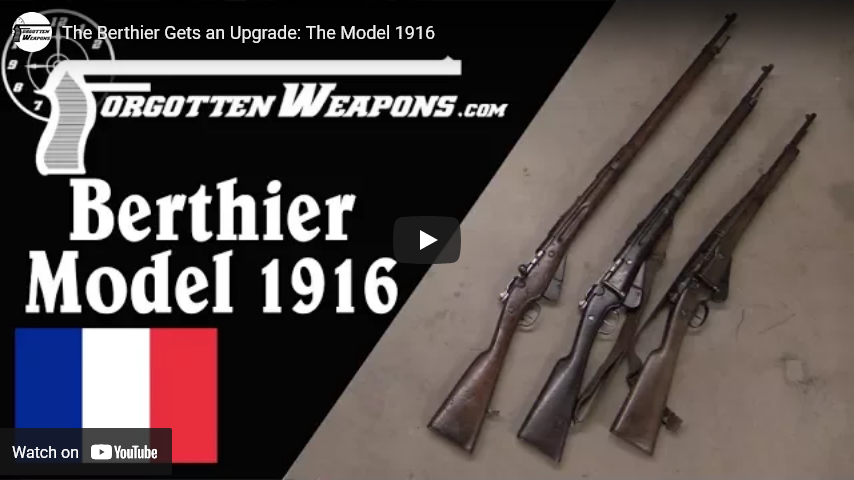
The Berthier Gets an Upgrade: The Model 1916
Forgotten Weapons
Published 26 Jul 2017http://www.patreon.com/ForgottenWeapons
The “Modifié 1916″ update to the Berthier system of rifles and carbines marked a major improvement in the gun’s combat effectiveness — really the first substantial overhaul to the design since it was developed in 1890. The two main elements of the upgrade were the addition of an upper handguard and an extension of the magazine from 3 rounds to 5, to match the capacity of the Mauser rifles used by Germany. In addition, several other improvements were made at the same time, including a redesign of the sights to favor quick target acquisition over long range precision and the addition of luminous radium elements to the sights. The upgrade package originally also included a dust cover over the bolt, but this was dropped for reasons I have not been able to determine.
This upgrade package was formally adopted in late 1916, and would go into production in 1917. However, it took a substantial time for the weapons to filter down to the front lines, and only a small number of M16 carbines and a very small number of M16 long rifles actually saw combat service before the Armistice. The M16 pattern (particularly the carbines) would form the standard armament for the French military right up to World War II, however, with Berthier carbine production continuing until 1939.
If you enjoy Forgotten Weapons, check out its sister channel, InRangeTV! http://www.youtube.com/InRangeTVShow
Comments Off on The Berthier Gets an Upgrade: The Model 1916
July 7, 2022
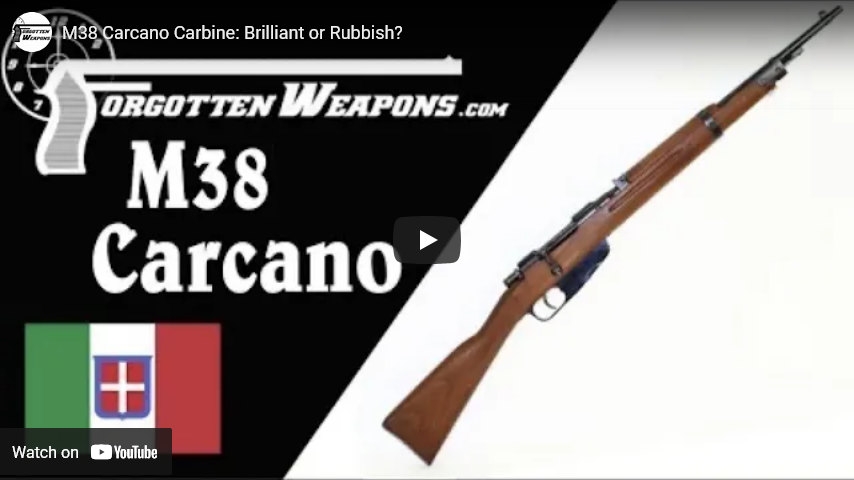
M38 Carcano Carbine: Brilliant or Rubbish?
Forgotten Weapons
Published 1 Aug 2017http://www.patreon.com/ForgottenWeapons
Cool Forgotten Weapons merchandise! http://shop.bbtv.com/collections/forg…
Carcano vs K98k Match video: https://www.youtube.com/watch?v=FAyxL…
I would like to propose that the M38 Carcano short rifle was, despite the poor reputation of the Carcano series of rifles, one of the best thought-out bolt action weapons of World War 2. Why, you ask? Well, let’s consider …
Only a few nations actually recognized the short ranges at which combat actually took place. Germany was one, as seen with its 8x33mm cartridge development, and Italy was another. The sights on the M38 series of carbines were made as simple fixed notches, with no adjustments to be knocked out of place unintentionally. With a 200 meter zero (or 150 meters, with the Finnish replacement front sight), the weapon needed no adjustment to make hits out to 300 meters, which is as far as anyone could realistically engage a target.
The M38 is a light and handy weapon compared to its contemporaries — 8.1 pounds and 40.2 inches (3.7kg and 1.02m) — and it fired a significantly lighter cartridge as well. The 7.35x51mm round used a 128gr (8.3g) bullet at 2400-2500 fps (735-755 m/s) depending on barrel length. This produced noticeably less recoil than rounds like the .30-06 or 8mm Mauser, which made it easier for troops to shoot effectively. The Carcano also had a 6-round capacity and fed with Mannlicher type clips, which are potentially faster to load than Mauser-type stripper clips.
Today we will discuss the M38 and these features (along with its predecessor, the M91 rifle) as they appear on paper. At the same time, over on InRangeTV, today we have the first stage of a 2-Gun Action Challenge Match in which I am shooting this M38 Carcano against Karl, who is using a Mauser K98k – so we will see how the theory works out in the field!
If you enjoy Forgotten Weapons, check out its sister channel, InRangeTV! http://www.youtube.com/InRangeTVShow
Comments Off on M38 Carcano Carbine: Brilliant or Rubbish?
July 4, 2022
QotD: The French solution to trench warfare
On the defensive, the French had adopted many of the same principles of the German defense-in-depth we’ve already discussed. On the offense, they came to favor (particularly under the influence of Philippe Pétain and […] Ferdinand Foch) an offensive doctrine designed to maximize France’s position in an attritional contest: that is to limit losses and maximize enemy casualties while still taking and holding ground. The system favored limited “bite-and-hold” attacks, ideally limited such that the attack stopped before triggering the inevitable German counter-attack. Remember that it was when the attacker ran out of steam and the defender’s counter-attack came that the casualty ratios tended to shift to favor the defender. In French thinking, the solution was just to not reach that point.
Instead, the French came to favor – and the British and Americans picked up the same method by the end – elaborately prepared small offensives. The elaborate preparation meant planning out the attack carefully, using shorter but carefully planned hurricane barrages (all of this planning, of course took time) and then seizing the enemy’s forward positions and just their forward positions. Instead of then trying to push through – the old French notion of assault brutal et continu (“brutal and continuous” – a “keep up the pressure till they break” method) which Robert Nivelle had favored – methodical battle focused on “bite-and-hold”.
Once you hit your limited objectives in that first rush where enemy resistence is disoriented (from the short, hurricane barrage) and weaker – and thus where the casualty ratio favors you – you stop and begin fortifying your position. You dig those communications trenches, move up your artillery and brace for the counter-attack. By the time the enemy realizes you aren’t going to attack his second or third line positions (and trigger his devastating counter-attack), you are dug in and prepared for his attack (the hold part of “bite-and-hold”). To reestablish defense in depth, the defender now has to back up to establish new lines to the rear (or launch his own fresh offensive, but by late 1918, the Germans were too weak for this). A long series of such attacks – with significant intervals for fresh careful planning and stockpiling resources – could slowly but surely lever your opponent off of key positions, one by one. It would also preserve a favorable balance of casualties, ensuring that in the end, the enemy runs out of men and shells before you do (that is the “rupture” that Joffre had always hoped for, but which arrived but two years too late for his career).
Such a slow, expensive, bloody and unglamorous strategy was in some ways only politically possible once, by 1918, it had become apparent that all other options were exhausted. That said, to argue that this bite-and-hold operational doctrine broke the trench stalemate is probably not fair either. The progress of allied offensives in 1918 was extremely slow by even the standards of 1914. The German Spring Offensive was well and truly done in July and the Allied offensive picked up in August and ran through November as fast as it could (with Foch doing everything short of getting out and pushing the offensive to try to speed it up) and yet the final allied positions by November were not even in Germany. Even at its greatest distance in 100 days of unbroken victories by a force with materiel and numerical superiority, the front moved less than 100 miles and the overall casualty ratio was roughly even (around a million on both sides).
Bret Devereaux, “Collections: No Man’s Land, Part II: Breaking the Stalemate”, A Collection of Unmitigated Pedantry, 2021-09-24.
Comments Off on QotD: The French solution to trench warfare


