
As we get into the Cold War era, one thing becomes simpler: the distinction between different kinds of tanks (heavy, medium, light, cruiser, infantry, etc) largely drops away. Improved engines, suspension and lighter but more effective composite armor meant that the slightly different roles of the different weights of tank could increasingly be accomplished by a single platform evolving out of late-war medium tanks. You could now fit a heavy tank’s gun and armor on a chassis with a medium tank’s speed and maneuverability. The first of these “universal” tanks was the British Centurion (first deployed in 1945 [but did not see WW2 combat]) and other countries followed suit.
The result is the modern “main battle tank” (MBT), typically between 45 and 75 tons, with a single powerful direct-fire cannon as its primary armament. That’s not to say design differences between militaries drop away; there are still decisions to be made: the level of emphasis between speed, armor and firepower for instance. Another major decision is whether a tank is designed with a three-person turret (one of whom is a dedicated loader) or a two-person turret with an autoloader (that is, a machine that does the loading for you). It used to be that now I’d have to go on about why going autoloaders aren’t simply obviously the best but given the live demonstrations of some of the drawbacks of Soviet/Russian carousel autoloaders going on right now [in Ukraine] I’ll just say that both options have advantages and drawbacks and move on. So there is variety within the idea of an MBT, but by and large most countries field just one type of MBT (or one family of MBTs for countries which can’t afford to retire older systems) and that covers their tank needs.
But of course nothing could easy so just as tanks were getting easier to keep track of, APCs get much more complicated. Even before they were fully enclosed, APCs had generally carried some kind of defensive weapon (usually a heavy machine gun), but you weren’t supposed to fight with it if you could avoid it. Beginning in the 1950s, designers – first in West Germany – began experimenting with the idea that an APC could be armed to not merely deliver the infantry (“dismounts”) but to actually fight when they got there. The thing is, there are a lot of situations where an infantry formation might want more firepower but where a tank would be overkill: armored vehicles lighter than tanks, or enemies with lighter fortifications, for instance. West Germany pioneered the idea by putting a 20mm autocannon on their APC, the Schützenpanzer Lang HS.30, enabling it to put out some meaningful firepower, albeit much less than a tank.
The USSR cottoned on to the idea and liked it, resulting in the Soviet BMP-1 and the subsequent BMP family of what we call “infantry fighting vehicles” (IFV). Initially resistant to the idea (American doctrine was that APCs move troops and should not fight if they could help it), the United States, noticing the effectiveness of these sorts of platforms, got into the act with the Bradley Fighting Vehicle (these days the M2 Bradley). And IFVs, especially the Bradley, look like tanks. And indeed, they are sometimes called on to do the kind of armored reconnaissance and infantry support jobs that in a previous era would have gone to a light tank.
But they are also notably not tanks in several key ways. The primary job of an IFV is to move infantry and support them against lighter targets; some IFVs do maintain some kind of anti-tank capability, but it tends to be more limited (e.g. the Bradley’s pair of TOW AT missiles). The requirement that an IFV needs to be fairly fast but also needs to fit a bunch of dismounts means they can’t carry the firepower or the armor of a tank, often using lighter aluminum armor rather than steel or heavy composites. Finally, the tendency is for IFVs to mount lighter primarily armaments – again, space and weight concerns – like the Bradley’s 25mm M242 Bushmaster chain gun. The BMP-3 is probably the most heavily armed IFV out there with a low-velocity 100mm rifled gun and a 30mm autocannon, which is still a far cry from the firepower of the high-velocity 125mm main gun of a contemporary T-80 or the 120mm high velocity gun of a M1A1 Abrams. Instead, most IFVs would rely on anti-tank missile systems to engage tanks (although IFV autocannons can cause a tank serious problems if they can engage the rear or side armor, which is thinner).
Note that the IFV did not mean the end of the APC just as the APC didn’t bring the end of soft-skinned troop transports. In the US military, the Bradley serves alongside lighter-but-still-IFV Strykers, the venerable M113 APC along with soft-skinned HMMWV (Humvees; to be in theory replaced with the Oshkosh L-ATV) and trucks of various kinds and uses. Likewise, the Russian army has its BMPs (which are IFVs), and BTRs (which are APCs) as well as soft-skinned vehicles – or at least it did until, I am now being told, they were all towed away by Ukrainian farmers. The real Iron Harvest.
The final category worth noting here are variations on the concept of the MRAP (Mine-Resistant, Ambush-Protected): infantry transport vehicles designed to resist the sort of dangers one encounters in counter-insurgency operations, mostly mines, IEDs and small-arms ambushes. In essence, these vehicles are a purpose-built version of the up-armored Humvees designed to operate in a very particular combat environment (insurgencies and particularly urban insurgencies). These sort of vehicles have gotten more visibility in the United States because many of them have been shifted into the hands of law enforcement, where their utility is questionable, to say the least.
Bret Devereaux, “Collections: When is a ‘Tank’ Not a Tank?”, A Collection of Unmitigated Pedantry, 2022-05-06.
July 23, 2026
QotD: The development of the Main Battle Tank (MBT) and Infantry Fighting Vehicle (IFV)
July 22, 2026
Why progressives are always so eager for more gun control
ESR discusses a recently posted chart about firearm homicide rates:

I’m not certain this chart is true, but looking at it shook something loose in my head. I think it explains why ordinary liberals are so obsessive about gun control despite the fact that it’s both bad policy and a persistent election-time loser.
This isn’t a trivial question. I understand why Communists are obsessive about gun control; the last thing they want is a population capable of armed resistance to tyranny. What I have never figured out is why Communists have been so successful at selling gun control to their dupes as an urgent moral necessity.
This chart could be exaggerated, but the figures are at least possible. In the United States, murder and other forms of criminal violence are heavily, heavily concentrated among Blacks. Usually with other Blacks as their victims.
And that’s a problem for your typical normie liberal, because not being “racist” against Blacks is the core of their moral and political identity.
What I now understand — forgive me because I probably should have noticed this sooner — is that gun-control advocacy is a sort of reaction formation. When you’re not an evil Communist, it’s something you do frantically to avert your eyes from unbearable reality.
The truth: outside of a relatively small cohort at the right-hand end of the Black IQ distribution, the people liberals want to treat as sacred victims deserving of infinite indulgence are savages that even intelligent Blacks fear and despise.
That’s the message in the left hand column, there.
IQ denialism, blank-slatism, “poverty causes crime” — these are all defensive formations. They cluster with gun-control advocacy as ways of avoiding the horrible, intolerable truth.
Which makes me wonder: what happens when the strain becomes too great and the protective illusion snaps?
July 21, 2026
Mauser M90 DA: Not Mauser and Not a High Power
Forgotten Weapons
Published 25 Feb 2026In the late 1980s and early 1990s, the Mauser firm was not in good shape. It had no new products, and its ability to survive marketing its name and legacy pistols was waning. Without much vision for the future, it turned to rebranding production from other companies, like Renato Gamba in Italy and FÉG in Hungary. From FEG they got the “Mauser Model 80” — a licensed copy of the Browning High Power — and the “Mauser Model 90” — a rebadged FEG P9R.
The P9R / Mauser 90 is often assumed to simply be a double-action modification of the High Power, but this is not true. The slide is almost identical in appearance to the High Power slide except for the decocking lever, but the frame has several important differences. The barrel lockup is taken from the S&W series of automatic pistols instead of the High Power, and the trigger mechanism is a stirrup around the magazine well instead of moving through the slide like a High Power.
In total, FEG made 26,000 of these pistols for Mauser. The plan was to sell them in Europe, but by 1995 sales remained poor and about 18,000 remained in Mauser inventory. In order to get rid of them, they were offered on the American market, where they were gobbled up by importers like Century between 1995 and 2001.
(more…)
July 18, 2026
Aimpoint’s First Tube Optics: 2000, 3000, & 5000
Forgotten Weapons
Published 23 Feb 2026Aimpoint introduced its first tubular red dot sight in 1985, the Aimpoint 2000. They were still making direct rail-mounted optics like the Aimpoint Electronic, but recognized the customer demand for a sight that could fit into normal scope rings. The 2000 included a number of other innovations, like a light sensor to automatically adjust brightness.
In 1989 the Aimpoint 3000 came out, which streamlined the profile of the optic by using a smaller battery compartment mounted tight to the tube, and abandoning the automatic light adjustment. This was followed in 1991 by the Aimpoint 5000, which was essentially the same optic in a 30mm tube instead of a 1″ tube. Larger diameter optics were gaining popularity for increased light transmission, and the 5000 followed that trend.
A number of options were offered, especially on the Aimpoint 5000. Different colors were made, a “Mag Dot” option for pistol competition offered up to a 15 MOA dot, and even a version with a fixed 2x magnification was made for hunters who thought that would be a good idea (it really wasn’t). The last in the line was the Aimpoint 5000 XD which introduced a new diode assembly with much longer battery life — this would go on to be the M68 CCO as adopted by the US military.
(more…)
July 14, 2026
July 11, 2026
Winston Churchill’s Personal Patchett/Sterling Submachine Gun
Royal Armouries
Published 4 Feb 2026This episode of “What Is This Weapon?” Jonathan examines a seemingly ordinary Sterling/Patchett submachine gun that turns out to be anything but.
This is a rare opportunity to examine a historically significant firearm that was owned and more than likely, used by Britain’s wartime Prime Minister.
0:00 Intro
1:55 The Hidden Plaque & Churchill Connection
3:36 Provenance: Churchill’s Firearm Certificate
5:58 Not a Wall Hanger: Ammunition & Use
6:05 Patchett vs Sterling: Design Differences
10:43 Churchill, Firearms & Wartime Image
14:49 Legacy & Back Next Week for Another Archive Film
(more…)
QotD: Could airpower have broken the trench stalemate on the western front in WW1?
There are two directions to take airpower here: tactical and strategic. One wasn’t ready then (but would be by WWII), the other still hasn’t managed to accomplish its stated objectives yet, but continues to over-promise and under-deliver results.
Let’s deal with tactical airpower first. The first function aircraft were put to in WWI was reconnaissance. In 1914, that might mean locating the enemy in a fast-moving battlefield, but as soon as the trench stalemate set in, reconnaissance mostly meant identifying enemy buildups along the line and – still more importantly – serving as spotters for artillery. It wasn’t a huge cognitive leap to go from having aircraft which identified targets for the artillery to thinking that the aircraft could be the artillery. But as with tanks, the technical limitations of the platforms in use meant that actually meaningful close air support was still two decades away when the war ended. The rapid development of aircraft in these early days means that there is a truly bewildering array of aircraft designs in use during the war, but the Farman F.50 is a good sample for what the most advanced bombers in common use looked like towards the war’s end. It carried a maximum of eight 44kg bombs (352kg) under the wings, which were dropped unguided. With a maximum speed of less than 100mph and a service ceiling under 5000m, it was also an extremely vulnerable platform: fragile, slow and with a relatively low flight ceiling. The French mainly used bombers at night for this reason.
But how much airpower does it take to really move a division out of position? In 1944, at the start of Operation Cobra as part of the Normandy breakout, it was necessary for US forces to move the powerful armored division Panzer Lehr out of its prepared positions outside of St. Lo. Over the course of an hour and a half, the U.S. Eighth Air Force hit Panzer Lehr with approximately three thousand aircraft, including 1,800 heavy bombers (each of which might have had bomb-loads of c. 2-3,500kg; the attack would have been the equivalent of about 13,000 Farman F.50s (of which only a hundred or so were built!)). By this point, even medium bombers carried bomb loads in the thousands of pounds, like the B-25 Mitchell medium bomber, with a bomb load of 3000lbs (1360kg). This was followed by a hurricane artillery barrage! Despite this almost absurdly awesome amount of firepower (which, to be clear, inflicted tremendous damage; by the end of Operation Cobra, Panzer Lehr – the heaviest and most powerful Panzer division in the west – had effectively ceased to exist), Panzer Lehr, badly weakened was still very capable of resisting and had to be pushed out of position by ground attack over the next three days.
Needless to say, nothing on offer in 1918 or for a decade or more after, was prepared to offer that kind of offensive potential from the air. That kind of assault would have required many thousands of aircraft with capabilities far exceeding what even the best late-war WWI bombers could do. Once again, while close air support doctrine was developed with one eye on the trench stalemate and the role airpower could play in facilitating a breakthrough and restoring maneuver (either by blasting the breakthrough or – as in Soviet Deep Battle doctrine – engaging enemy rear echelon units to bog down reinforcements). But the technology wasn’t anywhere near the decisive point by 1918. Instead, the most important thing aircraft could do was spot for the artillery, which is mostly what aircraft continued to do, even in late 1918.
But that’s tactical bombing against military targets. What about strategic bombing against civilian targets?
The first efforts at strategic bombing were made in WWI, though once again the technology wasn’t ready. The range for fixed-wing aircraft was still very limited; the aforementioned Farman F.50 had a range of only 420km, nowhere near enough to really bring entire countries under the threat of bombing. Dirigibles – zeppelins – could manage much longer ranges and the Germans did attempt to bomb British cities with them starting in 1915. The problem was that once aircraft powerful enough to climb to the zeppelin’s altitude were developed, the slow and fragile zeppelins were sitting ducks: lighter than air airships could hardly be armored, after all. Moreover, the bomb loads of zeppelins had always been far too low to make effective strategic bombing possible beyond the initial shock of it.
What no one could have known in WWI was not merely that the technology for effective conventional strategic bombing wasn’t ready, but that it would probably never be ready. Interwar air-power theorists, seeing the potential of strategic airpower to bypass the trench stalemate by flying over it began to try to work out how this would be done. Giulio Douhet (1869-1930) argued that future wars would be fought and won in the air, with fleets of bombers using high explosives and chemical weapons to massacre enemy civilian centers, until civilians forced their governments to surrender. Douhet was not alone; his vision of airpower was shared, for instance, by the “father of the RAF”, Hugh Trenchard (1873-1956).
This concept, “morale bombing” as it is sometimes called, probably deserves its own post discussing its failures. But in brief, the concept was tested, with far larger amounts of bombs than Douhet or any other interwar theorist could have ever dreamed of, during WWII. The argument by air theorists that high altitude bombers could not be stopped was proved false when the British did exactly this, stopping German bombers over Britain in 1940. Moreover, terror bombing against civilian targets in Britain didn’t lead to surrender, but hardened resolve. Likewise, “morale” bombing against German targets by the allies didn’t lead to surrender, but hardened resolve. Later efforts to demoralize the North Vietnamese through a American bombing campaign in the Vietnam War didn’t lead to surrender, but hardened resolve. More recent efforts to demoralize or destroy terrorists and the Taliban through the use of airpower hasn’t lead to surrender, but rather hardened resolve. Likewise, efforts by the Syrian Regime to defeat various opposition groups in Syria through the use of chemical weapon-based terror bombing didn’t lead to surrender (siege-and-starve tactics did), but hardened resolve.
It turns out the fundamental premise of the entire idea of morale bombing – that being bombed will make people want to stop fighting – was flawed. Morale bombing has been, depending on how hard you squint at the US air campaign over Japan in WWII (including the use of nuclear weapons) successful either once (out of many attempts) or never. In most cases, the sustained bombing of civilian centers has been shown to increase a population’s willingness to resist, making the strategy worse than useless.
The case for strategic bombing against industrial targets is marginally better, but only marginally. While airpower advocates, particularly in the United States promised throughout WWII that bombing campaigns against German industry could lead to the collapse of the German war machine, in the end many historians posit that the real achievement of the campaign was to lure the Luftwaffe into the air where it could be destroyed, thus denying the German army of air cover and close air support, particularly on the Eastern Front. Some diminution of German industrial capabilities was accomplished (though it is not clear that this ever approached the vast resources poured into producing the large numbers of extremely expensive bombers used to do it, though the allies had such an industrial advantage over Germany, forcing the Germans to fight in expensive ways in the sky was a winning trade anyway), but the collapse of German industry never happened. As Richard Overy notes, German industrial output continued to rise during strategic bombing and only began to fall as a result of the loss of territory on the ground. Needless to say, “strategic bombing can sucker the enemy into wasting their close air support” was not the result that airpower advocates had promised, nor could it have broken the stalemate.
I don’t want to oversimplify the continued debate over the efficacy of strategic airpower here too much so let’s just say that the jury is still very much out as to if strategic airpower works even with modern technology; it certainly wouldn’t have worked with WWI era technology.
Bret Devereaux, “Collections: No Man’s Land, Part II: Breaking the Stalemate”, A Collection of Unmitigated Pedantry, 2021-09-24.
July 8, 2026
Don’t call them “U-boats”!
In his latest post for The Line, Matt Gurney violates the cardinal rule of discussing German naval equipment … don’t call ’em “U-boats”!
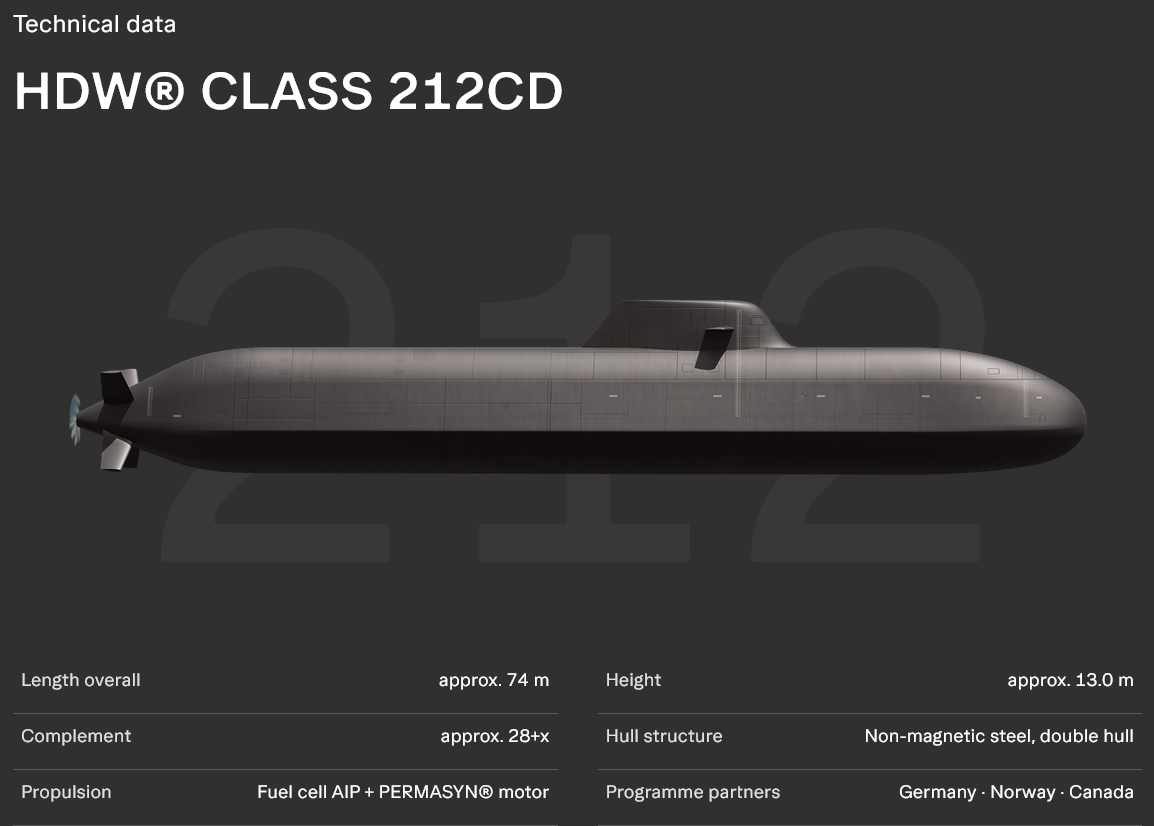
In Halifax on Monday, Prime Minister Mark Carney announced that Canada had chosen a preferred vendor for our new fleet of patrol submarines. Canada will (probably) be going with a German-Norwegian consortium that was offering the Type 212CD submarine, and not the South Korean boats offered by Hanwha. The prime minister said it was a close finish between the two competitors and noted that either design would have met Canada’s needs. The decision announced Monday is not a final purchase order but rather a determination of who our preferred partner would be. The prime minister said that if the negotiations with TKMS, the German company offering the 212CD, did not go well, Hanwha remained an acceptable option.
Personally, I was rooting for the Koreans. I liked their submarine’s ability to launch missiles vertically, which would’ve given the Canadian fleet some powerful strike options. I also tripped a little over the thought of Canadians in U-boats — I suspect many historically minded Canadians will also blink hard at that little twist of fate. But I fundamentally agree with the prime minister — either boat is fine for our purposes. The 212CD will be an excellent asset once it enters Canadian service (presumably with a snappier name).
Sooner would be better. The prime minister noted repeatedly during his remarks on Monday that the government was moving quickly to make this announcement, having settled on a preferred partner five years ahead of the original schedule. This is true, and I give the prime minister full credit for that. I would also note that the schedule was already ridiculously long. We actually should have begun replacing the submarines a decade ago. The PM’s comments reminded me that I had written a column about the urgent need to just get on with replacing the submarines when we had last announced another cycle of refurbishments to keep the current fleet in service because we had yet again delayed a decision on a replacement.
I found my old article. I wrote it seven years ago.
That was bad. Carney accelerating it is good. It’s also good that we are looking at a much larger fleet of submarines, going from four to as many as 12. Submarines are very complicated machines. For every boat you want available for service, you need three or four in your fleet. This gives you a large enough fleet to have an operational submarine available while others undergo maintenance or refits or participate in training exercises with their crews. The four Victoria-class submarines Canada possesses today mean that we typically might have one available for service at any given time, so a fleet of 12 will give us a much more robust presence. Given that we claim three oceans, and that the world is pretty much a dumpster fire these days, having a submarine available on each coast at all times seems like a good idea.
Time is of the essence. Germany and Norway, the prime minister said, have offered to allow Canada to cut ahead of them in line for deliveries of the submarines, which are already under construction but haven’t yet entered service. Given the decrepit state of our elderly existing fleet, that was obviously a meaningful sweetener, and the PM said the first boats could be in Canadian service in seven or eight years, which is pushing the Victorias to their limits, but should work. We hope?
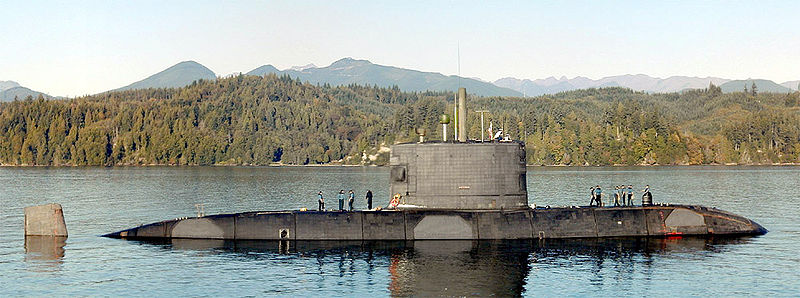
HMCS Victoria, one of four ex-Royal Navy submarines in Canadian service, will have to carry on in service — as much as the class can carry on — until the early 2030s.
Image via Wikimedia Commons.
ZKP-524: A Prototype Czech 7.62x25mm 1911 Copy
Forgotten Weapons
Published 18 Feb 2026The Czechoslovak military knew when they adopted it that the vz.52 pistol was not very good, and they initiated a replacement program at the same time as its adoption. Two pistols were developed to be its replacement; the CZ 531 and the ZKP 524. The ZKP was designed by the brothers Josef and František Koucký, based heavily on the Colt 1911 and Tokarev TT33 pistols. It was chambered for the 7.62x25mm cartridge as required by the military, and held 8 rounds in a single-stack magazine. In trials against the CZ-531, it proved to be more accurate, but less reliable and more expensive. It suffered a cracked slide after 4,198 rounds fired, and an improved second example was made. However, the vz.52 proved good enough despite its shortcomings, and the program to replace it fizzled out after this testing.
Thanks to the Czech Military History Institute (VHU) for graciously giving me access to this unique prototype to film for you! If you have the opportunity, don’t miss seeing their museums in Prague:
https://www.vhu.cz/en/english-summary/CZ 531 video: • CZ-531: A Czech Browning in 7.62mm Tokarev
(more…)
July 7, 2026
Canada decides to buy German submarines
I wouldn’t say I’ve been closely following the Canadian Patrol Submarines Project (CPSP), but I was interested enough to do a bit of reading about both of the contending bidders and their offerings. Based on my understanding of the RCN’s needs, I expected the South Korean KSS-III submarine to be the final winner, but I was wrong: Prime Minister Mark Carney announced that the German/Norwegian TKMS Type 212CD submarine had been selected instead.
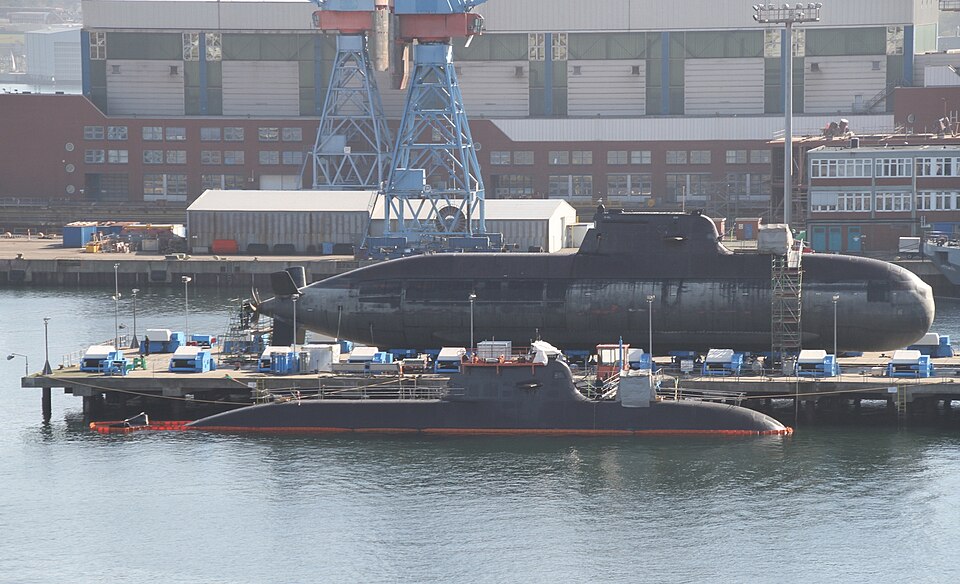
Type 212 submarines at the HDW shipyard in Kiel, Germany, 1 May 2013.
Photo by Bjoertvedt via Wikimedia Commons.Submarines enable the Royal Canadian Navy (RCN) to defend threats near and far from Canada’s shores. Yet, our current fleet is aging, with only one of four submarines seaworthy. With the longest coastline in the world, Canada’s ability to deploy underwater surveillance capability is critical. Our security and sovereignty depend on them.
Today, at Canadian Forces Base Halifax, the Prime Minister, Mark Carney, announced that Thyssenkrupp Marine Systems (TKMS) has been selected as the preferred supplier to begin negotiations for delivering Canada’s next fleet of submarines to the RCN. This will be the largest defence procurement in Canadian history, and it will equip the RCN with the capabilities they need to keep Canadians safe.
With ultra-low acoustic and magnetic signatures, TKMS’ 212CD is one of the stealthiest submarines in the world. It is capable of Arctic patrol, undersea surveillance, special forces deployment, and it is fully NATO-interoperable. These submarines provide an unparalleled combination of advanced technology and lethality that will enable the RCN to detect, track, deter and, if necessary, defeat adversaries in all three oceans bordering Canada. This procurement will bolster Canadian security through a platform shared by Germany and Norway, two of Canada’s closest Allies.
The Government of Canada and TKMS will now enter into negotiations to finalise the contracts and all arrangements required to deliver the requirements of the CPSP. Canada will conclude contracting no later than the end of 2027, with the first four submarines to be delivered ahead of schedule, in 2034. In the event that negotiations with the preferred supplier are unsuccessful, Canada may designate Hanwha Ocean as the preferred supplier and enter into negotiations.
The CPSP is being advanced by the Defence Investment Agency and aligns with Canada’s Defence Industrial Strategy. Under the Build-Partner-Buy framework, the project demonstrates the Partner approach, with collaborations with trusted Allies to develop and deliver capabilities while ensuring industrial and economic benefits for Canada. The CPSP will prioritise investments across the Canadian supply chain, to create high-paying jobs, leverage Canadian defence industries, and maximise benefits for Canadian workers and businesses.
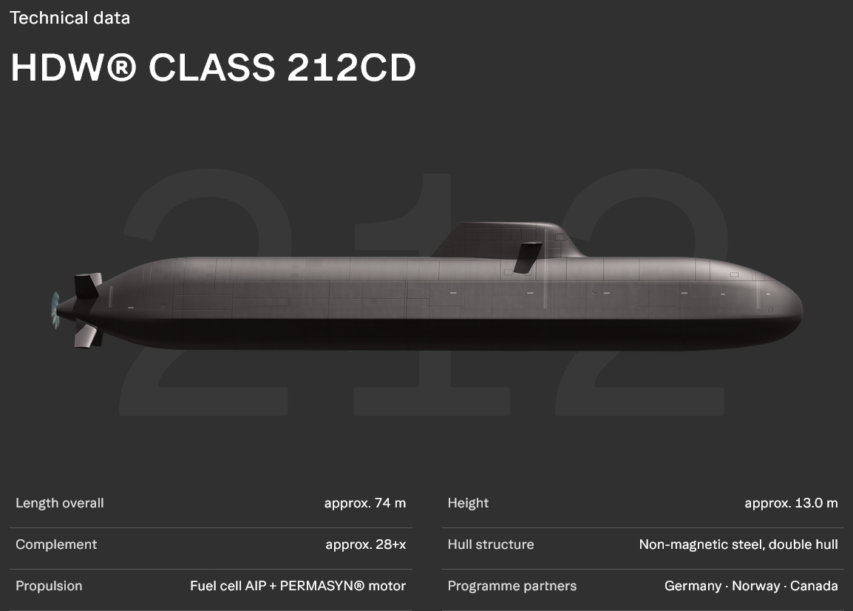
Noah comments on the press release information and some wider issues to do with the CPSP:
And with this, the long-awaited Canadian Patrol Submarine Project finds its home. What started as an ambitious RFI back in 2024 has quickly turned into one of the most consequential, publicized, and dynamic projects, I would say, in Canadian history.
TKMS and Kongsberg, operating as Team GERNOR, have claimed the preferred supplier designation from the federal government. As always, there is no contract today. The selection of a preferred supplier merely sets the table for negotiations to a final contract.
While the federal government will want to move quickly, and I’m sure that the Navy would like to see the contract signed, it is highly likely that comes in 2027. The typical “quick” timeframe is about a year. Keeping in mind, of course, that CPSP will be the largest procurement contract in federal history,1 and in this case also includes additional negotiations on build slots for submarines from both Germany and Norway.
[…]
There was no universal consensus, and I know this choice didn’t come easy for anyone. Both sides put all they could into it. Yet in the end, the GERNOR option pulled ahead. The European focus was championed heavily by those in the PMO as an opportunity to open doors and integrate Canadian industry into the wider European ecosystem, especially as European interest in Canadian expansion grows.
At the end of the day, that ecosystem came out on top. In the final weeks and months of the competition especially, the banner of Europe rallied to the call of unity, to stand with their hands at the back of Team GERNOR. That push, and that united front, is very likely what pushed that sense of alignment forward.
You don’t need to look far for it. Just after CANSEC, Italy’s Fincantieri, a noted ally of TKMS, signed a new MOU with Magellan Aerospace to investigate the potential production of heavyweight torpedoes and undersea countermeasures, building off the proposed investment TKMS plans to make.
While not in the 212CD network, Fincantieri is in the family, and they, among others, are also looking to Canada and our choices. It is the first example of the TKMS family taking notice and making proactive moves to jump in and secure capacity in a future Canadian submarine industry; and, as I understand it, far from the only one being discussed.
Another outside addition: Navantia of Spain and TKMS have also recently signed an MOU to investigate collaboration on naval shipbuilding. While this new agreement is young, I am also led to believe that Navantia is looking to Canada with interest, building off some of their previous engagements with industry.
Increasingly, the European front is united in industry, in the political sphere, and diplomatically to present the 212CD not as a German-Norwegian partnership but as a foundational Canada-Europe partnership that will build off the foundation of agreements like SAFE and the EU-Canada Security and Defence Partnership to create a united Atlantic front that promotes collaboration and joint investment, and opens the European market to Canadian industry.
- NR – “the largest procurement contract in federal history” … Canada’s major military purchases happen so rarely and always taking as long as bureaucratically/politically possible, so every ship, aircraft, helicopter, or tank purchase has a good chance of being the next “largest procurement contract in federal history”.
July 5, 2026
Terni Model 1921: Italian Interwar Assault Rifle with a Cube Mag
Forgotten Weapons
Published 16 Feb 2026After World War One, the Italian military spent some time studying the effectiveness of reduced-power cartridges, including both pistol calibers semiautomatic carbines and submachine guns as well as intermediate-caliber rifles. One of the rifles developed for the subsequent testing was the Terni Arsenal model 1921, of which 200 appear to have been made in total during the 1920s. This rifle used a surprising advanced 7.35x32mm cartridge, firing a 135 grain bullet at 1970 fps. It was a short recoil design and used a Fiat-Revelli style cube magazine. Ultimately the concept was not adopted (probably for reasons of cost), and some of the surviving rifles ended up in Ethiopia — where this example was found a few years ago.
(more…)
July 2, 2026
PBS-1 Soviet AK Silencer (the Original, not the Dead Air One)
Forgotten Weapons
Published 13 Feb 2026The Soviet Union had made fairly extensive use of silencers on Mosin Nagant rifles during World War Two, as tools for snipers and recon scouts among others. In the mid 1950s a new silencer was put into development for the new 7.62x39mm family of weapons, called the PBS (Прибор Бесшумной Стрельбы; Pribor Besshumnoi Strelyby; Silent Shooting Device). This was originally intended to be a multi-weapon silencer, but the abandonment of the SKS and reliability problems with the RPD led to it being limited to just the AK. Compared to the Mosin Nagant silencers, this new design was much more difficult, as it had to allow the rifle to cycle reliably using specialized subsonic ammunition, and also continue to run reliably with the silencer removed and standard ammunition used. This led to the most unusual element of its design; a thick rubber wipe just in front of the muzzle to help boost back pressure.
The remainder of the design was pretty simple, with 12 plain flat plate baffles. The first production PBS model used a clamshell main body, but this was replaced by a solid tube on the PBS-1 improved model in 1962. These suppressors were used until the late 1970s, when the 9x39mm cartridge was developed for better subsonic effectiveness, along with a number of unique new firearms designed for it.
Bramit Suppressor for Mosin Nagant: • Soviet WW2 Bramit Silencer for the M91/30
(more…)
June 29, 2026
A “good guy with a gun” is responsible for stopping a lot of crime in the US
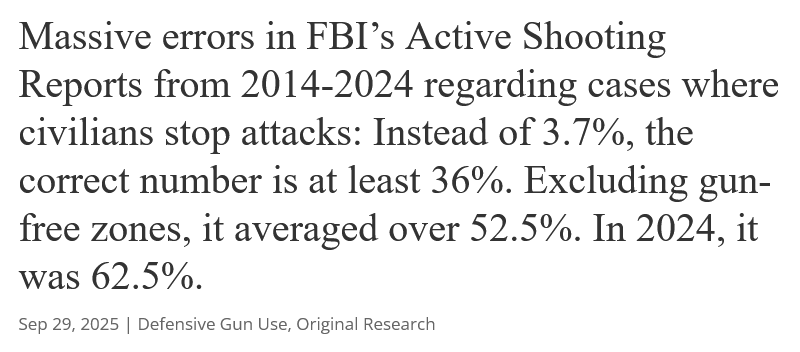
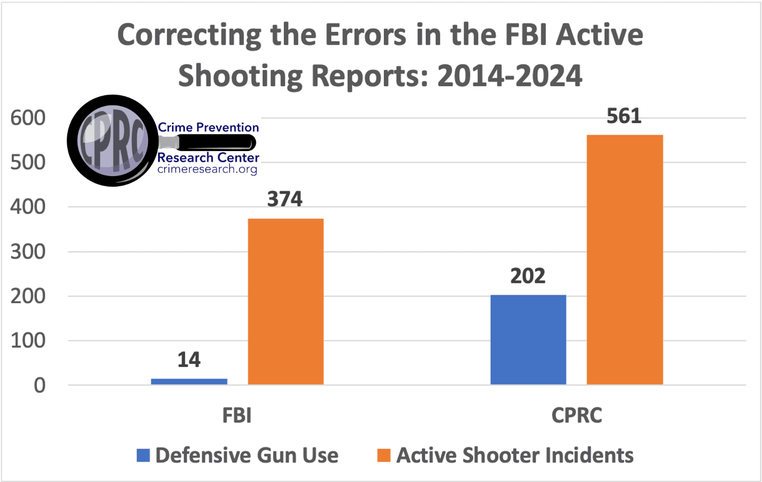
If you’ve paid any attention, you’ll have been told that private gun owners are rarely if ever able to stop a crime, and even that you’re somehow in more danger if you carry a gun than if you go unarmed. The FBI certainly contributed to that message with their annual Active Shooting Reports, which seemed to indicate that civilians with guns were only responsible for stopping gun attacks 3.7% of the time. This understates the frequency by a very large margin:
The FBI defines an active shooter as one or more individuals actively engaged in killing or attempting to kill people in a public place, not involving gang violence or some other crime such as robbery. Such an incident could be something as minor as one person being shot at and missed up to a mass public shooting.
While the FBI includes cases where civilians stop active shooters, the news media frequently relies on the limited number of these cases to argue that such interventions are rare. Headlines illustrate this framing: “Rare in US for an active shooter to be stopped by bystander” (Associated Press); “Rampage in Indiana a rare instance of armed civilian ending mass shooting” (Washington Post); and “After Indiana mall shooting, one hero but no lasting solution to gun violence” (New York Times). The FBI’s reports acknowledge that armed civilians stopped active shooting attacks in seven of the eleven years they reviewed.
When John Stossel asked the FBI about our claim that they had omitted many cases, the Bureau responded: “[Our data is] not intended to explore all active shooting incidents but rather to provide a baseline understanding …”
[…]
Between 2014 and 2024, citizens stopped 178 out of 339 potential or actual mass shootings where we could identify that guns were allowed in the area. So 52.5% of attacks were stopped by people legally carrying concealed handguns.
The numbers indicate that if we didn’t have gun-free zones, we would have more people stopping these attacks.
Finally, even these numbers underestimate the usefulness of legally carried concealed handguns in stopping mass public shootings because many of these active shooting incidents involve only one person being targeted. For example, suppose one person is targeted and only one person may be present. In that case, there is relatively little opportunity for people to stop attacks compared to a mass public shooting where many potential victims are present.
The general public seems to agree. A July 2022 survey by the Trafalgar Group showed that a plurality of American general election voters believe that armed citizens are the most effective element in protecting you and your family in the case of a mass shooting. First on the list was “armed citizens” at 42%, followed by “local police” (25%) and “federal agents” (10%). [“None of the above” was the answer chosen by 23% of respondents.] A survey by YouGov in May – before the Uvalde, Texas, attack – found that by a margin of 51% to 37% American adults supported letting schoolteachers and administrations carry concealed handguns.
Stupid Super Heavies: Germany’s Biggest Tanks
The Tank Museum
Published 27 Feb 2026By late 1943 Germany was losing the war …
They needed tanks, and lots of them, if they were going to wrestle back the initiative. Instead, they became obsessed with wonder weapons they hoped could change their fate
From the logistical paralysis of King Tiger, growing ever bigger and more unwieldy with the Maus, ultimately reaching the madness of the thousand tonne Ratte.
Like Augustus Gloop, German tank development in the Second World War greedily ate up more and more resources.
While an absolute boon for historians working at The Tank Museum, it made no logical sense … What were they thinking?
This is the bewildering story of the “Super Heavies”
00:00 | Introduction
00:48 | The Panther Problem
02:27 | Bigger is Better
05:42 | Pushing the Limits
09:19 | Gigantic Fantasies
12:03 | Losing the War (and the Plot)
(more…)
June 28, 2026
Bannerman, the Father of Gun Collecting: Tales from the Golden Age of Surplus
Forgotten Weapons
Published 11 Feb 2026Francis Bannerman is really the father of the modern military surplus industry, and in many ways a father of gun collecting as we know it today. Before Bannerman, “gun collecting” was generally something for the wealthy and revolved around fancy and bespoke guns. It was not about have representative pieces of normal arms, it was about having the fancy and exclusive things. Bannerman changed that by offering all manner of ordinary surplus at affordable prices to anyone who was interested. In addition to complete guns and other equipment, Bannerman also dealt in huge numbers of bits and pieces, and sometimes assembled them into various odd hybrid guns for sale, which we still see occasionally today …
Sample Bannerman catalog (1903):
https://archive.org/details/francis-b…
(more…)


