
Forgotten Weapons
Published 4 Feb 2026When the German Army tested last-ditch Volkssturm rifles late in World War Two, one of the particularly obscure submissions was August Coenders’ Coenders-Rochling Volkssturmkarabiner. This was a bolt-action rifle chambered for 8mm Mauser with a 5-round magazine. However, instead of using a traditional bolt action system it had a fixed breechblock and the handle was attached to the barrel. Cycling the action meant unlocking the barrel and sliding it forward, while the breechblock held the fired case in place. When the barrel was fully forward, the next round in the magazine would kick out the empty case, and pull the barrel rearward seated the next cartridge, ready to fire. In testing, the rifle was, frankly, terrible.
Thanks to the Springfield Armory National Historic Site for giving me access to this unique specimen from their reference collection to film for you! Don’t miss the chance to visit the museum there if you have a day free in Springfield, Massachusetts: https://www.nps.gov/spar/index.htm
(more…)
June 25, 2026
Coenders’ Bolt-Less Last Ditch Bolt Action Rifle
June 22, 2026
ADATS – Air Defense Anti-Tank System; Canada’s high tech cold warrior
Polyus
Published 19 Jun 2026While designed mainly in Switzerland, over the years its identity became distinctly Canadian. It was produced in Toronto by Oerlikon Aerospace Canada and was operated by Canadian forces from 1988 to 2011. This is the story of the Air Defense Anti-Tank System, or ADATS
ADATS was a very interesting and highly advanced air defense system designed to fight a cold war that never materialized. It was operated for a little over 20 years, so it was by no means a flash-in-the-pan. Unfortunately, Canada has since given up its short ranged air defense capability and all of the human expertise that was built up over the years. Hopefully in the future a new system can be acquired and Canada can again expand its sovereign air defense capabilities.
This video was made without the use of Artificial Intelligence (No AI). Long live people power!
0:00 Introduction
0:29 European Background
2:09 Technical Details
4:05 Engagement Sequence
5:38 Comparison to other Systems
6:06 Canadian Adoption
7:48 American Testing
8:32 Thai Adoption
8:57 Advanced Variants
10:23 ConclusionMusic:
“Denmark” – Portland Cello Project
“Your Suggestions” – Unicorn Heads
June 21, 2026
How Britain Made the L1A1 SLR: archive film with intro by Jonathan Ferguson
Royal Armouries
Published 21 Jan 2026Following last week’s look at the very first L1A1 SLR ever produced (1957), we’re sharing a remarkable Royal Small Arms Factory (RSAF) Enfield archive film, shot in the 1960s, showing the key stages of L1A1 manufacture and a rare glimpse of the original Enfield pattern room.
Then we step back and let the film speak for itself, nearly an hour of pure production and engineering process.
0:00 Intro
3:05 Enfield + Pattern Room
3:57 Planning & Tooling
4:37 Rifle body: Heat treat → Machining → Inspection
18:16 Barrels: Drilling, Rifling, Plating & Production line
34:28 Housing/Trigger, Furniture & Magazines
50:16 Assembly → Proofing/Testing → Packing & Dispatch
(more…)
June 20, 2026
“Every system on display is an answer to a question the war in Ukraine asked out loud”
Most wars are not significant drivers of technological change and military innovation. The Franco-Prussian War, the Boer Wars, World War 1, and World War 2 are some of the exceptions where the fighting accelerated innovation and adoption of new and untested technologies that were proven or discarded on the battlefield. The Russo-Ukraine war has been going on long enough and requiring new and improved weapons to such a degree that modern arms shows clearly reflect at least some of the technological changes in response to the ongoing combat:
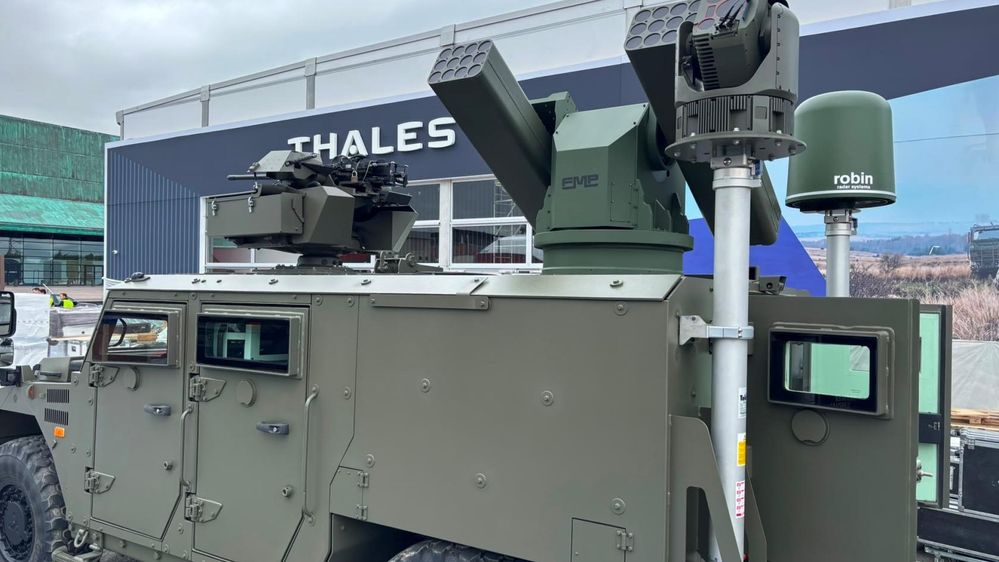
Thales RapidStriker SHORAD, I think. Oddly, what struck me about this image was how much it reminded me of very early WW1 armoured cars, both in general outline and in its being a quick reaction development to a current combat situation.
Photo from Eyes Only with Wes O’Donnell
I was thinking recently about the good ole pandemic days; ah, what a simpler time …
At the time, I was writing for military and cybersecurity magazines about whether NASA spacesuits can be hacked and hypersonic tomfoolery.
Six years ago, a defense expo like this was mostly about better armored boxes. Things like thicker protection, a nicer turret, an upgraded engine, a fire-control system with a new acronym.
The headline acts were tanks and infantry fighting vehicles, things that go very high and very fast, and the unspoken assumption underneath all of it was that war would look roughly like it always had, just with more cowbell.
Then 2022 happened.
Then Operation Spiderweb.
Then a year of Russian glide bombs and Ukrainian refinery strikes and FPV drones turning hundred-dollar quadcopters into tank-killers.
Then the Gulf woke up to Iranian missiles in March. And the entire defense industry got the same text message at the same time, written in other people’s blood.
You can read that message on the Eurosatory floor this year.
Almost every serious system on display is an answer to a question the war in Ukraine asked out loud:
How do I shoot from farther away so I don’t die?
How do I kill cheap drones without going bankrupt?
How do I send a robot instead of a soldier?
How do I keep my tank’s roof from becoming a Thermador pizza oven set to “broil?”
Back then, I also used to write listicles, like “Top Ten Gifts for Veterans!” In that tradition, I’ve put together a hand-picked list of ten weapon systems emerging this year at Eurosatory in Paris, and every one of them is really a story about how much war has changed since 2020.
June 18, 2026
Unexpected increase in legal gun ownership in Canada
The federal government has been doing everything it can to curtail Canadians’ access to firearms since 2015, most recently imposing bans on literally thousands of different gun models and almost completely restricting purchase, sale, or transfer of legal handguns. Under these circumstances, you’d expect that interest in legal gun ownership would be on a pretty steep decline. But that’s emphatically not the case:
Here is something the government does not talk about.
Canada’s handgun freeze took effect on October 21, 2022. Since that date, very few people who have exemptions have been able to buy, sell, gift, or inherit a handgun. The market for new restricted handguns is effectively closed.
So you might expect the number of Canadians holding a Restricted PAL (the licence required to own handguns and other restricted firearms) to be flat or declining. Why bother completing the restricted component of the Canadian Firearm Safety Course if you can’t use it to buy a handgun?
The data says otherwise.
According to the RCMP Commissioner of Firearms Reports, the number of RPAL holders has grown every year since the freeze:
2022: 716,348
2023: 752,002 (up 5.0%)
2024: 775,266 (up 3.1%)
2025: 794,768 (up 2.5%)That is a net gain of 78,420 restricted firearm licence holders in three years, a 10.9% increase, all during a period when the primary reason most people get the restricted designation on their PAL (to buy a handgun) was legislated away.
Canadians are still taking the safety course, submitting to the background checks, and getting licensed. The freeze did not stop the demand for restricted licences. It just stopped the legal market from serving the people who hold them.
Source: RCMP Commissioner of Firearms Reports, 2022, 2023, 2024, and 2025.

Ross 1912 Cadet: Straight Pull .22 Rimfire Training Rifle
Forgotten Weapons
Published 28 Jan 2026The Ross model 1912 Cadet rifle was introduced in 1912 as a diminutive rimfire companion to the 1905 and 1910 military Ross rifles. It was a single-shot straight pull rifle, with a somewhat unusual locking bolt system. Somewhere between 13,000 and 17,000 appear to have been made, for civilian commercial sale, Cadet Corps, and Militia use. Production ended in March 1917, when the Ross company collapsed. Today these are quite rare rifles.
(more…)
June 16, 2026
QotD: Nitpicking the field fortifications in Gladiator (2000)
[…] The army is also deployed wrong.
What we are shown is pretty clearly a prepared defense on a hillside, with a series of raised terraces, with a mix of abatis (sharpened wood obstacles, often crudely cut wood stakes set in an X pattern) and mantlets, with gaps in those defenses to allow units to move and a whole bunch of catapults positioned up on the hill. The terraces make for a layered, multi-stage fighting position at each level. On the one hand, the Romans were hardly averse to field fortifications and one wonders again if this set was a product of someone with an active imagination looking at the Column of Trajan [Wiki], which features a lot of scenes of Roman soldiers cutting trees and building bridges, roads and forts.
The problem isn’t that there are field fortifications, it is everything else about them: the style of field fortification, their position, layout and use. As we’ve noted before, Roman armies on campaign built fortified marching camps nightly, so we would expect Maximus’ army to have such a camp, but as we’ve discussed even more so, one of the classic, famous features of Roman armies is that they build the same layout of camp wherever they go, the famous Roman “playing card” forts, generally built on flat, open ground (rather than hillsides). That defense would not look like this, instead consisting of a ditch (the fossa) behind which would have been a earthwork rampart (the agger) topped with a wooden palisade (the vallum); thus rather than successive layers, you’d have a single clear fighting position (the vallum) on a mount with the ditch directly in front of it. And that would be a continuous line, with just four gates (at the center of each side), rather than this kind of checkerboard pattern of fortifications, because of course the purpose of this defense was to prohibit entry. Moreover, the line of field fortifications we see are not part of, nor connected to, a marching camp: it is simply a line of fortifications on the side of the hill with nothing on the flanks, rather than the distinctive “playing card shape”. We don’t see the camp sitting behind it either.
But the really immediate problem is that Maximus’ army has formed up within his troops strung through the field fortifications, with legionary soldiers mostly in front of them (but some are behind them) and the archers in between the stakes and mantlets. This may seem like a sensible way to form up a defense, but it is not the Roman way. Maximus is very intentionally “offering battle”, – inviting his opponent into an open field engagement. The way a Roman army did this was invariably forming up on the flat, open, unfortified ground in front of the camp, toward the enemy, signalling that they would fight in the open, outside of their walls (as Maximus does indeed intend to do).
So what we ought to see is Maximus’ army formed up outside in the open field, with the camp likely visible some distance behind them. That camp would be protected by very different fortifications: you’d be able to make out its “playing-card” shape, with watch-towers on the corners and the raised vallum running the exterior and the relatively neat grid of tents in the interior.
Finally, before we get to the battle plan, I want to note one more oddity here, which is the battlefield itself. The battlefield is a muddy field, which it looks to have been recently clear-cut, otherwise surrounded by dense forest. Of course part of the reason is that this is Bourne Wood, a coniferous tree plantation (and frequent filming location) in Surrey, England (which is why the trees are all the same species, so neatly spaced out) rather than the edge of an old-growth forest somewhere in southern Germany.
But the thing is, the Marcomanni, Quadi and other Germanic-language speaking peoples were an agrarian society, same as the Romans: their villages were surrounded by farm and pastureland. Of course a lot of the forest – old-growth forest, rather than tree-farms as here – remained, but if a Roman army wanted a flat, open space to offer battle in, they needn’t have cleared it themselves (and indeed probably couldn’t, at least not in the time frame they’d have to prepare for a pitched battle), but could simply march to the nearest village with its patches of farmland. Getting a Roman army to fight in dense, old-growth forest, after all, famously required clever ambushes, as a Teutoberg Forest (modern Kalkriese) in 9 AD. And if the enemy didn’t want to fight in the open, Roman armies were perfectly happy to burn villages and pillage crops as the standard way of attempting to force an enemy to accept an offer to battle or else vacate the area.
Bret Devereaux, “Collections: Nitpicking Gladiator’s Iconic Opening Battle, Part I”, A Collection of Unmitigated Pedantry, 2025-06-06.
June 15, 2026
QotD: “… shall not be infringed”
L. Neil Smith, “Ballistic Exceptionalism”, Libertarian Enterprise, 2020-09-20.
June 14, 2026
Mauser M80SA: Actually a High Power and Actually Hungarian
Forgotten Weapons
Published 21 Jan 2026In the 1980s, the Mauser company was completely adrift, without any real plans or goals or good leadership. They had been trying to get by on relaunched old designs, and not been very successful. By the late 80s they move on to just buying guns from other companies (like Renato Gamba) and relabelling them as Mauser. One of these partnerships was with FEG in Hungary.
In 1990, Mauser contracted with FEG to buy Browning High Power copies. FEG had actually licensed the high Power design from FN back in the 1970s, and was already tooled up for production, so they just added a Mauser roll mark and called the gun the M80. It was a straight copy of the High Power, except for the omission of the magazine safety. Production ran from 1990 until 1995, with only 3,200 made. The gun did not sell well, which should [not] be very surprising — this was a very outdated design by the 1990s and the Mauser name just wasn’t worth much as a value-add.
(more…)
June 11, 2026
The First Red Dot Sights: Aimpoint Electronic, MkIII, and Aimpoint 1000
Forgotten Weapons
Published 17 Jan 2026Today we are looking at the first commercial red dot optic, and its successors. In 1975, Aimpoint released the Aimpoint Electronic, a collimating optic using an LED as a light source. It was intended for the hunting market, where an unmagnified optic that could be used with both eyes open offered a significant improvement over traditional magnified optics for short-range moving targets. The sight proved popular, and led to a second generation in 1978 with an improved mount. In 1983, a third generation (the MkIII) was introduced. This model was zeroed by moving the collimating lens inside the optic, instead of moving the whole optic on its base as on the previous models.
In 1985 Aimpoint released their first optic that mounted in standard scope rings, the Aimpoint 2000. However, they continued to market and develop the initial family of optics as well, releasing the Aimpoint 1000 in 1987. This pattern was still very popular with hunters, and offered a lower mounting position than possible with scope rings. Ultimately the ring-style models became much more popular and the Aimpoint 1000 was the last of its type offered by the company.
How Red Dot Sights Work: • How Red Dot Sights Work (What is a Collima…
(more…)
June 8, 2026
A Brief History of Nuclear Weapons in Canada
Polyus
Published 6 Jun 2026 #aviationlovers #canadianaerospace #PolyusStudiosCanadians themselves were largely opposed to nuclear weapons but their utility in a full out conflict was impossible to ignore. And so up until fairly recently the Canadian government’s position on the matter was deliberately ambiguous. Promoting peace while supplying the means of war. Now with the luxury of hindsight we can see the true extent to which these weapons played a central role in the defense of this country during the Cold War.
Like it or not, Canada was a threatening and potent nuclear-armed force during a 9 year period between 1963 and 1972. The posturing was offensive in Europe, and defensive on Canadian soil. The last defensive weapons were relinquished in 1984. Nuclear weapons were adopted as part of its network of alliances, when it became obvious that the Soviet missile threat could only be defeated by deterrence. Politically the nuclear question was a hot potato, John Diefenbaker tried to keep the weapons out, Lester Pearson let them in, and Pierre Trudeau kicked them back out again.
This video was made without the use of Artificial Intelligence (No AI). Long live people power!
0:00 Introduction
1:20 Uranium mining in the North
2:31 Tube Alloys and the Manhattan Project
4:10 Post war fears of Soviet army and Canadian build up in Europe
6:04 Air threat from Soviet bombers
8:05 The case for nuclear weapons
9:28 Cancellation of the Arrow in favour of nuclear weapons
10:55 Defensive nukes
13:39 Offensive nukes
16:15 Nuclear capable platforms
16:59 Types and numbers of deployed weapons
18:30 Legacy and impact of these weapons
19:55 ConclusionSupport me on Patreon – / polyusstudios
Music:
Denmark – Portland Cello Project
Your Suggestions – Unicorn Heads
How Red Dot Sights Work (What is a Collimator?)
Forgotten Weapons
Published 16 Jan 2026A whole lot of people have used red dot sights, but how many actually understand how they work? Let’s see if we can fix that today …
(more…)
June 5, 2026
The First Ever British SLR: Serial Number One L1A1 Explained
Royal Armouries
Published Jan 14, 2026The L1A1 Self-Loading Rifle is one of the most iconic service rifles in British military history and on this week’s episode we have the very first one ever produced.
Next week: an original Royal Small Arms Factory archive film found by our archive team showing how the L1A1 was made.
0:00 Intro
0:46 Serial Number One Explained (UE57 Alpha 1)
1:40 Factory Plaque, Proof Marks & Enfield Details
4:26 Condition, Finish & Standard Configuration
5:17 Distinctive British L1A1 Features
7:08 Controls, Ergonomics & Fire Selector Choices
10:35 Why the L1A1 Won & Closing ThoughtsThis week’s object’s collections online page: https://royalarmouries.org/collection…
(more…)
June 3, 2026
China’s pirate fishing fleets
John Carter was really impressed with a recent self-published novel by Frank Kidd, and takes the time to set up the real-life situation the novel imagines being kinetically addressed:
A few years ago a photograph taken by a pilot over the Pacific went viral. It showed a mysterious red glow spreading ominously out over the water.
Initially people thought it was aliens, and to be fair, they weren’t far off. The glow belonged to the closest thing humanity has yet invented to a Tyranid hive fleet: a Chinese fishing fleet raping the seas in search of seafood. The glow is from huge banks of LEDs, which the ships use to draw marine life to the surface, where they trawl it up with nets. Much, maybe even most of the indiscriminate catch is discarded.
China has over half a million fishing vessels. Their vast fleets comprise thousands of ships, and can often be seen from orbit.
The triangular lights inside the red circle are a Chinese fishing fleet.
China has long since eaten its way through its own territorial waters, and therefore sends its fleets out into the rest of the world’s oceans. As a rule marine life is much more abundant close to the shore, since this is where most of the nutrients are. Fishing in another country’s territorial waters is illegal under international law. The Chinese do not care. Their fleets park just on the edge of a country’s Economic Exclusion Zone, and then turn off their Automatic Identification System transponders so that they can sneak inside and poach. Turning off an AIS transponder is also illegal: maritime law requires these to be activated at all times, for collision avoidance and search and rescue. Organizations which track this regularly observe Chinese ships on EEZ borders disappearing from the AIS network, and reappearing a few hours later on the right side of the border.
Here we see the scum pillaging the ocean around the Galapagos. Yeah. I know. Billions must die.
The consequences for local fishermen are disastrous: the Chinese scoop up all the fish, and lead the local fisheries towards ecosystem collapse. When they’re done pillaging they just move on, leaving an oceanic wasteland in their wake.
Environmental groups generally don’t seem very bothered about this, perhaps because the ocean is a CO2 sink whether or not there are fish in it, and the only thing that matters about the environment is how much carbon is in the air. National governments are reluctant to take action, because they are often dependent upon Chinese investment for their economic growth. The only people who really seem to care are fishermen and Internet racists.
This is the set-up for Frank Kidd‘s immensely satisfying debut mercenary novel, Once Upon A Time In Argentina.




June 2, 2026
Rare & Unique Sightings From 100 French FR-F2 Sniper Rifles
Forgotten Weapons
Published Jan 12, 2026Today I had a chance to dig through no less than one hundred FR-F2 snipers brought in by Navy Arms. I found a number of interesting and unusual things in the process, including a number of three-digit serial numbered very early production examples and some renumbered guns. We’ll also be looking at the Scrome J8, the modern picatinny scope mounts for the FR-F2, and things like depot refurbishment markings.
(more…)


