
Forgotten Weapons
Published Jan 12, 2026Today I had a chance to dig through no less than one hundred FR-F2 snipers brought in by Navy Arms. I found a number of interesting and unusual things in the process, including a number of three-digit serial numbered very early production examples and some renumbered guns. We’ll also be looking at the Scrome J8, the modern picatinny scope mounts for the FR-F2, and things like depot refurbishment markings.
(more…)
June 2, 2026
Rare & Unique Sightings From 100 French FR-F2 Sniper Rifles
Comments Off on Rare & Unique Sightings From 100 French FR-F2 Sniper Rifles
May 31, 2026
The Battle Of Jutland: How Britain Should Have “ANNIHILATED” Germany’s Fleet & Won EASILY
History Undone with James Hanson
Published 13 Dec 2024James Hanson is joined by Rear Admiral Dr Chris Parry and the YouTuber and naval historian @Drachinifel to discuss the Battle of Jutland. It was the largest naval battle of the First World War and the only time the British and German fleets went head to head.
So just how significant was it and should it have ended differently? This is History Undone.
Comments Off on The Battle Of Jutland: How Britain Should Have “ANNIHILATED” Germany’s Fleet & Won EASILY
May 30, 2026
Buying W.W. Greener: Tales from the Golden Age of Surplus
Forgotten Weapons
Published 7 Jan 2026I am joined today by Val Forgett III of Navy Arms for the first in a series of videos telling some of his stories form growing up in the golden age of surplus, with a father who was one of the largest arms dealers in the US. Today, we are talking about how his father ended up owning the W.W. Greener company for five days, and taking a look at a sniper rifle from the Greener museum collection — a .280 Ross fitted with a Zeiss optic used by Greener’s nephew to significant effect in the First World War.
Minor correction: The guns Val still has were duplicates for Edward VII, not Edward VI.
In addition, Mr Bailey’s story has a happy ending. Val’s father gave him the machine tools from the Greener shop and prepaid for six months lease on a nearby building for him to start his own business. He eventually partnered with a former Greener employee named Leonard Onions and they formed Bailons Gunmakers Ltd, which was in business for many years.
(more…)
Comments Off on Buying W.W. Greener: Tales from the Golden Age of Surplus
May 29, 2026
QotD: What is volley fire and what is it for?
We want to start by understanding what volley fire is and what it is for. Put simply, “volley fire” is the tactic of having a whole bunch of soldiers with ranged weapons (typically guns) fire in coordinated groups: sometimes with the entire unit all firing at once or with specific sub-components of the unit firing in coordinated fashion, as with the “counter-march”. In both cases, the problem that volley fire is trying to overcome is slow weapon reload times: this is a solution for slow-firing but powerful ranged weapons. That has generally meant firearms, historically, but we do actually see volley fire drill with crossbows in China from a very early period as well (but, interestingly, there’s no evidence I am aware of that volley fire was ever done with crossbows in Europe – when Europeans decide to do volley fire with firearms, it seems to have been an entirely new idea).1
Volley fire can cover for the slow reload rate of guns or crossbows in two ways. The first are volley fire drills designed to ensure a continuous curtain of fire; the most famous of these is the “counter-march”, a drill where arquebuses or muskets are deployed several ranks deep (as many as six). The front rank fires a volley (that is, they all fire together) and then rush to the back of their file to begin reloading, allowing the next rank to fire, and so on. By the time the last rank has fired, the whole formation has moved backwards slightly (thus “counter” march) and the first rank has finished reloading and is ready to fire. The problem this is solving is the danger of an enemy, especially cavalry, crossing the entire effective range of the weapon in the long gap between shots. This, by the by, was the volley fire tactic that was being used in China with crossbows before gunpowder; I don’t know that anyone ever did volley-and-charge with crossbows, which lack the lethality of muskets.
The other classic use is volley-and-charge. Because firearms are very lethal but slow to reload, it could be very effective to march in close order right up to an enemy, dump a single volley by the entire unit into them to cause mass casualties and confusion and then immediately charge with pikes or bayonets to try to capitalize on the enemy being demoralized and confused. You can see variations on this tactic in things like the 17th century Highland Charge or the contemporary Swedish Gå–På (“go on”). By charging rather than waiting to reload, the attacker could take advantage of the high lethality of firearms without suffering the drawback of long reload times.
Crucially, note that volley-and-charge works because it compresses a lot of lethality into a very short time, which I suspect is why we don’t see it with bows or crossbows (but do see it with javelins, which may have shorter range and far fewer projectiles, but seem to have had higher lethality per projectile). As we’re going to see in a moment, the lethality of bows or crossbows against armored, shielded infantry – even in close order – was pretty low at any given moment and needed to add up over an extended period of shooting. By contrast, muskets were powerful enough to defeat most armor and thus to disable or kill basically anyone they hit, limited of course by reload time: with a reload time of as much as 30 seconds for earlier matchlocks, a line of musketeers might only be able to fire a few times at an advancing infantry unit (which might take two or three minutes to walk through effective range) and given the limited accuracy of smoothbore muskets, only the last shots would hit at a high level. By contrast, a unit doing volley-and-charge is compressing probably close to 50% of the lethality of sustained shooting, devastating moment and then immediately charging.
Putting that much lethality into a singular instant was valuable from a morale perspective and of course it enabled a unit to quick march through the enemy’s effective range, stopping only briefly to fire and charge, limiting losses from steady enemy fire. But as we’re going to see, the lethality of bows (and, to a significant extent, crossbows) was much lower and so couldn’t be effectively compressed into that single, devastating, confusing moment.2
Bret Devereaux, “Collections: Why Archers Didn’t Volley Fire”, A Collection of Unmitigated Pedantry, 2005-05-02.
- On drill and in particular, counter-march volley fire with crossbows, see Andrade, The Gunpowder Age (2016), 149-160.
- It also didn’t generate a smokescreen to help with the final rushing charge, whereas a musket-and-bayonet unit might benefit significantly from firing and then charging through and out of its own obscuring smoke into a terrified and confused enemy.
May 25, 2026
Did The Taranto Raid Inspire Pearl Harbor?
TimeGhost Cartographic
Published 24 May 2026In November 1940, the British Royal Navy launched a daring carrier strike against the Italian fleet at Taranto. The attack shocked the world, crippled Italian naval power in the Mediterranean, and demonstrated just how devastating naval air power could be against battleships at anchor. But the consequences of Taranto didn’t end in Italy.
In this episode, we explore the aftermath of the raid, the race to understand how it had been achieved, and why military observers around the world paid such close attention to what happened there. From British convoy operations in the Mediterranean to Japanese investigations into shallow-water torpedo attacks, this episode examines how one raid would echo far beyond the harbor at Taranto.
How did the British make the attack possible? What lessons did foreign observers take away from it? And why did some nations react to the raid very differently than others?
Comments Off on Did The Taranto Raid Inspire Pearl Harbor?
CP-121 Tracker; carrier-borne ASW powerhouse turned aerial firefighter
Polyus
Published 31 Jan 2026This is an aircraft carrier borne submarine hunter, dressed up like a firefighter. Its story is one of Cold war posturing, coastal policing, and aerial firefighting. Quite the career for such an unassuming looking aircraft. It was the de Havilland Canada CP-121 Tracker, an icon of Canadian aviation for almost 60 Years.
0:00 Introduction
0:30 Historical Context
1:58 Tracker or Gannet?
4:26 Canadian built CS2F-1 Trackers
9:06 CS2F-2
10:23 CS2F-3
13:12 New roles
15:14 Marine Reconnaissance
16:10 Conair Firecat/Turbo Firecat
17:48 Conclusion
(more…)
Comments Off on CP-121 Tracker; carrier-borne ASW powerhouse turned aerial firefighter
May 24, 2026
US Tanks & Armour in the Vietnam War
The Tank Museum
Published Jan 9, 2026If you watch films like We Were Soldiers and Platoon, Vietnam was all about Hueys dropping off Air Cav with M60 door gunners giving fire support and M16 toting grunts humping through the jungle. Tanks and AFVs barely get a look-in. In fact, armour was vitally important in Vietnam. The South Vietnamese, the US Marines and Army, all used AFVs in some of the worst tank country in the world in ways that definitely weren’t in the owner’s handbook. This is the story of armour in Vietnam, told through three incredible vehicles
First, the M48 – part of the famous US Patton family. Designed with the battlefields of Europe in mind, it was the US Marine Corps that insisted on bringing them to Vietnam. With 110mm of frontal armour, and a hull designed to deflect mine blasts, the M48s proved their worth time and time again.
Next, the M113 (or “tracks”) – an armoured personnel carrier that was the most numerous and, arguably, the most effective AFV on the battlefield. Designed to be air portable, the M113s had aluminium armour and weighed just 12 tons. As an APC, the M113 was basically a battle taxi intended to drop off its passengers and perhaps provide a bit of fire support with its pintle mounted .50 Cal. However, the soldiers in Vietnam skipped reading the owner’s handbook and set about turning them into ersatz tanks.
And finally, one of the most bizarre vehicles to ever emerge on the battlefield – the M50 Ontos. The Ontos was small – only 12.5 feet long and lightweight at 9.5 tons, making it easy to move by air. Yet despite its diminutive size the Ontos bristled with 6 M40 106mm recoilless rifles. They were small, ferocious and devastatingly effective.
00:00 | Introduction
00:46 | The Beginning
03:02 | The Patton
08:04 | The ACAV
11:39 | “The Thing”
13:33 | The Other Side of the Hill
15:28 | The End is NighThis video features archive footage courtesy of British Pathé.
In this film, Chris Copson and Paul Famojuro reveal the untold story of armour in Vietnam. Whilst media portrayals of the Vietnam War tend to focus on other aspects of the armed forces, armoured fighting vehicles played an incredibly important role. The M48, a tank designed for Europe, ended up surviving mine strikes while crashing through the jungle. The M113, a lightly-armoured personnel carrier, was upgunned to serve in armoured assaults. And the M50 Ontos, a thing so ferocious a nearby shot would have the North Vietnamese abandoning their positions. This is the story of Armour in Vietnam.
(more…)
Comments Off on US Tanks & Armour in the Vietnam War
May 23, 2026
Beretta M1918: Italy’s Semiauto 9mm Carbine from WWI
Forgotten Weapons
Published 31 Dec 2025Italy adopted the Villar Perosa in 1915, a gun that is sometimes considered the first submachine gun. Despite being fully automatic and chambered for pistol ammo (9mm Glisenti/Parabellum), it was actually not a submachine gun in practice. It was actually a twin gun, fired usually from a bipod using spade grips. It had some very specific applications, but was generally not very useful, and Italy set about looking for alternative uses for them. The solution they found was to split the guns into single receivers and fit them with buttstocks and traditional triggers. This led to the first true Italian submachine gun — the OVP-1918 — and also the Beretta 1918, which was originally a semiauto-only carbine.
The Beretta was made using Villar Perosa magazines, magazine latches, receivers, and bolt assemblies. The stocks came from Vetterli rifles and the bayonets from Carcano carbines. Only a few parts like the trigger assembly and ejection port housing were made from scratch. Beretta was given a contract late in the war to convert 5,000 Villar Perosas into these carbines, but was unable to complete the work before the war ended and the contract was cancelled. Of the guns that were completed, many were later converted into Beretta M1918/30 carbines and others were sold as surplus. A bunch of them went to Ethiopia, where some were ironically recaptured by Italian forces in the 1930s and put back into service in World War Two in North Africa. This example is one of a few recently found intact in Ethiopia.
Villar Perosa: • M1915 Villar Perosa
Shooting the Villar Perosa: • WW1 Villar Perosa SMG at the Range
OVP-1918: • OVP 1918: Italy’s first WW1 Submachine Gun
Beretta M1918/30: • Beretta Model 1918/30
(more…)
Comments Off on Beretta M1918: Italy’s Semiauto 9mm Carbine from WWI
May 22, 2026
The Real-Life British Top Gun
Imperial War Museums
Published 7 Jan 2026This video take an in depth look at the Sea Harrier. We cover its development, the air battle for the Falklands in 1982 and renowned Sea Harrier pilot Nigel “Sharkey” Ward.
0:00 Introducing Sea Harrier ZA175
0:57 Why the Sea Harrier?
2:00 Harrier Development
2:40 GR.3 vs Sea Harrier
3:30 Nigel “Sharkey” Ward
4:35 The Falklands Conflict
5:39 Preparing for Battle
7:12 The Air War
9:11 The AIM-9L Sindewinder
9:54 Sharkey’s Kill
11:41 The Sea Harrier’s Record
12:17 What happened to Sharkey and ZA 175?
(more…)
Comments Off on The Real-Life British Top Gun
May 20, 2026
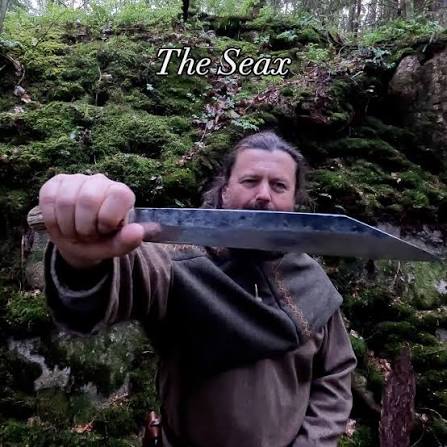
The seax as an English ethno-national equivalent to the kirpan
As most will know, the UK government has been steadily working to prevent UK citizens from carrying weapons of any time … except the religious exception for Sikhs to carry the kirpan, which is part of their faith. John Carter claims that the case for the Saxons to carry the seax is at least as strong:
Infamously, as one of its many assaults upon British tradition – the latest of which is the end of jury trials, a right Englishmen have enjoyed since the Magna Carta – the decline’s managers disarmed the British people. The right of (Protestant) Englishmen to keep and bear arms was enshrined in the Glorious Revolution’s 1689 Bill of Rights. The Second Amendment of the American Constitution’s Bill of Rights is essentially a reiteration of this ancient right of Englishmen; indeed, one of the complaints of the revolutionary colonists was that their rights as Englishmen were not being respected by the English crown. The right to bear arms was first expressed in the 1689 Bill of Rights, but its origin is much older, in the ancient Germanic understanding that a free man is an armed man, and that only slaves are prohibited the means of assuring their personal security. Britain’s managerial regime spent the twentieth century patiently gnawing away at the right to bear arms. It began its assault with licensing requirements in 1920, finally escalating to absolute bans following the 1988 Hungerford massacre and the 1996 Dunblane massacre.
As with all of its petty oppressions, the excuse for banning firearms has always been public safety, which the Yookish regime claims to prize much more highly than public liberty, which it does not claim to prize at all, that being the only honest thing about it. The sincerity of these invocations of safety is rendered dubious by the simultaneous premium Westminster, Whitehall, Number 10 Downing, and Buckingham Palace place upon the uninterrupted mass importation of humanoid dross from the most violently dysfunctional countries on the planet, which (notably) started in earnest at almost exactly the same time that the British people were disarmed.
It was not enough to take away the tools of self-defence. The principle of self-defence was also effectively eliminated: if a private citizen injures or kills a criminal in the course of defending himself against criminal predation, he will be charged as a criminal himself. The British people are expected to outsource their personal defence to police who refuse to defend them, in a country to which their government deliberately imports as many dangerous men as it can. Notably, defence against dangerous men of diversity is particularly frowned upon, because this is racist; indeed, even to complain about diversity danger is treated as a worse crime than rape, robbery, assault, or murder. The Yookay arrests more people for speechcrime than any other country on the planet.
Since firearms are banned, Britain’s criminal element has turned to knives, leading to a long-standing hysteria over knife crime. “Zombie-style knives” and “ninja swords” were banned in 2024 and 2025, while online knife sales now require 2-step age verification. There have even been calls to ban knives with sharp points, which would present certain challenges to the culinary arts. Meanwhile the stop-and-search policies intended to control knife crime on the streets are routinely derided as racist, as it is (surprise!) overwhelmingly young black men who are caught with concealed knives, which of course they conceal because their intent is to use them in the commission of robbery, assault, and murder. Which the British people are not permitted to defend themselves from, and which the Yookish police refuse to do anything about.
All of this raises the question of why, precisely, Digwa was walking around with a big knife.
The answer to this is that Digwa is a Sikh, and Sikhs have a special carve-out for the kirpan, a ceremonial knife which their religion mandates they carry with them at all times, as (if I understand correctly) a symbol of resistance to oppression and their readiness to always be prepared to defend the weak from injustice. Symbolic or not, the kirpan is a very real knife, with a very real edge.
The special religious dispensation granted Britain’s Sikhs is merely the most visible double-standard when it comes to keeping weapons. We saw another example during the Southport riots, when large numbers of Muslims turned out on the streets with machetes. Rather than arresting the lot of them (which the Yookish authorities couldn’t do, as they were busy filling the prisons with British protesters), the law enforcement officers on the scene advised them to hide their weapons in their mosque, which out of respect for the delicate sensibilities of the vibrant Islamic community the police would certainly never even dream of searching. One wonders just how many mosques are hiding caches of weapons.
Unlike the benevolently blind eye the Yookish authorities cast upon their treasured Muslims, however, the Sikh exemption is actually written into law.
As the Nowak case broke across social media a few days ago, a lot of people called for an end to this double standard. If whites are disarmed, then everyone else should be as well. There should be no special treatment on account of their heathen gods.
This is an understandable position, but I think it’s the wrong one. It is the thought pattern of The Raped.
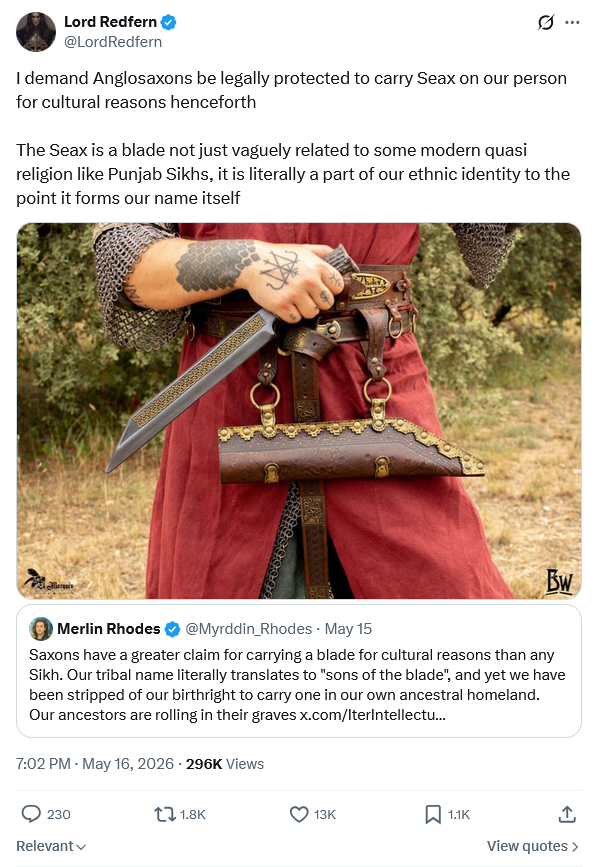
Rather than wanting to drag Sikhs down to the subbasement of slavish cuckery into which they’ve been pressed, Anglo-Saxons should instead demand that they, too, be allowed to arm themselves.
The Sikh argument is that their faith requires that they be armed at all time.
The Saxon argument is similar to the Sikh, but if anything it is even more fundamental.
The name Saxon derives from the seax, the characteristic short sword carried by the Germanic invaders who made England their home in the 5th century. “Saxon” literally means “the sons of the knife”, “the people of the blade”, or “the swordsmen”.
The very identity of our tribe is intertwined with privately held armaments. This is pre-political; it’s pre-religious; for the Saxon, armaments are an identitarian symbol that goes to the very core of what a Saxon is. To remove the seax from the Saxon is to strip him of his identity. Which, of course, is the avowed goal of the Fabian social engineers who have laboured for generations to reconstitute the definite form of the Anglo-Saxon into a pliable mush of generic, vaguely-defined, ahistorical, and universally extensible “values” that no Anglo-Saxon had even heard of until five minutes ago.
The same principle obviously applies to knife crime. Criminals are opportunistic predators. They avoid hard prey. There’s profit in jacking up easy meat to get a free iPhone, but not so much in getting stabbed into fresh meat yourself. If every Saxon wore a seax, street crime would very rapidly become a non-issue.
Of course, from the perspective of the Yookish governing apparat, the powerlessness of its subjects against criminal predation is quite an insignificant price to pay in exchange for ensuring the powerlessness of the autochthonous helotry against the apparat itself. If anything it’s a bonus. The regular humiliation of being forced to endure low-level criminality encourages a feeling of helplessness. The rainbow communists will therefore never “allow” the Saxon to rearm himself.
But what if the Saxon wore the seax without permission?
Comments Off on The seax as an English ethno-national equivalent to the kirpan
LMG-25: The Swiss Toggle-Locked Light Machine Gun
Forgotten Weapons
Published 29 Dec 2025The LMG-25 was designed by Adolph Furrer at Waffenfabrik Bern in the 1920s. Furrer was a devoted fan of the toggle locking system, and also designed a toggle-locked submachine gun that Switzerland (unwisely) adopted in 1941. The LMG-25 was first produced in 1924, adopted in 1925, and remained in production until 1946 with a total of 23,045 standard models and 1,742 optics-equipped fortress models made.
It is chambered for the standard 7.5x55mm Swiss cartridge with a 30-round side-mounted magazine (interchangeable with the later Stgw 57 magazine, incidentally). It is an effective design, if expensive to produce, and served Switzerland well for several decades.
(more…)
Comments Off on LMG-25: The Swiss Toggle-Locked Light Machine Gun
May 16, 2026
The failure of Operation Crossbow in 1943-45
Timing is everything in war — well, if not everything, it’s extremely important. An example was the development delays for the German V-1 and V-2 systems that kept them from being a potentially devastating weapon against the Anglo-American invasion forces on D-Day. Secretary of Defense Rock explains why allied air attacks to suppress the German launch sites were an almost unmitigated failure:
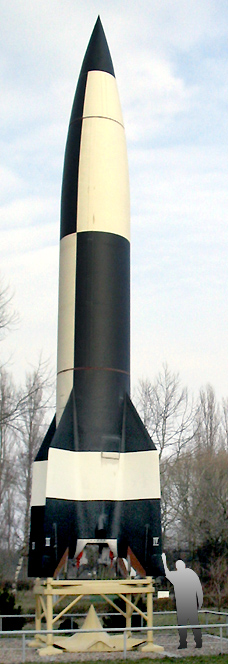
German A4 or V-2 replica at Peenemünde
Photo from Wikimedia Commons.
Two campaigns separated by 50 years — the Anglo-American CROSSBOW campaign against German V-weapons in 1943–1945 and the “Great Scud Chase” of Desert Storm in 1991 — suggest that what is happening over Iran today is not a deviation from the norm but simply a repeat of it. As Colonel Mark Kipphut argued in his 1996 study comparing the two campaigns, the failure to internalize CROSSBOW’s lessons was itself one of the reasons those same failures were repeated in 1991; the present campaign against Iran suggests we might still not have learned them.1
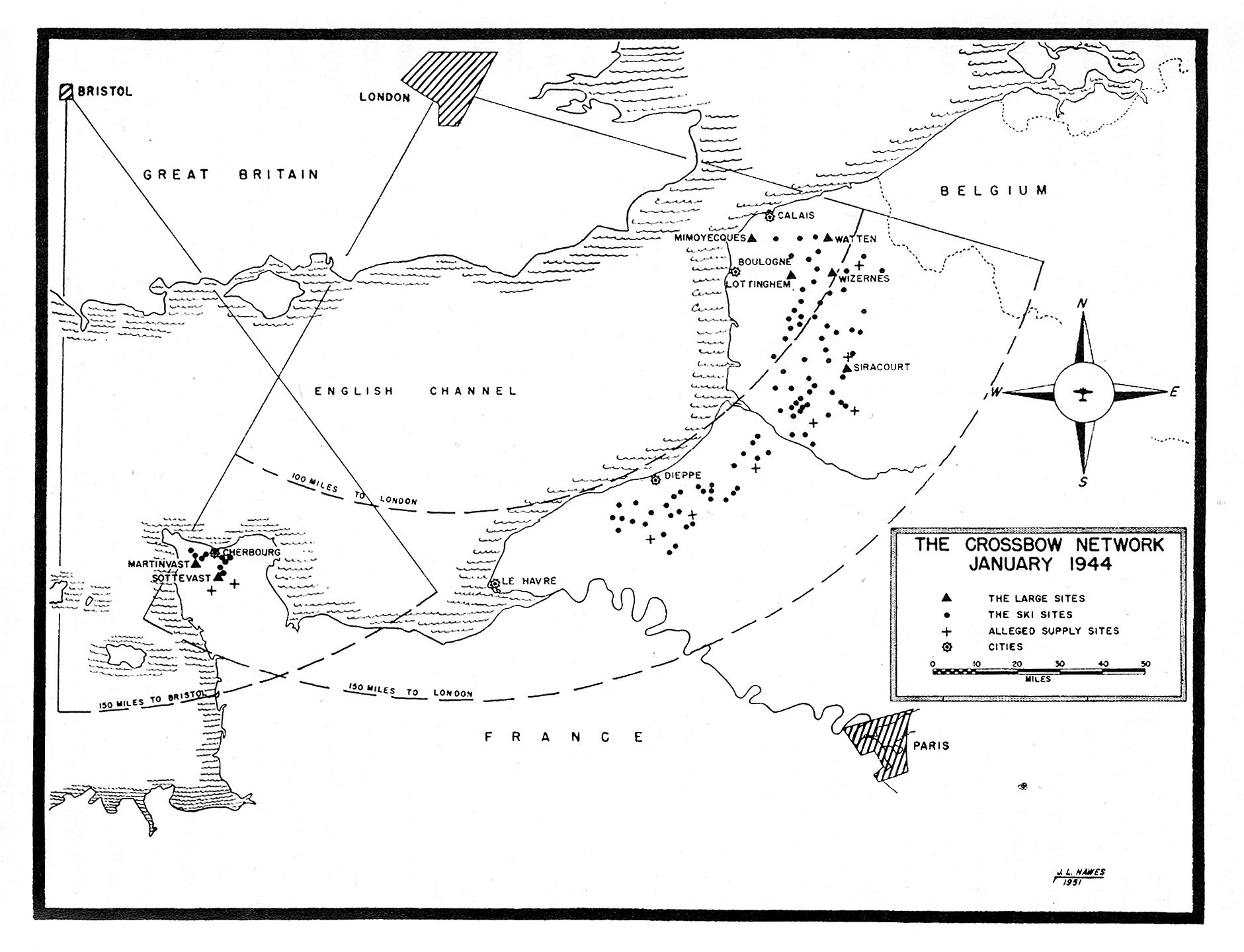
The first lesson of CROSSBOW is that fixed infrastructure is easy to destroy and that adversaries do not stay fixed for long. British intelligence had received “reliable and relatively full information” on German long-range weapons as early as November 1939 two months into the war.2 It wasn’t till four years later, in 1943, that Allied photo-reconnaissance first identified the German “ski-sites” in northwestern France, named for the curious shape of one of the buildings on each launcher complex.3 Within weeks, the U.S. Strategic Bombing Survey would later report, ninety-six sites had been cataloged, and a sustained bombing offensive against them had begun. Of these ninety-six sites, no more than two were ever used operationally.4 On its face, this was a complete victory. Allied airpower had, by direct attack, denied the Luftwaffe permanent launching infrastructure before the V-1 campaign could begin.5
The Germans drew the obvious conclusion. The Survey noted that during the period of the Allied counterattack, the Germans developed methods for launching V-1s and V-2s from small, inconspicuous sites that required minimal engineering work and freed firing operations from the elaborate sites originally planned.6 These were the “modified sites”, first photographed on April 26, 1944, which were well camouflaged, dependent largely on prefabricated buildings, of which more than sixty had been identified before the first V-1 was launched in England in mid-June.7 The “modified sites”, the Survey concluded plainly, were “heavily bombed without marked effect on the scale of effort”.8
Kipphut, working from the same primary documents, formalizes the consequence as a two-phase division of the campaign. CROSSBOW I, running from April 1943 to early June 1944, was a qualified success: it delayed the start of V-weapon attacks by an estimated three to six months and so allowed OVERLORD to proceed before the full weight of Hitler’s missile arsenal could be brought to bear.9 Eisenhower himself wrote that had the Germans perfected the weapons six months earlier, the invasion of Europe would have been “exceedingly difficult, perhaps impossible”, and that a sustained V-weapons attack on the Portsmouth-Southampton embarkation area could have caused OVERLORD to be written off entirely.10 CROSSBOW II, however, the campaign to suppress launches once they had begun, was in Kipphut’s assessment a “dismal failure”; despite thousands of sorties against more than 250 targets in the critical summer of 1944, the Germans averaged just over 80 launches per day, and German sources contend they never failed to launch on account of either Allied air attack or weapons shortages.11
A World War II map shows the two areas where the Germans were setting up their secret “V” weapons to bombard England (right, center). These are the areas in which the Royal Air Force and 8th Air Force heavy bombers concentrated their bombs in order to knock out the weapons — part of the pre-invasion plan. This event was given the operational code name Crossbow during World War II. The grouping (left, center) is the site of the Invasion of Normandy.
The implications for Allied resource allocation were severe. Between the beginning of May 1943 and the end of March 1944, nearly 40% of Allied reconnaissance sorties over Europe were devoted to supporting CROSSBOW, with those planes taking more than 1.25 million photographs and service members preparing more than 4 million prints for study and analysis.12 Over the course of the campaign, U.S. and British air forces flew approximately 68,913 sorties against CROSSBOW targets and dropped roughly 136,789 tons of munitions.13 During the thirteen-month peak period from August 1943 to August 1944, the joint strategic-bomber effort absorbed 13.7% of its sorties and 15.5% of its tonnage on V-weapon targets.14 By the autumn of 1944 and into the winter, RAF Fighter Command devoted 79% of its offensive sorties to CROSSBOW.15 Eisenhower, faced with the apparent failure of CROSSBOW II to suppress the launches that began on D-Day plus seven, directed that V-weapon suppression take priority over all other Allied air operations, including direct support to the Normandy lodgment and the Combined Bomber Offensive.16
That bombing, which failed against the dispersed V-2 launch sites, was almost overdetermined. The Survey concluded bluntly that after the initial Allied success, the firing sites for V-2s were small, well camouflaged, and made poor targets for bombers.17 No comparable problem arises with a factory complex. The V-2 launcher, like the modified V-1 ramp, was small, mobile, and concealable, and the strategic-bomber instrument was designed and procured to flatten large, stationary targets. In the end, Kipphut notes, silencing the V-weapons required ground forces to overrun the launch sites.18
- Mark E. Kipphut, “Crossbow and Gulf War Counter-Scud Efforts: Lessons from History”, Counterproliferation Paper No. 15 (Maxwell AFB, AL: USAF Counterproliferation Center, February 2003), 1–3. Originally published in Airpower Journal, Winter 1996.
- Wesley Frank Craven and James Lea Cate, eds., The Army Air Forces in World War II, vol. 3, Europe: Argument to V-E Day: January 1944 to May 1945 (Chicago: University of Chicago Press, 1951), 89.
- United States Strategic Bombing Survey, V-Weapons (Crossbow) Campaign, Military Analysis Division, 2nd ed. (Washington, D.C., January 1947), 5–6.
- Ibid, 6.
- Craven and Cate, eds., have a full chapter on the operational history of CROSSBOW, 84-106.
- Ibid, 2.
- Ibid, 6.
- Ibid, 6.
- Kipphut, 7–8.
- Dwight Eisenhower, Crusade in Europe (New York: Doubleday, 1948), 260, quoted in Kipphut, 5.
- Kipphut, “Crossbow and Gulf War Counter-Scud Efforts”, 8, citing Phillip Henshall, Hitler’s Rocket Sites (New York: St. Martin’s Press, 1985), 187.
- Craven and Cate, eds., 89.
- Kipphut, “Crossbow and Gulf War Counter-Scud Efforts”, 8
- USSBS, “V-Weapons (Crossbow) Campaign”, 28.
- USSBS, “V-Weapons (Crossbow) Campaign, 28”; Kipphut, 8–9.
- Kipphut, 5.
- USSBS, “V-Weapons (Crossbow) Campaign”, 7
- Kipphut, 10.
Comments Off on The failure of Operation Crossbow in 1943-45
Indonesian M95/51 Mannlicher Carbine & Short Rifle Converted to .303 British
Forgotten Weapons
Published 27 Dec 2025When Indonesia won its independence in 1949, its military had a real mess of different equipment. The SMLE was adopted as the first standard rifle, but these were in short supply and a lot of Arisakas and Dutch Mannlichers were also in the country’s possession. Looking for a weapon for rural police using the now-standard .303 British cartridge, the Indonesian government decided to revisit a program to convert 6.5mm M95 rifles and carbines to .303 — something initially done with Australian help in 1941.
With Australian advisors from Lithgow, the Indonesian PSM factory gear conversions in 1951, and continued them into early 1955. In total, 13,999 M95/51 conversions were made, 9,904 of them carbines and 4,905 short rifles. They were made by reboring the original 6.5mm barrels to .303 and reaming the chambers out (although this does result in a slight double shoulder to fired cases). The carbines (with 19″ barrels) were fitted with a variety of muzzle brakes, and made for an as-yet unidentified pattern of bayonet. The short rifles (with 26″ barrels) were given new 2-position rear notch sights, but left using standard Dutch M95 bayonets.
The guns were used in police and possibly military training roles until removed from service in 1961. A batch was sold as surplus in 1962 to InterArms, and another batch was found in the late 1970s and sold to Odin in the early 1980s. The InterArms guns tend to be in better condition, and have intact Indonesian markings, where the Odin guns are generally rougher and have the government property marks ground off.
(more…)
Comments Off on Indonesian M95/51 Mannlicher Carbine & Short Rifle Converted to .303 British
May 13, 2026
Between SMG and PDW: Sweden’s CBJ-MS
Forgotten Weapons
Published 20 Dec 2025The CBJ-MS is a submachine gun designed by Swedish arms developed Carl Bertil Johansson, perhaps better known for his remarkable armor-piercing 6.5x25mm CBJ cartridge. He developed the gun at about the same time as the cartridge, on his own time while working at the Carl Gustafs factory in Eskilstuna. While it bears a lot of visual similarities to the Uzi, and it is an open-bolt simple blowback action, it has a unique and clever fire control system — and several other creative features as well.
(more…)
Comments Off on Between SMG and PDW: Sweden’s CBJ-MS
May 9, 2026
M1E5 Experimental Paratrooper Garand
Forgotten Weapons
Published 17 Dec 2025In January 1944 men of the 93rd Infantry Division field-modified an M1 to give it a shorter (18″) barrel, and the rifle was sent back to the US and tested by the Infantry Board. The idea was that a rifle like this might be of use to paratroopers, being more powerful than the M1A1 Carbine they were already using. The job of exploring the idea was given to John Garand at Springfield Armory, and he began work that same month.
One example was made in the spring of 1944, using an underfolding stock designed by Garand (for which he received a patent in 1949). It was 5″ shorts and 1.2 pounds lighter than a standard M1, but exhibited excessive blast and concussion. The initial design used the folding stock with a traditional grip, and this was found uncomfortable (no surprise there). The rifle was refitted with a rather odd steel pistol grip, but this was also not a great solution. By this time testing found the whole thing undesirable and it went no farther.
Thanks to the Springfield Armory National Historic Site for giving me access to this truly unique specimen from their reference collection to film for you! Don’t miss the chance to visit the museum there if you have a day free in Springfield, Massachusetts: https://www.nps.gov/spar/index.htm
(more…)
Comments Off on M1E5 Experimental Paratrooper Garand


