Over the past weekend I watched Trumbo, the story of the Marxist screenwriter blacklisted by Hollywood during the Red Scare back in the 1950s. To say that I watched it with a jaundiced eye would be a very big understatement, because I suspected (just from the trailer) that the movie would just be one big blowjob for both Dalton Trumbo and his merry little band of Commiesymps who infested Hollywood back then.
And it was. Needless to say, the movie made villains of the conservatives who opposed the Marxist infiltration: people like John Wayne and Hedda Hopper in particular, Wayne because Wayne, and Hopper because she had a son serving in the U.S. Navy during the Korean War. Of course Wayne was made out to be a bully and Hopper a vindictive bitch — and the Senators and Congressmen who haled the Commies in front of the Senate and House Un-American Committee (HUAC) were depicted as ideological purists who saw Communists behind every bush — even though, in the case of Hollywood, there were Commies behind every bush at the time.
Of course, much was made of the fact that being a Communist wasn’t actually illegal (then, and now), and Trumbo made a great show of this being a First Amendment issue — which it was — and how these Commies all wanted to improve America, but of course there were evil right-wingers like Wayne, Joe McCarthy and HUAC harassing them at every turn.
The execution of the traitors Julius and Ethel Rosenberg got a little puff piece in the movie, which didn’t — couldn’t — actually say they weren’t guilty of
treasonespionage, so it was brushed over with the throwaway that it was the first execution for espionage in peacetime, as though peacetime should give espionage a pass. And if that wasn’t enough, the Rosenberg children were paraded around as sympathy magnets — as they still are — because Communists have no problem using children to serve their own purposes.Kim du Toit, “Blacklists Matter”, Splendid Isolation, 2020-07-28.
November 1, 2020
QotD: Trumbo
October 31, 2020
Modern Halloween costumes show us how wealthy we have become
Richard Lorenc looks back at the “costumes” for Halloween from the 1970s and 1980s to help illustrate how much our general economic picture has improved since those dark days:
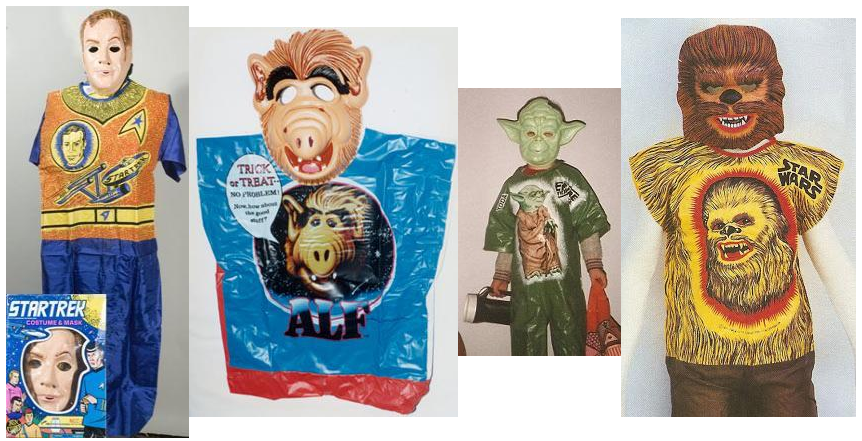
While my husband and I were recently struggling to figure out our costumes for this Halloween (and we still don’t have any idea), he pulled up some old commercials on YouTube. The off-the-shelf options that trick or treaters had were, in a word, pitiful.
Basically, costume makers thought it was ok to make a front-only plastic mask (in any color, really) of a character and top it off with a plastic smock featuring an illustration of said character with either its name or the name of the show or movie it comes from. There was no attempt to dress in the character’s actual attire. If you wanted that, you’d either have to know a professional costumer or cobble together something from your closet.
Take a look for yourself at just how costume-poor we used to be:
Obviously, every costume is an opportunity to generate interest in a brand or franchise, and slapping on a logo is an easy way to get a name out there, but these costumes truly heralded a dark time for Halloween. Some may even argue that it demonstrated crass consumerism at its worst, with cynical companies taking the easiest route to grabbing a couple of bucks from desperate parents.
The truth of the tragedy of terrible old Halloween costumes has to do with a simple idea: specialization.
[…]
The next time you compare our screen-accurate store-bought costumes of Darth Vader and Mr. Incredible to those of yesteryear, remember that we enjoy them today not because previous generations didn’t care for accurate costuming, but because growing trade across the globe has generated so much wealth for each of us that we can now demand things we may have only imagined previously.
I only realized as I got ready to schedule this post that it was an article I’d blogged a couple of years back, but the point of the story is still relevant even in our pandemic-wracked economy of 2020.
October 30, 2020
Covid Mask – Monster Mash parody – Halloween lightshow 2020
Paul Glozeris
Published 15 Oct 2020lyrics by Dale Officer
H/T to Melanie Nilles for the link.
Halloween Special: H. P. Lovecraft
Overly Sarcastic Productions
Published 31 Oct 2018HAPPY HALLOWEEN IT’S TIME TO GET SPOOKY WITH HISTORY’S MOST PROBLEMATIC HORROR WRITER LET’S GOOOOO
While there’s something to be said for separating the art from the artist, I think there’s a lot of merit in CONTEXTUALIZING the art WITH the artist. Did Lovecraft write some pretty incredible horror? Sure! Was he also a raging xenophobe? Absolutely! Are his perspectives on life connected with the stories he felt compelled to tell? Duh! If you look at Lovecraft’s writing through the lens of his life, clear patterns emerge that allow us to pin down what exactly he built his horror cosmology out of. It’s an invaluable analytical tool that allows us to take apart his writings by getting inside his head. So before you yell at me for Not Separating The Artist From The Art, know that it was completely intentional and I’m not sorry.
3:20 – THE CALL OF CTHULHU
8:40 – COOL AIR
10:36 – THE COLOR OUT OF SPACE
14:38 – THE DUNWICH HORROR
19:32 – THE SHADOW OVER INNSMOUTHPATREON: www.patreon.com/user?u=4664797
MERCH LINKS:
Shirts – https://overlysarcasticproducts.threa…
All the other stuff – http://www.cafepress.com/OverlySarcas…
From the comments:
Overly Sarcastic Productions
1 year ago
Hey gang! Can’t help but notice the comment section is a little bit on fire. That’s all good with me, but one recurring complaint I’ve noticed has started to get under my skin – namely that my explanation of non-euclidean geometry was insufficient, or even – dare I say – inaccurate. Now this is a fair complaint, because after a lifetime of experience finding that people’s eyes glaze over when I talk math at them, I concluded that interrupting a half-hour horror video with a long-winded explanation of a mathematical concept wouldn’t go over too well. I put it in layman’s terms and used a simple example to illustrate the point. However, since some of the more mathematically-inclined of you took offense, I now present in full a short (but comprehensive) explanation of what exactly non-euclidean geometry is.First, we axiomatically establish euclidean geometry. Euclidean geometry has five axioms:
1. We can draw a straight line between any two points.
2. We can infinitely extend a finite straight line.
3. We can draw a circle with any center and radius.
4. All right angles are equal to one another.
5. If two lines intersect with a third line, and the sum of the inner angles of those intersections is less than 180º, then those two lines must intersect if extended far enough.Axiom #5 is known as the PARALLEL POSTULATE. It has many equivalent statements, including the Triangle Postulate (“the sum of the angles in every triangle is 180º”) and Playfair’s Axiom (“given a line and a point not on that line, there exists ONE line parallel to the given line that intersects the given point”).
Euclidean geometry is, broadly, how geometry works on a flat plane.
However, there are geometries where the parallel postulate DOES NOT hold. These geometries are called “non-euclidean geometries”. There are, in fact, an infinite number of these geometries, and because the only defining characteristic is “the parallel postulate does not hold”, they can be all kinds of crazy shapes. (As you can see, my explanation of “this is just how geometry works on a curved surface” is quite reductive, but at the same time serves to get the general impression across without going into too much detail.)
An example of a non-euclidean geometry is “Elliptic geometry”, geometry on n-dimensional ellipses, which includes “Spherical geometry” as a subset. Spherical geometry is, predictably enough, how geometry works on the two-dimensional surface of a three-dimensional sphere.
In spherical geometry, “points” are defined the same as in euclidean geometry, but “line” is redefined to be “the shortest distance between two points over the surface of the sphere”, since there is no such thing as a “straight line” on a curved surface. All “lines” in spherical geometry are segments of “great circles” (which is defined as the set of points that exist at the intersection between the sphere and a plane passing through the center of that sphere).
The axiom that separates spherical geometry from euclidean geometry and replaces the parallel postulate is “5. There are NO parallel lines”. In spherical geometry, every line is a segment of a great circle, and any two great circles intersect at exactly two points. If two lines intersect when extended, they cannot be parallel, and thus there are no parallel lines in spherical geometry.
Since the Parallel Postulate is equivalent to Playfair’s Axiom, the fact that no parallel lines exist in spherical geometry negates Playfair’s Axiom, which thus negates the Parallel Postulate and defines spherical geometry as a non-euclidean geometry. Also, since the Triangle Postulate is another equivalent property to the Parallel Postulate, it is thus negated in spherical geometry. Hence, my use in-video of an example of a triangle drawn on the surface of a sphere whose inner angles sum greater than 180º.
Hope that cleared things up (and helped explain why I didn’t want to say “see, non-euclidean geometry is just a geometry where Euclid’s Parallel Postulate doesn’t hold – hold on, let me get the chalkboard to explain what THAT is-” in the video)
Peace!
-R ✌️

October 29, 2020
The Curse of the Mad Butcher: A New Orleans Folktale
Atun-Shei Films
Published 22 Oct 2019Spooky season is upon us, and leading up to Halloween, I’ll be sharing with you “true” New Orleans folktales and ghost stories popular among our city’s ghost tour guides. The 700 block of Ursulines Avenue in the French Quarter would be completely unremarkable… if not for the three eerily similar murders that have been committed there over the last 120 years.
Support Atun-Shei Films on Patreon ► https://www.patreon.com/atunsheifilms
#NewOrleans #GhostStory #Folklore
Watch our film ALIEN, BABY! free with Prime ► http://a.co/d/3QjqOWv
Reddit ► https://www.reddit.com/r/atunsheifilms
Twitter ► https://twitter.com/alienbabymovie
Instagram ► https://www.instagram.com/atunsheifilms
Merch ► https://atun-sheifilms.bandcamp.com
QotD: The art of the politician
The perfect politician, as the perfect salesman, sells this “vision” — dwarfing any specific programme with its stated assumptions and checkable facts. Details, details; to the uninitiated, these are always boring, and the voting masses will never be initiated. The people, especially in this Age of Netflix, want entertainment, and what they call “leadership.” A leader is a person who does your thinking for you. In politics, he has a rôle like that of film director, in a movie where he will be the principal star. We must go through the movie emotionally on his side; grieve his little setbacks, feel that we participate when he wins. Black hats, white hats: his opponents are clearly marked and can be seen at every moment to be deplorable.
David Warren, “Now playing”, Essays in Idleness, 2018-07-13.
October 27, 2020
America’s “brutal system of slavery [was] unlike anything that had existed in the world before”
I missed this article by Kay S. Hymowitz when it was published by City Journal a couple of weeks back:
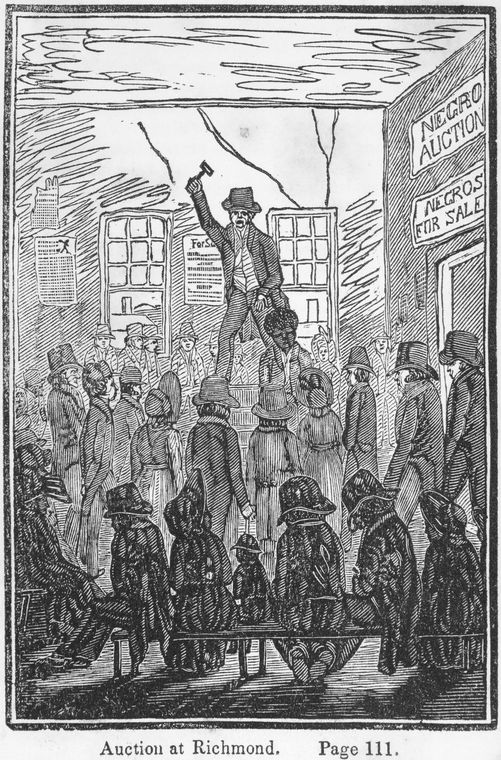
Auction at Richmond. (1834)
“Five hundred thousand strokes for freedom ; a series of anti-slavery tracts, of which half a million are now first issued by the friends of the Negro.” by Armistead, Wilson, 1819?-1868 and “Picture of slavery in the United States of America. ” by Bourne, George, 1780-1845
New York Public Library via Wikimedia Commons.
… slavery was a mundane fact in most human civilizations, neither questioned nor much thought about. It appeared in the earliest settlements of Sumer, Babylonia, China, and Egypt, and it continues in many parts of the world to this day. Far from grappling with whether slavery should be legal, the code of Hammurabi, civilization’s first known legal text, simply defines appropriate punishments for recalcitrant slaves (cutting off their ears) or those who help them escape (death). Both the Hebrew Bible and the New Testament take for granted the existence of slaves. Slavery was so firmly established in ancient Greece that Plato could not imagine his ideal Republic without them, though he rejected the idea of individual ownership in favor of state control. As for Rome, well, Spartacus, anyone?
In the ancient world, slaves were almost always captives from the era’s endless wars of conquest. They were forced to do all the heavy labor required for building and sustaining cities and towns: clearing forests; building roads, temples, and palaces; digging and transporting stone; hoeing fields; rowing galley ships; and marching to almost-certain death in the front line of battle. Women (and often enough boy) slaves had the task of servicing the sexual appetites of their masters. None of that changed with the arrival of a new millennium. Gaelic tribes took advantage of the fall of the Roman Empire to raid the west coast of England and Wales for strong bodies; one belonged to a 16-year-old later anointed St. Patrick, patron saint of Ireland. “In the slavery business, no tribe was fiercer or more feared than the Irish,” writes Thomas Cahill in How the Irish Saved Civilization.
Today, of course, the immorality of slave-owning is as clear as day. But in the premodern world, no neat division existed between evil slaveowners and their innocent victims. Once the Vikings arrived in their longboats in the 700s, the Irish enslavers found themselves the enslaved. Slavery became the commanding height of the Viking economy; Norsemen raided coastal villages across Europe and brought their captives to Dublin, which became one of the largest slave markets of the time. The Vikings thought of their slaves as more like cattle than people; the unlucky victims had to sleep alongside the domestic animals, according to the National Museum of Denmark in Copenhagen. Norsemen rounded up captured Irish men and women to settle the desolate landscape of Iceland; scientists have found Irish DNA in present-day Icelanders, a legacy of that time. The Slavic tribes in Eastern Europe were an especially fertile supplier for Viking slave traders as well as for Muslim dealers from Spain: their Latin name gave us the word slave. Slavs were evidently not deterred by the misery they must have suffered; when Viking power waned by the twelfth century, the Slavs turned around and enslaved Vikings as well as Greeks.
Slavery was a normal state of affairs well beyond the territory we now call Europe. The Mayans had slaves; the Aztecs harnessed the labor of captives to build their temples and then serve as human sacrifices at the altars they had helped construct. The ancient Near East and Asia Minor were chockfull of slaves, mostly from East Africa. According to eminent slavery scholar Orlando Patterson, East Africa was plundered for human chattel as far back as 1580 BC. Muhammad called for compassion for the enslaved, but that didn’t stop his followers from expanding their search for chattel beyond the east coast into the interior of Africa, where the trade flourished for many centuries before those first West Africans arrived in Jamestown. Throughout that time, African kings and merchants grew rich from capturing and selling the millions of African slaves sent through the Persian Gulf and Indian Ocean to Persians and Ottomans.
From the fifteenth to the eighteenth centuries, the North African Barbary coast was a hub for “white slavery.” This episode was relatively short-lived in the global history of slavery, but one with overlooked impact on Western culture. Around 1619, just as the first Africans were being sailed from the African coast to Jamestown, Algerian and Tunisian pirates, or “corsairs” as they were known, were using their boats to raid seaside villages on the Mediterranean and Atlantic for slaves who happened in this case to be white. In 1631, Ottoman pirates sacked Baltimore on the southern coast of Ireland, capturing and enslaving the villagers. Around the same time, Iceland was raided by Barbary corsairs who took hundreds of prisoners, selling them into lifetime bondage.
Conspiracy theories grow thanks to mistrust of public officials and media
It’s commonplace to say that such-and-such a conspiracy theory is merely an intellectual playground for the paranoid and the gullible, but conspiracy theories don’t spontaneously generate — at least not the ones that gain wide audiences. Daniel Miller looks at some of the reasons these theories become attractive and gain adherents:

QAnon alleged clues about the NYC bombing, 10 December 2017.
Wikimedia Commons.
In the wake of six months of mixed-messages and baffling government policies, following four years, if not twenty years, of mystifying imponderables, the concept of a “conspiracy theory” has recently reentered the lexicon of semi-criminalized thought.
In August The New York Times stigmatized anti-lockdown protesters in Berlin as a worrying admixture of “neo-Nazi groups, conspiracy theorists as well as Germans who said they were fed up with the restrictions” and similar language was used about the protesters in London, as social media companies began purging accounts linked to the QAnon conspiracy theory, which conjectures that the world is controlled by a secret global cabal of blood-drinking sex criminals.
Believing conspiracy theories, evidently, is a Bad Thing, but any concept capacious enough to incorporate both the tens, even hundreds of millions of people skeptical about the global political response to SARS-2, and the much smaller number entertaining more involved explanations demands a careful analysis.
Really the first question is who you can trust. One answer is the official authorities, as represented by the esteemed New York Times, but the news website which welcomed the 45th US President to office with three years of spurious coverage of what turned out to be the Russiagate hoax, before pivoting to the historical phantasmagoria of the 1619 Project, no longer strikes everyone as the impeccable source which revealed the existence of Saddam Hussein’s WMD stockpile and links to Al-Qaeda before the 2003 invasion of Iraq, or whose Pulitzer Prize winning journalist Walter Duranty discounted rumours of a 1933 famine in the Soviet Union as “an exaggeration or malignant propaganda.”
This leaves individuals only to their own wits and devices in the face of a puzzling world in which information is everywhere, much of it questionable, not all the facts are available, and many are ultra-politicized, and meanwhile, unknown agendas are being continually carried out.
What’s really going on? As with any speculative enterprise, the problem is to construct a plausible hypothesis by using various models to interpret limited data. There is no question that, at different moments in history, individuals and groups have worked together in secrecy to launch conspiratorial exploits and there is no obvious reason for thinking this practice has now totally ceased. “People of the same trade seldom meet together,” observed Adam Smith in 1776, “even for merriment and diversion, but the conversation ends in a conspiracy against the public.” Still, this is not in itself evidence of any specific plot happening now.
QotD: Trader Joe’s
Jim Treacher, “Trader Joe’s Apologizes for Being Racist”, P.J. Media, 2020-07-20.
October 25, 2020
The Crimes of Madame Delphine LaLaurie: The Truth Behind the Legends
Atun-Shei Films
Published 16 Dec 2019Madame Delphine LaLaurie, New Orleans’ most reviled serial killer, has become world famous thanks to American Horror Story and the wildly popular French Quarter ghost tour industry. The story of this deranged socialite who tortured, mutilated, and murdered her slaves has lost none of its horrifying bite, and the supposedly haunted mansion where her home once stood has become a major tourist attraction. Despite its popularity (or perhaps because of it), this story is steeped in legend and folklore. Most online sources about LaLaurie’s crimes are outdated, wrong, or both. In this video I attempt to separate the truth from the myth, and tell a purely historical account of the crimes of Delphine LaLaurie.
Support Atun-Shei Films on Patreon ► https://www.patreon.com/atunsheifilms
#MadameLaLaurie #NewOrleans #History
Watch our film ALIEN, BABY! free with Prime ► http://a.co/d/3QjqOWv
Reddit ► https://www.reddit.com/r/atunsheifilms
Twitter ► https://twitter.com/atun_shei
Instagram ► https://www.instagram.com/atunsheifilms
Merch ► https://atun-sheifilms.bandcamp.com
October 24, 2020
“So – a Truth and Reconciliation Commission in America?”
Arthur Chrenkoff responds to this tweet from Robert Reich:
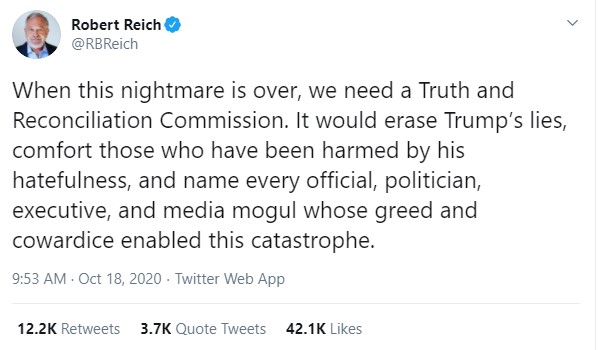
In case you are unfamiliar with the term, the Truth and Reconciliation Commission was instituted in the post-apartheid South Africa as a way of non-violently and non-punitively coming to terms with the painful racist past. It was a forum where the victims of human right abuses were able to testify about their experiences, and where some of the perpetrators could respond on record – ideally with some contrition – and request amnesty for their misdeeds. It was an exercise in “not forgotten, but possibly forgiven”, a way forward in transition to democracy that would not have to involve mass incarceration of those connected with the old regime. While criticised by many, this model of community healing is thought to have been quite successful in as much as it has been replicated in numerous other countries around the world as a way of dealing with the past and moving on. As the Good Book says, “the truth shall set you free”.
So – a Truth and Reconciliation Commission in America? You don’t have to have actually lived in a totalitarian society (even if, like with yours truly, it helps) to be taken aback at the insensitivity and the sheer tone deafness exhibited by a privileged member of the American elite (Clinton’s Labor Secretary, Berkley professor, 1 million Twitter followers) comparing the last four years in the United States to the four decades of South African apartheid or a quarter of a century of a military dictatorship in some coup-prone South American republic. Are these people really so lacking in self-awareness?
The answer is yes, and in turn it points to a more interesting socio-political phenomenon. For the past few decades, intellectuals (the great majority at various distances to the left of centre) have been looking at activists and dissidents outside of the developed, democratic “First World” – people like Nelson Mandela and Archbishop Desmond Tutu in South Africa, Ang Sang Suu Kyi in Burma/Myanmar, academics and trade unionists throughout Latin America fighting against right-wing dictatorships, and to a lesser extent those in opposition to communist dictatorships like the Dalai Lama, Lech Walesa in Poland, Vaclav Havel in Czechoslovakia, and Sakharov, Sharansky, Solzhenitsyn and others in the Soviet Union – and I think their main, if secret, reaction was envy and guilt.
Guilt because their own lives in the West were by and large safe, secure, privileged and prosperous, while their counterparts (intellectuals, artists, community leaders) in the Second and the Third World (now developing world) were putting their lives, freedom and livelihoods on the line for the principles and ideals they believed in. And envy because, as the stakes were so much higher “over there”, the lives of all these dissidents, oppositionists and human rights activists seemed so much more meaningful – and, yes, exciting. While you were pondering on the next New York Times op-ed you are going to write, while turning up to your monthly faculty meeting in your new Prius, somewhere in Africa or Asia or Latin America a prisoner of conscience was on a hunger strike, actually living the ideas you believed in and not just writing about them. Sure, it’s terrible, yet how much more interesting and consequential than your placid and predictable existence of mortgage repayments and the Monday morning undergraduate class in political theory?
The LaLaurie Mansion: A New Orleans Ghost Story
Atun-Shei Films
Published 25 Mar 2019Thought I’d try something different with this video. This is the story of famous serial killer Delphine LaLaurie and her allegedly haunted mansion.
Sorry for the background noises… such are the pitfalls of filming in the French Quarter.
Support Atun-Shei Films on Patreon ► https://www.patreon.com/atunsheifilms
#NewOrleans #GhostStory #History #AmericanHistory #MadameLaLaurie
Watch our film ALIEN, BABY! free with Prime ► http://a.co/d/3QjqOWv
Reddit ► https://www.reddit.com/r/atunsheifilms
Twitter ► https://twitter.com/alienbabymovie
Instagram ► https://www.instagram.com/atunsheifilms
Merch ► https://atun-sheifilms.bandcamp.com

October 22, 2020
Winchester Lever Action Development: Model 1895
Forgotten Weapons
Published 19 Jun 2017We have reached the final iteration of the Winchester lever action rifle development story today, the Model 1895. This was another John Browning design, although the locking system is basically the same as the 1894 but with the bolt extending over the top of the locking block and hiding it from sight.
The new feature of the Model 1895 was the replacement of the traditional tube magazine with a single stack box magazine located under the action. By this time, spitzer (pointed) bullets were becoming commonplace, to exploit the new high velocities made possible by the new smokeless powders. In a tubular magazine, these pointed bullets would rest on the primer of the next cartridge in the magazine, and ran the risk of causing rounds to detonate in the magazine tube under recoil. The box magazine, of course, negated this danger completely.
The Model 1895 was built around the .30-40 military cartridge, although was initially released in two black powder chamberings. It would eventually be offered in a wide variety of chamberings, including .30-03, .30-06, .303 British, and the .405 Winchester — Theodore Roosevelt’s “Big Medicine”. In addition, more than half of the total production (nearly 300,000 rifles) would be for the Russian military, with the rifles chambered for 7.62x54R and fitted with stripper clip guides.
Cool Forgotten Weapons merchandise! http://shop.bbtv.com/collections/forg…
http://www.patreon.com/ForgottenWeapons
If you enjoy Forgotten Weapons, check out its sister channel, InRangeTV! http://www.youtube.com/InRangeTVShow

October 21, 2020
“[A]ll white people are racists … because they participate in a system that secures their own structural advantages”
In The Line, Meaghie Champion commits some sort of thought crime by quoting Martin Luther King’s famous words (which I have been assured more than once are now “forbidden” to non-POC speakers because reasons):
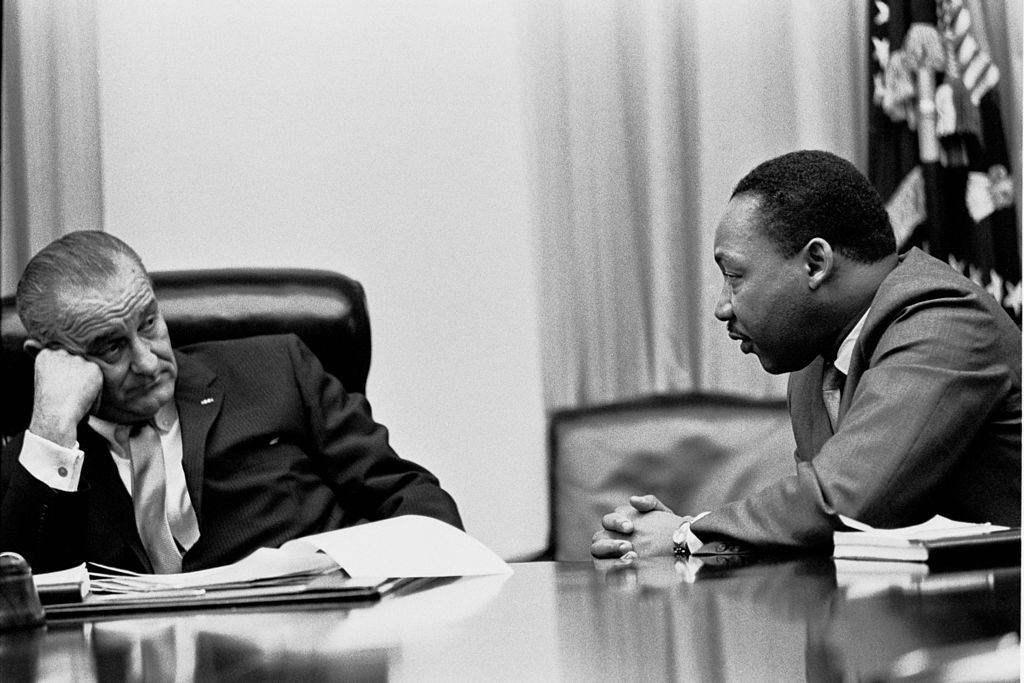
President Lyndon B. Johnson meets with Martin Luther King, Jr. in the White House Cabinet Room, 18 March 1966.
Photo by Yoichi Okamoto via Wikimedia Commons.
Most of us have been committed to the ideals of anti-racism since Martin Luther King famously delivered his “I Have a Dream Speech.” This was a masterclass of persuasion and rhetoric; one that convinced generations to re-frame their positions on racial inequity.
King said that he hoped that one day his children would grow up to be judged, not by the colour of their skin, but by the content of their character. That’s the ethos [BC NDP leader John] Horgan channelled when he said: “I don’t pay attention to skin colour or ethnicity.”
But this is not good enough for those who promote Critical Race Theory, an emerging ideology that tips these values on their head. CRT presupposes that the world is dominated by white supremacists. Further, that all white people are racists — regardless of their individual actions — simply because they participate in a system that secures their own structural advantages. CRT redefines what “racism” has traditionally meant: bigotry or discrimination based on skin colour.
Under this new ethos, only white people are capable of racism, because racism is systemic and works towards keeping all power vested in the hands of the white supremacists. I’m simplifying this, of course, because CRT is a rabbit hole best tackled by people with a lot more patience than me. One of the laziest rebuttals that CRT’s adherents use to deflect criticism is that its critics simply don’t understand it well enough, and therefore need to spend endless hours of their lives “doing the work,” integrating key academic texts, and absorbing their meaning until they fully accept the unerring truth of the ideology. If this tactic sounds indistinguishable from a deeply manipulative religious movement, well …
I’m a “person of colour” and I have spent my whole life trying to be anti-racist. I agree with the idea that there are systemic problems involving racism in many institutions within society. Some of those systemic problems are destroying Indigenous nations, including my own. Where I disagree with the Critical Race Theory crowd is in their depiction of everyone who is not a person of colour as being inherently racist. I don’t agree with their solutions for solving the racism problems we have to confront as a society. I don’t believe that they are the only ones working against racism, or coming up with viable strategies for how to do so. We can have differing views about racism and how to combat it; failing to adhere to one single philosophy, or parrot a specific set of terminology, does not mean a person is racist.
Horgan has worked for decades to do what he thought best for all the people. He’s been on our side in the struggle against racism all his life. The fact that he wasn’t up-to-date on the latest acceptable phrases to speak on the matter doesn’t negate that.
October 20, 2020
Winchester Lever Action Development: Model 1894
Forgotten Weapons
Published 17 Jun 2017The Winchester 1894 has become one of the most manufactured and most popular sporting rifles in American history, and it owes this success to a combination of factors. Mechanically, the 1894 was a continued improvement on John Browning’s already-excellent 1892 model. It was strong and simple to operate, offering both speed and power. The cartridge that cannot be separated from the history of the Winchester 94 is the .30-30 Winchester, aka the .30 WCF (Winchester Center Fire).
While the .30-30 shared a naming convention with the many black powder rounds that were in use (a .30 caliber bullet over 30 grains of powder), this new round was a smokeless powder cartridge. As such, it offered a very significant increase in velocity over everything else that was then available (just shy of 2000 fps). The cartridge was well suited for taking nearly any North American game, and the package of the 94 and the .30-30 made an outstanding general purpose weapon for a huge swathe of the American market.
By 1927, one million had been manufactured (the millionth one was presented to President Coolidge), and by 2006 production had exceeded 7 million. This truly is the iconic American deer and ranch rifle — so ubiquitous that its remarkable quality has set a new standard for the entire industry.
Cool Forgotten Weapons merchandise! http://shop.bbtv.com/collections/forg…
http://www.patreon.com/ForgottenWeapons
If you enjoy Forgotten Weapons, check out its sister channel, InRangeTV! http://www.youtube.com/InRangeTVShow