
The modern word “blockhead” […] was Lucy’s favorite label for the too-trusting Charlie Brown in the Peanuts comic strip. Lucy never tired of snatching away the football; Charlie fell for it every time. We all know the feeling: when you’re inching forward in the freeway exit lane, say, and another driver flies past and swerves onto the ramp at the last second; when your child has to complete her college-entrance exams within a designated time period, but your neighbor’s child gets twice as long because of a suddenly diagnosed “learning disability”; when you pay extra to have your pet travel in the airplane’s cargo hold but the yipping poodle across the aisle, an “emotional-support animal”, gets to ride on its owner’s lap for free. You didn’t know that you could get an emotional-support card just by claiming an anxiety disorder and paying a fee to an online agency? What are you — a chump?
What makes these indignities so infuriating isn’t just that a few people game the system. It’s that their selfish gambits work only because the rest of us follow the rules. If every driver mobbed the freeway exit from the passing lanes, traffic would come to a halt. The student who fraudulently obtains extra test time gets a leg up only if most other students stick to the original time limit. And if every pet were designated an emotional-support animal, airplanes and restaurants would become full-time menageries. (Some airlines have begun tightening rules on support animals for just this reason.)
Thousands of norms, rules, and traditions make civilized life possible. Some, like paying taxes or not littering, are enshrined in law. Others are informal. Most of us take pride in adhering to basic standards of etiquette and fairness, to say nothing of following the law. And we have a deep emotional investment in having the people around us follow these norms as well. There’s a reason that we call selfish, disruptive, or criminal behavior “antisocial”. We know that if everyone stopped paying their taxes, or started running red lights and shoplifting, our society would be on its way to collapse.
James B. Meigs, “The Chump Effect”, City Journal, 2020-11-15.
October 19, 2026
QotD: The “social norms” that enable society to exist
October 18, 2026
Singapore: The rise of Lee Kuan Yew
At The Wrong Side of History, Ed West continues his review of Lee Kuan Yew’s autobiography, detailing the difficult period after the British withdrawal from overseas military commitments “East of Suez”, including the vast naval base in Singapore and the Royal Air Force’s Changi air base:
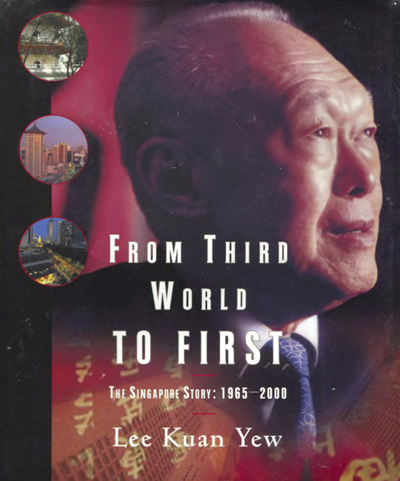
October 31, 1971, and the British are saying goodbye to their military base in Singapore, the city where the empire endured its greatest humiliation. Three years earlier, an increasingly straitened former imperial power had announced its immediate closure as part of their withdraw east of Suez. For the recently independent city-state, this was a disaster, and prime minister Lee Kuan Yew had done his best to postpone the big day. The city already suffered from high unemployment, and Britain’s military accounted for 20 per cent of Singapore’s GDP, providing 30,000 direct jobs and 40,000 in support.
Yet retreat was inevitable, and when the day came British forces were given a ceremonial send-off, Lee writes in his memoir, the withdrawal carried out with “good intentions, goodwill and good faith”. After 150 years in the Strait, the British were gone, handing over the airbase to the colony they created for the symbolic fee of one dollar.
Lee had cut his teeth in the independence movement, but the city-state could not survive without protection. As with many small countries which had depended on the British, Singapore now shifted its allegiances to its successor state, the United States of America.
The imperial retreat presented a huge financial headache for the former anti-colonial activist, but increasingly a more personal sense of unease. “I feared that slowly but inexorably British influence would decline”, he writes: “and American influence expand. For my generation born and bred in empire, it was not an easy change. I had to come to terms with American power without a British buffer. The British had enforced their will with a certain civility. The Americans were different, as I could see from the way they dealt with South Vietnamese leaders, and even with Thai and Filipino leaders who were not in as parlous a position as those in Saigon. America was a power on the ascendant, with bulging muscles and a habit of flexing them.”
Lee had built up a good relationship with both Harold Wilson and Edward Heath, and used this to delay the withdrawal for as long as possible. He had less luck in getting the British to help Singapore train their army, something they had done with Malaysia where the threat of communist insurgency necessitated it. Neither were most of the other newly independent states willing to help: Egypt’s Nasser recognised Singapore and sent good wishes, but ignored his requests for military aid. India’s prime minister Lal Bahadur Shastri also said no, so he turned to another small post-colonial nation surrounded by hostile neighbours. When a small group of Israelis arrived in November 1965, they had to keep their existence a secret to prevent unrest from the Malay minority. “To disguise their presence, we called them ‘Mexicans'”, he recalls: “They looked swarthy enough”.
The Chinese here traditionally shunned military service, “a historical legacy of the predatory habits of soldiers during the years of rebellions and warlords in China”. As trading people they looked down on the military as a career choices, and he quotes the Chinese saying “a good lad does not become a soldier, good steel does not become nails”.
Lee also had to negotiate the problem of “representation” which mars all multicultural societies. Under the British, the city had been policed by Malays, often recruited from Malaysia itself, as well as the more neutral Gurkhas. Now “we had to find some way to induct more Chinese and Indians into the police and armed forces to reflect their population mix”, otherwise they would not be accepted as legitimate. “We wanted the people to regard our soldiers as their protectors – a reversal from the days when army and police uniforms aroused fear and resentment as symbols of colonial coercion”.
Conscription, unpopular under the British, was reintroduced, and the authorities even set up military cadet corps in all secondary schools, although his colleague Goh Keng Swee reflected that “the Spartan approach to life does not come about naturally in a community that lives by buying and selling”. As with Israel, another small state formed by a market-dominant minority, they were forced to adapt their way of life to survive; yet rather than become the new Sparta, Singapore focussed on becoming the new Corinth, a commercial centre where great fortunes could be made. When the British finally withdrew, RAF Changi Air Base became Changi Airport, a transport hub which came to epitomise the city’s commercial success.
October 15, 2026
Nearly half of Cornell students report being “harassed”
William M Briggs discusses the most recent sexual harassment survey results from Cornell, where — if you take the numbers at face value — the situation is dire:
You may have heard of the depressing contretemps at Cornell of late (written in the lady’s (a hotelie) own words here, but I cannot recommended reading it). It is not a coincidence that Cornell recently asked all students about how much sexual assault and harassment they enjoyed. It is that survey which interests us, because it so closely matches the breed and we need to understand their shortcomings.
Don’t put too much blame on Cornell. New York has a law that makes them give this survey every two years. This allows bureaucrats and rulers to think that they have done something good, which is the main reason for their existence, regardless how silly the results are.
Cornell gave the “instrument” — toot, toot — to 6,000 students, but only had “757 full completions”, which is a return rate of just over 12%.
How would the missing 88% have answered? This is a key question. The assumption sociologists make is: exactly the same. Yet, as we’ll see, it is far from impossible that those who blew off the survey would have responded differently than those who did answer, especially on the questions I’ll highlight.
Naturally, a lot more ladies than men answered, because women like to “play quiz” more than men. They also had a handful of students who, it seems, were unable to identify their sex; non-science majors, one supposes. All the extra ladies would have been fine if Cornell had broken the results out by sex, which they always didn’t. It will make a difference.
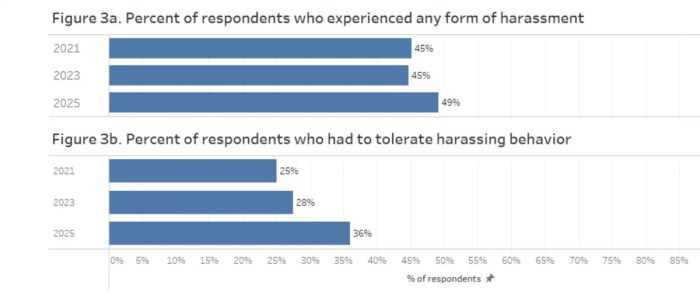
Cornell reported 49% of the students claimed that they “experienced any form of harassment”. My guess, since I am an arch sexist, is that the great bulk of that 49% were female reports. We never learn, but never mind. Let’s take the number as given.
If we extrapolate the survey results, as all good sociologists and rulers do, we would announce that half of all students were harassed. Half. Half, my dear readers, is an enormous number. Half would suggest that a small army of mouth-breathing harassers, likely from the Poetry Department, skulk around campus hiding behind bushes waiting for their chance to harass. Who could tolerate such an environment where half of all students are so abused?
I’ll tell you who: students. They can tolerate it. Because similar numbers of harassed were also reported in 2021 and 2023. Which can only mean one of two things. One: students come, they get harassed, then they come back for more of that rousing hands-on experience. They must be loving them some harassment to stick around when half get the business.
Or two: the survey and its results are, to use a technical word, bullshit.
I favor the second explanation, though I don’t entirely dismiss the first.
1980s gun myths from TV shows
On Substack, John Van Stry discusses one of the myths about guns that were commonplace in 1980s cop shows on TV:

Okay, so he’s talking handguns, but this is still kinda on-topic.
Decades ago, and I do mean decades, on one of the many police drama TV shows that existed in the 70’s, there was one about cops (of course there was!) where they followed a different set of officers (not detectives, street cops — kinda1) each week.
So in that particular episode we had these guys (I think it was two? It was more than one) going around and robbing banks and they were shooting (and of course killing) people at the banks. They were using “HIGH POWERED WEAPONS” (emphasis theirs) of some sort. I don’t remember if it was rifles (AR-15’s weren’t the boogie man back then) or pistols. I think it was pistols though, Magnums perhaps?
Anyway, cutting to the chase, we’ve got two officers “staking out” the bank that they believe is going to be next and all they’ve got are their wimpy-wimpy-wimpy (emphasis theirs) .38 revolvers. Because everyone knows being shot by a .38 is no more dangerous than being shot by a B-B gun!2
So, before the “big shootout” one officer comes up to the other and offers him a Special Bullet.3 He tells the other “I thought maybe we should have a little something to even the odds”.4
The other officer is of course duly horrified because this is NOT “regulation ammo”!
So what was this “special ammo”? Were they .357 magnum rounds? (which you might be able to shoot from some .38’s back then, if you could get them to fit, just once). Were they +P’s?5 Oh no no no no no! They were (Dun dun DAAAA!)
HOLLOW POINTS!!!!
Yup, their first bullet in their revolver was a .38 hollow point.
When the robbers attack, oh the things that happen! One officer blows one of the robber’s heads Clean OFF!! Yes, that’s right! The dreaded hollow point is so powerful it took off the guy’s head! Completely!!! I don’t recall exactly what the other robber had happen, but I think it was a hole blown throw him you could see through.6
But wait! There’s More!7
- I forget the details exactly, it was a long long time ago.
- In this episode at least — consistency from the anti-gun lefties who wrote this dreck in the 70’s was not to be expected.
- I ain’t making this part up.
- Or words that effect. Again, 50 years ago, I don’t remember the exact line.
- A lot of .38 ammo was ‘+P’ back then, because they hadn’t created the designation yet, look up the specs in the old reloading manuals if you don’t believe me.
- Props to these officers however for their first shots in each case being killing ones!
- Of course there is!
October 14, 2026
He really is the model of a modern Major-General
InfantryDort reacts to a retired US general’s opinions on public executions on X (that is, the post is on X, not the executions … but now that I think on it …)
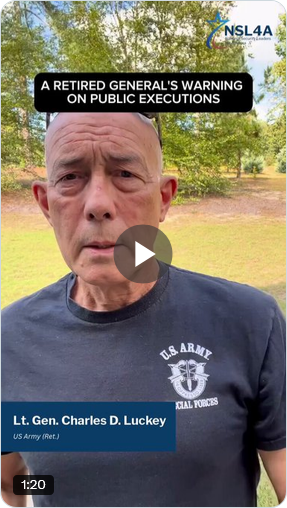
Why does it consistently appear that the criteria to be a General officer is historical illiteracy, suicidal empathy, and being toxically egalitarian? How did we get here?
This one thinks its “fundamentally unamerican” to publicly execute people. Well I guess George Washington is unamerican too. Or Abraham Lincoln.
You know what’s “fundamentally unamerican”, General? Simping for terrorists.
I hear this guy talk and I can’t help but think: no wonder GWOT didn’t end the way we wanted it to. The militarily crucial act of killing people disgusts this type of leader.
No wonder why it was so easy for guys like him and Stan McChrystal to make us practice “courageous restraint” on the battlefield. Letting the enemy gain the upper hand in every engagement, on purpose.
Out of what? Some wayward sense of nobility? That we’re the “good guys”?
No, General. Being the good guys doesn’t mean allowing our enemies to have a monopoly on violence. WE MUST HAVE THE MONOPOLY ON VIOLENCE.
Why am I constantly explaining this to Generals? Especially of the retired variety? Why am I having to explain that killing people is not only important to our profession, but for protecting western civilization itself?
The bar for General officer has been so low it’s practically in the basement. And no matter what institutional changes we make, these types always choose themselves to replace…. themselves.
So it’s more of the same. Same bad experience, same bad channel. Same feckless worldview. Incapable of victory. Incapable of common sense. Incapable of doing their jobs. But completely capable of making Instagram videos about how mean and cruel we’ve become.
BEING MEAN AND CRUEL TO OUR EVIL ENEMIES IS THE ENTIRE POINT!
Pathetic filth.
To which Tom Kratman responds:
Did I ever … hmmm … maybe not. Wait a sec …
Not only will you be rated or senior rated by about 100 people, in 30 years in the Army, but you can never have pissed one of them off. These men, however, will range from the bright to the ignorant, the moral to the immoral, and will have vastly diverging experiences which will drive their judgment. And you cannot disagree with them if you want stars. It would be one thing if they were all the same and you learned to echo just one theme. But when they are all different, and you still agree with every trivial thought they ever had, it can only be because you lack any center of your own, any moral compass whatsoever, since everything in the military has a moral aspect to it. In other words — with only very rare exceptions; I thought well of Foss, LeMoyne, and Petraeus, for example — the man who rises to stars usually has nothing, no values of worth, inside him.
Which is worse than contemptible; it’s absolutely pathetic, given how useless it is to become a general.
True story: Some people thought there were stars in my future. There came a day, early 1988, I was on my second company command, of three, and I was shooting the crap with the brigade commander in his office. I’d been ambivalent about stars for some time by then, but it was a very amorphous thing. I couldn’t have told you why. Eventually, I realized that my brigade commander (Annapolis, oddly enough) was trying to mentor me into stars. “You need to do this, Tom, then you need to do that. Then you need to …”
And it all came clear, an epiphany, a blinding flash of the obvious, and I said, “Sir, I don’t want to be a general.”
“Wha … what … WHAT?”
So I stood up, walked across the office to his LCE tree, and took his helmet in hands.
“Sir, do you remember General Meyer?”
“Shy Meyer? Chief of Staff?”
“Yes, sir, him.”
“Sure.”
“Sir, Meyer was a reformer. He had a bag full of good ideas for improving the Army. I counted thirty-seven once, about half and half trivial and important. I may have missed some.”
“Yes, so?”
Then I turned the helmet around to point at him the two silly bits of glow in the dark tape on the camouflage band around the helmet. “Sir, of all that, this is all that’s left of Meyer. Everything else is gone. In a matter of a few years it’s as if he never existed. So what, sir, would be the point of becoming a general, if, even if I rose to be Chief of Staff of the Army, I could not possibly have a good and lasting effect?”
Which is, in any case, why I turned to writing. My brigade commander didn’t get it; he still tried to stick me as the incoming CG’s Aide, but I wanted nothing to do with that.
The Korean War Week 121 – America Has Had Enough! – October 13, 1952
The Korean War by Indy Neidell
Published 13 Oct 2026The UN delegation walks out of the Panmunjom Peace Talks this week, after the Communist side refuses all of their proposals to solve the POW repatriation issue. A major naval training exercise off the coast comes to its end, with disappointing results, and in the field the Battle of White Horse Hill, the deadliest battle so far this year, rages all week long.
00:34 Recap
00:57 Naval Training Exercise
04:31 Harrison Walks Out
06:41 White Horse Hill
13:47 Operation Showdown
14:34 Summary
14:50 Conclusion
16:39 Memorial
QotD: The rise of the Reform Party of Canada
This small government conservatism wasn’t a homegrown ideology, it was adopted and imported from elsewhere. America especially. The dominant paradigm in postwar American conservatism became the fusionism that was associated with publications like National Review, and eventually became a dominant political force in Ronald Reagan. The success of this fusionism also made it appealing, and ready-made, to be imported to Canada and fused with this rejection of big government Liberal nationalism. In the process, Canadian conservatism begins to sound more American.
I’m not using this pejoratively and I don’t see this so much as a form of cultural imperialism. The adoption of this kind of conservatism made sense in response to the new Liberal nationalism. But it does present some serious problems for Canadian conservatism. This anti-nationalism and small government conservatism will appeal to some, especially in the West, but it’s not something that a national movement could be forged around.
This is what I mean when I say lots of conservatives don’t like Canada all that much. In adopting small government American conservatism, this kind of conservatism sounds like an American critique of Canada. Canadian healthcare looks “socialist” to American conservatives, and small government ideologues in America look at Canada and see big government “Soviet Canuckistan.” This is what Canadian conservatives adopting this kind of ideology sometimes sound like, and you can see why this has limited electoral appeal.
Ben Woodfinden, “True North Patriotism and a Distinctly Canadian Conservatism”, The Dominion, 2020-10-20.
October 13, 2026
The Un-Coupling of Gen Z
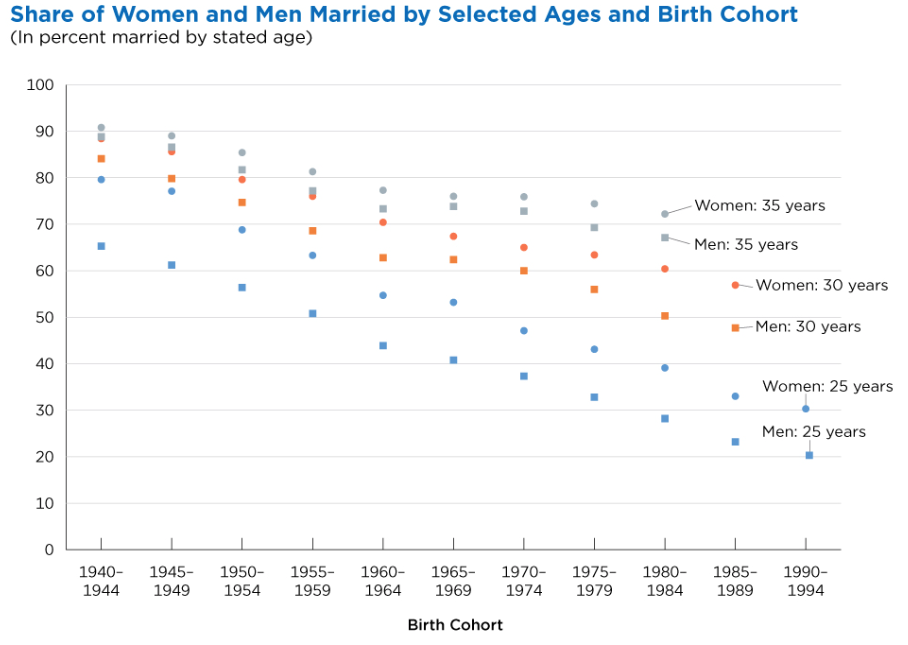
One of the most obvious demographic shifts in recent years has been the ongoing decline in the birth rate in pretty much the entire western world. But it isn’t surprising in one respect: Gen Z people aren’t forming relationships at the rate of earlier generations and have fewer (if any) sexual partners:
Why are so many Americans not getting married — or not even dating, in the first place?
The share of 40-year-olds who have never been hitched has quadrupled since 1980, as Americans get married later, or not at all.
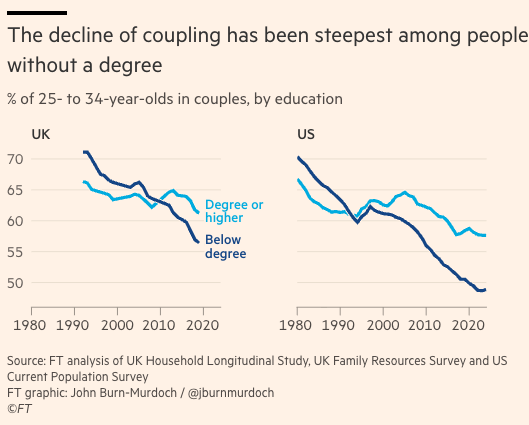
It’s not just marriage that’s declining but rather all forms of cohabitation. An analysis by John Burn-Murdoch found that “coupling” has declined steadily in both the UK and the U.S., especially for those without a college degree. The declining popularity of dating apps suggests that these trends are likely to continue.
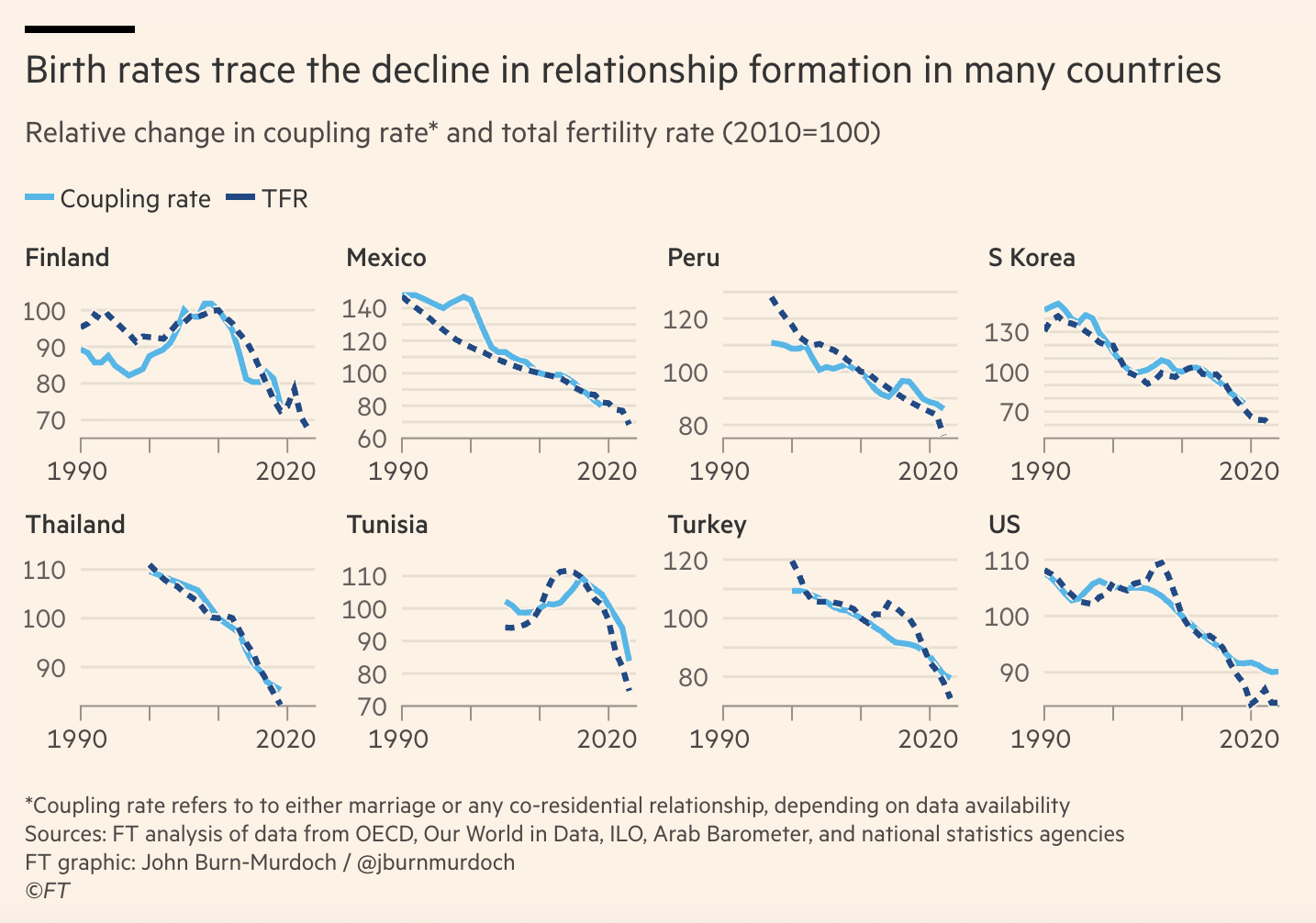
I care about the decline of coupling and marriage not because I consider myself a strict evangelist of matrimony — I think people should do what they can to enjoy themselves without hurting others — but rather because I think it bears on two of the most important questions about the future: (1) How many people exist, and (2) how happy are they? The relationship between romance and births is practically linear. Since 1990, Burn-Murdoch has shown, the decline of births traces the decline of relationship formation across many countries. Fewer relationships mean fewer people, and accelerating population declines around the world are, somewhat like climate change, a slowly accumulating phenomenon that will almost certainly shape the future of economics, technology, and the texture of human existence.
Then, there’s the mushy yet momentous question of whether people actually enjoy their existence. Self-reported happiness is declining in the west, and particularly in the U.S. Reviewing several decades of General Social Survey data, the economist Sam Peltzman came to the conclusion that “most of the overall downturn [in life satisfaction] is attributable to decline in marriage post-2000”. Reviewing Peltzman’s work, The Atlantic‘s Olga Khazan provided some useful context:
One paper alone might be easy enough to dismiss, but this is a fairly consistent finding dating back decades in social-science research: Married people are happier. Period.
If the decline of coupling is upstream of both falling births and falling happiness, then the most important question is what’s happening at the source. In his new book Generation Uncoupled, Daniel Cox, a public opinion researcher and director of the Survey Center on American Life, considers a range of causes that span technology, culture, media, economics, and politics.
October 12, 2026
The Great Game for Asia 1894-1905
Real Time History
Published 15 May 2026The 19th century is a time of violent global imperial competition. The Scramble for Africa and the Great Game between the Russian and British Empires over influence in Central Asia are among the best-known examples. But the 2nd half of the century also involved another Great Game – the Great Game for Asia.
00:00 Intro
05:35 1st Sino-Japanese War 1894-95
30:02 Boxer War 1900-01
55:40 Russo-Japanese War 1904-05
01:22:14 Conclusion
(more…)
QotD: Blame the “Silent generation” for The Sixties™, not the Boomers
Further, what could they really do? The voting age was 21 until 1971, and as hard as this is to hear, voting was just as pointless back then as it is now. St. Kennedy only won through massive voter fraud, and that was 1960. As John Derbyshire used to say, if the American People had been consulted on anything of importance since then, the USA would still be a White Christian nation … and yet, here we are.
Tweedledum and Tweedledee put on a better show back in the days, but the Uniparty was still the Uniparty. America’s ruling caste caught religion back in the 1920s, and on the long view, you could make a pretty robust argument that Mustache Guy and the Anime Club actually did us a huge fucking favor — left to his own devices, President-for-Life Roosevelt would’ve ushered in the USSA by the late 1930s, with the enthusiastic support of all the Beautiful People on both sides of the Uniparty.
… hats off to you [Isoroku Yamamoto] — you and your dipshit friends bought us a few decades. Decades we squandered, of course, but that’s not your fault. It’s not anyone’s fault, unless you think the boys on the Higgins boats should’ve shot their officers, turned the ships around, and conducted a massive air, land, and sea invasion of every faculty lounge and radio station in America … and even if you do think that, what are you going to do about it?
As for Gen X, we were no better. I can’t blame the Boomers for running with it, any more than I can blame myself for running with our thing. I spent most of college, for instance, getting drunk and chasing tail. Chasing tail is bad, full stop — I should’ve been saving it for marriage, with all that implies — and while getting drunk isn’t bad every now and again, I didn’t do it every now and again. I lived a life as dissolute as any Boomer’s, and while I was equally powerless to change anything in the broader culture, I could’ve been a much better person … but I wasn’t.
Severian, “Friday Mailbag”, Founding Questions, 2022-09-23.
October 11, 2026
QotD: The history of New Harmony, Indiana
Owen already ran successful textile mills in New Lanark, Scotland, where he was famous for treating workers well and running a profitable business at the same time. He believed that if you removed private property and paid everyone equally, cooperation would naturally replace competition.
In January 1826, William Maclure sailed a riverboat full of scientists, teachers, and geologists down the Ohio River to New Harmony. Historians call it the “Boatload of Knowledge”. Thomas Say, the father of American entomology, was on it. So was Charles-Alexandre Lesueur, one of the most respected naturalists of the era. This was the most educated, best-funded, best-equipped socialist community ever attempted on American soil. If cooperation could beat markets anywhere, it should have worked here.
It collapsed almost immediately.
The hardest workers were feeding, housing, and clothing neighbors who did nothing while receiving the same food, the same shelter, and the same rewards. So they stopped working too. Why wouldn’t they?
Production dropped and food ran short. Buildings decayed because no one owned them and no one was responsible for maintaining them. Endless meetings replaced actual work. Owen wrote seven different constitutions in two years trying to fix it. None of them worked.
American inventor Josiah Warren, one of the country’s earliest libertarian thinkers, was there. He watched the community fail from the inside and later wrote about why. His conclusion: “The difference of opinion, tastes and purposes increased just in proportion to the demand for conformity”. The more the community demanded unity, the more it fractured. Warren identified the deeper problem almost a century before Ludwig von Mises and Friedrich Hayek made it famous in academic economics.
When everyone owns everything, no one owns anything. When labor earns the same reward regardless of effort, effort disappears. When prices vanish, no one knows what anything is worth.
Owen finally admitted defeat in 1827. In his farewell address, he blamed the settlers themselves, saying they were “unprepared to be members of the community of common property and equality”.
Translation: the system would have worked if only people had been different.
Every socialist regime since has offered some version of that excuse.
His own son, Robert Dale Owen, put it plainly years later: “All cooperative schemes which provide equal remuneration to the skilled and industrious and the ignorant and idle must work their own downfall”. He had lived through the collapse. He knew what killed it.
Every socialist experiment since New Harmony has ended the same way, and for the same reasons.
Prices communicate what things are worth. Ownership creates responsibility for maintaining them. When both are abolished, production collapses because no one can calculate what to make or repair.
Tom Kratman, The social media site formerly known as Twitter, 2026-07-09.
October 10, 2026
QotD: JFK’s soft coup to destroy Diefenbaker and install Pearson
His name was Lou Harris. He was John F. Kennedy’s personal pollster, one of the handful of men who had just put a president in the White House, and he was moving under a false identity because the job he had come north to do could never be seen to be done. He had come to take down the Government of Canada.
It worked. Within months, John Diefenbaker’s nationalist Conservative government was gone, and the Liberal campaign that replaced it had been quietly run on American polling, American media tactics, and American psychological warfare, with Harris directing from the shadows. No shots were fired. No tanks crossed the border. Most Canadians lived out their lives never knowing it happened at all.
That is not a theory. This is documented history, laid out in painstaking detail in John Boyko’s Cold Fire: Kennedy’s Northern Front, and once you know it, you cannot look at this country the same way again. Because here is the question nobody has had the nerve to ask in the sixty years since: if Washington toppled a Canadian government in 1963 and paid no price of any kind, why on earth would it have stopped?
It didn’t stop. That is the argument of this essay, and I intend to prove it with receipts. What began as a Kennedy operation against one stubborn prime minister became the permanent condition of Canadian politics. Blue America captured our governing party, its money, its methods, its personnel, and eventually its policy. Red America, more quietly, built our opposition, supplying the ideas, the operatives, and the reflexes of what now calls itself Canadian conservatism. Two parties, two foreign patrons, one country in between, and not one law against any of it. By the end, you will understand why every election feels like choosing between American factions. Because it is. And you will have, in plain terms, the only program that can end it.
Start where the occupation started: with the prime minister who said no.
Diefenbaker’s crime, in Washington’s eyes, was sovereignty. JFK despised him for defending Canadian autonomy, and teamed up with Lester B. Pearson’s Liberals to permanently rewire this country’s trajectory. Harris and his fake passport were only the covert half. The overt half played out in public, and it is somehow more shocking. The breaking point was Diefenbaker’s refusal to accept American nuclear warheads for the Bomarc missiles Washington had parked on our soil, and refusing to put our forces on alert on Washington’s schedule during the Cuban Missile Crisis. He insisted a Canadian government would decide these things in Ottawa. For this, on January 30, 1963, the United States State Department did something no ally had ever done to another: it issued a press release publicly calling the Prime Minister of Canada a liar about the state of defence negotiations. A foreign power’s foreign ministry, openly contradicting our head of government, in writing, to force his hand. Within a week, Diefenbaker’s government fell on a non-confidence vote. Within months, Kennedy’s friend Ben Bradlee put Diefenbaker on the cover of Newsweek in a hit piece so vicious it read like an obituary. The pollster in the shadows, the press release in the open, the friendly magazine on the newsstand. Every layer of American power, aimed at one Canadian who said no.
What happened to Canada was not an isolated incident. It was one front in a global campaign of regime change Washington ran throughout the 1960s. The same decade they were meddling in Ottawa, they were toppling governments worldwide to secure their sphere of influence. In 1960, the Eisenhower administration laid the groundwork for the overthrow of Patrice Lumumba in the Congo, finalized in Mobutu Sese Seko’s military coup. In 1961, the Kennedy administration financed race riots and engineered an electoral coup in British Guiana to depose the democratically elected Cheddi Jagan. By 1963, Washington was backing the violent coup against South Vietnamese President Ngo Dinh Diem. A year later, the Johnson administration ran Operation Brother Sam, providing military backing to the coup in Brazil that replaced President João Goulart with a military dictatorship.
By installing Pearson, Washington broke Canada’s nationalist resistance using the exact playbook it deployed on developing nations, locking us permanently into a continentalist framework.
And look at what the new management delivered, and how fast. Within two years of taking office, Pearson gave Washington the warheads Diefenbaker had refused. In 1965 he signed the Auto Pact, integrating the commanding heights of Canadian manufacturing into the American industrial system, the economic annexation the National Policy had been built to prevent, accomplished with a signature. And in the same year came the new flag. Understand what that meant to the men who fought it. The Red Ensign, the banner Canadians had carried up Vimy Ridge and across the beaches of Normandy, was struck, and with it the visible sign that this country belonged to a British inheritance rather than an American continent. Diefenbaker fought the flag change with everything he had left, and he was mocked for it as a relic, because the men mocking him understood exactly what he understood: a country’s symbols are its memory, and a country stripped of its memory will accept a new identity from whoever supplies one. The supplier was already chosen.
That 1963 intervention laid the structural tracks for Pierre Trudeau to dismantle our traditional British and Loyalist inheritance entirely, replacing it with official multiculturalism, a weaponized Charter, and a hyper-progressive legal order. The horrors you see today are not random accidents. They are the long-term realization of the colony Kennedy and Pearson engineered decades ago.
But here is what even the people who know the Diefenbaker story get wrong. They think 1963 was a coup against Canada’s right. It was bigger than that. It was a proof of concept. Washington learned that Canadian politics could be run from outside, cheaply, legally, and without consequence. And in the sixty years since, both American political tribes have taken the lesson. Blue America perfected the Pearson playbook and used it to capture our government. Red America ran a quieter operation and captured the opposition. Not two conspiracies. One condition. A satellite country whose entire political spectrum, left flank and right flank, answers to a foreign capital’s internal quarrels.
Upper Canadian Cavalier, “The Occupied Dominion”, Upper Canadian Cavalier, 2026-07-06.
October 9, 2026
Conrad Black on Tucker Carlson
On his (new-ish) Substack, Conrad Black discusses Tucker Carlson’s media career before he unceremoniously left Fox News and what he has been doing since then:
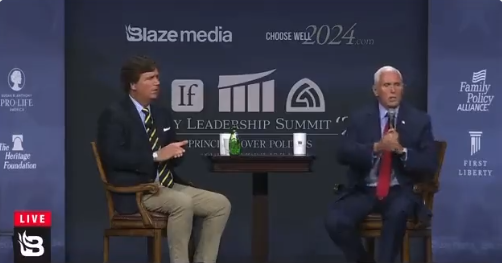
Tucker Carlson talking to Mike Pence, July 2023.
This became a dangerous cycle because the more Tucker forayed into the fringe, the harder he struck a vein of malformed but popular sentiment. Meanwhile, censorship of his relatively tame views only handed him a bigger megaphone and more incentive to go further. His sensible opposition to the Iraq and Afghanistan disasters, and his wariness of another quagmire emerging in Ukraine, curdled into progressively more unhinged forms of isolationism. His legitimate concerns about demographic trends and failed immigration policy curdled into belief in a coordinated conspiracy to erase white people from Europe and North America. Reasonable criticism of Israel and the American role in the Middle East curdled into the quasi-antisemitic trope of AIPAC as the hidden hand controlling U.S. foreign policy. His well-earned distrust of government curdled into various conspiracies involving some mix of extra-terrestrials, the CIA, and the Jews.
The pattern has become so predictable that if there was an effort to block him from praising Brussels sprouts as his favourite vegetable, at least three of his next five interview guests would spend two hours apiece insisting the maligned little cabbage is the victim of a coordinated smear campaign bankrolled by Big Salad. The attempted prohibition becomes the proof.
As a free-speech and free-market advocate, I think Tucker is entitled to say what he wants, and I congratulate him on his commercial success, even while finding many of his views idiotic. What troubles me is not so much the outlandish claims, but the skill atrophy — the phenomenon whereby any skill sharpened by adversarial pressure dulls without resistance. In boxing, the term “ring rust” is sometimes used to describe the way a boxer who stops facing strong opponents loses their timing, power, and urgency, until nothing’s left but a shell of their former selves. Looking back over his podcast guest list, with the exception of this Rees-Mogg segment, Ted Cruz last year, and perhaps a handful of others, it has been a long procession of hundreds of people brought on to confirm his own worldview back to him, in their own words. And the ring rust has set in.
I first noticed it at an event in Edmonton in January 2024, where I sat on a panel with Tucker and Jordan Peterson. I found myself in the awkward position of feeling the need to defend then-Finance Minister Chrystia Freeland in front of a packed arena of anti-Liberal partisans (with whom I would have considered myself somewhat of a kindred spirit). I was booed by parts of the audience for pointing out the fact that while Freeland, whom I know slightly and like personally, was politically hopeless, she was not, as Tucker had claimed, a fascist. The typically leftist habit of reducing every political opponent to a Hitler or Mussolini analog is lazy and obnoxious — not adjectives I would have used to describe the old Tucker. His justification was that he had recently seen a video of reporter David Menzies being detained by the RCMP after a collision with an officer while trying to get his microphone close enough to pick up Freeland’s response (or lack thereof). It was an outrageous overreaction by the officer, but there was no suggestion that Freeland had ordered the arrest. Ironically, Menzies’ question that Freeland was trying to dodge had been about why the Liberal government had gone soft on Iran’s terrorist regime — a question one might well put to Tucker.
The signs of atrophy continued to show up and in ways that, as a former admirer of Tucker’s, became progressively more alarming. At the memorial following the tragic murder of Charlie Kirk, Tucker gave an odd speech in which he claimed that the assassination was reminiscent of his “favourite story”, in which Jesus Christ was killed for telling the truth by a group of shadowy figures “in a lamp-lit room” in Jerusalem, “sitting around eating hummus”. When asked about it a few days later, Tucker employed a variation of the Jon Stewart technique of backing away from his own words to avoid serious scrutiny. With his characteristic forced laugh, he denied any implication that he had echoed the nascent conspiracy theory that Israel had murdered Charlie Kirk. His defense: hummus is a traditional Arab (rather than Jewish) food.
The evident decline grew even more pronounced in his May 2026 New York Times sit-down, when Lulu Garcia-Navarro asked why he had suggested that Donald Trump might be the Antichrist. Tucker insisted he had never said that, wasn’t even sure what the Antichrist was and insisted “those words never left my lips” — then, after he was shown a clip from his own show of the words leaving his lips, he apologized that his remarks from the clip implied “a precision I haven’t arrived at”. In other words, the jury is still out about whether Trump is the Antichrist, and he regretted jumping the gun on the verdict.
Which brings us to the latest instalment. After roughly 200 interviews, each amounting to hours-long sessions of Tucker and his guests regurgitating the same pablum into each other’s mouths, the transformation into a shell of his former self appears to be complete. In this conversation, moments after declaring that killing the innocent is “never justified under any circumstances”, he pivoted almost in the same breath into a full-throated defence of Hitler — history’s single greatest killer of innocents. He argued the invasion of Poland was understandable given that 15% of the country had been German before the Treaty of Versailles. While absurd, at least it is consistent with his position on Russia’s invasion of Ukraine. But even if, for argument’s sake, that justified Poland, Hitler didn’t stop there. What justified the invasions of Belgium and France? After all, France was faithfully adhering to the Tuckerite foreign policy of reluctant rearmament, appeasement, and assuming an entirely defensive posture (behind the Maginot Line). Stretching the flimsy logic further one could argue (feebly) that France had it coming too, since 6% of France (Alsace-Lorraine) was also German before Versailles. But there’s still no justification for the invasions of Denmark, Norway, the Netherlands, Yugoslavia, Greece, or the Soviet Union — with whom Hitler had a signed non-aggression pact. None of those countries were ever German, let alone Libya, Tunisia, and Egypt.
What’s clear is that Hitler used his early invasions to test whether anyone would stop him — and the feedback he got was a green light for more. History keeps teaching the same lesson: appeasement is just expansionism outsourced to your enemies.
Small wonder Tucker hasn’t learned this lesson from history, given that he called Darryl Cooper — a man with zero historical credentials — “the best and most honest popular historian in the United States.” Cooper spent two hours on Tucker’s show in September 2024, arguing Churchill, not Hitler, was the “chief villain” of the war, and that the deaths of millions in Nazi camps owed more to German logistical incompetence than deliberate extermination.
October 8, 2026
Utah’s VPN rules don’t fare well in court
Like many other jurisdictions, Utah wanted to apply age restrictions to online sites “to protect the children”. It didn’t go well in court:

“Virtual Private Network (VPN)” by Infosec Images is licensed under CC BY 2.0 
 .
.
As I write, I have my virtual private network (VPN) set to show me as surfing the internet from Berlin, Germany, despite my location in Arizona, for no good reason other than that I can. Given that Germany has rather tight restrictions on speech, this is probably the reverse of how a VPN is usually used between the two countries, but it illustrates the utility of technology that anonymizes internet traffic and lets users pick their points of origin to bypass censorship and surveillance. Germans can bypass controls on “hate speech” and insults directed at politicians, the Chinese can work around restrictions on Winnie the Pooh memes, and people in places like Utah can ignore intrusive age-verification rules.
That’s why it’s important that a federal court just paused enforcement of Utah’s effort to regulate VPNs.
Utah Pushes Age Verification and Targets VPNs
“Signed into law earlier this year, SB 73 attempted to regulate adult websites by requiring them to block VPN users or to identify the physical location of visitors using them or similar tools that mask their network traffic,” the Electronic Frontier Foundation’s (EFF) Rindala Alajaji details in a response to the case. “It even went so far as to prohibit websites from offering instructions on how to use a VPN to bypass these checks. This made Utah, to EFF’s knowledge, the first state in the nation to target the use of VPNs to avoid legally mandated age-verification gates.”
Utah was sued over the law by Aylo Freesites Ltd. and Aylo Group Ltd., the owners of Pornhub. The plaintiffs didn’t challenge the law’s age-verification requirements but went after its insistence that the law applies if a user is “actually located” in Utah without regard to the use of “a virtual private network, proxy server, or other means to disguise or misrepresent the individual’s geographic location to make it appear that the individual is accessing a website from a location outside this state”.
Utah’s focus on VPNs and similar tools comes after decades of technological innovation intended to allow internet users to bypass censorship, firewalls, and surveillance imposed by authoritarian regimes that want to monitor and muzzle dissidents. VPNs, perhaps the most popular of the tools, route internet traffic through intermediary servers, encrypting data in the process and concealing users’ locations. That’s extremely handy for people suffering under oppressive rule. In recent years, though, speech restrictions have been increasingly imposed by nominally liberal democratic governments.
VPNs are a good thing, and any government attempting to crack down on their use “to protect the children” is up to no good.
October 7, 2026
The Korean War Week 120 – The Battle of White Horse Hill begins – October 6, 1952
The Korean War by Indy Neidell
Published 6 Oct 2026The Chinese are busy this week; they open the floodgates of a reservoir and attack Arrowhead Hill, but it turns out these are diversions from their main attack, which begins the Battle of White Horse Hill. It does not at all begin well for the Chinese, although the ROK take pretty heavy casualties too. There are also plans afoot for a new UN offensive operation, and a naval exercise begins off the east coast.
00:00 Phone Call
00:50 Recap
01:21 Reinforcing ROK 9th Division
03:01 Diversions
07:02 Operation Showdown
08:47 Naval Exercise
10:38 Increasing the ROK
13:17 Commonwealth Division
15:43 Warsaw and Seattle
17:29 Summary
17:45 Conclusion


