
Judges often ignore the law in order to deliver decisions that make them happy. I recall my Con. Law professor talking about this. He called it the “TTWILI” rationale: “That’s The Way I Like It.” A judge will look at the law, find that it directs a result he finds objectionable, and then come up with a way to defy the law. He’ll pretend to misinterpret it, or he’ll turn a blind eye to inconvenient facts, or whatever it takes. It happens every day. It’s the judicial equivalent of jury nullification. And like jury nullification, it is perfectly legal, and there isn’t a hell of a lot you can do about it once it’s done. Like my father says, “A federal judge is the closest thing to God you will ever see on this earth.”
Steve H. “About Injunctive Relief: Read Before You Criticize”, Hog On Ice, 2005-03-23.
August 19, 2021
QotD: Judges
August 18, 2021
The Conscripts and Conscientious Objectors of World War Two – WW2 Special
World War Two
Published 17 Aug 2021In keeping with their ideals of personal liberty, Britain and the United States have historically maintained relatively small armies made up of volunteer soldiers. When Germany and Japan mobilize huge numbers of well-trained conscripts and sweep across Europe and Asia, the democratic allies devote huge resources to closing the gap, while respecting the rights of those who object to fighting on moral grounds.
(more…)
Historically, empires have fallen over decades or centuries …
… today, however, everything seems to move much faster than it used to:
The War on Terror began with men plunging to their deaths from the highest floors of skyscrapers hit by airplanes; it ended with men plunging to their deaths from the undercarriage of a US airplane taking off from what’s left of “Hamid Karzai International Airport” (the signs will be coming down even as you read this).
America is a global laughingstock right now, but that’s no reason not to give Chairman Xi and Putin and every up-country village headman in Helmand a few more yuks. Step forward, State Department spokeswanker Ned Price:
State Department calls for Taliban to include women in its government
The United States is dead as a global power because of this kind of indestructible stupidity. You’ve lost, you blew it, it’s over: The goatherds just decapitated you; could you at least have the self-respect not to run around like a headless chicken too stupid to know it’s nogginless? Or like a broken doll lying on its back with its mechanism jammed on the same simpleton phrases: “Diversity is our strength… diversity is our strength…”
Contrast the Washington presser with that in Kabul:
Taliban spokesperson Zabiullah Mujahid says ‘We have defeated a great power.’
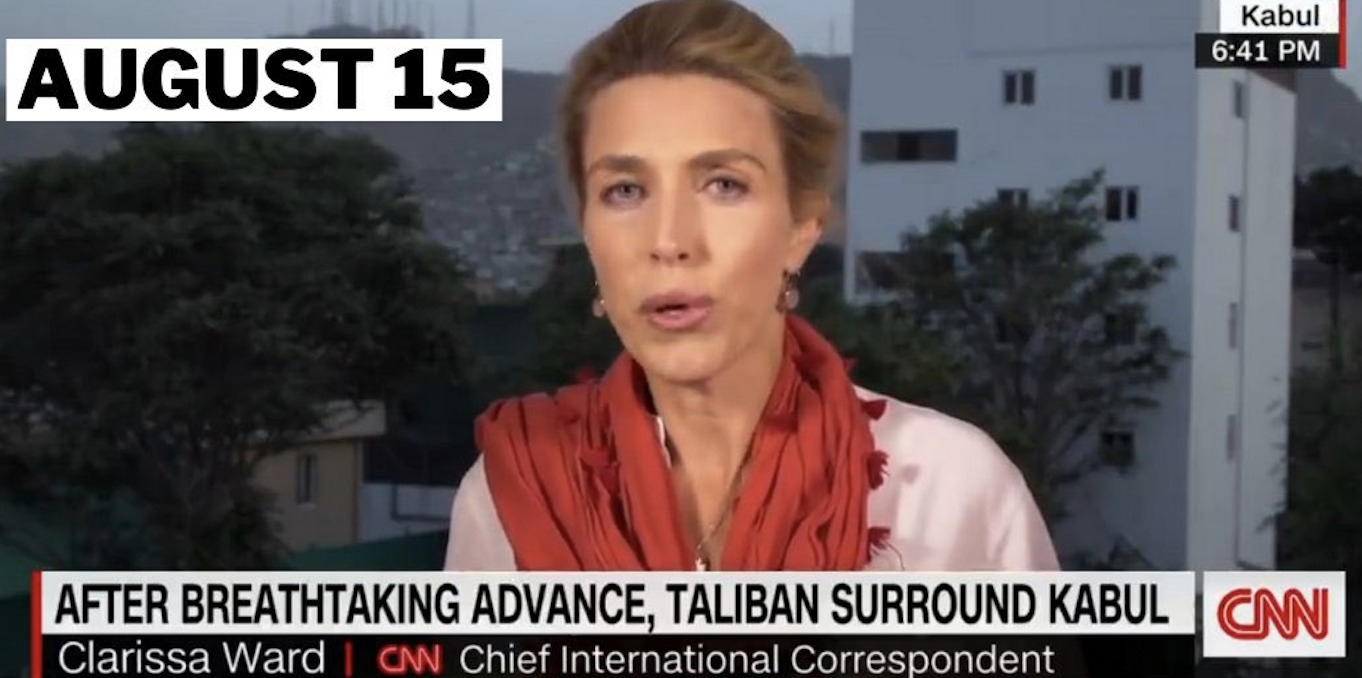
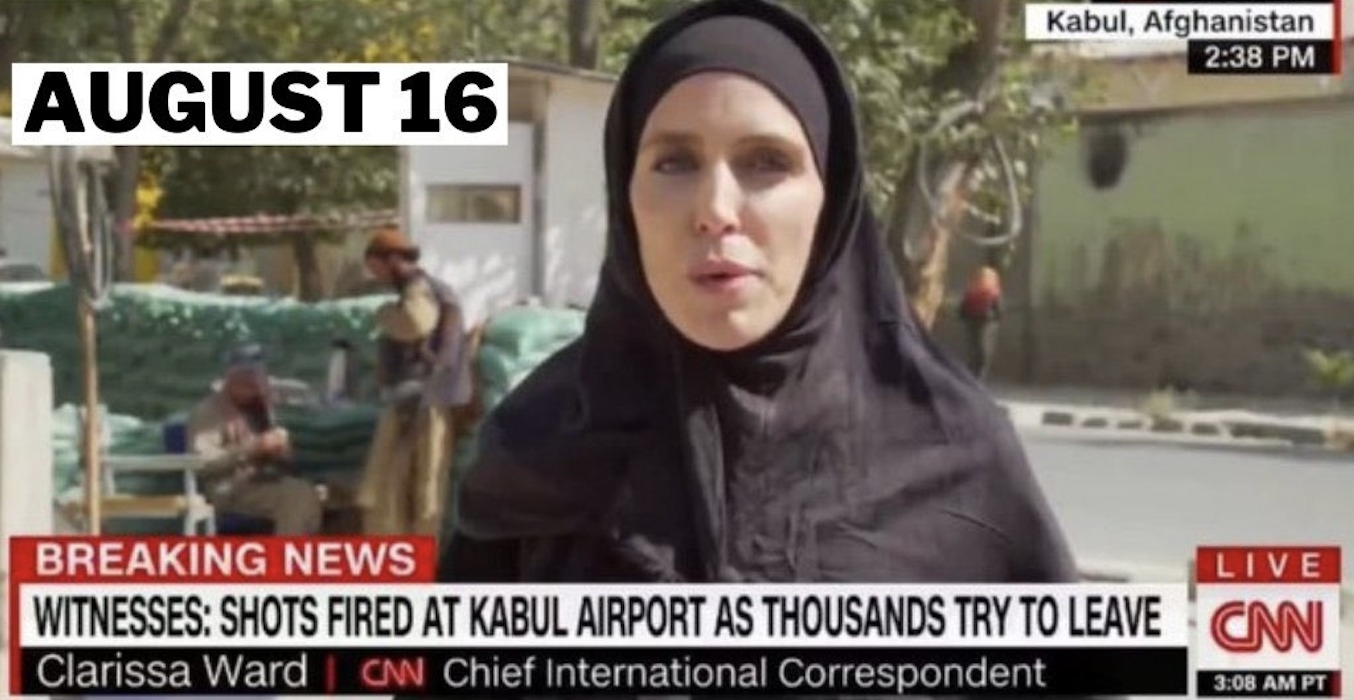
Hmm. Ned Price vs Zabiullah Mujahid: tough call. The mountain of non-existent dollar bills that the bloated husk of federal government blows through every minute surely should buy sufficient self-awareness to know that, whatever else it may be, this is not a day for wankery as usual. Even CNN has a more proximate relationship to reality. Here is their Kabul correspondent, Clarissa Ward, reporting on Sunday:
And here is the same Miss Ward reporting on Monday:
Gee, did anyone back at the anchor desk ask her what’s with the wardrobe switcheroo?
Just for the record, the Kingdom of Afghanistan introduced votes for women in 1964 – whereas Switzerland did not get even a very limited female franchise until 1971, and full suffrage not until the Nineties.
Yet, oddly, every Pushtun warlord prefers to keep his retirement account in Zurich.
Maybe, after taking twenty years to lose to goatherds with fertiliser, you State Department arses might have enough humility to recognize that that that big messy world is subtler than your one-size-fits-all clichés.
August 17, 2021
Mark Steyn – “The scale of America’s global humiliation is so total that I see my friends at Fox News cannot even bear to cover it”
The collapse of western — specifically American — control in Afghanistan got put on fast forward and the US dying media can’t be bothered to give it much attention. Mark Steyn didn’t explicitly predict this particular high-speed collapse, but he’s been warning about the Afghan situation for over a decade:
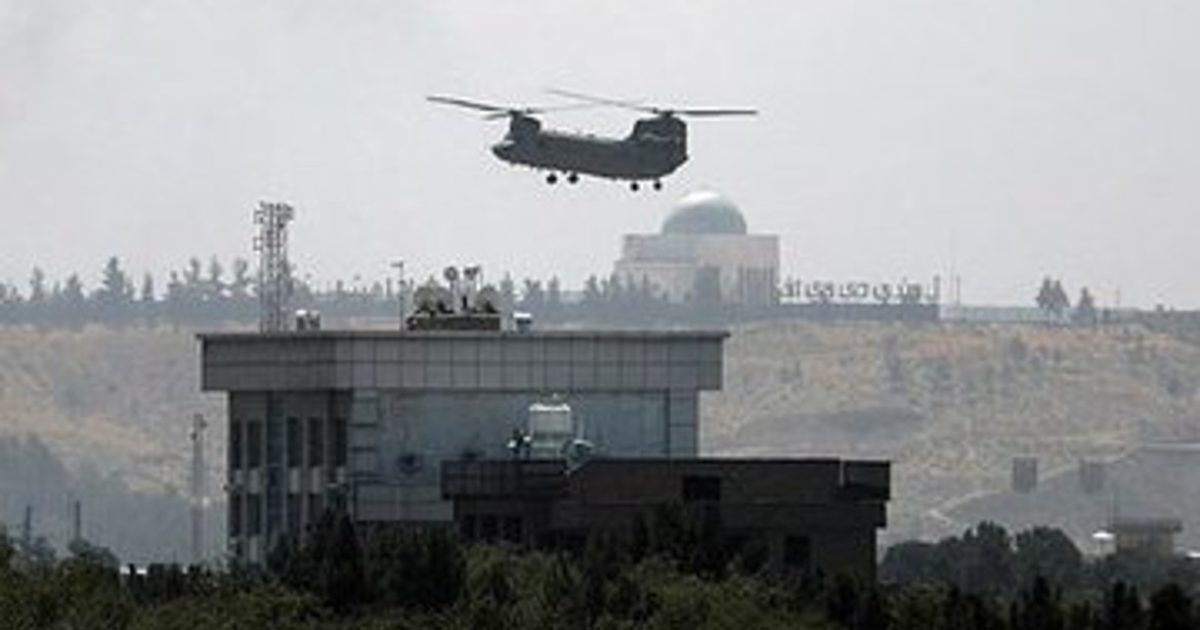
A Boeing CH-47 Chinook transport helicopter appears over the U.S. embassy compound in Kabul, 15 Aug 2021. Image from Twitter via libertyunyielding.com
To reprise a line from a decade-old column of mine:
Afghanistan is about Afghanistan – if you’re Afghan or Pakistani. But, if you’re Russian or Chinese or Iranian or European, Afghanistan is about America.
That’s the point to remember: if you’re an Afghan schoolgirl, today is the fall of Kabul; elsewhere, in the chancelleries of allies and enemies alike, it’s the fall of America. Even by their usual wretched standards, the world’s most somnolent media are struggling to stay up to speed on the story. Here’s the scoop from USA Today:
Taliban’s Afghanistan Advance Tests Biden’s ‘America Is Back’ Foreign Policy Promise
You don’t say! Did he misread the prompter, or mishear the guy in his ear? “America is on its back”, surely?
But don’t worry, the world’s most lavishly over-funded “intelligence community” is on the case:
Kabul Could Fall To The Taliban Within 90 Days, U.S. Intelligence Warns
Thank you, geniuses. That was Thursday. So it turned out to be well within ninety hours — which is close enough for US intelligence work.
Was this the same “seventeen intelligence agencies” who all agreed Russia had meddled in the 2016 election — and with whose collective intelligence only a fool would disagree?
Or perhaps it was only one intelligence agency — most likely the crack agents of the highly specialized Federal Unitary Central Kabul Western Intelligence Tracking Service.
To modify Hillary Clinton, what difference at this point would it make if the US government simply laid off its entire “intelligence community”?
Indeed, what difference would it make if it closed down its military? Obviously, it would present a few mid-life challenges for its corrupt Pentagon bureaucracy, since that many generals on the market for defense lobbyist gigs and board directorships all at once would likely depress the going rate. But, other than that, a military that accounts for 40 per cent of the planet’s military spending can’t perform either of the functions for which one has an army: it can’t defeat overseas enemies, and it’s not permitted to defend the country, as we see on the Rio Grande.
So what’s the point?
Oh, oh, but, if a nation doesn’t have an army to defend it, a quarter-of-a-million foreign invaders could just walk into the country with impunity every month!
The scale of America’s global humiliation is so total that I see my friends at Fox News cannot even bear to cover it. As I write, every other world network — the BBC, Deutsche Welle, France 24, not to mention the Chinese — is broadcasting the collapse of the American regime in real time; on Fox, meanwhile, they’re talking about the spending bill and the third Covid shot and the dead Haitians … as if the totality of the defeat is such that for once it cannot be fixed into the American right’s usual consolations (“well, this positions us pretty nicely for 2022”).
On the leftie side, of course, the court eunuchs have risen as one to protect the Dementia Kid, and are working as hurriedly as the Kabul document-shredders in an effort to figure out a way to blame it all on Trump.
Of course, retreating from Kabul is kind of a western military tradition:
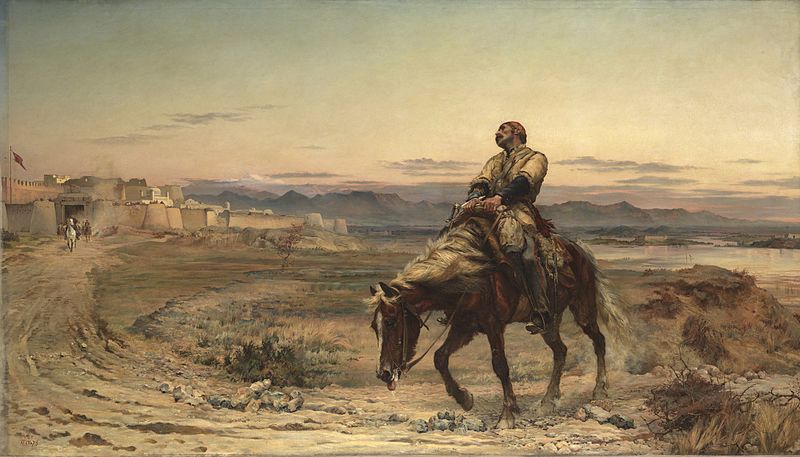
Remnants of an Army (1879) by Elizabeth Butler portraying William Brydon arriving at the gates of Jalalabad as the only survivor of a 16,500 strong evacuation from Kabul in January 1842.
Public domain image via Wikimedia Commons.
The remnants of an army, Jellalabad (sic), January 13, 1842, better known as Remnants of an Army, is an 1879 oil-on-canvas painting by Elizabeth Thompson, Lady Butler. It depicts William Brydon, assistant surgeon in the Bengal Army, arriving at the gates of Jalalabad in January 1842. The walls of Jalalabad loom over a desolate plain and riders from the garrison gallop from the gate to reach the solitary figure bringing the first word of the fate of the “Army of Afghanistan”.
Supposedly Brydon was the last survivor of the approximately 16,000 soldiers and camp followers from the 1842 retreat from Kabul in the First Anglo-Afghan War, and is shown toiling the last few miles to safety on an exhausted and dying horse. In fact a few other stragglers from the Army eventually arrived, and larger numbers were eventually released or rescued after spending time as captives of Afghan forces.
Early American Whiskey
Townsends
Published 3 Apr 2017Today Brian Cushing from Historic Locust Grove takes us on a tour of their new distillery and its history. #townsendswhiskey
Locust Grove Website ▶▶ http://locustgrove.org/ ▶
Help support the channel with Patreon ▶ https://www.patreon.com/townsend ▶▶
Twitter ▶ @Jas_Townsend
Instagram ▶ townsends_official

August 16, 2021
L. Neil Smith – “Take your children out of school!”
In the latest Libertarian Enterprise, L. Neil Smith offers a useful bit of advice to parents concerned about their children being indoctrinated in state-run schools:

“Abandoned Schoolhouse and Wheat Field 3443 B” by jim.choate59 is licensed under CC BY-NC-ND 2.0


For quite a while now, the boob-tube has been filled with coverage of various Board of Education meetings around the country attended by parents murderously angry that their kids are being forcibly indoctrinated with utter claptrap like CRT, which apparently stands for Communist Racist Toxin, a new and poisonous religion where the color of your skin is an Original Sin for which you will be made to suffer no matter what you think, do, or say. My wife Cathy, passing by the TV set half a dozen times a day, invariably shouts, “Take your children out of school!” This essay is admiringly dedicated to her.
I suppose the Public Schools got started out of some sense of specialization. “You chip the flint, Og, Ogla cooks the mammoth, and we’ll teach the kids.” Evolution would have it the other way. The young have been learning from their parents for thousands of generations and it worked out pretty well until sinister figures like Horace Mann and John Dewey, equipped with the limitless power of the State, decided to use it to steal our children from us.
Take your children out of school!
It was perhaps, the stupidest thing that a people have ever done, and I’m pretty sure that Thomas Jefferson would have recognized it as the stupid thing it was, so it had to wait until he and those like him were safely dead. It isn’t brain science. It isn’t rocket surgery. Hand your offspring over to the State, and they will be taught every self-destructive thing the State wants them to be taught — and by now it should be clear, as it surely was to Jefferson, that the State is the enemy of everything decent and productive. Public education was probably responsible for both world wars.
Take your children out of school!
And if it was such a self-evidently good idea, then why did it have to be compulsory? The rows of desks in public schools are populated by conscription — no matter how many pleasant memories we may have of our school days. Public schools are financed by extortion and theft, two of the reasons we fought a revolution in the first place.
Take your children out of school!
It might be cynically observed that public schools are cheaper than paying for baby-sitting, but, given property taxes and the damage it does to the most important people in our lives, is it really? Idiots have whimpered for the last year that having your kids at home is inconvenient.
Public Schools are convenient for the State. They give government two incomes to tax, instead of only one. Take your children out of school!
QotD: Biotechnology
Ignore the origin and look at the technology on its own terms. (This will be easier with the emergence of “open source” genetic engineering, which could work around restrictive corporate patents.) What is its net effect on the environment? GM crops are more efficient, giving higher yield on less land with less use of pesticides and herbicides. That’s why the Amish, the most technology-suspicious group in America (and the best farmers), have enthusiastically adopted GM crops.
There has yet to be a public debate among environmentalists about genetic engineering. Most of the scare stories that go around (Monarch caterpillars harmed by GM pollen!) have as much substance as urban legends about toxic rat urine on Coke can lids. Solid research is seldom reported widely, partly because no news is not news. A number of leading biologists in the U.S. are also leading environmentalists. I’ve asked them how worried they are about genetically engineered organisms. Their answer is “Not much,” because they know from their own work how robust wild ecologies are in defending against new genes, no matter how exotic. They don’t say so in public because they feel that entering the GM debate would strain relations with allies and would distract from their main focus, which is to research and defend biodiversity.
Stewart Brand, “Environmental Heresies”, Technology Review, 2005-05
August 15, 2021
No Soviet Oil for Hitler – WW2 – 155 – August 14, 1942
World War Two
Published 14 Aug 2021The Axis advance into the Caucasus is going great … except the oil towns they take have no oil, and wasn’t that the whole purpose? Meanwhile in the Pacific, the US Navy is suffering perhaps its greatest defeat ever off Savo Island, even as the Marines take Tulagi, Gavutu, and Tanambogo.
(more…)
QotD: A bold new electoral strategy for the US Republican party
Hear me out. It’s kind of crazy, but it just might work.
A nominee who doesn’t suck has certain advantages over the usual losers we see all too often idioting up our ballots. One of those advantages is that people are more likely to vote for someone who is not terrible than one who manifestly is. And getting more votes than the Democrat – who is always terrible – is a very, very important part of electoral victory, though you would not know that from the GOPe’s actions. Its members seem to think the goal is polite defeat, but us unwashed Jesus people who like guns and America and don’t live near Washington have this weird notion that candidates should attempt to win their elections.
Maybe we should try that in 2022.
Kurt Schlichter, “Idea: In 2020, Let’s Nominate Candidates Who Aren’t Awful”, TownHall.com, 2021-05-12.
August 14, 2021
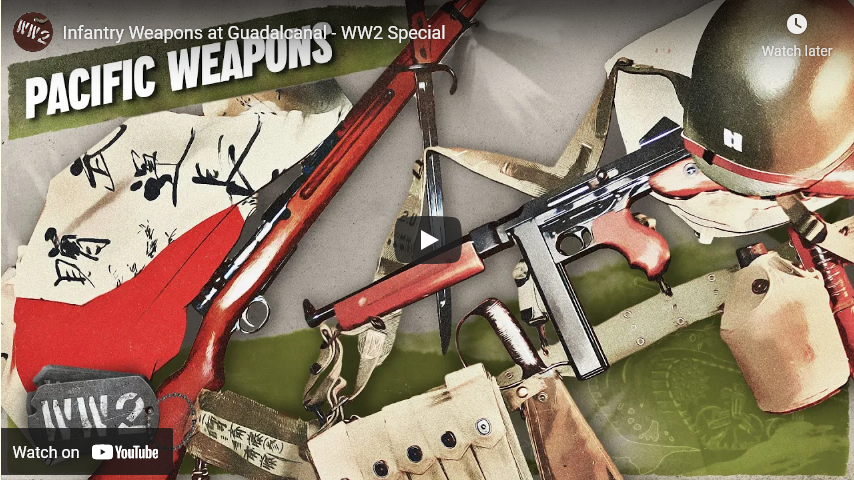
Infantry Weapons at Guadalcanal – WW2 Special
Update: The folks at the World War Two channel have taken down this video due to technical errors in the script. Here’s their explanation.
World War Two
21 hours ago
Video on Infantry Arms at Guadalcanal retracted. Indy explains why:Hi everyone. Indy here. As most of you know, I do the research and writing for all of the regular weekly episodes here. I host many of the specials as well, though I do not do the research for most of them- occasionally so, if it’s something that’s really in my field of expertise, like geopolitics, strategy, personal stories, communications, and international relations. The research for the other specials is done by a variety of specialists in their fields or historians, so we can maintain the quality you’ve come to expect from us. I understand, though, that many of you have serious issues with the research for the Guadalcanal infantry special. Our apologies for that- the research was done by an historian, a PhD [student], actually, and we also ensured it was double fact-checked, but obviously some serious mistakes slipped through. Live and learn. I will say that I think it is important that you continue to tell us when you take issue with something we present, since we strive to make the most complete and accurate documentary series possible, so although some of them are hard to read we appreciate such feedback from our community.
And this is from the researcher who worked on the script:
Marlon Londoño
18 hours ago
Hey guys! This is Marlon, the PhD student in question who helped with the researching and writing of the episode. Just to give a little background, I’m a volunteer researcher who helps with the channel over the summer while I’m not teaching/researching/taking coursework. I’m a military historian and my main academic focus is on social and cultural military history (i.e. what people’s wartime experiences were like and why. I’m especially interested in how people justify wartime violence and oftentimes the types of weapons they use play a role in that mental process, so that’s the context in which I usually think about weapons on the battlefield).I’m sorry that I let a lot of you down with the mistakes about the Garand and Arisaka, among others. To be honest, I was surprised to learn they were myths. But I certainly know now, and I don’t think I’ll be forgetting any time soon 😅 One thing that I firmly believe as a researcher and educator is that nobody has a monopoly on the truth, least of all me. I tell that to my students on the first day of class each semester. I certainly don’t presume that the degree I’m pursuing makes me infallible or instantly qualified for anything. And this was a classic example of just how wrong I can be sometimes!
For what it’s worth, I love war history just as much as anyone else in the community, and I’m sorry that my research wasn’t as rigorous as it might otherwise have been. I hope you all might be willing to give any future episodes of mine a second chance, and of course I’m all ears for any mistakes that you want to point out!
Great Moments in Unintended Consequences (Vol. 3)
ReasonTV
Published 7 May 2021Good intentions, bad results.
——————
Follow us on Twitter: https://twitter.com/reasonReason is the planet’s leading source of news, politics, and culture from a libertarian perspective. Go to reason.com for a point of view you won’t get from legacy media and old left-right opinion magazines.
—————-Window Wealth
The Year: 1696
The Problem: Britain needs money.The Solution: Tax windows! A residence’s number of windows increases with relative wealth and is easily observed and verified from afar. A perfect revenue generator is born!
Sounds like a great idea! With the best of intentions. What could possibly go wrong?
To avoid higher taxes, houses were built with fewer windows, and existing windows were bricked up. Tenements were charged as single dwellings, putting them in a higher tax bracket, which then led to rising rents or windowless apartments. The lack of ventilation and sunlight led to greater disease prevalence, stunted growth, and one rather irate Charles Dickens.
It took more than 150 years for politicians to see the error of their ways — perhaps because their view was blocked by bricks.
Loonie Ladies
The Year: 1992
The Problem: Nude dancing is degrading to women and ruining the moral fabric of Alberta, Canada.The Solution: Establish a one-meter buffer zone between patrons and dancers.
Sounds like total buzzkill! With puritanical intentions. What could possibly go wrong?
It turns out that dancers earn most of their money in the form of tips, and dollar bills don’t fly through the air very well. Thus, the measure designed to protect dancers from degrading treatment resulted in “the loonie toss” — a creepy ritual where naked women are pelted with Canadian one-dollar coins, which are known as loonies.
Way to make the ladies feel special, Alberta.
Gallant Grocers
The Year: 2021
The Problem: Local bureaucrats need to look like they care.The Solution: Mandate that grocery stores provide “hero pay” to their workers.
Sounds like a great idea! With the best of intentions. What could possibly go wrong?
Besides the fact that these ordinances may preempt federal labor and equal protection laws, a 28 percent pay raise for employees can be catastrophic to grocery stores that traditionally operate on razor-thin margins. As a result, many underperforming stores closed, resulting in a “hero pay” of sudden unemployment.
Don’t spend it all in one place!
Written and produced by Meredith and Austin Bragg; narrated by Austin Bragg

QotD: Modern parenting
But we also fear their independence. We’re up there in the climber because we can’t afford to miss a minute of face time, you see. We believe our physical presence is the linchpin to the children’s emotional well-being and, although we never say so out loud, we want it that way — because it’s central to our well-being. We’re scared the kids will grow up to resent the fact that Mommy works, or — the biggest golem on the list — they just plain won’t like us. And in an age of high divorce rates and transient communities, kids who don’t like us suggest the possibility that we might really end up alone.
Beth Hawkins, “Safe Child Syndrome: Protecting kids to death”, City Pages, Volume 26 – Issue 1267 (posted to the old blog, 2005-04-01).
August 13, 2021
QotD: Whisky, whiskey, and Canadian whiskey
- Scotch. Nectar of the Gods. Complex, smooth, and just the right thing to fill yourself up on before painting yourself blue and riding off to kick the crap out of a bunch of English gits. Lagavulin and Macallan (16 years) are the reason people have been able to tolerate life in the scrubby, bleak landscape of northern Great Britain. Or whatever the island that contains Scotland is called. For all I know, “Great Britain” includes the Falklands.
- Bourbon and sour mash. Only good for mixing, unless you spend at least forty dollars, because Bourbon is usually harsh. And that includes Wild Turkey. But the better ones are smooth and full-flavored, albeit about as complex as a Kool Pop. I like Blanton’s. Maker’s Mark gold is okay, but only if your friends are serving it free of charge. People holler about Knob Creek all the time. I’m suspicious of old-timey-looking products that didn’t seem to exist until 1985. I suspect that it’s a gimmick aimed at yuppie suckers, but I have not actually tried it.
- Irish whiskey. Wonderfully smooth; especially Black Bush, which is my favorite. Great subtle flavor. Even the cheaper brands are pretty good. But zero complexity.
- Canadian. This makes a good substitute for windshield-washer fluid. Absolutely the most boring whisky (with no “E”) in the universe. Tastes like brown water. Alcoholics love Canadian whisky, because there’s not much to it, and you can drink it day after day without much effort. I can’t believe Canadians waste their time driving to the distillery to make this garbage. Laughable.
I guess now I’ll get flames from the unfortunate people who enjoy Jack Daniel’s, and from pedantic losers who drink obscure distilled beverages made in Wales.
Canadian Club and Crown Royal drinkers won’t flame me until at least noon, because they are all alcoholics and won’t be done with their morning retching until then.
I still need to find some really bad Scotch on a par with Jack Daniel’s. Something packed in plastic bottles or even cans. You need a good cheap harsh whisky to marinate BBQ. The good stuff, I reserve for marinating myself.
Steve H., “Booze and Birds: My Stressful Life”, Hog On Ice, 2005-03-20
August 12, 2021
QotD: Ignoring the warnings
Let’s jump forward a few decades: in 1973, Israeli military intelligence was fully aware of a huge build-up of men and weapons on its borders with Syria and Egypt. The mobilizations were impossible to hide — tens of thousands of troops, tanks, artillery, the whole apparatus of modern warfare was lining up across Israel’s borders. But Israel’s top military intelligence officer concluded that the build-up was intended to apply political pressure ahead of negotiations, not actually to prepare for an assault. Israel was militarily superior, after all, and had handily defeated the combined Arab armies before, including just six years prior. The Arabs simply wouldn’t dare try again. Right?
Wrong. They dared, Israel was caught totally by surprise, and the Jewish state came shockingly close to defeat and likely destruction.
Ideally, these kinds of mistakes — mistakes of preparedness, mistakes of erroneous conclusion — are studied, learned from and then never repeated. In the real world, of course, we tend to make the same mistakes over and over.
Matt Gurney, “How the COVID crisis broke our leaders’ minds”, The Line, 2021-04-23.
August 11, 2021
The Symphony That Defeated the Wehrmacht – WAH 040 – August 1942, Pt .1
World War Two
Pubished 10 Aug 2021The Big Action at the Warsaw Ghetto continues, while The Japanese carry out retaliations against the Chinese for aiding American airmen. Dmitri Shostakovich’s “Symphony no. 7” premieres in the besieged city of Leningrad.
(more…)


